Proceedings of NAACL-HLT 2015, pages 116–120,
Using Word Semantics To Assist English as a Second Language Learners
Mahmoud Azab University of Michigan
Chris Hokamp Dublin City University [email protected]
Rada Mihalcea University of Michigan
Abstract
We introduce an interactive interface that aims to help English as a Second Language (ESL) students overcome language related hindrances while reading a text. The interface allows the user to find supplementary infor-mation on selected difficult words. The inter-face is empowered by our lexical substitution engine that provides context-based synonyms for difficult words. We also provide a prac-tical solution for a real-world usage scenario. We demonstrate using the lexical substitution engine – as a browser extension that can anno-tate and disambiguate difficult words on any webpage.
1 Introduction
According to the U.S. Department of Education, about 11% of all the students in public schools in the United States receive or have received English language learning services. The largest numbers of ESL students are in California (26% of all the dents) and Texas (16%). About 70% of these stu-dents are Spanish speakers (Dep, 2004). Moreover, there is a large number of non-English speaking countries that have programs for learning English, with as many as 750 million English as a Foreign Language students in the world (Crystal, 1997).
The goal of a number of computer-based language learning tools developed to date is to provide as-sistance to those with limited language abilities, in-cluding students learning a second or a foreign lan-guage or people suffering from disabilities such as aphasia. These tools draw on research in educa-tion, which found that text adaptation can improve
the reading comprehension skills for learners of En-glish (Yano et al., 1994; Carlo et al., 2004). The lan-guage learning technology often consists of methods for text simplification and adaptation, which is per-formed either at syntactic (Carroll et al., 1999; Sid-dharthan et al., 2004) or lexical level (Carroll et al., 1998; Devlin et al., 2000; Canning and Tait, 1999; Burstein et al., 2007). Work has also been carried out on the prediction and simplification of difficult technical text (Elhadad, 2006a; Elhadad, 2006b) and on the use of syntactic constraints for translations in context (Grefenstette and Segond, 2003).
In this paper, we describe an interface developed with the goal of assisting ESL students in their En-glish reading activities. The interface builds upon a lexical substitution system that we developed, which provides synonyms and definitions for target words in context. We first give a brief overview of the lex-ical substitution task, and then present our system SALSA (Sinha and Mihalcea, 2014) and (Sinha and
Mihalcea, 2012). We then describe the functionality of the interface, and the interaction that a user can have with this interface.
2 Lexical Substitution
Lexical substitution, also known as contextual syn-onym expansion (McCarthy and Navigli, 2007), in-volves replacing a certain word in a given con-text with another, suitable word, such that the over-all meaning of the word and the sentence are un-changed. As an example, see the four sentences in Table 1, drawn from the development data from the SEMEVAL-2007 lexical substitution task. In the first
the target word, a suitable substitute could be bril-liant, which would both maintain the meaning of the target word and at the same time fit the context.
Sentence Target Synonym
The sun wasbright. bright brilliant He wasbrightand independent. bright intelligent His featurefilmdebut won awards. film movie The market istightright now. tight pressured
Table 1: Examples of synonym expansion in context
We perform contextual synonym expansion in two steps: candidate synonym collection, followed by
context-based synonym fitness scoring.
Candidate synonym collectionis the first step of our system, and refers to the sub task of collecting a set of potential synonym candidates for a given tar-get word, starting with various resources. Note that this step does not disambiguate the meaning of the target word. Rather, all the possible synonyms are selected, and these synonyms can be further refined in the later step. For example, if we consider all the possible meanings of the wordbright, it can be potentially replaced by brilliant, smart, intelligent, vivid, luminous. SALSA uses five lexical resources,
as listed in Table 2, to ensure a good collection of candidate synonyms.
The second step iscontext-based synonym fitness scoring, which refers to picking the best candidates out of the several potential ones obtained as a re-sult of the previous step. There are several ways in which fitness scoring can be performed, for example by accounting for the semantic similarity between the context and a candidate synonym, or for the sub-stitutability of the synonym in the given context. We experimented with several unsupervised and super-vised methods, and the method that was found to work best uses a set of features consisting of counts obtained from Google N-grams (Brants and Franz, 2006) for several N-grams centered around the can-didate synonym when replaced in context.
The synonym selection process inside SALSA
was evaluated under two different settings. The first evaluation setting consists of the lexical sample dataset made available during SEMEVAL2007
(Mc-Carthy and Navigli, 2007) - a set of 1,700 annotated examples for 170 open-class words. On this dataset, SALSA is able to find the synonym agreed upon by
several human annotators as its best guess in 21.3% cases, and this synonym is in the top 10 candidates returned by our system in 64.7% cases. These results compare favorably with the best results reported dur-ing SEMEVAL2007 task on Lexical Substitution.
The second evaluation setting is a dataset consist-ing of 550 open-class words in runnconsist-ing text. On this set of words, SALSA finds the best manually
as-signed synonym in 29.9% of the cases, and this syn-onym is in our top ten candidates in 73.7% of the cases.
Overall, we believe SALSA is able to identify
good candidate synonyms for a target word in con-text, and therefore can form the basis for an interface to assist English learners.
3 An Interface for English as a Second Language Learners
Our goal is to leverage lexical substitution tech-niques in an interface that can provide support to ESL and EFL students in their reading activities. It is often the case that students who are not proficient in English have difficulty with understanding certain words. This in turn has implications for their com-prehension of the text, and consequently can neg-atively impact their learning and knowledge acqui-sition process. By having inline access to an ex-planation of the words they have difficulty with, we believe these students will have easier access to the knowledge in the texts that they read.
In order to support various devices and platforms, we implemented the prototype interface as a web ap-plication. Given a text, the interface allows readers to click on selected vocabulary words, and view plementary information in a side panel. This sup-plementary information includes a list of in-context synonyms, as provided by our system. In addition, we also include example sentences obtained from WordNet, corresponding to the target word meaning dictated by the top synonym selected by SALSA.
con-Table 2: Subsets of the candidates provided by different lexical resources for the adjectivebright
Resource Candidates
Roget (RG) ablaze aglow alight argent auroral beaming blazing brilliant WordNet (WN) burnished sunny shiny lustrous undimmed sunshiny brilliant TransGraph (TG) nimble ringing fine aglow keen glad light picturesque Lin (LN) red yellow orange pink blue brilliant green white dark Encarta (EN) clear optimistic smart vivid dazzling brainy lively
tribute to the construction of a “gold standard” that we can use to further improve the tool.
We evaluated an earlier static version of this inter-face with ESL students who read two articles from the BBC’s English learning website. We manually selected difficult words from the text, and for these words provided a list of in-context synonyms and clear examples. After each reading, the students took a post-reading quiz to evaluate their reading comprehension. We then evaluated the extent to which we could predict a student’s performance on the post-quiz using features of their interaction with the tool.
We also used this interface with English middle school students whose primary language is English. The students had to read short excerpts of a book that was a part of their curriculum. Students were allowed to click on only one highlighted word per excerpt. In this experiment, supplementary informa-tion was provided from WordNet. There was a post-reading quiz to evaluate the students understanding of the words. By training a regression model on the interaction features collected during the reading ex-ercises, we were able to accurately predict students’ performance on the post-quiz (Hokamp et al., 2014). We have now enabled the SALSA interface to
provide feedback on arbitrary English content from the web. By implementing the tool as a browser ex-tension, we are able to show inline additional infor-mation about text on any web page, even when the content is dynamically generated.
The interface also collects both explicit and im-plicit feedback. The exim-plicit feedback is collected via upvotes and downvotes on feedback items. The implicit feedback is based on the user interactions with the system while they are reading. Currently, we collect several kinds of interactions. These in-teractions include the clicked words, counts of user
clicks on a given word, the difficulty of the word as measured by the inverse document frequency, and the number of syllables it contains. In the future, this data will help us to adapt the tool to individual users.
4 Demonstration
During the demonstration, we will present the use of the interface. We will allow participants to freely browse the web with our tool enabled, to view feed-back on lexical items, and to provide their own feedback on the quality of the results. The system will automatically identify and highlight the diffi-cult words during browsing, and users can then click these highlighted words to receive supplementary information, consisting of synonyms and definitions, which should assist them in reading and compre-hending the content.
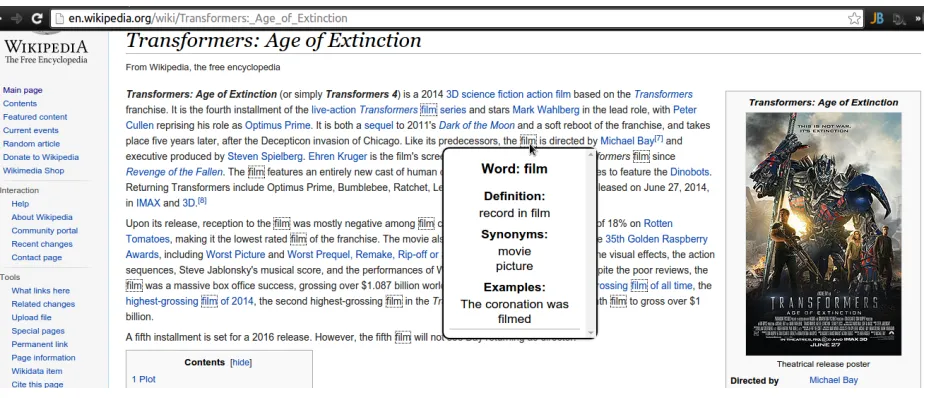
By hovering or clicking on an annotated word, users can access a small popup window that includes supplementary information. This supplementary in-formation includes a list of in-context synonyms, as provided by our system, and a clear example of the word in-context. Figure 1 shows an example of the current extension interface when a user hovers over the wordfilm.
[image:3.612.121.497.92.178.2]Figure 1: Example of supplementary information that the extension provides the user with when a user hovers over the wordfilm.
Acknowledgments
This work was partially funded by the National Sci-ence Foundation (CAREER award #1361274) and by DARPA (DEFT grant #12475008). Any opin-ions, findings, and conclusions or recommendations expressed in this material are those of the authors and do not necessarily reflect the views of the Na-tional Science Foundation, DARPA, or the other sources of support.
References
T. Brants and A. Franz. 2006. Web 1T 5-gram version 1. Linguistic Data Consortium.
J. Burstein, J. Shore, J. Sabatini, and Y. Lee. 2007. De-veloping a reading support tool for English language learners. InDemo proceedings of the the annual con-ference of the North American chapter of the Asso-ciation for Computational Linguistics (NAACL-HLT 2007), Rochester, NY.
Y. Canning and J. Tait. 1999. Syntactic simplification of newspaper text for aphasic readers. InProceedings of the ACM SIGIR’99 Workshop on Customised Informa-tion Delivery, Berkeley, California.
M.S. Carlo, D. August, B. McLaughlin, C.E. Snow, C. Dressler, D. Lippman, T. Lively, and C. White. 2004. Closing the gap: Addressing the vocabulary needs of english language learners in bilingual and mainstream classrooms.Reading Research Quarterly, 39(2).
J. Carroll, G. Minnen, Y. Canning, S. Devlin, and J. Tait. 1998. Practical simplification of English newspaper text to assist aphasic readers. In Proceedings of the AAAI-98 Workshop on Integrating Artificial Intelli-gence and Assistive Technology, Madison, Wisconsin. J. Carroll, G. Minnen, D. Pearce, Y. Canning, S. Devlin, and J. Tait. 1999. Simplifying text for language-impaired readers. In Proceedings of the Conference of the European Chapter of the ACL (EACL 1999), Bergen, Norway.
D. Crystal. 1997. English as a global language. Cam-bridge University Press.
2004. http://nces.ed.gov/fastfacts/display.asp?id=96. S. Devlin, J. Tait, J. Carroll, G. Minnen, and D. Pearce.
2000. Making accessible international communication for people with language comprehension difficulties. InProceedings of the Conference of Computers Help-ing People with Special Needs.
N. Elhadad. 2006a. Comprehending technical texts: Pre-dicting and defining unfamiliar terms. InProceedings of the Annual Symposium of the American Medical In-formatics Association, Washington.
N. Elhadad. 2006b. User-Sensitive Text Summariza-tion: Application to the Medical Domain. Ph.D. the-sis, Columbia University.
G. Grefenstette and F. Segond, 2003. Multilingual On-Line Natural Language Processing, chapter 38. C. Hokamp, R. Mihalcea, and P. Schuelke. 2014.
D. McCarthy and R. Navigli. 2007. The semeval English lexical substitution task. In Proceedings of the ACL Semeval workshop.
A. Siddharthan, A. Nenkova, and K. McKeown. 2004. Syntactic simplification for improving content selec-tion in multi-document summarizaselec-tion. In Proceed-ings of the 20th international conference on Computa-tional Linguistics.
R. Sinha and R. Mihalcea. 2012. Explorations in lexical-sample and all-words lexical substitution. Journal of Natural Language Engineering.
Ravi Som Sinha and Rada Mihalcea. 2014. Explorations in lexical sample and all-words lexical substitution. Natural Language Engineering, 20(1):99–129. Y. Yano, M. Long, and S. Ross. 1994. The effects of