Adding Context to Semantic Data-Driven Paraphrasing
Vered Shwartz Ido Dagan
Computer Science Department Bar-Ilan University
Ramat-Gan, Israel
[email protected] [email protected]
Abstract
Recognizing lexical inferences between pairs of terms is a common task in NLP applications, which should typically be performed within a given context. Such context-sensitive inferences have to con-sider both term meaning in context as well as the fine-grained relation hold-ing between the terms. Hence, to de-velop suitable lexical inference methods, we need datasets that are annotated with fine-grained semantic relations in-context. Since existing datasets either provide out-of-context annotations or refer to coarse-grained relations, we propose a method-ology for adding context-sensitive anno-tations. We demonstrate our methodol-ogy by applying it to phrase pairs from PPDB 2.0, creating a novel dataset of fine-grained lexical inferences in-context and showing its utility in developing context-sensitive methods.
1 Introduction
Recognizing lexical inference is an essential com-ponent in semantic tasks. In question answering, for instance, identifying that broadcast and air
are synonymous enables answering the question “When was ‘Friends’ first aired?” given the text “‘Friends’ was first broadcast in 1994”. Semantic relations such as synonymy(tall, high)and hyper-nymy (cat, pet) are used to infer the meaning of one term from another, in order to overcome lexi-cal variability.
In semantic tasks, such terms appear within cor-responding contexts, thus making two aspects nec-essary in order to correctly apply inferences: First, the meaning of each term should be considered within its context (Szpektor et al., 2007; Pantel
et al., 2007), e.g., playentailscompetein certain contexts, but not in the context of playing the na-tional anthem at a sports competition. Second, the soundness of inferences within context is condi-tioned on the fine-grained semantic relation that holds between the terms, as studied within natural logic (MacCartney and Manning, 2007). For in-stance, in upward-monotone sentences a term en-tails its hypernym (“myiPhone’s battery is low”
⇒ “myphone’s battery is low”), while in down-ward monotone ones it entails its hyponym (“talk-ing on thephoneis prohibited”⇒“talking on the
iPhoneis prohibited”).
Accordingly, developing algorithms that prop-erly apply lexical inferences in context requires datasets in which inferences are annotated in-context by fine-grained semantic relations. Yet, such a dataset is not available (see 2.1). Most ex-isting datasets provideout-of-context annotations, while the few availablein-context annotations re-fer to coarse-grained relations, such as relatedness or similarity.
In recent years, the PPDB paraphrase database (Ganitkevitch et al., 2013) became a popular re-source among semantic tasks, such as monolin-gual alignment (Sultan et al., 2014) and recog-nizing textual entailment (Noh et al., 2015). Re-cently, Pavlick et al. (2015) classified each para-phrase pair to the fine-grained semantic relation that holds between the phrases, following natu-ral logic (MacCartney and Manning, 2007). To that end, a subset of PPDB paraphrase-pairs were manually annotated, forming a fine-grained lexi-cal inference dataset. Yet, annotations are given
out-of-context, limiting its utility.
In this paper, we aim to fill the current gap in the inventory of lexical inference datasets, and present a methodology for adding context to out-of-context datasets. We apply our methodology on a subset of phrase pairs from Pavlick et al. (2015),
x y contexts out-of-contextrelation in-contextrelation
1 piece strip
Roughly 1,500 gold and silverpieceswere found and the hoard contains roughly 5kgs of gold and 2.5kgs of silver. A huge political storm has erupted around Australia after labor leader Kevin Rudd was found to have gone to
astripclub during a taxpayer funded trip.
Equivalence Independent
2 competition race
Three countries withdrew from thecompetition: Germany, Spain and Switzerland. Morgan Tsvangirai, the leader of the Movement for Democratic Change (MDC), Zimbabwe’s main opposition
party, has said that he will pull out of therace to become the president of Zimbabwe.
Reverse
Entailment Equivalence
3 boy family
The birth of theboy, whose birth name is disputed among different sources, is considered very
important in the entertainment world. Bill will likely disrupt the Obama family’s vacation to Martha’s Vineyard.
Forward
Entailment related
Other-4 jump walk
Amid wild scenes of joy on the pitch hejumpedonto the podium and lifted the trophy, the fourth of Italy’s history. In a game about rescuing hostages a hero mightwalk past Coca-Cola machine’s one week and Pepsi the next.
[image:2.595.74.526.62.338.2]
Other-related Alternation
Table 1:Illustration of annotation shifts when context is given. [1] the sense ofstripin the given context is different from the one which is equivalent topiece. [2] the termraceis judged out-of-context as more specific thancompetition, but is considered equivalent to it in a particular context. [3] a meronymy relation is (often) considered out-of-context as entailment, while in a given context this judgment doesn’t hold. [4] general relations may become more concrete when the context is given.
creating a novel dataset for fine-grained lexical in-ference in-context. For each term-pair, we add a pair of context sentences, and re-annotate these term-pairs with respect to their contexts.1 We show that almost half of the semantically-related term-pairs become unrelated when the context is specified. Furthermore, a generic out-of-context relation may change within a given context (see table 1). We further report baseline results that demonstrate the utility of our dataset in develop-ing fine-grained context-sensitive lexical inference methods.
2 Background
2.1 Lexical Inference Datasets
Figure 1 lists prominent human-annotated datasets used for developing lexical inference methods. In these datasets, each entry consists of an (x, y) term-pair, annotated to whether a certain semantic relation holds betweenx andy. Each dataset ei-ther specifies fine-grained semantic relations (see 2.2), or groups several semantic relations under a
1The dataset and annotation guidelines are available at:
http://u.cs.biu.ac.il/ ˜nlp/resources/downloads/
context-sensitive-fine-grained-dataset.
single coarse-grained relation (e.g. lexical substi-tution, similarity).
In some datasets, term-pairs are annotated to whether the relation holds between them in some (unspecified) contexts (out-of-context), while in others, the annotation is given with respect to a given context (in-context). In these datasets, each entry consists of a term-pair, x and y, and con-text, where some of the datasets provide a single context in whichx occurs while others provide a separate context for each ofxandy (correspond-ing to the 1 context and 2 contexts columns in Figure 1). The latter simulates a frequent need in NLP applications, for example, a question an-swering system recognizes thatbroadcast entails
airgiven the context of the question (“When was ‘Friends’ first aired?”) and that of the candidate passage (“‘Friends’ was first broadcast in 1994”).
relation
fine-grained
[15] PPDB-fine-human [16] this paper
coarse-grained
[1] WordSim-353 similarity [2] SimLex-999 [4] Annotated-PPDB [5] WordSim-353 relatedness
[6] MEN [10] Kotlerman2010
[11] Turney2014 [12] Levy2014 [13] Shwartz2015
[7] TR9856 [8] SemEval 2007
[9] All-Words [14] Zeichner2012
[3] SCWS
none 1 context 2 contexts
[image:3.595.76.504.59.228.2]context
Figure 1:A map of prominent lexical inference datasets.Word similarity: [1] Zesch et al. (2008), [2] Hill et al. (2014), [3] Huang et al. (2012), [4] Wieting et al. (2015).Term relatedness: [5] Zesch et al. (2008), [6] Bruni et al. (2014), [7] Levy et al. (2015).Lexical substitution: [8] McCarthy and Navigli (2007), [9] Kremer et al. (2014),Lexical inference: [10] Kotlerman et al. (2010), [11] Turney and Mohammad (2014), [12] Levy et al. (2014), [13] Shwartz et al. (2015), [14] Zeichner et al. (2012), [15] Pavlick et al. (2015) (see 2.2), [16].
≡ Equivalence is the same as
@ Forward Entailment is more specific than
A Reverse Entailment is more general than ˆ Negation is the exact opposite of | Alternation is mutually exclusive with ∼ Other-Related is related in some other way to
# Independence is not related to Table 2:Semantic relations in PPDB 2.0. Like Pavlick et al., we conflatenegationandalternationinto one relation.
2.2 PPDB with Semantic Relations
The PPDB paraphrase database (Ganitkevitch et al., 2013) is a huge resource of automatically de-rived paraphrases. In recent years, it has been used for quite many semantic tasks, such as semantic parsing (Wang et al., 2015), recognizing textual entailment (Noh et al., 2015), and monolingual alignment (Sultan et al., 2014).
Recently, as part of the PPDB 2.0 release, Pavlick et al. (2015) re-annotated PPDB with fine-grained semantic relations, following natural logic (MacCartney and Manning, 2007) (see table 2). This was done by first annotating a subset of PPDB pharaphase-pairs that appeared in the SICK dataset of textual entailment (Marelli et al., 2014). Annotators were instructed to select the appro-priate semantic relation that holds for each para-phrase pair. These human annotations were later used to train a classifier and predict the semantic relation for all paraphrase pairs in PPDB. Consid-ering the widespread usage of PPDB in applica-tions, this extension may likely lead to applying lexical inferences based on such fine-grained se-mantic relations.
In this paper, we focus on human-annotated datasets, and therefore find the above men-tioned subset of human-annotated paraphrases particularly relevant; we refer to this dataset as
PPDB-fine-human. This dataset, as well as the PPDB 2.0 automatically created resource, are still missing a key feature in lexical inference, since the semantic relation for each paraphrase pair is spec-ified out of context.
3 Dataset Construction Methodology
In this section, we present a methodology of adding context to lexical inference datasets, that we apply onPPDB-fine-human.
3.1 Selecting Phrase-Pairs
PPDB-fine-humanis a quite large dataset (14k pairs), albeit with some phrase-pairs that are less useful for our purpose. We therefore applied the following filtering and editing on the phrase pairs: Relation Types We expected that phrase pairs that were annotated out-of-context asindependent
will remain independent in almost every context; indeed, out of a sample of 100 such pairs that we annotated within context, only 8% were annotated with another semantic relation. As this was too sparse to justify the cost of human annotations, we chose to omit such phrase pairs.
[image:3.595.72.296.308.384.2]usually apply lexical inferences on syntactically coherent constituents. We therefore parse the original SICK (Marelli et al., 2014) sentences containing these phrases, and omit pairs in which one of the phrases is not a constituent.
Filtering Trivial Pairs In order to avoid trivial paraphrase pairs, we filter out inflections (Iraq, Iraqi) and alternate spellings (center, centre), by omitting pairs that share the same lemma, or those that have Levenshtein distance ≤ 3. In addi-tion, we omit pairs that have lexical overlaps
(a young lady, lady)and filter out pairs in which one of the two phrases is just a stop word.
Removing Determiners The annotation seems to be indifferent to the presence of a determiner, e.g., the labelers annotated all of (kid, the boy),
(the boy, the kid), and (a kid, the boy)asreverse entailment. To avoid repetitive pairs, and to get a single “normalized” phrase, we remove preceding determiners, e.g., yielding(kid, boy).
Finally, it is interesting to note that
PPDB-fine-human includes term-pairs in which terms are of different grammatical cat-egories. Our view is that such cross-category term-pairs are often relevant for semantic infer-ence (e.g. (bicycle, riding)) and therefore we decided to stick to the PPDB setting, and kept such pairs.
At the end of this filtering process we remained with 1385 phrase pairs from which we sampled 375 phrase pairs for our dataset, preserving the rel-ative frequency across relation types in PPDB.
3.2 Adding Context Sentences
We used Wikinews2 to extract context sentences. We used the Wikinews dump from November 2015, converted the Wiki Markup to clean text us-ing WikiExtractor3, and parsed the corpus using spaCy.4
For each (x, y) phrase-pair, we randomly sam-pled 10 sentence-pairs of the form (sx, sy), such
that sx contains x and sy contains y. In the
sampling process we require, for each of the two terms, that its 10 sentences are taken from differ-ent Wikinews articles, to obtain a broader range of the term’s senses. This yields 10 tuples of the form
2https://en.wikinews.org/
3https://github.com/attardi/wikiextractor 4http://spacy.io/
(x, y, sx, sy)for each phrase pair and 3750 tuples
in total.5
We split the dataset to 70% train, 25% test, and 5% validation sets. Each of the sets contains dif-ferent term-pairs, to avoid overfitting for the most common relation of a term-pair in the training set.
3.3 Annotation Task
Our annotation task, carried out on Amazon Me-chanical Turk, followed that of Pavlick et al. (2015). We used their guidelines, and altered them only to consider the contexts. We instructed an-notators to select the relation that holds between the terms (xandy) while interpreting each term’s meaningwithin its given context (sx andsy). To
ensure the quality of workers, we applied a quali-fication test and required a US location, and a 99% approval rate for at least 1,000 prior HITS. We as-signed each annotation to 5 workers, and, follow-ing Pavlick et al. (2015), selected the gold label using the majority rule, breaking ties at random. We note that for 91% of the examples, at least 3 of the annotators agreed.6
The annotations yielded moderate levels of agreement, with Fleiss’ Kappa κ = 0.51 (Lan-dis and Koch, 1977). For a fair comparison, we replicated the original out-of-context annotation on a sample of 100 pairs from our dataset, yield-ing agreement ofκ = 0.46, while the in-context agreement for these pairs wasκ = 0.51. As ex-pected, adding context improves the agreement, by directing workers toward the same term senses while revealing rare senses that some workers may miss without context.7
4 Analysis
Figure 2 displays the confusion matrix of rela-tion annotarela-tions in context compared to the out-of-context annotations. Most prominently, while the original relation holds in many of the contexts, it is also common for term-pairs to become inde-pendent. In some cases, the semantic relation is changed (as in table 1).
5Our dataset is comparable in size to most of the datasets
in Figure 1. In particular, the SCWS dataset (Huang et al., 2012), which is the most similar to ours, contains 2003 term-pairs with context sentences.
6We also released an additional version of the dataset,
in-cluding only the agreeable 91%.
7The gap between the reported agreement in Pavlick et
out-of-context
in-context
≡ @ A | ∼ #
≡ 60.54 6.9 0.38 0.38 9.58 22.22
@ 2.96 41.13 1.41 0 11.69 42.82
[image:5.595.323.514.63.105.2]A 5.97 1.67 37.92 2.08 13.19 39.17 | 1.25 1.88 5.42 41.46 2.92 47.08 ∼ 1.52 0.7 2.03 4.56 31.46 59.75
Figure 2:percentages of each relation annotation in-context, for annotations context. The diagonal shows out-of-context relations that hold in-out-of-context, and the last column shows term-pairs that become independent, usually due to sense-shifts. In all other cells, semantic relations are changed. Recall that we didn’t annotate out-of-context independent pairs.
4.1 Baseline Results
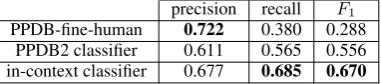
To demonstrate our dataset’s utility, we report sev-eral baseline performances on our test set (ta-ble 3). The first two are context-insensitive, as-signing the same label to a term-pair in all its contexts; the first assigns manual labels from
PPDB-fine-human, and the second assigns PPDB 2.0 classifier predictions. We also trained a context-sensitive logistic regression classifier on our train set, using the available PPDB 2.0 fea-tures, plus additional context-sensitive features. To represent words as vectors, we used pretrained GloVe embeddings of 300 dimensions, trained on Wikipedia (Pennington et al., 2014), and added the following features:
maxw∈sy~x·~w (1)
maxw∈sx~y·~w (2)
maxwx∈sx,wy∈syw~x·w~y (3)
(1) and (2) measure similarities between a term and its most similar term in the other term’s con-text, and (3) measures the maximal word similar-ity across the contexts.
This context-sensitive method, trained on our dataset, notably outperforms context insensitive baselines, thus illustrating the potential utility of our dataset for developing fine-grained context-sensitive lexical inference methods. Yet, the ab-solute performance is still mediocre, emphasizing the need to develop better such methods, using our dataset or similar ones created by our methodol-ogy.
5 Conclusion
In this paper, we presented a methodology for adding context to context-insensitive lexical in-ference datasets, and demonstrated it by cre-ating such dataset over PPDB 2.0 fine-grained
precision recall F1 PPDB-fine-human 0.722 0.380 0.288
PPDB2 classifier 0.611 0.565 0.556 in-context classifier 0.677 0.685 0.670 Table 3: Baseline performance on the test set (mean over all classes). (1)PPDB-fine-human manual annotations context). (2) PPDB 2.0 classifier predictions (out-of-context). (3) our context-sensitive logistic regression classi-fier. Like Pavlick et al., we conflate theforward entailment andreverse entailmentrelations in all baselines.
paraphrase-pair annotations. We then demon-strated that our dataset can indeed be used for developing fine-grained context-sensitive lexical inference methods, which outperform the corre-sponding context-insensitive baselines.
Acknowledgments
We would like to thank Ellie Pavlick and Chris Callison-Burch for their assistance and insightful comments.
This work was partially supported by an In-tel ICRI-CI grant, the Israel Science Foundation grant 880/12, and the German Research Founda-tion through the German-Israeli Project Coopera-tion (DIP, grant DA 1600/1-1).
References
Elia Bruni, Nam-Khanh Tran, and Marco Baroni. 2014. Multimodal distributional semantics. JAIR, 49:1–47.
Juri Ganitkevitch, Benjamin Van Durme, and Chris Callison-Burch. 2013. PPDB: The paraphrase database. InHLT-NAACL, pages 758–764.
Felix Hill, Roi Reichart, and Anna Korhonen. 2014. Simlex-999: Evaluating semantic models with (genuine) similarity estimation. arXiv preprint arXiv:1408.3456.
Eric H Huang, Richard Socher, Christopher D Man-ning, and Andrew Y Ng. 2012. Improving word representations via global context and multiple word prototypes. InACL 2012, pages 873–882. Associa-tion for ComputaAssocia-tional Linguistics.
Lili Kotlerman, Ido Dagan, Idan Szpektor, and Maayan Zhitomirsky-Geffet. 2010. Directional distribu-tional similarity for lexical inference. Natural Lan-guage Engineering, 16(04):359–389.
[image:5.595.78.287.65.123.2]J Richard Landis and Gary G Koch. 1977. The mea-surement of observer agreement for categorical data.
biometrics, pages 159–174.
Omer Levy, Ido Dagan, and Jacob Goldberger. 2014. Focused entailment graphs for open ie propositions. In CoNLL 2014, pages 87–97, Ann Arbor, Michi-gan, June. Association for Computational Linguis-tics.
Ran Levy, Liat Ein-Dor, Shay Hummel, Ruty Rinott, and Noam Slonim. 2015. Tr9856: A multi-word term relatedness benchmark. In ACL 2015, page 419.
Bill MacCartney and Christopher D Manning. 2007. Natural logic for textual inference. InProceedings of the ACL-PASCAL Workshop on Textual Entail-ment and Paraphrasing, pages 193–200. Associa-tion for ComputaAssocia-tional Linguistics.
Marco Marelli, Luisa Bentivogli, Marco Baroni, Raf-faella Bernardi, Stefano Menini, and Roberto Zam-parelli. 2014. Semeval-2014 task 1: Evaluation of compositional distributional semantic models on full sentences through semantic relatedness and textual entailment. SemEval-2014.
Diana McCarthy and Roberto Navigli. 2007. Semeval-2007 task 10: English lexical substitution task. In
Proceedings of the 4th International Workshop on Semantic Evaluations, pages 48–53. Association for Computational Linguistics.
Tae-Gil Noh, Sebastian Pad´o, Vered Shwartz, Ido Da-gan, Vivi Nastase, Kathrin Eichler, Lili Kotlerman, and Meni Adler. 2015. Multi-level alignments as an extensible representation basis for textual entailment algorithms.*SEM 2015, page 193.
Patrick Pantel, Rahul Bhagat, Bonaventura Coppola, Timothy Chklovski, and Eduard H Hovy. 2007. Isp: Learning inferential selectional preferences. In
HLT-NAACL, pages 564–571.
Ellie Pavlick, Johan Bos, Malvina Nissim, Charley Beller, Benjamin Van Durme, and Chris Callison-Burch. 2015. Adding semantics to data-driven para-phrasing. InACL 2015, Beijing, China, July. Asso-ciation for Computational Linguistics.
Jeffrey Pennington, Richard Socher, and Christo-pher D. Manning. 2014. Glove: Global vectors for word representation. InEMNLP 2014, pages 1532– 1543.
Vered Shwartz, Omer Levy, Ido Dagan, and Jacob Goldberger. 2015. Learning to exploit structured resources for lexical inference. CoNLL 2015, page 175.
Md Arafat Sultan, Steven Bethard, and Tamara Sum-ner. 2014. Back to basics for monolingual align-ment: Exploiting word similarity and contextual ev-idence.TACL 2014, 2:219–230.
Idan Szpektor, Eyal Shnarch, and Ido Dagan. 2007. Instance-based evaluation of entailment rule acqui-sition. InACL 2007, page 456.
Peter D Turney and Saif M Mohammad. 2014. Ex-periments with three approaches to recognizing lex-ical entailment. Natural Language Engineering, 21(03):437–476.
Yushi Wang, Jonathan Berant, and Percy Liang. 2015. Building a semantic parser overnight. InACL 2015. John Wieting, Mohit Bansal, Kevin Gimpel, and Karen Livescu. 2015. From paraphrase database to com-positional paraphrase model and back. TACL 2015, 3:345–358.
Naomi Zeichner, Jonathan Berant, and Ido Dagan. 2012. Crowdsourcing inference-rule evaluation. In
ACL 2012, pages 156–160. Association for Compu-tational Linguistics.
![Table 1: Illustration of annotation shifts when context is given. [1] the sense of strip in the given context is different from theone which is equivalent to piece](https://thumb-us.123doks.com/thumbv2/123dok_us/1430413.679472/2.595.74.526.62.338/table-illustration-annotation-shifts-context-context-different-equivalent.webp)
![Figure 1: A map of prominent lexical inference datasets.(2015). Word similarity: [1] Zesch et al](https://thumb-us.123doks.com/thumbv2/123dok_us/1430413.679472/3.595.72.296.308.384/figure-prominent-lexical-inference-datasets-word-similarity-zesch.webp)