Proceedings of the 13th International Workshop on Semantic Evaluation (SemEval-2019), pages 404–408 404
HATEMINER at SemEval-2019 Task 5: Hate speech detection against
Immigrants and Women in Twitter using a Multinomial Naive Bayes
Classifier
Nikhil Chakravartula
Teradata, Hyderabad
Abstract
This paper describes our participation in the SemEval 2019 Task 5 - Multilingual Detection of Hate. This task aims to identify hate speech against two specific targets, immigrants and women. We compare and contrast the per-formance of different word and sentence level embeddings on the state-of-the-art classifica-tion algorithms. Our final submission is a Multinomial binarized Naive Bayes model for both the subtasks in the English version.
1 Introduction
Twitter is a micro-blogging platform where peo-ple exchange ideas using short messages called tweets. Users can propagate their notions, includ-ing hatred against an individual or a group, to the entire global population with a latency of a few seconds. This poses a unique challenge of devel-oping systems that can automatically identify and mitigate hate speech. Although twitter condemns hate speech through its hateful conduct policy1, enforcing it is difficult. There are several reasons for this. Tweets often contain emoticons, emo-jis, language slangs, hashtags and other noisy data. Often, offensive and abusive language may be er-roneously perceived as hate speech and hence it is important to distinguish offensive, abusive and hateful languages (Davidson et al.,2017;Waseem and Hovy,2016). These problems are exacerbated by the fact that even humans find it difficult to de-lineate offensive and hateful language.
Many approaches have been put forward to de-tect hate speech. Bag of words and ngram features are effective in hate speech detection (Burnap and Williams,2015;Warner and Hirschberg,2012) as well as the detection of abusive and offensive con-tent (Nobata et al.,2016).Gitari et al.(2015) used
1https://help.twitter.
com/en/rules-and-policies/ hateful-conduct-policy
lexical resources to look up certain words that con-tribute significantly to hate speech but such fea-tures, when used in isolation may not be very ef-fective. SVM (Burnap and Williams,2015), Naive Bayes (Kwok and Wang,2013) and Logistic Re-gression (Davidson et al., 2017) are some of the classifiers used in this domain.
Most of the above methods are targeted to detect general hate speech. Through this task, we aim to identify hate speech, specifically against immi-grants and women.Frenda et al.(2018) used lexi-con resources to identify misogynistic comments.
Ahluwalia et al.(2018) used an ensemble of ran-dom forest, gradient boosting and logistic regres-sion with bag of words, ngram and lexical features to discern hatred against women. We did not find significant work in detection of hate speech in En-glish against immigrants.
2 Shared Task Description
The SemEval 2019 Task 5 is divided into two sub-tasks.
1. Subtask A, where systems must predict whether a tweet is hateful (HS=1) against im-migrants and women.
2. Subtask B, where systems must first classify hateful tweets as aggressive (AG=1) or not, and secondly to identify the target harassed as an individual (TR=1) or generic.
We used the datasets provided by the organizers. Table1 describes the composition of the dataset. Further details of the task are available in the task description paper (Basile et al.,2019).
3 System Description
3.1 Pre Processing
HS=1 TR=1 AG=1 Train 57.9% 17.3% 14.9% Dev 42.7% 20.4% 21.9%
Table 1: Dataset composition. HS: Hate Speech TR: Target AG:Aggressiveness
• All text is converted to lower case.
• All URLs, mentions, emojis and smileys are removed from the tweets. We used a python package tweet-preprocessor2to achieve this.
• All contractions are replaced with their full form. For example,don’twill be replaced by
do notandcan’twill be replaced bycan not.
• All punctuation marks are removed.
• All numerical sequences are removed from the text.
• Hashtag segmentation and spell correc-tion: Hashtags provide insights about a specific ideology by a group of people. These notions provide vital information for text classification, especially in the case of hate speech against immigrants and women. For example, hashtags like #endimmigra-tion, often come from a group of peo-ple who are against immigrants. Segmen-tation (Segaran and Hammerbacher, 2009) of the hashtags is essential to allow the classifier to treat #buildthatwall, #buildthe-wall, #buildthedamnwall, #buildwall, etc with the same importance. After segmenta-tion,#buildthatwallbecomesbuild that wall,
#buildthedamnwallbecomes build the damn walletc. Many tweets contain abusive words in elongated form, such as f****kkkk. We perform spell corrections (Jurafsky and Mar-tin, 2018) on these words to reduce the vo-cabulary size and to account for better results. Text83is utilized to generate unigram and bi-gram word statistics with ekphrasis (Baziotis et al.,2017) to perform both these operations.
• Stemming: Stemming is the process of re-ducing a word to its base root form. We used Porter Stemmer4 from NLTK (Steven Bird
2
https://github.com/s/preprocessor
3
http://mattmahoney.net/dc/textdata. html
4https://tartarus.org/martin/
PorterStemmer/
and Loper,2009) to stem. Stemming is used in combination with the Naive Bayes clas-sifier. For other classifiers, pretrained word embeddings without stemming are used.
3.2 Feature Engineering
The following features are considered in our ex-periments.
• Bag of words (BoW): Bag of words is used to represent the presence of word n-grams.
• Word Embeddings: Glove840B - common crawl, GloveTwitter27B - twitter crawl ( Pen-nington et al., 2014) and fasttext - common crawl (Mikolov et al.,2018) pre-trained word embeddings are used to analyze their impact on the classification.
• Sentence Embeddings: Infersent (Conneau et al.,2017) is used to produce sentence level embeddings. InferSent is a sentence embed-ding method that provides semantic represen-tations for English sentences. It is trained on natural language inference.
4 Experiments
In this section, we describe the experimental set-tings used in our research. All our code is publicly available in a github repository.5
4.1 Evaluation Metrics
The evaluation metrics for subtask A are preci-sion(HS), recall(HS) and F1-score(HS). Macro av-eraged F1-score(HS,TR,AG) and Exact Match Ra-tio (EMR) are the evaluaRa-tion metrics for subtask-B. Submissions are ranked based on F1-score(HS) and EMR for subtask-A and subtask-B, respec-tively.
4.2 Methodology
All the experiments are developed using the Scikit-Learn (Pedregosa et al., 2011) machine learning library. Five-fold cross validation score on the train set used to evaluate our models. We ran several experiments on various classification algorithms. The best performing classifiers were Naive Bayes, logistic regression, SVM and XG-Boost. The following are the details of the classi-fier settings.
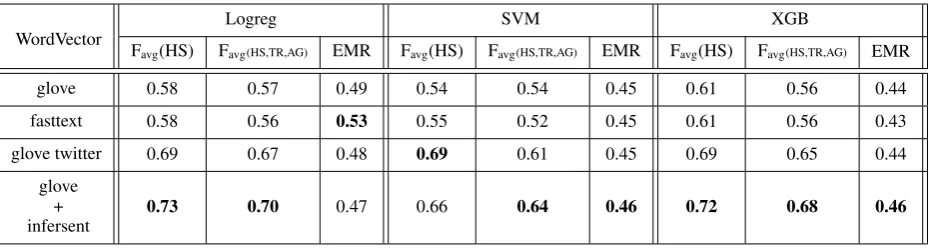
WordVector
Logreg SVM XGB
Favg(HS) Favg(HS,TR,AG) EMR Favg(HS) Favg(HS,TR,AG) EMR Favg(HS) Favg(HS,TR,AG) EMR
glove 0.58 0.57 0.49 0.54 0.54 0.45 0.61 0.56 0.44
fasttext 0.58 0.56 0.53 0.55 0.52 0.45 0.61 0.56 0.43
glove twitter 0.69 0.67 0.48 0.69 0.61 0.45 0.69 0.65 0.44
glove + infersent
0.73 0.70 0.47 0.66 0.64 0.46 0.72 0.68 0.46
Table 2: Pretrained word and sentence embeddings results. For each classifier family, the best score is made bold.
Word
ngrams Stem Binary Favg(HS)
Favg
(HS,TR,AG) EMR
1,2 false true 0.69 0.66 0.45 1,2 false false 0.68 0.66 0.45 1,2 true true 0.69 0.67 0.47
[image:3.595.67.533.61.185.2]1,2 true false 0.68 0.66 0.45 1,3 false true 0.69 0.66 0.45 1,3 true true 0.69 0.66 0.47 1,4 false true 0.69 0.66 0.45 1,4 true true 0.69 0.66 0.47
Table 3: Multinomial Naive Bayes Classifier results with word ngram range, stemming and binarization
• Logistic Regression, SVM and XGBoost
Word or sentence level embeddings are fed as inputs to these classifiers. In the absence of a sentence embedder, we averaged all the word vectors to get a vector representation of the tweet. For logistic regression, the solver is li-blinear (Fan et al.,2008) and L2 norm is used for penalization. For SVM, inputs are nor-malized using a soft scaling scheme and the kernel used is a Radial Basis Function ( Buh-mann and BuhBuh-mann, 2003). The default pa-rameters are kept as is for XGBoost6. Table
2shows the results.
• Naive Bayes classifier: Multinomial Naive Bayes classifier, along with the bag of words generated with CountVectorizer7 gave bet-ter results than other Naive Bayes variations. Different runs are carried out to tune the pa-rameters as shown in Table3.
6https://xgboost.readthedocs.io/en/
latest/python/python_api.html
7https://scikit-learn.org/stable/
modules/generated/sklearn.feature_ extraction.text.CountVectorizer.html
Classifier F1(HS) F1
(HS,TR,AG) emr
glove twitter+logreg 0.70 0.70 0.48 glove twitter+XGB 0.69 0.66 0.55
glove+infersent+
XGB 0.72 0.69 0.55
glove+infersent+
logreg 0.72 0.72 0.53
stem+ NB binarized+ word-ngrams(1.2)
0.74 0.73 0.57
Table 4: Results on the dev set
5 Results and Analysis
6 Conclusion and Future Work
The aim of this research was to detect hate speech against two specific targets, immigrants and women. We described a naive bayes classi-fier system and also elucidated our trials of us-ing different pre-trained word and sentence level embeddings on the state-of-the-art classification algorithms. In the future, we would like to in-clude lexicon-based, Parts Of Speech features to further investigate the performance of these clas-sifiers. We would also like to evaluate how deep learning approaches respond to this task.
References
Resham Ahluwalia, Himani Soni, Edward Callow, A. Nascimento, and Martine De Cock. 2018. De-tecting hate speech against women in english tweets. InEVALITA@CLiC-it.
Valerio Basile, Cristina Bosco, Elisabetta Fersini, Deb-ora Nozza, Viviana Patti, Francisco Rangel, Paolo Rosso, and Manuela Sanguinetti. 2019. Semeval-2019 task 5: Multilingual detection of hate speech against immigrants and women in twitter. In Pro-ceedings of the 13th International Workshop on Se-mantic Evaluation (SemEval-2019). Association for Computational Linguistics”, location = “Minneapo-lis, Minnesota.
Christos Baziotis, Nikos Pelekis, and Christos Doulk-eridis. 2017. Datastories at semeval-2017 task 4: Deep lstm with attention for message-level and topic-based sentiment analysis. In Proceedings of the 11th International Workshop on Semantic Eval-uation (SemEval-2017), pages 747–754, Vancouver, Canada. Association for Computational Linguistics.
Martin D. Buhmann and M. D. Buhmann. 2003. Radial Basis Functions. Cambridge University Press, New York, NY, USA.
Pete Burnap and Matthew L. Williams. 2015. Cyber hate speech on twitter : An application of machine classification and statistical modeling for policy and decision making.
Alexis Conneau, Douwe Kiela, Holger Schwenk, Lo¨ıc Barrault, and Antoine Bordes. 2017. Supervised learning of universal sentence representations from natural language inference data. InProceedings of the 2017 Conference on Empirical Methods in Nat-ural Language Processing, pages 670–680, Copen-hagen, Denmark. Association for Computational Linguistics.
Thomas Davidson, Dana Warmsley, Michael W. Macy, and Ingmar Weber. 2017. Automated hate speech detection and the problem of offensive language. CoRR, abs/1703.04009.
Rong-En Fan, Kai-Wei Chang, Cho-Jui Hsieh, Xiang-Rui Wang, and Chih-Jen Lin. 2008. LIBLINEAR: A library for large linear classification. Journal of Machine Learning Research, 9:1871–1874.
Simona Frenda, Bilal Ghanem, Estefan´ıa Guzm´an-Falc´on, Manuel Montes-y-G´omez, and Luis Vil-lase˜nor Pineda. 2018. Automatic expansion of lex-icons for multilingual misogyny detection. In Pro-ceedings of the Sixth Evaluation Campaign of Natu-ral Language Processing and Speech Tools for Ital-ian. Final Workshop (EVALITA 2018) co-located with the Fifth Italian Conference on Computational Linguistics (CLiC-it 2018), Turin, Italy, December 12-13, 2018.
Njagi Dennis Gitari, Zhang Zuping, Hanyurwimfura Damien, and Jun Long. 2015. A lexicon-based ap-proach for hate speech detection.
Daniel Jurafsky and James H. Martin. 2018. Speech and Language Processing: An Introduction to Nat-ural Language Processing, Computational Linguis-tics, and Speech Recognition. Prentice Hall.
Irene Kwok and Yuzhou Wang. 2013. Locate the hate: detecting tweets against blacks. InAAAI 2013.
Tomas Mikolov, Edouard Grave, Piotr Bojanowski, Christian Puhrsch, and Armand Joulin. 2018. Ad-vances in pre-training distributed word representa-tions. InProceedings of the International Confer-ence on Language Resources and Evaluation (LREC 2018).
Chikashi Nobata, Joel Tetreault, Achint Thomas, Yashar Mehdad, and Yi Chang. 2016. Abusive lan-guage detection in online user content. In Proceed-ings of the 25th International Conference on World Wide Web, WWW ’16, pages 145–153, Republic and Canton of Geneva, Switzerland. International World Wide Web Conferences Steering Committee.
F. Pedregosa, G. Varoquaux, A. Gramfort, V. Michel, B. Thirion, O. Grisel, M. Blondel, P. Pretten-hofer, R. Weiss, V. Dubourg, J. Vanderplas, A. Pas-sos, D. Cournapeau, M. Brucher, M. Perrot, and E. Duchesnay. 2011. Scikit-learn: Machine learning in Python. Journal of Machine Learning Research, 12:2825–2830.
Jeffrey Pennington, Richard Socher, and Christo-pher D. Manning. 2014. Glove: Global vectors for word representation. InEmpirical Methods in Nat-ural Language Processing (EMNLP), pages 1532– 1543.
Toby Segaran and Jeff Hammerbacher. 2009. Beautiful Data: The Stories Behind Elegant Data Solutions. O’Reilly Media, Inc.
William Warner and Julia Hirschberg. 2012.Detecting hate speech on the world wide web. InProceedings of the Second Workshop on Language in Social Me-dia, LSM ’12, pages 19–26, Stroudsburg, PA, USA. Association for Computational Linguistics.