DFKI’s system for WMT16 IT-domain task,
including analysis of systematic errors
Eleftherios Avramidis, Aljoscha Burchardt, Vivien Macketanz and Ankit Srivastava
German Research Center for Artificial intelligence (DFKI) Language Technology Lab, Berlin
Abstract
We are presenting a hybrid MT approach in the WMT2016 Shared Translation Task for the IT-Domain. Our work con-sists of several translation components based on rule-based and statistical ap-proaches that feed into an informed selec-tion mechanism. Addiselec-tions to last year’s submission include a WSD component, a syntactically-enhanced component and several improvements to the rule-based component, relevant to the particular do-main. We also present detailed human evaluation on the output of all translation components, focusing on particular sys-tematic errors.
1 Introduction
We are presenting extensions on our hybrid MT approach from the WMT 2015 translation task in the generic-domain (Avramidis et al., 2015). The system combines several SMT and RBMT compo-nents that feed into an informed selection mecha-nism. For WMT 2016, several new system com-ponents have been submitted to the IT-task that are described in more detail in this paper.
In our work, detailed evaluation of translation quality using a wide variety of methods from au-tomatic scores to human error annotation is an ac-tive part of the MT development process. Already in previous work (Popovi´c et al., 2014), we have argued for an approach to MT research and devel-opment (R&D) that makes a more direct use of the knowledge and expertise of language profession-als.
One of the reasons is that it is difficult to build hybrid architectures (that take advantage of the fact that different engines make different errors) solely based on the rough feedback provided by automatic scores. As scores like BLEU
(Pap-ineni et al., 2002) are not suitable for compari-son across different types of engines like Statis-tical Machine Translation (SMT) and Rule-based Machine Translation (RBMT), we have included human feedback by a language professional in the development of the components reported in this paper.
To this end, we complement our system devel-opment with specific manual analysis. We have identified and manually inspected phenomena in the given domain that frequently lead to errors in our engines.
We are using the insights gained from this de-tailed analysis to guide further improvements of our engines and selection mechanism, some of which are detailed below. Therefore, the compo-nents developed follow the direction of addressing some of the most observed systematic issues. Nev-ertheless, the systems submitted to this task are only a stage in the continuous development effort. The short paper is structured as follows: Section 2 includes a description of the individual compo-nents and the hybridization mechanism, section 3 presents a detailed manual evaluation focusing on systematic errors, whereas conclusions and ideas for further work are given in section 4.
2 System components
We hereby present the systems that appear in our submissions and our hybrid system:
2.1 Phrase-based SMT baseline
The baseline system consists of a basic phrase-based SMT model, trained with the state-of-the-art settings on both the generic and technical data. The translation table was trained on a concatena-tion of generic and technical data, filtering out the sentences longer than 80 words. Batch 1 was used as a tuning set for MERT (Och, 2003).
One language model (monolingual) of order 5 was trained on the target side from both the
corpus entries words Chromium browser 6.3K 55.1K
Drupal 4.7K 57.4K
[image:2.595.71.283.64.247.2]Libreoffice help 46.8K 1.1M Libreoffice UI 35.6K 143.7K Ubuntu Saucy 182.9K 1.6M Europarl (mono) 2.2M 54.0M News (mono) 89M 1.7B Commoncrawl (parallel) 2.4M 53.6M Europarl (parallel) 1.9M 50.1M MultiUN (parallel) 167.6K 5.8M News Crawl (parallel) 201.3K 5.1M
Table 1: Size of corpora used for SMT.
technical (IT-domain) and Europarl corpora, plus one language model was trained on the target-language news corpus from the years 2007 to 2013 (Callison-Burch et al., 2007). All language mod-els were interpolated on the tuning set (Schwenk and Koehn, 2008). The size of the training data is shown in Table 1.
The text has been tokenized and truecased (Koehn et al., 2008) prior to the training and the decoding, and de-tokenized and de-truecased af-terwards. A few regular expressions were added to the tokenizer, so that URLs are not tokenized before being translated. Normalization of punc-tuation was also included, mainly in order to fix several issues with variable typography on quotes. The phrase-based SMT system was trained with Moses (Koehn, 2010) using EMS (Koehn, 2010), whereas the language models were trained with SRILM (Stolcke, 2002) and queried with KenLM (Heafield, 2011).
All statistical systems presented below are ex-tensions of this system, also based on the same data and settings, unless stated otherwise.
2.2 SMT with Word Sense Disambiguation
The word-sense-disambiguated SMT system is a factored phrase-based statistical system with two decoding paths, one basic and one alternative. In the basic path, all nouns of the source language (English) have been annotated with a WSD system (Weissenborn et al., 2015) that assigns BabelNet senses to nouns and has recently shown improve-ments over state-of-the-art results on several cor-pora. The sense labels are estimated based on the disambiguation analysis on the sentence level by
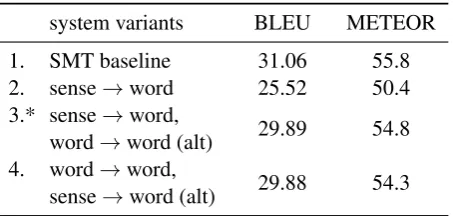
system variants BLEU METEOR 1. SMT baseline 31.06 55.8 2. sense→word 25.52 50.4
3.* sense→word,
word→word (alt) 29.89 54.8
4. word→word,
[image:2.595.309.536.75.183.2]sense→word (alt) 29.88 54.3
Table 2: Automatic scores for factored SMT vari-ants with WSD. (*) indicates the version included in the selection mechanism.
choosing the best ranked sense out of the ones pro-vided by the WSD system. Each produced WSD label replaces the respective base word form of the noun. In the alternative path, non-annotated input is used. The alternative path allows for decoding phrases when there are no WSD labels or the de-coder cannot form a translation with a good prob-ability.
Due to the high computational demands of the WSD annotation, this model was trained on less data than the respective phrase-based models, us-ing the first 1.1M sentences of Europarl and om-miting the entire Commoncrawl. We experi-mented with four different settings concerning the translation path. These settings with the corre-sponding automatic scores are depicted in Table 2, which includes the results on the development set 2. On this set, WSD does not show a positive ef-fect over the baseline in terms of automatic scores.
2.3 Syntax-enhanced SMT
Motivated by the importance of grammar in the translation between English and German, we de-veloped a syntax-enhanced SMT system. The pro-cess is similar to that of our baseline, but this version includes syntax-aware phrase extraction. Phrase pairs in the baseline SMT system were aug-mented with linguistically-motivated phrase pairs. These phrases were extracted by generating con-stituency and dependency parse trees for both the source and target languages, followed by node-aligning the parallel parse trees using a statistical tree aligner (Zhechev, 2009). The syntax-aware phrase extraction algorithm obtains surface-level chunks (syntax-aware) from the aligned subtrees (Srivastava and Way, 2009).
parsing and it was discovered that despite con-taining phrase pairs unique to each parsing model (around 28%), no statistically significant differ-ence was observed in the MT system performance. We therefore present the version that uses both of them by concatenating all phrase pairs in one ta-ble in an attempt to beenfit from multiple knowl-edge sources (Srivastava et al., 2009). Aditionally informed by the manual inspection in Section 3, we performed a pseudo-Named Entity Recogni-tion (words and phrases tagged as nouns) in or-der to identify in-domain terminology and trans-late them separately in a post-decoding automatic post-editing framework.
For the constituency and dependency parsing we employed the Berkeley Parser (Petrov and Klein, 2007) and the Stanford Dependency Parser (Klein and Manning, 2003) respectively.
2.4 Rule-based component
The rule-based system Lucy (Alonso and Thur-mair, 2003) is also part of our experiment, due to its state-of-the-art performance in the previous years. Additionally, manual inspection on the de-velopment set has shown that it provides better handling of complex grammatical phenomena par-ticularly when translating into German, due to the fact that it operates based on transfer rules from the source to the target syntax tree.
This year’s work on RBMT focuses on issues revealed through manual inspection of its perfor-mance on the development set:
• Separate menu items: The rule-based sys-tem was observed to be incapable of han-dling menu items properly, mostly when they were separated by the “>” symbol, as they
often ended up as compounds. We identi-fied the menu items by searching for conse-quent title-cased chunks before and after each separator. These items were translated sepa-rately from the rest of the sentence, to avoid them being bundled as compounds. The rule-based system was then forced to treat the pre-translated menu items as chunks that should not be translated.
• Menu items by SMT: Additionally, we used the method above to check whether menu items could be translated with the baseline SMT system instead of Lucy.
• Unknown words by SMT: Since Lucy is
flagging unknown words, we translated these individually with the baseline SMT system.
Finally, we experimented with normalization of the punctuation (which was previously included in the pre-processing steps of SMT but not in RBMT), addition of quotes on the menu items and some additional automatic source pre-processing in order to remove redundant phrases such as “where it says”.
We ran exhaustive search with all possible com-binations of the modification above and the most indicative automatic scores are shown in table 3. Although automatic scores have in the past shown low performance when evaluating RBMT sys-tems, our proposed modifications have a lexical impact that can be adequately measured with n-gram based metrics. Our investigation and dis-cussion is performed on Batch 2. The best com-bination of the suggested modifications achieves an overall improvement of 0.51 points BLEU and 0.68 points METEOR over the baseline. In partic-ular:
• Adding quotes around menu items resulted in
a significant drop of the automatic scores, so it was not used; this needs to be further evalu-ated, as references do not use quotes for menu items either. Nevertheless, quotes were not always useful due to an occasional erroneous identification of menu item boundaries.
• Separate translation of the menu items (sep-Menus) gives a positive result of about 0.46 BLEU and 0.63 METEOR.
• Normalizing punctuation (normPunct) has a slightly positive effect when the menu items are translated separately by Lucy.
• Passing only RBMT’s unknown words (unk)
to SMT results in a loss of 0.4 BLEU.
• Translating the RBMT’s menus with SMT
(SMTmenus) also deteriorates the scores and
• translating both menu items and unknown words with SMT (unk+SMTmenus) has a positive effect against the baseline and it seems to be comparable with the best system without SMT (sepMenus+normPunct).
BLEU METEOR manual
baseline 24.90 44.38
quotes 24.00 44.29
sepMenus 25.39 45.01
sepMenus + normPunct 25.41 45.06 15.8% sepMenus + normPunct - WhereItSays* 25.36 45.00 84.2%
SMTmenus 24.06 42.83
unk 24.50 44.05
[image:4.595.137.466.63.224.2]unk + sepMenus 23.68 43.30 unk + SMTmenus 25.41 44.95 unk + SMTmenus - WhereItSays* 25.36 44.88
Table 3: Improvements on the RBMT system. (*) indicates the submitted variations.
input WSD
WSD-SMT
RBMT
RBMT→SMT
selection output
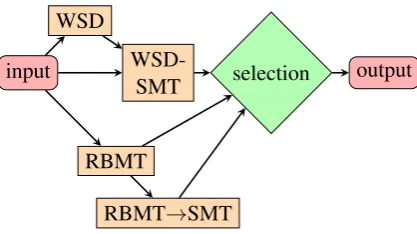
Figure 1: Architecture of the selection mechanism
automatic scores, the difference does not seem sig-nificant, and manual inspection raised the concern that this may be because of the way this phrase has been translated in the references. We therefore conducted manual sentence selection on 38 (out of the 69) sentences where this phrase appeared and in 84.2% of the cases its removal made the translation preferable. We therefore concluded in selecting this variation, despite the slightly lower scores.
2.5 Serial RBMT post-editing with SMT
As an alternative to automatic post-editing of the RBMT system, a serial RBMT+SMT system com-bination is used, as described in (Simard et al., 2007). For building it, the first stage is translation of the source language part of the training corpus by the RBMT system. In the second stage, a SMT system is trained using the RBMT translation out-put as a source language and the target language part as a target language. Later, the test set is first translated by the RBMT system, and the obtained translation is translated by the SMT system.
2.6 Selection mechanism
The selection mechanism aims to combine vari-ous systems, by selecting the best MT output for every sentence. The architecture of the system is illustrated in figure 1. The core of the selection mechanism is a ranker which reproduces rank-ing by aggregatrank-ing pairwise decisions by a binary classifier (Avramidis, 2013). Such a classifier is trained on binary comparisons in order to select the best one out of two different MT outputs given one source sentence at a time. As training ma-terial, we used the test-sets of WMT evaluation task (2008-2014). The rank labels for the train-ing are automatically generated, after ordertrain-ing the given MT outputs based on their sentence-level METEOR (Lavie and Agarwal, 2007) against the references. We have previously experimented with training on ranking provided by users, but experi-ments showed that for this task, ranks made out of sentence-level METEOR maximize all automatic scores on our development set, including other document-level ones, such as BLEU.
We exhaustively tested the available feature sets with many machine learning methods and Sup-port Vector Machines seemed to give the best per-formance. The binary classifiers were wrapped into rankers using thesoft pairwise recomposition
(Avramidis, 2013) to reduce ties between the sys-tems. Due to technical reasons, the version of the selection mechanism that is submitted to this task is only a pilot version that includes WSD-SMT (section 2.2), baseline RBMT (section 2.4) and RBMT→SMT (section 2.5). When ties
[image:4.595.73.282.262.379.2]pre-defined order of the systems needs to be further confirmed as part of the future work.
3 Manual evaluation
Apart from the automatic evaluation scores, we in-clude manual evaluation performed by a profes-sional German linguist.
3.1 Manual evaluation methodology
The manual evaluation was performed in four phases:
• The annotator reads through the development set translated by all systems and identifies the phenomena where often errors occur.
• For each one of the prominent linguistic
phe-nomena, the annotator selects 100 source seg-ments including the respective phenomenon that is prone to MT errors.
• The total occurrences of each phenomenon in
all source segments are counted (each phe-nomenon may occur more than once in a seg-ment, and each segment may contain more than one sentences).
• Consequently, the annotator counts the times each phenomenon has been translated cor-rectly. For a translation to be correct it does not have to be identical with the reference translation. This is repeated for the output of every MT system. The accuracy is calcu-lated as the ratio of the correct translations of the phenomenon divided by the occurrences of the phenomenon in the source.
3.2 Manual evaluation results
The most prominent error categories were found to be imperatives, compounds, quotation marks, menu item sequences (separated by “>”),
miss-ing verbs, phrasal verbs and terminology. In these 7 categories, 657 source segments were cho-sen from development set Batch 2 to demonstrate the phenomena bound to the frequent errors1.
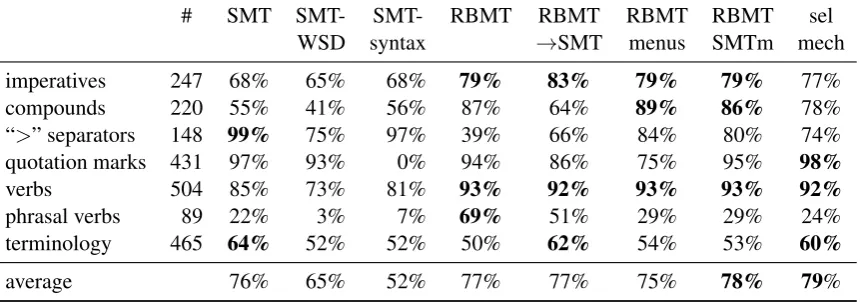
Many segments contained multiple instances of the respective phenomena, resulting in 2104 in-stances of phenomena in overall. The results ap-pear in table 4.
The two baseline systems SMT and RBMT
seem to have complementary behavior regarding
1Despite the goal of collecting 100 segments per category,
it was possible to find only 57 segments with phrasal verbs within the development set Batch 2.
the investigated phenomena. SMT performs well on terminology, menu items and quotation marks, but seems to suffer on imperatives, missing verbs, phrasal verbs and generation of compounds. On the contrary, RBMT does relatively well with im-peratives, compounds, verbs and phrasal verbs, whereas it has issues with menu items and is rela-tively worse with terminology.
The linear combination systemRBMT→SMT
manages to successfully combine the performance of the two systems regarding imperatives and maintains almost the same performance on verbs and terminology, whereas all other phenomena deteriorate, despite achieving higher automatic scores in overall.
The SMT-syntax and the SMT-WSDsystems seem to have relatively lower performance in all categories.2 Since the performance of the WSD
analyzer has already been confirmed, the failure of the SMT-WSD system to achieve a good per-formance on terminology and high n-gram-based automatic scores may be an indication that the cur-rent data setting does not face ambiguity issues and the senses probably only add additional com-plexity.
The selection mechanism (which in its cur-rent version only included SMT-WSD, RBMT and RBMT→SMT) performs better with the terminol-ogy and the quotation marks, whereas it maintains the good performance of its components on verbs and menu items. Performance on phrasal verbs nevertheless suffers. Additionally it achieves the highest accuracy on the selected phenomena, with 2% less errors than its best component, the base-line RBMT system.
The two improved versions of the RBMT sys-tem appear to have solved the problems they were developed for, namely the compounded menu items and one of them also does better with the quotation marks. The performance on imperatives, verbs and terminology remains the same, but the deterioration on phrasal verbs is obvious. A post-mortem analysis attributes this loss to a logical bug in the menu items detection, which often er-roneously included title-cased verbs in the begin-ning of the sentence, preventing them from being translated as an active part of the sentence.
2A pre-processing bug prevented SMT-syntax from
# SMT SMT- SMT- RBMT RBMT RBMT RBMT sel WSD syntax →SMT menus SMTm mech imperatives 247 68% 65% 68% 79% 83% 79% 79% 77% compounds 220 55% 41% 56% 87% 64% 89% 86% 78% “>” separators 148 99% 75% 97% 39% 66% 84% 80% 74%
quotation marks 431 97% 93% 0% 94% 86% 75% 95% 98%
verbs 504 85% 73% 81% 93% 92% 93% 93% 92%
phrasal verbs 89 22% 3% 7% 69% 51% 29% 29% 24% terminology 465 64% 52% 52% 50% 62% 54% 53% 60%
average 76% 65% 52% 77% 77% 75% 78% 79%
Table 4: Translation accuracy on manually evaluated sentences focusing on particular phenomena. Test-sets consist of hand-picked source sentences of Batch 2 that include the respective phenomenon. Bold-face indicates best systems on each phenomenon (row) with a 0.95 confidence level.
4 Discussion and further work
In our shared task submission we included:
(i) the SMT and RBMT baseline systems, (ii) the syntax-enhanced system (DFKI-syntax), (iii) the RBMT system with separate menu items,
normalization of punctuation and removal of “where it says” (previously appearing as sepMenus+normPunct-WhereItSays, sub-mitted as qtl-RBMT-menus),
(iv) the RBMT system with removal of “where it says”, passing menu items and unknown words to SMT (previously appearing as unk+SMTmenus-WhereItSays, submitted as qtl-RBMT-SMTmenus) and
(v) the selection mechanism which includes the systems SMT-WSD, RBMT and RBMT→SMT.
The results of the official evaluation campaign for our systems appear in the table 5. RBMT-menus appears to be slightly better than all the other systems we developed, but the difference with the other RBMT systems is not statistically significant. Nevertheless, it is our only system that competes with another competitor system for the 2nd position. Additionally, it is worth not-ing the failure of BLEU to correlate with the hu-man preferences, mainly for the systems that relate to RBMT, inline with past observations (Callison-Burch et al., 2006).
In future work, we intend to continue this line of development by including all the individual com-ponents in the selection mechanism. Additionally,
[image:6.595.86.517.65.216.2]rank TrueSkill BLEU RBMT-SMTmenus 2-6 -0.062 25.4 RBMT baseline 3-6 -0.093 25.2 RMBT-menus 3-6 -0.098 25.2 SMT-syntax 7-8 -0.190 34.8 selection 9 -0.382 29.0 SMT baseline 10 -0.485 34.0
Table 5: Human ranks and automatic scores of our submitted systems on the tests, as a result of the official evaluation. Ranks are given in a range in order to account for confidence intervals.
we would focus on solving issues on the partic-ular phenomena, by employing specialized meth-ods. Finally, we should perform a more in-depth evaluation of the selection mechanism and study how the insights gained from the manual inspec-tion of errors can be translated into features that improve the selection.
Acknowledgments
References
Alonso, J. A. and Thurmair, G. (2003). The
Com-prendium Translator system. InProceedings of the
Ninth Machine Translation Summit. International Association for Machine Translation (IAMT).
Avramidis, E. (2013). Sentence-level ranking with quality estimation. Machine Translation, 27(Special issue on Quality Estimation):239–256.
Avramidis, E., Popovic, M., and Burchardt, A. (2015). DFKI’s experimental hybrid MT system for WMT
2015. In Proceedings of the Tenth Workshop on
Statistical Machine Translation. Workshop on Sta-tistical Machine Translation (WMT-2015), 10th, September 17-18, Lisbon, Portugal, pages 66–73. Association for Computational Linguistics.
Callison-Burch, C., Fordyce, C., Koehn, P., Monz, C., and Schroeder, J. (2007). (Meta-) Evaluation of
Ma-chine Translation. In Proceedings of the Second
Workshop on Statistical Machine Translation, pages 136–158, Prague, Czech Republic. Association for Computational Linguistics.
Callison-Burch, C., Osborne, M., and Koehn, P. (2006). Re-evaluating the Role of Bleu in Machine
Transla-tion Research. InProceedings of the 11th
Confer-ence of the European Chapter of the Association for Computational Linguistics, pages 249–256, Trento, Italy.
Heafield, K. (2011). KenLM : Faster and Smaller
Lan-guage Model Queries. InProceedings of the Sixth
Workshop on Statistical Machine Translation, num-ber 2009, pages 187–197, Edinburgh, Scotland. As-sociation for Computational Linguistics.
Klein, D. and Manning, C. D. (2003). Accurate Unlex-icalized Parsing. InProceedings of the 41st Annual Meeting on Association for Computational Linguis-tics - Volume 1, ACL ’03, pages 423–430, Strouds-burg, PA, USA. Association for Computational Lin-guistics.
Koehn, P. (2010). An Experimental Management Sys-tem. The Prague Bulletin of Mathematical Linguis-tics, 94(-1):87–96.
Koehn, P., Arun, A., and Hoang, H. (2008). Towards better Machine Translation Quality for the German-English Language Pairs. InProceedings of the Third Workshop on Statistical Machine Translation, pages 139–142, Columbus, Ohio. Association for Compu-tational Linguistics.
Lavie, A. and Agarwal, A. (2007). METEOR: An Au-tomatic Metric for MT Evaluation with High Levels
of Correlation with Human Judgments. In
Proceed-ings of the Second Workshop on Statistical Machine Translation, pages 228–231, Prague, Czech Repub-lic. Association for Computational Linguistics.
Och, F. J. (2003). Minimum error rate training in
statis-tical machine translation. InACL ’03: Proceedings
of the 41st Annual Meeting on Association for Com-putational Linguistics, pages 160–167, Morristown, NJ, USA. Association for Computational Linguis-tics.
Papineni, K., Roukos, S., Ward, T., and Zhu, W.-J. (2002). BLEU: a Method for Automatic
Evalua-tion of Machine TranslaEvalua-tion. InProceedings of the
40th Annual Meeting of the Association for Com-putational Linguistics, pages 311–318, Philadelphia, Pennsylvania, USA. Association for Computational Linguistics.
Petrov, S. and Klein, D. (2007). Improved inference for
unlexicalized parsing. InProceedings of the 2007
Annual Conference of the North American Chap-ter of the Association for Computational
Linguis-tics, Rochester, New York. Association for
Compu-tational Linguistics.
Popovi´c, M., Avramidis, E., Burchardt, A., Hunsicker, S., Schmeier, S., Tscherwinka, C., Vilar, D., and Uszkoreit, H. (2014). Involving language profes-sionals in the evaluation of machine translation.
Language Resources and Evaluation, 48(4):541– 559.
Schwenk, H. and Koehn, P. (2008). Large and Diverse Language Models for Statistical Machine
Transla-tion. In Proceedings of the Third International
Joint Conference on Natural Language Processing: Volume-II.
Simard, M., Goutte, C., and Isabelle, P. (2007).
Sta-tistical Phrase-based Post-editing. Proceedings of
the 2007 Annual Conference of the North American Chapter of the Association for Computational Lin-guistics, (April):508–515.
Srivastava, A., Penkale, S., Groves, D., and Tinsley, J. (2009). Evaluating Syntax-Driven Approaches to Phrase Extraction for MT. InProceedings of the 3rd International Workshop on Example-based Machine Translation, pages 19–28, Dublin, Ireland.
Srivastava, A. K. and Way, A. (2009). Using Perco-lated Dependencies for Phrase Extraction in SMT. In Proceedings of the Machine Translation Summit XII, pages 316–323, Ottawa, Canada.
Stolcke, A. (2002). SRILM an Extensible Language
Modeling Toolkit. InSystem, volume 2, pages 901–
904. ISCA.
Zhechev, V. (2009). Unsupervised Generation of
Paral-lel Treebank through Sub-Tree Alignment. Prague