
PolyU at CL-SciSumm 2016
Ziqiang Cao1, Wenjie Li1, and Dapeng Wu2
1
Department of Computing, The Hong Kong Polytechnic University, Hong Kong, {cszqcao, cswjli}@comp.polyu.edu.hk
2
Department of Electrical & Computer Engineering, University of Florida, USA, [email protected]
Abstract. This document demonstrates our participant system PolyU on CL-SciSumm 2016. There are three tasks in CL-CL-SciSumm 2016. In Task 1A, we apply SVM Rank to identify the spans of text in the reference paper reflecting the citance. In Task 1B, we use the decision tree to classify the facet that a ci-tance belongs to. Finally, in Task 2, we develop an enhanced Manifold Ranking summarization model.
1
Introduction
Task Performance
1A Accuracy: 11.8, Recall: 8.7, F1-score: 10.0 1B Micro-accuracy: 61.9, Macro-accuracy: 21.4 2 ROUGE-1: 49.5, ROUGE-2: 15.4
Table 1.Overall performance (%) of PolyU.
2
Task 1A
2.1 Problem Transformation
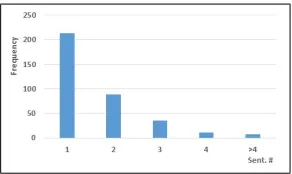
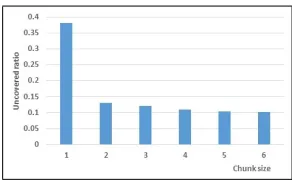
In this task, we need to identify the spans of text (cited text spans) in the RP that most accurately reflect the citation. Since a citation text span can be linked to many sentences in the reference paper, we firstly analyze the corresponding sentence number distribu-tion, as shown in Fig. 1. As can be seen, a large proportion of reference spans contain more than one sentences. Therefore, the most direct approach for this task is to train a ranking model and select a series of top ranked sentences. However, this idea has two disadvantages. On the one hand, the threshold is hard to set due to the serious variation of ranking scores on different document sets. On the other hand, a reference span tends to contain adjacent sentences, which cannot be reflected by the top ranked items. The adjacency property of reference spans is presented in Fig. 2. In this figure, we count the number of reference sentences which fail to be covered by adjacent sentence chunks. We observe that most multi-sentence reference spans are just a pair of adjacent sen-tences. Meanwhile, when the chunk size≥ 4, about 90% reference sentences can be covered by sentence chunks, and the uncovered ratio keeps stable.
[image:2.612.235.381.533.620.2]Therefore, we simplify Task 1A into a ranking problem which just needs to select the first item. Specifically, like n-grams, we put adjacent sentences inton-sentence chunks. According to the data property, we setn∈[1,· · ·,4]. Then, a reference paper is represented by thesen-sentence chunks. The actual ranking score of ann-sentence chunk is the ratio of reference sentences it contains. We extract a series of features from (CP,n-sentence chunk) pairs. Finally, we train a ranking model and choose the top rankedn-sentence chunk as the reference span.
Fig. 2.Numbers of uncovered sentences with the change of chunk sizes.
2.2 Model Description
Since most sentence chunks have no reference sentences, the regression model trained on this dataset tends to predict the zero score. Therefore, we adopt SVM Rank [3] to handle this ranking task. SVM Rank is a popular supervised pair-wise model. It con-verts a ranking task into a binary classification task, which avoids the problem of data imbalance. The major feature we use is the tf-idf cosine similarity between a citance and a sentence chunk in the reference paper. We also extract some citance-independent features such as the position of the sentence chunk. The motivation behind is that most citances are related to the facet of method. As a result, the reference sentences may have some common characteristics. The whole ranking features are presented in Table 2.
We analyze the model weight for each feature. The feature SIMILARITY holds the highest weight, which accords with common sense. In addition, three position fea-tures, i.e., SENT POSITION, SECTION POSITION and INNER POSITION all have relatively large negative weights. It seems sentences in front are more likely to be cited.
Name Description
SIMILARITY The tf-idf cosine similarity between a citance and a sentence chunk. SENT POSITION The sentence position, divided by the number of sentences.
SECTION POSITION The position of the corresponding section of the sentence chunk, divided by the number of sections
INNER POSITION The sentence position in the section, divided by the number of sentences in the section.
NUMBER Indicate whether there are numbers in the sentence chunk. NER Indicate whether there are named entities in the sentence chunk.
Table 2.Ranking features.
3
Task 1B
3.1 Problem Transformation
multi-label classification task. However, from the training data, we find more than 90% of citances only belong to one facet. Therefore, we simply treat this task as the common multi-class classification problem by reserving the first facet for citances with more than one facets.
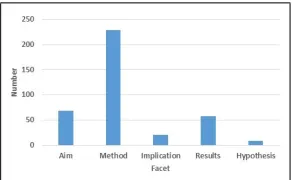
Afterwards, we analyze the facet distribution on the training set. The result is shown in Fig 3. From this figure, we find the facet distribution is extremely imbalanced. The Method facet takes about 60% proportion of the total data, and there are only 9 instances in the Hypothesis facet. Trained on the extremely biased dataset, many classifiers such as SVM and Naive Bayes tend to classify all the data into the Method facet. Although this practice achieves high overall accuracy, it is not a proper solution. Therefore, we introduce two metrics to measure the performance, i.e., the macro-averaged accuracy (AM) as well as the micro-averaged accuracy (Am). Their formulas are as follows:
Am=
P
c∈Crc
P
c∈CNc
(1)
AM = 1
|C|
X
c∈C rc
Nc (2)
whereCstands for the class set,rc is the right number in the Classc, andNc is the
actual number. Just predicting the Method facet,Am= 0.59andAM = 0.2.
[image:4.612.235.381.435.525.2]We focus on the increase of the macro-averaged accuracy. To this end, we use the decision tree to conduct hierarchical classification. The most important advantage of the decision tree is that it has the ability to remember patterns of all the facets in the training data. In comparison, SVM and Naive Bayes are likely to merely reserve the patterns of the dominant class.
Fig. 3.The distribution of facets.
3.2 Model Description
there is often just one support case. It seems this decision tree is still quite over-fitted. We also consider to add more features such as the position of the citance in the citation paper. However, the result shows these features only make the decision tree more biased to the Method facet.
Fig. 4.Decision tree classifier. Each featureX[.]stands for a tf-idf score.
4
Task 2
This task requires to generate a summary for the reference paper with the help of ci-tances. Our summarization system makes full use of the structure information in the corpus. We regard a section of a paper as a document, since sentences in important sec-tions should also be important. Meanwhile, we treat the citance as a query. The idea behind is that sentences relevant to citance may be the focus of the paper. After the above two steps, Task 2 is converted into the query-focused multi-document summa-rization problem. Then we develop an enhanced version of Manifold Ranking [4] to generate summaries.
4.1 Enhanced Manifold Ranking
Manifold Ranking [4] can naturally make full use of both the relationships among all the sentences in the documents and the relationships between the given query and the sentences. In Manifold Ranking, a document set is represented by a sentence listD=
{xq1,· · ·xqk, xD
k+1,· · ·xDn}, wherex q
i represents a query sentence andxDi stands for a
document sentence. Then, we compute the similarity matrixW ∈ Rn×n, whereWij
is the tf-idf cosine similarity of two sentences. Different from LexRank [1], Manifold Ranking distinguishes the relationships between inter-document and intra-document sentences. Specifically,W can be decomposed as:
Then, it gives different weights for these two matrices.
f
W =λ1Winter+λ2Wintra (4)
We fixλ1 = 1, and changeλ2in the experiments. Ifλ2 <1, inter-document links are more important than the intra-document links in the algorithm and vice versa. Note that ifλ2= 1, Equation 4 reduces to Equation 3.
Subsequently, We normalize the similarity matrixWfinto a probability matrixS.
S=G−1/2W Gf −1/2 (5)
whereGis the diagonal matrix with(i, i)-element equal to the sum of theithrow of
f
W. With the probability matrix S, we can now apply the random walk algorithm to compute the saliency scoresf of the sentences:
f(t+ 1) =αSf(t) + (1−α)y, (6)
whereαis a weight parameter, andyis the prior score distribution. In Manifold Rank-ing,yis set as follows:
yi=
1/k, i≤k
0, otherwise (7)
It means the query-relevant sentences are most important in the prior.
We improve Manifold Ranking by modifying the prior score distribution to inspect the importance of citances. We introduce an extra parameterγ ∈ [0,1]to control the weight of citances, and Eq. 7 becomes:
yi=
γ/k, i
≤k 1−γ
n−k, otherwise
(8)
[image:6.612.137.475.446.509.2]Maniflod Ranking is a special case whereγ= 1.
Fig. 5.Grid search withγ= 0,0.5,1respectively.
4.2 Parameter Selection
There are three parameters in our summarization model, i.e., the intra-document weight
λ2, the random walk weightαand the citance weightγ. We setγ = 0,0.5,1 respec-tively and conduct grid search on the development set to check the change of perfor-mance. The result is shown in Fig 5. As can be seen, γ = 0.5 shows the highest performance potential. Meanwhile, whenλ2>0.6, the performance is not sensitive to its change. Forα, a common value of0.85often works well. To sum up, we choose
5
Conclusion
This document demonstrates our participant system PolyU on CL-SciSumm 2016. There are three tasks in CL-SciSumm 2016. In Task 1A, we apply SVM Rank to identify the spans of text in the reference paper reflecting the citance. In Task 1B, we use the deci-sion tree to classify the facet that a citance belongs to. Finally, in Task 2, we develop an enhanced Manifold Ranking summarization model.
References
1. Erkan, G., Radev, D.R.: Lexrank: Graph-based lexical centrality as salience in text summa-rization. Journal of Artificial Intelligence Research pp. 457–479 (2004)
2. Jaidka, K., Chandrasekaran, M.K., Rustagi, S., Kan, M.Y.: Overview of the 2nd computational linguistics scientific document summarization shared task (cl-scisumm 2016). In: Proceedings of the Joint Workshop on Bibliometric-enhanced Information Retrieval and Natural Language Processing for Digital Libraries (BIRNDL 2016) (2016)
3. Joachims, T.: Training linear svms in linear time. In: Proceedings of the 12th ACM SIGKDD international conference on Knowledge discovery and data mining. pp. 217–226. ACM (2006) 4. Wan, X., Yang, J., Xiao, J.: Manifold-ranking based topic-focused multi-document
![Fig. 4. Decision tree classifier. Each feature X[.] stands for a tf-idf score.](https://thumb-us.123doks.com/thumbv2/123dok_us/1478749.687430/5.612.154.463.181.342/fig-decision-tree-classier-feature-stands-idf-score.webp)

