SemEval-2010 Task 7: Argument Selection and Coercion
James Pustejovsky and Anna Rumshisky and Alex Plotnick
Dept. of Computer Science Brandeis University Waltham, MA, USA
Elisabetta Jezek
Dept. of Linguistics University of Pavia
Pavia, Italy
Olga Batiukova
Dept. of Humanities Carlos III University of Madrid
Madrid, Spain
Valeria Quochi
ILC-CNR Pisa, Italy
Abstract
We describe the Argument Selection and Coerciontask for the SemEval-2010 eval-uation exercise. This task involves char-acterizing the type of compositional oper-ation that exists between a predicate and the arguments it selects. Specifically, the goal is to identify whether the type that a verb selects is satisfied directly by the argument, or whether the argument must change type to satisfy the verb typing. We discuss the problem in detail, describe the data preparation for the task, and analyze the results of the submissions.
1 Introduction
In recent years, a number of annotation schemes that encode semantic information have been de-veloped and used to produce data sets for training machine learning algorithms. Semantic markup schemes that have focused on annotating entity types and, more generally, word senses, have been extended to include semantic relationships between sentence elements, such as the seman-tic role (or label) assigned to the argument by the predicate (Palmer et al., 2005; Ruppenhofer et al., 2006; Kipper, 2005; Burchardt et al., 2006; Subi-rats, 2004).
In this task, we take this one step further and attempt to capture the “compositional history” of the argument selection relative to the predicate. In particular, this task attempts to identify the oper-ations of type adjustment induced by a predicate over its arguments when they do not match its se-lectional properties. The task is defined as fol-lows: for each argument of a predicate, identify whether the entity in that argument position satis-fies the type expected by the predicate. If not, then
identify how the entity in that position satisfies the typing expected by the predicate; that is, identify the source and target types in a type-shifting or co-ercionoperation.
Consider the example below, where the verb re-port normally selects for a human in subject po-sition, as in (1a). Notice, however, that through a metonymic interpretation, this constraint can be violated, as demonstrated in (1b).
(1) a. John reported in late from Washington. b. Washington reported in late.
Neither the surface annotation of entity extents and types nor assigning semantic roles associated with the predicate would reflect in this case a cru-cial point: namely, that in order for the typing requirements of the predicate to be satisfied, a
type coercionor ametonymy(Hobbs et al., 1993; Pustejovsky, 1991; Nunberg, 1979; Egg, 2005) has taken place.
The SemEval Metonymy task (Markert and Nis-sim, 2007) was a good attempt to annotate such metonymic relations over a larger data set. This task involved two types with their metonymic variants: categories-for-locations (e.g., place-for-people) andcategories-for-organizations(e.g., organization-for-members). One of the limitations of this approach, however, is that while appropri-ate for these specialized metonymy relations, the annotation specification and resulting corpus are not an informative guide for extending the annota-tion of argument selecannota-tion more broadly.
In fact, the metonymy example in (1) is an in-stance of a much more pervasive phenomenon of type shifting and coercion in argument selection. For example, in (2) below, the sense annotation for the verb enjoyshould arguably assign similar values to both (2a) and (2b).
Figure 1: TheMATTERMethodology
(2) a. Mary enjoyed drinking her beer. b. Mary enjoyed her beer.
The consequence of this is that under current sense and role annotation strategies, the mapping to a syntactic realization for a given sense is made more complex, and is in fact perplexing for a clus-tering or learning algorithm operating over subcat-egorization types for the verb.
2 Methodology of Annotation
Before introducing the specifics of the argument selection and coercion task, we will briefly review our assumptions regarding the role of annotation in computational linguistic systems.
We assume that the features we use for encoding a specific linguistic phenomenon are rich enough to capture the desired behavior. These linguistic descriptions are typically distilled from extensive theoretical modeling of the phenomenon. The de-scriptions in turn form the basis for the annota-tion values of the specificaannota-tion language, which are themselves the features used in a development cycle for training and testing a labeling algorithm over a text. Finally, based on an analysis and eval-uation of the performance of a system, the model of the phenomenon may be revised.
We call this cycle of development the MATTER methodology (Fig. 1):
Model: Structural descriptions provide theoretically in-formed attributes derived from empirical observations over the data;
Annotate: Annotation scheme assumes a feature set that en-codes specific structural descriptions and properties of the input data;
Train: Algorithm is trained over a corpus annotated with the target feature set;
Test: Algorithm is tested against held-out data;
Evaluate: Standardized evaluation of results;
Revise: Revisit the model, annotation specification, or algo-rithm, in order to make the annotation more robust and reliable.
Some of the current and completed annotation ef-forts that have undergone such a development cy-cle include PropBank (Palmer et al., 2005), Nom-Bank (Meyers et al., 2004), and TimeNom-Bank (Puste-jovsky et al., 2005).
3 Task Description
The argument selection and coercion (ASC) task involves identifying the selectional mechanism used by the predicate over a particular argument.1 For the purposes of this task, the possible relations between the predicate and a given argument are re-stricted toselectionandcoercion. Inselection, the argument NPsatisfies the typing requirements of the predicate, as in (3):
(3) a. The spokesman denied the statement (PROPOSI -TION).
b. The child threw the stone (PHYSICAL OBJECT).
c. The audience didn’t believe the rumor (PROPOSI
-TION).
Coercion occurs when a type-shifting operation must be performed on the complementNPin order to satisfy selectional requirements of the predicate, as in (4). Note that coercion operations may apply to any argument position in a sentence, including the subject, as seen in (4b). Coercion can also be seen as an object of a proposition, as in (4c).
(4) a. The president denied the attack (EVENT→PROPO -SITION).
b. The White House (LOCATION→HUMAN) denied
this statement.
c. The Boston office called with an update (EVENT→
INFO).
In order to determine whether type-shifting has taken place, the classification task must then in-volve (1) identifying the verb sense and the asso-ciated syntactic frame, (2) identifying selectional requirements imposed by that verb sense on the target argument, and (3) identifying the semantic type of the target argument.
4 Resources and Corpus Development
Figure 2: Corpus Development Architecture
4.1 Data Set Construction Phase: English
For the English data set, the data construction phase was combined with the annotation phase. The data for the task was created using the fol-lowing steps:
1. The verbs were selected by examining the data from the BNC, using the Sketch Engine (Kilgar-riff et al., 2004) as described in (Rumshisky and Batiukova, 2008). Verbs that consistently im-pose semantic typing on one of their arguments in at least one of their senses (strongly coercive verbs) were included into the final data set: ar-rive (at),cancel,deny,finish, andhear.
2. Sense inventories were compiled for each verb, with the senses mapped to OntoNotes (Pradhan et al., 2007) whenever possible. For each sense, a set of type templates was compiled using a modification of the CPA technique (Hanks and Pustejovsky, 2005; Pustejovsky et al., 2004): every argument in the syntactic pattern asso-ciated with a given sense was assigned a type specification. Although a particular sense is often compatible with more than one semantic type for a given argument, this was never the case in our data set, where no disjoint types were tested. The coercive senses of the chosen verbs were associated with the following type templates:
a. Arrive (at), sensereach a destination or goal: HU -MANarrive atLOCATION
b. Cancel, sensecall off:HUMANcancelEVENT
c. Deny, sensestate or maintain that something is un-true:HUMANdenyPROPOSITION
d. Finish, sensecomplete an activity: HUMAN finish
EVENT
e. Hear, senseperceive physical sound:HUMANhear
SOUND
We used a subset of semantic types from the Brandeis Shallow Ontology (BSO), which is a shallow hierarchy of types developed as a part of the CPA effort (Hanks, 2009; Pustejovsky et al., 2004; Rumshisky et al., 2006). Types were selected for their prevalence in manually identified selection context patterns developed for several hundred English verbs. That is, they capture common semantic distinctions as-sociated with the selectional properties of many verbs. The types used for annotation were:
ABSTRACT ENTITY,ANIMATE,ARTIFACT,ATTITUDE, DOCUMENT,DRINK,EMOTION,ENTITY,EVENT,FOOD, HUMAN,HUMAN GROUP,IDEA,INFORMATION,LOCA -TION,OBLIGATION,ORGANIZATION,PATH,PHYSICAL OBJECT,PROPERTY,PROPOSITION,RULE,SENSATION, SOUND,SUBSTANCE,TIME PERIOD,VEHICLE
This set of types is purposefully shallow and non-hierarchical. For example, HUMAN is a subtype of both ANIMATEand PHYSICAL OB -JECT, but annotators and system developers were instructed to choose the most relevant type (e.g.,HUMAN) and to ignore inheritance. 3. A set of sentences was randomly extracted for
each target verb from the BNC (Burnard, 1995). The extracted sentences were parsed automati-cally, and the sentences organized according to the grammatical relation the target verb was in-volved in. Sentences were excluded from the set if the target argument was expressed as anaphor, or was not present in the sentence. The seman-tic head for the target grammaseman-tical relation was identified in each case.
4. Word sense disambiguation of the target predi-cate was performed manually on each extracted sentence, matching the target against the sense inventory and the corresponding type templates as described above. The appropriate senses were then saved into the database along with the associated type template.
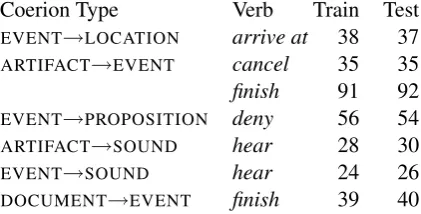
Coerion Type Verb Train Test EVENT→LOCATION arrive at 38 37
ARTIFACT→EVENT cancel 35 35
finish 91 92
EVENT→PROPOSITION deny 56 54
ARTIFACT→SOUND hear 28 30
EVENT→SOUND hear 24 26
[image:4.595.78.289.64.171.2]DOCUMENT→EVENT finish 39 40
Table 1: Coercions in the English data set
6. To guarantee robustness of the data, two addi-tional steps were taken. First, only the six most recurrent coercion types were selected; these are given in table 1. Preference was given to cross-domain coercions, where the source and the target types are not related ontologically. Second, the distribution of selection and co-ercion instances were skewed to increase the number of coercions. The final English data set contains about 30% coercions.
7. Finally, the data set was randomly split in half into a training set and a test set. The training data has 1032 instances, 311 of which are co-ercions, and the test data has 1039 instances, 314 of which are coercions.
4.2 Data Set Construction Phase: Italian
In constructing the Italian data set, we adopted the same methodology used for the English data set, with the following differences:
1. The list of coercive verbs was selected by exam-ining data from the ItWaC (Baroni and Kilgar-riff, 2006) using the Sketch Engine (Kilgarriff et al., 2004):
accusare‘accuse’,annunciare‘announce’,arrivare ‘ar-rive’, ascoltare ‘listen’, avvisare ‘inform’, chiamare ‘call’,cominciare‘begin’,completare‘complete’, con-cludere‘conclude’,contattare‘contact’, divorare ‘de-vour’,echeggiare‘echo’,finire‘finish’,informare ‘in-form’,interrompere‘interrupt’,leggere‘read’, raggiun-gere‘reach’,recar(si)‘go to’,rimbombare‘resound’, sentire‘hear’,udire‘hear’,visitare‘visit’.
2. The coercive senses of the chosen verbs were associated with type templates, some of which are listed listed below. Whenever possible, senses and type templates were adapted from the Italian Pattern Dictionary (Hanks and Jezek, 2007) and mapped to their SIMPLE equiva-lents (Lenci et al., 2000).
a. arrivare, sense reach a location: HUMAN arriva [prep]LOCATION
b. cominciare, senseinitiate an undertaking: HUMAN
cominciaEVENT
c. completare, sensefinish an activity: HUMAN
com-pletaEVENT
d. udire, senseperceive a sound:HUMANodeSOUND
e. visitare, sensevisit a place: HUMANvisitaLOCA -TION
The following types were used to annotate the Italian dataset:
ABSTRACT ENTITY,ANIMATE,ARTIFACT,ATTITUDE, CONTAINER,DOCUMENT,DRINK,EMOTION,ENTITY, EVENT, FOOD, HUMAN, HUMAN GROUP, IDEA, IN -FORMATION, LIQUID, LOCATION, ORGANIZATION, PHYSICAL OBJECT, PROPERTY, SENSATION,SOUND,
TIME PERIOD,VEHICLE
The annotators were provided with a set of def-initions and examples of each type.
3. A set of sentences for each target verb was ex-tracted and parsed from the PAROLE sottoin-sieme corpus (Bindi et al., 2000). They were skimmed to ensure that the final data set con-tained a sufficient number of coercions, with proportionally more selections than coercions. Sentences were preselected to include instances representing one of the chosen senses.
4. In order to exclude instances that may have been wrongly selected, a judge performed word sense disambiguation of the target predicate in the ex-tracted sentences.
5. Annotators were presented with a list of sen-tences and asked to determine the usual seman-tic type associated with the argument in the specified grammatical relation. Every sentence was annotated by two annotators and one judge, who resolved disagreements.
6. Some of the coercion types selected for Italian were:
a. LOCATION→HUMAN(accusare, annunciare)
b. ARTIFACT→HUMAN(annunciare, avvisare) c. EVENT→LOCATION(arrivare, raggiungere) d. ARTIFACT→EVENT(cominciare, completare)
e. EVENT→DOCUMENT(leggere, divorare)
f. HUMAN→DOCUMENT(leggere, divorare)
g. EVENT→SOUND(ascoltare, echeggiare) h. ARTIFACT→SOUND(ascoltare, echeggiare) 7. The Italian training data contained 1466
in-stances, 381 of which are coercions; the test data had 1463 instances, with 384 coercions.
5 Data Format
shown below. The test data differed from the train-ing data in the omission ofCompLinkelements.
In case ofcoercion, there is a mismatch between the source and the target types, and both types need to be identified; e.g., The State Department repeatedly denied the attack:
The State Department repeatedly <SELECTOR sid="s1">denied</SELECTOR> the <TARGET id="t1">attack</TARGET>. <CompLink cid="cid1"
compType="COERCION" selector_id="s1" relatedToTarget="t1" sourceType="EVENT"
targetType="PROPOSITION"/>
When the compositional operation isselection, the source and target types must match; e.g.,The State Department repeatedly denied the statement:
The State Department repeatedly <SELECTOR sid="s2">denied</SELECTOR> the <TARGET id="t2">statement</TARGET>. <CompLink cid="cid2"
compType="SELECTION" selector_id="s2" relatedToTarget="t2" sourceType="PROPOSITION" targetType="PROPOSITION"/>
6 Results & Analysis
We received only a single submission for the ASC task. The UTDMet system was an SVM-based system with features derived from two main sources: a PageRank-style algorithm over Word-Net hypernyms used to define semantic classes, and statistics from a PropBank-style parse of some 8 million documents from the English Gigaword corpus. The results, shown in Table 2, were computed from confusion matrices constructed for each of four classification tasks for the 1039 link instances in the English test data: determination of argument selection or coercion, identification of the argument source type, identification of the ar-gument target type, and the joint identification of the source/target type pair.
Clearly, the UTDMet system did quite well at this task. The one immediately noticeable outlier is the macro-averaged precision for the joint type, which reflects a small number of miscategoriza-tions of rare types. For example, eliminating the single miscategorized ARTIFACT-LOCATION link in the submitted test data bumps this score up to a respectable 94%. This large discrepancy can ex-plained by the lack of any coercions with those types in the gold-standard data.
Prec. Recall Averaging
Selectionvs. 95 96 (macro)
Coercion: 96 96 (micro)
Source Type: 96 96 (macro)
96 96 (micro)
Target Type: 100 100 (both)
Joint Type: 86 95 (macro)
[image:5.595.312.497.62.175.2]96 96 (micro)
Table 2: Results for the UTDMet submission.
In the absence of any other submissions, it is difficult to provide a point of comparison for this performance. However, we can provide a base-line by taking each link to be a selection whose source and target types are the most common type (EVENTfor the gold-standard English data). This yields micro-averaged precision scores of 69% for selectionvs. coercion, 33% for source type iden-tification, 37% for the target type ideniden-tification, and 22% for the joint type.
The performance of the UTDMet system sug-gests that most of the type coercions were identifi-able based largely on examination of lexical clues associated with selection contexts. This is in fact to be expected for the type coercions that were the focus of the English data set. It will be interesting to see how systems perform on the Italian data set and an expanded corpus for English and Italian, where more subtle and complex type exploitations and manipulations are at play. These will hope-fully be explored in future competitions.
7 Conclusion
References
M. Baroni and A. Kilgarriff. 2006. Large
linguistically-processed web corpora for multiple
languages. InProceedings of European ACL.
R. Bindi, P. Baroni, M. Monachini, and E. Gola. 2000.
PAROLE-Sottoinsieme. ILC-CNR Internal Report.
Aljoscha Burchardt, Katrin Erk, Anette Frank, An-drea Kowalski, Sebastian Pado, and Manfred Pinkal. 2006. The salsa corpus: a german corpus resource
for lexical semantics. In Proceedings of LREC,
Genoa, Italy.
L. Burnard, 1995. Users’ Reference Guide, British
Na-tional Corpus. British National Corpus Consortium, Oxford, England.
Marcus Egg. 2005. Flexible semantics for
reinterpre-tation phenomena. CSLI, Stanford.
P. Hanks and E. Jezek. 2007. Building Pattern
Dictio-naries with Corpus Analysis. InInternational
Col-loquium on Possible Dictionaries, Rome, June, 6-7. Oral Presentation.
P. Hanks and J. Pustejovsky. 2005. A pattern
dic-tionary for natural language processing. Revue
Franc¸aise de Linguistique Appliqu´ee.
P. Hanks. 2009. Corpus pattern analysis. CPA Project Page. Retrieved April 11, 2009, from http://nlp.fi.muni.cz/projekty/cpa/.
J. R. Hobbs, M. Stickel, and P. Martin. 1993. Interpre-tation as abduction. Artificial Intelligence, 63:69– 142.
A. Kilgarriff, P. Rychly, P. Smrz, and D. Tugwell.
2004. The Sketch Engine. Proceedings of Euralex,
Lorient, France, pages 105–116.
Karin Kipper. 2005.VerbNet: A broad-coverage,
com-prehensive verb lexicon. Phd dissertation, Univer-sity of Pennsylvania, PA.
A. Lenci, N. Bel, F. Busa, N. Calzolari, E. Gola, M. Monachini, A. Ogonowski, I. Peters, W. Peters, N. Ruimy, et al. 2000. SIMPLE: A general frame-work for the development of multilingual lexicons.
International Journal of Lexicography, 13(4):249. K. Markert and M. Nissim. 2007. SemEval-2007
task 8: Metonymy resolution. In Eneko Agirre, Llu´ıs M`arquez, and Richard Wicentowski, editors,
Proceedings of the Fourth International Workshop on Semantic Evaluations (SemEval-2007), Prague, Czech Republic, June. Association for Computa-tional Linguistics.
A. Meyers, R. Reeves, C. Macleod, R. Szekely, V. Zielinska, B. Young, and R. Grishman. 2004.
The NomBank project: An interim report. In
HLT-NAACL 2004 Workshop: Frontiers in Corpus Anno-tation, pages 24–31.
Geoffrey Nunberg. 1979. The non-uniqueness of
se-mantic solutions: Polysemy. Linguistics and
Phi-losophy, 3:143–184.
M. Palmer, D. Gildea, and P. Kingsbury. 2005. The proposition bank: An annotated corpus of semantic roles.Computational Linguistics, 31(1):71–106. S. Pradhan, E. Hovy, MS Marcus, M. Palmer,
L. Ramshaw, and R. Weischedel. 2007. Ontonotes: A unified relational semantic representation. In
International Conference on Semantic Computing, 2007, pages 517–526.
J. Pustejovsky, P. Hanks, and A. Rumshisky. 2004.
Automated Induction of Sense in Context. In
COL-ING 2004, Geneva, Switzerland, pages 924–931. J. Pustejovsky, R. Knippen, J. Littman, and R. Sauri.
2005. Temporal and event information in natural
language text. Language Resources and Evaluation,
39(2):123–164.
J. Pustejovsky, A. Rumshisky, J. Moszkowicz, and O. Batiukova. 2009. GLML: Annotating argument
selection and coercion. IWCS-8: Eighth
Interna-tional Conference on ComputaInterna-tional Semantics.
J. Pustejovsky. 1991. The generative lexicon.
Compu-tational Linguistics, 17(4).
A. Rumshisky and O. Batiukova. 2008. Polysemy in verbs: systematic relations between senses and
their effect on annotation. In COLING Workshop
on Human Judgement in Computational Linguistics (HJCL-2008), Manchester, England.
A. Rumshisky, P. Hanks, C. Havasi, and J. Pustejovsky. 2006. Constructing a corpus-based ontology using
model bias. InThe 19th International FLAIRS
Con-ference, FLAIRS 2006, Melbourne Beach, Florida, USA.
J. Ruppenhofer, M. Ellsworth, M. Petruck, C. Johnson,
and J. Scheffczyk. 2006. FrameNet II: Extended
Theory and Practice.
Carlos Subirats. 2004. FrameNet Espa˜nol. Una red
sem´antica de marcos conceptuales. In VI
Interna-tional Congress of Hispanic Linguistics, Leipzig. Marc Verhagen. 2010. The Brandeis Annotation Tool.