An Empirical Study of Mini-Batch Creation Strategies
for Neural Machine Translation
Makoto Morishita1∗, Yusuke Oda2, Graham Neubig3,2,
Koichiro Yoshino2,4, Katsuhito Sudoh2, Satoshi Nakamura2 1NTT Communication Science Laboratories, NTT Corporation
2Nara Institute of Science and Technology 3Carnegie Mellon University
4PRESTO, Japan Science and Technology Agency
[email protected], [email protected]
{oda.yusuke.on9, koichiro, sudoh, s-nakamura}@is.naist.jp
Abstract
Training of neural machine translation (NMT) models usually uses mini-batches for efficiency purposes. During the mini-batched training process, it is necessary to pad shorter sentences in a mini-batch to be equal in length to the longest sentence therein for efficient computation. Previ-ous work has noted that sorting the cor-pus based on the sentence length before making mini-batches reduces the amount of padding and increases the processing speed. However, despite the fact that mini-batch creation is an essential step in NMT training, widely used NMT toolkits implement disparate strategies for doing so, which have not been empirically vali-dated or compared. This work investigates mini-batch creation strategies with exper-iments over two different datasets. Our results suggest that the choice of a mini-batch creation strategy has a large effect on NMT training and some length-based sorting strategies do not always work well compared with simple shuffling.
1 Introduction
Mini-batch training is a standard practice in large-scale machine learning. In recent implementa-tions of neural networks, the efficiency of loss and gradient calculation is greatly improved by mini-batching due to the fact that combining training examples into batches allows for fewer but larger operations that can take advantage of the paral-lelism allowed by modern computation architec-tures, particularly GPUs.
∗This work is done while the author was at Nara Institute of Science and Technology.
In some cases, such as the case of processing images, mini-batching is straightforward, as the inputs in all training examples take the same form. However, in order to perform mini-batching in the training of neural machine translation (NMT) or other sequence-to-sequence models, we need to
padshorter sentences to be the same length as the longest sentences to account for sentences of vari-able length in each mini-batch.
To help prevent wasted calculation due to this padding, it is common to sort the corpus accord-ing to the sentence length before creataccord-ing mini-batches (Sutskever et al., 2014; Bahdanau et al., 2015), because putting sentences that have sim-ilar lengths in the same mini-batch will reduce the amount of padding and increase the per-word computation speed. However, we can also easily imagine that this grouping of sentences together may affect the convergence speed and stability, and the performance of the learned models. De-spite this fact, no previous work has explicitly ex-amined how mini-batch creation affects the learn-ing of NMT models. Various NMT toolkits in-clude implementations of different strategies, but they have neither been empirically validated nor compared.
In this work, we attempt to fill this gap by sur-veying the various mini-batch creation strategies that are in use: sorting by length of the source sen-tence, target sensen-tence, or both, as well as making mini-batches according to the number of sentences and the number of words. We empirically compare their efficacy on two translation tasks and find that some strategies in wide use are not necessarily op-timal for reliably training models.
2 Mini-batches for NMT
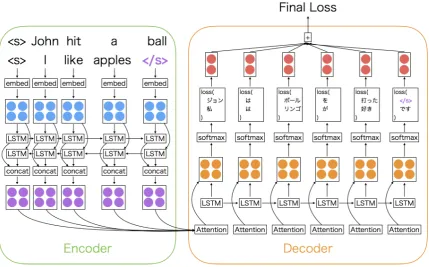
First, to clearly demonstrate the problem of mini-batching in NMT models, Figure 1 shows an
Figure 1: An example of mini-batching in an encoder-decoder translation model.
ample of mini-batching two sentences of different lengths in an encoder-decoder model.
The first thing that we can notice from the fig-ure is that multiple operations at a particular time steptcan be combined into a single operation. For example, both “John” and ”I” are embedded in a single step into a matrix that is passed into the en-coder LSTM in a single step. On the target side as well, we calcualate the loss for the target words at time steptfor every sentence in the mini-batch simultaneously.
However, there are problems when sentences are of different length, as only some sentences will have any content at a particular time step. To re-solve this problem, we pad short sentences with end-of-sentence tokens to adjust their length to the length of the longest sentence. In the Figure 1, purple colored “h/si” indicates the padded end-of-sentence token.
Padding with these tokens makes it possible to handle variably-lengthed sentences as if they were of the same length. On the other hand, the com-putational cost for a mini-batch increases in pro-portion to the longest sentence therein, and ex-cess padding can result in a significant amount of wasted computation. One way to fix this prob-lem is by creating mini-batches that include sen-tences of similar length (Sutskever et al., 2014)
Algorithm 1Create mini-batches 1: C ←Training corpus
2: C ←sort(C)or shuffle(C) .sort or shuffle the whole corpus
3: B← {} .mini-batches
4: i←0, j ←0
5: whilei <C.size()do 6: B[j]←B[j] +C[i]
7: ifB[j].size()≥max mini-batch sizethen
8: B[j]←padding(B[j]) .
Padding tokens to the longest sentence in the mini-batch
9: j←j+ 1
10: end if 11: i←i+ 1 12: end while
13: B←shuffle(B) .shuffle the order of the mini-batches
3 Mini-batch Creation Strategies
Specifically, we examine three aspects of mini-batch creation: mini-mini-batch size, word vs. sentence mini-batches, and sorting strategies. Algorithm 1 shows the pseudo code of creating mini-batches. 3.1 Mini-batch Size
The first aspect we consider ismini-batch sizefor which, of the three aspects we examine here, the effect is relatively well known.
When we use larger mini-batches, more sen-tences participate in the gradient calculation mak-ing the gradients more stable. They also increase efficiency with parallel computation. However, they decrease the number of parameter updates performed in a certain amount of time, which can slow convergence at the beginning of train-ing. Large mini-batches can also pose problems in practice due to the fact that they increase mem-ory requirements.
3.2 Sentence vs. Word Mini-batching
The second aspect that we examine, which has not been examined in detail previously, is whether to create mini-batches based on the number of sen-tencesornumber of target words.
Most NMT toolkits create mini-batches with a constant number of sentences. In this case, the number of words included in each mini-batch dif-fers greatly due to the variance in sentence lengths. If we use the neural network library that constructs graphs in a dynamic fashion (e.g. DyNet (Neubig et al., 2017), Chainer (Tokui et al., 2015), or Py-Torch1), this will lead to a large variance in
mem-ory consumption from mini-batch to mini-batch. In addition, because the loss function for the mini-batch is equal to the sum of the losses incurred for each word, the scale of the losses will vary greatly from mini-batch to mini-batch, which could be po-tentially detrimental to training.
Another choice is to create mini-batches by keeping the number of target words in each mini-batch approximately stable, but varying the num-ber of sentences. We hypothesize that this may lead to more stable convergence, and test this hy-pothesis in the experiments.
3.3 Corpus Sorting Methods
The final aspect that we examine, which has sim-ilarly is not yet well understood, is the effect of
1http://pytorch.org
the method that we use to sort the corpus before grouping consecutive sentences into mini-batches. A standard practice in online learning shuffles training samples to ensure that bias in the pre-sentation order does not adversely affect the final result. However, as we mentioned in Section 2, NMT studies (Sutskever et al., 2014; Bahdanau et al., 2015) prefer uniform length samples in the mini-batch by sorting the training corpus, to re-duce the amount of padding and increase per-word calculation speed. In particular, in the encoder-decoder NMT framework (Sutskever et al., 2014), the computational cost in the softmax layer of the decoder is much heavier than the encoder. Some NMT toolkits sort the training corpus based on the target sentence length to avoid unnecessary soft-max computations on padded tokens in the tar-get side. Another problem arises in the atten-tional NMT model (Bahdanau et al., 2015; Luong et al., 2015); attentions may give incorrect positive weights to the padded tokens in the source side. The problems above also motivate the mini-batch creation with uniform length sentences with fewer padded tokens.
Inspired by sorting methods in use in current open source implementations, we compare the fol-lowing sorting methods:
SHUFFLE: Shuffle the corpus randomly before
creating mini-batches, with no sorting.
SRC: Sort based on the source sentence length. TRG: Sort based on the target sentence length.
SRC TRG: Sort using the source sentence length,
break ties by sorting by target sentence length.
TRG SRC: Converse ofSRC TRG.
Of established open-source toolkits, OpenNMT (Klein et al., 2017) uses the SRCsorting method, Nematus2 and KNMT (Cromieres, 2016) use
the TRG sorting method, and lamtram3 uses the TRG SRCsorting method.
4 Experiments
We conducted NMT experiments with the strate-gies presented above to examine their effects on NMT training.
4.1 Experimental Settings
ASPEC-JE WMT 2016 train 2,000,000 4,562,102
dev 1,790 2,169
[image:4.595.103.259.62.117.2]test 1,812 2,999
Table 1: Number of sentences in the corpus
pus (Nakazawa et al., 2016) and English-German using the WMT 2016 news task with news-test2016 as the test-set (Bojar et al., 2016). Table 1 shows the number of sentences contained in the corpora.
The English and German texts were tokenized withtokenizer.perl4, and the Japanese texts
were tokenized with KyTea (Neubig et al., 2011). As a testbed for our experiments, we used the standard global attention model of Luong et al. (2015) with attention feeding and a bidirectional encoder with one LSTM layer of 512 nodes. We used the DyNet-based (Neubig et al., 2017) NMTKit5, with a vocabulary size of 65536 words
and dropout of 30% for all vertical connections. We used the same random numbers as initial pa-rameters for each experiment to reduce variance due to initialization. We used Adam (Kingma and Ba, 2015) (α = 0.001) or SGD (η = 0.1) as the learning algorithm. After every 50,000 train-ing sentences, we processed the test set to record negative log likelihoods. In the testing, we set the mini-batch size to 1, in order to calculate negative log likelihood correctly. We calculated the case-insensitive BLEU score (Papineni et al., 2002) withmulti-bleu.perl6script.
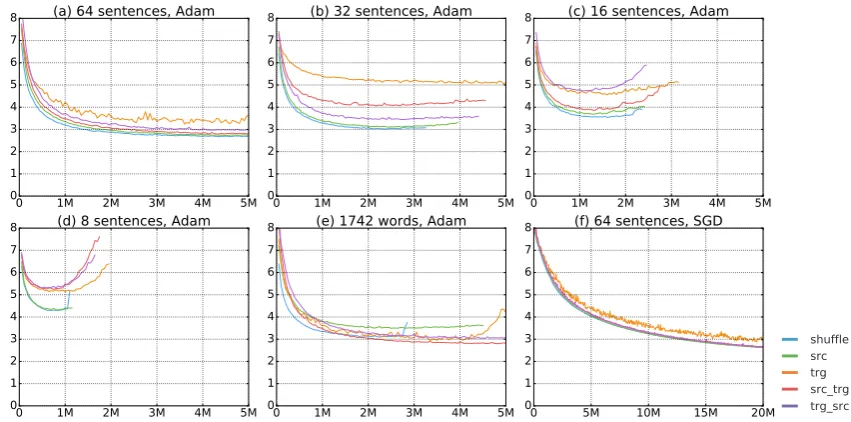
Table 2 shows the mini-batch creation settings compared in this paper, and we tried all sorting methods discussed in Section 3.3 for each setting. In method (e), we set the average number of target words in 64 sentences: 2055 words for ASPEC-JE, 1742 words for WMT. For all experiments, we shuffled the processing order of the mini-batches. 4.2 Experimental Results and Analysis Figure 2, 3, 4 and 5 show the transition of negative log likelihoods and the BLEU scores according to the number of processed sentences in ASPEC-JE
4https://github.com/moses-smt/ mosesdecoder/blob/master/scripts/ tokenizer/tokenizer.perl
5https://github.com/odashi/nmtkit We
used the commit number566e9c2.
6https://github.com/moses-smt/ mosesdecoder/blob/master/scripts/ generic/multi-bleu.perl
mini-batch units learning algorithm
(a) 64 sentences Adam
(b) 32 sentences Adam
(c) 16 sentences Adam
(d) 8 sentences Adam
(e) 2055 or 1742 words Adam
[image:4.595.306.526.64.211.2](f) 64 sentences SGD
Table 2: Compared settings
sorting method average time (hour)
SHUFFLE 8.08
SRC 6.45
TRG 5.21
SRC TRG 4.35
TRG SRC 4.30
Table 3: Average time needed to train a whole ASPEC-JE corpus using method (a). We used a GTX 1080 GPU for this experiment.
and WMT2016 test sets. Table 3 shows the aver-age time to process the whole ASPEC-JE corpus.
The learning curves show very similar tenden-cies in different language pairs. We discuss the results in detail on each strategy that we investi-gated.
4.2.1 Effect of Mini-batch Size
We carried out the experiments with the mini-batch size of 8 to 64 sentences.7
From the experimental results of the method (a), (b), (c) and (d), in the case of using Adam, the mini-batch size affects the training speed and it also has an impact on the final accuracy of the model. As we mentioned in Section 3.1, the gra-dients can be stabler by increasing the mini-batch size, and it seems to have a positive impact on the model from the view of accuracy. Thus, we can first note that mini-batch size is a very important hyper-parameter for NMT training that should not be ignored. In our case in particular, the largest mini-batch size that could be loaded into the mem-ory was the best for the NMT training.
4.2.2 Effect of Mini-batch Unit
Looking at the experimental results of the meth-ods (a) and (e), we can see that perplexities drop faster if we useSHUFFLEfor method (a) and SRC for method (e), but we couldn’t see any large dif-ferences in terms of the training speed and the final 7We tried the experiments with larger mini-batch size, but
Figure 2: Training curves on the ASPEC-JE test set. The y- and x-axes shows the negative log likelihoods and number of processed sentences. The scale of the x-axis in the method (f) is different from others.
Figure 3: Training curves on the WMT2016 test set. Axes are the same as Figure 2.
accuracy of the model. We hypothesize that the large variance of the loss affects the final model accuracy, especially when using the learning algo-rithm that uses momentum such as Adam. How-ever, these results indicate that these differences do not significantly affect the training results. We leave a comparison of memory consumption for future research.
4.2.3 Effect of Corpus Sorting Method using Adam
From all experimental results of the method (a), (b), (c), (d) and (e), in the case of using SHUF
[image:5.595.84.510.327.538.2]Figure 4: BLEU scores on the ASPEC-JE test set. The y- and x-axes shows the BLEU scores and number of processed sentences. The scale of the x-axis in the method (f) is different from others.
Figure 5: BLEU scores on the WMT2016 test set. Axes are the same as Figure 4.
in the mini-batch had different features. This is evidenced by the more jagged lines of the TRG method.
As a conclusion, theTRGandTRG SRCsorting methods, which are used by many NMT toolkits, have a higher overall throughput when just mea-suring the number of words processed, but for con-vergence speed and final model accuracy, it seems to be better to useSHUFFLEorSRC.
Some toolkits shuffle the corpus first, then cre-ate mini-batches by sorting a few consecutive sen-tences. We think that this method may be effective by combining the advantage ofSHUFFLEand other
sorting methods, but an empirical comparison is beyond the scope of this work.
4.2.4 Effect of Corpus Sorting Method using SGD
[image:6.595.81.511.327.539.2]nega-0
1M
2M
3M
4M
5M
0
1
2
3
4
5
6
7
8
(a) 64 sentences, Adam
shuffle
trg_src
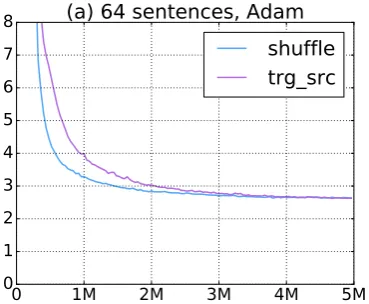
Figure 6: Training curves on the ASPEC test set using lamtram toolkit. Axes are the same as Fig-ure 2.
tive log likelihoods and the BLEU scores are not stable. It can be conjectured that this is an effect of gathering the similar sentences in a mini-batch as we mentioned in Section 4.2.3. These results indicate that in the case of SGD it is acceptable to TRG SRC, which is the fastest method to process the whole corpus (see Table 3), for SGD.
Recently, Wu et al. (2016) proposed a new learning paradigm, which uses Adam for the ini-tial training, then switches to SGD after several iterations. If we use this learning algorithm, we may be able to train the model more effectively by using SHUFFLEorSRC sorting method for Adam, andTRG SRCfor SGD.
4.3 Experiments with a Different Toolkit In the previous experiments, we conducted the ex-periments with only one NMT toolkit, so the re-sults may be dependent on the particular imple-mentation provided therein. To ensure that these results generalize to other toolkits with different default parameters, we conducted the experiments with another NMT toolkit.
4.3.1 Experimental Settings
In this section, we used lamtram8 as a NMT
toolkit. We carried out the Japanese-English trans-lation experiments with ASPEC-JE corpus. We used Adam (Kingma and Ba, 2015) (α = 0.001) as the learning algorithm and tried the two sort-ing algorithms: SHUFFLE which is the best sort-ing method on previous experiments andTRG SRC which is the default sorting method used by the
8https://github.com/neubig/lamtram
lamtram toolkit. Normally, lamtram creates mini-batches based on the number of target words con-tained in each mini-batch, but we changed it to fix the mini-batch size to 64 sentences because we find that larger mini-batch size seems to be bet-ter in the previous experiments. Other experimen-tal settings are the same as described in the Sec-tion 4.1.
[image:7.595.91.276.68.220.2]4.3.2 Experimental Results
Figure 6 shows the transition of negative log like-lihoods using lamtram. We can see the tendency of the training curves are similar to the Figure 2 (a), the combination withSHUFFLEdrops negative log likelihood faster than theTRG SRCone.
From this experiments, we could verify that our experimental results in the Section 4 do not rely on the toolkit and we think the observed behavior will generalize to other toolkits and implementations.
5 Related Work
Recently, Britz et al. (2017) have released a pa-per about exploring the hypa-per-parameters of NMT. This work is similar to our paper in the terms of finding the better hyper-parameters by doing a large number of experiments and deriving em-pirical conclusions. However, notably this paper fixed the mini-batch size to 128 sentences and did not treat mini-batch creation strategy as one of the hyper-parameters of the model. With our experi-mental results, we argue that the mini-batch cre-ation strategies also have an impact on the NMT training, and thus having solid recommendations for how to adjust this hyper-parameter are also of merit.
6 Conclusion
In this paper, we analyzed how mini-batch cre-ation strategies affect the training of NMT models for two language pairs. The experimental results suggest mini-batch creation strategy is an impor-tant hyper-parameter of the training process, and commonly-used sorting strategies are not always optimal. We sum up the results as follows:
• Mini-batch size can affect the final accuracy of the model in addition to the training speed and the larger mini-batch size seems to be better.
• We should use SHUFFLE or SRC sorting method for Adam, and it is sufficient to use TRG SRCfor SGD.
In the future, we plan to do experiments with larger mini-batch sizes and compare the used peak memory between making mini-batches by the number of sentences or target words. We are also interested in checking the effects of different mini-batch creation strategies with other language pairs, corpora and optimization functions.
Acknowledgments
This work was done as a part of the joint re-search project with NTT and Nara Institute of Sci-ence and Technology. This research has been sup-ported in part by JSPS KAKENHI Grant Number 16H05873. We thank the anonymous reviewers for their insightful comments.
References
Dzmitry Bahdanau, Kyunghyun Cho, and Yoshua Ben-gio. 2015. Neural machine translation by jointly learning to align and translate. In Proceedings of the 3rd International Conference on Learning Rep-resentations (ICLR).
Ondˇrej Bojar, Rajen Chatterjee, Christian Federmann, Yvette Graham, Barry Haddow, Matthias Huck, Antonio Jimeno Yepes, Philipp Koehn, Varvara Logacheva, Christof Monz, Matteo Negri, Aure-lie Neveol, Mariana Neves, Martin Popel, Matt Post, Raphael Rubino, Carolina Scarton, Lucia Spe-cia, Marco Turchi, Karin Verspoor, and Marcos Zampieri. 2016. Findings of the 2016 conference on machine translation. In Proceedings of the 1st Conference on Machine Translation (WMT).
Denny Britz, Anna Goldie, Minh-Thang Luong, and Quoc V. Le. 2017. Massive exploration of neural machine translation architectures. arXiv preprint arXiv:1703.03906.
Fabi`en Cromieres. 2016. Kyoto-NMT: a neural ma-chine translation implementation in chainer. In Pro-ceedings of the 26th International Conference on Computational Linguistics (COLING).
Diederik Kingma and Jimmy Ba. 2015. Adam: A method for stochastic optimization. In Proceed-ings of the 3rd International Conference on Learn-ing Representations (ICLR).
Guillaume Klein, Yoon Kim, Yuntian Deng, Jean Senellart, and Alexander M. Rush. 2017. Open-NMT: Open-source toolkit for neural machine trans-lation. arXiv preprint arXiv:1701.02810.
Minh-Thang Luong, Hieu Pham, and Christopher D. Manning. 2015. Effective approaches to attention-based neural machine translation. In Proceedings of the Conference on Empirical Methods in Natural Language Processing (EMNLP).
Toshiaki Nakazawa, Manabu Yaguchi, Kiyotaka Uchi-moto, Masao Utiyama, Eiichiro Sumita, Sadao Kurohashi, and Hitoshi Isahara. 2016. ASPEC: Asian scientific paper excerpt corpus. In Proceed-ings of the 10th International Conference on Lan-guage Resources and Evaluation (LREC).
Graham Neubig, Chris Dyer, Yoav Goldberg, Austin Matthews, Waleed Ammar, Antonios Anastasopou-los, Miguel Ballesteros, David Chiang, Daniel Clothiaux, Trevor Cohn, Kevin Duh, Manaal Faruqui, Cynthia Gan, Dan Garrette, Yangfeng Ji, Lingpeng Kong, Adhiguna Kuncoro, Gaurav Ku-mar, Chaitanya Malaviya, Paul Michel, Yusuke Oda, Matthew Richardson, Naomi Saphra, Swabha Swayamdipta, and Pengcheng Yin. 2017. DyNet: The dynamic neural network toolkit. arXiv preprint arXiv:1701.03980.
Graham Neubig, Yosuke Nakata, and Shinsuke Mori. 2011. Pointwise prediction for robust, adaptable Japanese morphological analysis. InProceedings of the 49th Annual Meeting of the Association for Com-putational Linguistics (ACL).
Kishore Papineni, Salim Roukos, Todd Ward, and Wei-Jing Zhu. 2002. BLEU: a method for automatic evaluation of machine translation. In Proceedings of the 40th Annual Meeting of the Association for Computational Linguistics (ACL).
Ilya Sutskever, Oriol Vinyals, and Quoc V. Le. 2014. Sequence to sequence learning with neural net-works. In Proceedings of the 28th Annual Con-ference on Neural Information Processing Systems (NIPS).
Seiya Tokui, Kenta Oono, Shohei Hido, and Justin Clayton. 2015. Chainer: a next-generation open source framework for deep learning. InProceedings of Workshop on Machine Learning Systems (Learn-ingSys) in The Twenty-ninth Annual Conference on Neural Information Processing Systems (NIPS). Yonghui Wu, Mike Schuster, Zhifeng Chen, Quoc V.