Identifying Comparative Structures in Biomedical Text
Samir Gupta1, A. S. M. Ashique Mahmood1, Karen E. Ross2, Cathy H. Wu1,3, K. Vijay-Shanker1 1Department of Computer & Information Sciences
3Center for Bioinformatics and Computational Biology
University of Delaware, Newark, DE
{sgupta, ashique, wuc, vijay}@udel.edu
2Department of Biochemistry and Molecular & Cellular Biology
Georgetown University Medical Center, Washington, DC
Abstract
Comparison sentences are very commonly used by authors in biomedical literature to report results of experiments. In such comparisons, authors typically make ob-servations under two different scenarios. In this paper, we present a system to au-tomatically identify such comparative sen-tences and their components i.e. the com-pared entities, the scale of the comparison and the aspect on which the entities are be-ing compared. Our methodology is based on dependencies obtained by applying a parser to extract a wide range of compar-ison structures. We evaluated our system for its effectiveness in identifying compar-isons and their components. The system achieved a F-score of 0.87 for compari-son sentence identification and 0.77-0.81 for identifying its components.
1 Introduction
Biomedical researchers conduct experiments to validate their hypotheses and infer associations be-tween biological concepts and entities, such as mutation and disease or therapy and outcome. It is often not enough to simply report the effects of an intervention; instead, the most common way to validate such observations is to perform compar-isons. In such studies, researchers make observa-tions under two different scenarios (e.g., disease sample vs. control sample). When the differences between the groups are statistically significant, as-sociation can be inferred.
Comparative studies are prevalent in nearly ev-ery field of biomedical/clinical research. For ex-ample, in the experimental approach known as “reverse genetics”, researchers draw inferences about gene function by comparing the
pheno-type of a gene knockdown sample to that of a sample expressing the gene at the normal level. In clinical trial studies, researchers study the ef-fectiveness or side-effects of a drug compared to a placebo. A simple PubMed query “com-pared[TIAB] OR than[TIAB] OR versus[TIAB]” returned 3,149,702 citations, which provides a rough estimate of the pervasive nature of compar-isons in the biomedical literature. Thus, devel-opment of automated techniques to identify such statements would be highly useful.
Comparative sentences typically contain two (or more) entities, which are being compared with re-spect to some common are-spect. Consider sentence (1), which compares gene expression level in can-cerous vs. non-cancan-cerous tissues:
(1) The expression of GPC5 gene was lower in lung cancer tissues compared with adjacent noncancerous tissues.
Typically, the entities, which we will refer as
compared entities, are of the same type. In the ex-ample, the entities being compared are two tissues: “lung cancer tissues” and “adjacent noncancerous issues”, which are separated by the phrase “com-pared with”. “Expression of GPC5 gene”, which we call the compared aspect, is the aspect on which comparison between the two entities is be-ing made. The word “lower” indicates the scale of the comparison, thereby providing an ordering of the compared entities with respect to the com-pared aspect. These definitions are similar to those described in (Park and Blake,2012).
In this paper, we describe a system to au-tomatically identify comparative structures from text. We have developed patterns based on sen-tence syntactic dependency information to identify comparison sentences and also extract the various components (compared aspect, compared entities
and scale). The developed system identifies ex-plicit comparative structures at the sentence level, where all the components of the comparison are present in the sentence. The main challenge is to capture patterns at a sufficiently high level given the sheer variety of comparative structures. In the rest of the paper we will define the task, describe our approach and comparison patterns and present the results of our evaluation. We achieved a F-score of 0.87 for identifying comparison sentences and 0.78, 0.81, 0.77 for extracting the compared aspect, scale indicator and compared entities, re-spectively. Thus the major contributions of this work are:
• Development of a general approach for iden-tifying comparison sentences using syntactic dependencies.
• Development of methods to extract all of the components of the comparative structure.
2 Related Works
The sentence constructions used to make compar-isons in English are complex and variable. Bres-nan (1973) discussed the syntax of comparative clause construction in English and noted its syn-tactic complexity, ‘exhibiting a variety of gram-matical processes’. Friedman (1989) reported a general treatment of comparative structures based on basic linguistic principles and noted that auto-matically identifying them is computationally dif-ficult. They also noted that comparative struc-tures resemble and can be transformed into other syntactic forms such as general coordinate con-junctions, relative clauses, and certain subordinate and adverbial clauses and thus ‘syntactically the comparative is extraordinarily diverse’. In (Staab and Hahn,1997), the authors proposed a model of comparative interpretation that abstracts from tex-tual variations using descriptive logic representa-tion.
The above studies provide an analysis of com-parative sentences from a linguistic point of view. Computational systems for identifying compar-isons have also been developed. Jindal and Liu (2006a) proposed a machine learning approach to identify comparative sentences from text. The sys-tem first categorizes comparative sentences into different types, and then presents a pattern dis-covery and supervised learning approach to clas-sify each sentence into two classes: compara-tive and non-comparacompara-tive. Class sequential rules
based on words and part-of-speech tags automat-ically generated while learning the model were used as features in this work. The authors eval-uated their classifier on product review sentences containing comparison between products and re-ported a precision of 79% and a recall of 81%. The authors extended their work (Jindal and Liu, 2006b) to extract comparative relations i.e. the compared entities and their features, and com-parison keywords from the identified comcom-parison sentences. In (Xu et al., 2011), the authors de-scribed a machine learning approach to extract and visualize comparative relations between prod-ucts from Amazon customer reviews. They de-scribe a comparative relation as a 4-tuple, con-taining the two compared products, the compared aspect and a comparison direction (better, worse, same). They reported a F-score of 38.81% using multi-class SVM and 56.68% using Conditional Random Fields (CRF). (Jindal and Liu,2006b;Xu et al.,2011) are the only works that extract the dif-ferent components of the comparison. In (Ganap-athibhotla and Liu,2008), the authors focused on mining opinions from comparative sentences from product review sentences and extracting the pre-ferred product. Yang and Ko(2009) proposed a machine learning approach to identify compara-tive sentences from Korean web-based text but did not address the extraction of the comparison ar-guments. They first constructed a set of compar-ative keywords manually and extracted candidate comparative sentences and then used Maximum Entropy Model (MEM) and Naive Bayes (NB) to eliminate non-comparative sentences from the candidates.
Fiszman et al. (2007) described a technique to identify comparative constructions in MEDLINE citations using under-specified semantic interpre-tation. The authors used textual patterns com-bined with semantic predications extracted from the semantic processor SemRep (Rindflesch and Fiszman, 2003; Rindflesch et al., 2005). The predications extracted by SemRep are based on the Unified Medical Language System (UMLS) (Humphreys et al., 1998). Their system extracts the compared entities (limited to drugs) and the scale of the comparison. They reported an aver-age F-score of 0.78 for identifying the compared drug names, scale and scale position. To the best of our knowledge, (Fiszman et al., 2007) is the only reported work that goes beyond identification of comparison sentences to identify the different components of the comparison in biomedical text. But unlike our work, theirs is limited to son between drugs, does not extract the compari-son aspect and appears to be limited in their cov-erage of comparison structures.
3 Method
3.1 Task Definition
Basic comparison sentences contain two or more
compared entities (CE) and a comparison as-pect (CA) on which compared entities are being compared. Additionally, there are two parts in such sentences indicating the comparison. The first is the presence of a word that indicates the scale of the comparison and the other separates the two compared entities. The former is often com-parative adjectives or adverbs (such as “higher”, “lower”, “better”, etc.), while the latter can be ex-pressed with phrases or words (such as “than”, “compared with”, “versus” etc.). We will refer to the former comparative word indicating the scale as theScale Indicator (SI)and the latter, separat-ing the entities, as the Entity Separator (ES). In example (2) below the key parts of such a compar-ison structure are highlighted.
(2) [Arteriolar sclerosis]CA was significantly higherSIin addictsCEthanEScontrolsCE. Jindal and Liu(2006b) categorized comparative structures into four classes: (1) Non-Equal Grad-able, (2) Equative, (3) Superlative and (4) Non-Gradable. Non-Equal Gradablecomparison indi-cate relations of the type greater or less than, pro-viding an ordering of the compared entities.
Equa-tivestructures indicate equal relation between the two entities with respect to the aspect. Com-parisons where one entity is “ better” than all other entities are termed asSuperlative. Sentences in which the compared entities are not explicitly graded are calledNon-Gradable.
Based on our previous discussion, we will be addressing only the first two types: Non-Equal Gradable and Equative comparison. First, we consider processing at the sentence-level only. While there are cases of comparisons, where the context provided by a larger body of text might provide the information about all the components, they are not considered in this work. Thus most of the superlative cases will not be considered be-cause all the compared entities are rarely men-tioned within a single sentence. It also rules out cases such as in Example (3a), where the second compared entity must be inferred from previous sentences. Second, we consider only those sen-tences where the authors mention the result or con-clusion of an experiment/study. Thus, we will not consider sentences such as in Example (3b), since it only mentions the intention to perform a com-parison but does not indicate the result of the ex-periment. While such sentences can still be cap-tured with minor changes to our existing patterns, our goal here is to only consider sentences that in-dicate the results of experiment by means of com-parison. The patterns developed in this work iden-tify explicit comparative structures at the sentence level and extract all components of the comparison relations, i.e., the compared aspect, entities and the scale indicator.
(3) a. Mean procedure time was significantly shorter for the percutaneous procedure. b. We compared lesion growth between
placebo and tissue plasminogen activator-treated patients.
3.2 Approach
tool (Manning et al., 2014; De Marneffe et al., 2014) to convert the parse tree to into the syntac-tic dependency graph (SDG). We use the “CCPro-cessed” representation, which collapses and prop-agates dependencies allowing for an appropriate treatment of sentences that involve conjunctions. Note that “CCProccessed” is helpful as dependen-cies involving preposition, conjuncts, as well as referent of relative clauses are “collapsed” to get direct dependencies between context words. Thus, as seen in Figure 2, which shows the “CCPro-cessed” SDG, there is a direct edge from “lower” to the cells in the Noun Phrase (NP) “Hep3B cells” rather than a path with two edges where the first reaches the preposition “in” and the second from “in” word to the word “cells”. This simplifies the pattern development in relation extraction.
Based on this syntactic dependencies represen-tation, we have developed patterns to identify the different arguments of the comparison relation. Next we use Semgrex, which is a part of the Stan-ford NLP Toolkit, to specify the translated patterns as regular expressions based on lemmas, part-of-speech tags, and dependency labels, which will au-tomatically match with the sentence dependency parse structure. We have developed a total of 35 and 8 patterns to identify Non-Equal Gradable and Equative comparisons respectively. The de-veloped Semgrex rules as well as the evaluation test set can be found at the link below1. Each
Sem-grex rule/pattern identifies all components of the comparison, specifically the head of the compar-ison aspect, entities and scale. Since the compo-nents are typically Noun Phrases (NPs), we look at the outgoing edges from the head nouns to obtain the NPs corresponding to the comparison compo-nents. In the next subsection, we will discuss the development of different comparison patterns.
3.3 Comparative Patterns
As discussed earlier in subsection3.1, the two key parts in a basic comparison sentence are a Scale Indicator (SI), indicating the scale of the compar-ison and a Entity Separator (ES), separating the compared entities. We will use dependencies from these SI and ES words to extract the compared aspect and the compared entities. We have de-veloped rules based on syntactic dependencies for various combinations of the two keys parts. We broadly categorize our comparison patterns based
1http://biotm.cis.udel.edu/biotm/projects/comparison/
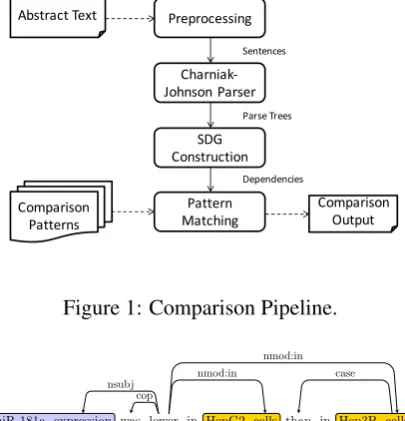
Abstract(Text Preprocessing
Charniak5 Johnson(Parser
SDG( Construction
Pattern( Matching Comparison(
Patterns
Comparison( Output
Sentences
Parse(Trees
[image:4.595.316.519.70.281.2]Dependencies
Figure 1: Comparison Pipeline.
miR-181a expression was lower in HepG2 cells than in Hep3B cells
nsubj cop
nmod:in nmod:in
case
Figure 2: Example SDG
on the Scale Indicator word indicating either Non-Equal Gradable or Equative Comparison.
3.3.1 Non-Equal Gradable
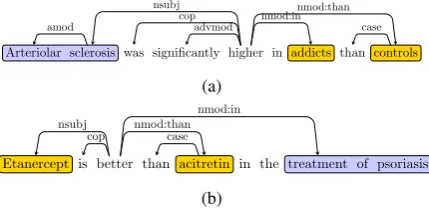
Non-Equal Gradable comparison indicates a dif-ference between the compared entities. Based on three part-of-speech tags (POS) of the Scale In-dicator, different syntactic structures are possible, as described below. Note that in all the figures de-picting the dependency graph the compared aspect is highlighted in blue and the compared entities in yellow.
com-Arteriolar sclerosis was significantly higher in addicts than controls
amod
nsubj cop
advmod
nmod:innmod:than case
(a)
Etanercept is better than acitretin in the treatment of psoriasis
nsubj
cop nmod:than nmod:in case
[image:5.595.75.290.64.168.2](b)
Figure 3: Comparative Adjective copular forms.
pared entity. Thus we further verify that the ex-tracted compared entities are separated by an ES.
The position of the entity separator “than” is critical for determining the second compared en-tity as well as the first compared enen-tity. As shown in Figure3b, despite the similar copular structure to the sentence in Figure3a, the subject of the JJR (“better” in this case) is the compared entity rather than the aspect. This is due to the fact that the JJR is followed by the ES “than”. Thus ordering of the words is an important clue when differentiat-ing between these cases.
Thesecondcategory involves sentences, where the comparative adjective modifies a head noun and this modified noun provides the compared as-pect, as shown in Figures4and5. Since the com-pared aspect is modified by the JJR, we used the amod edge to detect the aspect. In these cases, the noun phrase containing the Scale Indicator will be connected to a verb and typically serves as the predicate of the comparison relation. The entity separator in the sentence in Figure4is “compared to” and we can extract one of the compared en-tities (“intravenous morphine”) by following the advcl:compared to edge from the predicate verb (“offers”).
Note that in the first example (Figure 4), the Verb Group (“offer”) is in the active form and in the second example (Figure 5), it is in the pas-sive form (“was observed in”). Due to the ac-tive/passive form difference, the aspect is in the object position and one of the compared entities in the subject position in the first example, while the reverse is true for the second example. In the dependency representation, thensubjedge and the nmod:in edge provide the subjects in active and passive cases anddobjandnsubjpassprovide the possible objects. Note that in certain cases, the au-thor might use an adjective (JJ) instead of the com-parative form (“high” instead of “higher”). We
treat such cases in the same way we treat the com-parative adjective (JJR) form.
Note that the Semgrex patterns only identifies the head words of the various components, which are typically NPs. We follow outgoing depen-dency edges from these head words to extract phrases corresponding to each comparison compo-nent. For example, in Figure3a“sclerosis” is iden-tified as the aspect head and we follow the edge amodto extract the aspect phrase “Arteriolar scle-rosis”. In Figure5, we extract “TP expression” as the aspect phrase and not “Higher TP expression” as “higher” is the trigger of the comparison and identified as the scale.
Comparative Adverb: In these sentences, the comparison scale is indicated through comparative adverbs (RBR) such as “more”, “less” etc.. Typi-cally, the RBR modifies an adjective (JJ) as shown in Figure 6, where the adjective is “effective”. This adjective serves as the predicate of the com-parison and dependency edges from it are used to determine the aspect and entities. The syntactic structure and our rules are very similar to the first category of the Comparative Adjective case. Thus we use the nsubj and advcl:compared to edges from “effective” to determine the compared enti-ties. Note that the compared aspect in this exam-ple is a clause headed by a VBG (“reducing MCP-1 levels”) and thus in addition tonmodedges, we need to consider the adverbial clause modifier (ad-vcl) edge to determine the aspect.
Verbs: Certain verbs such as “increased”, “de-creased” as well as “improved” indicate differ-ences and can be used as a SI. This verb serves as the predicate of the comparison relation and outgoing dependencies can be used to determine the arguments of the comparison. We have ob-served two categories based on the voice (passive
vs.active) of the Verb Group containing this verb. The passive case is depicted in Figure7a(“was in-creased in”). In this case, we follow thensubjpass edge to determine the compared aspect. In Fig-ure7b, since the scale indicator “improved” is in active voice, the direct object of the verb will in-stead provide the aspect. Extraction and verifica-tion of the compared entities is similar to the cases described previously (e.g. nmod:inin Figure7a; dobjandadvcl:compared within Figure7b).
Epidural morphine offers better pain control compared to intravenous morphine
nsubj
dobj
advcl:compared to
[image:6.595.133.471.64.121.2]amod case
Figure 4: Comparative Adjective modifier form 1.
Higher TP expression was observed in ovarian cancers than in normal ovaries
amod
compound nsubjpassauxpass
nmod:in
nmod:in
[image:6.595.128.471.161.216.2]case
Figure 5: Comparative Adjective modifier form 2.
We treat cases when the scale indicator verb is used as a modifier of a NP like the second cate-gory of Comparative Adjectives.
3.3.2 Equative
A sentence with Equative comparison corresponds to cases, where the result of comparison indicates no difference between the compared entities (as in Figure 8). In these cases, it is very rare to find the usual Entity Separator (ES) and instead words such as conjuctions (“and”, “or”), “ between” and “among” play the role of the ES. We have ob-served three frequently occurring types of such Equative comparative structures.
The firstcategory involves the structure“X as JJ as Y”, where JJ is an adjective. In these cases, the adjective serves as the predicate of the com-parison. Figure 8 depicts such a case, where the adjective is “effective”. Here one of the compared entity “botox” is the subject of the JJ “effective”. The second compared entity “oral medication” is preceded by the ES “as” and anmod:asedge from the JJ to the entity is present. The compared aspect is typically attached to the second compared entity through a nmod edge (nmod:forin this case). Note that the ES “as” need not appear immediately af-ter the JJ (e.g. “Botox is as effective for overactive bladder as oral medication”). Due to the “CCPro-cessed” representation of collapsing edges we can still consider thenmod:asfrom “effective” to de-termine the second compared entity. The only dif-ference in this case is that thenmod:foredge used to determine the aspect is from the predicate “ef-fective”.
The second case involves the Scale Indicator phrase“similar to”as shown in Figure9. Here the subject of the adjective “similar” is the compared
aspect. Thenmodedges (nmod:inin this example) from “similar” are used to determine the compared entities. The entities in these cases are separated through conjunctions. Note that the SI “similar” can also modify the compared aspect (e.g. “Simi-lar CA was observed in CE1 and CE2”). This case closely resembles the second category of compar-ative adjectives and similar rules are used.
The third category involves Scale Indicator phrases such ‘‘no differences”, “no changes”etc. Similar to the case of the second category com-parative adjectives, here the SI “difference” is part of a NP and hence is connected to a verb, which serves as the predicate. Typically these verbs can be “linking” verbs (‘is”, “was” etc.) in active form or certain verbs indicating presence (“found in”, “noted in”, “observed in”) in the passive form. In active voice case, as shown in Figure 10, the SI typically follows an existential such as “there”. In these cases, the nmod:between from the pred-icate verb ( “was” in this case) is used to deter-mine the compared entities. Other nmod edges we consider arenmod:amongandnmod:in. The com-pared aspect is attached to the second comcom-pared entity thoughnmodedges (nmod:forin this exam-ple). A large proportion of Equative structures do not mention the compared entities explicitly, and as per the definition of our task, we do not extract the comparison components in these cases.
4 Evaluation
sys-Compared to metformin , exenatide was more effective in reducing MCP-1 levels
case
advcl:compared to nsubj
cop
[image:7.595.122.474.64.116.2]advmod advclmark
Figure 6: Comparative Adverb copular form.
PNPLA3 expression was increased in NAFLD than in NL
nsubjpass
auxpass nmod:in nmod:in
case
(a) Passive
Tiotropium significantly increased spirometry compared with placebo
nsubj
advmod dobj
advcl:compared with case
(b) Active
Figure 7: Comparative Verb forms.
Botox is as effective as oral medication for overactive bladder
nsubj
cop nmod:ascase nmod:for
Figure 8: Equative Form 1.
tem. Note that the annotator also annotated an ad-ditional 50 abstracts, which was used in the de-velopment of the comparison patterns. Although the work by Fiszman et al. (2007) attempts to tackle the similar task of identifying comparison sentences and its components, we do not directly compare with their results. This is due to the fact that their implementation is limited to “direct com-parisons of the pharmacological actions of two drugs”. We ran their system on our annotated test data and only 8 out of the 189 comparisons were identified by their system as their implementation only detects comparison if the two compared en-tities (CEs) are drugs. We also ran their system on some artificially created sentences obtained by replacing CEs with drugs and observed that their system seemed limited in the coverage of compari-son structures. In the subsequent sections, we will describe the evaluation methodology, present the results and provide an analysis of errors.
4.1 Experimental Setup
To evaluate our system’s performance, we have created a test set of 125 abstracts. We selected abstracts that usually draw conclusions by means of comparing between two contrasting situations. Randomized controlled trials (RCT), which com-pare the outcome between two randomly selected
groups, fit this definition very well. For this rea-son, we searched for RCTs in PubMed with the query “(Randomized Controlled Trial[Publication Type]). This query yielded 431,226 abstracts. However, we noticed that this set lacked abstracts concerning gene expression studies. Thus, we ap-pended to our initial dataset with abstracts related to the effect of differential expression of genes on diseases. As we target to identify comparison sen-tences, we chose abstracts tagged as “compara-tive study” in PubMed because they tend to con-tain comparisons. We used the PubMed query: “(Comparative Study [Publication Type]) AND expression[TIAB] AND (cancer[TI] OR carci-noma[TI])”, restricting the comparative studies to gene expressions and cancer related studies. This query yielded 8,479 abstracts.
From this initial set of abstracts, we randomly selected 125 abstracts for annotation by a biomed-ical researcher expert who did not take part in the development of the system. 150 sentences from the 125 abstracts were annotated as comparison sentences and included 189 comparisons. Our guidelines required the annotation of the four com-ponents for each comparison: the compared as-pect (CA), the two compared entities (CE1 and CE2) and a word or phrase that indicates the scale of comparison (SI). Additionally, they (the guide-lines) required annotation at a sentence level for sentences which had a explicit conclusion i.e. in-dicated the scale of comparison and is not a men-tion of a planned investigamen-tion.
4.2 Results and Discussion
Attrition at 24 weeks was similar in the MTX monotherapy and combination groups
nsubj
cop
nmod:in
nmod:in
cc
[image:8.595.135.465.65.197.2]conj:and
Figure 9: Equative Form 2.
There was no difference between the control and sleep-deprived groups for learning of surgical tasks
nsubj neg
nmod:between
ccconj:and case
nmod:for nmod:of
[image:8.595.81.286.261.323.2]Figure 10: Equative Form 3.
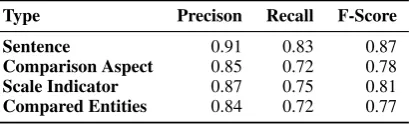
Table 1: Evaluation Results.
Type Precison Recall F-Score
Sentence 0.91 0.83 0.87
Comparison Aspect 0.85 0.72 0.78
Scale Indicator 0.87 0.75 0.81
Compared Entities 0.84 0.72 0.77
in both a false negative and false positive. We computed Precision (P), Recall (R), and F-score (F) measures for each evaluation type, results of which are shown in Table1.
We analyzed the errors made by our system and majority of the errors (more than 80%) en-countered were due to incorrect parsing of com-plicated sentences. For example, in sentence (4), the clause modifier edge acl to “compared” was from “feed” instead of the aspect “palatable”. If the clause “with significantly less consumption of treated feed” is removed, thereby simplifying the sentence, the parse is correct and we correctly ex-tract the comparison.
(4) Pro-Dynam was significantly less palatable, with significantly less consumption of treated feed compared with either Equipalazone Powder or Danilon Equidos
A second but rarer category of error involves cases, where we did not consider certain Scale In-dicators (SI) such as “superior”, “non-inferior”, “extra” as in sentence (5). In such examples, the parser tagged the SI as adjective (JJ) and not a comparative adjective (JJR) even though these words indicate a comparison. Since our treatment of such patterns was limited to JJR scale indica-tors, we missed these cases. It is important to note that our system will identify such structures if we replace such JJ scale indicators by a JJR.
(5) Moxifloxacin was non-inferior to ceftriax-one/metronidazole in terms of clinical re-sponse at test-of-cure in the PP population
The third category involved cases missed due to missing patterns such as seen in sentences (6). In sentence (6a), two set of patients are being compared with respect to improvement extent, while sentence (6b) compares the concentration of “plasma F2-isoprostane” before and after drug administration. These cases where a comparison sentence was not detected due to missing patterns were very few.
(6) a. Both paroxetine and placebo-treated pa-tients improved to a similar extent on sel-frated pain measures
b. Maximal plasma F2-isoprostane concen-trations after IS + C (iron sucrose + vi-tamin C) were significantly elevated from baseline
More than 90% of the false positive cases, where we detected a component of a comparison incorrectly was due to parsing error. For example, in sentence (7), the compared aspect is incorrectly identified as “Sixty minutes” as the parser detects it as the subject of “higher” rather than “FEV(1)% increase”. If the phrase “Sixty minutes after” is re-moved, the parse is correct and we correctly iden-tify the aspect. We would like to emphasis that most of the errors, either FN or FP, were due to incorrect parsing of complicated sentences rather than the incompleteness of our developed patterns.
5 Conclusion
We have presented a system to identify compari-son sentences and extract their components from literature using syntactic dependencies. The sig-nificance of developing a system to identify parisons arises from the prevalent nature of com-parative structures in the biomedical literature. We have observed that in a sample of abstracts describing randomized controlled trials or com-parative studies, almost every abstract contained at least one comparison. Moreover, other text-mining applications might rely on extracting the arguments of a comparison. For example, this approach could be applied to mining reports of differential expression experiments, which are in-herently comparisons. In (Yang et al., 2010), the authors defined seven comparative classes of dif-ferential expression analyses relevant to the pro-cesses of neoplastic transformation and progres-sion, including cancer vs. normal tissue, high grade vs. low grade samples, and metastasis vs. primary cancer. Because comparative statements are often used to summarize the results of a study, these sentences are often of high interest to the reader. To the best of our knowledge, ours is the only work that attempts to cover a wide range of comparisons, capture all comparison components, and does not impose any restrictions on the type of compared entities. Our system achieved F-scores of 0.87, 0.78, 0.81 and 0.77 for identifying com-parison sentences, aspects, scale and entities re-spectively. We plan to extend this work to consider situations, where one of the entities is implied and needs to be extracted from context.
Acknowledgments
Research reported in this manuscript is supported by the National Institutes of Health under Grants No. U01GM120953 and No. 1 U01 HG008390-01. The funders had no role in study design, data collection and analysis, decision to publish, or preparation of the manuscript.
References
Joan W Bresnan. 1973. Syntax of the
compara-tive clause construction in english. Linguist. Inq. 4(3):275–343.
Eugene Charniak. 2000. A maximum-entropy-inspired
parser. In Proceedings of the 1st North American
Chapter of the Association for Computational Lin-guistics Conference. Association for Computational Linguistics, Stroudsburg, PA, USA, NAACL 2000, pages 132–139.
Eugene Charniak and Mark Johnson. 2005. Coarse-to-fine n-best parsing and MaxEnt discriminative
reranking. InProceedings of the 43rd Annual
Meet-ing on Association for Computational LMeet-inguistics. Association for Computational Linguistics, Strouds-burg, PA, USA, ACL ’05, pages 173–180.
Marie-Catherine De Marneffe, Timothy Dozat, Na-talia Silveira, Katri Haverinen, Filip Ginter, Joakim Nivre, and Christopher D Manning. 2014. Universal stanford dependencies: A cross-linguistic typology.
InLREC. volume 14, pages 4585–4592.
Marcelo Fiszman, Dina Demner-Fushman, Francois M Lang, Philip Goetz, and Thomas C Rindflesch. 2007. Interpreting comparative constructions in
biomedi-cal text. InProceedings of the Workshop on BioNLP
2007: Biological, Translational, and Clinical Lan-guage Processing. Association for Computational Linguistics, Stroudsburg, PA, USA, BioNLP ’07, pages 137–144.
Carol Friedman. 1989. A general computational treat-ment of the comparative. InProceedings of the 27th Annual Meeting on Association for Computational Linguistics. Association for Computational Linguis-tics, Stroudsburg, PA, USA, ACL ’89, pages 161– 168.
Murthy Ganapathibhotla and Bing Liu. 2008. Mining
opinions in comparative sentences. InProceedings
of the 22Nd International Conference on Computa-tional Linguistics - Volume 1. Association for Com-putational Linguistics, Stroudsburg, PA, USA, COL-ING ’08, pages 241–248.
Betsy L Humphreys, Donald A B Lindberg, Harold M Schoolman, and G Octo Barnett. 1998. The unified
medical language system. J. Am. Med. Inform.
As-soc.5(1):1–11.
Nitin Jindal and Bing Liu. 2006a. Identifying compara-tive sentences in text documents. InProceedings of the 29th Annual International ACM SIGIR Confer-ence on Research and Development in Information Retrieval. ACM, New York, NY, USA, SIGIR ’06, pages 244–251.
Nitin Jindal and Bing Liu. 2006b. Mining comparative sentences and relations.AAAI.
Christopher D Manning, Mihai Surdeanu, John Bauer, Jenny Rose Finkel, Steven Bethard, and David Mc-Closky. 2014. The stanford corenlp natural
lan-guage processing toolkit. In ACL (System
Demon-strations). pages 55–60.
David Mcclosky. 2010. Any Domain Parsing:
Dae Hoon Park and Catherine Blake. 2012. Identify-ing comparative claim sentences in full-text
scien-tific articles. In Proceedings of the Workshop on
Detecting Structure in Scholarly Discourse. Asso-ciation for Computational Linguistics, Stroudsburg, PA, USA, ACL ’12, pages 1–9.
Thomas C Rindflesch and Marcelo Fiszman. 2003. The interaction of domain knowledge and linguistic structure in natural language processing:
interpret-ing hypernymic propositions in biomedical text. J.
Biomed. Inform.36(6):462–477.
Thomas C Rindflesch, Marcelo Fiszman, and Bisharah
Libbus. 2005. Semantic interpretation for the
biomedical research literature. In Hsinchun Chen, Sherrilynne S Fuller, Carol Friedman, and William
Hersh, editors, Medical Informatics, Springer US,
Integrated Series in Information Systems, pages 399–422.
Steffen Staab and Udo Hahn. 1997. Comparatives in
context. InProceedings of the Fourteenth National
Conference on Artificial Intelligence and Ninth Con-ference on Innovative Applications of Artificial In-telligence. AAAI Press, Providence, Rhode Island, AAAI’97/IAAI’97, pages 616–621.
Kaiquan Xu, Stephen Shaoyi Liao, Jiexun Li, and Yuxia Song. 2011. Mining comparative opinions from customer reviews for competitive intelligence. Decis. Support Syst.50(4):743–754.
Seon Yang and Youngjoong Ko. 2009.
Extract-ing comparative sentences from korean text docu-ments using comparative lexical patterns and
ma-chine learning techniques. In Proceedings of the
ACL-IJCNLP 2009 Conference Short Papers. Asso-ciation for Computational Linguistics, Stroudsburg, PA, USA, ACLShort ’09, pages 153–156.
Zhen Yang, Fei Ren, Changning Liu, Shunmin He, Gang Sun, Qian Gao, Lei Yao, Yangde Zhang, Ruoyu Miao, Ying Cao, Yi Zhao, Yang Zhong, and Haitao Zhao. 2010. dbDEMC: a database of
differ-entially expressed miRNAs in human cancers. BMC