Automatically Acquired Lexical Knowledge Improves
Japanese Joint Morphological and Dependency Analysis
Daisuke Kawahara and Yuta Hayashibe1 and Hajime Morita2 and Sadao Kurohashi
Graduate School of Informatics, Kyoto University {dk, kuro}@i.kyoto-u.ac.jp
[email protected], [email protected]
Abstract
This paper presents a joint model for mor-phological and dependency analysis based on automatically acquired lexical knowl-edge. This model takes advantage of rich lexical knowledge to simultaneously re-solve word segmentation, POS, and de-pendency ambiguities. In our experiments on Japanese, we show the effectiveness of our joint model over conventional pipeline models.
1 Introduction
Morphological analysis, i.e., word segmentation, POS tagging and lemmatization, is the first step for processing unsegmented languages such as Chi-nese and JapaChi-nese. Words segmented by a mor-phological analyzer are usually fed into subse-quent analyzers, such as dependency parsers and predicate-argument structure (PAS) analyzers, in a pipeline manner. One problem with this pipeline process is that errors in morphological analysis are propagated to the subsequent steps. In morpholog-ical analysis, it is also difficult in some cases to de-termine word segmentations without syntactic and structural knowledge, which could be available at the step of dependency or PAS analysis.
For instance, the Japanese phrase “あるかない”
in Sentence (1) can be segmented into (2a) or (2b).3
(1) 可能性
possibilityがNOMあるかない かor 分からknow ないnot
1The second author is now affiliated with Fairy Devices Inc.
2The third author is now affiliated with Fujitsu Laborato-ries Ltd.
3In this paper, we use the following abbreviations: NOM (nominative), ACC (accusative), DAT (dative), LOC (locative), ABL (ablative), and TOP (topic marker).
(2) a. ある exist//
か or //
ない not b. あるか
walk //
ない not
In this case, (2a) is the correct segmentation, which means “whether a possibility exists,” while the incorrect segmentation (2b) is meaningless: “a possibility does not walk.” It might be possible to select the correct segmentation if a morpholog-ical analyzer could look up selectional preference knowledge of the predicates “exist” and “walk.”
Thus far, several models have been proposed for joint morphological and dependency analy-sis, but the performance improvement is not sta-ble among target languages. For Chinese joint analysis, where the parsing accuracy of a baseline pipeline model is around 80%, an F1 improvement of around 2% was reported (Hatori et al., 2012; Zhang et al., 2014). For Japanese joint analysis, where the parsing accuracy of a pipeline model is around 90%, there have been no studies that report a significant improvement (Tawara et al., 2015). One of the reasons for such instability is that most of these joint models are trained only on a small-scale treebank, which consists of sev-eral tens of thousands of sentences. These mod-els do not make use of large-scale external lexi-cal knowledge. Since it is necessary to use lexilexi-cal knowledge of selectional preferences to address the abovementioned ambiguities, these joint mod-els cannot solve such ambiguities in many cases.
This paper proposes a joint model for morpho-logical and dependency analysis based on auto-matically acquired lexical knowledge. The lexical knowledge includes case frames acquired from a large-scale raw corpus, which provide useful clues to resolve morphological and syntactic ambigui-ties. In our experiments on Japanese corpora, we show a significant improvement over conventional
pipeline models.
The remainder of this paper is organized as fol-lows. Section 2 summarizes previous joint models for morphological and dependency analysis. Sec-tion 3 describes our method for constructing lexi-cal knowledge. Section 4 illustrates our idea and describes our joint analysis model in detail. Sec-tion 5 is devoted to our experiments. Finally, sec-tion 6 gives the conclusions.
2 Related Work
Some variants of transition-based parsing meth-ods have been proposed for joint POS tagging and parsing (Bohnet and Nivre, 2012; Bohnet et al., 2013; Wang and Xue, 2014) and joint Chinese word segmentation, POS tagging, and dependency parsing (Hatori et al., 2012; Zhang et al., 2014). As an external knowledge source, Hatori et al. (2012) used a word dictionary extracted mainly from Wikipedia, but it did not provide lexical knowledge for resolving syntactic ambiguities.
Lattice parsing methods have been proposed for Hebrew and Arabic (Goldberg and Tsarfaty, 2008; Goldberg et al., 2009; Green and Manning, 2010; Goldberg and Elhadad, 2011). These methods first generate a word lattice and then apply PCFG pars-ing to the word lattice. Startpars-ing with a word lattice, the methods of Wang et al. (2013) and Zhang et al. (2015) select the best parse using dual decomposi-tion and the randomized greedy algorithm, respec-tively. Of these methods, Goldberg et al. (2009) incorporated an external morphological lexicon, which does not provide selectional preferences.
As a different method from lattice parsing, Qian and Liu (2012) trained separate models for Chi-nese word segmentation, POS tagging, and con-stituency parsing. They proposed a unified decod-ing algorithm that combines the scores from these three models. This is a purely supervised method that does not use lexical knowledge.
As dependency parsing models using lexical knowledge, there have been semi-supervised ap-proaches that use knowledge of word classes, lexi-cal preferences or selectional preferences acquired from raw corpora (e.g., (van Noord, 2007; Koo et al., 2008; Chen et al., 2009; Zhou et al., 2011; Bansal and Klein, 2011)). However, these depen-dency parsing models cannot be applied to joint morphological and dependency analysis.
For Japanese, Morita et al. (2015) proposed a morphological analyzer that jointly performs
seg-mentation and POS tagging using recurrent neural network language models, but does not perform dependency parsing. We employ this morpholog-ical analyzer, JUMAN++4, as a pre-processor to
generate word lattice (described in Section 4.1). Kawahara and Kurohashi (2006) proposed a prob-abilistic model for Japanese dependency parsing and PAS analysis based on case frames automat-ically compiled from a large raw corpus, which are also used as a source of selectional preferences in our model (described in Section 3.1). Kudo and Matsumoto (2002), Sassano (2004), Iwatate (2012) and Yoshinaga and Kitsuregawa (2014) proposed supervised models for Japanese depen-dency parsing without using external knowledge sources. These models need a 1-best output of segmentation and POS tagging as an input, and are not a joint model of morphological analysis and dependency parsing. We adopt KNP5 and
CaboCha6as baseline dependency parsers, which
are implementations of Kawahara and Kurohashi (2006) and Sassano (2004), respectively.7
Tawara et al. (2015) proposed a joint model for Japanese morphological analysis and dependency parsing without lexical knowledge. However, they failed to achieve significant improvements over conventional pipeline methods.
To the best of our knowledge, there have been no joint models of morphological and dependency analysis that use large-scale lexical knowledge which includes selectional preferences.
3 Lexical Knowledge Acquisition
In our joint analysis model, we use the following three types of lexical knowledge automatically ac-quired from a large raw corpus: case frames, cooc-currence probabilities of noun-noun / predicate-predicate dependencies, and word embeddings. We deeply utilize case frames in our joint model
4http://nlp.ist.i.kyoto-u.ac.jp/EN/?JUMAN++
5http://nlp.ist.i.kyoto-u.ac.jp/?KNP
6https://taku910.github.io/cabocha/
7As baseline parsers, we did not use J.DepP (http:
//www.tkl.iis.u-tokyo.ac.jp/˜ynaga/jdepp/) and the
and also consider these resources as features in our scoring function described in Section 4.2. Below, we describe the methods for constructing each of the resources, which are basically based on previ-ous work.
3.1 Case Frames
We use case frames to evaluate the plausibility of PASs. Case frames are predicate-specific semantic frames like PropBank (Palmer et al., 2005), which are distinguished for each predicate sense or us-age. Although PropBank was elaborated by hand and does not have frequency information, we auto-matically compile large-scale case frames that re-flect real predicate uses.
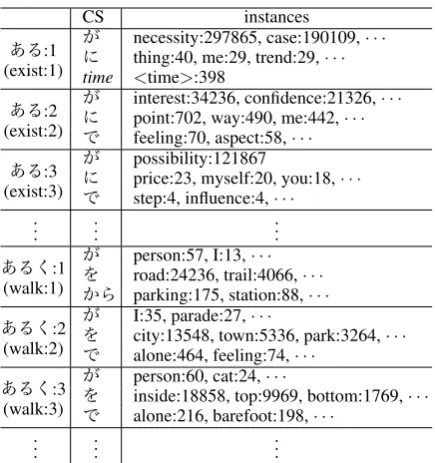
Each predicate has several case frames that are semantically distinguished. Each case frame con-sists of case slots, each of which concon-sists of word instances that can be filled. Examples of Japanese case frames are shown in Table 1. Case frames are the source of selectional preferences, which are compiled by aggregating PASs for each predicate usage.
We adapted the method of Kawahara et al. (2014) to Japanese case frame compilation. They proposed an unsupervised method for compiling English case frames from a large raw corpus. The procedure for inducing case frames is as follows:
1. apply dependency parsing to a raw corpus and extract PASs for each predicate from the automatic parses,
2. merge the PASs that have presumably the same meaning based on the assumption of one sense per collocation to get a set of initial frames, and
3. apply clustering to the initial frames based on the Chinese Restaurant Process (Aldous, 1985) to produce predicate-specific case frames.
While the original method used Stanford depen-dency labels as the representations of case slots, we use case-marking postpositions in Japanese, such as “が” (NOM), “を” (ACC), and “に”
(DAT). At Step 1, we apply the morphological and dependency analyzers, JUMAN++ and KNP, to the raw corpus. To alleviate the influence of errors in segmentations, POS tags and dependencies, we extract only reliable PASs that have no syntactic ambiguities. At Step 2, the PASs that have pre-sumably the same meaning are identified by
cou-CS instances
が necessity:297865, case:190109,· · · ある:1 に thing:40, me:29, trend:29,· · ·
(exist:1) time <time>:398
が interest:34236, confidence:21326,· · ·
ある:2 に point:702, way:490, me:442,· · · (exist:2) で feeling:70, aspect:58,· · ·
が possibility:121867
ある:3 に price:23, myself:20, you:18,· · ·
(exist:3) で step:4, influence:4,· · ·
..
. ... ...
が person:57, I:13,· · · あるく:1 を road:24236, trail:4066,· · ·
(walk:1) から parking:175, station:88,· · ·
が I:35, parade:27,· · ·
あるく:2 を city:13548, town:5336, park:3264,· · ·
(walk:2) で alone:464, feeling:74,· · · が person:60, cat:24,· · ·
あるく:3 を inside:18858, top:9969, bottom:1769,· · · (walk:3) で alone:216, barefoot:198,· · ·
..
[image:3.595.308.526.59.291.2]. ... ...
Table 1: Acquired case frames for the Japanese verbs “ある” (exist) and “あるく” (walk). CS
de-notes case slots, such as “が” (NOM), “を” (ACC),
“に” (DAT), “で” (LOC), and “から” (ABL).
In-stances in each CS are originally Japanese words but expressed only in English due to space limita-tion. The number following each word denotes its frequency.
pling a predicate and the closest argument. That is, PASs are distinguished by predicate-argument pairs, such as “道を あるく” (walk road) and “町
を あるく” (walk city).
We crawled the Web to obtain a large-scale Japanese Web corpus. As a result, we extracted 10 billion Japanese sentences without duplicates from three billion Web pages. We automatically compiled case frames from these sentences and acquired case frames for approximately 100,000 predicates. Examples of acquired case frames are shown in Table 1.
We collect noun-noun and predicate-predicate dependencies from automatic parses and calcu-late cooccurrence probabilities of these dependen-cies. We acquired these probabilities from au-tomatic parses of 1.6 billion Japanese Web sen-tences, which are a part of the Japanese Web cor-pus constructed for case frame compilation.
3.3 Word Embeddings
To detect coordinate structures, which cover a large proportion of dependency relations in a sen-tence, it is important to capture similarities be-tween words and word sequences. In this paper, we employ word embeddings to calculate similar-ities between words and word sequences.
We trained word embeddings using 100 million Japanese Web sentences by word2vec8 (Mikolov
et al., 2013) using skip-gram and negative sam-pling. The dimension of word embeddings was set to 500. To calculate the similarity between two words, we compute the cosine measure between the embeddings of these words.
4 Joint Morphological and Dependency Analysis based on Automatically Acquired Lexical Knowledge 4.1 Joint Analysis Model
We deal with dependencies between base phrases, which are the dependency unit defined in the an-notation guidelines of the Japanese treebanks de-scribed in Section 5.1. A base phrase consists of a content word and zero or more function words. Although the traditional dependency unit for Japanese isbunsetsu, which can contain more than one content word,9 we adopt base phrase
dependencies instead of bunsetsu dependencies. This is because base phrase dependencies are ba-sically based on bunsetsu dependencies but ex-tended to consider the dependencies inside com-pound nouns. Hereafter, we call base phrases
sim-plyphrases.
We adopt the widely used CKY algorithm for our joint analysis model. In our model, a cell in the CKY table corresponds to a span of characters in the input sentence. This model outputs the best parse tree, which contains all the disambiguated results of words, phrases, and dependencies. The
8https://code.google.com/p/word2vec/
9Abunsetsuconsists of one or more content words and zero or more function words. A compound noun containing multiple content words constitutes abunsetsu.
procedure of our joint analysis model is described below.
1. Projection of candidate words onto the CKY table
First, a word lattice is generated using a morpho-logical analyzer. All the words included in the word lattice are projected onto the CKY table.
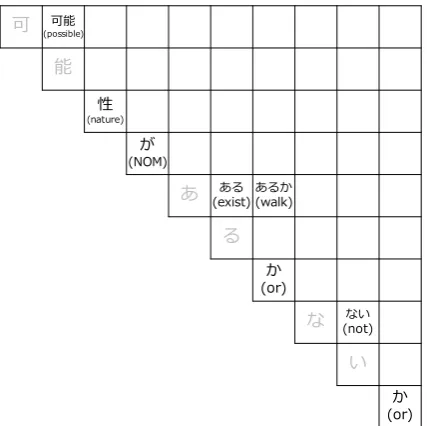
For instance, in Figure 1, the input sentence is
“可能性があるかないか.” The possible words for
this sentence are projected as described in Figure 1(a). For example, the span “あるか” has the
fol-lowing three possible word cells: “ある” (exist),
“か” (or), and “あるか” (walk).
2. Generation of phrases
Possible phrases are generated on the CKY table using POS-based phrase chunking rules. These rules are extracted from the Japanese dependency parser KNP. Because there are ambiguities in words and POS tags, there are also ambiguities in phrases. Each of the generated phrases is re-garded as the smallest sub-tree consisting of only one phrase.
In Figure 1, by concatenating words in Fig-ure 1(a) using the phrase chunking rules, the light blue cells in Figure 1(b) are generated as candidate phrases. For example, the span “あるか” has the
following two possible phrases: “あるか” (walk)
and “ある/か” (exist or).
3. Merging neighboring sub-tree pairs
Neighboring sub-tree pairs are merged to generate a new possible sub-tree. This process is iterated in a bottom-up manner, and finally possible trees for the whole input sentence are generated.
In general, there can be multiple sub-trees that correspond to the same span. When merging two spans with multiple sub-trees, it is necessary to consider all the possible combinations of these sub-trees. New sub-trees generated by merging are ranked by the scoring function described in Sec-tion 4.2 and only top-bsub-trees are kept for the subsequent process, wherebis the beam width.
! !" #$%&&'()*+ " , #-./01*+ 2 #345+ 6 67 #*8'&/+ 679 #:.);+ 7 9 #%1+ < <= #-%/+ = 9 #%1+
(a) Projection of candidate words onto the CKY table
! !" #$%&&'()*+ !",-#$%&&'(')'./+ !", -,0 #$%&&'(')'./,1 234+ " -#56.78*+ 0 #234+ 9 9: #*;'&.+ <=, >:= 9:=, ?@ #A%5B.1 C6)D+ 9:=, ?@,= #A%5B.1 C6)D1%8+ : = #%8+
? #5%.+?@ ?@,=
#5%.1%8+ @ = #%8+ 9:,= #*;'&.1%8+ 9:= #C6)D+
(b) Generation of phrases
! !" #$%&&'()*+ !",-#$%&&'(')'./+ !"# $#% &'())*+*,*-.#/ 0123 " -#01.23*+ 4 #567+ 8 89 #*:'&.+ ;<, =9< 9 < #%3+ > >? #0%.+ 45#6 &7(-/(83 ? < #%3+ 9:#6 &;<*)-/ (83 9:6 &=>,?3 9:#6# 45#6 &;<*)-/(8/ 7(-3 !"#$# %#9:# 6#45# 6 &@%3*ABCDE &@%3*ABFDG
!"#$%&'(#)%*!"+%,-$./01 #!"#$% 23$$-4-5-.6&'(')*+
$!,-.% /0123&(4567893:;&(<5 8=>&')56???
%!@#A% 9B3/&C561D;:>3D23&C56 ???
???
!EF3BF306G6 /=991H1:1B863I19B9%
!.F36D>7H306;=::=E1DJ63G2F6E=0K673GD961B96;03L>3D28?%
(c) Generation process of the tree for “可能/性/が/ある/か/
ない/か” (correct analysis)
! !" #$%&&'()*+ !",-#$%&&'(')'./+ !"# $#% &'())*+*,*-.#/ 0123 " -#01.23*+ 4 #567+
8 #*:'&.+89 =9<;<,
9
<
#%3+
> #0%.+>? 45#6
&7(-/(83 ? < #%3+ 9:#6 &;<*)-/ (83 9:6 &=>,?3 9:6# 45#6 &@(7A-/ =>,?/(83 !"#$# %#9:6 #45#6 &@%3*ABCDE &@%3*ABCFDG
!"#$%&'(#)%*!"#+,#-./01 !!"#$% &'()*+,-./0 1,23/0444
"!566% (*78,9:93;/0 <(7=>,:?;;/0444
#$!5@A% &7(B=+C,2.-/0 )<7<=*+,DD/0444
444
!70&*))=E=>=<F08*')0 +*<0G7>B0*(%
(d) Generation process of the tree for “可能/性/が/あるか/
[image:5.595.74.288.64.277.2]ない/か” (incorrect analysis)
Figure 1: Illustration of our joint analysis model.
case frame with the highest score is selected ac-cording to the scoring function.
For example, Figure 1(c) shows the merging process for the interpretation “可能/性/が/ある/か/ない/か” (whether a
possi-bility exists), and Figure 1(d) shows the merging process for “可能/性/が/あるか/ない/か”
(pos-sibility does not walk). The best-matching case frame “ある:3” (exist:3) was selected for the
interpretation in Figure 1(c), and the case frame “あるく:1” (walk:1) was selected in Figure 1(d),
respectively.
4. Selection of the tree with the highest score The tree with the highest score is selected as an output from the candidate trees for the whole input sentence using the following equation:
ˆ
y = argmax
y∈Y score(y), (1)
Word feature
·Marginal score of morphological analysis Phrase features
·Word 2,3-grams in a phrase ·# of phrases in a sentence ·Words at a phrase boundary ·# of predicates
·A predicate representation Dependency features ·A dependency label
·Content/function words and punctuations of a modifier ·Content/function words and punctuations of a head ·Distance between a modifier and its head
Features derived from lexical knowledge ·# of predicates that do not have case frames ·Probabilities calculated based on case frames
(case frame/slot generating probability, etc.) ·A cooccurrence probability between nouns ·A cooccurrence probability between predicates ·Content word similarity between a modifier and its head ·Similarity of word sequences for coordination
Table 2: Features.
In Figure 1, the upper-right corner cell of the CKY table, which keeps the interpretations of the whole input sentence, contains two possible trees illustrated in Figures 1(c) and 1(d). Our algo-rithm selects the tree of 1(c), which has the high-est score. Here, selectional preferences from case frames tell that “ある” (exist) is more likely to take
the nominative filler “可能性” (possibility) than
“あるく” (walk).
4.2 Scoring Function and Training
The score of a tree for the input sentencexis de-fined as the weighted sum of features. This score is calculated using the following scoring function:
score(y) =∑ i
(wi·ϕi(x, y)), (2)
where ϕi is a feature function corresponding to
featurei, andwiis a weight of featurei. This
scor-ing function is also used for calculatscor-ing the score of a sub-tree, which is constructed at an interme-diate step of parsing, i.e., an intermeinterme-diate cell built at Step 3.
Table 2 lists the features used, which include words constituting a phrase, dependencies be-tween phrases, and the plausibility of a PAS mea-sured by case frames. The basic features that are not derived from lexical knowledge (the upper part of Table 2) are based on the features used in the CaboCha parser.10
10Although the features for dependency parsing in CaboCha were designed forbunsetsudependency parsing, we found out that these features are also compatible with base-phrase dependency parsing.
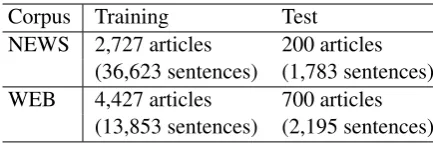
Corpus Training Test NEWS 2,727 articles 200 articles
(36,623 sentences) (1,783 sentences) WEB 4,427 articles 700 articles
[image:6.595.307.524.61.133.2](13,853 sentences) (2,195 sentences) Table 3: Statistics of the treebanks.
We use the following learning procedure. First, the feature weights are initialized, and the word lattice for each sentence in a training corpus is input. A sentence is analyzed using the method described in Section 4.1 with a beam width ofb, and candidate trees for this sentence are obtained. The tree with the highest dependency score (UAS) against the gold tree is regarded as a positive in-stance, and the remaining candidate trees are re-garded as negative instances. The feature weights are optimized using the training instances gener-ated from all the sentences in the training cor-pus. We adopt candidate selection learning and optimize the feature weights using L-BFGS. The above procedure is iterated several times to obtain the final feature weights.
5 Experiments
5.1 Experimental Settings
In our experiments, we used the Kyoto Uni-versity Text Corpus11 (Kawahara et al., 2002)
(NEWS) and the Kyoto University Web Document Leads Corpus12 (Hangyo et al., 2012) (WEB) as
Japanese treebanks. NEWS consists of news ar-ticles and WEB consists of web pages in various domains. We split these into training and test sets as shown in Table 3. We merged the training sets of NEWS and WEB to generate a training set in our experiment and conducted evaluations on each test set of NEWS and WEB.
For the parser input, we used the Japanese morphological analyzer JUMAN++ (Morita et al., 2015) to generate a word lattice. We did not use all possible words in the lexicon of JUMAN++, but converted the N-best output of JUMAN++ to a word lattice to speed up parsing. This is rea-sonable because the segmentation accuracy of JU-MAN++ is between 98%–99% and its N-best put contains only plausible words. N-best out-puts were obtained using the option –autoN of
JU-11http://nlp.ist.i.kyoto-u.ac.jp/EN/
?KyotoUniversity\%20Text\%20Corpus
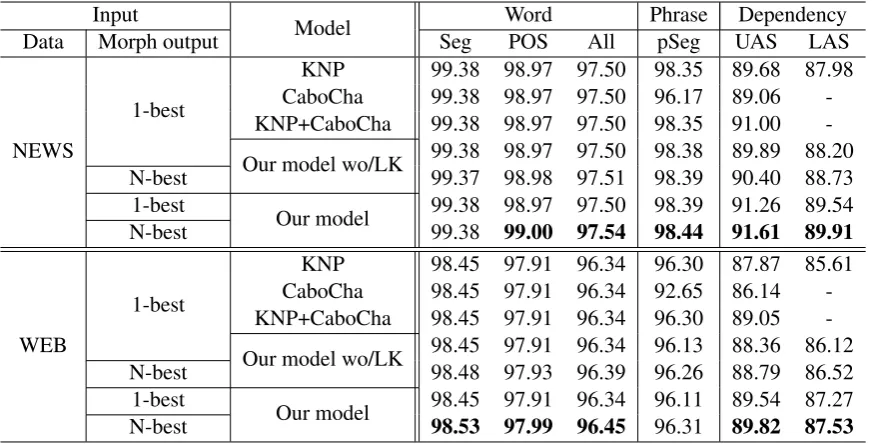
Input Model Word Phrase Dependency Data Morph output Seg POS All pSeg UAS LAS
NEWS
1-best
KNP 99.38 98.97 97.50 98.35 89.68 87.98 CaboCha 99.38 98.97 97.50 96.17 89.06 -KNP+CaboCha 99.38 98.97 97.50 98.35 91.00 -Our model wo/LK 99.38 98.97 97.50 98.38 89.89 88.20 N-best 99.37 98.98 97.51 98.39 90.40 88.73 1-best Our model 99.38 98.97 97.50 98.39 91.26 89.54 N-best 99.38 99.00 97.54 98.44 91.61 89.91
WEB
1-best
[image:7.595.82.521.62.284.2]KNP 98.45 97.91 96.34 96.30 87.87 85.61 CaboCha 98.45 97.91 96.34 92.65 86.14 -KNP+CaboCha 98.45 97.91 96.34 96.30 89.05 -Our model wo/LK 98.45 97.91 96.34 96.13 88.36 86.12 N-best 98.48 97.93 96.39 96.26 88.79 86.52 1-best Our model 98.45 97.91 96.34 96.11 89.54 87.27 N-best 98.53 97.99 96.45 96.31 89.82 87.53 Table 4: Evaluation results. “wo/LK” means “without lexical knowledge.”
MAN++, which increases N proportionally to the length of the input sentence. We applied 10-way jackknifing to the training set and analyzed the test set using a model trained on the whole training set. To train our joint model, we used Classias13
with L1 regularization. We set the beam widthb of our model to 10 for both training and testing.
For comparison, we adopted the latest versions of KNP and CaboCha, both of which are widely used Japanese dependency parsers. KNP is an im-plementation of Kawahara and Kurohashi (2006), which accepts the 1-best output of morphological analysis, applies rule-based phrase chunking and performs probabilistic labeled dependency pars-ing based on case frames. In KNP, we used the same case frames compiled in this paper. CaboCha is an implementation of Sassano (2004), which accepts the 1-best output of morphologi-cal analysis, applies CRF-based phrase chunking and performs transition-based unlabeled depen-dency parsing using SVM. The training of CRF and SVM was conducted using the training data in this paper. Because phrase chunking in CaboCha was designed to identifybunsetsu, we also tested KNP+CaboCha for fair comparison, which identi-fies phrases using KNP and parses using CaboCha. Since KNP and CaboCha are not a joint model and accept only the 1-best output of morphological analysis, we fed the 1-best morphological analy-sis into KNP and CaboCha. We fed both 1-best and N-best morphological analysis outputs into
13http://www.chokkan.org/software/classias/
our model for comparison. We also tested our model without the automatically acquired lexical knowledge.
We measured the performance of each sys-tem using the F1-scores of the following aspects: word segmentation (Seg), “segmentation + POS” (POS), “segmentation+ POS + fine-grained POS + base form” (All), phrase segmentation (pSeg), and unlabeled/labeled dependency attachment score (UAS/LAS). For the dependency labels, the fol-lowing four labels are defined in the treebanks: D (dependency), P (parallel), I (incomplete parallel), and A (apposition).
5.2 Results and Discussion
Table 4 lists the evaluation results. In this ta-ble, the accuracies in bold of “our model with N-best input” are significantly higher than the other models. Statistical testing was conducted using the bootstrap method (Efron and Tibshirani, 1986, 1993) atp <0.01.
The following is typical examples improved by our joint model.
(3) a. あの that
店 shop
は TOP
で もの×
LOC thing が NOM
よく often 見つかる
found b. あの
that 店 shop
は
TOPでもの○bargain
が NOM
よく often 見つかる
found
Seg POS All pSeg UAS LAS 1-best 97.01 95.26 94.51 94.21 86.87 85.52 N-best 97.38 95.63 95.13 94.44 87.84 86.49
Table 5: Results on a corpus with ambiguities.
baseline systems, and (3b) is the correct output of our joint model. Here, case frames tell that the verb “見つかる” (be found) is likely to take
“でもの” (bargain) as its nominative.
(4) a. お いや× (prefix) nasty
めい niece
と ABL
わかれる part b. おい や○
nephew and めい niece
と ABL
わかれる part
In this example, (4a) is the incorrect output of the baseline systems, and (4b) is the correct output of our joint model. In this case, “わかれる” (part)
is likely to take people including “おい” (nephew)
and “めい” (niece) as the ablative fillers. Also,
because “おい” (nephew) and “めい” (niece) are
judged to be similar by the word embeddings, these are recognized as a coordinate structure.
In Table 4, while the dependency accuracies were improved well, the improvements in morpho-logical analysis (Seg, POS, and All) and phrase segmentation (pSeg) were moderate, even though most of them were significant. In Japanese, the same word segments can have multiple possible words with the same POS and base form, which do not influence the segmentation and POS accuracy. For example, consider the following sentence.
(5) 皮
rindをACCむくpeel/turn
The verb “むく” is represented as two possible
words with different meanings “peel” and “turn,” both of which appear in the N-best output of morphological analysis. Although “peel” is cor-rect, this kind of meaning difference is not dis-tinguished in the evaluation of segmentation and POS tagging.14 However, such ambiguities are
resolved based on lexical knowledge in our joint analysis model, and this disambiguation leads to the improvement of case frame selection and de-pendency parsing.
To further verify the improvements in morpho-14If this verb “むく” is written using a Chinese character, such as “向く” (turn) and “剥く” (peel), this kind of
ambigu-ity does not occur. However, there are many uses of words without using Chinese characters, especially on Web texts.
logical analysis, we manually annotated 50 sen-tences with various morphological ambiguities us-ing the same annotation criteria as NEWS and WEB. We tested our model given 1-best and N-best morphological analysis with lexical knowl-edge. Table 5 shows the results. The joint model (N-best) outperformed the pipeline model (1-best) in terms of all the measures by a large margin.
6 Conclusion
This paper proposed a joint model for morpho-logical and dependency analysis based on au-tomatically acquired lexical knowledge. This model takes advantage of rich lexical knowledge to jointly resolve word segmentation, POS, and dependency ambiguities. In our Japanese exper-iments, we succeeded in showing the effective-ness of our joint model over conventional pipeline models.
In the future, we will try to incorporate lexi-cal knowledge into a neural network-based model for joint morphological and dependency analysis. By doing this, we can automatically consider fea-ture combinations as the polynomial kernel used in CaboCha. We also plan to integrate PAS analysis including zero anaphora resolution into our joint model.
References
David Aldous. 1985. Exchangeability and related top-ics. ´Ecole d’ ´Et´e de Probabilit´es de Saint-Flour XIII
―1983pages 1–198.
Mohit Bansal and Dan Klein. 2011. Web-scale
features for full-scale parsing. In Proceedings
of the 49th Annual Meeting of the Association for Computational Linguistics: Human Language Technologies. Association for Computational Lin-guistics, Portland, Oregon, USA, pages 693–702. http://www.aclweb.org/anthology/P11-1070.
Bernd Bohnet and Joakim Nivre. 2012. A
Lan-guage Learning. Association for Computational Linguistics, Jeju Island, Korea, pages 1455–1465. http://www.aclweb.org/anthology/D12-1133. Bernd Bohnet, Joakim Nivre, Igor Boguslavsky,
Rich´ard Farkas, Filip Ginter, and Jan Hajiˇc. 2013. Joint morphological and syntactic analysis for richly
inflected languages. Transactions of the
Asso-ciation for Computational Linguistics 1:415–428. http://www.aclweb.org/anthology/Q13-1034. Wenliang Chen, Jun’ichi Kazama, Kiyotaka
Uchi-moto, and Kentaro Torisawa. 2009.
Improv-ing dependency parsImprov-ing with subtrees from
auto-parsed data. In Proceedings of the 2009
Conference on Empirical Methods in Natural Language Processing. Association for Compu-tational Linguistics, Singapore, pages 570–579. http://www.aclweb.org/anthology/D/D09/D09-1060.
Bradley Efron and Robert Tibshirani. 1986. Bootstrap methods for standard errors, confidence intervals,
and other measures of statistical accuracy.
Statis-tical science1(1):54–75.
Bradley Efron and Robert J. Tibshirani. 1993. An
Intro-duction to the Bootstrap. Chapman and Hall/CRC. Yoav Goldberg and Michael Elhadad. 2011. Joint
He-brew segmentation and parsing using a PCFGLA
lattice parser. In Proceedings of the 49th
Annual Meeting of the Association for Com-putational Linguistics: Human Language Tech-nologies. Association for Computational Linguis-tics, Portland, Oregon, USA, pages 704–709. http://www.aclweb.org/anthology/P11-2124.
Yoav Goldberg and Reut Tsarfaty. 2008. A
sin-gle generative model for joint morphological
seg-mentation and syntactic parsing. In
Proceed-ings of ACL-08: HLT. Association for Computa-tional Linguistics, Columbus, Ohio, pages 371–379. http://www.aclweb.org/anthology/P/P08/P08-1043. Yoav Goldberg, Reut Tsarfaty, Meni Adler, and
Michael Elhadad. 2009. Enhancing
unlexical-ized parsing performance using a wide coverage lexicon, fuzzy tag-set mapping, and
EM-HMM-based lexical probabilities. In Proceedings of
the 12th Conference of the European Chapter of the ACL (EACL 2009). Association for Computa-tional Linguistics, Athens, Greece, pages 327–335. http://www.aclweb.org/anthology/E09-1038. Spence Green and Christopher D. Manning. 2010.
Better Arabic parsing: Baselines, evaluations,
and analysis. In Proceedings of the 23rd
In-ternational Conference on Computational Lin-guistics (Coling 2010). Coling 2010 Organiz-ing Committee, BeijOrganiz-ing, China, pages 394–402. http://www.aclweb.org/anthology/C10-1045. Masatsugu Hangyo, Daisuke Kawahara, and Sadao
Kurohashi. 2012. Building a diverse
docu-ment leads corpus annotated with semantic
rela-tions. In Proceedings of the 26th Pacific Asia
Conference on Language, Information, and Com-putation. Faculty of Computer Science, Univer-sitas Indonesia, Bali,Indonesia, pages 535–544. http://www.aclweb.org/anthology/Y12-1058. Jun Hatori, Takuya Matsuzaki, Yusuke Miyao, and
Jun’ichi Tsujii. 2012. Incremental joint
ap-proach to word segmentation, POS tagging, and
dependency parsing in Chinese. In
Proceed-ings of the 50th Annual Meeting of the Asso-ciation for Computational Linguistics (Volume 1: Long Papers). Association for Computational Lin-guistics, Jeju Island, Korea, pages 1045–1053. http://www.aclweb.org/anthology/P12-1110. Masakazu Iwatate. 2012. Development of pairwise
comparison-based Japanese dependency parsers and application to corpus annotation. Ph.D dissertation at Nara Institute of Science and Technology. Daisuke Kawahara and Sadao Kurohashi. 2006.
A fully-lexicalized probabilistic model for Japanese syntactic and case structure analy-sis. In Proceedings of the Human Language Technology Conference of the NAACL, Main Conference. Association for Computational Lin-guistics, New York City, USA, pages 176–183. http://www.aclweb.org/anthology/N/N06/N06-1023.
Daisuke Kawahara, Sadao Kurohashi, and Koiti Hasida. 2002. Construction of a Japanese
relevance-tagged corpus. In Proceedings of the 3rd
Inter-national Conference on Language Resources and Evaluation. pages 2008–2013. http://www.lrec-conf.org/proceedings/lrec2002/pdf/302.pdf. Daisuke Kawahara, Daniel Peterson, Octavian
Popescu, and Martha Palmer. 2014.
Induc-ing example-based semantic frames from a
massive amount of verb uses. In
Proceed-ings of the 14th Conference of the European Chapter of the Association for Computational Linguistics. Association for Computational Lin-guistics, Gothenburg, Sweden, pages 58–67. http://www.aclweb.org/anthology/E14-1007. Terry Koo, Xavier Carreras, and Michael Collins. 2008.
Simple semi-supervised dependency parsing. In
Proceedings of ACL-08: HLT. Association for Com-putational Linguistics, Columbus, Ohio, pages 595– 603. http://www.aclweb.org/anthology/P/P08/P08-1068.
Taku Kudo and Yuji Matsumoto. 2002. Japanese dependency analysis using cascaded chunk-ing. In Proceedings of the 6th Conference on Natural Language Learning. pages 63–69. http://www.aclweb.org/anthology/W/W02/W02-2016.pdf.
Tomas Mikolov, Chen Kai, Greg Corrado, and Jeffrey Dean. 2013. Efficient Estimation of Word
Represen-tations in Vector Space. InProceedings of Workshop
Hajime Morita, Daisuke Kawahara, and Sadao Kuro-hashi. 2015. Morphological analysis for unseg-mented languages using recurrent neural network
language model. In Proceedings of the 2015
Con-ference on Empirical Methods in Natural Lan-guage Processing. Association for Computational Linguistics, Lisbon, Portugal, pages 2292–2297. http://aclweb.org/anthology/D15-1276.
Martha Palmer, Daniel Gildea, and Paul Kingsbury. 2005. The Proposition Bank: An Annotated
Cor-pus of Semantic Roles. Computational Linguistics
31(1):71–106.
Xian Qian and Yang Liu. 2012. Joint
Chi-nese word segmentation, POS tagging and pars-ing. In Proceedings of the 2012 Joint Con-ference on Empirical Methods in Natural guage Processing and Computational Natural Lan-guage Learning. Association for Computational Linguistics, Jeju Island, Korea, pages 501–511. http://www.aclweb.org/anthology/D12-1046.
Manabu Sassano. 2004. Linear-time dependency
analysis for Japanese. In Proceedings of Coling
2004. COLING, Geneva, Switzerland, pages 8–14.
http://www.aclweb.org/anthology/C04-1002. Yuki Tawara, Ai Azuma, and Yuji Matsumoto. 2015.
Japanese morphological analysis using dependency
information (in Japanese). In IPSJ 2015-NL-220.
pages 1–7.
Gertjan van Noord. 2007. Using self-trained
bilexical preferences to improve
disambigua-tion accuracy. In Proceedings of the Tenth
International Conference on Parsing Tech-nologies. Association for Computational Lin-guistics, Prague, Czech Republic, pages 1–10. http://www.aclweb.org/anthology/W/W07/W07-2201.
Zhiguo Wang and Nianwen Xue. 2014. Joint POS tagging and transition-based constituent parsing in
Chinese with non-local features. In
Proceed-ings of the 52nd Annual Meeting of the Asso-ciation for Computational Linguistics (Volume 1: Long Papers). Association for Computational Lin-guistics, Baltimore, Maryland, pages 733–742. http://www.aclweb.org/anthology/P14-1069. Zhiguo Wang, Chengqing Zong, and Nianwen Xue.
2013. A lattice-based framework for joint Chi-nese word segmentation, POS tagging and
pars-ing. In Proceedings of the 51st Annual Meeting of
the Association for Computational Linguistics (Vol-ume 2: Short Papers). Association for Computa-tional Linguistics, Sofia, Bulgaria, pages 623–627. http://www.aclweb.org/anthology/P13-2110. Naoki Yoshinaga and Masaru Kitsuregawa. 2014.
A self-adaptive classifier for efficient text-stream
processing. In Proceedings of COLING 2014,
the 25th International Conference on Compu-tational Linguistics: Technical Papers. Dublin
City University and Association for Computational Linguistics, Dublin, Ireland, pages 1091–1102. http://www.aclweb.org/anthology/C14-1103. Meishan Zhang, Yue Zhang, Wanxiang Che, and Ting
Liu. 2014. Character-level Chinese dependency
parsing. In Proceedings of the 52nd Annual
Meet-ing of the Association for Computational LMeet-inguis- Linguis-tics (Volume 1: Long Papers). Association for Com-putational Linguistics, Baltimore, Maryland, pages 1326–1336. http://www.aclweb.org/anthology/P14-1125.
Yuan Zhang, Chengtao Li, Regina Barzilay, and Ka-reem Darwish. 2015. Randomized greedy infer-ence for joint segmentation, POS tagging and
de-pendency parsing. InProceedings of the 2015
Con-ference of the North American Chapter of the As-sociation for Computational Linguistics: Human Language Technologies. Association for Computa-tional Linguistics, Denver, Colorado, pages 42–52. http://www.aclweb.org/anthology/N15-1005. Guangyou Zhou, Jun Zhao, Kang Liu, and Li Cai.
2011. Exploiting web-derived selectional prefer-ence to improve statistical dependency parsing. In