Towards Linguistically Generalizable NLP Systems:
A Workshop and Shared Task
Allyson Ettinger4♥ Sudha Rao♣♥ Hal Daum´e III4♣♦♥∇ Emily M. Bender♠ University of Maryland: Linguistics4, Computer Science♣, Language Science♦and UMIACS♥
University of Washington Department of Linguistics♠ Microsoft Research New York∇
{aetting@, raosudha@cs., hal@umiacs.}umd.edu, [email protected]
Abstract
This paper presents a summary of the first Workshop on Building Linguistically Generalizable Natural Language Process-ing Systems, and the associated Build It Break It, The Language Edition shared task. The goal of this workshop was to bring together researchers in NLP and lin-guistics with a shared task aimed at test-ing the generalizability of NLP systems beyond the distributions of their training data. We describe the motivation, setup, and participation of the shared task, pro-vide discussion of some highlighted re-sults, and discuss lessons learned.
1 Introduction
Machine learning techniques have had tremen-dously positive impact on the field of natural lan-guage processing, to the point that we now have systems for many NLP problems that work ex-tremely well—at least when the NLP problem is carefully designed and these systems are tested on data that looks like their training data. Espe-cially with the influx of deep learning approaches to NLP, we find ourselves more and more in the situation that we have systems that work well un-der some conditions, but we (and the models!) may have little idea what those conditions are.
We believe that linguistic knowledge is critical in many phases of the NLP pipeline, including:
1. Task design and choice of language(s) 2. Annotation schema design
3. System architecture design and/or feature de-sign
4. Evaluation design and error analysis 5. Generalization beyond training data
Our goal in this workshop was to bring together researchers from NLP and linguistics through a carefully designed shared task. This shared task was designed to test the true generalization ability of NLP systems beyond the distribution of data on which they may have been trained. In addition to the shared task, the workshop also welcomed re-search contribution papers.
In this paper, we describe the shared task, lay-ing out our motivations for pursulay-ing this twist on the traditional set up (§2) and the various design decisions we made as we took the initial idea and worked to shape it into something that would be feasible for participants and informative for our field (§3). We then go on to describe our data (§4), the participating systems and breaker approaches (§5), and our approach to scoring (§6). Finally, we give an overview of the shared task results in§7, and discuss lessons learned in§8.
Our hope is that in laying out the successes and challenges of the first iteration of this shared task, we can help future shared tasks of this type to build on our experience. To this end, we also make available the datasets collected for and cre-ated during the shared task (§4).
2 Motivation: Robust NLP Systems Natural language processing has largely embraced the “independently and identically distributed” (iid) probably-approximately-correct (PAC) model of learning from the machine learning community (c.f.Valiant,1984), typically under a uniform cost function. This model has been so successful that it often simply goes unquestioned as the “right way” to do NLP. Under this model, any phenomenon that is sufficiently rare in a given corpus (seen as a “distribution of data”) is not worth addressing. Systems are not typically built to handle tail phenomena, and iid-based learning
similarly trains systems to ignore such phenom-ena. This problem is exacerbated by frequent use of overly simplistic loss functions, which further encourage systems to ignore phenomena that they do not capture adequately.
The result is that NLP systems are quite brittle in the face of infrequent linguistic phenomena,1 a characteristic which stands in stark contrast to human language users, who at a very young age can make subtle distinctions that have little sup-port in the distribution of data they’ve been ex-posed to (c.f.,Legate and Yang,2002;Crain and Nakayama, 1987). This ability also allows hu-mans to avoid making certain errors due to over-or under-exposure. A computational counter-example is ignoring negations because they are relatively infrequent and typically only have a small effect on the loss function used in training.
The brittleness of current NLP systems, and the substantial discrepancy between their capacities and that of humans, suggests that there is much left to be desired in the traditional “iid” model. This applies not only to training and testing, but also to error analysis: iid development data is unlikely to exhibit all the linguistic phenomena that we might be interested in testing. Even if one is uninterested in the scientific questions addressed by testing a model’s ability to handle less frequent phenomena, it should be noted that any NLP system that is re-leased is likely to be adversarially tested by users who want to break it for fun.
This state of affairs has not gone unnoticed. On the one hand, there is work on creating tar-geted evaluation datasets that exhibit and are an-notated for particular linguistic phenomena, in or-der to facilitate fine-grained analysis of the lin-guistic capacities of systems for tasks such as pars-ing, entailment, and semantic relatedness (Rimell et al., 2009; Bender et al., 2011; Marelli et al.,
2014). Additionally, there is an increasing amount of work on developing methods of exposing ex-actly what linguistic knowledge NLP models de-velop (K´ad´ar et al.,2016;Li et al.,2015) and what linguistic information is encoded in models’ pro-duced representations (Adi et al., 2016; Ettinger et al., 2016). Our aim in organizing this work-1During a panel at the 1st Workshop on
Representa-tion Learning for NLP (ACL 2016; https://sites. google.com/site/repl4nlp2016/) some panelists acknowledged the fact that they could probably break any NLP system with very little effort—meaning it shouldn’t be hard to invent reasonable examples that would confuse the systems.
shop was to build on this foundation, designing the shared task to generate data specifically created to identify the boundaries of systems’ linguistic ca-pacities, and welcoming further related research contributions to stimulate additional discussion.
3 Shared Task: Build It Break It, The Language Edition
To address the issues identified above, we devel-oped a shared task inspired by the Build It Break It Fix It Contest2 and adapted for application to NLP. The shared task proceeded in three phases: a building phase, a breaking phase, and a scoring phase:
1. In the first phase, “builders” take a designated NLP task and develop techniques to solve it.
2. In the second phase, “breakers”, having seen the output of the builders’ systems on some development data, are tasked with construct-ing minimal-pair test cases intended to iden-tify the boundaries of the systems’ capabili-ties.
3. In the third phase, builders run their systems on the newly created minimal pair test set and provide their predictions for scoring.
Builders are scored based how well their sys-tems can withstand the attacks of breakers, and breakers are scored based on how well they can identify system boundaries.
The goals of this type of shared task are multi-fold: we want to build more reliable NLP tech-nology, by stress-testing against an adversary; we want to learn more about what linguistic phenom-ena our systems are capable of handling so that we can guide research in interesting directions; we want to encourage researchers to think about what assumptions their models are implicitly making by asking them to break them; we want to engage lin-guists in the process of testing NLP systems; we want to build a test collection of examples that are not necessarily high probability under the distribu-tion of the training data, but are nonetheless repre-sentative of language phenomena that we expect a reasonable NLP system to handle; and we want to increase cross-talk between linguistics and natural language processing researchers.
Sentence UCD finished the 2006 champi-onship as Dublin champions, by beating St Vincents in the final. Predicate beating
Question Who beat someone? Answer UCD
Figure 1: Example QA-SRL item
3.1 Task Selection
In selecting the NLP task to be solved by the builders, we had a number of considerations. The task should be one that requires strong linguistic capabilities, so that in identifying the boundaries of the systems, breakers are encouraged to target linguistic phenomena key to increasing the robust-ness of language understanding. Additionally, we want the task to be without significant barrier to entry, to encourage builder participation.
In the interest of balancing these considerations and testing the effectiveness of different tasks, we ran two tasks in parallel: sentiment analysis and question-answer driven semantic role label-ing (QA-SRL;He et al.,2015). The sentiment task consists of standard sentiment analysis performed on movie reviews. In the QA-SRL task, the in-put is a sentence and a question related to one of the predicates in the sentence, and the output is a span of the sentence that answers the question. See Figure1for an example item. The task allows for testing semantic role labeling without the need for a pre-defined set of roles, or for annotators with significant training or linguistic expertise.
3.2 Building
From the builders’ point of view, the shared task is similar to other typical shared tasks in our field. Task organizers provide training and development data, and the builder teams create systems on the basis of that data. We do not distinguish open ver-sus closed tracks (use of provided training data is optional). Our goal was to attract a variety of ap-proaches, both knowledge engineering-based and machine learning-based.
We considered requiring builders to submit sys-tem code as an alternative to running their syssys-tems on two different datasets (see Section4). However, ultimately we decided in favor of builder teams running their own systems and submitting predic-tions in both phases.
3.3 Breaking
The task of breaker teams was to construct min-imal pairs to be used as test input to the builder systems, with the goal of identifying the bound-aries of system capacities. In order for a test pair to be effective in identifying a system’s boundaries, it needs to satisfy two requirements:
1. The system succeeds on one item of the pair but fails on the other.
2. The difference between the items in the pair is specific enough that the ability of the sys-tem to handle one but not the other can be attributed to an identifiable cause.
Satisfaction of requirement1 is what we will re-fer to as “breaking” a system (note that this also applies if the system fails on the original example but succeeds on the hand-constructed variant).
Breakers were thus instructed to create minimal pairs on which they expected systems to make a correct prediction on one but not the other of the items. Breakers were additionally asked, while constructing minimal pairs, to keep in mind what exactly they would be able to conclude about a system’s linguistic capacity if it proved able to handle one item of a given pair but not the other. Along this line, breakers were encouraged to pro-vide a rationale with each minimal pair, to explain their reasoning in making a given change.3
In order to exert a certain amount of control over the domain and style of breakers’ items, we re-quired breakers to work from data provided for each task. Specifically, we asked them to select sentences from the provided dataset and make tar-geted changes in order to create their minimal pairs. This means that each minimal pair consisted of one unaltered sentence from the original dataset and one sentence reflecting the breakers’ change to that sentence. This was done to ensure that sys-tems had at least a reasonable chance at success, by scoping down the range of possible variants that breakers could provide.
As an example, let us say that the provided sen-timent analysis dataset includes the sentenceI love this movie, which has positive sentiment (+1). A breaker team could then construct a pair such as the following:
(1) +1 I love this movie!
+1 I’m mad for this movie!
While the first item is likely straightforward to classify, we might anticipate a simple sentiment system to fail on the second, since it may flag the word mad as indicating negative sentiment. Breakers could choose to change the sentiment with their modification, or let it remain the same.
For the QA-SRL task, breakers were only to change the original sentence (and, if appropriate, the answer), leaving the question unaltered. For instance, breakers could generate the following item to be paired with the example in Figure1: (2) Sent0 UCD finished the 2006
champi-onship as Dublin champions, when they beat St Vincents in the final. Ans0 UCD (unchanged)
We might anticipate that the system would now predict the pronountheyas the answer to the ques-tion, without resolving to UCD.4
The sets of minimal pairs created by the break-ers then constituted the test set of the shared task, which was sent to builders to generate predictions on for scoring.
4 Shared Task Data 4.1 Training Data
For the sentiment training data, we used the Senti-ment Treebank dataset from Socher et al. (2013), developed from the Rotten Tomatoes review dataset of Pang and Lee (2005).5 Each sentence in the dataset has a sentiment value between 0 and 1, as well as sentiment values for the phrases in its syntactic parse. In order to establish a binary labeling scheme at the sentence level, we mapped sentences in range (0, 0.4) to “negative” and sen-tences in range (0.6, 1.0) to “positive”. Neutral sentences—those with a sentiment value between 0.4 and 0.6—were removed. The sentiment train-ing data had a total of 6921 sentences and 166738 phrases. Phrase-level sentiment labels were made available to participants as an optional resource.
4Breakers were not allowed to change the sentence such
that the accompanying question was no longer answerable with a substring from the original sentence. For instance, breakers could not make a change such asTerry fed Parker →Parker was fed with an accompanying test question of Who fed Parker?, since the answer to that question would no longer be contained in the sentence.
5Sentiment training data available here: https:// nlp.stanford.edu/sentiment/
For QA-SRL training data, we used the data created by He et al. (2015).6 These items were drawn from Wikipedia, and each item of the train-ing data includes the sentence (with the relevant predicate identified), the question, and the answer. The training data had a total of 5149 sentences.
4.2 Blind Development Data
Blind dev data was provided for builders to submit initial predictions on, as produced by their sys-tems. These predictions were made available for breakers, to be used as a reference when creating test minimal pairs. For sentiment, we collected an additional 500 sentences from a pool of Rotten Tomatoes reviews for movies in the years 2003-2005. For annotations, we used the same method of annotation via crowd-sourcing that was used by Socher et al. (2013). For QA-SRL, we extracted a set of 814 sentences from Wikipedia and annotated these by crowd-sourcing, following the method of He et al. (2015).
4.3 Starter Data for Breakers
As described above, breakers were given data from which to draw items that could then be al-tered to create minimal pairs. Sentiment break-ers were provided an additional set of 500 sen-timent sentences, collected and annotated by the same method as that used for the 500 blind dev sentences for sentiment. QA-SRL breakers were provided an additional set of 814 items, collected and annotated by the same method as the blind dev items for QA-SRL.
4.4 Test Data
The test data for evaluating builder systems consisted of the minimal pairs constructed by the breaker teams. The labels for the pairs were provided by the breakers themselves, though addi-tional crowd-sourced labels were made available for teams to check for any substantial deviations.
We release the minimal pair test sets, as well as annotated blind dev and starter data for sentiment and QA-SRL: https://bibinlp.umiacs. umd.edu/data.
5 Task Participants
5.1 Builder Teams: Sentiment
Strawman Kyunghyun Cho contributed a sen-timent analysis system intended to serve as a na¨ıve baseline for the shared task. This model, called Strawman, consisted of an ensemble of five deep bag-of-ngrams multilayer perceptron classi-fiers. The model’s vocabulary was composed of the most frequent 100k n-grams from the provided training data, withnup to 2 (Cho,2017).
University of Melbourne, CNNs The builder team from University of Melbourne (which also participated as a breaker team), contributed two sentiment analysis systems consisting of convolu-tional neural networks. One CNN was trained on data labeled at the phrase level (PCNN), and the other was trained on data labeled at the sentence level (SCNN) (Li et al.,2017).
Recursive Neural Tensor Network To supple-ment our submitted builder systems, we tested several additional sentiment analysis systems on the breaker test set. The first of these was the Stanford Recursive Neural Tensor Network (RNTN) (Socher et al., 2013). This model is a recursive neural network-based sentiment classi-fier, composing words and phrases of input sen-tences based on binary branching syntactic struc-ture, and using the composed representations as input features to softmax classifiers at every syn-tactic node. This model, rather than parameter-izing the composition function by the words be-ing composed (Socher et al.,2012), uses a single more powerful tensor-based composition function for composing each node of the syntactic tree.
DCNN The second supplementary sentiment system was the Dynamic Convolutional Neural Network from University of Oxford ( Kalchbren-ner et al., 2014). This is a convolutional neu-ral network sentiment classifier that uses inter-leaved one-dimensional convolutional layers and dynamic k-max pooling layers, and handles input sequences of varying length.
Bag-of-ngram features Finally, we tested an additional bag-of-ngrams sentiment system with
n up to 3, consisting of a linear classifier, imple-mented by one of the organizers in vowpal wab-bit (Langford et al.,2007).
5.2 Breaker Teams: Sentiment
Utrecht The breaker team from Utrecht Uni-versity used a variety of strategies, includ-ing insertion of modals and opinion adverbs that convey speaker stance, changes based in world knowledge, and pragmatic and syntactic changes (Stali¯unait˙e and Bonfil,2017).
Ohio State University The breaker team from OSU also used a variety of strategies, classi-fied as morphosyntactic, semantic, pragmatic, and world knowledge-based changes, to target hypoth-esized weaknesses in the sentiment analysis sys-tems (Mahler et al.,2017).
University of Melbourne The breaker team from University of Melbourne opted to generate test minimal pairs automatically, borrowing from methods for generating adversarial examples in computer vision. They used reinforcement learn-ing, optimizing on reversed labels, to identify to-kens or phrases to be changed, and then applied a substitution method (Li et al.,2017). Some hu-man supervision was used to ensure grammatical-ity and correct labeling of the sentences.
Team 4 The fourth sentiment breaker team did not submit a description paper, but the results from this team’s test set are reported below.
5.3 Builder Team: QA-SRL
The organizers provided a QA-SRL system, as there were no external builder submissions for this task. The provided system was a logistic re-gression classifier, trained with 1-through-5 skip-grams with a maximum skip of 4. Potential an-swers were neighbors and neighbors-of-neighbors in a dependency parse of the sentence (Stanford dependency parser;De Marneffe et al.,2006), and input to the classifier was the predicate, question verb, question string, and dependency relation be-tween the predicate and the potential answer. An answer was marked as correct at training time if it overlapped at least 75% in characters with the true answer.
5.4 Breaker Team: QA-SRL
changing prepositional phrases, substituting syn-onyms, using distractor noun phrases, and target-ing pronoun resolution.
6 Shared Task Scoring
For the purpose of scoring, a test minimal pair is considered to have “broken” a system if one item of the pair gets a correct prediction and the other item gets an incorrect prediction. As out-lined above, this is to reward breakers for zeroing in on system boundaries.
For scoring the breakers, we decided to use the average across systems of the product of the sys-tem dev set accuracy and syssys-tem breaking percent-age. Specifically, if a breakerj provides a set of examplesDj to break systems i = 1. . . N, then
the breaker score is:
score(j) = N1 XN
i=1
acci(dev)break|D(i, j)
j| (1)
acci(dev) =accuracy of systemion dev (2)
break(i, j) = #x∈Djthat break systemi (3)
The motivation here is to weight breaker successes against a given system by the general strength of that system.
For scoring the builders, we used two metrics: 1. Average F score across all sentences
(origi-nals and modified) for all breaker teams 2. Percentage of sentence pairs that break
sys-tem.
7 Results and Discussion
Since our participation in the QA-SRL task was minimal, we focus in this section on the results for the sentiment analysis task.
7.1 Aggregate Results
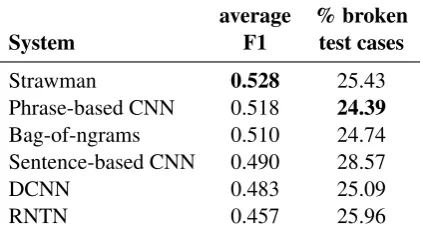
Aggregate results for builders are shown in Ta-ble1. Computing by F1 score, Strawman comes out on top among builder systems with an average F1 of 0.528, followed by the phrase-based CNN and bag-of-ngrams. When scored by percentage of pairs that break the system, the phrase-based CNN comes out on top, broken by 24.39% of test pairs. The bag-of-ngrams model and DCNN follow closely behind, while the sentence-based CNN falls last by a fair margin.
Aggregate results for breakers are shown in Ta-ble2. By our chosen scoring metric, the team from
average % broken
System F1 test cases
Strawman 0.528 25.43
Phrase-based CNN 0.518 24.39 Bag-of-ngrams 0.510 24.74 Sentence-based CNN 0.490 28.57
DCNN 0.483 25.09
[image:6.595.312.524.65.181.2]RNTN 0.457 25.96
Table 1: Builder team scores: Average F1 across all breaker test cases, and percent of breaker test cases that broke the system
Breaker score Utrecht 31.17
OSU 28.66
Melbourne 19.28 Team 4 7.48
Table 2: Breaker team scores
Utrecht falls in first place among breaker teams, followed closely by the breaker team from OSU.
7.2 Detailed Results
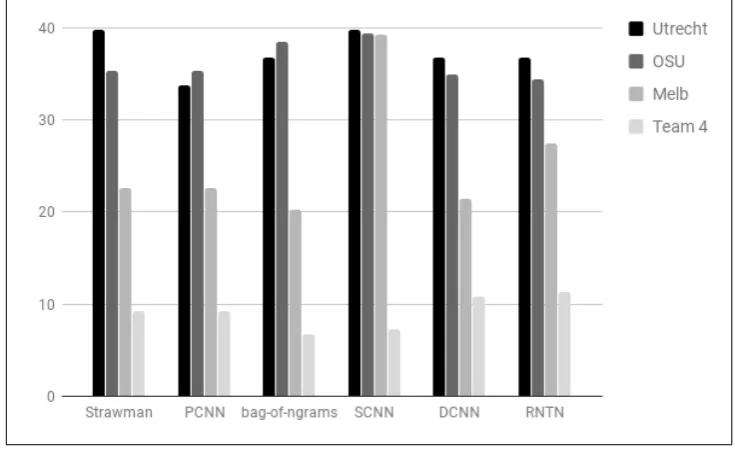
Aggregate scores obscure the important details that we aim to probe for with this shared task, namely the particular weaknesses of a given sys-tem targeted by a given minimal pair or set of min-imal pairs. Figure2brings us closer to the desired granularity with individual breaking percentages, allowing us a clearer sense of the interaction be-tween breaker team and builder system.
Some patterns emerge. The Utrecht and OSU breaker team are roughly on par across systems, with Utrecht pulling ahead by the largest margin on Strawman. These teams seem to have used a comparable variety of linguistically diverse and targeted attacks, which may explain the fact that they perform similarly.
The Melbourne test set stood out from the others in that it was automatically generated. As might be expected, this test set lags behind in breaking percentage against most systems— however, against the sentence-based CNN it per-forms on par with the other two teams.
Figure 2: Detailed breaking percentages
sentence-based CNN, which was the source of some of the highest breaking percentages for the other breaker teams.
7.3 Item-based Results
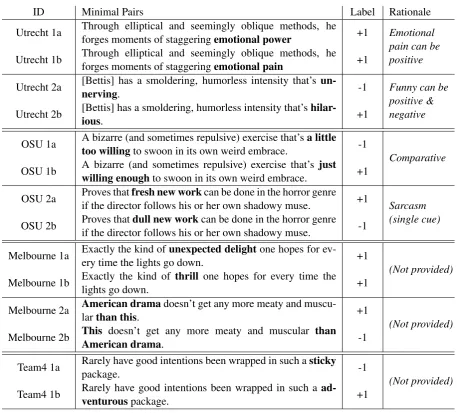
It is of course at the level of individual minimal pairs that our analysis of this shared task can have the most power. Tables3and4show a sample of breaker minimal pairs and builder system predic-tions on those pairs, allowing us to observe sys-tem performance at the isys-tem level for this sam-ple. These examples were chosen with the goal of finding interesting strategies that break some sys-tems but not others, in order to explore differences. However, we found that for a majority of success-ful test pairs, systems tended to break together.
On Utrecht pair 1a/b, we see that the addition of the word pain breaks Strawman and bag-of-ngrams, as we might expect from ngram-based systems. Apart from RNTN, which makes incor-rect predictions on both items, the remaining sys-tems are able to handle this change.
On Utrecht pair 2a/b, we see that bag-of-ngrams, DCNN, SCNN and RNTN all break, though in different directions, with SCNN and RNTN getting the altered sentence wrong, and bag-of-ngrams and DCNN getting the original sentence wrong. This suggests a lack of sensi-tivity to the subtly different sentiments conveyed in context by the substituted wordsunnervingand
hilarious. Strawman and PCNN, however, predict
both items correctly.
The substitution of the comparative phrase in OSU pair 1a/b impressively breaks every sys-tem, suggesting that the sentiment conveyed by the phrase just willing enough in context is be-yond the capacity of any of the systems. The sar-casm addition in OSU 2a/b breaks Strawman, bag-of-ngrams and DCNN, but not SCNN or RNTN (while PCNN breaks in the opposite direction).
Strawman breaks on Melbourne 1a/b, which is interesting as we might expect the substituted item
thrillto be flagged as carrying positive sentiment. Bag-of-ngrams fails on both items of the pair, and RNTN gives a neutral label for the second item.
Melbourne 2a/b employs a word re-ordering technique and breaks every system in various directions—except for bag-of-ngrams and RNTN, which fail on both items—suggesting that both the original and altered sentences of this pair give sys-tems trouble.
Team 4 1a/b fools bag-of-ngrams with the al-tered sentence, while DCNN and RNTN make in-correct predictions on the original.
straightforward conclusions. For instance, OSU pair 1a/b allows us to conclude that inferring the positive effect of the phrase just [...] enough on a previously negative context is beyond the sys-tems’ capacities. On the other hand, the more dif-fuse changes in Melbourne pair 2a/b make it more difficult to determine the precise cause of a system breaking in one direction or the other.
Of course, to be more confident about our con-clusions, we would want to analyze system pre-dictions on multiple different pairs that target the same linguistic phenomenon. This can be a goal for future iterations and analyses.
8 Lessons for the Future
A variety of lessons came out of the shared task, which can be helpful for future iterations or future shared tasks of this type. We describe some of these lessons here.
The choice of NLP task is an important one. While QA-SRL is a promising task in terms of re-quiring linguistic robustness, it yielded lower par-ticipation than sentiment analysis. Strategies for encouraging buy-in from both builders and break-ers will be important. One strategy would be to team up with existing shared tasks, to which we could add a breaking phase.
While going through the labels assigned to the minimal pairs by breaker teams, we find some la-bel choices to be questionable. Since unreliable labels will skew the assessment of builder perfor-mance, in future iterations there should be an ad-ditional phase in which we validate breaker labels with an external source (e.g., crowd-sourcing). To minimize cost and time, this could be done only for examples that are “contested” by either builders or other breakers.
The notion of a “minimal pair” is critical to this task, so it is important that we define the notion clearly, and that we ensure that submitted pairs conform to this definition. Reviewing breaker sub-missions, we find that in some cases breakers have significantly changed the sentence, in ways that may not conform to our original expectations. In future iterations, it will be important to have clear and concrete definitions of minimal pair, and it would also be useful to have some external review of the pairs to confirm that they are permissible.
For this year’s shared task we chose to limit breakers by requiring them to draw from existing data for creating their pairs. A potential variation
to consider would be allowing breaker teams to create their own sentence pairs from scratch, in ad-dition to drawing from existing sentences (with the restriction that sentences should fall in the speci-fied domain). This greater freedom for breakers may increase the range of linguistic phenomena able to be targeted, and the precision with which breakers can target them.
Finally, it is important to consider general strategies for encouraging participation. We iden-tify two potential areas for improvement. First, the timeline of this year’s shared task was shorter than would be optimal, which placed an undue bur-den in particular on builders, who needed to run systems and submit predictions in two different phases. A longer timeline could make participa-tion more feasible. Second, participants may be reluctant to submit work to be broken—to address this, we might consider anonymous system sub-missions in the future.
9 Conclusion
The First Workshop on Building Linguistically Generalizable NLP systems, and the associated first iteration of the Build It Break It, The Lan-guage Editionshared task, allowed us to begin ex-ploring the limits of current NLP systems with re-spect to specific linguistic phenomena, and to ex-tract lessons to build on in future iterations or fu-ture shared tasks of this type. We have described the details and results of the shared task, and dis-cussed lessons to be applied in the future. We are confident that tasks such as this, that emphasize testing the effectiveness of NLP systems in han-dling of linguistic phenomena beyond the training data distributions, can make significant contribu-tions to improving the robustness and quality of NLP systems as a whole.
Acknowledgments
ID Minimal Pairs Label Rationale Utrecht 1a Through elliptical and seemingly oblique methods, heforges moments of staggeringemotional power +1 Emotional
pain can be positive
Utrecht 1b Through elliptical and seemingly oblique methods, heforges moments of staggeringemotional pain +1
Utrecht 2a [Bettis] has a smoldering, humorless intensity that’snerving. un- -1 Funny can be positive & negative
Utrecht 2b [Bettis] has a smoldering, humorless intensity that’sious. hilar- +1
OSU 1a A bizarre (and sometimes repulsive) exercise that’stoo willingto swoon in its own weird embrace. a little -1
Comparative
OSU 1b A bizarre (and sometimes repulsive) exercise that’swilling enoughto swoon in its own weird embrace. just +1
OSU 2a Proves thatif the director follows his or her own shadowy muse.fresh new workcan be done in the horror genre +1 Sarcasm
(single cue)
OSU 2b Proves thatif the director follows his or her own shadowy muse.dull new workcan be done in the horror genre -1
Melbourne 1a Exactly the kind ofery time the lights go down.unexpected delightone hopes for ev- +1
(Not provided)
Melbourne 1b Exactly the kind oflights go down. thrill one hopes for every time the +1
Melbourne 2a American dramalarthan this. doesn’t get any more meaty and muscu- +1
(Not provided)
Melbourne 2b ThisAmerican dramadoesn’t get any more meaty and muscular. than -1
Team4 1a Rarely have good intentions been wrapped in such apackage. sticky -1
(Not provided)
[image:9.595.70.528.58.471.2]Team4 1b Rarely have good intentions been wrapped in such aventurouspackage. ad- +1
Table 3:Sample minimal pairs: Examples of minimal pairs created by different breaker teams with the minimal changes highlighted. ‘Label’ is the label provided to the pairs by the breaker teams.
ID True Label Strawman PCNN Bag-of-ngrams SCNN DCNN RNTN
Utrecht 1a +1 +1 +1 +1 +1 +1 -1
Utrecht 1b +1 -1 +1 -1 +1 +1 -1
Utrecht 2a -1 -1 -1 +1 -1 +1 -1
Utrecht 2b +1 +1 +1 +1 -1 +1 -1
OSU 1a -1 -1 -1 -1 -1 -1 -1
OSU 1b +1 -1 -1 -1 -1 -1 -1
OSU 2a +1 +1 -1 +1 +1 +1 +1
OSU 2b -1 +1 -1 +1 -1 +1 -1
Melbourne 1a +1 +1 +1 -1 +1 +1 +1
Melbourne 1b +1 -1 +1 -1 +1 +1 0
Melbourne 2a +1 -1 +1 -1 -1 -1 -1
Melbourne 2b -1 -1 +1 +1 -1 -1 0
Team4 1a -1 -1 -1 -1 -1 +1 +1
Team4 1b +1 +1 +1 -1 +1 +1 +1
[image:9.595.72.511.511.728.2]Ettinger under Grant No. DGE 1322106. Any opinions, findings, conclusions, or recommenda-tions expressed here are those of the authors and do not necessarily reflect the view of the spon-sor(s).
References
Yossi Adi, Einat Kermany, Yonatan Belinkov, Ofer Lavi, and Yoav Goldberg. 2016. Fine-grained anal-ysis of sentence embeddings using auxiliary predic-tion tasks.arXiv preprint arXiv:1608.04207. Emily M. Bender, Dan Flickinger, Stephan Oepen,
and Yi Zhang. 2011. Parser evaluation over local and non-local deep dependencies in a large corpus. In Proceedings of the 2011 Conference on Empiri-cal Methods in Natural Language Processing, pages 397–408, Edinburgh, Scotland, UK. Association for Computational Linguistics.
Kyunghyun Cho. 2017. Recursive deep models for se-mantic compositionality over a sentiment treebank. In Proceedings of the Workshop on Building Lin-guistically Generalizable NLP Systems.
Stephen Crain and Mineharu Nakayama. 1987. Struc-ture dependence in grammar formation. Language, pages 522–543.
Marie-Catherine De Marneffe, Bill MacCartney, Christopher D Manning, et al. 2006. Generat-ing typed dependency parses from phrase structure parses. InProceedings of LREC, volume 6, pages 449–454. Genoa Italy.
Allyson Ettinger, Ahmed Elgohary, and Philip Resnik. 2016. Probing for semantic evidence of composition by means of simple classification tasks. ACL 2016, page 134.
Luheng He, Mike Lewis, and Luke Zettlemoyer. 2015. Question-answer driven semantic role labeling: Us-ing natural language to annotate natural language. In
Proceedings of the Conference on Empirical Meth-ods in Natural Language Processing, pages 643– 653.
´Akos K´ad´ar, Grzegorz Chrupała, and Afra Alishahi. 2016. Representation of linguistic form and func-tion in recurrent neural networks. arXiv preprint arXiv:1602.08952.
Nal Kalchbrenner, Edward Grefenstette, and Phil Blunsom. 2014. A convolutional neural net-work for modelling sentences. arXiv preprint arXiv:1404.2188.
J Langford, L Li, and A Strehl. 2007. Vowpal wabbit online learning project.
Julie Anne Legate and Charles D Yang. 2002. Em-pirical re-assessment of stimulus poverty arguments.
The Linguistic Review, 18(1-2):151–162.
Jiwei Li, Xinlei Chen, Eduard Hovy, and Dan Jurafsky. 2015. Visualizing and understanding neural models in nlp. arXiv preprint arXiv:1506.01066.
Yitong Li, Trevor Cohn, and Timothy Baldwin. 2017. Bibi system description: Building with cnns and breaking with deep reinforcement learning. In Pro-ceedings of the Workshop on Building Linguistically Generalizable NLP Systems.
Taylor Mahler, Willy Cheung, Micha Elsner, David King, Marie-Catherine de Marneffe, Cory Shain, Symon Stevens-Guille, and Michael White. 2017. Breaking nlp: Using morphosyntax, semantics, pragmatics and world knowledge to fool sentiment analysis systems. In Proceedings of the Workshop on Building Linguistically Generalizable NLP Sys-tems.
Marco Marelli, Stefano Menini, Marco Baroni, Luisa Bentivogli, Raffaella Bernardi, and Roberto Zam-parelli. 2014. A SICK cure for the evaluation of compositional distributional semantic models. In
Language Resources and Evaluation, pages 216– 223.
Bo Pang and Lillian Lee. 2005. Seeing stars: Exploit-ing class relationships for sentiment categorization with respect to rating scales. InProceedings of the 43rd Annual Meeting of the Association for Compu-tational Linguistics, pages 115–124. Association for Computational Linguistics.
Laura Rimell, Stephen Clark, and Mark Steedman. 2009. Unbounded dependency recovery for parser evaluation. InProceedings of the 2009 Conference on Empirical Methods in Natural Language Pro-cessing, pages 813–821, Singapore. Association for Computational Linguistics.
Richard Socher, Brody Huval, Christopher D Manning, and Andrew Y Ng. 2012. Semantic compositional-ity through recursive matrix-vector spaces. In Pro-ceedings of the 2012 Joint Conference on Empiri-cal Methods in Natural Language Processing and Computational Natural Language Learning, pages 1201–1211. Association for Computational Linguis-tics.
Richard Socher, Alex Perelygin, Jean Y Wu, Jason Chuang, Christopher D Manning, Andrew Y Ng, Christopher Potts, et al. 2013. Recursive deep mod-els for semantic compositionality over a sentiment treebank. InProceedings of the Conference on Em-pirical Methods in Natural Language Processing, volume 1631, page 1642.
Ieva Stali¯unait˙e and Ben Bonfil. 2017. Breaking senti-ment analysis of movie reviews. InProceedings of the Workshop on Building Linguistically Generaliz-able NLP Systems.
Leslie G Valiant. 1984. A theory of the learnable.