Segmentation Granularity in Dependency Representations for Korean
Jungyeul Park Department of Linguistics
University of Arizona
Abstract
Previous work on Korean language pro-cessing has proposed different basic seg-mentation units. This paper explores dif-ferent possible dependency representa-tions for Korean using different levels of segmentation granularity — that is, differ-ent schemes for morphological segmdiffer-enta- segmenta-tion of tokens into syntactic words. We provide a new Universal Dependencies (UD)-like corpus based on different lev-els of segmentation granularity for Ko-rean. The corpus contains 67K words in 5,000 sentences which are split into train-ing, development and evaluation data sets. We report parsing results using the new de-pendency corpus for Korean and compare them with the previous Korean UD corpus.
1 Dependency Parsing and the Korean Language
Language processing including morphological analysis for Korean has traditionally been based on theeojeol, which is a basic segmentation unit delimited by a blank in the sentence. Let us con-sider the sentence in (1), which contains ten eo-joels (the corresponding morphological analysis is found in Figure 1). The number of eojoels is entirely based on the blank space character and the tenth eojeol in (1) also includes the punctu-ation mark. Almost all natural-language process-ing systems that have been previously developed for Korean have used the eojeol as a fundamen-tal unit of analysis. As Korean is an agglutina-tive language, joining content and functional mor-phemes is very productive and they can be com-bined exponentially. For example,yeoghal(‘role’) is a content morpheme (a common noun) and-eul, a case marker (‘ACC’, accusative), is a functional
morpheme.1 They form together a single eojeol
yeoghal-eul (‘role + ACC’). A predicate
gangjo-ha-ass-da (‘focused’) also consists of the con-tent morpheme gangjo-ha (‘focus’) and its func-tional morphemes,-ass (‘PAST’, past tense) and
-da(‘IND’, indicative), respectively.
In this paper, we analyze different levels of seg-mentation granularity in dependency representa-tions for syntactic annotation (§2). We then
pro-pose a scheme to build a new Universal Depen-dencies (UD)-like corpus for Korean based on seg-mentation granularity (§3). UD has been
devel-oped cross-linguistically using a consistent tree-bank annotation scheme for many languages.2We
provide 5,000 sentences based on each of the segmentation granularity possibilities described in this paper. We also present its UD parsing results, compare them with previously proposed UD for Korean (§4), and discuss future perspectives of
de-pendency annotation and parsing for Korean (§5).
2 Segmentation Granularity for Korean
We define the following four different levels of segmentation granularity for Korean. These gran-ularity levels have been independently proposed in previous work on Korean language processing as different basic segmentation units.
2.1 Eojeols
Most language processing systems and corpora developed for Korean have used the eojeol as a fundamental unit of analysis (Figure 2). For exam-ple, the Sejong corpus, the most widely-used cor-pus for Korean, uses the eojeol as the basic unit of analysis as presented in (1). Most morpholog-ical analysis systems have been developed based
1For convenience sake, we add the hyphen-minus (-) at the beginning of functional morphemes, such as-eulto dis-tinguish boundaries between content and functional mor-phemes. The accusative case marker-eul or-leulvary de-pending on the preceding character.
2http://universaldependencies.org
(1) 황석영을 비롯해 도서전에 참가한 한국 작가들도 이구동성으로 번역자의 역할을 강조했다.
hwangseogyeong-eul Hwang Seok-young-ACC
bilos-ha-a
including doseojeon-ebook exhibition-LOC
chamga-ha-n
participated hangugKorean jagga-deul-doother authors-ALSO
igudongseong-eulo
with one voice beonyeogja-uitranslators-GEN
yeoghal-eul role-ACC
gangjo-ha-ass-da. emphasize-PAST-IND-.
‘Hwang Seok-young and other Korean authors who participated in the book exhibition emphasized the role of trans-lators with one voice.’
1 황석영을 황석영/NNP+을/JKO hwangseogyeong-eul
2 비롯해 비롯/XR+하/XSA+아/EC bilos-ha-a
3 도서전에 도서/NNG+전/NNB+에/JKB doseojeon-e
4 참가한 참가/NNG+하/XSV+ㄴ/ETM chamga-ha-n
5 한국 한국/NNP hangug
6 작가들도 작가/NNG+들/XSN+도/JX jagga-deul-do
7 이구동성으로 이구동성/NNG+으로/JKB igudongseong-eulo
8 번역자의 번역자/NNG+의/JKG beonyeogja-ui
9 역할을 역할/NNG+을/JKO yeoghal-eul
10 강조했다. 강조/NNG+하/XSV+았/EP+다/EF+./SF gangjo-ha-ass-da.
Figure 1: Sejong corpus-style POS tagging example
on eojeols as input and can yield morphologically analyzed results, in which a single eojeol can con-tain several morphemes. The dependency parsing systems described in Oh and Cha (2010) and Park et al. (2013) use eojeols as an input token to rep-resent dependency relationships between eojeols. Interestingly, Oh et al. (2011) presented a system of phrase-level syntactic label prediction for eo-jeols based on morpheme information. Petrov et al. (2012) proposed Universal POS tags for Ko-rean based on the eojeol and Stratos et al. (2016) worked on POS tagging accordingly.
2.2 Separating words and punctuation
As eojeols have been used as a basic analysis unit in Korean corpora, the tokenization task is often ignored for Korean. However, there are corpora which use an English-like tokenization (Figure 3). Words in these corpora are already preprocessed: for example, the Penn Korean treebank (Han et al., 2002), in which punctuation marks are separated from words. Note that among existing corpora for Korean, only the Sejong treebank separates quo-tation marks from the word. Other Sejong pora including the morphologically analyzed cor-pus do not separate the quotation marks. While the Korean Penn treebank separates all punctua-tion marks, quotapunctua-tion marks are the only symbols that are separated from words in the Sejong tree-bank. Chung and Gildea (2009) used this
granular-ity of separating words and symbols for a baseline tokenization system for a machine translation sys-tem. Park et al. (2014) also used this granularity to develop Korean FrameNet lexicon units.
2.3 Separating case markers
The Sejong corpus has been criticized for the scope of the case marker, in which only a fi-nal noun (usually the lexical anchor) in the noun phrase is a modifier of the case marker. For ex-ample,Emmanuel Ungaro-gain the Sejong corpus is annotated as(NP (NP Emmanuel) (NP Ungaro-ga)), in which only Ungaro is a modifier of -ga
(‘NOM’). The Korean Penn treebank does not
ex-plicitly represent this phenomenon. It just groups a noun phrase together:e.g. (NP Emmanuel Ungaro-ga). Collins’ preprocessing for parsing the Penn treebank adds intermediate NP terminals for the noun phrase (Collins, 1997; Bikel, 2004), and NPs in the Korean Penn treebank will have a similar NP structure in the Sejong corpus (Chung et al., 2010). To fix the problem in the previous tree-bank annotation scheme, there are other annota-tion schemes proposed in the corpus and lexical-ized parsing grammars for the purpose to correctly express the scope of the case marker (Figure 4).
ad-...
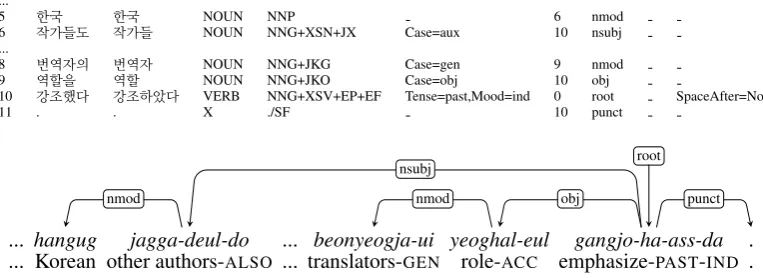
5 한국 한국 NOUN NNP 6 nmod
6 작가들도 작가들 NOUN NNG+XSN+JX Case=aux 10 nsubj ...
8 번역자의 번역자 NOUN NNG+JKG Case=gen 9 nmod 9 역할을 역할 NOUN NNG+JKO Case=obj 10 obj 10 강조했다. 강조하았다. VERB NNG+XSV+EP+EF+SF Tense=past,Mood=ind 0 root
... hangug jagga-deul-do ... beonyeogja-ui yeoghal-eul gangjo-ha-ass-da.
... Korean other authors-ALSO ... translators-GEN role-ACC emphasize-PAST-IND-. nmod
nsubj
nmod obj
[image:3.595.117.485.66.196.2]root
Figure 2: CoNLL-U format for eojeols: the basic elements of dependency relationships are based on eojeols delimited by a blank space character in the sentence. While the actual CoNLL-U data that we provide in this paper contain the results of morphological analysis (such as강조/NNG+하/XSV+았/EP+ 다/EF+./SF for line 10) to conserve the original structure of a combination of the word, for simplicity’s
sake we do not present them here.
...
5 한국 한국 NOUN NNP 6 nmod
6 작가들도 작가들 NOUN NNG+XSN+JX Case=aux 10 nsubj ...
8 번역자의 번역자 NOUN NNG+JKG Case=gen 9 nmod 9 역할을 역할 NOUN NNG+JKO Case=obj 10 obj
10 강조했다 강조하았다 VERB NNG+XSV+EP+EF Tense=past,Mood=ind 0 root SpaceAfter=No
11 . . X ./SF 10 punct
... hangug jagga-deul-do ... beonyeogja-ui yeoghal-eul gangjo-ha-ass-da . ... Korean other authors-ALSO ... translators-GEN role-ACC emphasize-PAST-IND .
nmod
nsubj
nmod obj
root
punct
Figure 3: CoNLL-U format for English-like tokenization by separating punctuation marks: it separates the punctuation mark from the wordgangjo-ha-ass-da(‘focused’) withpunct. Otherwise, it still keeps the original structure of the eojeols.
joined to a noun phrase. For example, the single token jagga-deul-do becomes two tokens, jagga-deul (‘author’) and -do (‘also’). However, verbal endings on the inflected forms of predicates are still in the eojoel and they are represented as ini-tial trees for Korean TAG grammars. The lemma of the predicate and its verbal endings are dealt with as inflected forms instead of separate func-tional morphemes.
2.4 Separating verbal endings
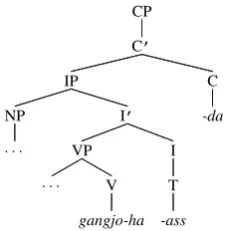
Government and binding (GB) theory for Ko-rean often proposed a syntactic analysis, in which the entire sentence depends on verbal endings. For example, gangjo-ha-ass-da becomes gangjo-ha (‘emphasize’), -ass (‘PAST’), and -da (‘IND’)
as described in Figure 5.
The Kaist treebank (Choi et al., 1994), the first treebank created for Korean adapted this type of analysis (Figure 6). While the Kaist treebank sep-arates case markers and verbal endings with their lexical morphemes, punctuation marks are not separated and they are still a part of the preceding token. Therefore, strictly speaking, this granular-ity level is not exactly same as in the Kaist tree-bank.
2.5 Discussion
[image:3.595.108.490.311.450.2]7 한국 한국 NOUN NNP 8 nmod 8-9 작가들도
8 작가들 작가들 NOUN NNG+XSN 16 id
9 도 도 X 도/JX Case=aux 8 case
...
12-13 번역자의
12 번역자 번역자 X NNG 14 id
13 의 의 X JKG Case=gen 12 case
14-15 역할을 역할 NOUN NNG+JKO 16 obj
14 역할 역할 X NNG 16 id
15 을 을 X 을/JKO Case=obj 14 case
16 강조했다 강조하았다 VERB NNG+XSV+EP+EF Tense=past,Mood=ind 0 root SpaceAfter=No
17 . . X ./SF 16 punct
... hangug jagga-deul do ... beonyeogja ui yeoghal eul gangjo-ha-ass-da . ... Korean other authors ALSO ... translators GEN role ACC emphasize-PAST-IND .
nmod
nsubj
case
nmod case
obj case
root
[image:4.595.104.495.67.263.2]punct
Figure 4: CoNLL-U format by separating case markers, which requires a dependency relationship be-tween the noun phrase and the case marker (case), for exampleyeoghal(‘role’) andeul(‘ACC’).
CP
C’
C
-da IP
I’
I
T
-ass VP
V
gangjo-ha
· · ·
NP
· · ·
Figure 5: X-bar schema forgangjo-ha, -ass, and
-dain Korean
datasets: Kaist (Choi et al., 1994), Sejong3, and
Penn (Han et al., 2002) treebanks. Even for the segmentation granularity which we deal with, syn-tactic theory is implicitly presented in the corpus for Korean words. Granularity described in §2.1 and §2.3 is based on the Sejong treebank. Gran-ularity described in§2.2 and§2.4 is based on the
Korean Penn treebank and the Kaist treebank, re-spectively.
Many applications for Korean language pro-cessing are based on another level of segmentation granularity, in which all morphemes are separated: phrase-structure parsing (Choi et al., 2012; Park et al., 2016) and statistical machine translation (SMT) (Park et al., 2016), etc. Such
morpheme-3https://www.sejong.or.kr
based analysis for the word can be generated by a morphological analysis system, and most POS tag-ging systems such as Hong (2009) and Park et al. (2011) can produce all morpheme-based analysis. For example,jagga-deul-do (‘authors-ALSO’) is
separated intojagga(‘author’),deul(‘PLUR’), and
do (‘ALSO’). However, we do not deal with this
granularity to represent dependencies. It shows rather how words are formed, and it should in-clude the fine-grained relationships between mor-phemes. This type of representation of words does not conform with the current dependency schemes for other languages and especially, neither with UD best practices.
3 UD for Korean
[image:4.595.124.238.351.467.2]...
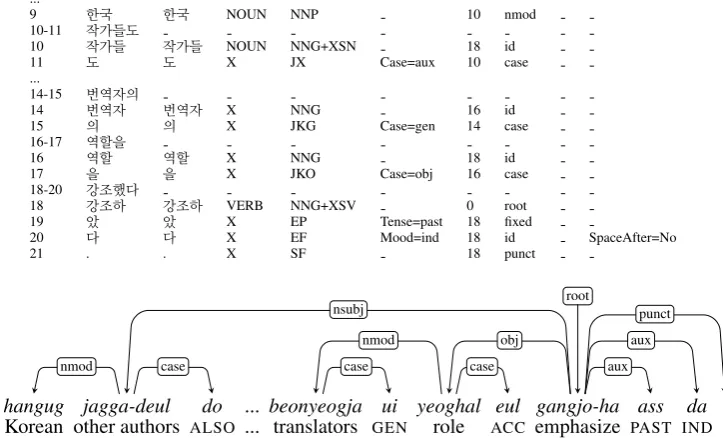
9 한국 한국 NOUN NNP 10 nmod
10-11 작가들도
10 작가들 작가들 NOUN NNG+XSN 18 id 11 도 도 X JX Case=aux 10 case ...
14-15 번역자의
14 번역자 번역자 X NNG 16 id 15 의 의 X JKG Case=gen 14 case 16-17 역할을
16 역할 역할 X NNG 18 id
17 을 을 X JKO Case=obj 16 case 18-20 강조했다
18 강조하 강조하 VERB NNG+XSV 0 root 19 았 았 X EP Tense=past 18 fixed
20 다 다 X EF Mood=ind 18 id SpaceAfter=No
21 . . X SF 18 punct
... hangug jagga-deul do ... beonyeogja ui yeoghal eul gangjo-ha ass da . ... Korean other authors ALSO ... translators GEN role ACC emphasize PAST IND .
nmod
nsubj
case
nmod case
obj case
root
aux aux
[image:5.595.122.484.67.286.2]punct
Figure 6: CoNLL-U format that separates verbal endings, which requires a dependency relationship between the verbal head and the verbal ending (aux), for example a verbgangjoha(‘focus’), and two verbal endingsass(‘PAST’) andda(‘IND’) for tense and mood.
3.1 Universal POS
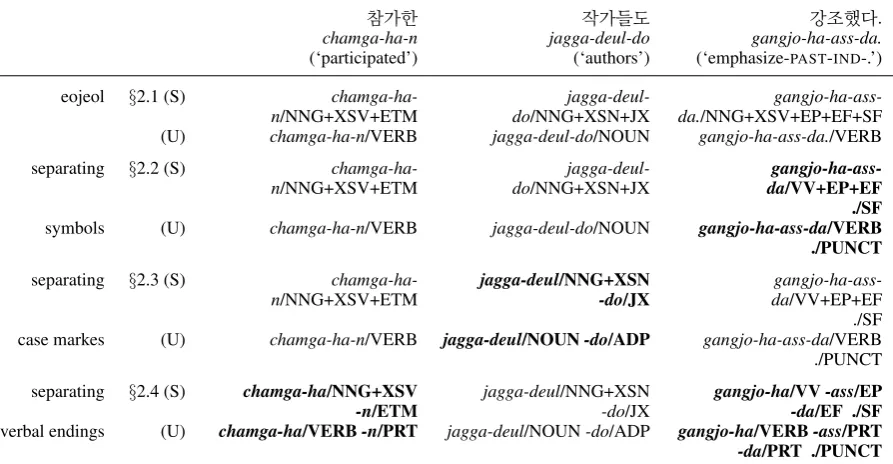
Using the eojeol and morpheme level mapping ta-bles to Universal POS tags for the Sejong tagset proposed in Petrov et al. (2012) and Park et al. (2016), we can convert the single tags (mor-phemes) and the sequences of tags (eojeols and tokens) in the Sejong corpus into Universal POS tags. We also use additional mapping rules by us-ing the approach to find Universal POS tags de-scribed in Oh et al. (2011) in which they predict phrase tags for the eojeol. In addition, the Sejong tags (morphemes) and the sequence of tags (to-kens and eojeols) represented as immediate non-terminal nodes in the eventual parse tree can be used as a language-specific part-of-speech tag in the CoNLL-U format. Figure 7 shows example mapping rules for each segmentation granularity level. Tagsets in the Sejong corpus are mapped to the Universal POS tag sets either individu-ally (NNP → PROPN) or by a sequence of the POS tags (NNP+JKS → PROPN). Figure 8
rep-resents the 1-to-1 mapping from the POS tags in the Sejong corpus to Universal POS tags de-scribed in Park et al. (2016). These 1-to-1 mapping rules are used throughout segmentation granular-ity schemes described§2.1 to§2.4 if the eojeol is composed only by a single morpheme.
3.2 Universal features
Park (2006) detailed an approach to extract fea-tures from the Sejong treebank. Syntactic tags and morphological analysis allow us to extract syn-tactic features automatically and to develop uni-versal features. For example, NP-SBJ syntactic tag is changed into NP and a syntactic feature
Case=Nom is added. Syntactic tags which end with -sbj (subject), -obj (object) and -CMP (attribute), we extract Case features which de-scribe argument structures in the sentence. Along-side Case features, we also extract Mood and
Tense from the morphological analyses in the Sejong treebank. Since however morphological analyses for verbal and adjectival endings in the Sejong treebank are simply divided intoep (non-final endings), ef (final endings) and ec (con-junctive endings),ModeandTensefeatures can not be extracted directly. Park (2006) analyzed 7 non-final endings and 77 final endings used in the Sejong treebank to extract automatically
MoodandTensefeatures. In general,efcarries
Mood inflections, and ep carries Tense inflec-tions. Conjunctive endings are not concerned with
Mood and Tense features and we only extract
ec features with their string value. We also add
참가한 작가들도 강조했다. chamga-ha-n jagga-deul-do gangjo-ha-ass-da. (‘participated’) (‘authors’) (‘emphasize-PAST-IND-.’)
eojeol §2.1 (S)
chamga-ha-n/NNG+XSV+ETM do/NNG+XSN+JXjagga-deul- da./NNG+XSV+EP+EF+SF gangjo-ha-ass-(U) chamga-ha-n/VERB jagga-deul-do/NOUN gangjo-ha-ass-da./VERB separating §2.2 (S)
chamga-ha-n/NNG+XSV+ETM do/NNG+XSN+JXjagga-deul- da/VV+EP+EF gangjo-ha-ass-./SF
symbols (U) chamga-ha-n/VERB jagga-deul-do/NOUN gangjo-ha-ass-da/VERB ./PUNCT
separating §2.3 (S)
chamga-ha-n/NNG+XSV+ETM jagga-deul/NNG+XSN-do/JX
gangjo-ha-ass-da/VV+EP+EF ./SF case markes (U) chamga-ha-n/VERB jagga-deul/NOUN-do/ADP gangjo-ha-ass-da/VERB
./PUNCT separating §2.4 (S) chamga-ha/NNG+XSV
-n/ETM
jagga-deul/NNG+XSN
-do/JX gangjo-ha/VV-da/EF ./SF-ass/EP
[image:6.595.78.525.58.290.2]verbal endings (U) chamga-ha/VERB-n/PRT jagga-deul/NOUN-do/ADP gangjo-ha/VERB-ass/PRT -da/PRT ./PUNCT
Figure 7: Example of the tag sequences at each granularity level. We show the examples for the convert-ing mappconvert-ing table between Sejong and Universal POS tag sets described in§3.1:e.g.NNG+XSV+ETM
is converted into VERB in§2.1. (S) and (U) are for the Sejong and Universal POS tag sets.
such as-si.
3.3 Universal dependency representations
We use basic dependencies (core, non-core, noun dependents) for eojeols for segmentation gran-ularity in §2.1. We add punct between word and punctuation marks (§2.2), andcasebetween noun phrase and case markers (§2.3). We also
em-ployfixedfor verbal endings (§2.4). Initial
de-pendency labels are based on phrase information in the Sejong treebank such asnp-sub,np-obj, etc. We create conversion rules to conform to Uni-versal Dependency relations.
nsubj (nominal subject) andcsubj (clausal subject) can be assigned in which np-sbj oc-curs and nouns ended with either jks (nomina-tive marker) orjx(topic marker). We distinguish
nsubjandcsubjas follows:
• if a subject noun is a derivational noun from the verb or the adjective, which are usually ended with etn+jks or etn+jx
(where etn is a derivational morpheme for the noun), thencsubj.
• otherwise,nsubj.
(2) a. unggaro-ga ... naseo-eoss-da
Ungaro-jx ... become-PAST-IND
‘Ungaro became ...’
b. unggaro-ga naseo-gi-ga ... sib-eoss-da
Ungaro-NOMbecome-etn-jx ... easy-PAST -IND
‘Ungaro’s becoming ... was easy’
While the previous UD for Korean uses
nsubj:passfor the passive construction in Ko-rean, we do not use it for the following two reasons: First, passive and causative verbs are often in the same form if they use passive or causative derivational morphemes such as-i, -hi, etc. and they are very ambiguous. Second, intran-sitive verbs are also allowed in the passive con-struction unlike in English.
obj (direct object) can be assigned in which
np-obj occurs and nouns ended with jko (ac-cusative marker). There are several cases where nouns can be ended withjx(topic marker). There are also some cases where nouns can be ended with jx (topic marker) for obj. iobj (second core dependent) can be assigned when np-alt
(NP adjunct) occurs and nouns ended with jkb
(auxiliary marker) such as -ege, -e, -gge (dative markers).
(3) ... sagoa-leulunggaro-egeju-eoss-da
... apple-jkoUngaro-jkbgive-PAST-IND
‘... gave an apple to Ungaro’
Sejong POS (S) description Universal POS (U) NNG, NNB, NR, XR Noun related NOUN
NNP Proper noun PROPN
NP Pronoun PRON
MAG, Adverb ADV
MAJ Conjunctive adverb CCONJ
MM Determiner DET
VV, VX, VCN, VCP Verb related VERB
VA Adjective ADJ
EP, EF, EC, ETN, ETM Verbal endings PRT JKS, JKC, JKG, JKO, JKB, JKV, JKQ, JX, JC Postpositions (case markers) ADP
XPN, XSN, XSA, XSV Suffixes PRT SF, SP, SE, SO, SS Punctuation marks PUNCT
SW Special characters X SH, SL Foreign characters X
SN Number NUM
[image:7.595.113.485.60.241.2]NA, NF, NV Unknown words X
Figure 8: POS tags in the Sejong corpus and their 1-to-1 mapping to Universal POS tags.
ending (among 410) in the Sejong treebank for
ccomp. Otherwise, if vp or vnp occurs, and a phrase ends with ec, we consider it as a non-core dependent clause and assign advcl (adver-bial clause modifier).
(4) ... unggaro-ga ... naseo-eoss-dagomalha-eoss-da
... Ungaro-NOM ... become-PAST-ectell-PAST -IND
‘... told that Ungaro became ...’
acl (adnominal clause) and amod (adjectival modifier) for Korean, in which vp-mod occurs, are defined as follows:
• if a verb ends with etm (verbal/adjectival ending for the relative clause) and it modifies anoun, we assignacl.
• if a adj ends with etm and it modifies a
noun, we assignamod.
UD for Korean annotates acl:relinstead of
aclto specify a relative clause for the verb ended with etm. ajt (adjunct) or nmod (nominal de-pendents) can be assigned where np-ajtornp
occurs, respectively. det:poss is assigned for
noun ended with jkg (genitive marker). Other UD relations such asadvmod,det, etc can be as-signed as a 1-to-1 mapping table by using Sejong POS labels as described in Table 1.
4 Experiments and Results
We collected sentences from news articles in one of Korean News websites published during 2016.4
We select the length of sentences in which there
4http://hani.co.kr
Sejong POS UD relations
mag advmod maj cc
mm det sn nummod
Table 1: Miscellaneous conversion between Se-jong POS labels and UD representations
are words (eojeols) between 10 and 20 and the sentence should end with the final verbal ending such as-da(IND) or-gga(INT) and the
punctua-tion mark such asperiodorquestion mark(sf).5
We perform initial automatic preprocessing tasks using existing tools for Korean such as POS tag-ging (Hong, 2009), assigning Universal POS la-bels (Petrov et al., 2012; Park et al., 2016), and MaltParser-based dependency parsing (Park et al., 2016). We manually correct the initial preprocess-ing tasks especially focused on dependency rela-tion as described in §3.3.6 First, we build a
cor-pus as described in§2.1, then convert it into other
levels of segmentation granularity as described in from§2.2 to §2.4. As a result, we provide a new
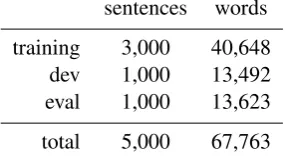
UD for Korean which contain 5,000 sentences. We split them into 3K-1K-1K sentences for train-ing, development, and evaluation data sets. Ta-ble 2 shows the brief statistics of the new UD for Korean. The number of words indicates the number of eojeols as described in §2.1. We train and evaluate four different dependency
segmen-5Similar criteria for selecting sentences are used for the Kaist and the Penn Korean treebank.
sentences words
training 3,000 40,648
dev 1,000 13,492
eval 1,000 13,623
[image:8.595.318.519.63.164.2]total 5,000 67,763
Table 2: Statistics of the new UD for Korean. A number based on granularity§2.1)
tation schemes based on segmentation granular-ity for Korean. Table 3 shows results produced by UDPipe (Straka et al., 2016). Upper granularity (towards granularity described in§2.4) generally gives better results than lower granularity (towards
§2.1) because lexical items with functional
mor-phemes in lower granularity can yield data sparse-ness. Bengoetxea and Gojenola (2010) presents a system that also changes segmentation granularity. They converted back the result of parsing to the original granularity to decide whether the new rep-resentation is effective for parsing. Additionally, the usual attachment score metrics used to evalu-ate dependency parsers are biased as described in Nivre and Fang (2017) for the cross-lingual set-ting. This bias can be equally applied to different segmentation granularity for Korean. We leave the evaluation as future work.
The current Universal Dependencies treebank for Korean used for the CoNLL 2017 UD Shared Task(Zeman et al., 2017)7uses the same
segmen-tation granularity as described in§2.2. We obtain 59.64% (UAS) and 51.05% (LAS) using the cur-rent version of UD for Korean (Nivre et al., 2017). While the current UD for Korean has a more sen-tences in the training data (4400 sensen-tences vs. 3000), its results are comparable with the results by our corpus of §2.2 where we obtain 65.72% (UAS) and 48.44% (LAS).
5 Conclusion
The different levels of segmentation granularity described in this paper are mainly due to different representations of syntactic structure in the various Korean treebank datasets. They have used differ-ent word segmdiffer-entation depending on their linguis-tic and computational requirements. While a cer-tain segmentation granularity may be well suited for some linguistic phenomena or applications, it
7http://hdl.handle.net/11234/1-1983
case verbal
eojeol symbol marker ending
§2.1 §2.2 §2.3 §2.4
UPOS 93.04 94.13 97.12 98.31
XPOS 82.59 85.22 90.63 95.19
UAS 62.08 65.72 76.19 79.59
LAS 40.51 48.44 71.29 78.07
Table 3: POS tagging and parsing results using UDPipe trained with four different UDs for Ko-rean.
does not mean that this granularity is a better rep-resentation than the other in general. We need to find the most adequate segmentation granularity to adapt to our requirements for Korean language processing. The UDs corpus for Korean based on different levels of segmentation granularity will be publicly available.
Acknowledgement
We thank Francis Morton Tyers, Lo¨ıc Dugast, and the anonymous reviewers for their helpful com-ments and suggestions.
References
[Bengoetxea and Gojenola2010] Kepa Bengoetxea and Koldo Gojenola. 2010. Application of Different Techniques to Dependency Parsing of Basque. In
[image:8.595.110.253.65.143.2]Proceedings of the NAACL HLT 2010 First Work-shop on Statistical Parsing of Morphologically-Rich Languages, pages 31–39, Los Angeles, CA, USA. Association for Computational Linguistics.
[Bikel2004] Daniel M. Bikel. 2004. Intricacies of Collins’ Parsing Model. Computational Linguistics, 30(4):479–511.
[Choi et al.1994] Key-Sun Choi, Young S Han, Young G Han, and Oh W Kwon. 1994. KAIST Tree Bank Project for Korean: Present and Future Development. In Proceedings of the Interna-tional Workshop on Sharable Natural Language Resources, pages 7–14.
[Choi et al.2012] DongHyun Choi, Jungyeul Park, and Key-Sun Choi. 2012. Korean Treebank Transfor-mation for Parser Training. InProceedings of the ACL 2012 Joint Workshop on Statistical Parsing and Semantic Processing of Morphologically Rich Lan-guages, pages 78–88, Jeju, Republic of Korea. As-sociation for Computational Linguistics.
Processing, pages 718–726, Singapore. Association for Computational Linguistics.
[Chung et al.2010] Tagyoung Chung, Matt Post, and Daniel Gildea. 2010. Factors Affecting the Ac-curacy of Korean Parsing. In Proceedings of the NAACL HLT 2010 First Workshop on Statistical Parsing of Morphologically-Rich Languages, pages 49–57, Los Angeles, CA, USA. Association for Computational Linguistics.
[Collins1997] Michael Collins. 1997. Three Genera-tive, Lexicalised Models for Statistical Parsing. In
Proceedings of the 35th Annual Meeting of the Asso-ciation for Computational Linguistics, pages 16–23, Madrid, Spain. Association for Computational Lin-guistics.
[Han et al.2002] Chung-Hye Han, Na-Rae Han, Eon-Suk Ko, Heejong Yi, and Martha Palmer. 2002. Penn Korean Treebank: Development and Evalua-tion. InProceedings of the 16th Pacific Asia Confer-ence on Language, Information and Computation.
[Hong2009] Jeen-Pyo Hong. 2009. Korean Part-Of-Speech Tagger using Eojeol Patterns. Master’s the-sis. Changwon National University.
[Joshi et al.1975] Aravind K. Joshi, Leon S. Levy, and Masako Takahashi. 1975. Tree Adjunct Gram-mars. Journal of Computer and System Sciences, 10(1):136–163.
[Nivre and Fang2017] Joakim Nivre and Chiao-Ting Fang. 2017. Universal Dependency Evaluation. In Proceedings of the NoDaLiDa 2017 Workshop on Universal Dependencies (UDW 2017), pages 86– 95, Gothenburg, Sweden. Association for Computa-tional Linguistics.
[Nivre et al.2016] Joakim Nivre, Marie-Catherine de Marneffe, Filip Ginter, Yoav Goldberg, Jan Hajic, Christopher D. Manning, Ryan McDonald, Slav Petrov, Sampo Pyysalo, Natalia Silveira, Reut Tsarfaty, and Daniel Zeman. 2016. Universal De-pendencies v1: A Multilingual Treebank Collection. In Luis von Ahn, editor, Proceedings of the Tenth International Conference on Language Resources and Evaluation (LREC 2016), Portoroˇz, Slove-nia. European Language Resources Association (ELRA).
[Nivre et al.2017] Joakim Nivre, ˇZeljko Agi´c, Lars Ahrenberg, et al. 2017. Universal dependencies 2.0 – CoNLL 2017 shared task development and test data. LINDAT/CLARIN digital library at the Insti-tute of Formal and Applied Linguistics, Charles Uni-versity.
[Oh and Cha2010] Jin-Young Oh and Jeong-Won Cha. 2010. High Speed Korean Dependency Analy-sis Using Cascaded Chunking. Korean Simulation Journal, 19(1):103–111.
[Oh et al.2011] Jin-Young Oh, Yo-Sub Han, Jungyeul Park, and Jeong-Won Cha. 2011. Predicting Phrase-Level Tags Using Entropy Inspired Discriminative Models. In International Conference on Informa-tion Science and ApplicaInforma-tions (ICISA) 2011, pages 1–5.
[Park et al.2011] Jungyeul Park, Jeong-Won Cha, and Seok Woo Jang. 2011. Korean POS Tagging using Noisy Channel Model with Syllable Lattice Based OOV Words Resolution. Information - an interna-tional interdisciplinary journal, 14(8):2835–2843.
[Park et al.2013] Jungyeul Park, Daisuke Kawahara, Sadao Kurohashi, and Key-Sun Choi. 2013. To-wards Fully Lexicalized Dependency Parsing for Korean. In Proceedings of The 13th International Conference on Parsing Technologies (IWPT 2013), Nara, Japan.
[Park et al.2014] Jungyeul Park, Sejin Nam, Youngsik Kim, Younggyun Hahm, Dosam Hwang, and Key-Sun Choi. 2014. Frame-Semantic Web : a Case Study for Korean. In Proceedings of ISWC 2014 : International Semantic Web Conference 2014 (Posters and Demonstrations Track), pages 257– 260.
[Park et al.2016] Jungyeul Park, Jeen-Pyo Hong, and Jeong-Won Cha. 2016. Korean Language Re-sources for Everyone. In Proceedings of the 30th Pacific Asia Conference on Language, Information and Computation (PACLIC 30), pages 49–58, Seoul, Korea.
[Park2006] Jungyeul Park. 2006. Extraction automa-tique d’une grammaire d’arbres adjoints `a partir d’un corpus arbor´e pour le cor´een. Ph.D. thesis, Universit´e Paris 7 - Denis Diderot.
[Petrov et al.2012] Slav Petrov, Dipanjan Das, and Ryan McDonald. 2012. A Universal Part-of-Speech Tagset. In Proceedings of the Eighth In-ternational Conference on Language Resources and Evaluation (LREC-2012), pages 2089–2096, Istan-bul, Turkey. European Language Resources Associ-ation (ELRA).
[Schuster and Manning2016] Sebastian Schuster and Christopher D. Manning. 2016. Enhanced English Universal Dependencies: An Improved Represen-tation for Natural Language Understanding Tasks. In Proceedings of the Tenth International Confer-ence on Language Resources and Evaluation (LREC 2016), Paris, France, 5. European Language Re-sources Association (ELRA).
[Stratos et al.2016] Karl Stratos, Michael Collins, and Daniel Hsu. 2016. Unsupervised Part-Of-Speech Tagging with Anchor Hidden Markov Models.
Transactions of the Association for Computational Linguistics, 4:245–257.
[Sulubacak et al.2016] Umut Sulubacak, Memduh G¨okırmak, Francis M. Tyers, C¸a˘grı C¸¨oltekin, Joakim Nivre, and G¨uls¸en Eryi˘git. 2016. Universal dependencies for Turkish. In Proceedings of COLING 2016.
[Tanaka et al.2016] Takaaki Tanaka, Yusuke Miyao, Masayuki Asahara, Sumire Uematsu, Hiroshi Kanayama, Shinsuke Mori, and Yuji Matsumoto. 2016. Universal Dependencies for Japanese. In
Proceedings of the Tenth International Confer-ence on Language Resources and Evaluation (LREC 2016), Paris, France, 5. European Language Resources Association (ELRA).
[Tyers and Washington2015] Francis Morton Tyers and Jonathan North Washington. 2015. Towards a Free/Open-source Universal-dependency Treebank for Kazakh. InProceedings of the 3rd International Conference on Turkic Languages Processing (Turk-Lang 2015), pages 276–289.