Towards Coherent Multi-Document Summarization
Janara Christensen, Mausam, Stephen Soderland, Oren Etzioni Computer Science & Engineering
University of Washington Seattle, WA 98195, USA
{janara,mausam,soderlan,etzioni}@cs.washington.edu
Abstract
This paper presents G-FLOW, a novel system for coherent extractive multi-document sum-marization (MDS).1 Where previous work on MDS considered sentence selection and or-dering separately, G-FLOWintroduces a joint model for selection and ordering that balances coherence and salience. G-FLOW’s core rep-resentation is a graph that approximates the discourse relations across sentences based on indicators including discourse cues, deverbal nouns, co-reference, and more. This graph en-ables G-FLOWto estimate the coherence of a candidate summary.
We evaluate G-FLOW on Mechanical Turk, and find that it generates dramatically bet-ter summaries than an extractive summarizer based on a pipeline of state-of-the-art sentence selection and reordering components, under-scoring the value of our joint model.
1 Introduction
The goal of multi-document summarization (MDS) is to produce high quality summaries of collections of related documents. Most previous work in ex-tractive MDS has studied the problems of sentence selection (e.g., (Radev, 2004; Haghighi and Vander-wende, 2009)) and sentence ordering (e.g., (Lapata, 2003; Barzilay and Lapata, 2008)) separately, but we believe that a joint model is necessary to produce coherent summaries. The intuition is simple: if the sentences in a summary are first selected—without regard to coherence—then a satisfactory ordering of the selected sentences may not exist.
1
System and data at http://knowitall.cs.washington.edu/gflow/
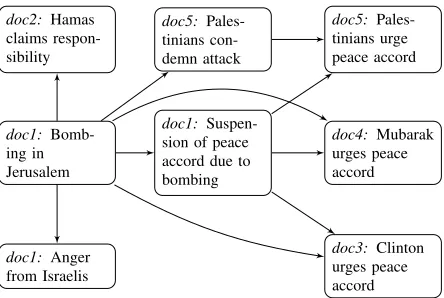
doc1: Bomb-ing in Jerusalem
doc1: Anger from Israelis
doc1: Suspen-sion of peace accord due to bombing doc2: Hamas
claims respon-sibility
doc5: Pales-tinians con-demn attack
doc4: Mubarak urges peace accord doc5: Pales-tinians urge peace accord
[image:1.612.314.536.242.391.2]doc3: Clinton urges peace accord
Figure 1: An example of a discourse graph covering a bombing and its aftermath, indicating the source docu-ment for each node. A coherent summary should begin with the bombing and then describe the reactions. Sen-tences are abbreviated for compactness.
An extractive summary is a subset of the sen-tences in the input documents, ordered in some way.2 Of course, mostpossiblesummaries are in-coherent. Now, consider a directed graph where the nodes are sentences in the collection, and each edge represents a pairwise ordering constraint necessary for a coherent summary (see Figure 1 for a sample graph). By definition, anycoherentsummary must obey the constraints in this graph.
Previous work has constructed similar graphs au-tomatically for single document summarization and manually for MDS (see Section 2). Our system, G-FLOW extends this research in two important ways. First, it tackles automatic graph construction for MDS, which requires novel methods for identi-fying inter-document edges (Section 3). It uses this
2
We focus exclusively on extractive summaries, so we drop the word “extractive” henceforth.
State-of-the-art MDS system G-FLOW
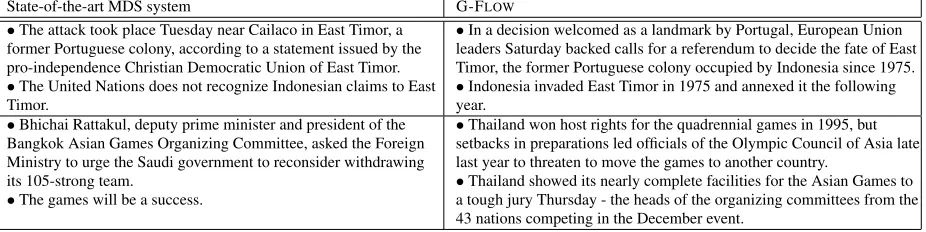
•The attack took place Tuesday near Cailaco in East Timor, a former Portuguese colony, according to a statement issued by the pro-independence Christian Democratic Union of East Timor.
•The United Nations does not recognize Indonesian claims to East Timor.
•In a decision welcomed as a landmark by Portugal, European Union leaders Saturday backed calls for a referendum to decide the fate of East Timor, the former Portuguese colony occupied by Indonesia since 1975.
•Indonesia invaded East Timor in 1975 and annexed it the following year.
•Bhichai Rattakul, deputy prime minister and president of the Bangkok Asian Games Organizing Committee, asked the Foreign Ministry to urge the Saudi government to reconsider withdrawing its 105-strong team.
•The games will be a success.
•Thailand won host rights for the quadrennial games in 1995, but setbacks in preparations led officials of the Olympic Council of Asia late last year to threaten to move the games to another country.
[image:2.612.77.540.62.178.2]•Thailand showed its nearly complete facilities for the Asian Games to a tough jury Thursday - the heads of the organizing committees from the 43 nations competing in the December event.
Table 1: Pairs of sentences produced by a pipeline of a state-of-the-art sentence extractor (Lin and Bilmes, 2011) and sentence orderer (Li et al., 2011a), and by G-FLOW.
graph to estimate coherence of a candidate summary. Second, G-FLOW introduces a novel methodology for joint sentence selection and ordering (Section 4). It casts MDS as a constraint optimization problem where salience and coherence are soft constraints, and redundancy and summary length are hard con-straints. Because this optimization problem is NP-hard, G-FLOWuses local search to approximate it.
We report on a Mechanical Turk evaluation that directly compares G-FLOWto state-of-the-art MDS systems. Using DUC’04 as our test set, we com-pare G-FLOWagainst a combination of an extractive summarization system with state-of-the-art ROUGE scores (Lin and Bilmes, 2011) followed by a state-of-the-art sentence reordering scheme (Li et al., 2011a). We also compare G-FLOW to a combina-tion of an extractive system with state-of-the-art co-herence scores (Nobata and Sekine, 2004) followed by the reordering system. In both cases participants substantially preferred G-FLOW. Participants chose G-FLOW 54% of the time when compared to Lin, and chose Lin’s system 22% of the time. When com-pared to Nobata, participants chose G-FLOW 60% of the time, and chose Nobata only 20% of the time. The remainder of the cases were judged equivalent.
A further analysis shows that G-FLOW’s sum-maries are judged superior along several dimensions suggested in the DUC’04 evaluation (including co-herence, repetitive text, and referents). A compar-ison against manually written, gold standard maries, reveals that while the gold standard sum-maries are preferred in direct comparisons, G-FLOW has nearly equivalent scores on almost all dimen-sions suggested in the DUC’04 evaluation.
The paper makes the following contributions:
• We present G-FLOW, a novel MDS system that
jointly solves the sentence selection and order-ing problems to produce coherent summaries. • G-FLOW automatically constructs a domain-independent graph of ordering constraints over sentences in a document collection, based on syntactic cues and redundancy across docu-ments. This graph is the backbone for estimat-ing the coherence of a summary.
• We perform human evaluation on blind test sets and find that G-FLOWdramatically outper-forms state-of-the-art MDS systems.
2 Related Work
Most existing research in multi-document summa-rization (MDS) focuses on sentence selection for in-creasing coverage and does not consider coherence of the summary (Section 2.1). Although coherence has been used in ordering of summary sentences (Section 2.2), this work is limited by the quality of summary sentences given as input. In contrast, G-FLOWincorporates coherence in both selection and ordering of summary sentences.
G-FLOWcan be seen as an instance of discourse-driven summarization (Section 2.3). There is prior work in this area, but primarily for summarization of single documents. There is some preliminary work on the use of manually-created discourse models in MDS. Our approach is fully automated.
2.1 Subset Selection in MDS
cov-ering weighted scores of concepts (Takamura and Okumura, 2009; Qazvinian et al., 2010), formula-tion as minimum dominating set problem (Shen and Li, 2010), and use of submodularity in sentence se-lection (Lin and Bilmes, 2011). Graph centrality has also been used to estimate the salience of a sentence (Erkan and Radev, 2004). Approaches to content analysis include generative topic models (Haghighi and Vanderwende, 2009; Celikyilmaz and Hakkani-Tur, 2010; Li et al., 2011b), and discriminative mod-els (Aker et al., 2010).
These approaches do not consider coherence as one of the desiderata in sentence selection. More-over, they do not attempt to organize the selected sentences into an intelligible summary. They are often evaluted by ROUGE (Lin, 2004), which is coherence-insensitive. In practice, these approaches often result in incoherent summaries.
2.2 Sentence Reordering
A parallel thread of research has investigated taking a set of summary sentences as input and reordering them to make the summary fluent. Various algo-rithms use some combination of topic-relatedness, chronology, precedence, succession, and entity co-herence for reordering sentences (Barzilay et al., 2001; Okazaki et al., 2004; Barzilay and Lapata, 2008; Bollegala et al., 2010). Recent work has also used event-based models (Zhang et al., 2010) and context analysis (Li et al., 2011a).
The hypothesis in this research is that a pipelined combination of subset selection and reordering will produce high-quality summaries. Unfortunately, this is not true in practice, because sentences are se-lected primarily for coverage without regard to co-herence. This methodology often leads to an inad-vertent selection of a set of disconnected sentences, which cannot be put together in a coherent sum-mary, irrespective of how the succeeding algorithm reorders them. In our evaluation, reordering had lim-ited impact on the quality of the summaries.
2.3 Coherence Models and Summarization
Research on discourse analysis of documents pro-vides a basis for modeling coherence in a docu-ment. Several theories have been developed for modeling discourse,e.g., Centering Theory, Rhetor-ical Structure Theory (RST), Penn Discourse
Tree-Bank (Grosz and Sidner, 1986; Mann and Thomp-son, 1988; Wolf and GibThomp-son, 2005; Prasad et al., 2008). Numerous discourse-guided summariza-tion algorithms have been developed (Marcu, 1997; Mani, 2001; Taboada and Mann, 2006; Barzilay and Elhadad, 1997; Louis et al., 2010). However, these approaches have been applied to single document summarization and not to MDS.
Discourse models have seen some application to summary generation in MDS, for example, using a detailed semantic representation of the source texts (McKeown and Radev, 1995; Radev and McKe-own, 1998). A multi-document extension of RST is Cross-document Structure Theory (CST), which has been applied to MDS (Zhang et al., 2002; Jorge and Pardo, 2010). However, these systems require a stronger input, such as a manual CST-annotation of the set of documents. Our work can be seen as an instance of summarization based on lightweight CST. However, a key difference is that our proposed algorithm is completely automated and does not re-quire any additional human annotation. Addition-ally, while incorporating coherence into selection, this work does not attempt to order the sentences coherently, while our approach performs joint selec-tion and ordering.
Discourse models have also been used for evalu-ating summary quality (Barzilay and Lapata, 2008; Louis and Nenkova, 2009; Pitler et al., 2010). Fi-nally, there is work on generating coherent sum-maries in specific domains, such as scientific articles (Saggion and Lapalme, 2002; Abu-Jbara and Radev, 2011) using domain-specific cues like citations. In contrast, our work generates summaries without any domain-specific knowledge. Other research has fo-cused on identifying coherent threads ofdocuments
rather than sentences (Shahaf and Guestrin, 2010).
3 Discourse Graph
As described in Section 1, our goal is to identify pairwise ordering constraints over a set of input sen-tences. These constraints specify a multi-document discourse graph, which is used by G-FLOWto eval-uate the coherence of a candidate summary.
fol-lowing three sentences (from possibly different doc-uments) there should be an edge froms1 tos2, but
not betweens3and the other sentences:
s1Militants attacked a market in Jerusalem.
s2Arafat condemned the bombing.
s3The Wye River Accord was signed in Oct.
Discourse theories have proposed a variety of re-lationships between sentences such as background and interpretation. RST has 17 such relations (Mann and Thompson, 1988) and PDTB has 16 (Prasad et al., 2008). While we seek to identify pairs of sen-tences that have a relationship, we do not attempt to label the edges with the exact relation.
We use textual cues from the discourse literature in combination with the redundancy inherent in re-lated documents to generate edges. Because this methodology is noisy, the graph used by G-FLOWis an approximation, which we refer to as an approx-imate discourse graph (ADG). We first describe the construction of this graph, and then discuss the use of the graph for summary generation (Section 4).
3.1 Deverbal Noun Reference
Often, the main description of an event is mentioned in a verbal phrase and subsequent references use deverbal nouns (nominalization of verbs) (e.g., ‘at-tacked’ and ‘the attack’). In this example, the noun is derivationally related to the verb, but that is not al-ways the case. For example, ‘bombing’ ins2 above
refers to ‘attacked’ ins1.
We identify verb-noun pairs with this relationship as follows. First, we locate a set of candidate pairs from WordNet: for each verbv, we determine po-tential noun referencesnusing a path length of up to two in WordNet (moving from verb to noun is pos-sible via WordNet’s ‘derivationally related’ links).
This set captures verb-noun pairs such as (‘to at-tack’, ‘bombing’), but also includes generic pairs such as (‘to act’, ‘attack’). To filter such errors we score the candidate references. Our goal is to emphasize common pairs and to deemphasize pairs with common verbs or verbs that map to many nouns. To this end, we score pairs by(c/p)∗(c/q), where c is the number of times the pair(v, n) ap-pears in adjacent sentences,pis the number of times the verb appears, andq is the number of times that vappears with a different noun. We generate these statistics over a background corpus of 60,000
arti-cles from the New York Times and Reuters, and filter out candidate pairs scoring below a threshold identified over a small training set.
We construct edges in the ADG between pairs of sentences containing these verb to noun mappings. To our knowledge, we are the first to use deverbal nouns for summarization.
3.2 Event/Entity Continuation
Our second indicator is related to lexical chains (Barzilay and Lapata, 2008). We add an edge in the ADG from a sentence si to sj if they contain the same event or entity and the timestamp ofsi is less than or equal to the timestamp ofsj(timestamps generated with (Chang and Manning, 2012)).
3.3 Discourse Markers
We use 36 explicit discourse markers (e.g., ‘but’, ‘however’, ‘moreover’) to identify edges between two adjacent sentences of a document (Marcu and Echihabi, 2002). This indicator lets us learn an edge froms4 tos5below:
s4Arafat condemned the bombing.
s5However,Netanyahu suspended peace talks.
3.4 Inferred Edges
We exploit the redundancy of information in MDS documents to infer edges to related sentences. An edge (s, s00) can be inferred if there is an existing edge(s, s0) ands0 ands00 express similar informa-tion. As an example, the edge (s6, s7) can be
in-ferred based on edge(s4, s5):
s6Arafat condemned the attack.
s7Netanyahu has suspended the talks.
To infer edges we need an algorithm to identify sentences expressing similar information. To iden-tify these pairs, we extract Open Information Extrac-tion (Banko et al., 2007) relaExtrac-tional tuples for each sentence, and we mark any pair of sentences with an equivalent relational tuple as redundant (see Sec-tion 4.3). The inferred edges allow us to propagate within-document discourse information to sentences from other documents.
3.5 Co-referent Mentions
presi-dent’) pointing to a specific entity or event insi(e.g., ‘President Bill Clinton’). We construct edges based on coreference mentions, as predicted by Stanford’s coreference system (Lee et al., 2011). We are able to identify syntactic edge(s8, s9):
s8Pres. Clinton expressed sympathy for Israel.
s9Hesaid the attack should not derail the deal.
3.6 Edge Weights
We weight each edge in the ADG by adding the number of distinct indicators used to construct that edge – if sentences sands0 have an edge because of a discourse marker and a deverbal reference, the edge weightwG(s, s0)will be two. We also include negative edges in the ADG.wG(s, s0)is negative if s0 contains a deverbal noun reference, a discourse marker, or a co-reference mention that is not fulfilled bys. For example, ifs0contains a discourse marker, and s is neither the sentence directly preceding s0 and there is no inferred discourse link betweensand s0, then we will add a negative edgewG(s, s0).
3.7 Preliminary Graph Evaluation
We evaluated the quality of the ADG used by G-FLOW, which is important not only for its use in MDS, but also because the ADG may be used for other applications like topic tracking and decompos-ing an event into sub-events. One author randomly chose 750 edges and labeled an edge correct if the pair of sentences did have a discourse relationship between them and incorrect otherwise. 62% of the edges accurately reflected a discourse relationship. Our ADG has on average 31 edges per sentence for a dataset in which each document cluster has on av-erage 253 sentences. This evaluation includes only the positive edges.
4 Summary Generation
We denote a candidate summaryXto be a sequence of sentenceshx1, x2, . . . , x|X|i. G-FLOW’s
summa-rization algorithm searches through the space of or-dered summaries and scores each candidate sum-mary along the dimensions of coherence (Section 4.1), salience (Section 4.2) and redundancy (Section 4.3). G-FLOWreturns the summary that maximizes a joint objective function (Section 4.4).
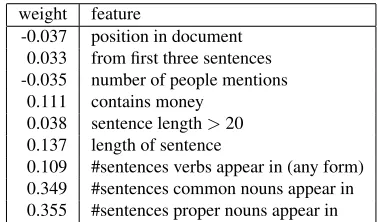
weight feature
-0.037 position in document 0.033 from first three sentences -0.035 number of people mentions
0.111 contains money 0.038 sentence length>20 0.137 length of sentence
[image:5.612.331.520.59.170.2]0.109 #sentences verbs appear in (any form) 0.349 #sentences common nouns appear in 0.355 #sentences proper nouns appear in
Table 2: Linear regression features for salience.
4.1 Coherence
G-FLOW estimates coherence of a candidate sum-mary via the ADG. We define coherence as the sum of edge weights between successive summary sen-tences. For disconnected sentence pairs, the edge weight is zero.
Coh(X) = X i=1..|X|−1
wG+(xi, xi+1) +λwG−(xi, xi+1)
wG+represents positive edges andwG−represents
negative edge weights.λis a tradeoff coefficient for positive and negative weights, which is tuned using the methodology described in Section 4.4.
4.2 Salience
Salience is the inherent value of each sentence to the documents. We compute salience of a summary (Sal(X)) as the sum of the saliences of individual sentences (P
iSal(xi)).
To estimate salience of a sentence, G-FLOWuses a linear regression classifier trained on ROUGE scores over the DUC’03 dataset. The classifier uses surface features designed to identify sentences that cover important concepts. The complete list of fea-tures and learned weights is in Table 2. The clas-sifier finds a sentence more salient if it mentions nouns or verbs that are present in more sentences across the documents. The highest ranked features are the last three – number of other sentences that mention a noun or a verb in the given sentence. We use the same procedure as in deverbal nouns for de-tecting verb mentions that appear as nouns in other sentences (Section 3.1).
4.3 Redundancy
arg2).3 For example, it finds (Militants, bombed, a marketplace) as a tuple from sentences12.
Two sentences will express redundant information if they both contain the same or synonymous com-ponent fact(s). Unfortunately, detecting synonymy even at relational tuple level is very hard. G-FLOW approximates this synonymy by considering two re-lational tuples synonymous if the relation phrases contain verbs that are synonyms of each other, have at least one synonymous argument, and are times-tamped within a day of each other. Because the in-put documents cover related events, these relatively weak rules provide good performance. The same algorithm is used for inferring edges for the ADG (Section 3.4). This algorithm can detect that the fol-lowing sentences express redundant information:
s12Militants bombed a marketplace in Jerusalem.
s13He alerted Arafat after assailants attacked the
busy streets of Mahane Yehuda.
4.4 Objective Function
The objective function needs to balance coherence, salience and redundancy and also honor the given budget,i.e., maximum summary lengthB. G-FLOW treats redundancy and budget as hard constraints and coherence and salience as soft. Coherence is neces-sarily soft as the graph is approximate. While previ-ous MDS systems specifically maximized coverage, in preliminary experiments on a development set, we found that adding a coverage term did not improve G-FLOW’s performance. We optimize:
maximize: F(x),Sal(X) +αCoh(X)−β|X|
s.t. P
i=1..|X|len(xi)< B
∀xi, xj∈X :redundant(xi, xj) = 0
Herelenrefers to the sentence length. We add|X| term (the number of sentences in the summary) to avoid picking many short sentences, which may in-crease coherence and salience scores at the cost of overall summary quality.
The parameters α,β andλ(see Section 4.1) are tuned automatically using a grid search over a de-velopment set as follows. We manually generate ex-tractivesummaries for each document cluster in our development set (DUC’03) and choose the parame-ter setting that minimizes |F(XG-FLOW) −F(X∗)|
3
Available from http://ollie.cs.washington.edu
summed over all document clusters.F is the objec-tive function,XG-FLOWis the summary produced by G-FLOWandX∗is the manual summary.
This constraint optimization problem is NP hard, which can be shown by using a reduction of the longest path problem. For this reason, G-FLOWuses local search to reach an approximation of the opti-mum. G-FLOW employs stochastic hill climbing with random restarts as the base search algorithm. At each step, the search either adds a sentence, re-moves a sentence, replaces a sentence by another, or reorders a pair of sentences. The initial summary for random restarts is constructed as follows. We first pick the highest salience sentence with no incoming negative edges as the first sentence. The following sentences are probabilistically added one at a time based on the summary score up to that sentence. The initial summary is complete when there are no possi-ble sentences left to fit within the budget. Intuitively, this heuristic chooses a good starting point by se-lecting a first sentence that does not rely on context and subsequent sentences that build a high scoring summary. As with all local search algorithms, this algorithm is highly scalable and can easily apply to large collections of related documents, but does not guarantee global optima.
5 Experiments
Because summaries are intended for human con-sumption we focused on human evaluations. We hired workers on Amazon Mechanical Turk (AMT) to evaluate the summaries. Our evaluation addresses the following questions: (1) how do G-FLOW sum-maries compare against the state-of-the-art in MDS (Section 5.2)? (2) what is G-FLOW’s performance along important summarization dimensions such as coherence and redundancy (Section 5.3)? (3) how does G-FLOW perform on coverage as measured by ROUGE (Section 5.3.1)? (4) how much do the components of G-FLOW’s objective function con-tribute to performance (Section 5.4)? (5) how do G-FLOW’s summaries compare to human summaries?
5.1 Data and Systems
doc-uments also includes four gold standard summaries used for evaluation. As in the DUC’04 competition, we allowed 665 bytes for each summary including spaces and punctuation. We used DUC’03 as our development set, which contains 30 document clus-ters, again with approximately 10 documents each.
We compared G-FLOWagainst four systems. The first is a recent MDS extractive summarizer, which we choose for its state-of-the-art ROUGE scores (Lin and Bilmes, 2011).4 The second is a pipeline of Lin’s system followed by a reimplementation of a state-of-the-art sentence reordering system (Li et al., 2011a). We refer to these systems as LIN and LIN-LI, respectively. This second baseline allows us to quantify the advantage of using coherence as a factor in both sentence extraction and ordering.
We also compare against the system that had the highest coherence ratings at DUC’04 (Nobata and Sekine, 2004), which we refer to as NOBATA. As this system did not preform sentence ordering on its output, we also compare against a pipeline of No-bata’s system and the sentence reordering system. We refer to this system as NOBATA-LI.
Lastly, to evaluate how well the system performs against human generated summaries, we compare against the gold standard summaries provided by DUC.
5.2 Overall Summary Quality
Following (Haghighi and Vanderwende, 2009) and (Celikyilmaz and Hakkani-Tur, 2010), to compare overall summary quality, we asked AMT workers to compare two candidate system summaries. The workers first read a gold standard summary, fol-lowed by the two system summaries, and were then asked to choose the better summary from the pair. The system summaries were shown in a random or-der to remove any bias.
To ensure that workers provided high quality data we added two quality checks. First, we restricted to workers who have an overall approval rating of over 95% on AMT. Second, we asked the workers to briefly describe the main events of the summary. We manually filtered out work where this descrip-tion was incorrect.
4We thank Lin and Bilmes for providing us with their code.
Unfortunately, we were unable to obtain other recent MDS sys-tems from their authors.
Six workers compared each pair of summaries. We recorded the scores for each cluster, and report three numbers: the percentages of clusters where a system is more often preferred over the other and the percentage where the two systems are tied. G-FLOW is preferred almost three times as often as LIN:
G-FLOW Indifferent LIN
56% 24% 20%
Next, we compared G-FLOW and LIN-LI. Sen-tence reordering improves performance, but G-FLOWis still overwhelmingly preferred:
G-FLOW Indifferent LIN-LI
54% 24% 22%
These results suggest that incorporating coher-ence in sentcoher-ence extraction adds significant value to a summarization system. In these experiments, LIN and LIN-LI are preferred in some cases. We an-alyzed those summaries more carefully, and found that occasionally, G-FLOW will sacrifice a small amount of coverage for coherence, resulting in lower performance in those cases (see Section 5.3.1).
We also compared LIN and LIN-LI, and found that reordering does not improve performance by much.
LIN-LI Indifferent LIN
32% 38% 30%
While the scores presented above represent com-parisons between G-FLOW and a summarization system with state-of-the-art ROUGE scores, we also compared against a summarization system with state-of-the-art coherence scores – the system with the highest coherence scores from DUC’04, (No-bata and Sekine, 2004). We found that G-FLOWwas again preferred:
G-FLOW Indifferent NOBATA
68% 10% 22%
Adding in sentence ordering again improved the scores for the comparison system somewhat:
G-FLOW Indifferent NOBATA-LI
60% 20% 20%
G-FLOW Indifferent Gold
14% 18% 68%
While we were pleased that in 32% of the cases, Turkers either preferred G-FLOW or were indiffer-ent, there is clearly a lot of room for improvement despite the gains reported over previous sytems.
5.3 Comparison along Summary Dimensions
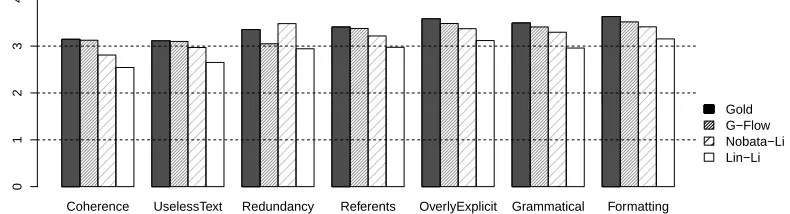
A high quality summary needs to be good along sev-eral dimensions. We asked AMT workers to rate summaries using the quality questions enumerated in DUC’04 evaluation scheme.5 These questions concern: (1) coherence, (2) useless, confusing, or repetitive text, (3) redundancy, (4) nouns, pronouns, and personal names that are not well-specified (5) entities rementioned in an overly explicit way, (6) ungrammatical sentences, and (7) formatting errors. We evaluated G-FLOW LIN-LI and NOBATA-LI against the gold standard summaries, using the same AMT scheme as in the previous section. To assess automated performance with respect to the standards set by human summaries, we also evaluated a (dif-ferent) gold standard summary for each document cluster, using the same Mechanical Turk scheme as in the previous section. The 50 summaries produced by each system were evaluated by four workers. The results are shown in Figure 2.
G-FLOWwas rated significantly better than LIN -LIin all categories except ‘Redundancy’ and signif-icant better than NOBATA-LI on ‘Coherence’ and ‘Referents’. The ratings for ‘Coherence’, ‘Refer-ents’, and ‘OverlyExplicit’ are not surprising given G-FLOW’s focus on coherence. The results for ‘UselessText’ may also be due to G-FLOW’s focus on coherence which ideally prevents it from getting off topic. Lastly, G-FLOW may perform better on ‘Grammatical’ and ‘Formatting’ because it tends to choose longer sentences than other systems, which are less likely to be sentence segmentation errors. There may also be some bleeding from one dimen-sion to the other – if a worker likes one summary she may score it highly for many dimensions.
Finally, somewhat surprisingly, we find G-FLOW’s performance to be nearly that of human summaries. G-FLOW is rated statistically signifi-cantly lower than the gold summaries on only
‘Re-5
http://duc.nist.gov/duc2004/quality.questions.txt
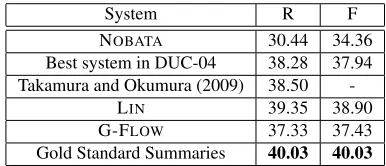
System R F
NOBATA 30.44 34.36 Best system in DUC-04 38.28 37.94 Takamura and Okumura (2009) 38.50
-LIN 39.35 38.90
G-FLOW 37.33 37.43
[image:8.612.329.522.59.142.2]Gold Standard Summaries 40.03 40.03
Table 3: ROUGE-1 recall and F-measure results (%) on DUC-04. Some values are missing because not all sys-tems reported both F-measure and recall.
dundancy’. Given the results from the previous sec-tion, G-FLOW is likely performing worse on cate-gories not conveyed in these scores, such as Cover-age, which we examine next.
5.3.1 Coverage Evaluation using ROUGE
Most recent research has focused on the ROUGE evaluation, and thus implicitly on coverage of in-formation in a summary. To estimate the coverage of G-FLOW, we compared the systems on ROUGE (Lin, 2004). We calculated ROUGE-1 scores for G-FLOW, LIN, and NOBATA.6 As sentence order-ing does not matter for ROUGE, we do not include LIN-LI or NOBATA-LI in this evaluation. Because our algorithm does not explicitly maximize coverage while LIN does, we expected G-FLOW to perform slightly worse than LIN.
The ROUGE-1 scores for G-FLOW, LIN, NO -BATAand other recent MDS systems are listed in Ta-ble 3. We also include the ROUGE-1 scores for the gold summaries (compared to the other gold sum-maries). G-FLOW has slightly lower scores than LIN and the gold standard summaries, but much higher scores than NOBATA. G-FLOW only scores significantly lower than LIN and the gold standard summaries.
We can conclude that good summaries have both the characteristics listed in the quality dimensions, and good coverage. The gold standard summaries outperform G-FLOW on both ROUGE scores and the quality dimension scores, and therefore, out-perform G-FLOW on overall comparison. How-ever, G-FLOWis preferred to LIN-LI in addition to NOBATA-LI indicating that its quality scores out-weigh its ROUGE scores in that comparison. An improvement to G-FLOW may focus on increasing
6
Coherence UselessText Redundancy Referents OverlyExplicit Grammatical Formatting
Rating
0
1
2
3
4
[image:9.612.106.501.64.171.2]Gold G−Flow Nobata−Li Lin−Li
Figure 2: Ratings for the systems. 0 is the lowest possible score and 4 is the highest possible score. G-FLOWis rated significantly higher than LIN-LIon all categories, except for ‘Redundancy’, and significantly higher than NOBATA-LI
on ‘Coherence’ and ‘Referents’. G-FLOWis only significantly lower than the gold standard on ‘Redundancy’.
coverage while retaining strengths such as coher-ence.
5.4 Ablation Experiments
In this ablation study, we evaluated the contribution of the main components of G-FLOW – coherence and salience. The details of the experiments are the same as in the experiment described in Section 5.2.
We first measured the importance of coherence in summary generation. This system G-FLOW-SALis identical to the full system except that it does not include the coherence term in the objective function (see Section 4.4). The results show that coherence is very important to G-FLOW’s performance:
G-FLOW Indifferent G-FLOW-SAL
54% 26% 20%
Similarly, we evaluated the contribution of salience. This system G-FLOW-COH does not in-clude the salience term in the objective function:
G-FLOW Indifferent G-FLOW-COH
60% 20% 20%
Without salience, the system produces readable, but highly irrelevant summaries.
5.5 Agreement of Expert & AMT Workers
Because summary evaluation is a relatively complex task, we compared AMT workers’ annotations with expert annotations from DUC’04. We randomly selected ten summaries from each of the seven DUC’04 annotators, and asked four Turk workers to annotate them on the DUC’04 quality questions. For each DUC’04 annotator, we selected all pairs of summaries where one summary was judged more than one point better than the other summary. We
compared whether the workers (voting as in Sec-tion 5.2) likewise judged that summary better than the second summary. We found that the annotations agreed in 75% of cases. When we looked only at pairs more than two points different, the agreement was 80%. Thus, given the subjective nature of the task, we feel reasonably confident that the AMT an-notations are informative, and that the dramatic pref-erence of G-FLOWover the baseline systems is due to a substantial improvement in its summaries.
6 Conclusion
Acknowledgements
We thank Luke Zettlemoyer, Lucy Vanderwende, Hal Daume III, Pushpak Bhattacharyya, Chris Quirk, Erik Frey, Tony Fader, Michael Schmitz, Alan Ritter, Melissa Winstanley, and the three anonymous reviewers for help-ful conversations and feedback on earlier drafts. We also thank Lin and Bilmes for providing us with the code for their system. This research was supported in part by NSF grant IIS-0803481, ONR grant N00014-11-1-0294, and DARPA contract FA8750-13-2-0019, and carried out at the University of Washington’s Turing Center. This pa-per was also supported in part by the Intelligence Ad-vanced Research Projects Activity (IARPA) via Air Force Research Laboratory (AFRL) contract number FA8650-10-C-7058. The U.S. Government is authorized to repro-duce and distribute reprints for Governmental purposes notwithstanding any copyright annotation thereon. The views and conclusions contained herein are those of the authors and should not be interpreted as necessarily rep-resenting the official policies or endorsements, either ex-pressed or implied, of IARPA, AFRL, or the U.S. Gov-ernment.
References
Amjad Abu-Jbara and Dragomir R. Radev. 2011. Coher-ent citation-based summarization of sciCoher-entific papers. InProceedings of ACL 2011, pages 500–509.
Ahmet Aker, Trevor Cohn, and Robert Gaizauskas. 2010. Multi-document summarization using A * search and discriminative training. In Proceedings of EMNLP 2010.
Michele Banko, Michael Cafarella, Stephen Soderland, Matt Broadhead, and Oren Etzioni. 2007. Open in-formation extraction from the web. InProceedings of IJCAI 2007, pages 68–74.
Regina Barzilay and Michael Elhadad. 1997. Using lex-ical chains for text summarization. InProceedings of the ACL Workshop on Intelligent Scalable Text Sum-marization, pages 10–17.
Regina Barzilay and Mirella Lapata. 2008. Modeling local coherence: An entity-based approach. Computa-tional Linguistics, 34(1):1–34.
Regina Barzilay, Noemie Elhadad, and Kathleen R McK-eown. 2001. Sentence ordering in multidocument summarization. In Proceedings of HLT 2001, pages 1–7.
Danushka Bollegala, Naoaki Okazaki, and Mitsuru Ishizuka. 2010. A bottom-up approach to sentence ordering for multi-document summarization. Informa-tion Process Management, 46(1):89–109.
Jaime Carbonell and Jade Goldstein. 1998. The use of MMR, diversity-based reranking for reordering
docu-ments and producing summaries. In Proceedings of SIGIR 1998, pages 335–336.
Asli Celikyilmaz and Dilek Hakkani-Tur. 2010. A hy-brid hierarchical model for multi-document summa-rization. InProceedings of ACL 2010, pages 815–824. Angel Chang and Christopher Manning. 2012. SU-TIME: A library for recognizing and normalizing time expressions. InProceedings of LREC 2012.
Gunes Erkan and Dragomir R Radev. 2004. LexRank: Graph-based centrality as salience in text summa-rization. Journal of Artificial Intelligence Research, 22(1):457–479.
Barbara Grosz and Candace Sidner. 1986. Attention, intentions, and the structure of discourse. Computa-tional Linguistics, 12(3):175–204.
Aria Haghighi and Lucy Vanderwende. 2009. Explor-ing content models for multi-document summariza-tion. Proceedings of NAACL 2009, pages 362–370. Maria Lucia Castro Jorge and Thiago
Alexan-dre Salgueiro Pardo. 2010. Multi-Document Summarization: Content Selection based on CST Model (Cross-document Structure Theory). Ph.D. thesis, N´ucleo Interinstitucional de Ling¨u´ıstica Computacional (NILC).
Mirella Lapata. 2003. Probabilistic text structuring: Ex-periments with sentence ordering. InProceedings of ACL 2003, pages 545–552.
Heeyoung Lee, Yves Peirsman, Angel Chang, Nathanael Chambers, Mihai Surdeanu, and Dan Jurafsky. 2011. Stanford’s multi-pass sieve coreference resolution sys-tem at the CoNLL-2011 shared task. InCoNLL 2011 Shared Task.
Peifeng Li, Guangxi Deng, and Qiaoming Zhu. 2011a. Using context inference to improve sentence ordering for multi-document summarization. InProceedings of IJCNLP 2011, pages 1055–1061.
Peng Li, Yinglin Wang, Wei Gao, and Jing Jiang. 2011b. Generating aspect-oriented multi-document summa-rization with event-aspect model. In Proceedings of EMNLP 2011, pages 1137–1146.
Hui Lin and Jeff Bilmes. 2011. A class of submodular functions for document summarization. In Proceed-ings of ACL 2011, pages 510–520.
Chin-Yew Lin. 2004. ROUGE: A package for auto-matic evaluation of summaries. InText Summarization Branches Out: Proceedings of the ACL-04 Workshop, pages 74–81.
Annie Louis and Ani Nenkova. 2009. Automatic sum-mary evaluation without using human models. In Pro-ceedings of EMNLP 2009, pages 306–314.
Inderjeet Mani. 2001. Automatic Summarization. John Benjamins Publishing Co, Amsterdam/Philadelphia. William C. Mann and Sandra A. Thompson. 1988.
Rhetorical structure theory: Toward a functional the-ory of text organization. Text, 8(3):243–281.
Daniel Marcu and Abdessamad Echihabi. 2002. An unsupervised approach to recognizing discourse rela-tions. InProceedings of ACL 2002, pages 368–375. Daniel Marcu. 1997. From discourse structures to text
summaries. InProceedings of the ACL Workshop on Intelligent Scalable Text Summarization, pages 82–88. Mausam, Michael Schmitz, Robert Bart, Stephen Soder-land, and Oren Etzioni. 2012. Open language learning for information extraction. InProceedings of EMNLP 2012, pages 523–534.
Kathleen McKeown and Dragomir Radev. 1995. Gen-erating summaries of multiple news articles. In Pro-ceedings of SIGIR 1995, pages 74–82.
Chikashi Nobata and Satoshi Sekine. 2004. Crl/nyu summarization system at duc-2004. InProceedings of DUC 2004.
Naoaki Okazaki, Yutaka Matsuo, and Mitsuru Ishizuka. 2004. Improving chronological sentence ordering by precedence relation. InProceedings of COLING 2004, pages 750–756.
Emily Pitler, Annie Louis, and Ani Nenkova. 2010. Automatic evaluation of linguistic quality in multi-document summarization. In Proceedings of ACL 2010, pages 544–554.
Rashmi Prasad, Nikhil Dinesh, Alan Lee, Eleni Milt-sakaki, Livio Robaldo, Aravind Joshi, and Bonnie Webber. 2008. The Penn Discourse TreeBank 2.0. InProceedings of LREC 2008.
Vahed Qazvinian, Dragomir R. Radev, and Arzucan ¨
Ozg¨ur. 2010. Citation summarization through keyphrase extraction. In Proceedings of COLING 2010, pages 895–903.
Dragomir R. Radev and Kathleen R. McKeown. 1998. Generating natural language summaries from mul-tiple on-line sources. Computational Linguistics, 24(3):469–500.
Dragomir R. Radev, Hongyan Jing, Malgorzata Stys, and Daniel Tam. 2004. Centroid-based summarization of multiple documents. Information Processing and Management, 40(6):919–938.
Dragomir R. Radev. 2004. LexRank: Graph-based lexi-cal centrality as salience in text summarization. Jour-nal of Artificial Intelligence Research, 22(1):457–479. Horacio Saggion and Robert Gaizauskas. 2004. Multi-document summarization by cluster/profile relevance and redundancy removal. In Proceedings of DUC 2004.
Horacio Saggion and Guy Lapalme. 2002. Generating indicative-informative summaries with sumUM. Com-putational Linguistics, 28(4):497–526.
Dafna Shahaf and Carlos Guestrin. 2010. Connecting the dots between news articles. InProceedings of KDD 2010, pages 623–632.
Chao Shen and Tao Li. 2010. Multi-document summa-rization via the minimum dominating set. In Proceed-ings of Coling 2010, pages 984–992.
Maite Taboada and William C. Mann. 2006. Applica-tions of rhetorical structure theory. Discourse Studies, 8(4):567–588.
Hiroya Takamura and Manabu Okumura. 2009. Text summarization model based on maximum coverage problem and its variant. InProceedings of EACL 2009, pages 781–789.
Florian Wolf and Edward Gibson. 2005. Representing discourse coherence: A corpus-based study. Compu-tational Linguistics, 31(2):249–288.
Zhu Zhang, Sasha Blair-Goldensohn, and Dragomir R. Radev. 2002. Towards CST-enhanced summarization. InProceedings of AAAI 2002, pages 439–445. Renxian Zhang, Li Wenjie, and Lu Qin. 2010.