40
Multi-modal Discriminative Model for Vision-and-Language Navigation
Haoshuo Huang∗ Vihan Jain∗ Harsh Mehta Jason Baldridge Eugene Ie Google AI Language
{haoshuo, vihan, harshm, jridge, eugeneie}@google.com
Abstract
Vision-and-Language Navigation (VLN) is a natural language grounding task where agents have to interpret natural language instructions in the context of visual scenes in a dynamic environment to achieve prescribed navigation goals. Successful agents must have the abil-ity to parse natural language of varying lin-guistic styles, ground them in potentially un-familiar scenes, plan and react with ambigu-ous environmental feedback. Generalization ability is limited by the amount of human annotated data. In particular, paired vision-language sequence data is expensive to col-lect. We develop a discriminator that evalu-ates how well an instruction explains a given path in VLN task using multi-modal alignment. Our study reveals that only a small fraction of the high-quality augmented data fromFried et al.(2018), as scored by our discriminator, is useful for training VLN agents with simi-lar performance on previously unseen environ-ments. We also show that a VLN agent warm-started with pre-trained components from the discriminator outperforms the benchmark suc-cess rates of 35.5 by 10% relative measure on previously unseen environments.
1 Introduction
There is an increased research interest in the problems containing multiple modalities (Yu and
Siskind, 2013;Chen et al., 2015;Vinyals et al.,
2017;Harwath et al.,2018). The models trained
on such problems learn similar representations for related concepts in different modalities. Model components can be pretrained on datasets with indi-vidual modalities, the final system must be trained (or fine-tuned) on task-specific datasets (Girshick
et al.,2014;Zeiler and Fergus,2014).
In this paper, we focus on vision-and-language navigation (VLN), which involves understanding
∗
Authors contributed equally.
visual-spatial relations as described in instructions written in natural language. In the past, VLN datasets were built on virtual environments, with
MacMahon et al.(2006) being perhaps the most
prominent example. More recently, challenging photo-realistic datasets containing instructions for paths in real-world environments have been re-leased (Anderson et al., 2018b; de Vries et al.,
2018; Chen et al., 2018). Such datasets require
annotations by people who follow and describe paths in the environment. Because the task is quite involved–especially when the paths are longer– obtaining human labeled examples at scale is chal-lenging. For instance, the Touchdown dataset
(Chen et al.,2018) has only 9,326 examples of the
complete task. Others, such asCirik et al.(2018)
andHermann et al.(2019) side-step this problem by
using formulaic instructions provided by mapping applications. This makes it easy to get instructions at scale. However, since these are notnatural lan-guage instructions, they lack the quasi-regularity, diversity, richness and errors inherent in how peo-ple give directions. More importantly, they lack the more interesting connections between language and the visual scenes encountered on a path, such ashead over the train tracks, hang a right just past a cluster of palm trees and stop by the red brick town home with a flag over its door.
human-annotated instructions in R2R. Using this augmented data improved the navigation models in the original paper as well as later models such as
Wang et al.(2018a). However, our own inspection
of the generated instructions revealed that many have little connection between the instructions and the path they were meant to describe, raising ques-tions about what models can and should learn from noisy, automatically generated instructions.
We instead pursue another, high precision strat-egy for augmenting the data. Having access to an environment provides opportunities for creating instruction-path pairs for modeling alignments. In particular, given a path and a navigation instruction created by a person, it is easy to create incorrect paths by creating permutations of the original path. For example, we can hold the instructions fixed, but reverse or shuffle the sequence of perceptual inputs, or sample random paths, including those that share the start or end points of the original one. Crucially, given the diversity and relative unique-ness of the properties of different rooms and the trajectories of different paths, it is highly unlikely that the original instruction will correspond well to the mined negative paths.
This negative path mining strategy stands in stark contrast with approaches that create new instruc-tions. Though they cannot be used to directly train navigation agents, negative paths can instead be used to train discriminative models that can as-sess the fit of an instruction and a path. As such, they can be used to judge the quality of machine-generated extensions to VLN datasets and possibly reject bad instruction-path pairs. More importantly, the components of discriminative models can be used for initializing navigation models themselves and thus allow them to make more effective use of the limited positive paths available.
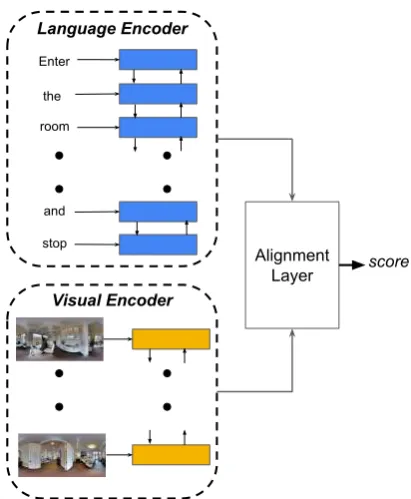
We present four main contributions. First, we propose adiscriminatormodel (Figure1) that can predict how well a given instruction explains the paired path. We list several cheap negative sam-pling techniques to make the discriminator more robust. Second, we show that only a small por-tion of the augmented data inFried et al.(2018) are high fidelity. Including just a small fraction of them in training is sufficient for reaping most of the gains afforded by the full augmentation set: using just the top 1% augmented data samples, as scored by the discriminator, is sufficient to generalize to previously unseen environments. Third, we train
the discriminator usingalignment-basedsimilarity metric that enables the model to align same con-cepts in the language and visual modalities. We provide a qualitative assessment of the alignment learned by the model. Finally, we show that a navi-gation agent, when initialized with components of fully-trained discriminator, outperforms the exist-ing benchmark on success rate by over 10% relative measure on previously unseen environments.
2 The Room-to-Room Dataset
Room-to-Room (R2R) is a visually-grounded nat-ural language navigation dataset in photo-realistic environments (Anderson et al.,2018b). Each en-vironment is defined by a graph where nodes are locations with egocentric panoramic images and edges define valid connections for agent navigation. The navigation dataset consists of language instruc-tions paired with reference paths, where each path is defined by a sequence of graph nodes. The data collection process is based on sampling pairs of start/end nodes and defining the shortest path be-tween the two. Furthermore the collection process ensures no paths are shorter than 5m and must be between 4 to 6 edges. Each sampled path is associ-ated with 3 natural language instructions collected from Amazon Mechanical Turk with an average length of 29 tokens from a vocabulary of 3.1k to-kens. Apart from the training set, the dataset in-cludes two validation sets and a test set. One of the validation sets includes new instructions on envi-ronments overlapping with the training set (Valida-tion Seen), and the other is entirely disjoint from the training set (Validation Unseen).
Several metrics are commonly used to evalu-ate agents’ ability to follow navigation instruc-tions.Path Length (PL)measures the total length of the predicted path, where the optimal value is the length of the reference path.Navigation Error (NE)
measures the distance between the last nodes in the predicted path and the reference path.Success Rate (SR)measures how often the last node in the predicted path is within some threshold distance
dth of the last node in the reference path. More
recently,Anderson et al.(2018a) proposed the Suc-cess weighted by Path Length (SPL)measure that also considers whether the success criteria was met (i.e., whether the last node in the predicted path is within some thresholddth of the reference path)
the
room
and
stop
Language Encoder
Visual Encoder
Alignment
Layer score
[image:3.595.77.283.68.318.2]Enter
Figure 1: Overview of the discriminator model struc-ture. Alignment layer corresponds to Eq.5,6,7
3 Discriminator Model
VLN tasks are composed of instruction-path pairs, where a path is a sequence of connected locations along with their corresponding perceptual contexts in some environment. While the core task is to create agents that can follow the navigation instruc-tions to reproduce estimates of reference paths, we instead explore models that focus on the simpler problem of judging whether an instruction-path pair are a good match for one another. These mod-els would be useful in measuring the quality of machine-generated instruction-path pairs. Another reasonable expectation from such models would be that they are also able to align similar concepts in the two modalities, e.g., in an instruction like “Turn right and move forward around the bed, enter the bathroom and wait there.”, it is expected that the wordbed is better aligned with a location on the path that has a bed in the agent’s egocentric view.
To this effect, we train a discriminator model that learns to delineate positive instruction-path pairs from negative pairs sampled using different strategies described in Sec.3.2. The discrimination is based on an alignment-based similarity score that determines how well the two input sequences align. This encourages the model to map perceptual and textual signals for final discrimination.
3.1 Model Structure
We use a two-tower architecture to independently encode the two sequences, with one tower encoding the token sequencex1, x2, ..., xnin the instruction X and another tower encoding the visual input se-quencev1, v2, ..., vmfrom the pathV. Each tower
is a bi-directional LSTM (Schuster and Paliwal,
1997) which constructs the latent space representa-tionHof a sequencei1, i2, ..., ikfollowing:
H= [h1;h2;...;hk] (1)
ht=g(
− →
ht,
←−
ht) (2)
− →
ht=LST M(it,
− →
ht−1) (3)
←−
ht=LST M(it,
←−
ht+1) (4)
where g function is used to combine the output of forward and backward LSTM layers. In our implementation,gis the concatenation operator.
We denote the latent space representation of in-structionX asHX and pathV asHV and compute the alignment-based similarity score as following:
A=HX(HV)T (5)
{c}ll==1X=softmax(A
l
)·Al (6)
score=softmin({c}ll==1X)· {c}
l=X
l=1 (7)
where(.)T is matrix transpose transformation,Ais the alignment matrix whose dimensions are[n, m],
Al is thel-th row vector inAand softmin(Z) =
exp−Zj P
exp−Zj. Eq.6corresponds to taking a softmax
along the columns and summing the columns, which amounts to content-based pooling across columns. Then we apply softmin operation along the rows and sum the rows up to get a scalar in Eq.7. Intuitively, optimizing this score encourages the learning algorithm to construct the best worst-case sequence alignment between the two input sequences in latent space.
3.2 Training
Training data consists of instruction-path pairs which may be similar (positives) or dissimilar (neg-atives). The training objective maximizes the log-likelihood of predicting higher alignment-based similarity scores for similar pairs.
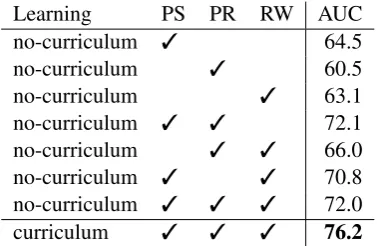
Learning PS PR RW AUC no-curriculum 3 64.5 no-curriculum 3 60.5 no-curriculum 3 63.1 no-curriculum 3 3 72.1 no-curriculum 3 3 66.0 no-curriculum 3 3 70.8 no-curriculum 3 3 3 72.0 curriculum 3 3 3 76.2
Table 1: Results on training in different combinations of datasets and evaluating against validation dataset containing PR and RW negatives only.
instruction-path pair, we sample negatives by keep-ing the same instruction but alterkeep-ing the path se-quence by:
• Path Substitution (PS) – randomly picking other paths from the same environment as neg-atives.
• Partial Reordering (PR) – keeping the first and last nodes in the path unaltered and shuf-fling the intermediate locations of the path.
• Random Walks (RW)– sampling random paths of the same length as the original path that either (1) start at the same location and end sufficiently far from the original path or (2) end at the same location and start sufficiently far from the original path.
4 Results
Our experiments are conducted using the R2R dataset (Anderson et al.,2018b). Recently,Fried
et al.(2018) introduced an augmented dataset
(re-ferred to asFried-Augmented from now on) that is generated by using a speaker model and they show that the models trained with both the original data and the machine-generated augmented data improves agent success rates.
We show three main results. First, the discriminator effectively differentiates be-tween high-quality and low-quality paths in
Fried-Augmented. Second, we rank all instruction-path pairs in Fried-Augmented
with the discriminator and train with a small fraction judged to be the highest quality—using just the top 1% to 5% (the highest quality pairs) provides most of the benefits derived from the entirety of Fried-Augmentedwhen
Figure 2: Culmulative distributions of discriminator scores for different datasets. The mean of distribution for R2R validation seen, Fried-Augmented and R2R validation unseen is 0.679, 0.501, and 0.382 re-spectively.
generalizing to previously unseen environments. Finally, we initialize a navigation agent with the visual and language components of the trained discriminator. This strategy allows the agent to benefit from the discriminator’s multi-modal alignment capability and more effectively learn from the human-annotated instructions. This agent outperforms existing benchmarks on previously unseen environments as a result.
4.1 Discriminator Results
We create two kinds of dataset for each of the neg-ative sampling strategies defined in Section3.2– a training set from paths in R2Rtrain split and validation set from paths in R2Rvalidation seen
andvalidation unseensplits. The area-under ROC curve (AUC) is used as the evaluation metric for the discriminator. From preliminary studies, we observed that the discriminator trained on dataset containing PS negatives achieved AUC of 83% on validation a dataset containing PS negatives only, but fails to generalize to validation set containing PR and PW negatives (AUC of 64.5%). This is because it is easy to score PS negatives by just attending to first or last locations, while scoring PR and PW negatives may require carefully align-ing the full sequence pair. Therefore, to keep the task challenging, the validation set was limited to contain validation splits from PR and RW nega-tive sampling strategies only. Table1shows the results of training the discriminator using various combinations of negative sampling.
[image:4.595.310.523.63.225.2]Dataset Score Example
Fried-Augmented
0.001
Walk out of the bedroom and turn left. Walk past the couch and turn right. Walk past the pool and stop on the second step.
Gym
0.999 Go up the stairs and turn left. Walk past the kitchen and dining table. Stop behind the dining table.
Validation Seen
0.014 Walk across the patio, stop at hanging basket chair.
Hardly visible
0.999
Leave the closet and take a right into the hallway. In the hall walk straight and stick left passing a cabinet on your left. Once past the cabinet go into the first room on your left.
Validation Unseen
0.00004
Exit the room then turn left and go up the steps then turn right and turn right and wait near the beige couches.
[image:5.595.74.522.59.381.2]0.9808 Walk down the stairs, at the landing enter the second doorway on the left. Wait near the bookshelf.
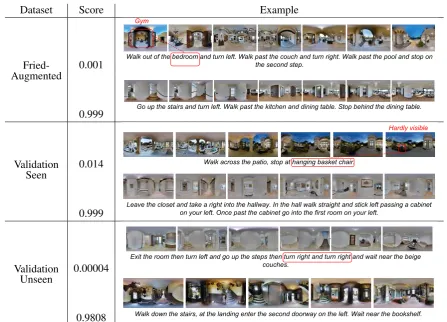
Table 2: Selected samples from datasets with discriminator scores.
negatives helps model performance across the board. Simple mismatch patterns in PS negatives help bootstrap the model with a good initial policy for further fine-tuning on tougher negatives pat-terns in PR and RW variations. For example in PS negatives, a path that starts in a bathroom does not match with an instruction that begins with “Exit the bedroom.”–this would be an easy discrimina-tion pair. In contrast, learning from just PR and RW negatives fails to reach similar performance. To further confirm this hypothesis, we train a dis-criminator using curriculum learning (Bengio et al.,
2009) where the model is first trained on only PS negatives and then fine-tuned on PR and RW nega-tives. This strategy outperforms all others, and the resulting best performing discriminator is used for conducting studies in the following subsections.
Discriminator Score DistributionFig.2shows the discriminator’s score distribution on different R2R datasets. Since Fried-Augmented con-tains paths from houses seen during training, it would be expected that discriminator’s scores on
validation seenandFried-Augmenteddatasets be the same if the data quality is comparable. How-ever there is a clear gap in the discriminator’s
con-fidence between the two datasets. This matches our subjective analysis of Fried-Augmented
where we observed many paths had clear start-ing/ending descriptions but the middle sections were often garbled and had little connection to the perceptual path being described. Table2contains some samples with corresponding discriminator scores.
Finally we note that the discriminator scores onvalidation unseenare rather conservative even though the model differentiates between positives and negatives from validation set reasonably well (last row in Table1).
4.2 Training Navigation Agent
We conducted studies on various approaches to incorporate selected samples from
Dataset size Strategy PL NE↓ SR↑ SPL↑
U S U S U S U S
1%
Top 11.2 11.1 8.5 8.5 20.4 21.2 16.6 17.6
Bottom 10.8 10.7 8.9 9.0 15.4 16.3 14.1 13.1 Random Full 11.7 12.5 8.1 8.3 22.1 21.2 17.9 16.6 Random Bottom 14.2 15.8 8.4 8.1 19.7 21.7 14.3 15.6 Random Top 15.9 15.6 7.9 7.6 22.6 25.4 15.2 14.8
2%
Top 11.3 11.7 8.2 7.9 22.3 25.5 18.5 21.0 Bottom 11.4 14.5 8.4 9.1 17.5 17.7 14.1 12.7 Random Full 13.3 10.8 7.9 7.9 24.3 25.5 18.2 22.7
Random Bottom 15.2 18.2 8.1 8.1 20.5 20.8 11.8 16.0 Random Top 12.9 14.0 7.6 7.5 25.6 25.8 19.5 19.7
5%
[image:6.595.107.494.62.291.2]Top 17.6 16.9 7.7 7.2 24.6 28.2 14.4 18.2 Bottom 10.0 10.2 8.3 8.2 20.1 23.2 17.1 19.4 Random Full 17.8 21.4 7.3 7.0 27.2 29.1 16.4 14.3 Random Bottom 16.3 10.4 7.9 8.3 22.1 23.0 14.2 20.1 Random Top 20.0 15.0 7.0 6.9 27.7 30.6 14.8 22.1
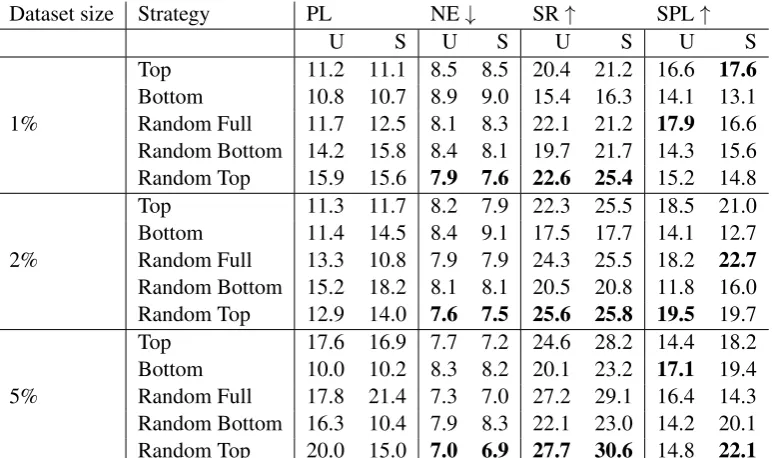
Table 3: Results on R2R validation unseen paths (U) and seen paths (S) when trained only with small fraction of Fried-Augmentedordered by discriminator scores. ForRandom Fullstudy, examples are sampled uniformly over entire dataset. ForRandom Top/Bottomstudy, examples are sampled from top/bottom 40% of ordered dataset. SPL and SR are reported as percentages and NE and PL in meters.
Fried-Augmentedto R2R traindataset, only the top 1% fromFried-Augmentedis needed to match the performance on existing benchmarks.
Training Setup. The training setup of the navi-gation agent is identical toFried et al.(2018). The agent learns to map the natural language instruc-tionX and the initial visual scenev1to a sequence
of actionsa1..T. Language instructionsX =x1..n
are initialized with pre-trained GloVe word em-beddings (Pennington et al., 2014) and encoded using a bidirectional RNN (Schuster and Paliwal,
1997). At each time step t, the agent perceives a 360-degree panoramic view of its surroundings from the current location. The view is discretized intomview angles (m= 36in our implementation, 3 elevations x 12 headings at 30-degree intervals). The image at view angle i, heading angleφand elevation angleθis represented by a concatenation of the pre-trained CNN image features with the 4-dimensional orientation feature [sinφ; cosφ; sin
θ; cosθ] to formvt,i. As inFried et al.(2018), the
agent is trained usingstudent forcingwhere actions are sampled from the model during training, and supervised using a shortest-path action to reach the goal state.
Training using Fried-Augmented only.
The experiments in Table3are based on training a navigation agent on different fractions of the
Fried-Augmenteddataset (X={1%,2%,5%}) and sampling from different parts of the discrim-inator score distribution (Top, Bottom, Random Full,Random Top,Random Bottom). The trained agents are evaluated on bothvalidation seenand
validation unseendatasets.
Not surprisingly, the agents trained on examples sampled from the Top score distribution consis-tently outperform the agents trained on examples from theBottomscore distribution. Interestingly, the agents trained using theRandom Fullsamples is slightly better than agents trained using just the
Topsamples. This suggests that the agent benefits from higher diversity samples. This is confirmed by the studyRandom Topwhere the agents trained using high quality samples with sufficient diversity consistently outperform all other agents.
Training using both R2R train and
Fried-Augmented. To further investi-gate the utility of the discriminator, the navigation agent is trained with the full R2R train dataset (which contains human annotated data) as well as selected fractions of Fried-Augmented1. Table4shows the results.
1We tried training onFried-Augmentedfirst and then
Dataset PL NE↓ SR↑ SPL↑
U S U S U S U S
[image:7.595.144.454.62.212.2]Benchmark2 - - 6.6 3.36 35.5 66.4 - -0% 17.8 18.5 6.8 5.3 32.1 46.1 21.9 30.3 1% 12.5 11.2 6.4 5.7 35.2 45.3 28.9 39.1 2% 14.5 15.1 6.5 5.5 35.7 44.6 27.0 34.1 5% 17.0 12.9 6.1 5.6 36.0 44.8 23.6 37.0 40% 14.9 11.9 6.4 5.5 36.5 49.1 27.1 43.4 60% 16.8 15.7 6.3 5.3 36.0 47.2 24.7 35.4 80% 17.1 18.5 6.2 5.2 35.8 45.0 23.8 29.6 100% 15.6 15.9 6.4 4.9 36.0 51.9 29.0 43.0
Table 4: Results3 on R2R validation unseen (U) and validation seen (S) paths when trained with full training set and selected fraction ofFried-Augmented. SPL and SR are reported as percentages and NE and PL in meters.
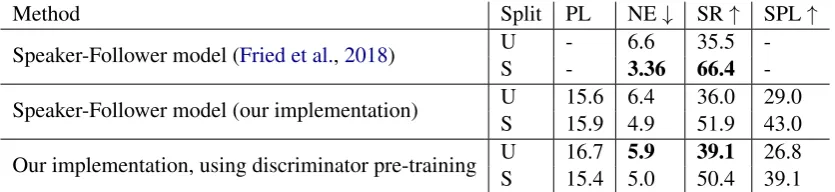
Method Split PL NE↓ SR↑ SPL↑
Speaker-Follower model (Fried et al.,2018) U - 6.6 35.5 -S - 3.36 66.4
-Speaker-Follower model (our implementation) U 15.6 6.4 36.0 29.0 S 15.9 4.9 51.9 43.0
Our implementation, using discriminator pre-training U 16.7 5.9 39.1 26.8 S 15.4 5.0 50.4 39.1
Table 5: Results on R2R validation unseen (U) and validation seen (S) paths after initializing navigation agent’s instruction and visual encoders with discriminator.
Validation Unseen: The performance of the agents trained with just 1%Fried-Augmented
matches with benchmark for NE and SR. With just 5%Fried-Augmented, the agent starts out-performing the benchmark for NE and SR. Since
Fried-Augmentedwas generated by a speaker model that was trained on R2R train, the lan-guage diversity in the dataset is limited, as evi-denced by the unique token count: R2Rtrainhas 2,602 unique tokens whileFried-Augmented
has only unique 369 tokens. The studies show that only a small fraction of top scored
Fried-Augmentedis needed to augment R2R
trainto achieve the full performance gain over the benchmark.
Validation Seen: Since Fried-Augmented
contains paths from houses seen during train-ing, mixing more of it with R2R train helps the agent overfit on validation seen. Indeed, the model’s performance increases nearly mono-tonically on NE and SR as higher fraction of
Fried-Augmentedis mixed in the training data. The agent performs best when it is trained on all of
Fried-Augmented.
Initializing with Discriminator. To further demonstrate the usefulness of the discriminator strategy, we initialize a navigation agent’s instruc-tion and visual encoder using the discriminator’s in-struction and visual encoder respectively. We note here that since the navigation agent encodes the visual input sequence using LSTM, we re-train the best performing discriminator model using LSTM (instead of bidirectional-LSTM) visual encoder so that the learned representations can be transferred correctly without any loss of information. We ob-served a minor degradation in the performance of the modified discriminator. The navigation agent so initialized is then trained as usual usingstudent
2
For a fair comparison, the benchmark is the Speaker-Follower model fromFried et al.(2018) which uses panoramic action space and augmented data, but no beam search (prag-matic inference).
3
[image:7.595.91.509.270.366.2]Turn right and exit the door . Once out turn right and go to the end of the hallway and turn right , enter the bedroom and stop .
1 2
3 4
5 6
(a) (b)
[image:8.595.86.526.73.389.2]1 2 3 4 5 6 1 2 3 4 5 6
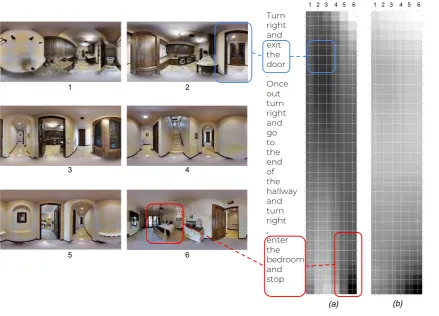
Figure 3: Alignment matrix (Eq.5) for discriminator model trained (a) with curriculum learning on the dataset containing PS, PR, RW negatives (b) without curriculum learning on the dataset with PS negatives only. Note that darker means higher alignment.
forcing. The agent benefits from the multi-modal alignment learned by the discriminator and outper-forms the benchmark on theValidation Unseenset, as shown in Table 5. This is the condition that best informs how well the agent generalizes. Nev-ertheless, performance drops onValidation Seen, so further experimentation will hopefully lead to improvements on both.
4.3 Visualizing Discriminator Alignment
We plot the alignment matrixA (Eq.5) from the discriminator for a given instruction-path pair to try to better understand how well the model learns to align the two modalities as hypothesized. As a com-parison point, we also plot the alignment matrix for a model trained on the dataset with PS negatives only. As discussed before, it is expected that the discriminator trained on the dataset containing only PS negatives tends to exploit easy-to-find patterns in negatives and make predictions without carefully attending to full instruction-path sequence.
Fig.3shows the difference between multi-modal
alignment for the two models. While there is no clear alignment between the two sequences for the model trained with PS negatives only (except maybe towards the end of sequences, as expected), there is a visible diagonal pattern in the alignment for the best discriminator. In fact, there is appre-ciable alignment at the correct positions in the two sequences, e.g., the phraseexit the dooraligns with the image(s) in the path containing the objectdoor, and similarly for the phraseenter the bedroom.
5 Related Work
The release of Room-to-Room (R2R for short) dataset (Anderson et al., 2018b) has sparked re-search interest in multi-modal understanding. The dataset presents a unique challenge as it not only substitutes virtual environments (e.g.,MacMahon
et al. (2006)) with photo-realistic environments
methods (Anderson et al.,2018b;Fried et al.,2018;
Wang et al.,2018a;Ma et al.,2019a;Wang et al.,
2018b;Ma et al.,2019b) have been proposed
re-cently to solve the navigation task described in R2R dataset. All these methods build models for agents that learn to navigate in R2R environment and are trained on the entire R2R dataset as well as the augmented dataset introduced byFried et al.(2018) which is generated by a speaker model trained on human-annotated instructions.
Our work is inspired by the idea of Generative Adversarial Nets (Goodfellow et al.,2014), which use a discriminative model to discriminate real and fake distribution from generative model. We pro-pose models that learn to discriminate between high-quality instruction-path pairs from lower qual-ity pairs. This discriminative task becomes im-portant for VLN challenges as the data is usually limited in such domains and data augmentation is a common trick used to overcome the short-age of available human-annotated instruction-path pairs. While all experiments in this work focus on R2R dataset, same ideas can easily be extended to improve navigation agents for other datasets like Touchdown (Chen et al.,2018).
6 Conclusion
We show that the discriminator model is capable of differentiating high-quality examples from low-quality ones in machine-generated augmentation to VLN datasets. The discriminator when trained withalignment basedsimilarity score on cheaply mined negative paths learns to align similar con-cepts in the two modalities. The navigation agent when initialized with the discriminator generalizes to instruction-path pairs from previously unseen environments and outperforms the benchmark.
For future work, the discriminator can be used in conjunction with generative models producing ex-tensions to human-labeled data, where it can filter out low-quality augmented data during generation as well as act as a reward signal to incentivize gen-erative model to generate higher quality data. The multi-modal alignment learned by the discrimina-tor can be used to segment the instruction-path pair into several shorter instruction-path pairs which can then be used for creating a curriculum of easy to hard tasks for the navigation agent to learn on. It is worth noting that the trained discriminator model is general enough to be useful for any downstream task which can benefit from such multi-modal
align-ment measure and not limited to VLN task that we use in this work.
References
Peter Anderson, Angel Chang, Devendra Singh Chap-lot, Alexey Dosovitskiy, Saurabh Gupta, Vladlen Koltun, Jana Kosecka, Jitendra Malik, Roozbeh Mot-taghi, Manolis Savva, and Amir R. Zamir. 2018a. On evaluation of embodied navigation agents. arXiv preprint arXiv:1807.06757.
Peter Anderson, Qi Wu, Damien Teney, Jake Bruce, Mark Johnson, Niko S¨underhauf, Ian Reid, Stephen Gould, and Anton van den Hengel. 2018b. Vision-and-language navigation: Interpreting visually-grounded navigation instructions in real environ-ments. In Proceedings of the IEEE Conference on Computer Vision and Pattern Recognition (CVPR).
Yoshua Bengio, J´erˆome Louradour, Ronan Collobert, and Jason Weston. 2009. Curriculum learning. In Proceedings of the 26th Annual International Con-ference on Machine Learning, ICML ’09, pages 41– 48, New York, NY, USA. ACM.
Howard Chen, Alane Suhr, Dipendra Kumar Misra, Noah Snavely, and Yoav Artzi. 2018. Touchdown: Natural language navigation and spatial reasoning in visual street environments.CoRR, abs/1811.12354.
Xinlei Chen, Hao Fang, Tsung-Yi Lin, Ramakr-ishna Vedantam, Saurabh Gupta, Piotr Doll´ar, and C. Lawrence Zitnick. 2015. Microsoft COCO cap-tions: Data collection and evaluation server. CoRR, abs/1504.00325.
Volkan Cirik, Yuan Zhang, and Jason Baldridge. 2018. Following formulaic map instructions in a street sim-ulation environment. In2018 NeurIPS Workshop on Visually Grounded Interaction and Language.
Daniel Fried, Ronghang Hu, Volkan Cirik, Anna Rohrbach, Jacob Andreas, Louis-Philippe Morency, Taylor Berg-Kirkpatrick, Kate Saenko, Dan Klein, and Trevor Darrell. 2018. Speaker-follower models for vision-and-language navigation. InNeural Infor-mation Processing Systems (NeurIPS).
Ross B. Girshick, Jeff Donahue, Trevor Darrell, and Ji-tendra Malik. 2014. Rich feature hierarchies for ac-curate object detection and semantic segmentation. In 2014 IEEE Conference on Computer Vision and Pattern Recognition, CVPR 2014, Columbus, OH, USA, June 23-28, 2014, pages 580–587.
David Harwath, Adri`a Recasens, D´ıdac Sur´ıs, Galen Chuang, Antonio Torralba, and James R. Glass. 2018. Jointly discovering visual objects and spoken words from raw sensory input. InComputer Vision - ECCV 2018 - 15th European Conference, Munich,
Germany, September 8-14, 2018, Proceedings, Part VI, pages 659–677.
Karl Moritz Hermann, Mateusz Malinowski, Piotr Mirowski, Andras Banki-Horvath, and Raia Hadsell Keith Anderson. 2019. Learning to follow direc-tions in street view.CoRR, abs/1903.00401.
Chih-Yao Ma, Jiasen Lu, Zuxuan Wu, Ghassan Al-Regib, Zsolt Kira, Richard Socher, and Caiming Xiong. 2019a. Self-monitoring navigation agent via auxiliary progress estimation. InProceedings of the International Conference on Learning Representa-tions (ICLR).
Chih-Yao Ma, Zuxuan Wu, Ghassan AlRegib, Caiming Xiong, and Zsolt Kira. 2019b. The regretful agent: Heuristic-aided navigation through progress estima-tion.
Matt MacMahon, Brian Stankiewicz, and Benjamin Kuipers. 2006. Walk the talk: Connecting language, knowledge, action in route instructions. InIn Proc. of the Nat. Conf. on Artificial Intelligence (AAAI, pages 1475–1482.
Jeffrey Pennington, Richard Socher, and Christopher Manning. 2014.Glove: Global vectors for word rep-resentation. InProceedings of the 2014 Conference on Empirical Methods in Natural Language Process-ing (EMNLP), pages 1532–1543. Association for Computational Linguistics.
Mike Schuster and Kuldip K. Paliwal. 1997. Bidirec-tional recurrent neural networks. IEEE Trans. Sig-nal Processing, 45:2673–2681.
Oriol Vinyals, Alexander Toshev, Samy Bengio, and Dumitru Erhan. 2017. Show and tell: Lessons learned from the 2015 MSCOCO image captioning challenge. IEEE Trans. Pattern Anal. Mach. Intell., 39(4):652–663.
Harm de Vries, Kurt Shuster, Dhruv Batra, Devi Parikh, Jason Weston, and Douwe Kiela. 2018. Talk the walk: Navigating new york city through grounded dialogue.CoRR, abs/1807.03367.
Jiang Wang, Yang Song, Thomas Leung, Chuck Rosen-berg, Jingbin Wang, James Philbin, Bo Chen, and Ying Wu. 2014. Learning fine-grained image simi-larity with deep ranking. InProceedings of the 2014 IEEE Conference on Computer Vision and Pattern Recognition, CVPR ’14, pages 1386–1393, Wash-ington, DC, USA. IEEE Computer Society.
Xin Wang, Qiuyuan Huang, Asli C¸ elikyilmaz, Jian-feng Gao, Dinghan Shen, Yuan-Fang Wang, William Yang Wang, and Lei Zhang. 2018a. Re-inforced cross-modal matching and self-supervised imitation learning for vision-language navigation. CoRR, abs/1811.10092.
Xin Wang, Wenhan Xiong, Hongmin Wang, and William Yang Wang. 2018b. Look before you leap: Bridging model-free and model-based rein-forcement learning for planned-ahead vision-and-language navigation. In Computer Vision – ECCV 2018, pages 38–55, Cham. Springer International Publishing.
Haonan Yu and Jeffrey Mark Siskind. 2013. Grounded language learning from video described with sen-tences. In Proceedings of the 51st Annual Meet-ing of the Association for Computational LMeet-inguistics, ACL 2013, 4-9 August 2013, Sofia, Bulgaria, Volume 1: Long Papers, pages 53–63.