35
compare-mt
:
A Tool for Holistic Comparison of Language Generation Systems
Graham Neubig, Zi-Yi Dou, Junjie Hu, Paul Michel, Danish Pruthi, Xinyi Wang Language Technologies Institute, Carnegie Mellon University
Abstract
In this paper, we describe compare-mt, a tool for holistic analysis and comparison of the results of systems for language generation tasks such as machine translation. The main goal of the tool is to give the user a high-level and coherent view of the salient differences between systems that can then be used to guide further analysis or system improvement. It im-plements a number of tools to do so, such as analysis of accuracy of generation of partic-ular types of words, bucketed histograms of sentence accuracies or counts based on salient characteristics, and extraction of characteristic
n-grams for each system. It also has a number
of advanced features such as use of linguistic labels, source side data, or comparison of log likelihoods for probabilistic models, and also aims to be easily extensible by users to new types of analysis. compare-mtis a pure-Python open source package,1that has already
proven useful to generate analyses that have been used in our published papers.
1 Introduction
Tasks involving the generation of natural language are ubiquitous in NLP, including machine trans-lation (MT; Koehn (2010)), language generation from structured data (Reiter and Dale,2000), sum-marization (Mani, 1999), dialog response gener-ation (Oh and Rudnicky, 2000), image caption-ing (Mitchell et al., 2012). Unlike tasks that in-volve prediction of a single label such as text classification, natural language texts are nuanced, and there are not clear yes/no distinctions about whether outputs are correct or not. Evaluation measures such as BLEU (Papineni et al., 2002), ROUGE (Lin, 2004), METEOR (Denkowski and Lavie,2011), and many others attempt to give an
1Code http://github.com/neulab/compare-mt and video demohttps://youtu.be/K-MNPOGKnDQare available.
compare-mt
Reference
Sys1 Output
Sys2 Output
[image:1.595.316.514.224.362.2]Input
Report
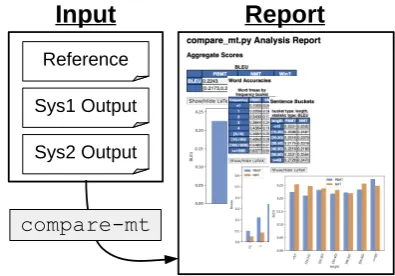
Figure 1: Workflow of usingcompare-mtfor analy-sis of two systems
overall idea of system performance, and technical research often attempts to improve accuracy ac-cording to these metrics.
However, as useful as these metrics are, they are often opaque: if we see, for example, that an MT model has achieved a gain in one BLEU point, this does not tell us what characteristics of the output have changed. Without fine-grained anal-ysis, readers of research papers, or even the writ-ers themselves can be left scratching their heads asking “what exactly is the source of the gains in accuracy that we’re seeing?”
or others not intimately familiar with the task at hand. In addition, creation of special-purpose one-off analysis scripts is time-consuming.
In this paper, we presentcompare-mt, a tool for holistic comparison and analysis of the re-sults of language generation systems. The main use case ofcompare-mt, illustrated in1, is that once a developer obtains multiple system outputs (e.g. from a baseline system and improved sys-tem), they feed these outputs along with a refer-ence output into compare-mt, which extracts aggregate statistics comparing various aspects of these outputs. The developer can then quickly browse through this holistic report and note salient differences between the systems, which will then guide fine-grained analysis of specific examples that elucidate exactly what is changing between the two systems.
Examples of the aggregate statistics generated bycompare-mtare shown in§2, along with de-scription of how these lead to discovery of salient differences between systems. These statistics in-clude word-level accuracies for words of different types, sentence-level accuracies or counts for sen-tences of different types, and salient n-grams or
sentences where one system does better than the other. §4demonstrates compare-mt’s practical applicability by showing some case studies where has already been used for analysis in our previ-ously published work. AppendixAfurther details more advanced functionality of compare-mt that can make use of specific labels, perform anal-ysis over source side text through alignments, and allow simple extension to new types of analy-sis. The methodology in compare-mt is in-spired by several previous works onautomatic er-ror analysis(Popovi´c and Ney,2011), and we per-form an extensive survey of the literature, note how many of the methods proposed in previous work can be easily realized by using functionality incompare-mt, and detail the differences with other existing toolkits in AppendixB.
2 Basic Analysis usingcompare-mt Using compare-mt with the default settings is as simple as typing
compare-mt ref sys1 sys2
where ref is a manually curated reference file, andsys1 andsys2 are the outputs of two sys-tems that we would like to compare. These
analy-PBMT NMT Win?
BLEU 22.43 24.03 s2>s1 [21.76,23.19] [23.33,24.65] p<0.001
RIBES 80.00 80.00
-[79.39,80.64] [79.44,80.92] p=0.44 Length 94.79 93.82 s1>s2
[image:2.595.309.524.61.151.2][94.10,95.49] [92.90,94.85] p<0.001
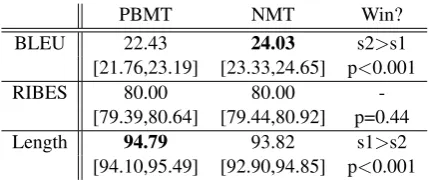
Table 1: Aggregate score analysis with scores, confi-dence intervals, and pairwise significance tests.
sis results can be written to the terminal in text for-mat, but can also be written to a formatted HTML file with charts and LaTeX tables that can be di-rectly used in papers or reports.2
In this section, we demonstrate the types of analysis that are provided by this standard usage of compare-mt. Specifically, we use the ex-ample of comparing phrase-based (Koehn et al.,
2003) and neural (Bahdanau et al.,2015) Slovak-English machine translation systems fromNeubig and Hu(2018).
Aggregate Score Analysis The first variety of analysis is not unique tocompare-mt, answer-ing the standard question posed by most research papers: “given two systems, which one has better accuracy overall?”It can calculate scores accord-ing to standard BLEU (Papineni et al.,2002), as well as other measures such as output-to-reference length ratio (which can discover systematic bi-ases towards generating too-long or too-short sen-tences) or alternative evaluation metrics such as chrF (Popovi´c, 2015) and RIBES (Isozaki et al.,
2010). compare-mt also has an extensible Scorerclass, which will be used to expand the metrics supported bycompare-mtin the future, and can be used by users to implement their own metrics as well. Confidence intervals and signif-icance of differences in these scores can be mea-sured using bootstrap resampling (Koehn,2004).
Fig. 1shows the concrete results of this anal-ysis on our PBMT and NMT systems. From the results we can see that the NMT achieves higher BLEU but shorter sentence length, while there is no significant difference in RIBES.
Bucketed Analysis A second, and more nuanced, variety of analysis supported by
(a) Word F-measure bucketed
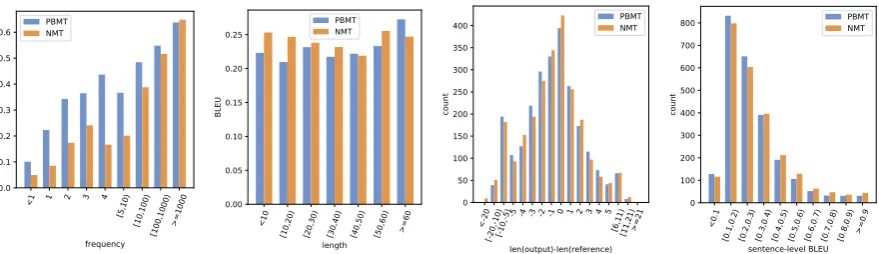
[image:3.595.82.522.64.191.2]by frequency. (b) BLEU bucketed by sen-tence length. (c) Counts of sentences bylength difference. (d) Counts of sentences bysentence-level BLEU.
Figure 2: Examples of bucketed analysis
compare-mt is bucketed analysis, which assigns words or sentences to buckets, and calculates salient statistics over these buckets.
Specifically, bucketed word accuracy analysis attempts to answer the question “which types of words can each system generate better than the other?” by calculating word accuracy by bucket. One example of this, shown in Fig. 2a, is mea-surement of word accuracy bucketed by frequency in the training corpus. By default this “accuracy” is defined as f-measure of system outputs with re-spect to the reference, which gives a good over-all picture of how well the system is doing, but it is also possible to separately measure precision or recall, which can demonstrate how much a system over- or under-produces words of a specific type as well. From the results in the example, we can see that both PBMT and NMT systems do more poorly on rare words, but the PBMT system tends to be more robust to low-frequency words while the NMT system does a bit better on very high-frequency words.
A similar analysis can be done on the sentence level, attempting to answer questions of“on what types of sentences can one system perform bet-ter than the other?” In this analysis we define the “bucket type”, which determines how we split sentences into bucket, and the “statistic” that we calculate for each of these buckets. For example, compare-mt calculates three types of analysis by default:
• bucket=length, statistic=score: This calcu-lates the BLEU score by reference sentence length, indicating whether a system does bet-ter or worse at shorbet-ter or longer sentences. From the Fig. 2b, we can see that the PBMT
system does better at very long sentences, while the NMT system does better at very short sentences.
• bucket=lengthdiff, statistic=count: This outputs a histogram of the number of sen-tences that have a particular length differ-ence from the referdiffer-ence output. A distribu-tion peaked around 0 indicates that a system generally matches the output length, while a flatter distribution indicates a system has trouble generating sentences of the correct length Fig. 2c indicates that while PBMT rarely generates extremely short sentences, NMT has a tendency to do so in some cases.
• bucket=score, statistic=count:This outputs a histogram of the number of sentences re-ceiving a particular score (e.g. sentence-level BLEU score). This shows how many sen-tences of a particular accuracy each system outputs. Fig. 2d, we can see that the PBMT system has slightly more sentences with low scores.
These are just three examples of the many differ-ent types of sdiffer-entence-level analysis that are pos-sible with difference settings of the bucket and statistic types.
n-gram m1 m2 s
phantom 34 1 0.945
Amy 9 0 0.909
, who 8 0 0.900
my mother 7 0 0.889
else happened 5 0 0.857 going to show you 0 6 0.125 going to show 0 6 0.125
hemisphere 0 5 0.143
Is 0 5 0.143
[image:4.595.309.521.61.144.2]’m going to show 0 5 0.143
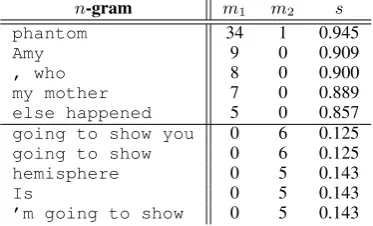
Table 2: Examples discovered byn-gram analysis
each system, and tries to find n-grams that each
system is better at producing than the other (Akabe et al.,2014). Specifically, it counts the number of times each system matches each ngramx, defined
asm1(x)andm2(x)respectively, and calculates a
smoothed probability of ann-gram match coming
from one system or another:
p(x) = m1(x) +↵
m1(x) +m2(x) + 2↵
. (1)
Intuitively,n-grams where the first system excels
will have a high value (close to 1), and when the second excels the value will be low (close to 0). If smoothing coefficient↵is set high, the system
will prefer frequentn-grams with robust statistcs,
and when ↵is low, the system will prefer highly
characteristicn-grams with a high ratio of matches
in one system compared to the other.
An example of n-grams discovered with this
analysis is shown in Tab. 2. From this, we can then explore the references and outputs of each system, and figure out what phenomena resulted in these differences in n-gram accuracy. For
ex-ample, further analysis showed that the relatively high accuracy of “hemisphere” for the NMT tem was due to the propensity of the PBMT sys-tem to output the mis-spelling “hemispher,” which it picked up from a mistaken alignment. This may indicate the necessity to improve alignments for word stems, a problem that could not have easily been discovered from the bucketed analysis in the previous section.
Sentence Example Analysis Finally, compare-mt makes it possible to analyze and compare individual sentence examples based on statistics, or differences of statistics. Specifi-cally, we can calculate a measure of accuracy of each sentence (e.g. sentence-level BLEU score), sort the sentences in the test set according to the difference in this measure, then display the
Ref/Sys BLEU Text
Ref - Beth Israel ’s in Boston . PBMT 1.00 Beth Israel ’s in Boston . NMT 0.41 Beat Isaill is in Boston .
[image:4.595.88.275.63.176.2]Ref - And what I ’m talking about is this . PBMT 0.35 And that ’s what I ’m saying is this . NMT 1.00 And what I ’m talking about is this .
Table 3: Sentence-by-sentence examples
examples where the difference in evaluation is largest in either direction.
Tab.3shows two examples (cherry-picked from the top 10 sentence examples due to space limi-tations). We can see that in the first example, the PBMT-based system performs better on accurately translating a low-frequency named entity, while in the second example the NMT system accurately generates a multi-word expression with many fre-quent words. These concrete examples can both help reinforce our understanding of the patterns found in the holistic analysis above, or uncover new examples that may lead to new methods for holistic analysis.
3 Advanced Features
Here we discuss advanced features that allow for more sophisticated types of analysis using other sources of information than the references and sys-tem outputs themselves.
Label-wise Abstraction One feature that greatly improves the flexibility of analysis is compare-mt’s ability to do analysis over arbi-trary word labels. For example, we can perform word accuracy analysis where we bucket the words by POS tags, as shown in4. In the case of the PBMT vs. NMT analysis above, this uncovers the interesting fact that PBMT was better at gen-erating base-form verbs, whereas NMT was better at generating conjugated verbs. This can also be applied to then-gram analysis, finding which
POSn-grams are generated well by one system or
another, a type of analysis that was performed by
Chiang et al. (2005) to understand differences in reordering between different systems.
Figure 3: Word F-measure bucketed by POS tag.
also be used for other kinds of analysis. For exam-ple, one may perform analysis to find accuracy of generation of words with particular morphological tags (Popovi´c et al.,2006), or words that appear in a sentiment lexicon (Mohammad et al.,2016). Source-side Analysis While most analysis up until this point focused on whether a particular word on the target side is accurate or not, it is also of interest what source-side words are or are not accurately translated.compare-mtalso sup-ports word accuracy analysis for source-language words given the source language input file, and alignments between the input, and both the refer-ence and the system outputs. Using alignments, compare-mt finds what words on the source side were generated correctly or incorrectly on the target side, and can do aggregate word accuracy analysis, either using word frequency or labels such as POS tags.
Word Likelihood Analysis Finally, as many re-cent methods can directly calculate a log likeli-hood for each word, we also provide another tool compare-ll that makes it possible to perform holistic analysis of these log likelihoods. First, the user creates a file where there is one log likelihood for each word in the reference file, and then, like the word accuracy analysis above,compare-ll can calculate aggregate statistics for this log like-lihood based on word buckets.
Extendingcompare-mt One other useful fea-ture is compare-mt’s ability to be easily ex-tended to new types of analysis. For example,
• If a user is interested in using a different eval-uation metric, they could implement a new instance of theScorerclass and use it for
both aggregate score analysis (with signifi-cance tests), sentence bucket analysis, or sen-tence example analysis.
• If a user wanted to bucket words accord-ing to a different type of statistic or feature, they could implement their own instance of aBucketerclass, and use this in the word accuracy analysis.
4 Example Use-cases
To emphasize compare-mt’s practical utility, we also provide examples of how it has already been used in analyses in published research pa-pers: Figs. 4 and 5 of Wang et al. (2018) use sentence-level bucketed analysis. Tab. 7 of Qi et al. (2018) and Tab. 8 of Michel and Neubig
(2018) show the results ofn-gram analysis. Fig.
2 ofQi et al.(2018), Fig. 4 ofSachan and Neu-big(2018), Tab. 5 ofKumar and Tsvetkov(2019) show the results of word accuracy analysis. 5 Conclusion
In this paper, we presented an open-source tool for holistic analysis of the results of machine trans-lation or other language generation systems. It makes it possible to discover salient patterns that may help guide further analysis.
compare-mtis evolving, and we plan to add more functionality as it becomes necessary to fur-ther understand cutting-edge techniques for MT. One concrete future plan includes better integra-tion with example-by-example analysis (after do-ing holistic analysis, clickdo-ing through to individual examples that highlight each trait), but many more improvements will be made as the need arises.
References
Koichi Akabe, Graham Neubig, Sakriani Sakti, Tomoki Toda, and Satoshi Nakamura. 2014. Discriminative language models as a tool for machine translation error analysis. InProc. COLING, pages 1124–1132. Wilker Aziz, Sheila Castilho, and Lucia Specia. 2012. Pet: a tool for post-editing and assessing machine translation. InProc. LREC, pages 3982–3987. Dzmitry Bahdanau, Kyunghyun Cho, and Yoshua
Ben-gio. 2015. Neural machine translation by jointly learning to align and translate. InProc. ICLR. Rachel Bawden, Rico Sennrich, Alexandra Birch, and
Barry Haddow. 2018. Evaluating Discourse Phe-nomena in Neural Machine Translation. In Proc. NAACL, pages 1304–1313, New Orleans, Louisiana. Association for Computational Linguistics.
Luisa Bentivogli, Arianna Bisazza, Mauro Cettolo, and Marcello Federico. 2016. Neural versus phrase-based machine translation quality: a case study. In
Proc. EMNLP, pages 257–267, Austin, Texas. Asso-ciation for Computational Linguistics.
Alexandra Birch, Miles Osborne, and Phil Blunsom. 2010. Metrics for mt evaluation: evaluating reorder-ing. Machine Translation, 24(1):15–26.
Konstantinos Chatzitheodorou and Stamatis Chatzis-tamatis. 2013. COSTA MT evaluation tool: An open toolkit for human machine translation evalua-tion. The Prague Bulletin of Mathematical Linguis-tics, 100(1):83–89.
David Chiang, Adam Lopez, Nitin Madnani, Christof Monz, Philip Resnik, and Michael Subotin. 2005. The hiero machine translation system: Extensions, evaluation, and analysis. In Proc. EMNLP, pages 779–786.
Steve DeNeefe, Kevin Knight, and Hayward H. Chan. 2005. Interactively exploring a machine translation model. InProc. ACL, pages 97–100. Association for Computational Linguistics.
Michael Denkowski and Alon Lavie. 2011. Meteor 1.3: Automatic Metric for Reliable Optimization and Evaluation of Machine Translation Systems. In
Proc. WMT, pages 85–91.
Yanzhuo Ding, Yang Liu, Huanbo Luan, and Maosong Sun. 2017. Visualizing and understanding neural machine translation. InProceedings of the 55th An-nual Meeting of the Association for Computational Linguistics (Volume 1: Long Papers), volume 1, pages 1150–1159.
Ahmed El Kholy and Nizar Habash. 2011. Automatic error analysis for morphologically rich languages. InProc. MT Summit, pages 225–232.
Christian Federmann. 2012. Appraise: an open-source toolkit for manual evaluation of mt output.
The Prague Bulletin of Mathematical Linguistics, 98(1):25–35.
Mark Fishel, Rico Sennrich, Maja Popovi´c, and Ondˇrej Bojar. 2012. Terrorcat: a translation er-ror categorization-based mt quality metric. InProc. WMT, pages 64–70.
Mary Flanagan. 1994. Error classification for mt eval-uation. InProc. AMTA, pages 65–72.
Meritxell Gonz`alez, Jes´us Gim´enez, and Llu´ıs M`arquez. 2012. A graphical interface for mt evalu-ation and error analysis. InProceedings of the ACL 2012 System Demonstrations, pages 139–144.
Pierre Isabelle, Colin Cherry, and George Foster. 2017.
A challenge set approach to evaluating machine translation. InProc. EMNLP, pages 2476–2486.
Hideki Isozaki, Tsutomu Hirao, Kevin Duh, Katsuhito Sudoh, and Hajime Tsukada. 2010. Automatic eval-uation of translation quality for distant language pairs. InProc. EMNLP, pages 944–952.
Ondˇrej Klejch, Eleftherios Avramidis, Aljoscha Bur-chardt, and Martin Popel. 2015. Mt-compareval: Graphical evaluation interface for machine transla-tion development. The Prague Bulletin of Mathe-matical Linguistics, 104(1):63–74.
Philipp Koehn. 2004. Statistical significance tests for machine translation evaluation. In Proc. EMNLP, pages 388–395.
Philipp Koehn. 2010. Statistical Machine Translation. Cambridge Press.
Phillip Koehn, Franz Josef Och, and Daniel Marcu. 2003. Statistical phrase-based translation. InProc. HLT, pages 48–54.
Sachin Kumar and Yulia Tsvetkov. 2019. Von mises-fisher loss for training sequence to sequence models with continuous outputs. InProc. of ICLR.
Jaesong Lee, Joong-Hwi Shin, and Jun-Seok Kim. 2017. Interactive visualization and manipulation of attention-based neural machine translation. In
Proceedings of the 2017 Conference on Empirical Methods in Natural Language Processing: System Demonstrations, pages 121–126, Copenhagen, Den-mark. Association for Computational Linguistics.
Chin-Yew Lin. 2004. Rouge: A package for automatic evaluation of summaries. In Text Summarization Branches Out: Proceedings of the ACL-04 Work-shop, pages 74–81.
Adam Lopez and Philip Resnik. 2005. Pattern visual-ization for machine translation output. In Proceed-ings of HLT/EMNLP 2005 Interactive Demonstra-tions, pages 12–13.
Inderjeet Mani. 1999.Advances in automatic text sum-marization. MIT press.
Paul Michel and Graham Neubig. 2018. MTNT: A testbed for machine translation of noisy text. In
Conference on Empirical Methods in Natural Lan-guage Processing (EMNLP), Brussels, Belgium.
Margaret Mitchell, Jesse Dodge, Amit Goyal, Kota Ya-maguchi, Karl Stratos, Xufeng Han, Alyssa Men-sch, Alex Berg, Tamara Berg, and Hal Daume III. 2012. Midge: Generating image descriptions from computer vision detections. InProc. EACL, pages 747–756.
Saif M Mohammad, Mohammad Salameh, and Svet-lana Kiritchenko. 2016. How translation alters sen-timent. Journal of Artificial Intelligence Research, 55:95–130.
Mathias M¨uller, Annette Rios, Elena Voita, and Rico Sennrich. 2018. A large-scale test set for the evalu-ation of context-aware pronoun translevalu-ation in neural machine translation. InProc. WMT, pages 61–72, Belgium, Brussels. Association for Computational Linguistics.
Masaki Murata, Kiyotaka Uchimoto, Qing Ma, Toshiyuki Kanamaru, and Hitoshi Isahara. 2005. Analysis of machine translation systems’ errors in tense, aspect, and modality. InProc. PACLIC.
Sudip Kumar Naskar, Antonio Toral, Federico Gaspari, and Andy Way. 2011. A framework for diagnos-tic evaluation of mt based on linguisdiagnos-tic checkpoints.
Proc. MT Summit, pages 529–536.
Graham Neubig and Junjie Hu. 2018.Rapid adaptation of neural machine translation to new languages. In
Proc. EMNLP, Brussels, Belgium.
Alice H Oh and Alexander I Rudnicky. 2000. Stochas-tic language generation for spoken dialogue sys-tems. In Proceedings of the 2000 ANLP/NAACL Workshop on Conversational systems-Volume 3, pages 27–32. Association for Computational Lin-guistics.
Kishore Papineni, Salim Roukos, Todd Ward, and Wei-Jing Zhu. 2002. BLEU: a method for automatic evaluation of machine translation. In Proc. ACL, pages 311–318.
Maja Popovi´c. 2015. chrf: character n-gram f-score for automatic mt evaluation. InProceedings of the Tenth Workshop on Statistical Machine Translation, pages 392–395, Lisbon, Portugal. Association for Computational Linguistics.
Maja Popovi´c, Adri`a de Gispert, Deepa Gupta, Pa-trik Lambert, Hermann Ney, Jos´e B. Mari˜no, Mar-cello Federico, and Rafael Banchs. 2006. Morpho-syntactic information for automatic error analysis of statistical machine translation output. In Proc. WMT, pages 1–6.
Maja Popovi´c and Hermann Ney. 2007. Word error rates: Decomposition over POS classes and applica-tions for error analysis. InProceedings of the Sec-ond Workshop on Statistical Machine Translation, pages 48–55.
Maja Popovi´c and Hermann Ney. 2011. Towards au-tomatic error analysis of machine translation output.
Computational Linguistics, 37(4):657–688.
Ye Qi, Devendra Sachan, Matthieu Felix, Sarguna Pad-manabhan, and Graham Neubig. 2018. When and why are pre-trained word embeddings useful for neural machine translation? InProc. NAACL, New Orleans, USA.
Ehud Reiter and Robert Dale. 2000. Building natural language generation systems. Cambridge university press.
Devendra Sachan and Graham Neubig. 2018. Parame-ter sharing methods for multilingual self-attentional translation models. In Proc. WMT, Brussels, Bel-gium.
Rico Sennrich. 2017. How Grammatical is Character-level Neural Machine Translation? Assessing MT Quality with Contrastive Translation Pairs. InProc. EACL, pages 376–382, Valencia, Spain.
Sara Stymne. 2011. BLAST: A tool for error analysis of machine translation output. InProceedings of the ACL-HLT 2011 System Demonstrations, pages 56– 61.
David Vilar, Jia Xu, Luis Fernando d’Haro, and Her-mann Ney. 2006. Error analysis of statistical ma-chine translation output. InProc. LREC, pages 697– 702.
Xinyi Wang, Hieu Pham, Pengcheng Yin, and Gra-ham Neubig. 2018. A tree-based decoder for neu-ral machine translation. In Conference on Em-pirical Methods in Natural Language Processing (EMNLP), Brussels, Belgium.
Jonathan Weese and Chris Callison-Burch. 2010. Vi-sualizing data structures in parsing-based machine translation. The Prague Bulletin of Mathematical Linguistics, 93:127–136.
Daniel Zeman, Mark Fishel, Jan Berka, and Ondˇrej Bo-jar. 2011. Addicter: What is wrong with my trans-lations? The Prague Bulletin of Mathematical Lin-guistics, 96(1):79–88.