Automatic Generation and Scoring of Positive Interpretations
from Negated Statements
Eduardo Blanco and Zahra Sarabi
Human Intelligence and Language Technologies Lab University of North Texas
Denton, TX, 76203
[email protected],[email protected]
Abstract
This paper presents a methodology to extract positive interpretations from negated state-ments. First, we automatically generate plau-sible interpretations using well-known gram-mar rules and manipulating semantic roles. Second, we score plausible alternatives ac-cording to their likelihood. Manual annota-tions show that the positive interpretaannota-tions are intuitive to humans, and experimental results show that the scoring task can be automated.
1 Introduction
Negation is an intricate phenomenon present in all human languages (Hoeksema, 2000), and studied from a theoretical perspective since Aristotle. Ac-quiring and understanding negation is more chal-lenging than language in general: children acquire negation after learning to communicate (Nordmeyer and Frank, 2013), and adults take longer to pro-cess negative sentences than positive ones (Clark and Chase, 1972). In any given language, humans communicate in positive terms most of the time, and use negation to express something unusual or an ex-ception (Horn, 1989).
In classical logic, negation is a simple unary op-erator that reverses the truth value of a proposi-tion. In natural language, negation is always marked (Horn and Wansing, 2015) and it is used to re-verse polarity, i.e., turning something affirmative into negative, or something negative into affirma-tive. Albeit most sentences are affirmative, negation is rather ubiquitous (Morante and Sporleder, 2012): In scientific papers, 13.76% of statements contain a negation (Szarvas et al., 2008); in product reviews, 19% (Councill et al., 2010); and in a selection of
Conan Doyle stories, 22.23% (Morante and Daele-mans, 2012). In health records, 12.3% of concepts are tagged as negated (Elkin et al., 2005); and in OntoNotes (Hovy et al., 2006), 10.15% of state-ments contain a verb negated withnot,n’tornever.
From a theoretical perspective, it is accepted that negation conveys positive meaning (Rooth, 1992; Huddleston and Pullum, 2002). For example, when reading (1) John doesn’t eat meat, humans intu-itively understand that (1a) John eats something other than meat, and (1b)Some people eat meat, but not John. Extracting positive interpretations from negated statements automatically is not straightfor-ward: a negated statement may convey one or more positive interpretations, and not all positive interpre-tations are equally likely. For example, from (2)
They didn’t order the right parts, it is very likely that (2a) They ordered the wrong parts, but (2b) Some-body ordered the right parts, but not theyis unlikely. This paper presents a methodology to automati-cally extract and score positive interpretations from negated statements, as intuitively done by humans when reading text. A key feature of the work pre-sented here is that it is not tied to any existing ap-proach to extract meaning from text—we generate positive interpretations in plain text, and these pos-itive interpretations can be semantically represented with any existing approach. The main contributions are: (1) procedure to automatically generate plausi-ble positive interpretations from negated statements, (2) annotations scoring plausible positive interpre-tations,1 and (3) experiments detailing results with
several combinations of features, as well as gold-standard and predicted linguistic information.
1Available athttp://hilt.cse.unt.edu/
2 Background and Definitions
Negation is well-understood in grammars, the valid ways to form a negation are well-documented (Quirk et al., 2000; van der Wouden, 1997). Nega-tion can be expressed by verbs (e.g., avoid doing any look-up), nouns (e.g., the absence of any phonic se-quence), adjectives (e.g., it is pointless to argue with a fool), adverbs (e.g., I never tried Persian food be-fore), prepositions (e.g., you can always exchange it without a problem), determiners (e.g., the new law has no direct implications to international shipping), pronouns (e.g., nobody will keep election promises). Huddleston and Pullum (2002) distinguish four negation types:
• Verbal if the marker of negation is grammati-cally associated with a verb, e.g.,I did not see anything, non-verbal if it is associated with a dependent of the verb, e.g.,I saw nothing. • Synthetic if the negation mark has a
func-tion besides marking a negafunc-tion, e.g.,
[Nobody]AGENT liked it, analytic otherwise, e.g.,Not many people liked it.
• Clausal if the negation yields a negative clause, e.g., The terms aren’t negotiable, subclausal otherwise, e.g.,The terms are non-negotiable. • Ordinary if the negation indicates that
some-thing is not the case, e.g., That car does not drive smooth, metalinguistic if it does not dis-pute the truth but rather reformulates a state-ment, e.g.,That TV is not small, it is tiny. In this paper, we target verbal, analytic, clausal and both ordinary and metalinguistic negation. 2.1 Positive Interpretations.
In philosophy and linguistics, it is generally accepted that negation conveys positive mean-ings (Horn, 1989). These positive meanmean-ings range from implicatures, i.e., what is suggested in an ut-terance even though neither expressed nor strictly implied (Blackburn, 2008), to entailments. Other terms used in the literature include implied mean-ings (Mitkov, 2005), implied alternatives (Rooth, 1985) and semantically similars (Agirre et al., 2013). We do not strictly fit into any of this terminol-ogy, we reveal positive interpretations as intuitively done by humans when reading text.
2.2 Scope and Focus.
From a theoretical perspective, it is accepted that negation has scope and focus, and that the focus— not just the scope—yields positive interpretations (Horn, 1989; Rooth, 1992; Taglicht, 1984). Scope is “the part of the meaning that is negated” and fo-cus “the part of the scope that is most prominently or explicitly negated” (Huddleston and Pullum, 2002). Consider the following statement in the context of the recent refuge crisis: (3) Mr. Haile was not looking for heaven in Europe. By definition, scope refers to “all elements whose individual falsity would make the negated statement strictly true”, and focus is “the element of the scope that is intended to be interpreted as false to make the overall negative true” (Huddleston and Pullum, 2002). The falsity of any of the truth conditions below makes statement (3) true, thus the scope of the negation is (3a–3d):
3a. Somebody was looking for something some-where. [verblooking]
3b. Mr. Haile was looking for something some-where. [AGENTof looking,Mr. Haile]
3c. Somebody was looking for heaven some-where. [THEMEof looking,heaven]
3d. Somebody was looking for something in Eu-rope. [LOCATIONof looking,in Europe]
Determining the focus is almost always more challenging than the scope. The challenge lies on determining which of the truth conditions (3a–3d) is intended to be interpreted as false to make the negated statement true: all of them qualify, but some are more likely. A natural reading of statement (3) suggests thatMr. Haile was looking for something (a regular life, a job, etc.) in Europe, but not heaven. Determining that the focus isheaven, i.e., that ev-erything in statement (3) is actually positive except the THEME oflooking, is the key to reveal the
in-tended positive interpretation. It is worth noting that other foci yield unlikely interpretations, e.g.,
Somebody was looking for heaven in Europe, but not Mr. Haile(3b, AGENT),Mr. Haile was looking for
heaven somewhere, but not in Europe (3d, LOCA -TION). Note that (1) scope on its own does not yield
3 Previous Work
Within computational linguistics, approaches to pro-cess negation are shallow, or target scope and focus detection. Popular semantic representations such as semantic roles (Palmer et al., 2005; Baker et al., 1998) or AMR (Banarescu et al., 2013) do not reveal the positive interpretations we target in this paper. Shallow approaches are usually application-specific. In sentiment and opinion analysis, negation has been reduced to marking as negated all words between a negation cue and the first punctuation mark (Pang et al., 2002), or within a five-word window of a nega-tion cue (Hu and Liu, 2004). The examples through-out this paper show that these techniques are insuffi-cient to reveal implicit positive interpretations. 3.1 Scope Annotation and Detection
Scope of negation detection has received a lot of attention, mostly using two corpora: BioScope in the medical domain (Szarvas et al., 2008) and CD-SCO (Morante and Daelemans, 2012). BioScope annotates negation cues and linguistic scopes exclu-sively in biomedical texts. CD-SCO annotates nega-tion cues, scopes, and negated events or properties in selected Conan Doyle stories.
There have been several supervised proposals to detect the scope of negation using BioScope and CD-SCO ( ¨Ozg¨ur and Radev, 2009; Øvrelid et al., 2010). Automatic approaches are mature (Abu-Jbara and Radev, 2012): F-scores are 0.96 for nega-tion cue detecnega-tion, and 0.89 for neganega-tion cue and scope detection (Velldal et al., 2012; Li et al., 2010). Outside BioScope and CD-SCO, Reitan et al. (2015) present a negation scope detector for tweets, and show that it improves sentiment analysis. As shown in Section 2, scope detection is insufficient to reveal positive interpretations from negated statements. 3.2 Focus Annotation and Detection
While focus of negation has been studied for decades in philosophy and linguistics (Section 2), corpora and automated tools are scarce. Blanco and Moldovan (2011) annotate focus of negation in the 3,993 negations marked with ARGM-NEGsemantic
role in PropBank (Palmer et al., 2005). Their an-notations, PB-FOC, were used in the *SEM-2012 Shared Task (Morante and Blanco, 2012). Their guidelines require annotators to choose as focus the
semantic role that “is most prominently negated” or the verb. If several roles may be the focus, they prioritize “the one that yields the most meaningful implicit [positive] information”, but do not specify whatmost meaningfulmeans. Consider again state-ment (1) John doesn’t eat meat. Their approach would determine that the focus is theTHEMEofeat,
meat, because it arguably yields the “most meaning-ful implicit [positive] information” (using our termi-nology, positive interpretation):John eats something other than meat. By design, they ignore other valid positive interpretations, e.g.,Some people eat meat, but not John. In this paper, we improve upon their work: instead of extracting the “most meaningful” positive interpretation from a negated statement, we generate several positive interpretations and score them according to their likelihood.
Anand and Martell (2012) present a complimen-tary approach to annotate focus of negation. They refine PB-FOC and argue that positive interpre-tations arising from scalar implicatures and neg-raising predicates should be separated from those arising from focus detection. According to their an-notations, 27.4% of negations with a focus annotated in PB-FOC do not actually have a focus. Blanco and Moldovan (2012) introduce the concept of fine-grained foci and refine the annotations in PB-FOC by annotating foci at the token level, and Matsuyoshi et al. (2014) annotate focus of negation in Japanese. In this paper, we are not concerned about annotat-ing focus of negation per se, but about extractannotat-ing positive interpretations from negated statements as intuitively understood by humans.
Neg. statement In 1995, Murdoch bought [the rest of Star TV]ARG1 that [he]ARG0did [not]ARGM-NEG[own]verb Positive
counterpart
after Step 1 In 1995, Murdoch bought the rest of Star TV that he did own after Step 2 In 1995, Murdoch bought the rest of Star TV that he owned
after Step 3 In 1995, Murdoch bought the rest of Star TV that he owned (no change) Plausible
positive interpretations
fromARG0 In 1995, Murdoch bought the rest of Star TV that [somebody] owned, but nothe
fromARG1 In 1995, Murdoch bought [something] that he owned, but notthe rest of Star TV
fromverb In 1995, Murdoch bought the rest of Star TV that he [some verb], but notowned Table 1:Negated statement, and automatically generated positive counterpart and plausible positive interpretations.
4 Corpus Creation
Our goal is to create a corpus of negated statements and their positive interpretations as intuitively un-derstood by humans. We put a strong emphasis on automation. First, given a negated statement, we automatically generate plausible positive interpreta-tions following a battery of linguistically motivated deterministic rules (Section 4.1). Second, we collect manual annotation to score the plausible positive in-terpretations according to their likelihood (Section 4.2). We then use these manually obtained scores to learn models that automatically score positive inter-pretations (Section 6).
We decided to work on top of OntoNotes (Hovy et al., 2006) instead of plain text or other corpora for several reasons. First, OntoNotes includes gold linguistic annotations such as part-of-speech tags, parse trees and semantic roles. Second, state-of-the-art role labelers trained with Propbank achieve F-measures of 0.835 (Lewis et al., 2015), and we use semantic roles to generate positive interpreta-tions. Third, unlike BioScope, CD-SCO and PB-FOC (Section 2), OntoNotes includes sentences from several genres, e.g., newswire, broadcast news and conversations, magazines, the web.
4.1 Generating Positive Interpretations
OntoNotes2is a large corpus containing 63,918
sen-tences. Annotating all positive interpretations from all negations is outside of the scope of this paper. Instead, we target selected representative negations. Selecting Negated Statements.We first selected all verbs negated with ARGM-NEG semantic role and
obtained 6,617 verbal negations. After examining the negated verbs, it became clear that negation is not uniformly distributed across verbs in OntoNotes,
2We use the CoNLL-2011 Shared Task distribution (Pradhan
et al., 2011),http://conll.cemantix.org/2011/
it roughly follows Zipf’s law. In order to allevi-ate the annotation effort while accounting for all negated verbs in OntoNotes, we randomly selected up to 5 negations for each verb. The number of negated statements selected is 600.
Converting Negated Statements into Their Posi-tive Counterparts. We apply 3 steps inspired after the grammatical rules to form negation detailed by Huddleston and Pullum (2002, Ch. 9):
1. Remove the negation mark by removing the to-kens withinARGM-NEGsemantic role.
2. Remove auxiliaries, expand contractions, and fix third-person singular and past tense. For ex-ample (before: after),doesn’t go: goes,didn’t go:went,won’t go: will go, We use a standard list of irregular verbs,3 and grammar rules to
convert to third-person singular and past tense based on orthographic patterns.
3. Rewrite negatively-oriented polarity-sensitive items. For example (before: after), any-one: someone, any longer: still, yet: al-ready. at all: somewhat. We use the cor-respondences between negatively-oriented and positively-oriented polarity-sensitive items by Huddleston and Pullum (2002, pp. 831).
Generating Positive Interpretations. Once the
positive counterpart is obtained, we generate posi-tive interpretations by rewriting each semantic role or the (originally negated) verb. Among others, we use the following rewriting rules: ARG0–ARG4:
someone / some people / something, ARGM-TMP:
at some point of time, ARGM-LOC: somewhere, ARGM-MNR: in some manner,ARGM-CAU: because
of something andARGM-PRP: to do something.
Ad-ditionally, if the semantic role starts with a prepo-sition, we also include it, e.g.,gave [to John]ARG2:
3https://en.wikipedia.org/wiki/English_
gave to someone, but not John. This methodol-ogy generated 1,888 positive interpretations from the 600 selected negations (average: 3.15).
Table 1 exemplifies the 3 steps to transform a negated statement into its positive counterpart, and the positive interpretations generated. Additional examples are provided in Table 3.
We acknowledge that some of the positive inter-pretations we generate automatically are not as spe-cific or intuitive as carefully crafted, manually gen-erated interpretations could be. For example, from
[John]ARG0 does[n’t]ARGM-NEG [know]verb [the de-tails about how they met]ARG1, the proposed method-ology would generate, among others, John knows about something, but not about the details of how they met. A better interpretations that we do not gen-erate isJohn knows something about how they met, but not the details. We argue that generating inter-pretations automatically is the only option in order to incorporate this work into an NLP pipeline, and reserve for future work generating positive interpre-tations beyond rewriting semantic roles.
4.2 Ranking Positive Interpretations
Once positive interpretations were automatically generated, we asked annotators to rank them. An-notators were presented with one negated statement and one positive interpretation at a time, and were asked Given the negated statement above, do you think the statement [positive interpretation] below is true? They only had access to the text in the original negated statement, the positive interpreta-tion, and the previous and next sentences as context. We did not display semantic role information for the original negated statement, its positive counterpart or the semantic role from which the positive inter-pretation was generated. As we shall see (Section 5.1), context often helps scoring interpretations.
Annotators were required to answer with a score from 0 to 5, were 0 meansabsolutely disagree and 5 meansabsolutely agree. We did not provide de-scriptions for intermediate scores or used additional categorical labels. This simple guidelines were suf-ficient to reliably score plausible positive interpreta-tions automatically generated.
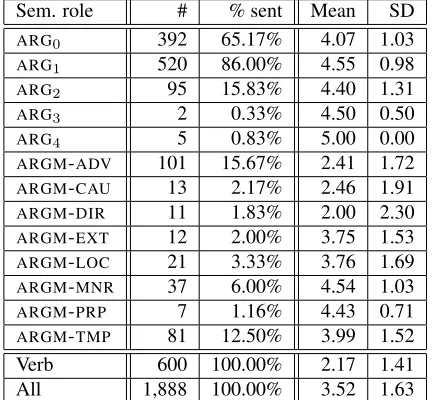
Sem. role # % sent Mean SD
ARG0 392 65.17% 4.07 1.03
ARG1 520 86.00% 4.55 0.98
ARG2 95 15.83% 4.40 1.31
ARG3 2 0.33% 4.50 0.50
ARG4 5 0.83% 5.00 0.00
ARGM-ADV 101 15.67% 2.41 1.72 ARGM-CAU 13 2.17% 2.46 1.91
ARGM-DIR 11 1.83% 2.00 2.30 ARGM-EXT 12 2.00% 3.75 1.53 ARGM-LOC 21 3.33% 3.76 1.69 ARGM-MNR 37 6.00% 4.54 1.03 ARGM-PRP 7 1.16% 4.43 0.71 ARGM-TMP 81 12.50% 3.99 1.52
Verb 600 100.00% 2.17 1.41 All 1,888 100.00% 3.52 1.63 Table 2: Basic corpus analysis. For each semantic role, we show the number of positive interpretations generated (#), the percentage of sentences for which a positive interpretation is generated (% sent), and the mean and standard deviation (SD) of the annotated scores.
5 Corpus Analysis
On average, we generated 3.15 positive interpreta-tions per negation (standard deviation: 0.82), and 74% of negations have at least one interpretation scored 4 or higher. Basic counts and statistics for the annotations are provided in Table 2. Over-all, we annotated 1,888 positive interpretations gen-erated from 600 sentences, or equivalently, from 600 verbs negated with ARGM-NEG semantic role
in OntoNotes. Overall mean score is 3.52 (out of 5) and overall standard deviation, 1.63. The 25th percentile is 2.0, the 50th percentile is 4.0 and the 75th percentile is 5.0. These numbers show that most positive interpretations automatically gener-ated are deemed likely by annotators, and over 25% are scored with a 5 (out of 5).
In general, positive interpretations generated from numbered roles (ARG0–ARG4) are scored higher
than the ones generated from modifiers (ARGM -ADV, ARGM-CAU, ARGM-DIR, etc.). Also, positive
interpretations generated from infrequent roles are generally ranked higher, e.g., ARG4 and ARG3 vs. ARG0,ARGM-PRPandARGM-MNRvs.ARGM-ADV.
Annotation Quality. In order to ensure annotation
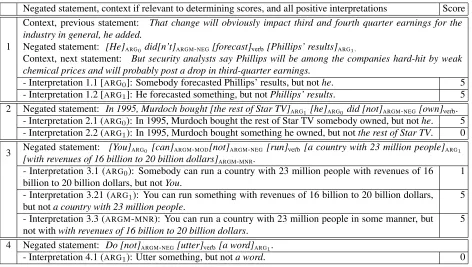
de-Negated statement, context if relevant to determining scores, and all positive interpretations Score
1
Context, previous statement: That change will obviously impact third and fourth quarter earnings for the industry in general, he added.
Negated statement: [He]ARG0did[n’t]ARGM-NEG[forecast]verb[Phillips’ results]ARG1.
Context, next statement: But security analysts say Phillips will be among the companies hard-hit by weak chemical prices and will probably post a drop in third-quarter earnings.
- Interpretation 1.1 [ARG0]: Somebody forecasted Phillips’ results, but nothe. 5
- Interpretation 1.2 [ARG1]: He forecasted something, but notPhillips’ results. 5
2 Negated statement: In 1995, Murdoch bought [the rest of Star TV]ARG1[he]ARG0did [not]ARGM-NEG[own]verb.
- Interpretation 2.1 (ARG0): In 1995, Murdoch bought the rest of Star TV somebody owned, but nothe. 5
- Interpretation 2.2 (ARG1): In 1995, Murdoch bought something he owned, but notthe rest of Star TV. 0
3 Negated statement: [You]ARG0 [can]ARGM-MOD[not]ARGM-NEG [run]verb [a country with 23 million people]ARG1
[with revenues of 16 billion to 20 billion dollars]ARGM-MNR.
- Interpretation 3.1 (ARG0): Somebody can run a country with 23 million people with revenues of 16
billion to 20 billion dollars, but notYou. 1
- Interpretation 3.21 (ARG1): You can run something with revenues of 16 billion to 20 billion dollars,
but nota country with 23 million people. 5
- Interpretation 3.3 (ARGM-MNR): You can run a country with 23 million people in some manner, but not withwith revenues of 16 billion to 20 billion dollars. 5 4 Negated statement: Do [not]ARGM-NEG[utter]verb[a word]ARG1.
[image:6.612.72.544.58.325.2]- Interpretation 4.1 (ARG1): Utter something, but nota word. 0
Table 3:Annotation examples. We show all positive interpretations automatically generated and their scores (out of 5).
signed for categorical labels are not well-suited for our annotation task, since not all disagreements be-tween numeric scores are the same, e.g., 4 vs. 5 should be counted as relatively high agreement, and 1 vs. 5 should be counted as high disagreement. Overall Pearson correlation is 0.761.
5.1 Annotation Examples
Table 3 presents annotation examples. We show the original negated statement including semantic role annotations from OntoNotes (square brackets), all positive interpretations automatically generated, and their scores. We also include context (previous and next sentence) if it helps determining scores.
Example (1) shows that context sometimes is vital to scoring plausible positive interpretations. Given
He didn’t forecast Phillips’ resultsin isolation, it is uncertain if he forecasted anything at all, or whether somebody forecasted Phillips’ results. However, the previous statement makes certain (5/5) the interpre-tation generated fromARG1: he forecasted earnings
for the industry in general. Similarly, the next state-ment makes very likely (5/5) the interpretation gen-erated from ARG0: other people (security analysts)
made forecasts about Phillips. In this example, 2
positive interpretations are generated from one nega-tion, and they are assigned the highest score (5/5).
The positive interpretations generated from exam-ple (2) can be annotated without context. Somebody other than Murdoch had to own the rest of Star TV that he bought in 1995 (score 5/5), and people can-not buy what they already own (score 0/5).
Example (3) presents a positive interpretation generated from ARG0 that is scored low (1/5);
re-call that the mean score for interpretations gener-ated fromARG0 is 4.07 and the standard deviation
Finally, example (4) presents a short statement from which only one positive interpretations is gen-erated. Annotators were asked whether givenDo not utter a word, they think Utter something, but not a wordis true. They correctly annotated that this posi-tive interpretations is invalid (score 0/5). Indeed, the negated statement in example (4) can only be inter-preted as an order to not utter anything.
6 Learning to Score Positive Interpretations
We follow a standard supervised machine learning approach. The 1,888 positive interpretations along with their scores become instances, and we divide them into training (80%) and test splits (20%) mak-ing sure that all interpretations generated from a sen-tence are assigned to either the training or test splits. Note that splitting instances randomly would not be sound: training with some interpretations generated from a negated statement, and testing with the rest of interpretations generated from the same statement would be an unfair evaluation.
We trained a Support Vector Machine (SVM) for regression with RBF kernel using scikit-learn (Pedregosa et al., 2011), which in turn uses LIBSVM (Chang and Lin, 2011). The feature set and SVM parameters (C andγ) were tuned using 10-fold cross-validation with the training set, and re-sults were calculated using the test set.
6.1 Feature Selection
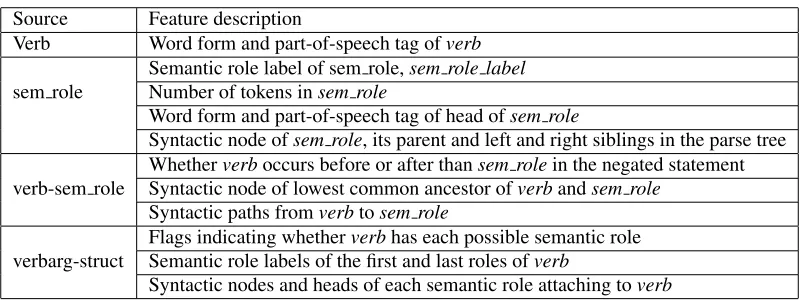
We tried features derived exclusively from the negated statement from which the positive inter-pretation was generated, more specifically, we ex-tract features from the negated verb or semantic role (sem role) used to generate the positive inter-pretation, from both of them (verb-sem role) and from the verb-argument structure ofverb( verbarg-struct), i.e., all semantic roles ofverb.
Verbfeatures are straightforward and account for the verb word form and part-of-speech tag.
Sem rolefeatures include the label of the seman-tic role from which the positive interpretation was generated (sem role label), its length (number of to-kens), and the word form and part-of-speech tag of its head. Additionally, we add standard features in semantic role labeling (Gildea and Jurafsky, 2002):
the syntactic nodes (NP, PP, etc.) of the semantic role and its parent in the parse tree, as well as the left and right siblings, if any.
Verb-sem role features are also standard in role labeling. We include a flag indicating whether the verb occurs before or after the semantic role in the negated statement (not in the positive counterpart), syntactic node of the lowest common ancestor be-tweenverbandsem role, and the syntactic path.
Finally,verbarg-structfeatures encode character-istics of the verb-argument structure to whichverb
andsem rolebelong to. Namely, we added flags in-dicating semantic role presence, and features indi-cating the first and last semantic roles in order of ap-pearance in the negated statement. We also included the syntactic nodes of semantic roles and their heads. We exemplify all features with Interpretation 3.1 generated from Statement 3 in Table 3:
• Verbfeatures: verb wf=run, verb pos=VBP. • Sem rolefeatures: label=ARG0, num tokens=1,
head wf=You, head pos=PRP, synt node=NP, synt node parent=S, synt node left=NONE, synt node right=VP
• Verb-sem role features: direction=after, low-est anclow-estor=S, synt path=VP+VP+S-NP • Verbarg-struct features: ARG0=1, ARGM
-MOD=1,ARG1=1, ARGM-MNR=1, first=ARG0,
last=ARGM-MNR, ARG1 head=country, ARG1 pos=NN, etc.
7 Experimental Results
We report results obtained with several combina-tions of features in Table 5. We detail results ob-tained with features extracted from gold-standard and predicted linguistic annotations (part-of-speech tags, parse trees, semantic roles, etc.) as annotated in the gold and auto files from the CoNLL-2011 Shared Task release of OntoNotes (Pradhan et al., 2011). All models are trained with gold-standard linguistic annotations, and tested with either gold-standard or predicted linguistic annotations.
Testing with gold-standard linguistic
annota-tions. Using only the label of the semantic role
Source Feature description
Verb Word form and part-of-speech tag ofverb
sem role Semantic role label of sem role,Number of tokens insem role sem role label Word form and part-of-speech tag of head ofsem role
Syntactic node ofsem role, its parent and left and right siblings in the parse tree
verb-sem role WhetherSyntactic node of lowest common ancestor ofverboccurs before or after thansem roleverbin the negated statementandsem role Syntactic paths fromverbtosem role
verbarg-struct Flags indicating whetherSemantic role labels of the first and last roles ofverbhas each possible semantic roleverb Syntactic nodes and heads of each semantic role attaching toverb
Table 4: Features used to score positive interpretations from negated statements. Features are extracted from the negatedverb or semantic role (sem role) from which the positive interpretation was generated, from both of them (verb-sem role), or from the verb-argument structure ofverb(verbarg-struct), i.e., from all semantic roles ofverb.
Gold Predicted
sem role label feature 0.603 0.642
verb features -0.025 -0.022
[image:8.612.105.506.57.207.2]verb + sem role features 0.630 0.648 verb + sem role + verb-sem role features 0.627 0.638 verb + sem role + verb-sem role + verbarg-struct features 0.642 0.650
Table 5: Pearson correlations in the test set using gold-standard and predicted linguistic annotations (part-of-speech tags, parse trees and semantic roles). Results are provided using sem role label as only feature, and using several features incrementally. Number of test instances with gold-standard linguistic annotations is 378, and with predicted annotations, 268.
fact that our corpus includes at most 5 instances for each negated verb in OntoNotes (Section 4). Adding sem role features yields a correlation of 0.630, and incorporating verb-sem role features is useless (Pearson: 0.627). Considering all features, however, yields the highest correlation, 0.642.
Testing with predicted linguistic annotations.We
assigned 20% of instances to the test split, totalling 378 instances (Section 6). However, some of these instances cannot be obtained using predicted role la-bels: a missing or incorrect semantic role will un-equivocally lead to positive interpretations that are not in our corpus and thus evaluation is not straight-forward. Results presented with predicted linguistic annotations are calculated using only the 268 (out of 378) positive interpretations that are generated from predicted semantic roles and are also generated (and thus annotated in our corpus) from gold-standard linguistic annotations.
Results using onlysem role labelfeature (0.642) are better or very similar than using any combina-tion of features (0.638–0.650) exceptVerbfeatures alone, which perform poorly as explained earlier.
These results should be taken with a grain of salt: the number of test instances is much lower (268 vs. 378). Additionally, these 268 test instances corre-spond to positive interpretations generated from se-mantic roles that were predicted correctly automat-ically. Role labels are predicted better for shorter sentences without complicated syntactic structure; positive interpretations for this kind sentences are also easier to score, e.g., Statement 4 in Table 3.
8 Conclusions
Humans intuitively understand negated statements in positive terms when reading text. This pa-per presents an automated methodology to generate plausible positive interpretations from verbal nega-tion, and score them based on their likelihood. We use simple grammar rules and manipulate semantic roles to generate positive interpretations. Experi-mental results show that these interpretations can be scored automatically using standard supervised ma-chine learning techniques.
(scores ≥4), thus the amount of positive meaning revealed by the methodology presented here is sub-stantial (on average, 3.15 interpretations are gener-ated per negation). We believe that more annotations and a learning algorithm that scores jointly all posi-tive interpretations generated from each negation (as opposed to individually) would yield better results.
References
Amjad Abu-Jbara and Dragomir Radev. 2012. Umichi-gan: A conditional random field model for resolving the scope of negation. InProceedings of the First Joint Conference on Lexical and Computational Semantics-Volume 1: Proceedings of the main conference and the shared task, and Volume 2: Proceedings of the
Sixth International Workshop on Semantic Evaluation,
pages 328–334. Association for Computational Lin-guistics.
Eneko Agirre, Daniel Cer, Mona Diab, Aitor Gonzalez-Agirre, and Weiwei Guo. 2013. *sem 2013 shared task: Semantic textual similarity. In Second Joint Conference on Lexical and Computational Semantics (*SEM), Volume 1: Proceedings of the Main
Confer-ence and the Shared Task: Semantic Textual Similarity,
pages 32–43, Atlanta, Georgia, USA, June. Associa-tion for ComputaAssocia-tional Linguistics.
Pranav Anand and Craig Martell. 2012. Annotating the focus of negation in terms of questions under dis-cussion. In Proceedings of the Workshop on Extra-Propositional Aspects of Meaning in Computational
Linguistics, ExProM ’12, pages 65–69, Stroudsburg,
PA, USA. Association for Computational Linguistics. Collin F. Baker, Charles J. Fillmore, and John B. Lowe.
1998. The Berkeley FrameNet Project. In Proceed-ings of the 17th international conference on
Computa-tional Linguistics, Montreal, Canada.
Laura Banarescu, Claire Bonial, Shu Cai, Madalina Georgescu, Kira Griffitt, Ulf Hermjakob, Kevin Knight, Philipp Koehn, Martha Palmer, and Nathan Schneider. 2013. Abstract meaning representation for sembanking. InProceedings of the 7th Linguistic Annotation Workshop and Interoperability with
Dis-course, pages 178–186, Sofia, Bulgaria, August.
As-sociation for Computational Linguistics.
Simon Blackburn. 2008. The Oxford Dictionary of
Phi-losophy. Oxford University Press.
Eduardo Blanco and Dan Moldovan. 2011. Semantic representation of negation using focus detection. In Proceedings of the 49th Annual Meeting of the Asso-ciation for Computational Linguistics: Human
Lan-guage Technologies, pages 581–589, Portland,
Ore-gon, USA, June. Association for Computational Lin-guistics.
Eduardo Blanco and Dan Moldovan. 2012. Fine-grained focus for pinpointing positive implicit mean-ing from negated statements. In Proceedings of the 2012 Conference of the North American Chapter of the Association for Computational Linguistics: Human
Language Technologies, pages 456–465, Montr´eal,
Canada, June. Association for Computational Linguis-tics.
Eduardo Blanco and Dan Moldovan. 2014. Retriev-ing implicit positive meanRetriev-ing from negated statements.
Natural Language Engineering, 20:501–535, 10.
Chih-Chung Chang and Chih-Jen Lin. 2011. Libsvm: A library for support vector machines. ACM Trans.
Intell. Syst. Technol., 2(3):27:1–27:27, May.
H. H. Clark and W. G. Chase. 1972. On the process of comparing sentences against pictures. Cognitive
Psy-chology, 3(3):472–517, July.
Isaac Councill, Ryan McDonald, and Leonid Velikovich. 2010. What’s great and what’s not: learning to clas-sify the scope of negation for improved sentiment anal-ysis. InProceedings of the Workshop on Negation and
Speculation in Natural Language Processing, pages
51–59, Uppsala, Sweden, July. University of Antwerp. Peter L. Elkin, Steven H. Brown, Brent A. Bauer, Casey S. Husser, William Carruth, Larry R. Bergstrom, and Dietlind L. Wahner-Roedler. 2005. A controlled trial of automated classification of negation from clinical notes. BMC Medical Informatics and Decision Mak-ing, 5(13).
Daniel Gildea and Daniel Jurafsky. 2002. Auto-matic labeling of semantic roles. Comput. Linguist., 28(3):245–288, September.
Jack Hoeksema. 2000. Negative polarity items: trigger-ing, scope,and c-command. In L. Horn and Y. Kato, editors,Negation and polarity, chapter 4, pages 115– 146. Oxford University Press, Oxford.
Laurence R. Horn and Heinrich Wansing. 2015. Nega-tion. In Edward N. Zalta, editor,The Stanford
Ency-clopedia of Philosophy. Summer 2015 edition.
Laurence R. Horn. 1989. A natural history of negation. Chicago University Press, Chicago.
Eduard Hovy, Mitchell Marcus, Martha Palmer, Lance Ramshaw, and Ralph Weischedel. 2006. OntoNotes: the 90% Solution. In NAACL ’06: Proceedings of the Human Language Technology Conference of the
NAACL, Companion Volume: Short Papers on XX,
pages 57–60, Morristown, NJ, USA. Association for Computational Linguistics.
on Knowledge discovery and data mining, pages 168– 177, New York, NY, USA. ACM.
Rodney D. Huddleston and Geoffrey K. Pullum. 2002.
The Cambridge Grammar of the English Language.
Cambridge University Press, April.
Mike Lewis, Luheng He, and Luke Zettlemoyer. 2015. Joint a* ccg parsing and semantic role labelling. In
Empirical Methods in Natural Language Processing.
Junhui Li, Guodong Zhou, Hongling Wang, and Qiaom-ing Zhu. 2010. LearnQiaom-ing the Scope of Negation via Shallow Semantic Parsing. InProceedings of the 23rd International Conference on Computational
Linguis-tics (Coling 2010), pages 671–679, Beijing, China,
August. Coling 2010 Organizing Committee.
Suguru Matsuyoshi, Ryo Otsuki, and Fumiyo Fukumoto. 2014. Annotating the focus of negation in japanese text. In Nicoletta Calzolari, Khalid Choukri, Thierry Declerck, Hrafn Loftsson, Bente Maegaard, Joseph Mariani, Asuncion Moreno, Jan Odijk, and Stelios Piperidis, editors, Proceedings of the Ninth Interna-tional Conference on Language Resources and
Eval-uation (LREC’14), pages 1743–1750, Reykjavik,
Ice-land, May. European Language Resources Association (ELRA). ACL Anthology Identifier: L14-1606. Ruslan Mitkov. 2005. The Oxford handbook of
compu-tational linguistics. Oxford University Press.
Roser Morante and Eduardo Blanco. 2012. *SEM 2012 Shared Task: Resolving the Scope and Focus of Nega-tion. InProceedings of the First Joint Conference on
Lexical and Computational Semantics (*SEM 2012),
pages 265–274, Montr´eal, Canada, June.
Roser Morante and Walter Daelemans. 2012. Conandoyle-neg: Annotation of negation in conan doyle stories. In Proceedings of the Eighth Interna-tional Conference on Language Resources and
Evalu-ation, Istanbul.
Roser Morante and Caroline Sporleder. 2012. Modal-ity and negation: An introduction to the special issue.
Comput. Linguist., 38(2):223–260, June.
Ann E Nordmeyer and Michael C Frank. 2013. Measur-ing the comprehension of negation in 2-to 4-year-old children. Proceedings of the 35th Annual Conference of the Cognitive Science Society. Austin, TX: Cognitive
Science Society.
Lilja Øvrelid, Erik Velldal, and Stephan Oepen. 2010. Syntactic Scope Resolution in Uncertainty Analysis.
In Proceedings of the 23rd International Conference
on Computational Linguistics (Coling 2010), pages
1379–1387, Beijing, China, August. Coling 2010 Or-ganizing Committee.
Arzucan ¨Ozg¨ur and Dragomir R. Radev. 2009. Detect-ing Speculations and their Scopes in Scientific Text.
In Proceedings of the 2009 Conference on
Empiri-cal Methods in Natural Language Processing, pages
1398–1407, Singapore, August. Association for Com-putational Linguistics.
Martha Palmer, Daniel Gildea, and Paul Kingsbury. 2005. The Proposition Bank: An Annotated Cor-pus of Semantic Roles. Computational Linguistics, 31(1):71–106.
Bo Pang, Lillian Lee, and Shivakumar Vaithyanathan. 2002. Thumbs up? sentiment classification using ma-chine learning techniques. InProceedings of the 2002 Conference on Empirical Methods in Natural
Lan-guage Processing, pages 79–86. Association for
Com-putational Linguistics, July.
F. Pedregosa, G. Varoquaux, A. Gramfort, V. Michel, B. Thirion, O. Grisel, M. Blondel, P. Prettenhofer, R. Weiss, V. Dubourg, J. Vanderplas, A. Passos, D. Cournapeau, M. Brucher, M. Perrot, and E. Duches-nay. 2011. Scikit-learn: Machine learning in Python.
Journal of Machine Learning Research, 12:2825–
2830.
Sameer Pradhan, Lance Ramshaw, Mitchell Marcus, Martha Palmer, Ralph Weischedel, and Nianwen Xue. 2011. Conll-2011 shared task: Modeling unrestricted coreference in ontonotes. InProceedings of the Fif-teenth Conference on Computational Natural
Lan-guage Learning: Shared Task, pages 1–27, Portland,
Oregon, USA, June. Association for Computational Linguistics.
Randolph Quirk, Sidney Greenbaum, and Geoffrey Leech. 2000. A comprehensive grammar of the
En-glish language. Longman, London.
Johan Reitan, Jørgen Faret, Bj¨orn Gamb¨ack, and Lars Bungum. 2015. Negation scope detection for twitter sentiment analysis. In Proceedings of the 6th Work-shop on Computational Approaches to Subjectivity,
Sentiment and Social Media Analysis, pages 99–108,
Lisboa, Portugal, September. Association for Compu-tational Linguistics.
Mats Rooth. 1985. Association with focus. Ph.D. the-sis, Dept. of Linguistics, University of Massachusetts, Amherst.
Mats Rooth. 1992. A theory of focus interpretation.
Nat-ural language semantics, 1(1):75–116.
Sabine Rosenberg and Sabine Bergler. 2012. Ucon-cordia: Clac negation focus detection at *sem 2012.
In *SEM 2012: The First Joint Conference on
Lexi-cal and Computational Semantics – Volume 1: Pro-ceedings of the main conference and the shared task, and Volume 2: Proceedings of the Sixth International
Workshop on Semantic Evaluation (SemEval 2012),
pages 294–300, Montr´eal, Canada, 7-8 June. Associa-tion for ComputaAssocia-tional Linguistics.
for negation, uncertainty and their scopein biomedical texts. InProceedings of BioNLP 2008, pages 38–45, Columbus, Ohio, USA. ACL.
Josef Taglicht. 1984. Message and emphasis: On
fo-cus and scope in English, volume 15. Addison-Wesley
Longman Limited.
Ton van der Wouden. 1997. Negative contexts:
colloca-tion, polarity, and multiple negation. Routledge,
Lon-don.
Erik Velldal, Lilja Ovrelid, Jonathon Read, and Stephan Oepen. 2012. Speculation and negation: Rules, rankers, and the role of syntax. Comput. Linguist., 38(2):369–410, June.
Bowei Zou, Guodong Zhou, and Qiaoming Zhu. 2014. Negation focus identification with contextual dis-course information. InProceedings of the 52nd An-nual Meeting of the Association for Computational
Linguistics (Volume 1: Long Papers), pages 522–530,