An In-depth Analysis of the Effect of Text Normalization in Social Media
Tyler Baldwin∗
[email protected] IBM Research - AlmadenYunyao Li 650 Harry Road San Jose, CA 95120, USA
Abstract
Recent years have seen increased interest in text normalization in social media, as the in-formal writing styles found in Twitter and other social media data often cause problems for NLP applications. Unfortunately, most current approaches narrowly regard the nor-malization task as a “one size fits all” task of replacing non-standard words with their stan-dard counterparts. In this work we build a taxonomy of normalization edits and present a study of normalization to examine its effect on three different downstream applications (de-pendency parsing, named entity recognition, and text-to-speech synthesis). The results sug-gest that how the normalization task should be viewed is highly dependent on the targeted ap-plication. The results also show that normal-ization must be thought of as more than word replacement in order to produce results com-parable to those seen on clean text.
1 Introduction
The informal writing style employed by authors of social media data is problematic for many natural language processing (NLP) tools, which are gener-ally trained on clean, formal text such as newswire data. One possible solution to this problem is nor-malization, in which the informal text is converted into a more standard formal form. Because of this, the rise of social media data has coincided with a rise in interest in the normalization problem.
Unfortunately, while many approaches to the problem exist, there are notable limitations to the
∗Work was done while at IBM Research - Almaden.
way in which normalization is examined. First, although social media normalization is universally motivated by pointing to its role in helping down-stream applications, most normalization work gives little to no insight into the effect of the normalization process on the downstream application of interest. Further, the normalization process is generally seen to be agnostic of the downstream application, adopt-ing a “one size fits all” view of how normalization should be performed. This view seems intuitively problematic, as different information is likely to be of importance for different tasks. For instance, while capitalization is important for resolving named enti-ties, it is less important for other tasks, such as de-pendency parsing.
Some recent work has given credence to the idea that application-targeted normalization is appropri-ate (Wang and Ng, 2013; Zhang et al., 2013). How-ever, how certain normalization actions influence the overall performance of these applications is not well understood. To address this, we design a taxonomy of possible normalization edits based on inspiration from previous work and an examination of anno-tated data. We then use this taxonomy to examine the importance of individual normalization actions on three different downstream applications: depen-dency parsing, named entity recognition, and text-to-speech synthesis. The results suggest that the im-portance of a given normalization edit is highly de-pendent on the task, making the “one size fits all” approach inappropriate. The results also show that a narrow view of normalization as word replacement is insufficient, as many often-ignored normalization actions prove to be important for certain tasks.
In the next section, we give an overview of previ-ous work on the normalization problem. We then introduce our taxonomy of normalization edits in Section 3. In Section 4, we present our evaluation methodology and present results over the three ap-plications, using Twitter data as a representative do-main. Finally, we discuss our results in Section 5 and conclude in Section 6.
2 Related Work
Twitter and other social media data is littered with non-standard word forms and other informal usage patterns, making it difficult for many NLP tools to produce results comparable to what is seen on for-mal datasets. There are two approaches proposed in the literature to handle this problem (Eisenstein, 2013). One approach is to tailor a specific NLP tool towards the data, by using training data from the do-main to help the tool learn its specific idiosyncrasies. This approach has been applied with reasonable suc-cess on named entity recognition (Liu et al., 2011b; Ritter et al., 2011) as well as on parsing and part-of-speech tagging (Foster et al., 2011).
The other approach is normalization. Rather than tailoring a NLP tool towards the data, normalization seeks to tailor the data towards the tool. This is accomplished by transforming the data into a form more akin to the formal text that NLP tools are gen-erally trained on. While normalization is often more straightforward and more easily applied in instances in which retraining is difficult or impractical, it has potential disadvantages as well, such as the potential loss of pragmatic nuance (Baldwin and Chai, 2011). Prior to the rise of social media, the normalization process was primarily seen as one of standardizing non-standard tokens found in otherwise clean text, such as numbers, dates, and acronyms (Sproat et al., 2001). However, the current popularity of Twitter and other informal texts has caused the normaliza-tion task to take on a broader meaning in these con-texts, where the goal is to convert informal text into formal text that downstream applications expect.
Many different approaches to social media nor-malization have been undertaken. These approaches often draw inspiration from other tasks such as ma-chine translation (Pennell and Liu, 2011; Aw et al., 2006), spell checking (Choudhury et al., 2007) or
speech recognition (Kobus et al., 2008). Other ap-proaches include creating automatic abbreviations via a maximum entropy classifier (Pennell and Liu, 2010), creating word association graphs (Sonmez and Ozgur, 2014), and incorporating both rules and statistical models (Beaufort et al., 2010). While most initial approaches used supervised methods, unsupervised methods have recently become popu-lar (Cook and Stevenson, 2009; Liu et al., 2011a; Yang and Eisenstein, 2013; Li and Liu, 2014). Some work has chosen to focus on specific aspects of the normalization process, such as providing good cov-erage (Liu et al., 2012) or building normalization dictionaries (Han et al., 2012).
In all of the work mentioned above, the normal-ization task was seen primarily as one of convert-ing non-standard tokens into an equivalent standard form. Similarly, many of these works defined the problem even more narrowly such that punctuation, capitalization, and multi-word replacements were ignored. However, two pieces of recent work have suggested that this understanding of the normaliza-tion task is too narrow, as it ignores many other hallmarks of informal writing that are prevalent in social media data. Wang and Ng (2013) present a beam search based approach designed to handle ma-chine translation which incorporates attempts to cor-rect mistaken punctuation and add missing words, such as forms of the verbto be. Similarly, Zhang et al. (2013) attempt to perform all actions necessary to create a formal text. In both instances the work was motivated by, and evaluated with respect to, a specific downstream application (machine transla-tion and dependency parsing, respectively). How-ever, not every study that tied the output to an ap-plication chose a broad interpretation of the normal-ization problem (Beaufort et al., 2010; Kaji and Kit-suregawa, 2014).
3 Taxonomy of Normalization Edits
Replacement
Punctuation Word Insertion
Be
Subj. Det. Other Punctuation Word
Slang Contraction Capitalization Other
Removal
Punctuation Word
[image:3.612.95.525.62.147.2]Twitter Other Edit
Figure 1: Taxonomy of normalization edits
taxonomy of normalization token or edit types, dif-ferent analyses often look at difdif-ferent edit types and at different levels of granularity. In an attempt to help future work converge on a common understand-ing of normalization edits, in this section we present our taxonomy of normalization edits at several dif-ferent levels of granularity. While it would be diffi-cult for a taxonomy of normalization edits to be uni-versal enough to be appropriate over all datasets and domains, we attempt to provide a taxonomy general enough to give future work a meaningful initial point of reference.
3.1 Methodology
Our taxonomy draws inspiration from both previous work and an examination of our own dataset (Sec-tion 3.3). In doing so, it attempts to cover normal-ization edits broadly, including cases that are uni-versally understood to be important, such as slang replacement, as well as cases that are frequently ig-nored, such as capitalization correction.
One of the guiding principles in the design of our taxonomy was that categories should not be divided so narrowly such that the phenomenon they capture appeared very infrequently in the data. One exam-ple of this is our decision not to divide punctuation edits at the lowest level of granularity. While certain clear categories exist (e.g., emoticons), these cases appeared in a small enough percentage of tokens that they would be difficult to examine and likely have a negligible effect on overall performance.
3.2 Taxonomy
Our taxonomy of normalization edits is shown in Figure 1. As can be seen, we categorize edits at three levels of granularity.
Level One. The primary goal of the level one seg-mentation is to separate token replacements which
are most centrally thought of as part of the normal-ization task from other instances that may require additional pragmatic inference. Specifically, we sep-arate edits coarsely into three categories:
• Token Replacements. Replacing one or more existing tokens with one or more new tokens (e.g., replacingwannawithwant to).
• Token Additions. Adding a token that does not replace an existing token (e.g., adding in missing subjects).
• Token Removals. Removing a token without replacing it with an equivalent (e.g., removing laughter words such aslolandhahaha).
Level Two. The next level of granularity separates normalization edits over word tokens from those over punctuation:
• Word. Replacing, adding, or removing word tokens (depending on parent).
• Punctuation. Replacing, adding, or removing punctuation tokens (depending on parent).
Level Three. At the final level, we subdivide word edits into groups as appropriate for the edit type. Rather than attempting to keep consistent groups across all leaf nodes, we selected the grouping based on the data distribution. For instance, Twitter-specific tokens (e.g., retweets) are often removed during normalization, so examining the removal of these words as a group is warranted. In contrast, these tokens are never added, so different segmenta-tion is appropriate when examining word addisegmenta-tion.
• Contraction Replacements. Unrolling stan-dard contractions (don’t), common informal cases (wanna), and non-standard variations produced via apostrophe omission (dont).
• Slang Replacements. Replacing slang terms, such as slang shortenings and word elongation.
• Capitalization Replacements. Correcting the capitalization of words. The replaced word dif-fers from its replacement byonlycapitalization.
• Other Replacements. Correcting uninten-tional typographic mistakes, such as mis-spelling and word concatenation.
When segmenting word additions, we note that words that need to be added in a normalization edit were often consciously dropped by the user in the original text. Our categorization reflects this by ex-amining syntactic categories that are often dropped in informal writing:
• Subject Addition.Adding in omitted subjects.
• Determiner Addition. Adding in omitted de-terminers (e.g., “[The] front row is so close”).
• Be-verb Addition.Adding in omitted forms of the verbto be.
• Other Addition. All word additions not cov-ered by the other categories.
Finally, word removals are subdivided into just two categories:
• Dataset-specific Removals. Removing tokens that do not appear outside of the dataset in question (e.g., for Twitter: hashtags,@replies, and retweets).
• Other Removals. Removing interjections, laughter words, and other expression of emo-tion (e.g.,ugh).
Note that we are not suggesting here that dataset-specific words should be removed in all cases. While in many cases they may be removed if they do not have a formal equivalent, they may also be replaced or retained as is, depending on the context.
3.3 Dataset
To facilitate our experiments, we collected and an-notated a dataset of Twitter posts (tweets) from the TREC Twitter Corpus1. The TREC Twitter corpus
is a collection of 16 million tweets posted in Jan-uary and FebrJan-uary of 2011. The corpus is designed to be a representative sample of Twitter usage, and as such includes both regular and spam tweets. To build our dataset, we sampled 600 posts at random from the corpus. The tweets were then manually fil-tered such that tweets that were not in English were replaced with those in English.
To produce our gold standard, two oDesk2
con-tractors were asked to manually normalize each tweet in the dataset to its fully grammatical form, as would be found in formal text. Annotation guide-lines stipulated that twitter-specific tokens should be retained if important to understanding the sen-tence, but modified or removed otherwise. As noted, most previous work often stopped short of requiring full grammaticality. However, Zhang et al. (2013) argued that grammaticality should be the ideal end goal of normalization since the mod-els used in downstream applications are typically trained on well-formed sentences. We adopt this methodology here both because we agree with this assertion and because a fully grammatical form is appropriate for all of the downstream applications of interest, allowing for a single unified gold standard that can aid comparison across applications.
During gold standard creation, each normaliza-tion edit was labeled with its type, according to the above taxonomy. The distribution of normalization edits in the dataset is given in Table 1. As shown, normalization edits accounted for about 29% of all tokens. Token replacements accounted for just over half of all edits (53%), while token addition (29%) was more common than token removal (18%). One interesting observation is non-capitalization word replacement accounted for only 25% of all normal-ization edits, intuitively indicating potential draw-backs for the common definition of normalization as one of simple word replacement which ignores cap-italization and punctuation.
Configuration Count
No edit 8479
All edits 3411
ADDITION 993
PUNCT 437
WORD 556
BEVERB 137
DETERMINER 103
OTHER 141
SUBJECT 175
REPLACEMENT 1797
PUNCT 312
WORD 1485
CAPITALIZATION 634 CONTRACTION 246
OTHER 176
SLANG 429
REMOVAL 621
PUNCT 120
WORD 501
OTHER 172
[image:5.612.114.257.58.329.2]TWITTER 329
Table 1: Token counts for each type of normalization edit.
4 Evaluation
In this section, we present our examination of the ef-fect of normalization edits on downstream NLP ap-plications. To get a broad understanding of these effects, we examine three very different cases: de-pendency parsing, named entity recognition (NER), and text-to-speech (TTS) synthesis. We chose these tasks because they each require the extraction of different information from the text. For instance, named entity recognition requires only a shallow syntactic analysis, in contrast to the deeper under-standing required for dependency parsing. Simi-larly, only speech synthesis requires phoneme pro-duction, while the other tasks do not. Despite their differences, each of these tasks is relevant to larger applications that would benefit from improved per-formance on Twitter data, and each has garnered at-tention in the normalization and Twitter-adaptation literature (Beaufort et al., 2010; Liu et al., 2011b; Zhang et al., 2013).
Although the differences in these tasks also dic-tates that they be evaluated somewhat differently, we examine them within a common evaluation struc-ture. In all cases, to examine the effects of each
nor-malization edit we model our analyses as ablation studies. That is, for every category in the taxonomy, we examine the effect of performing all normaliza-tion editsexceptthe relevant case. This allows us to measure the drop in performance solely attributable to each category; the greater the performance drop observed when a given normalization edit is not per-formed, the greater the importance of performing that edit.
To aid analysis, results are presented in two ways: 1) as raw performance numbers, and 2) as an er-ror rate per-token. These metrics give two different views of the relevance of each edit type. The raw numbers give a sense of the overall impact of a given category, and as such may be impacted by the size of the category, with common edits becoming more im-portant simply by virtue of their frequency. In con-trast, the per-token error rate highlights the cost of failing to perform a single instance of a given nor-malization edit, independent of the frequency of the edit. Both of these measures are likely to be relevant when attempting to improve the performance of a normalization system. Note that since the first mea-sure is one of overall performance, smaller numbers reflect larger performance drops when removing a given type of edit, so that the smaller the number the more critical the need to perform the given type of normalization. In contrast, the latter judgment is one of error rate, and thus interpretation is reversed; the larger the error rate when it is removed, the more critical the normalization edit.
Another commonality among the analyses is that performance is measured relative to the top perfor-mance of the tool, not the task. That is, following Zhang et al. (2013), we consider the output pro-duced by the tool (e.g., the dependency parser) on the grammatically correct data to be gold standard performance. This means that some output based on our gold standard may in fact be incorrect rel-ative to human judgment, simply because the tool used does not have perfect performance even if the text if fully grammatical. Since the goal is to un-derstand how normalization edits impact the perfor-mance, this style of evaluation is appropriate; it con-siders mistakes attributable to normalization edits as erroneous, but ignores those mistakes attributable to the limitations of the tool.
given here, in each case we employ publicly avail-able and widely used tools.
4.1 Parser Evaluation
To examine the effect of normalization on depen-dency parsing, we employ the Stanford dependepen-dency parser3(Marneffe et al., 2006). To produce the gold
standard dependencies for comparison, the manu-ally grammaticalized tweets (Section 3.3) were run through the parser. To compare the ablation results to the gold standard parses, we adopt a variation of the evaluation method used by Zhang et al. (2013). Given dependency parses from the gold standard and a candidate normalization, we define precision and recall as follows:
precisionsov = |SOV ∩SOVgold| |SOV| (1)
recallsov = |SOV|SOV∩SOVgold|
gold| (2)
WhereSOV andSOVgoldare the sets of subject,
object, and verb dependencies in the candidate nor-malization and gold standard, respectively. While Zhang et al. chose to examine subjects and objects separately from verbs, we employ a unified metric to simplify interpretation.
4.1.1 Results
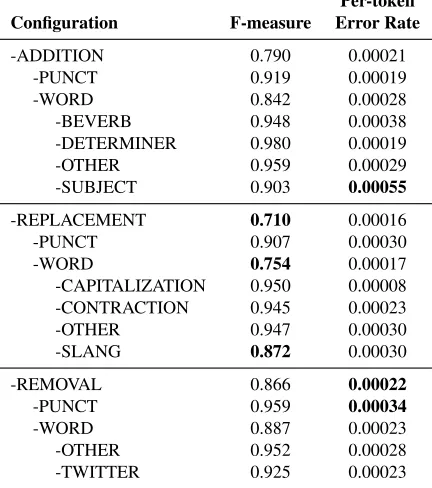
Results of the ablation study are summarized in Table 2. As shown, the performance of a com-plex task such as dependency parsing is broadly im-pacted by a variety of normalization edits. Based on the raw F-measure, the more common word re-placements proved to be the most critical, although failing to handle token addition and removal edits also resulted in substantial drops in performance. At the lowest level in the taxonomy, slang replacements and subject addition were the most critical edits.
Although many replacement tasks were important in aggregate, on a per-token basis the most important edits were those that required token removal and ad-dition. Perhaps unsurprisingly, failing to add sub-jects and verbs resulted in the largest issues, as the parser has little chance of identifying these depen-dencies if the terms simply do not appear in the sen-tence. However, not all word additions proved
crit-3Version 2.0.5
Per-token
Configuration F-measure Error Rate
-ADDITION 0.790 0.00021
-PUNCT 0.919 0.00019
-WORD 0.842 0.00028
-BEVERB 0.948 0.00038
-DETERMINER 0.980 0.00019
-OTHER 0.959 0.00029
-SUBJECT 0.903 0.00055
-REPLACEMENT 0.710 0.00016
-PUNCT 0.907 0.00030
-WORD 0.754 0.00017
-CAPITALIZATION 0.950 0.00008
-CONTRACTION 0.945 0.00023
-OTHER 0.947 0.00030
-SLANG 0.872 0.00030
-REMOVAL 0.866 0.00022
-PUNCT 0.959 0.00034
-WORD 0.887 0.00023
-OTHER 0.952 0.00028
[image:6.612.315.536.64.314.2]-TWITTER 0.925 0.00023
Table 2: Dependency Parser Results.
ical, as failing to add in a missing determiner gen-erally had little impact on the overall performance. Similarly, failing to correct capitalization did not cause substantial problems for the parser. Some word replacements did prove to be important, with slang and other word replacements showing some of the largest per-token error rates. Removing mislead-ing punctuation or changmislead-ing non-standard punctua-tion both proved important, but the per-token effect of punctuation addition was modest.
In general, the results suggest that a complex task such as dependency parsing suffers substan-tially when the input data differs from formal text in any number of ways. With the exception of cap-italization correction, performing almost every nor-malization edit is necessary to achieve results com-mensurate with those seen on formal text.
4.2 NER Evaluation
[image:6.612.319.535.69.313.2]The setup for evaluation of normalization edits on named entity recognition closely follows that of de-pendency parsing. We once again employ a tool from the suite of Stanford NLP tools, the Stanford named entity recognizer4 (Finkel et al., 2005). We
also define precision and recall in a similar manner:
precisionner = |ENT|ENT∩ENT| gold| (3)
recallner = |ENT|ENT∩ENTgold|
gold| (4)
Where ENT andENTgold are the sets of
enti-ties identified over the candidate normalization and gold standard sentences, respectively. Entities were labeled as one of three classes (person,location, ororganization), and two entities were only con-sidered a match if they both selected the same entity and the same entity class.
[image:7.612.316.536.62.314.2]4.2.1 Results
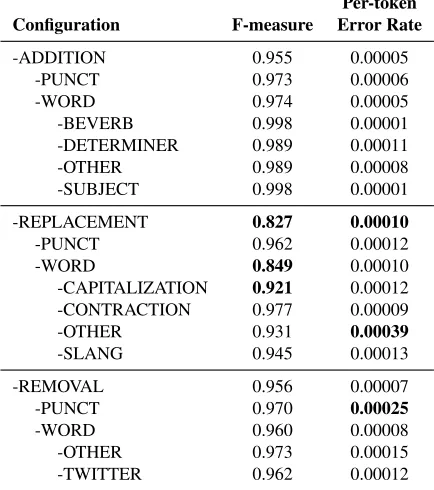
Table 3 shows the results of the NER ablation study. Unlike dependency parsing, only word re-placement edits proved to be critically important for NER tasks, as adding and subtracting words had lit-tle impact on the overall performance. Capitaliza-tion, which is generally an important feature for the identification of named entities, was unsurprisingly important. Similarly, the replacement of word types other than slang and contraction was important, be-cause many of these instances may come from mis-spelled named entities. Slang and contractions were less important, as they were generally not used to reference named entities. As the words dropped by Twitter users tend to be function words that are not critical to understanding the sentence they are rarely named entities and have only a small effect on named entity recognition. Similarly, terms that are removed during normalization also tend to not be named entities, and thus has minor overall impact.
A similar phenomenon is observed in the per-token evaluation, where unintentionally produced, non-slang, non-contraction word replacement was seen to be of paramount importance. Punctuation removal was also important on a per-token basis, de-spite having little impact in aggregate.
Overall, the results given in Table 3 indicate that a focused approach to normalization for named entity
4Version 1.2.8
Per-token
Configuration F-measure Error Rate
-ADDITION 0.955 0.00005
-PUNCT 0.973 0.00006
-WORD 0.974 0.00005
-BEVERB 0.998 0.00001
-DETERMINER 0.989 0.00011
-OTHER 0.989 0.00008
-SUBJECT 0.998 0.00001
-REPLACEMENT 0.827 0.00010
-PUNCT 0.962 0.00012
-WORD 0.849 0.00010
-CAPITALIZATION 0.921 0.00012
-CONTRACTION 0.977 0.00009
-OTHER 0.931 0.00039
-SLANG 0.945 0.00013
-REMOVAL 0.956 0.00007
-PUNCT 0.970 0.00025
-WORD 0.960 0.00008
-OTHER 0.973 0.00015
[image:7.612.318.535.68.313.2]-TWITTER 0.962 0.00012
Table 3: NER Results.
recognition is warranted. Unlike dependency pars-ing that required a broad approach involvpars-ing token addition and removal, the replacement-centric nor-malization approach typically employed by previous work is likely to be sufficient when the goal is to im-prove entity recognition.
4.3 TTS Evaluation
Per-token
Configuration F-measure Error Rate
-ADDITION 0.713 0.00029
-PUNCT 0.920 0.00018
-WORD 0.723 0.00050
-BEVERB 0.903 0.00071
-DETERMINER 0.937 0.00061
-OTHER 0.910 0.00064
-SUBJECT 0.853 0.00084
-REPLACEMENT 0.550 0.00025
-PUNCT 0.877 0.00040
-WORD 0.590 0.00028
-CAPITALIZATION 0.860 0.00022
-CONTRACTION 0.910 0.00037
-OTHER 0.883 0.00066
-SLANG 0.783 0.00051
-REMOVAL 0.580 0.00068
-PUNCT 0.880 0.00100
-WORD 0.600 0.00080
-OTHER 0.837 0.00095
[image:8.612.76.296.61.313.2]-TWITTER 0.710 0.00088
Table 4: Text-To-Speech Synthesis Results.
to be similar to the gold standard.
The eSpeak speech synthesizer5 was used to
pro-duce audio files for all tweet variations in the abla-tion study. As is common for speech synthesizers, eSpeak does perform some amount of TTS-specific normalization natively. While this does influence the normalizations produced, the comparison to gold standard methodology employed in this study helps us to focus on differences that are primarily at-tributable to the normalization edits we wish to ex-amine, not those produced natively. To obtain the gold standard, two native-English speaking judges were recruited via oDesk. Inter-annotator agreement was moderate,κ= 0.48.
4.3.1 Results
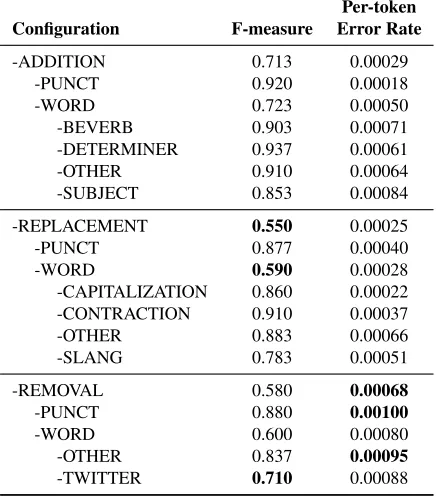
Table 4 shows the results of the speech synthesis study. As shown, the removal of non-standard or out of place tokens was most critical to the production of a normalization that is clearly understandable to human listeners. The aggregate results for token re-movals were comparable to or better than those of replacements at all levels of the taxonomy, in con-trast to the results from the other two tasks, where the larger number of replacements led to the largest
5Version 1.47.11,http://espeak.sourceforge.net/
performance hits. Meanwhile, word addition proved to be less essential overall.
At the token level, the importance of token re-moval is even more stark; the per-token error rate of every category of removal is greater than that of all other categories at the same taxonomy level. Although most word additions had a comparatively small effect on performance overall, they were im-portant on a per-token basis. Most notably, sub-ject adding had high per-token importance. In con-trast, failing to add missing punctuation was not of-ten marked as erroneous by human judges, nor was failing to normalize capitalization or contractions.
Similar to those on dependency parsing, the re-sults on speech synthesis suggest that a broad ap-proach that considers several different types of nor-malization edit is necessary to produce results com-parable to those seen on clean text. However, at a high level there is a clear divide in importance be-tween normalization types, where the greatest per-formance gains can be obtained by focusing on the comparatively small number of token removals.
5 Discussion
The results presented in Section 4 are consistent with the hypothesis that a “one size fits all” approach to Twitter normalization is problematic, as the im-portance of a given normalization edit was highly dependent on the intended downstream task. Differ-ences in which edits had the most substantial effect were present at all levels of scrutiny. Adding sub-jects and other words that a Twitter author dropped can be vitally important if the goal is to improve parsing performance, but can mostly be ignored if the goal is NER. Removing twitter-specific or other-wise non-standard words showed a gradation of im-portance over the three tasks, with little imim-portance for NER, moderate importance for parsing, and crit-ical importance for speech synthesis. Capitalization correction had negligible impact on the parser or synthesizer, but was helpful for NER.
[image:8.612.77.295.66.314.2]to-kens with their standard forms. In contrast, parser-targeted normalization must attend to both of the tasks, as well as the task of restoring dropped tokens. Despite the differences, there are a few common threads that appear in each evaluation. Most no-tably, the results suggest that the decision of most cent Twitter normalization work to focus on word re-placement was not entirely without merit, as the high frequency of token replacements translated into high overall importance for all tasks. Similarly, the focus on slang was also somewhat reasonable, as failing to handle slang terms had a significant impact on pars-ing and speech synthesis, though it had little impact on entity recognition. Nonetheless, the results in Section 4 clearly suggest that handling these cases represent only a small fraction of the actions nec-essary to produce performance comparable to what would be seen on formal text.
Another similarity among all instances was the lack of importance of certain categories. For in-stance, punctuation addition was not important for any of the three tasks. While Zhang et al. had hy-pothesized that punctuation addition would be im-portant for dependency parsing, the results given here suggest that the overall impact is minor. Sim-ilarly, contraction standardization was not shown to be important in any of the evaluations. Contraction normalization is more representative of how the nor-malization task was seen prior to the rise of social media normalization, as it represents a fairly minor normalizing action that might still be performed on formal text. Since contractions likely appear in a va-riety of forms in the data used to train NLP tools, it is unsurprising that these tools are comparatively ro-bust to contraction differences than to cases that are less typically encountered.
6 Conclusion
In this work, we presented an in-depth look at the effects of the normalization of Twitter data. To do so, we introduced a taxonomy of normalization ed-its based on an examination of our Twitter dataset and inspiration from previous work. The taxonomy allowed for normalization edits to be examined sys-tematically at different levels of granularity, and en-abled an examination of the effects of not only token replacements, but the token additions and removals
that recent work has suggested may have been un-justly ignored.
To understand the effects of each edit, we con-ducted ablation studies that examined results on three different downstream tasks: dependency pars-ing, named entity recognition, and text-to-speech synthesis. We found that while some normaliza-tion edits were universally important (or unimpor-tant) for the production of accurate results, many differences persist. These results suggest that, for best results, how the normalization task is performed should not be agnostic of the downstream applica-tion. Further, our results support the suggestion that in order for downstream applications to produce ac-curate results, in most cases it is necessary to take a broad view of the normalization task the looks be-yond simple word replacements.
Acknowledgments
The authors would like to thank Benny Kimelfeld for his comments on an early draft of this work. We also thank our anonymous reviewers for their constructive comments and feedback, and Stephanie Mcneish, Lacy Corlis, and Kaila Milos C. Factolerin for their assistance with annotation and evaluation.
References
AiTi Aw, Min Zhang, Juan Xiao, and Jian Su. 2006. A phrase-based statistical model for sms text normaliza-tion. InACL, pages 33–40.
Tyler Baldwin and Joyce Chai. 2011. Beyond normal-ization: Pragmatics of word form in text messages. InIJCNLP, pages 1437–1441, Chiang Mai, Thailand, November. Asian Federation of Natural Language Pro-cessing.
Richard Beaufort, Sophie Roekhaut, Louise-Am´elie Cougnon, and C´edrick Fairon. 2010. A hybrid rule/model-based finite-state framework for normaliz-ing sms messages. InACL, pages 770–779.
Alan W. Black and Keiichi Tokuda. 2005. The blizzard challenge - 2005: evaluating corpus-based speech syn-thesis on common datasets. InINTERSPEECH, pages 77–80.
Paul Cook and Suzanne Stevenson. 2009. An unsuper-vised model for text message normalization. InCALC, pages 71–78.
Jacob Eisenstein. 2013. What to do about bad language on the internet. InNAACL-HLT, pages 359–369, At-lanta, Georgia, June. Association for Computational Linguistics.
Jenny Rose Finkel, Trond Grenager, and Christopher Manning. 2005. Incorporating non-local information into information extraction systems by gibbs sampling. In ACL, pages 363–370, Ann Arbor, Michigan, June. Association for Computational Linguistics.
Jennifer Foster, ¨Ozlem C¸etinoglu, Joachim Wagner, Joseph Le Roux, Stephen Hogan, Joakim Nivre, Deirdre Hogan, and Josef van Genabith. 2011. hard-toparse: Pos tagging and parsing the twitterverse. vol-ume WS-11-05 ofAAAI Workshops. AAAI.
Bo Han, Paul Cook, and Timothy Baldwin. 2012. Auto-matically constructing a normalisation dictionary for microblogs. InEMNLP-CoNLL, pages 421–432. Nobuhiro Kaji and Masaru Kitsuregawa. 2014.
Accu-rate word segmentation and pos tagging for japanese microblogs: Corpus annotation and joint modeling with lexical normalization. In Proceedings of the 2014 Conference on Empirical Methods in Natural Language Processing (EMNLP), pages 99–109, Doha, Qatar, October. Association for Computational Lin-guistics.
Catherine Kobus, Franc¸ois Yvon, and G´eraldine Damnati. 2008. Normalizing SMS: are two metaphors better than one? InCOLING, pages 441–448. Chen Li and Yang Liu. 2014. Improving text
nor-malization via unsupervised model and discriminative reranking. In Proceedings of the ACL 2014 Student Research Workshop, pages 86–93, Baltimore, Mary-land, USA, June. Association for Computational Lin-guistics.
Fei Liu, Fuliang Weng, Bingqing Wang, and Yang Liu. 2011a. Insertion, deletion, or substitution? normal-izing text messages without pre-categorization nor su-pervision. InACL, pages 71–76.
Xiaohua Liu, Shaodian Zhang, Furu Wei, and Ming Zhou. 2011b. Recognizing named entities in tweets. In NAACL-HLT, pages 359–367, Portland, Oregon, USA, June. Association for Computational Linguis-tics.
Fei Liu, Fuliang Weng, and Xiao Jiang. 2012. A broad-coverage normalization system for social media lan-guage. InACL, pages 1035–1044.
Marie-Catherine De Marneffe, Bill MacCartney, and Christopher D. Manning. 2006. Generating typed dependency parses from phrase structure parses. In LREC, pages 449–454.
Deana Pennell and Yang Liu. 2010. Normalization of text messages for text-to-speech. In ICASSP, pages 4842–4845.
Deana Pennell and Yang Liu. 2011. A character-level machine translation approach for normalization of SMS abbreviations. InIJCNLP, pages 974–982. Alan Ritter, Sam Clark, Mausam, and Oren Etzioni.
2011. Named entity recognition in Tweets: An ex-perimental study. InEMNLP, pages 1524–1534. Cagil Sonmez and Arzucan Ozgur. 2014. A graph-based
approach for contextual text normalization. In Pro-ceedings of the 2014 Conference on Empirical Meth-ods in Natural Language Processing (EMNLP), pages 313–324, Doha, Qatar, October. Association for Com-putational Linguistics.
Richard Sproat, Alan W. Black, Stanley F. Chen, Shankar Kumar, Mari Ostendorf, and Christopher Richards. 2001. Normalization of non-standard words. Com-puter Speech & Language, 15(3):287–333.
Pidong Wang and Hwee Tou Ng. 2013. A beam-search decoder for normalization of social media text with application to machine translation. In NAACL-HLT, pages 471–481, Atlanta, Georgia, June. Association for Computational Linguistics.
Yi Yang and Jacob Eisenstein. 2013. A log-linear model for unsupervised text normalization. InProceedings of the 2013 Conference on Empirical Methods in Natu-ral Language Processing, pages 61–72, Seattle, Wash-ington, USA, October. Association for Computational Linguistics.