Predicate Argument Alignment using a Global Coherence Model
Travis Wolfe, Mark Dredze, and Benjamin Van Durme
Johns Hopkins University Baltimore, MD, USA
Abstract
We present a joint model for predicate argu-ment alignargu-ment. We leverage multiple sources of semantic information, including temporal ordering constraints between events. These are combined in a max-margin framework to find a globally consistent view of entities and events across multiple documents, which leads to improvements over a very strong local baseline.
1 Introduction
Natural language understanding (NLU) requires analysis beyond the sentence-level. For example, anentitymay be mentioned multiple times in a dis-course, participating in various events, where each event may itself be referenced elsewhere in the text. Traditionally the task ofcoreference resolution
has been defined as finding those entity mentions within a single document that co-refer, while cross-document coreference resolutionconsiders a wider discourse context across many documents, yet still pertains strictly to entities.
Predicate argument alignment, or entity-event cross-document coreference resolution, enlarges the set of possible co-referent elements to include the mentions of situations in which entities participate. This expanded definition drives practitioners to-wards a more complete model of NLU, where sys-tems must not only consider who is mentioned, but also what happened. However, despite the drive to-wards an expanded notion of discourse, models typ-ically are formulated with strong notions of local-independence: viewing a multi-document task as one limited to individual pairs of sentences. This creates a mis-match between the goals of such work – considering entire documents – with the systems – consider individual sentences.
In this work, we consider a system that takes a document level view in considering coreference for entities and predictions: the task of predicate ar-gument linking. We treat this task as a global in-ference problem, leveraging multiple sources of se-mantic information identified at the document level. Global inference for this problem is mostly unex-plored, with the exception of Lee et al. (2012) (dis-cussed in§ 8). Especially novel here is the use of document-level temporal constraints on events, rep-resenting a next step forward on the path to full un-derstanding.
Our approach avoids the pitfalls of local infer-ence while still remaining fast and exact. We use the pairwise features of a very strong predicate argu-ment aligner (Wolfe et al., 2013) (competitive with the state-of-the-art (Roth, 2014)), and add quadratic factors that constrain local decisions based on global document information. These global factors lead to superior performance compared to the previous state-of-the-art. We release both our code and data.1
2 Model
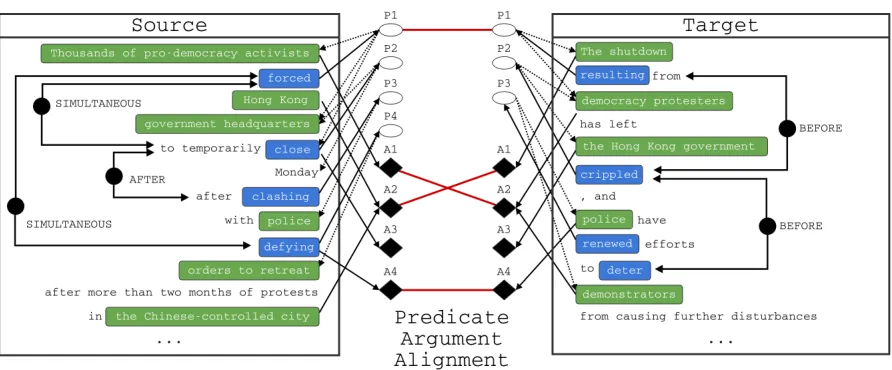
Consider the two sentences from the document pair shown in Figure 1. These sentences describe the same event, although with different details. The source sentence has four predicates and four ar-guments, while the target has three predicates and three arguments. In this case, one of the predicates from each sentence aligns, as do three of the argu-ments. We also show additional information poten-tially helpful to determining alignments: temporal relations between the predicates. The goal of predi-cate argument alignment is to assign these links in-dicating coreferent predicates and arguments across a document pair (Roth and Frank, 2012).
Previous work by Wolfe et al. (2013) formulated 1https://github.com/hltcoe/parma2
Figure 1: An example analysis and predicate argument alignment task between a source and target document. Predicates appear as hollow ovals, have blue mentions, and are aligned considering their arguments (dashed lines). Arguments, in black diamonds with green mentions, represent a document-level entity (coreference chain), and are aligned using their predicate structure and mention-level features. The alignment choices appear in the middle in red. Temporal relation information is lifted into the global inference over alignments.
this as a binary classification problem: given a pair of arguments or predicates, construct features and score the pair, where scores above threshold indi-cate links. A binary classification framework has ad-vantages: it’s fast since individual decisions can be made quickly, but it comes at the cost of global in-formation across links. The result may be links that conflict in their interpretation of the document. Fig-ure 1 makes clear that jointly considering all links at once can aid individual decisions, for example, by including temporal ordering of predicates.
The global nature of this task is similar to word alignment for machine translation (MT). Many sys-tems consider alignment links between words indi-vidually, selecting the best link for each word inde-pendently of the other words in the sentence. Just as with an independent linking strategy in predicate ar-gument alignment, this can lead to inconsistencies in the output. Lacoste-Julien et al. (2006) introduced a model that jointly resolved word alignments based on the introduction of quadratic variables, factors that depend on two alignment decisions which char-acterize patterns that span word-word links. Their approach achieved improved results even in the pres-ence of little training data.
We present a global predicate argument alignment model based on considering quadratic interactions between alignment variables to captures patterns we expect in coherent discourse. We introduce factors which are comprised of a binary variable, multiple quadratic constraints on that variable, and features that determine the cost associated with that vari-able in order to characterize the dependence between alignment decisions.
Notation An alignment between an item indexed byiin the source document andjin the target docu-ment is represented by variablezij ∈ {0,1}, where
zij = 1indicates that itemsiandj are aligned. In some cases, we will explicitly indicate when the two items are predicates aszijp; an argument alignment will beza
ij. We represent all alignments for a docu-ment pair as matrixz.
For clarity, we omit any variable representing observed data when discussing feature functions; alignment variables are endowed with this informa-tion. For each pair of items we use “local” fea-ture functions f(·) and corresponding parameters
w, which capture the similarity between two items without the context of other alignments.
sij =w·f(zij) (1)
wheresij is the score of linking itemsiandj. Using only local features, our system would greedily select alignments. To capture global as-pects we add joint factors that capture effects be-tween alignment variables. Each joint factor φ is comprised of a constrained binary variablezφ asso-ciated with featuresf(φ)that indicates when the fac-tor is active. Together with parameterswthese form additional scoressφfor the objective:
sφ=w·f(φ) (2)
The full linear scoring function on alignments sums over both local similarity and joint factors:
X
ij
sijzij+
X
φ∈Φ
sφzφ. (3)
Lastly, it is convenient to describe the local fea-ture functions and their corresponding alignment variable as factors with no constraints, and we will do so when describing the full score function.
3 Local Factors
Local factors encode features based on the men-tion pair, which include a wide variety of simi-larity measures, e.g. whether two headwords ap-pear as synonyms in WordNet, gender agreement based on possessive pronouns. We adopt the fea-tures of Wolfe et al. (2013), a strong baseline system
which doesn’t use global inference.2 These features
are built on top of a variety of semantic resources (PPDB (Ganitkevitch et al., 2013), WordNet (Miller, 1995), FrameNet (Baker et al., 1998)) and methods for comparing mentions (tree edit distance (Yao et al., 2013), string transducer (Andrews et al., 2012)).
4 Joint Factors
Our goal is to develop joint factors that improve over the feature rich local factors baseline by considering global information.
Fertility A common mistake when making
inde-pendent classification decisions is to align many source items to a single target item. While each link looks promising on its own, they clearly cannot all be right. Empirically, the training set reveals that many to one alignments are uncommon; thus many to one predictions are likely errors. We add a fertility factor for predicates and arguments, where fertility is defined as the number of links to an item. Higher fertilities are undesired and are thus penalized. For-mally, for matrixz, the fertility of a rowior column
jis the sum of that row or column. We discuss fer-tility in terms of rows below.
We include two types of fertility factors. First, factorφfert1distinguishes between rows with at least one link from those with none. For rowi, we add one instance of the linear factorφfert1with constraints
zφfert1 ≥zij ∀j (4)
The cost associated with zφfert1, which we will re-fer to assfert1, will be incurred any time an item is
mentioned in both documents. For data sets with many singletons,sfert1more strongly penalizes non-singleton rows, reflecting this pattern in the training data. We makesfert1 parametric, where the features of theφfert1factor allow us to learn different weights for predicates and arguments, as well as the size of the row, i.e. number of items in the pairing.
quadratic constraints:
zφfert2 ≥zijzik∀j < k (5)
This factor penalizes rows that have fertility of at least two, but does not distinguish beyond that. An alternative would be to introduce a factor for every pair of variables in a row, each with one constraint. This would heavily penalize fertilities greater than two. We found that the resulting quadratic program took longer to solve and gave worse results.
Since documents have been processed to identify in-document coreference chains, we do not expect multiple arguments from a source document to align to a single target item. For this reason, we expect
φfert2 for arguments to have a large negative weight. In contrast, since predicates do not form chains, we may have multiple source predicates for one target.
We note an important difference between our fertility factor compared with Lacoste-Julien et al. (2006). We parameterize fertility for only two cases (1 and 2) whereas they consider fertility factors from 2 to D. We do not parameterize fertilities higher than two because they are not common in our dataset and come at a high computational cost.
The featuresf(φ)for bothφfert1 andφfert2 are an intercept feature (which always fires), indicator fea-tures for whether this row corresponds to an argu-ment or a predicate, and a discretized feature for how many alignments are in this row.
Predicate Argument Structure We expect
struc-ture among links that involve a predicate and its as-sociated arguments. Therefore, we add joint factors that consider a predicate and its associated align-ments: the predicate argument structure. We deter-mine this structure from a dependency parse, though the idea is general to any semantic binding, e.g. FrameNet or Propbank style parses. Given a co-herent discourse, there are several expected types of patterns in the PAS; we add factors for these.
Predicate-centric We begin with a
predicate-centric factor, which views scores an alignment be-tween predicates based on their arguments, i.e. the two predicates share the same arguments. Ideally, two predicates can only align when their arguments are coreferent. However, in practice we may in-correctly resolve argument links, or there may be
implicit arguments that do not appear as syntactic dependencies of the predicate trigger. Therefore, we settle for a weaker condition, that there should besomeoverlap in the arguments of two coreferent predicates.
For every predicate alignmentzijp, we add a factor
φpsawhose scorespsa is a penalty for having no
ar-gument overlap; predicates share arar-guments (psa). To constrain the variable ofφpsa, we add a quadratic
constraint that considers every possible pair of argu-ment alignargu-ments that might overlap:
zφpsa ≥zijp 1−k∈maxargs(pi) l∈args(pj)
za kl
(6)
where args(pi) finds the indices of all arguments governed by the predicatepi.
Entity-centric We expect similar behavior from arguments (entities). If an entity appears in two doc-uments, it is likely that this entity will be mentioned in the context of a common predicate, i.e. arguments share predicates (asp). For a given argument align-mentza
ij we add quadratic constraints so thatzφasp represents a penalty for two arguments not sharing a single predicate:
zφasp ≥zaij 1−k∈maxpreds(ai) l∈preds(aj)
zklp (7)
where preds(ai) finds the indices of all predicates that govern any mention of argumentai.
The features f(φ) for both psa andasp are an intercept feature and a bucketed count of the size of args(pi)×args(pj)or preds(ai)×preds(aj) respec-tively.
Temporal Information Temporal ordering, in
TimeML (Pustejovsky et al., 2003), the format for specifying temporal relations, defines relations be-tween predicates (e.g. immediately before and si-multaneous), each with an inverse (e.g.immediately afterandsimultaneousrespectively). We will refer to a relation as Rand its inverse as R−1. Suppose we hadpaandpb in the source document,pxandpy in the target document, andpaR1pb,pxR2py. Given this configuration the following alignments conflict with the in-doc relations:
zax zby zay zbx In-Doc Relations
* * 1 1 R1 =R2
1 1 * * R1 =R−21
where 1 means there is a link and * means there is a link or no link (wildcard). The simplest example that fits this pattern is: ‘a before b’, ‘x before y’, ‘a corefers with y’, and ‘b corefers with x’ implies a conflict.
We introduce a factor that penalizes these conflict-ing configurations. In every instance where the pre-dicted temporal relation for a pair of predicate align-ments matches one of the conflict patterns above, we add a factor usingzφtemp:
zφtemp ≥zayzbx
ifpaR1pb, pxR2py, R1=R2
zφtemp ≥zaxzby
ifpaR1pb, pxR2py, R1=R−21 (8)
Thus sφtemp is the cost of disagreeing with the in-doc temporal relations. This is a general technique for incorporating relational information into coref-erence decisions. It only requires specifying when two relations are incompatible, e.g.spouseOfand
siblingOf are incompatible relations (in most states). We leave this for future work.
Since CAEVO gives each relation prediction a probability, we incorporate this into the feature by indicating the probability of a conflictnotarising:
f(φtemp) = log 1−p(R1)p(R2) + (9)
avoids large negative values since CAEVO proba-bilities are not perfectly calibrated. We use= 0.1, allowing feature values of at most−2.3.
Summary The objective is a linear function over binary variables. There is a local similarity score
def train(alignments): w = init_weights() working_set = set() while True:
xi = solve_ILP(w, working_set)
c = most_violated_constraint(w, alignments) working_set.add(c)
if hinge(c, w) < xi: break
def most_violated_constraint(w, alignments): delta_features = vector()
loss = 0
for z in alignments: z_mv = make_ILP(z) for phi in factors:
costs = dot(w, phi.features) z_mv.add_terms(costs, phi.vars) z_mv.add_constraints(phi.constraints) solve_ILP(z_mv)
mu = (z.size + k) / (avg_z_size + k) delta_features += mu * (f(z) - f(z_mv)) loss += mu * Delta(z, z_mv)
return Constraint(delta_features, loss)
def hinge(c, w):
return max(0, c.loss - dot(w, c.delta_features))
Figure 2: Learning algorithm (caching and ILP solver not shown). The sum in each constraint is performed once when finding the constraint, and implicitly thereafter.
coefficient on every alignment variable, and a joint factor similarity score on every quadratic variable. These quadratic variables are constrained by prod-ucts of the original alignment variables. Decoding an alignment requires solving this quadratically con-strained integer program; in practice is can be solved quickly without relations.
5 Inference
Learning We use the supervised structured SVM
formulation of Joachims et al. (2009). As is common in structure prediction we use margin rescaling and 1 slack variable, with the structural SVM objective:
min
w ||w|| 2 2+Cξ s.t.ξ≥0
ξ+
N
X
i=1
w·f(zi)≥ N
X
i=1
w·f( ˆzi) + ∆(zi,zˆi)
∀zˆi∈ Zi
The score function for an alignment uses three types of terms: weights, features, and alignment variables. When we decode, we take the product of the weights and the features to get the costs for the ILP (e.g.sφ=w·f(φ)). When we optimize our SVM objective, we take the product of the alignment variables and the features to get modified features for the SVM:
f(z) =X
ij
zijf(zij) +
X
φ∈Φ
zφf(φ) (11)
Since we cannot iterate over the exponentially many margin constraints, we solve for this optimiza-tion using the cutting-plane learning algorithm. This algorithm repeatedly asks the “separation oracle” for the most violated SVM constraint, which finds this constraint by solving:
arg max
ˆ z1...zNˆ
X
i
w·f( ˆzi) + ∆(zi,zˆi) (12)
subject to the constraints defined by the joint fac-tors. When the separation oracle returns a constraint that is not violated or is already in the working set, then we have a guarantee that we solved the original SVM problem with exponentially many constraints. This is the most time-consuming aspect of learning, but since the problem decomposes over document alignments, we cache solutions on a per document alignment basis. With caching, we only call the sep-aration oracle around 100-300 times.
We implement the separation oracle using an ILP solver, CPLEX,3 due to complexity of the discrete
optimization problem: there are2mn
possible align-ments for andm×nalignment grid. In practice this is solved very efficiently, taking less than a third of a second per document alignment on average. We would like∆to be F1, but we need a decomposable loss to include it in a linear objective (Taskar et al., 2003). Instead, we use Hamming loss as a surrogate, as in Lacoste-Julien et al. (2006).
Our training data is heavily biased towards nega-tive examples, performing poorly on F1 since preci-sion and recall are unbalanced. We use an asym-metric version of Hamming loss that incurs cF P cost for predicting an alignment for two unaligned
3http://www-01.ibm.com/software/
commerce/optimization/cplex-optimizer/
items andcF N for predicting no alignment for two aligned items. We fixedcF P = 1and tunedcF N ∈ {1,2,3,4} on dev data. Additionally we found it useful to tune the scale of the loss function across {1
2,1,2,4}. Previous work, such as Joachims et al. (2009), use a hand-chosen constant for the scale of the Hamming loss, but we observe some sensitivity in this parameter and choose to optimize it.
Decoding Following Wolfe et al. (2013), we tune the threshold for classificationτon dev data to max-imize F1 (via linesearch). For SVMsτ is typically fixed at 0: this is not necessarily good practice when your training loss differs from test loss (Hamming vs F1). In our case this extra parameter is worth al-locating a portion of training data to enable tuning. Tuningτ addresses the same problem as using an asymmetric Hamming loss, but we found that do-ing both led to better results.4 Since we are using a
global scoring function rather than a set of classifi-cations,τ is implemented as a test-time unary factor on every alignment.
6 Experiments
Data We consider two datasets for evaluation. The first is a cross-document entity and event corefer-ence resolution dataset called the Extended Event Coref Bank (EECB) created by Lee et al. (2012) and based on a corpus from Bejan and Harabagiu (2010). The dataset contains clusters of news articles taken from Google News with annotations about corefer-ence over entities and events. Following the proce-dure of Wolfe et al. (2013), we select the first doc-ument in every cluster and pair it with every other document in the cluster.
The second dataset (RF) comes from Roth and Frank (2012). The dataset contains pairs of news articles that describe the same news story, and are annotated for predicate links between the document pairs. Due to the lack of annotated arguments, we can only report predicate linking performance and thepsa andasp factors do not apply. Lastly, the size of the RF data should be noted as it is much smaller than EECB: the test set has 60 document pairs and the dev set has 10 document pairs.
Both datasets are annotated with parses and in-document coreference labels provided by the toolset of Napoles et al. (2012)5 and are available with our
code release. Due to the small data size, we usek -fold cross validation for both datasets. We choose
k = 10 for RF due to its very small size (more folds give more training examples) and k = 5 on EECB to save computation time (amount of training data in EECB is less of a concern). Hyperparam-eters were chosen by hand using using cross vali-dation on the EECB dataset using F1 as the crite-ria (rather than Hamming). Figures report averages across these folds.
Systems Following Roth and Frank (2012) and
Wolfe et al. (2013) we include a Lemma baseline for identifying alignments which will align any two predicates or arguments that have the same lemma-tized head word.6 TheLocalbaseline uses the same
features as Wolfe et al., but none of our joint fac-tors. In addition to running our joint model with all factors, we measure the efficacy of each individual factor by evaluating each with the local features.
For evaluation we use a generous version of F1 that is defined for alignment labels composed of sure, Gs, and possible links, Gp and the system’s proposed links H (following Cohn et al. (2008), Roth and Frank (2012) and Wolfe et al. (2013)).
P = |H|∩HG| p| R= |H|G∩Gs|
s| F =
2P R P +R
Note that the EECB data does not have a sure and possible distinction, soGs = Gp, resulting in stan-dard F1. In addition to F1, we separately measure predicate and argument F1 to demonstrate where our model makes the largest improvements.
We performed a one-sided paired-bootstrap test where the null hypothesis was that the joint model was no better than theLocalbaseline (described in Koehn (2004)). Cases wherep <0.05are bolded.
5https://github.com/cnap/anno-pipeline 6The lemma baseline is obviously sensitive to the lemma-tizer used. We used the Stanford CoreNLP lemmalemma-tizer (Man-ning et al., 2014) and found it yielded slightly better results than previously reported as the lemma baseline (Roth and Frank, 2012), so we used it for all systems to ensure fairness and that the baseline is as strong as it could be.
7 Results
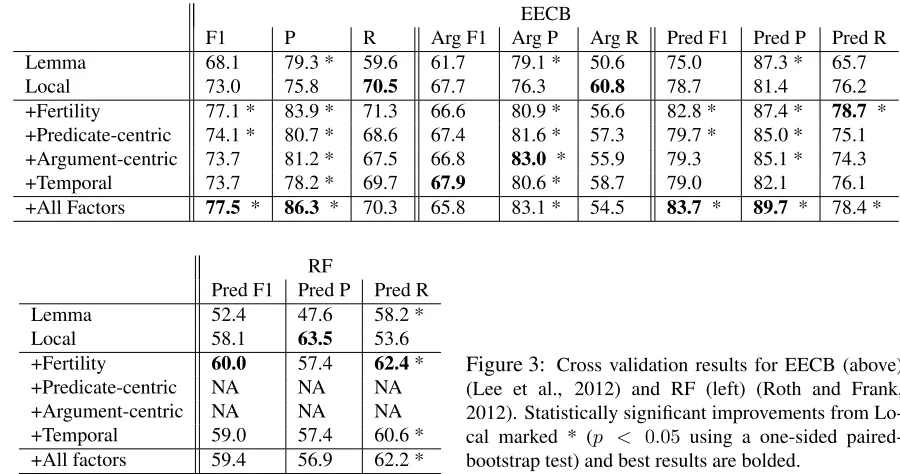
Results for EECB and RF are reported in Table 7. As previously reported, using just local factors (features on pairs) improves over lemma baselines (Wolfe et al., 2013). The joint factors make statistically sig-nificant gains over local factors in almost all experi-ments. Fertility factors provide the largest improve-ments from any single constraint. A fertility penalty actually allows the pairwise weights to be more op-timistic in that they can predict more alignments for reasonable pairs, allowing the fertility penalty to ensure only the best is chosen. This penalty also prevents the “garbage collecting” effect that arises for instances that have rare features (Brown et al., 1993).
Temporal constraints are relatively sparse, ap-pearing just 2.8 times on average. Nevertheless, it was very helpful across all experiments, though only statistically significantly on the RF dataset. This is one of the first results to demonstrate ben-efits of temporal relations affecting an downstream task. Perhaps surprisingly, these improvements re-sult from a a temporal relation system that has rela-tively poor absolute performance. Despite this, im-provements are possibly due to the orthogonal na-ture of temporal information; no other feana-ture cap-tures this signal. This suggests that future work on temporal relation prediction may yield further im-provements and deserves more attention as a useful feature for semantic tasks in NLP.
EECB
F1 P R Arg F1 Arg P Arg R Pred F1 Pred P Pred R Lemma 68.1 79.3 * 59.6 61.7 79.1 * 50.6 75.0 87.3 * 65.7 Local 73.0 75.8 70.5 67.7 76.3 60.8 78.7 81.4 76.2 +Fertility 77.1 * 83.9 * 71.3 66.6 80.9 * 56.6 82.8 * 87.4 * 78.7 * +Predicate-centric 74.1 * 80.7 * 68.6 67.4 81.6 * 57.3 79.7 * 85.0 * 75.1 +Argument-centric 73.7 81.2 * 67.5 66.8 83.0 * 55.9 79.3 85.1 * 74.3 +Temporal 73.7 78.2 * 69.7 67.9 80.6 * 58.7 79.0 82.1 76.1 +All Factors 77.5 * 86.3 * 70.3 65.8 83.1 * 54.5 83.7 * 89.7 * 78.4 *
RF
Pred F1 Pred P Pred R Lemma 52.4 47.6 58.2 *
Local 58.1 63.5 53.6
[image:8.612.78.528.59.296.2]+Fertility 60.0 57.4 62.4* +Predicate-centric NA NA NA +Argument-centric NA NA NA +Temporal 59.0 57.4 60.6 * +All factors 59.4 56.9 62.2 *
Figure 3: Cross validation results for EECB (above) (Lee et al., 2012) and RF (left) (Roth and Frank, 2012). Statistically significant improvements from Lo-cal marked * (p < 0.05 using a one-sided paired-bootstrap test) and best results are bolded.
predicate- and argument-centric improve similarly across both predicates and arguments on EECB.
While each of the joint factors all improve over the baselines on RF, the full model with all the joint factors does not perform as well as with some fac-tors excluded. Specifically, the fertility model per-forms the best. We attribute this small gap to lack of training data (RF only contains 64 training docu-ment pairs in our experidocu-ments), as this is not a prob-lem on the larger EECB dataset.
Additionally, the joint models seem to trade pre-cision for recall on the RF dataset compared to the
Localbaseline. Note that both models are tuned to maximize F1, so this tells you more about the shape of the ROC curve as opposed to either models’ abil-ity to achieve either high precision or recall. Since we don’t see this behavior on the EECB corpus, it is more likely that this is a property of the data than the model.
8 Related Work
The task of predicate argument linking was intro-duced by Roth and Frank (2012), who used a graph parameterized by a small number of semantic fea-tures to express similarities between predicates and used min-cuts to produce an alignment. This was followed by Wolfe et al. (2013), who gave a locally-independent, feature-rich log-linear model that uti-lized many lexical semantic resources, similar to the
sort employed in RTE challenges.
Lee et al. (2012) considered a similar problem but sought to produceclustersof entities and events rather than an alignment between two documents with the goal of improving coreference resolution. They used features which consider previous event and entity coreference decisions to make future coreference decisions in a greedy manner. This dif-fers from our model which is built on non-greedy joint inference, but much of the signal indicating when two mentions corefer or are aligned is similar. In the context of in-document coreference reso-lution, Recasens et al. (2013) sought to overcome the problem of opaque mentions7 by finding
high-precision paraphrases of entities by pivoting off verbs mentioned in similar documents. We address the issue of opaque mentions not by building a para-phrase table, but by jointly reasoning about entities that participate in coreferent events (c.f.§4); the ap-proaches are complementary.
In this work we incorporate ordering information of events. Though we consider it an upstream task, there is a line of work trying to predict temporal rela-tions between events (Pustejovsky et al., 2003; Mani et al., 2006; Chambers et al., 2014). Our results in-dicate this is a useful source of information, one of the first results to show an improvement from this
type of system (Glavaˇs and ˇSnajder, 2013).
We utilize an ILP to improve upon a pipelined system, similar to Roth and Yih (2004), but our work differs in that we do not use piecewise-trained clas-sifiers. Our local similarity scores are calibrated ac-cording to a global objective by propagating the gra-dient back from the loss to every parameter in the model. When using piecewise training, local clas-sifiers must focus more on recall (in the spirit of Weiss and Taskar (2010)) than they would for an or-dinary classification task with no global objective. Our method trains classifiers jointly with a global convex objective. While our training procedure re-quires decoding an integer program, the parameters we learn are globally optimal.
9 Conclusion
We presented a max-margin quadratic cost model for predicate argument alignment, seeking to ex-ploit discourse level semantic features to improve on previous, locally independent approaches. Our model includes factors that consider fertility of pred-icates and arguments, the predicate argument struc-ture present in coherent discourses, and soft con-straints on predicate coreference determined by a temporal relation classifier. We have shown that this model significantly improves upon prior work which uses extensive lexical resources but without the ben-efit of joint inference. Additionally, this is one of the first demonstrations of the benefits of temporal rela-tion identificarela-tion. Overall, this work demonstrates the benefits of considering global document infor-mation as part of natural language understanding.
Future work should extend the problem formu-lation of predicate argument alignment to consider
incremental linking: starting with a pair of docu-ments, perform linking, and then continue to add in documents over time. This problem formula-tion would capture the evoluformula-tion of a breaking news story, which closely matches the type of data (news articles) considered in this work (EECB and RF datasets). This formulation ties into existing work on news summarization, topic detection and track-ing, an multi-document NLU. This goes hand with work on better intra-document relation prediction methods, such as the temporal relation model used in this work, to lead to better joint linking decisions.
References
Nicholas Andrews, Jason Eisner, and Mark Dredze. 2012. Name phylogeny: A generative model of string variation. InEMNLP-CoNLL, pages 344–355. ACL. Collin F. Baker, Charles J. Fillmore, and John B. Lowe.
1998. The berkeley framenet project. In Proceed-ings of the 36th Annual Meeting of the Association for Computational Linguistics and 17th International Conference on Computational Linguistics - Volume 1, ACL ’98, pages 86–90, Stroudsburg, PA, USA. Asso-ciation for Computational Linguistics.
Cosmin Adrian Bejan and Sanda Harabagiu. 2010. Un-supervised event coreference resolution with rich lin-guistic features. In Proceedings of the 48th Annual Meeting of the Association for Computational Linguis-tics, ACL ’10, pages 1412–1422, Stroudsburg, PA, USA. Association for Computational Linguistics. Peter F. Brown, Stephen A. Della Pietra, Vincent J.
Della Pietra, Meredith J. Goldsmith, Jan Hajic, Robert L. Mercer, and Surya Mohanty. 1993. But dictionaries are data too. In Proceedings of the Workshop on Human Language Technology, HLT ’93, pages 202–205, Stroudsburg, PA, USA. Association for Computational Linguistics.
Nathanael Chambers, Taylor Cassidy, Bill McDowell, and Steven Bethard. 2014. Dense event ordering with a multi-pass architecture. Transactions of the Associ-ation for ComputAssoci-ational Linguistics, 2.
Trevor Cohn, Chris Callison-Burch, and Mirella Lapata. 2008. Constructing corpora for the development and evaluation of paraphrase systems. Comput. Linguist., 34(4):597–614, December.
Juri Ganitkevitch, Benjamin Van Durme, and Chris Callison-Burch. 2013. PPDB: The paraphrase database. InProceedings of NAACL-HLT, pages 758– 764, Atlanta, Georgia, June. Association for Compu-tational Linguistics.
Goran Glavaˇs and Jan ˇSnajder. 2013. Recognizing identical events with graph kernels. In Proceedings of the 51st Annual Meeting of the Association for Computational Linguistics (Volume 2: Short Papers), pages 797–803, Sofia, Bulgaria, August. Association for Computational Linguistics.
Thorsten Joachims, Thomas Finley, and Chun-Nam John Yu. 2009. Cutting-plane training of structural svms.
Mach. Learn., 77(1):27–59, October.
Philipp Koehn. 2004. Statistical significance tests for machine translation evaluation. In Dekang Lin and Dekai Wu, editors, Proceedings of EMNLP 2004, pages 388–395, Barcelona, Spain, July. Association for Computational Linguistics.
quadratic assignment. In Robert C. Moore, Jeff A. Bilmes, Jennifer Chu-Carroll, and Mark Sanderson, editors, HLT-NAACL. The Association for Computa-tional Linguistics.
Heeyoung Lee, Marta Recasens, Angel Chang, Mihai Surdeanu, and Dan Jurafsky. 2012. Joint entity and event coreference resolution across documents. In
Proceedings of the 2012 Joint Conference on Empir-ical Methods in Natural Language Processing and Computational Natural Language Learning, EMNLP-CoNLL ’12, pages 489–500, Stroudsburg, PA, USA. Association for Computational Linguistics.
Inderjeet Mani, Marc Verhagen, Ben Wellner, Chong Min Lee, and James Pustejovsky. 2006. Machine learn-ing of temporal relations. InProceedings of the 21st International Conference on Computational Linguis-tics and the 44th annual meeting of the Association for Computational Linguistics, pages 753–760. Associa-tion for ComputaAssocia-tional Linguistics.
Christopher D. Manning, Mihai Surdeanu, John Bauer, Jenny Finkel, Steven J. Bethard, and David McClosky. 2014. The Stanford CoreNLP natural language pro-cessing toolkit. InProceedings of 52nd Annual Meet-ing of the Association for Computational LMeet-inguistics: System Demonstrations, pages 55–60.
George A. Miller. 1995. Wordnet: A lexical database for english. Communications of the ACM, 38:39–41. Courtney Napoles, Matthew Gormley, and Benjamin Van
Durme. 2012. Annotated gigaword. In AKBC-WEKEX Workshop at NAACL 2012, June.
James Pustejovsky, Jos Castao, Robert Ingria, Roser Saur, Robert Gaizauskas, Andrea Setzer, and Graham Katz. 2003. Timeml: Robust specification of event and temporal expressions in text. Inin Fifth Interna-tional Workshop on ComputaInterna-tional Semantics (IWCS-5).
Marta Recasens, Matthew Can, and Daniel Jurafsky. 2013. Same referent, different words: Unsupervised mining of opaque coreferent mentions. In Proceed-ings of the 2013 Conference of the North American Chapter of the Association for Computational Linguis-tics: Human Language Technologies, pages 897–906, Atlanta, Georgia, June. Association for Computational Linguistics.
Michael Roth and Anette Frank. 2012. Aligning pred-icate argument structures in monolingual comparable texts: a new corpus for a new task. In Proceedings of the First Joint Conference on Lexical and Com-putational Semantics - Volume 1: Proceedings of the main conference and the shared task, and Volume 2: Proceedings of the Sixth International Workshop on Semantic Evaluation, SemEval ’12, pages 218–227, Stroudsburg, PA, USA. Association for Computational Linguistics.
Dan Roth and Wen-tau Yih. 2004. A linear programming formulation for global inference in natural language tasks. InIn Proceedings of CoNLL-2004, pages 1–8. Michael Roth. 2014. Inducing Implicit Arguments via
Cross-document Alignment: A Framework and its Ap-plications. Ph.D. thesis, Heidelberg University, June. Ben Taskar, Carlos Guestrin, and Daphne Koller. 2003.
Max-margin markov networks. MIT Press.
Naushad UzZaman, Hector Llorens, Leon Derczynski, James Allen, Marc Verhagen, and James Pustejovsky. 2013. Semeval-2013 task 1: Tempeval-3: Evaluat-ing time expressions, events, and temporal relations. In Second Joint Conference on Lexical and Compu-tational Semantics (*SEM), Volume 2: Proceedings of the Seventh International Workshop on Semantic Eval-uation (SemEval 2013), pages 1–9, Atlanta, Georgia, USA, June. Association for Computational Linguis-tics.
David Weiss and Benjamin Taskar. 2010. Structured pre-diction cascades. Journal of Machine Learning Re-search - Proceedings Track, 9:916–923.
Travis Wolfe, Benjamin Van Durme, Mark Dredze, Nicholas Andrews, Charley Bellar, Chris Callison-Burch, Jay DeYoung, Justin Snyder, Jonathann Weese, Tan Xu, and Xuchen Yao. 2013. Parma: A predicate argument aligner. InProceedings of the 51th Annual Meeting of the Association for Computational Linguis-tics (Volume 2: Short Papers). Association for Compu-tational Linguistics, July.