Inferring Missing Entity Type Instances for Knowledge Base Completion:
New Dataset and Methods
Arvind Neelakantan∗ Department of Computer Science University of Massachusetts, Amherst
Amherst, MA, 01003 [email protected]
Ming-Wei Chang Microsoft Research
1 Microsoft Way Redmond, WA 98052, USA [email protected]
Abstract
Most of previous work in knowledge base (KB) completion has focused on the problem of relation extraction. In this work, we focus on the task of inferring missing entity type in-stances in a KB, a fundamental task for KB competition yet receives little attention. Due to the novelty of this task, we construct a large-scale dataset and design an automatic evaluation methodology. Our knowledge base completion method uses information within the existing KB and external information from Wikipedia. We show that individual methods trained with a global objective that consid-ers unobserved cells from both the entity and the type side gives consistently higher qual-ity predictions compared to baseline methods. We also perform manual evaluation on a small subset of the data to verify the effectiveness of our knowledge base completion methods and the correctness of our proposed automatic evaluation method.
1 Introduction
There is now increasing interest in the construction of knowledge bases likeFreebase(Bollacker et al., 2008) and NELL (Carlson et al., 2010) in the nat-ural language processing community. KBs contain facts such asTiger Woodsis anathlete, andBarack Obamais thepresident of USA. However, one of the main drawbacks in existing KBs is that they are in-complete and are missing important facts (West et
∗Most of the research conducted during summer internship
at Microsoft.
al., 2014), jeopardizing their usefulness in down-stream tasks such as question answering. This has led to the task of completing the knowledge base entries, or Knowledge Base Completion (KBC) ex-tremely important.
In this paper, we address an important subprob-lem of knowledge base completion— inferring miss-ing entity type instances. Most of previous work in KB completion has only focused on the problem of relation extraction (Mintz et al., 2009; Nickel et al., 2011; Bordes et al., 2013; Riedel et al., 2013). Entity type information is crucial in KBs and is widely used in many NLP tasks such as relation extraction (Chang et al., 2014), coreference reso-lution (Ratinov and Roth, 2012; Hajishirzi et al., 2013), entity linking (Fang and Chang, 2014), se-mantic parsing (Kwiatkowski et al., 2013; Berant et al., 2013) and question answering (Bordes et al., 2014; Yao and Durme, 2014). For example, adding entity type information improves relation extraction by 3% (Chang et al., 2014) and entity linking by 4.2 F1 points (Guo et al., 2013). Despite their im-portance, there is surprisingly little previous work on this problem and, there are no datasets publicly available for evaluation.
We construct a large-scale dataset for the task of inferring missing entity type instances in a KB. Most of previous KBC datasets (Mintz et al., 2009; Riedel et al., 2013) are constructed using a single snapshot of the KB and methods are evaluated on a subset of facts that are hidden during training. Hence, the methods could be potentially evaluated by their abil-ity to predicteasyfacts that the KB already contains. Moreover, the methods are not directly evaluated
Figure 1: Freebase description ofJean Metelluscan be used to infer that the entity has the type/book/author. This missing fact is found by our algorithm and is still missing in the latest version of Freebase when the paper is written.
on their ability to predict missing facts. To over-come these drawbacks we construct the train and test data using two snapshots of the KB and evaluate the methods on predicting facts that are added to the more recent snapshot, enabling a more realistic and challenging evaluation.
Standard evaluation metrics for KBC methods are generallytype-based (Mintz et al., 2009; Riedel et al., 2013), measuring the quality of the predictions by aggregating scores computed within a type. This is not ideal because: (1) it treats every entity type equally not considering the distribution of types, (2) it does not measure the ability of the methods to rank predictions across types. Therefore, we additionally use a global evaluation metric, where the quality of predictions is measured within and across types, and also accounts for the high variance in type distri-bution. In our experiments, we show that models trained with negative examples from the entity side perform better on type-based metrics, while when trained with negative examples from the type side perform better on the global metric.
In order to design methods that can rank pre-dictions both within and across entity (or relation) types, we propose a global objective to train the models. Our proposed method combines the ad-vantages of previous approaches by using nega-tive examples from both the entity and the type side. When considering the same number of nega-tive examples, we find that the linear classifiers and the low-dimensional embedding models trained with the global objective produce better quality ranking within and across entity types when compared to training with negatives examples only from entity or type side. Additionally compared to prior methods, the model trained on the proposed global objective can more reliably suggest confident entity-type pair candidates that could be added into the given knowl-edge base.
Our contributions are summarized as follows:
• We develop an evaluation framework
com-prising of methods for dataset construction and evaluation metrics to evaluate KBC approaches for missing entity type in-stances. The dataset and evaluation scripts are
publicly available at http://research.
microsoft.com/en-US/downloads/
df481862-65cc-4b05-886c-acc181ad07bb/ default.aspx.
• We propose a global training objective for KBC methods. The experimental results show that both linear classifiers and low-dimensional em-bedding models achieve best overall perfor-mance when trained with the global objective function.
• We conduct extensive studies on models for in-ferring missing type instances studying the im-pact of using various features and models.
2 Inferring Entity Types
We consider a KBΛcontaining entity type informa-tion of the form(e, t), wheree∈E(Eis the set of all entities) is an entity in the KB with typet∈T (T
is the set of all types). For example,ecould beTiger Woods and t could be sports athlete. As a single entity can have multiple types, entities in Freebase often miss some of their types. The aim of this work is to infer missing entity type instances in the KB. Given an unobserved fact (an entity-type pair) in the training data(e, t)6∈Λwhere entitye∈Eand type
t∈T, the task is to infer whether the KB currently misses the fact, i.e., infer whether(e, t) ∈ Λ. We consider entities in the intersection of Freebase and Wikipedia in our experiments.
2.1 Information Resources
infer its types. We use information in Freebase and external information from Wikipedia to complete the KB.
• Entity Type Features: The entity types ob-served in the training data can be a useful sig-nal to infer missing entity type instances. For example, in our snapshot ofFreebase, it is not uncommon to find an entity with the type /peo-ple/deceased personbut missing the type /peo-ple/person.
• Freebase Description: Almost all entities in Freebase have a short one paragraph descrip-tion of the entity. Figure 1 shows theFreebase description of Jean Metellus that can be used to infer the type/book/author whichFreebase does not contain as the date of writing this arti-cle.
• Wikipedia: As external information, we in-clude theWikipedia full text article of an en-tity in its feature representation. We con-sider entities in Freebase that have a link to their Wikipedia article. TheWikipediafull text of an entity gives several clues to predict it’s entity types. For example, Figure 2 shows a section of the Wikipedia article of Claire Martin which gives clues to infer the type /award/award winnerthatFreebasemisses.
3 Evaluation Framework
In this section, we propose an evaluation methodol-ogy for the task of inferring missing entity type in-stances in a KB. While we focus on recovering entity types, the proposed framework can be easily adapted to relation extraction as well.
First, we discuss our two-snapshot dataset con-struction strategy. Then we motivate the importance of evaluating KBC algorithms globally and describe the evaluation metrics we employ.
3.1 Two Snapshots Construction
In most previous work on KB completion to pre-dict missing relation facts (Mintz et al., 2009; Riedel et al., 2013), the methods are evaluated on a subset of facts from asingleKB snapshot, that are hidden while training. However, given that the missing en-tries are usually selected randomly, the distribution
of the selected unknown entries could be very differ-ent from the actual missing facts distribution. Also, since any fact could be potentially used for evalua-tion, the methods could be evaluated on their ability to predict easy facts that are already present in the KB.
To overcome this drawback, we construct our train and test set by consideringtwosnapshots of the knowledge base. The trainsnapshot is taken from an earlier time without special treatment. Thetest snapshot is taken from a later period, and a KBC algorithm is evaluated by its ability of recovering newly added knowledge in the test snapshot. This enables the methods to be directly evaluated on facts that are missing in a KB snapshot. Note that the facts that are added to the test snapshot, in general, are more subtle than the facts that they already con-tain and predicting the newly added facts could be harder. Hence, our approach enables a more realis-tic and challenging evaluation setting than previous work.
We use manually constructedFreebaseas the KB in our experiments. Notably, Chang et al. (2014) use a two-snapshot strategy for constructing a dataset for relation extraction using automatically constructed NELLas their KB. The new facts that are added to a KB by an automatic method may not have all the characteristics that make the two snapshot strategy more advantageous.
We construct our train snapshotΛ0by taking the
Freebasesnapshot on3rdSeptember, 2013 and
con-sider entities that have a link to their Wikipedia page. KBC algorithms are evaluated by their ability to pre-dict facts that were added to the1stJune, 2014
snap-shot ofFreebaseΛ. To get negative data, we make a closed world assumption treating any unobserved instance in Freebase as a negative example. Un-observed instances in theFreebasesnapshot on3rd
September, 2013 and1stJune, 2014 are used as
neg-ative examples in training and testing respectively.1
The positive instances in the test data (Λ−Λ0) are
Figure 2: A section of the Wikipedia article of Claire Martin which gives clues that entity has the type
/award/award winner. This currently missing fact is also found by our algorithm.
of entities that have at least one new fact in the test data. Additionally, we add a portion of the negative examples for entities which do not have new fact in the test data and that were unused during training. This makes our dataset quite challenging since the number of negative instances is much larger than the number of positive instances in the test data.
It is important to note that the goal of this work is not to predict facts that emerged between the time period of the train and test snapshot2.
For example, we do not aim to predict the type /award/award winner for an entity that won an award after 3rd September, 2013. Hence, we use
the Freebase description in the training data snap-shot andWikipediasnapshot on3rdSeptember, 2013
to get the features for entities.
One might worry that the new snapshot might contain a significant amount of emerging facts so it could not be an effective way to evaluate the KBC algorithms. Therefore, we examine the differ-ence between the training snapshot and test snap-shot manually and found that this is likely not
the case. For example, we randomly selected 25
/award/award winner instances that were added to the test snapshot and found that all of them had won at least one award before3rdSeptember, 2013.
Note that while this automatic evaluation is closer to the real-world scenario, it is still not perfect as the new KB snapshot is still incomplete. Therefore, we also perform human evaluation on a small dataset to verify the effectiveness of our approach.
2In this work, we also do not aim to correct existing false positive errors inFreebase
3.2 Global Evaluation Metric
Mean average precision (MAP) (Manning et al., 2008) is now commonly used to evaluate KB com-pletion methods (Mintz et al., 2009; Riedel et al., 2013). MAP is defined as the mean ofaverage pre-cisionover all entity (or relation) types. MAP treats each entity type equally (not explicitly accounting for their distribution). However, some types occur much more frequently than others. For example, in our large-scale experiment with500entity types, there are many entity types with only5instances in the test set while the most frequent entity type has tens of thousands of missing instances. Moreover, MAP only measures the ability of the methods to correctly rank predictions within a type.
To account for the high variance in the distribu-tion of entity types and measure the ability of the methods to correctly rank predictions across types we use global average precision (GAP) (similarly to micro-F1) as an additional evaluation metric for KB completion. We convert the multi-label classi-fication problem to a binary classiclassi-fication problem where the label of an entity and type pair is true if the entity has that type in Freebase and false oth-erwise. GAP is the average precision of this trans-formed problem which can measure the ability of the methods to rank predictions both within and across entity types.
Prior to us, Bordes et al. (2013) use mean recip-rocal rank as a global evaluation metric for a KBC task. We use average precision instead of mean re-ciprocal rank since MRR could be biased to the top predictions of the method (West et al., 2014)
beneficial to measure the quality of the top k pre-dictions of the model for bootstrapping and active learning scenarios (Lewis and Gale, 1994; Cucerzan and Yarowsky, 1999). We report G@k, GAP mea-sured on the top k predictions (similarly to Preci-sion@k and Hits@k). This metric can be reliably used to measure the overall quality of the topk pre-dictions.
4 Global Objective for Knowledge Base Completion
We describe our approach for predicting missing en-tity types in a KB in this section. While we focus on recovering entity types in this paper, the meth-ods we develop can be easily extended to other KB completion tasks.
4.1 Global Objective Framework
During training, only positive examples are ob-served in KB completion tasks. Similar to previous work (Mintz et al., 2009; Bordes et al., 2013; Riedel et al., 2013), we get negative training examples by treating the unobserved data in the KB as negative examples. Because the number of unobserved ex-amples is much larger than the number of facts in the KB, we follow previous methods and sample few unobserved negative examples for every positive ex-ample.
Previous methods largely neglect the sampling methods on unobserved negative examples. The pro-posed global object framework allows us to system-atically study the effect of the different sampling methods to get negative data, as the performance of the model for different evaluation metrics does de-pend on the sampling method.
We consider a training snapshot of the KB Λ0,
containing facts of the form(e, t)whereeis an en-tity in the KB with type t. Given a fact (e, t) in the KB, we consider two types of negative examples constructed from the following two sets:NE(e, t)is
the “negative entity set”, andNT(e, t)is the
“nega-tive type set”. More precisely,
NE(e, t)⊂ {e0|e0 ∈E, e0 6=e,(e0, t)∈/ Λ0},
and
NT(e, t)⊂ {t0|t0 ∈T, t06=t,(e, t0)∈/ Λ0}.
Letθ be the model parameters, m = |NE(e, t)|
andn=|NT(e, t)|be the number of negative
exam-ples and types considered for training respectively. For each entity-type pair(e, t), we define the scor-ing function of our model as s(e, t|θ).3 We define
two loss functions one using negative entities and the other using negative types:
LE(Λ0, θ) =
X
(e,t)∈Λ0,e0∈NE(e,t)
[s(e0, t)−s(e, t) + 1]k+,
and
LT(Λ0, θ) =
X
(e,t)∈Λ0,t0∈NT(e,t)
[s(e, t0)−s(e, t) + 1]k+,
wherekis the power of the loss function (kcan be 1 or 2), and the function[·]+is the hinge function.
The global objective function is defined as min
θ Reg(θ) +CLT(Λ0, θ) +CLE(Λ0, θ), (1)
where Reg(θ) is the regularization term of the model, and C is the regularization parameter. In-tuitively, the parametersθare estimated to rank the observed facts above the negative examples with a margin. The total number of negative examples is controlled by the size of the setsNE andNT. We
experiment by sampling only entities or only types or both by fixing the total number of negative exam-ples in Section 5.
The rest of section is organized as follows: we propose three algorithms based on the global objec-tive in Section 4.2. In Section 4.3, we discuss the re-lationship between the proposed algorithms and ex-isting approaches. LetΦ(e) → Rde be the feature function that maps an entity to its feature represen-tation, andΨ(t) →Rdt be the feature function that maps an entity type to its feature representation.4 de
anddtrepresent the feature dimensionality of the
en-tity features and the type features respectively. Fea-ture representations of the entity types (Ψ) is only used in the embedding model.
3We often uses(e, t)as an abbreviation ofs(e, t|θ)in order to save space.
Algorithm 1 The training algorithm for Lin-ear.Adagrad.
1: Initializewt= 0,∀t= 1. . .|T|
2: for(e, t)∈Λ0 do
3: fore0∈ N
E(e, t) do
4: ifwT
tΦ(e)−wTtΦ(e0)−1<0 then
5: AdaGradUpdate(wt,Φ(e0)−Φ(e))
6: end if 7: end for 8: fort0∈ N
T(e, t) do
9: ifwT
tΦ(e)−wTt0Φ(e)−1<0 then 10: AdaGradUpdate(wt,−Φ(e))
11: AdaGradUpdate(wt0,Φ(e)). 12: end if
13: end for 14: end for
4.2 Algorithms
We propose three different algorithms based on the global objective framework for predicting missing entity types. Two algorithms use the linear model and the other one uses the embedding model. Linear Model The scoring function in this model is given by s(e, t|θ = {wt}) = wTtΦ(e), where
wt ∈ Rde is the parameter vector for target type
t. The regularization term in Eq. (1) is defined as follows:R(θ) = 1/2Pt=1wT
twt. We usek= 2in
our experiments. Our first algorithm is obtained by using the dual coordinate descent algorithm (Hsieh et al., 2008) to optimize Eq. (1), where we modi-fied the original algorithm to handle multiple weight vectors. We refer to this algorithm asLinear.DCD.
While DCD algorithm ensures convergence to the global optimum solution, its convergence can be slow in certain cases. Therefore, we adopt an on-line algorithm, Adagrad (Duchi et al., 2011). We use the hinge loss function (k = 1) with no regu-larization (Reg(θ) = ∅) since it gave best results in our initial experiments. We refer to this algo-rithm asLinear.Adagrad, which is described in Al-gorithm 1. Note that AdaGradUpdate(x, g)is a pro-cedure which updates the vectorxwith the respect to the gradientg.
Embedding Model In this model, vector repre-sentations are constructed for entities and types us-ing linear projection matrices. Recall Ψ(t) → Rdt is the feature function that maps a type to its feature representation. The scoring function is given by
Algorithm 2The training algorithm for the embed-ding model.
1: InitializeV,Urandomly. 2: for(e, t)∈Λ0 do
3: fore0∈ N
E(e, t) do
4: ifs(e, t)−s(e0, t)−1<0 then
5: µ←VTΨ(t)
6: η←UT(Φ(e0)−Φ(e))
7: for i∈1. . . ddo
8: AdaGradUpdate(Ui, µ[i](Φ(e0)−Φ(e)))
9: AdaGradUpdate(Vi, η[i]Ψ(t))
10: end for 11: end if 12: end for 13: fort0∈ N
T(e, t) do
14: ifs(e, t)−s(e, t0)−1<0 then
15: µ←VT(Ψ(t0)−Ψ(t))
16: η←UTΦ(e)
17: for i∈1. . . ddo
18: AdaGradUpdate(Ui, µ[i]Φ(e))
19: AdaGradUpdate(Vi, η[i](Ψ(t0)−Ψ(t)))
20: end for 21: end if 22: end for 23: end for
s(e, t|θ= (U,V)) = Ψ(t)TVUTΦ(e),
whereU ∈ Rde×d andV ∈ Rdt×d are projection matrices that embed the entities and types in a d -dimensional space. Similarly to the linear classifier model, we use the l1-hinge loss function (k = 1) with no regularization (Reg(θ) = ∅). Ui and Vi
denote thei-th column vector of the matrixU and
V, respectively. The algorithm is described in detail in Algorithm 2.
The embedding model has more expressive power than the linear model, but the training unlike in the linear model, converges only to a local optimum so-lution since the objective function is non-convex.
4.3 Relationship to Existing Methods
Many existing methods for relation extraction and entity type prediction can be cast as a special case under the global objective framework. For exam-ple, we can consider the work in relation extrac-tion (Mintz et al., 2009; Bordes et al., 2013; Riedel et al., 2013) as models trained withNT(e, t) = ∅.
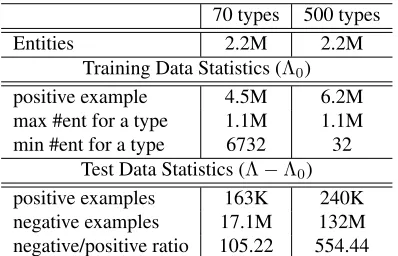
70 types 500 types
Entities 2.2M 2.2M
Training Data Statistics (Λ0)
positive example 4.5M 6.2M max #ent for a type 1.1M 1.1M min #ent for a type 6732 32
Test Data Statistics (Λ−Λ0)
positive examples 163K 240K negative examples 17.1M 132M negative/positive ratio 105.22 554.44
Table 1: Statistics of our dataset.Λ0is our training
snap-shot andΛis our test snapshot. An example is an entity-type pair.
we refer to as the Negative Type (NT) objective. The embedding model described in Weston et al. (2011) developed for image retrieval is also a special case of our model trained with the NT objective.
While theNE orNT objective functions could
be suitable for some classification tasks (Weston et al., 2011), the choice of objective functions for the KBC tasks has not been well motivated. Often the choice is made neither with theoretical foundation nor with empirical support. To the best of our knowl-edge, the global objective function, which includes bothNE(e, t)andNT(e, t), has not been considered
previously by KBC methods.
5 Experiments
In this section, we give details about our dataset and discuss our experimental results. Finally, we per-form manual evaluation on a small subset of the data.
5.1 Data
First, we evaluate our methods on 70 entity types with the most observed facts in the training data.5
We also perform large-scale evaluation by testing the methods on500types with the most observed facts in the training data.
Table 1 shows statistics of our dataset. The num-ber of positive examples is much larger in the train-ing data compared to that in the test data since the test set contains only facts that were added to the more recent snapshot. An additional effect of this is 5We removed few entity types that were trivial to predict in the test data.
that most of the facts in the test data are about en-tities that are not very well-known or famous. The high negative to positive examples ratio in the test data makes this dataset very challenging.
[image:7.612.87.286.59.187.2]5.2 Automatic Evaluation Results
Table 2 shows automatic evaluation results where we give results on70types and500types. We compare different aspects of the system on70 types empiri-cally.
Adagrad Vs DCD We first study the linear mod-els by comparing Linear.DCD and Linear.AdaGrad. Table 2a shows that Linear.AdaGrad consistently performs better for our task.
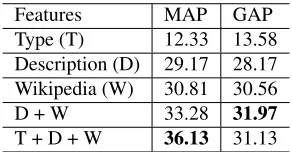
Impact of Features We compare the effect of different features on the final performance using Linear.AdaGrad in Table 2b. Types are repre-sented by boolean features while Freebase descrip-tion and Wikipedia full text are represented using tf-idf weighting. The best MAP results are obtained by using all the information (T+D+W) while best GAP results are obtained by using the Freebase descrip-tion and Wikipedia article of the entity. Note that the features are simply concatenated when multiple resources are used. We tried to use idf weighting on type features and on all features, but they did not yield improvements.
The Importance of Global Objective Table 2c and 2d compares global training objective with NE and NT training objective. Note that all the three methods use the same number of negative examples. More precisely, for each (e, t) ∈ Λ0, |NE(e, t)|+
|NT(e, t)| = m +n = 2. The results show that
the global training objective achieves best scores on both MAP and GAP for classifiers and low-dimensional embedding models. Among NE and NT, NE performs better on the type-based metric while NT performs better on the global metric. Linear Model Vs Embedding Model Finally, we compare the linear classifier model with the embed-ding model in Table 2e. The linear classifier model performs better than the embedding model in both MAP and GAP.
Features Algorithm MAP GAP Description Linear.Adagrad 29.17 28.17Linear.DCD 28.40 27.76 Description +
Wikipedia Linear.AdagradLinear.DCD 33.28 31.9731.92 31.36
(a) Adagrad vs. Dual coordinate descent (DCD). Results are obtained using linear models trained with global training ob-jective (m=1, n=1) on 70 types.
Features MAP GAP Type (T) 12.33 13.58 Description (D) 29.17 28.17 Wikipedia (W) 30.81 30.56 D + W 33.28 31.97 T + D + W 36.13 31.13
(b) Feature Comparison. Results are obtained from using Lin-ear.Adagrad with global training objective (m=1, n=1) on 70 types.
Features Objective MAP GAP
D + W NE (m = 2)NT (n = 2) 33.01 23.9731.61 29.09 Global (m = 1, n = 1) 33.28 31.97
T + D + W NE (m = 2)NT (n = 2) 34.56 21.7934.45 31.42 Global (m = 1, n = 1) 36.13 31.13
(c) Global Objective vs NE and NT. Results are obtained us-ing Linear.Adagrad on 70 types.
Features Objective MAP GAP
D + W NE (m = 2)NT (n = 2) 30.92 22.3825.77 23.40 Global (m = 1, n = 1) 31.60 30.13
T + D + W NE (m = 2)NT (n = 2) 28.70 19.3428.06 25.42 Global (m = 1, n = 1) 30.35 28.71
(d) Global Objective vs NE and NT. Results are obtained us-ing the embeddus-ing model on 70 types.
Features Model MAP GAP G@1000 G@10000 D + W Linear.Adagrad 33.28Embedding 31.60 30.13 73.4031.97 79.63 68.0864.69
T + D + W Linear.AdagradEmbedding 36.1330.35 28.71 62.6131.13 70.02 65.0964.30
(e) Model Comparison. The models were trained with the global training objective (m=1, n=1) on 70 types.
Model MAP GAP G@1000 G@10000 Linear.Adagrad 13.28 20.49 69.23 60.14 Embedding 9.82 17.67 55.31 51.29
[image:8.612.357.503.59.135.2](f) Results on 500 types using Freebase description features. We train the models with the global training objective (m=1, n=1).
Table 2: Automatic Evaluation Results. Note thatm=|NE(e, t)|andn=|NT(e, t)|.
One might expect that with the increased number of types, the embedding model would perform better than the classifier since they share parameters across types. However, despite the recent popularity of em-bedding models in NLP, linear model still performs better in our task.
5.3 Human Evaluation
To verify the effectiveness of our KBC algorithms, and the correctness of our automatic evaluation method, we perform manual evaluation on the top 100predictions of the output obtained from two
dif-ferent experimental setting and the results are shown in Table 3. Even though the automatic evalua-tion gives pessimistic results since the test KB is also incomplete6, the results indicate that the
auto-matic evaluation is correlated with manual evalua-tion. More excitingly, among the 179 unique in-stances we manually evaluated, 17 of them are still7
missing in Freebase which emphasizes the effective-ness of our approach.
6This is true even with existing automatic evaluation meth-ods.
Features G@100 G@100-M Accuracy-M D + W 87.68 97.31 97
[image:9.612.71.288.59.98.2]T + D + W 84.91 91.47 88
Table 3: Manual vs. Automatic evaluation of top 100 pre-dictions on 70 types. Prepre-dictions are obtained by train-ing a linear classifier ustrain-ing Adagrad with global traintrain-ing objective (m=1, n=1). G@100-M and Accuracy-M are computed by manual evaluation.
5.4 Error Analysis
• Effect of training data: We find the perfor-mance of the models on a type is highly de-pendent on the number of training instances for that type. For example, the linear classifier
model when evaluated on 70 types performs
24.86 % better on the most frequent 35 types compared to the least frequent 35types. This indicates bootstrapping or active learning tech-niques can be profitably used to provide more supervision for the methods. In this case, G@k would be an useful metric to compare the effec-tiveness of the different methods.
• Shallow Linguistic features: We found some of the false positive predictions are caused by the use of shallow linguistic features. For ex-ample, an entity who has acted in a movie and composes music only for television shows is wrongly tagged with the type /film/composer since words like ”movie”, ”composer” and ”music” occur frequently in the Wikipedia
arti-cle of the entity (http://en.wikipedia.
org/wiki/J._J._Abrams).
6 Related Work
Entity Type Prediction and Wikipedia Features Much of previous work (Pantel et al., 2012; Ling and Weld, 2012) in entity type prediction has fo-cused on the task of predicting entity types at the sentence level. Yao et al. (2013) develop a method based on matrix factorization for entity type predic-tion in a KB using informapredic-tion within the KB and New York Times articles. However, the method was still evaluated only at the sentence level. Toral and Munoz (2006), Kazama and Torisawa (2007) use the first line of an entity’s Wikipedia article to perform named entity recognition on three entity types.
Knowledge Base Completion Much of precious work in KB completion has focused on the problem of relation extraction. Majority of the methods infer missing relation facts using information within the KB (Nickel et al., 2011; Lao et al., 2011; Socher et al., 2013; Bordes et al., 2013) while methods such as Mintz et al. (2009) use information in text doc-uments. Riedel et al. (2013) use both information within and outside the KB to complete the KB.
Linear Embedding Model Weston et al. (2011) is one of first work that developed a supervised linear embedding model and applied it to image retrieval. We apply this model to entity type prediction but we train using a different objective function which is more suited for our task.
7 Conclusion and Future Work
We propose an evaluation framework comprising of methods for dataset construction and evaluation metrics to evaluate KBC approaches for inferring missing entity type instances. We verified that our automatic evaluation is correlated with human eval-uation, and our dataset and evaluation scripts are publicly available.8 Experimental results show that
models trained with our proposed global training ob-jective produces higher quality ranking within and across types when compared to baseline methods.
In future work, we plan to use information from entity linked documents to improve performance and also explore active leaning, and other human-in-the-loop methods to get more training data.
References
Jonathan Berant, Vivek Srikumar, Pei-Chun Chen, Abby Vander Linden, Brittany Harding, Brad Huang, and Christopher D. Manning. 2013. Semantic parsing on freebase from question-answer pairs. InEmpirical Methods in Natural Language Processing.
Kurt Bollacker, Colin Evans, Praveen Paritosh, Tim Sturge, and Jamie Taylor. 2008. Freebase: a collabo-ratively created graph database for structuring human knowledge. InProceedings of the ACM SIGMOD In-ternational Conference on Management of Data.
8http://research.microsoft.com/en-US/
Antoine Bordes, Nicolas Usunier, Alberto Garcia-Duran, Jason Weston, and Oksana Yakhnenko. 2013. Trans-lating embeddings for modeling multi-relational data. In Advances in Neural Information Processing Sys-tems.
Antoine Bordes, Sumit Chopra, and Jason Weston. 2014. Question answering with subgraph embeddings. In
Empirical Methods in Natural Language Processing.
Andrew Carlson, Justin Betteridge, Bryan Kisiel, Burr Settles, Estevam R. Hruschka, and A. 2010. Toward an architecture for never-ending language learning. In
In AAAI.
Kai-Wei Chang, Wen tau Yih, Bishan Yang, and Christo-pher Meek. 2014. Typed tensor decomposition of knowledge bases for relation extraction. In Proceed-ings of the 2014 Conference on Empirical Methods in Natural Language Processing.
Silviu Cucerzan and David Yarowsky. 1999. Lan-guage indep endent named entity recognition combin-ing morphological and contextual evidence. In oint SIGDAT Conference on Empirical Methods in Natural Language Processing and Very Large Corpora.
John Duchi, Elad Hazan, and Yoram Singer. 2011. Adaptive subgradient methods for online learning and stochastic optimization. InJournal of Machine Learn-ing Research.
Yuan Fang and Ming-Wei Chang. 2014. Entity link-ing on microblogs with spatial and temporal signals. InTransactions of the Association for Computational Linguistics.
Stephen Guo, Ming-Wei Chang, and Emre Kiciman. 2013. To link or not to link? a study on end-to-end tweet entity linking. In The North American Chap-ter of the Association for Computational Linguistics., June.
Hannaneh Hajishirzi, Leila Zilles, Daniel S. Weld, and Luke Zettlemoyer. 2013. Joint coreference resolution and named-entity linking with multi-pass sieves. In
Empirical Methods in Natural Language Processing.
Cho-Jui Hsieh, Kai-Wei Chang, Chih-Jen Lin, S. Sathiya Keerthi, and S. Sundararajan. 2008. A dual coordinate descent method for large-scale linear svm. In Interna-tional Conference on Machine Learning.
Jun’ichi Kazama and Kentaro Torisawa. 2007. Exploit-ing wikipedia as external knowledge for named entity recognition. InJoint Conference on Empirical Meth-ods in Natural Language Processing and Computa-tional Natural Language Learning.
Tom Kwiatkowski, Eunsol Choi, Yoav Artzi, and Luke. Zettlemoyer. 2013. Scaling semantic parsers with on-the-fly ontology matching. In Empirical Methods in Natural Language Processing.
Ni Lao, Tom Mitchell, and William W. Cohen. 2011. Random walk inference and learning in a large scale
knowledge base. InConference on Empirical Methods in Natural Language Processing.
David D. Lewis and William A. Gale. 1994. A sequential algorithm for training text classifiers. InACM SIGIR Conference on Research and Development in Informa-tion Retrieval.
Xiao Ling and Daniel S. Weld. 2012. Fine-grained entity recognition. In Association for the Advancement of Artificial Intelligence.
Christopher D. Manning, Prabhakar Raghavan, and Hin-rich Sch¨utze. 2008. Introduction to information re-trieval. In Cambridge University Press, Cambridge, UK.
Mike Mintz, Steven Bills, Rion Snow, and Dan Jurafsky. 2009. Distant supervision for relation extraction with-out labeled data. In Association for Computational Linguistics and International Joint Conference on Nat-ural Language Processing.
Maximilian Nickel, Volker Tresp, and Hans-Peter Kriegel. 2011. A three-way model for collective learning on multi-relational data. In International Conference on Machine Learning.
Patrick Pantel, Thomas Lin, and Michael Gamon. 2012. Mining entity types from query logs via user intent modeling. InAssociation for Computational Linguis-tics.
Lev Ratinov and Dan Roth. 2012. Learning-based multi-sieve co-reference resolution with knowledge. InJoint Conference on Empirical Methods in Natural guage Processing and Computational Natural Lan-guage Learning.
Sebastian Riedel, Limin Yao, Andrew McCallum, and Benjamin M. Marlin. 2013. Relation extraction with matrix factorization and universal schemas. In The North American Chapter of the Association for Com-putational Linguistics.
Richard Socher, Danqi Chen, Christopher Manning, and Andrew Y. Ng. 2013. Reasoning with neural ten-sor networks for knowledge base completion. In Ad-vances in Neural Information Processing Systems.
Antonio Toral and Rafael Munoz. 2006. A proposal to automatically build and maintain gazetteers for named entity recognition by using wikipedia. In European Chapter of the Association for Computational Linguis-tics.
Jason Weston, Samy Bengio, and Nicolas Usunier. 2011. Wsabie: Scaling up to large vocabulary image anno-tation. InInternational Joint Conference on Artificial Intelligence.
Xuchen Yao and Benjamin Van Durme. 2014. Informa-tion extracInforma-tion over structured data: QuesInforma-tion answer-ing with freebase. InAssociation for Computational Linguistics.