On Target with Solutions
Our systems-capabilitysolu-tions are dead-center on your minicomputer problems. "We aim to solve your problems
in a variety of ways. Aside from our line of general-purpose computers described below,
we"have a full range of DELIVERABLE software: MOS, FORTRAN IV, BASIC, RPG IV, among others. We offer the . largest line of FIELD-PROVEN peripherals. And we have main-tenance contractsJthat are tail-ored to your system needs. We
have a special Systems
Engineering Department that DELIVERS.
Now about that hardware ~ ..
620/i:
The total capability minicomputer. So great, over1400 used worldwide.
620/1:
New, so fast it just did one mega-execution while you read "so fast," comple~ely com-patible with the 620/i.R620/i:
The number one rug-gedized minicomputer.520/DC: Today's most
cost-effective data communications system.
CIRCLE 1 ON READER CARD
If you want to be on target with TOTAL solutions, why'not talk to 'the big company in small computers?
U.S. Sales Office~: Downey, San Diego, San Francisco, Calif.; Washington, D.C.; Chi-cago, III.; Waltham, Mass.; Ann Arbor, Mich.; Minneapolis, Minn.;Albuquerque, New Mex.; New Rochelle, Syracuse, N. Y.; Fort Washington, Pa.; Dallas, Houston, Texas. Other offices worldwide.
Varian Data Machines, a Varian subsidiary, 2722 Michelson Dr., I rvi ne, California 92664. Tele-phone 714/833-2400.
@ -
varian
data machines
An easier keyboard
for your operator ...
An advanced tape station
for your computer
The Tally Datascribe emphasizes simple operation
with your keypunch operator in mind ... and a host
of versatile data handling options for more efficient
utilization of a key-to-tape recorder.
If
you already
have key-to-tape recording and communications
equipment, you'll be especially interested in
Data-scribe. That's because Datascribe designers took the'
time to reflect on the shortcomings of all the earlier
key-to-tape equipment in order to build a better
machine.
The keyboard is virtually identical to the
conven-tional keypunch keyboard. Operation is so simple you
can learn from the manual
if
you choose. For training
purposes, all data is displayed in English language.
Both the 7 and 9 track units are identical in
opera-tion and features.
The Datascribe system is one basic unit which, with
the addition of appropriate plug-in options, can be
additionally used as a remote data terminal, pooler,
high speed communicator or high speed print station.
The Datascribe offers a unique and highly efficient
data compression feature. In the transmission mode,
one character can be used to represent many when
data is identical to the preceding data or preceding
record. Datascribe operates over dial up telephone
lines. Both supply and take-up for full 10%" reels is
standard.
And this is just the beginning. Call your nearest Tally
regional office or contact us here for full details.
Tally Corporation, 8301 South 180th Street, Kent,
Washington 98031. Phone (206) 251-5500.
Regional Offices:
Chicago: 33 North Addison Road, Addison, Illinois 60101 (312) 279-9200
Dallas: 2339 Inwood Plaza, Dallas, Texas 75235 (214) 521-5657
Los Angeles: 501 N. Golden Circle Drive, Santa Ana, Cali- . fornia 92705 (714) 542-1196
New York: 45 North Village Avenue, Rockville Centre, Long Island, N.Y. (516) 678-4220
Richmond: 5404 Distributor Drive, Richmond, Virginia 23225 (703) 231-0259
San Francisco:. 420 Market Street, San Francisco, California 94111 (415) 989-5375
England: Tally, Ltd., Tally House, 7 Cremyll Road, Reading RG18NQ, Berkshire Reading 580-142
TALLY
8Vanguard Series
SUZY'S MARRIED
TO OUR
AD MANAGER
(they
fight
a
lot)
. "My husband Clyde?
Oh, he's all right. Good husband,
good manager -
but he never wants
to say enough about a good thing.
PI's new 1217/19 customized
digital recorder, for instance. That's
why we have an occasional spat.
"If it were left to him,
he'd just tell you the 1217/19 is
synchronous and incremental, up to·
1600 bpi, and features IBM
compatibility, 7 or 9 channels.
'Never write too much in an ad,'
he says, 'people won't read it.'
"Phooey!
You're reading this, aren't you?
"The rest of the good news
(with apologies to no one): the
1217/19
also comes
in7
and
9 channels read-read, remotely
selectable. It interfaces with your
existing equipment, and is ideal for
such uses as process control,
off-line data processing, key-to-tape
and tape .. to-tape transfer,
minicomputers, and many more.
"Every unit is easily field modified
to meet new
requirements-you simply choose the modular
features you want. Result?
A top-quality custom recorder at
surprisingly low cost!
"If you'd like more information
on the enchanting 1217/19, call, TWX
or write Clyde or one of the other
boys-Norm, Ridge or Konrad.
Better yet, if you want the
full
story, call me!
PRECISION
INSTRUMENT
3170 Porter Drive, Palo Alto, California 94304. Phone (415) 493-2222 • TWX No. 910-373-1752
FEBRUARV
~J ~97~volume 17 number 3
departments
Calendar 9 Letters to the Editor 13
Look Ahead
17
Perspective 44 News Scene 46 Hardware 69 Software 73 People 78 World Roundup 85 Index to Advertisers 86 The Forum 90.M
ANAGEMENT
22
Job
IMan
Matching in the '70s
Developed in the '20s, perfected in the '30s, industry's per-sonnel selection techniques are no longer adequate. Here is a system that offers some hope.
28
EPIC - a Cafeteria Compensation Plan
Man does not work for bread alone - maybe a better park-ing place should be part of the reward package.[!J
ECHNICAL
32
Optimizing Assembly Program for Minis
This assembler algorithm is a plan to reduce errors and in-crease the efficiency of your minicomputer.J·G]ENERAL
34
De Ludi Natura
A new and less restrictive theory of programming and infor-mation could lead to a breakthrough into the realm of intui-tive knowledge and draw more talented individuals into the profession.
37 Australian Report
Establishment of two peripheral manufacturers, a major in-crease in available computing power, and formation of pub-lic companies highlight the dp year Down Under.
40
Tokyo Show
A conference report.lCJ
DMMENTARV
44
Perspective
There is some progress in the government's efforts to up-grade the nation's air traffic control system - but the goal may not be any nearer ... And a report on IBM's recent moves to unplug the compatible peripherals with new price cuts.
About the Cover
4
IN/OPAC's Data Cen-ter, designed specifi-cally for Teletype Model 33 terminals with time-share users in mind, provides continuous, simultaneous winding and unwinding without operator attention. The Data Center fastens to the terminal in seconds. Write for details. Let us
FEED,
send you our new data processing inpu't-outputCOLLECT
accessories catalog.TAPES
IN ONE OPERATION
injopac
DIVISION
Numeridex Tape Systems, Inc., Dept. D
4711 W. North Ave.lChicago, III. 60639/312-772-6400 Your most complete source of supply for
data processing peripherals and expendables CIRCLE 50 ON READER CARD
Novar terminals can be
equipped for automatic
detection of errors caused
by noisy phone lines -
and
for automatic correction by
retransmission. Assures
that only correct data goes
to the computer. Models
5-50 and 5-51.
Novar Corporation • 2370 Charleston Road Mountain View, Calif. 94040 • (415) 964-3900 Nationwide Service In 56 Cities
A Member of GT&E Information Systems, Inc.
CIRCLE 33 ON READER CARD
DATAMATION®
FEBRUARY 1. 1971
volume 17
number 3
This issue
110,901
copies
EDITOR
ROBERT B. FOREST
EDITORIAL STAFF
Managing Editor Senior Associate Editors Associate Editors
Copy Editor Assistant Editors
Special Features Editor Eastern Editors New England Editor Washington Editor Midwestern Editor European Editor Australian Editor Contributing Editors
Editorial Adviser Technical Consultant
EDWARD K. YASAKI WILLIAM J. ROLPH, TOM McCUSKER AUBREY DAHL, RICHARD A. McLAUGHLIN, EDITH D. MYERS, JOHN T. WATERHOUSE JANET EYLER MICHAEL WILLIAM CASHMAN ALMA O'STEEN ANGELINE PANTAGES JOHN WESSLER, F. BARRY NELSON W. DAVID GARDNER PHIL HIRSCH LAWRENCE RAGAN PEARCE WRIGHT FREDERICK A. BLAND HOWARD BROMBERG, ROBERT V. HEAD, PHILIP H. DORN, LOUIS B. MARIENTHAL, DANIEL D. McCRACKEN, F. G. WITHINGTON, PAUL ARMER, ROBERT P. BIGELOW ROBERT L. PATRICK LOWELL AMDAHL
EDITORIAL OFFICES
HEADQUARTERS: 94 S. Los Robles Ave., Pasadena, Calif. 91101, Phone: (213) 681·8486; EASTERN: 35 Mason St., Greenwich, Conn. 06830, (203) 661·5400; 19
Marlborough St., Boston, Mass. 02116, (617) 267·9414; 9805 Singleton Dr., .Bethesda, Md. 20034, (301) 365·8671; MIDWESTERN: 407 S. Dearborn St., Chicago. III. 60605, (312) 922·8245. FOREIGN: 65, Hill Road, Chelmsford, Essex, England;
322, Park Regis, Park St., Sydney, NSW 2000, Australia.
GRAPHIC DESIGN
AND PRODUCTION
Art & Production Director CLEVE MARIE BOUTELL
Production Manager MARILEE PITMAN
Production Assistants GLORIA J. FASANA, LOUISE T. O'CONNOR
CIRCULATION
35 Mason Street Greenwich, Conn. 06830
Circulation Manager Marketing Research Director
PUBLISHER
GARDNER F. LANDONASSISTANT PUBLISHER JAMES M. MORRIS
Circulation audited by ~ Business Publications Audit
IiiiitIIiiI
MAE VAN RENNES DOUGLAS DeCARLO
~
---AS"""
Member, American~,..-Business Press, Inc.
~
DATAMATION is published twice monthly on or about the fir.st and fifteenth day of every month by Technical Publishi ng Company, 1301South Grove Ave., Barrington, Illinois 60010; Arthur L. Rice.Jr., Presi-dent; Gardner F. Landon, Executive Vice President. Executive, Circu· lation and Advertisi ng offices, 35 Mason Street, Greenwich, Conn. 06830 (203) 661·5400. Editorial offices, 94 So. Los Robles Avenue, Pasadena, California
91101. Published at Chicago. III.
DATAMATION is circulated without charge by name and title to certain qualified individuals who are employed by companies involved with automatic information handling equipment. Available to others by subscription at the rate of $25
annually in the U.S. and Canada. Reduced rate for qualified students. Foreign subscriptions are on a paid basis only at a rate of $38 annually. No subscription agency is authorized by us to solicit or take orders for subscriptions. Controlled circulation paid at Columbus, O. and Form 3579 to be sent to Technical Pub· lishing Company, P.O. Box 2000, Greenwich, Conn. 06830. Copyright 1971, Tech· nical Publishing Company. Microfilm copies of DATAMATION may be obtained from University Microfilms, Inc., 313 No. First St., Ann Arbor, Michigan. Printed by Beslow Associates, Inc.
IIYQutbiDk
your uDiversit oDly
wlDtsba ,
bowcolDe
tb~
boysolDueb
tilDesharing service1
time from remote terminals, too. And all
simultaneously.
University comp centers mostly offer
batch processing. And that's aq. Tradition has
it that batch is the only thing the scientists and
economists and business offices want.
But 'tain't so.
Look around the campus for terminals
connected to outside timesharing services. Look
in the physics department, or engineering, and
among the biologists and economists. Look in
the special research grants where timesharing
Batch processing keeps the computer
efficient. But more and more universities are dis ..
covering that timesharing keeps the users
efficient. And with a PDP,10, you get the best of
both worlds - timesharing and batch processing
simultaneously. Plus real,time.
, services are easy to bury . You may be in for
a surprise.
That's where the PDP, 10 comes in. A
big, flexible computer that can handle a campus
full of timesharers, as well as your batch. Real,
And the economics of having a PDP,10
will be another surprise. As a rule of thumb, if
your university rents 20 timesharing terminals,
you could own the PDP, 10 for the same fees.
Think about it. And give us a call.
Bowdoin did. Catholic U. did. University of
Oregon did. SMU did. Western Ontario did ...
~BmBDmD
6
POTTER LP 301]
135
LPM,UP TO
$3,3851
This is the lowest price in the world for a printer with
(ill"" -
~.::." these characteristics. Until now, system manufacturers I iii! ,ihave had to decide between 15 char/sec. typewriters
t1
or the high priced 300 Ipm or faster computer printers. ._. .1The Potter LP 3000 combines high speed with low cost.
The Potter LP 3000 Line Printer is ideal for data com-munications systems and mini-computers. At 300 char/sec. or 135 Ipm it is perfectly matched to 2400 baud data rates and offers more than 10 times the speed of ordinary I/O typewriters - all at only a frac-tion of the cost of computer line printers.
IJLI EPRI
132COLUM
ACH/l00
TER
5
Designed with just a small percentage of the parts used in other printers, it gives you a level of reliability never be-fore possible. You can incorporate the Potter LP 3000 Printer into your system easily and with confidence. It's in produc-tion now!
For information on the LP 3000 and any of Potter's
com-plete line of magnetic tape transports,
I
disk drives, printers or 96 column card _...,
!!!!!!!!:.l®
peripherals, contact Potter Instrument .~_
Company, Inc., 532 Broad Hollow Road, Melville, N. Y. 11746. Phone: (516) 694-9000
No one beats a path through
your computer room on
Heugatile Carpet Squares
In the time other carpets are developing bedraggled trails of wear in the heavy traffic lanes, Heugati les stay fresh and new-two to three times longer.
Noise problems? Heugatiles help silence the 'drum effect' created by vibrations from suspended floors. No static build-up either.
The secret is rotation. Before Heugatiles are worn by And you don't have to buy Heugatile. You can lease it, heavy traffic, you simply lift them
out and easily move them to light traffic areas.
And underfloor access needn't be a headache. The one floor
cov-
,...---I
~ • " , . . . HEUGATILE CORPORATIONI
I
HEUGATILE[1' . .
185 Sumner Avenue Kenilworth, New Jersey 07033I
I
I
1m
j Dept. 0-21ering that licks this problem effi-
I
I
0 Send me more information on Heugatile.
ciently for computer rooms is Heu- 0 This is for a current project.
I
I
0 I'm interested in leasing Heugatile.gatile. Our carpet squares lock sol- 0 Have representative contact me.
I
idly in position by their own vacu-
I
Name Title _ _ _ _ um. But when you need to get toI
CompanyI
I
I
underfloor switches and controlca-I
Addressbles, up they come with no effort
-just as you would lease any equip-ment-with a service contract that guarantees continuing satisfaction . You can lease as little as 200 square yards, too.
Heugatile's special construction hides soil. Cleans easier. They're made by the most experienced man-ufacturer of carpet squares in the world.
Send in the coupon today for more information.
I
City State _ _ _ Zip _ _whatsoever. No glue, tape, tack _ _ _ _ _ _ _ _ _ _ _ _ _ • Warehouses and showrooms from
strip or pad is needed, ever. coast to coast.
DATE EVENT/SPONSOR LOCATION
Feb. 9-11 : WIN CON Aerospace Los Angeles
I & Electronic Systems
Convention
Feb. 9-11 I COMPSO East New York City
Feb. 15-19 Computer Display Frankfurt, Equipment Exhibit Germany
Feb. 17-18 AIAA Integrated Palo Alto, Calif. Information Systems
Conference
Feb. 18-19 ADAPSO 31st Phoenix, Ariz. Management Conf.
Feb. 17-19 6th Annual Conference Baton Rouge, La. on Digital Computers
in Process Control
Feb. 22-24 Canadian DP Ottawa
Institute Conference & Trade Show
March 8-10 AMA Management Systems New York City EDP Conference
March 9-11 ASM,AMS Tulsa,Okla
Business Equipment Show
March 10-12 4th Annual' Tampa, Fla. Simulation
Symposium
March 22-24 Numerical Control Anaheim, Calif. Society's 8th Annual
Conference
March 23-26 Information Industry Lancaster, Pa. Association 3rd
Annual Meeting
April 1-2 ACM Symposium'on College Park, Md. Information Storage
& Retrieval
April 6-9 COMPSO West Anaheim, Calif.
April 14-15 ISA, IEEE Electronics Cincinnati & Instrumentation
Conference
!
May 18-20 I Spring Joint Atlantic City Computer Conference
1
May 25-28 20th Annual Convention Washington,D.C. National Microfilm Assn.
. '
CONTACT
W. H. Herrman, IEEE : 3600 Wilshire Blvd.
Los Angeles, Calif. 90005
I Computer Exposition, Inc.
'37 W. 39th St.
I New York, N.Y. 10018
I U.S. Commerce Dept.
BIC-932
: Washington, D.C. 20230
R. W. Rector
I Cognitive Systems
i
319 S. Robertson Blvd. Beverly Hills, Calif. 90211ADAPSO 551 5th Ave.
: New York, N.Y. 10017 I
' Dr. Cecil L. Smith Louisiana State Univ. ; Baton Rouge, La.
Revett Eldred, DPI Box 2458, Sta. 0 Ottawa 4, Canada
American Mgt. Assn. 135 W. 50th St.
t New York, N.Y. 10020
: A. O. Oyler, BEST : Box 141
Tulsa, Okla. 74102
! Annual Simulation Symp.
I P.O. Box 1155
Tampa, Fla. 33601 NCS
44 Nassau St. Princeton, N.J. 08540 IIA
1025 15th St. NW Washington, D.C. 20005
Dr. Jack Minker University of Maryland College Park, Md. Computer Expositions, Inc. 37 W. 31st St.
New York, N.Y. 10018 William Meinders Husky Products, Inc.
! 7405 Industrial Rd. l Florence, Ky. 41042
AFIPS
210 Summit Ave. Montvale, N.J. 07645 NMA
Suite 1101
8728 Colesville Rd .
! Silver Spring, Md. 20910
COST
$15, members $20, others
Prereg., free $2 at door
$450, exhibitors $20, members $35, others $80, members $100, others Unknown Invitational, by request Unknown Free admission $215, exhibitors $85 $95, members $125, others $75, members $125, others $25, spouses Unknown Free preregistered $2 at door . $2 registration
(Cleared up by' Cybermatics Inc., Fort Lee, New Jersey)
What you see in the picture below is a bad case of cyberling rivalry.
The phone book is full of companies named Cyber-something. Since we
helped make this mess, we'd like to clean up our comer of it.
Here's the mess, torn from the phonebook. We're in there somewhere. Can you find us?
Our full name is "Cybermatics:' You won't find the word in a dictionary
yet, but it has a precise meaning: the science of managing
information-communication systems.
That's exactly what'Cybermatics Inc. does.We develop on-lil1e computer
systems. This is the big leagues of the computer game. It taJ<es big-league
talent. Four of the 18 great brains in on-line computers work at Cybermatics.
Companies don't build on-line computer systems every day. So it may be
quite a while before you ask your secretary to get·you
"CYbermatics~'
But when you do,please pronounce it very,very', carefully.
~ 1970 CVBERMATICS INC.
More than just a "smart" terminal, George combines the flexibility of a minicomputer
terminal with the hardware for
real time data acquisition
and control. Designed for the
scientific user, George can be individually programmed to meet a customer's special needs.
Remote batch, interactive, real time data collection, on-line and off-line modes to build a
truly cost effective automation system.
Available with a variety of I/O devices
*
IBM compatible tape
* I ine printer
*
card reader
*
A-D converters
*
D-A converters
*
plotter
*
cassette storage
*
CRT displays
*
multiplexers
*
stepping'motors
Write or call today and let ACSI sorve your problem.
APPLIED COMPUTER, SYSTEMS, INC.
A Subsidiary of COLUMBIA SCIENTIFIC INDUSTRIES, INC.
BOX 6479 AUSTIN, TEXAS 78702
(512) 926·1536
12
What looks
like a new computer,
acts like a new computer,
but costs 30% less?
A used computer.
Figure it out. With savings like 30% onSystem/360's and peripherals, a used computer gives you great price/performance. Especially since computers don't wear out.
have the world's largest available selection of used computer systems. Plus reps around the world. And all our equipment qualifies for manufacturer's maintenance.
Dataware Marketing buys and sells used computers. Aside from the manufacturer, we
Speak to the people at Dataware about your computer needs. The savings speak for themselves.
o a tawaRe
MARKETING, INC.
Subsidiary
of
Boothe Computer Corp.Home Office 555 California St., San Francisco 94104, (415) 989-6580
New York (212) 758-4955 • Chicago (312) 696-4550· Los Angeles (213) 776-6861
[image:14.621.61.530.68.690.2]LETTERS
Dumping grounds
Sir:
Re the letter in the Nov. 15 issue, p. 15:
If Koh Amar
J
achweg' s wife sees anything pornographic in that core dump, he should cancel his wife, notDATAMATION. SCHUYLER SHARP Tulsa, Oklahoma
Glad tidings
Sir:
I enjoyed reading the historical ac-count of the analog tide predicting machine used for over half a century by the Coast and Geodetic Survey in the article, "The Great Brass Brain," by Mr. Al Collins (Nov. 15, p. 32). I share the admiration of Mr. Collins for the ingenuity of the designers of , the "Brass Brain." However, I was somewhat disturbed by the critical comments concerning the digital computer program which is now used for tide prediction.
The implication is made that the digital program is changing the prob-lem to be solved. Mr. Collins says, "The problem has to do with nature, not the corporate controller or the latest super-programmer's notion of what he thinks the problem is or should be. The machine did not stretch the state of the art." I am certain that the digital computer programmer has not lost the concept of the tide prediction problem. Both the tide predicting machine and the computer program combine the elementary constituent tides into the composite tide. Both systems use the same harmonic constants to represent the constituent tides. Schureman, in his Manual of Harmonic Analysis
and Prediction of Tides, stated,
"Without the use of a predicting ma-chine the harmonic method would involve too much labor to be of prac-tical service, . . . " The digital com-puter simply supplies the labor that was not available to Schureman.
Mr. Collins indicates the tide for any minute can no longer be at-tained. Actually the tide at any de-sired time interval, whether it be each hour, minute, second, microsec-ond, etc., can be obtained with the
use of the digital computer. This is done by supplying the angular speeds of the 37 tidal constituents in units of the time interval desired.
The article brings up the question of whether the computer will have as good a record of error-free operation as the tide predicting machine. I have used the tide prediction pro-gram about 700-800 times in the last 12 years and I do not recall having a bad program run.
An estimate of the savings by using the digital computer can be made by comparing the cost of op-erating the tide machine to the cost of using the digital computer. For one year of tide predictions at one location, about eight (rather than three as stated by Collins) hours of labor are required to adjust and op-erate the tide machine. One year of predictions consisting of high and low tides to the nearest minute and a value for each hour of the year re-quires about 35 seconds on the CDC
6600. In terms of expense this means about $80 for the operation of the tide machine and about $8 for the digital computer-a ratio of 10 to 1. I have great respect for the scien-tists who developed the tide predict-ing machines of this country, Ferrel
(1885) and Harris and Fischer (1912). I imagine that if these men were in the tide predicting business today they would be using electronic digital computers.
N. A. PORE
U.S. Weather Bureau Silver Spring, Maryland
Tender compaction
Sir:
I read with great interest the article entitled "The Myriad Virtues of Text Compaction" (Dec. 1, p. 36). How-ever, since we are manufacturers of "intelligent remote batch" data ter-minals, it is with regret that I note that none of these excellent
princi-ples have been applied to the data transmission industry. It seems that giant steps have been taken with re-gard to the hardware that is. used to transmit data. Speeds of up to 9600 baud on voice-grade lines are becom-ing commonplace. Associated with these advances, however, are
rela-tively high costs.
It is a shame that the large main-frame manufacturers have not seen fit to make use of these excellent compaction and compression tech-niques in their "supported" commu-nications software. We, as indepen-dent telminal manufacturers, are forced to simulate existing hardwired terminals in order to gain a foothold in the marketplace. Our intelligent terminal as well as others in the mar-ketplace could easily be programmed to make use of the new compaction technology.
I t is not economically feasible, however, to write a new communica-tions program for each new custom-er. We are therefore at the mercy of the mainframe manufacturers' soft-ware development schedule. It is only through their efforts that an industry standard can be developed. It is frustrating to be aware of tech-niques which could improve data communications throughput by 25% to 50% without increasing the cost ,and not be able to implement them. The ramifications of this concept are staggering. Throughput could be im-proved drastically; therefore, time-sharing utilities could handle more lines with the same equipment, and existing data communications facili-ties could handle a proportionate in-crease in data customers without any investment in additional facilities. It is time that we call upon our existing hardware resources to perform effi-ciently, rather than replacing them with faster hardware devices which will perform inefficiently faster.
NEIL
J.
WEBER, C.D.P. Noller Control Systems Milwaukee, WisconsinTh, en, re, ed, on
Sir:
I must congratulate Messrs. Synder-man and Hunt on their interesting article on text compaction. As a user of large free text files X wish I had thought of it myself.
However, in regard to their remark that the optimal selection of master and combining characters would make the basis of an excellent thesis, perhaps I can make a contribution. Cryptographers have long been in-terested in the frequency of occur-rence of letter pairs in English text. The reference quotes a work dated 1893. The 15 commonest digraphs in order of frequency are:
National Blank Book Company, Inc. Dept. D
Holyoke, Massachusetts 01040
I'd like my free copy of your Data Reference Control System Catalog.
Letters ...
TH, HE, AN, ER, ON, RE, IN, ED, ND, AT, OF, OR, HA, EN, NT.
The most frequent digraph is commoner than the letter C, and the least frequent occurs more often than V, which confirms the authors' idea of the value of compaction.
Examination of the list given above shows that U should probably be dropped from the master list in favor of H. I say "probably" because the initial and final letters in words become important in the light of the authors' finding that blanks are so common. Reference to the nearest dictionary shows that the most likely letter for a word taken at random to begin with is S. Since S is a popular final letter, appearing in most plurals, it must also be a candidate for master character.
One more thought, the trigraph THE occurs more often than the letter G, and 10 others more often than
J.
I look forward to the graduate thesis and only hope that we wait for it before standardizing on a "com-pact text code."
B. FARRELL CHOWN
Ottawa, Ontario, Canada
Moduclarity
Sir:
Your columns have recently con-tained some comments on COBOL and modular programming techniques. The discussion stems from Mr. Vaughn's article "Can COBOL Cope" in your Sept. 1 issue (p. 42). May I add to the fire by suggesting that the problem is not so much COBOL as modularity?
It is now generally accepted amongst computer programmers that modularity is a useful technique. The advantages of breaking down a com-plex problem into its constituent parts now seem so obvious that they need not be summarized here. Yet few installations manage to do modu-lar programming successfully, and the resulting modular programs are often no better than the monolithic programs they replace. In fact, mod-ular programs are often monolith-ic programs broken into arbitrary "modules," each of which reflects the characteristics of the monolithic pro-grams they replace. How then should a programmer avoid this pitfall? How should a programmer break a pro-gram down into modules? These questions are only now beginning to receive the attention they deserve.
To answer them one must answer the following questions: What is the theoretical structure of a program; what compromises have to be made to make a program testable; what compromises have to be made to code a program in a given language. Attention is usually given only to the last question-hence the preoc-cupation with COBOL. Sometimes at-tention is given to the second ques-tion, and only rarely to the first. But it is just the structural characteristics of a program which can throw most light on the problem of devising modular solutions to programming problems.
For example, how does a program structure relate to the files it is pro-cessing; how should file. exception conditions be handled; why does hardware dependent logic (i.e. page spacing) cause so many headaches; at what point should particular report lines be constructed and printed? And so on. Answers to these questions must be found which de-pend only on program structures, and not on programmer whims, if
there is to be any consistency in pro-gram design.
If program design is seen as the real problem, then language prob-lems are put into a proper perspec-tive, and seem far less important. A better understanding of program de-sign might even open the way for we programmers to influence the kind of languages which are provided to code our programs.
ALAN COHEN
New York, New York
Tagging along
Sir:
The "particularly biting jab" leveled at the NCR color coded tag by Wil-liam H. Burkhart, president of Transaction Systems, Inc., as quoted by author F. Barry Nelson in the article "pos Now Respectable; NCR Has It!" in the Nov. 15 issue (p. 129-131) is completely untrue. The NCR color bar tag cannot be falsified by the use of a Polaroid Colorpak camera (either the $25 minu~ employee dis-count model, or the $170 model with no discount) because of the specific spectral components demanded of the reflected light by the handheld wilnd.
This, and most other attempts to alter the color coded tag data con-tent, will render the tag completely unreadable due to the extensive error
checking designed into the NCB cod-ing and reader system.
The NCR color bar tag is as "crimi-nal proof" as a magnetic tag, and much easier to determine visually if it has been tampered with by some unscrupulous person.
THOMAS A. SHEHBY
Director, Dayton Engineering and Advanced Develupment
National Cash Register Company Dayton, Ohio
Sensorship
Sir:
Your Dec. 1 issue's "Look Ahead" column included some incorrect and misleading speculation a bou t IBM'S DACS (Data Acquisition and Control Systems) organization, which-among other duties-handles the IB~I 1800.
In announcing IB~I System/7, we made it clear that the new computer complemented the capabilities of the 1800 by extending its range and making additional applications feasi-ble.
We referred to System/7 as a "sen-sor-based system" and have taken the same approach with our DACS centers and specialized marketing represen-tatives. They have been redesignated as "Sensor-Based Systems Centers" and as "sensor-based systems repre-sentatives" to more accurately de-scribe their scope. The only change was one of terminology.
Rather than cutting back our sen-sor-based marketing organization, we have, in fact, expanded it by provid-ing additional educational, technical, and marketing support.
JAMES J. KEIL
Director of Systems Marketing IBM
White Plains, New York
Caught on base
Sir:
Regarding the letter from Mr.
J.
N. Lambrecht in the Dec. 1 issue: I hate to tell him, but hexadecimal was used by the people connected with SWAC, which went on the air in early 1951, I believe.They became quite proficient in operating on that base. One of them claimed that lapsing into base 16 in a supermarket had been a minor source of embarrassment on occasion. ARNOLD 1. DU~1EY
BURROUGHS B6700
Its the ITlost advanced business
data processing systeITl
now available for service.
16
Because it provides:
POWER. One, two or three central processors.
One, two or three input! output processors.
Double-size main memory (up to six million bytes).
Electronic exchange architecture.
MULTIPROCESSING. It's automatic. With
any mix of programs. For flexibility and throughput.
DYNAMIC RESOURCE ALLOCATION.
For "fail-soft" security and continuous operating
efficiency.
COMPLETE SELF-REGULATION. The
computer runs itself under Master Control Program
supervision.
EXPANDABILITY. You can
add equipment as you add the work.
Any time. With no reprograming.
DATA COMMUNICATIONS.
Service for more than 3,000 lines.
Without burdening the central system.
VIRTUAL MEMORY. No
more limits on program size. It's
independent, so programmers don't
have to plan for it.
COMPILER LANGUAGE
PROGRAMING. Exclusively. It
makes program writing and
modification a lot easier.
DISK STORAGE.
Massive-with up to 72 billion bytes on-line. Fast-Massive-with
access to any record in as little as 1/S00th of a second.
These important systems design capabilities
are ready for you now in the B 6700.
From the company that's recognized for
leadership in systems design ...
LOOK
AHEAD
IBM ALSO FEELS
FITS OF DEPRESSION
BOOTHE LIKES TERMINALS;
ANTES UP $1 MILLION
BERKELEY COMPUTER
IN BUSINESS FOR REAL
IBM BOMBS
USER SUPPLY LINES
IBM, the firm that "fires but never has layoffs,"
has reportedly given 1,800 staff-level employees a
choice: go back into the field or submit to
"involuntary resignation."
It's well known that IBM
hasn't escaped the effects of a lousy economy; it
has had to fire people, trim development, drastically'
cut travel budgets, even eliminate thousands of phone
"squawk boxes." The next squawk you hear ...
Boothe Computer has upped its stake in the crowded
CRT terminal field with an injection of funds into
Courier Terminal Systems, two-year-old Phoenix firm.
now headed by ex-UCC executive Ed Kearns.
Kearns
joined the struggling 55-man firm last November as
. it was about to run out of the original $1.5 million
investment by Boothe and three other firms.
Boothe
has now committed an additional $1 million, raising
its interest to 80% from 40%.
Courier has been
making the Executerm, a Teletype compatible terminal,
and recently the E-60 and E-65 which are replacements
for IBM's 2260 and 2265.
Some 100 have been
installed and the company is about to announce a
$500,000 order from a large bank in the Pacific
northwest, boosting its backlog to $1 million.
One of the companies most rumored to be going out of
business in 1970, began 1971 still very much alive.
Berkeley Computer Corp. says its big Model 500
time-sharing machine is now ready for customer use.
It had been up and running since early last fall but
needed software refinements.
Now Berkeley says
it's ready to talk with prospects.
And the company
expects by the middle of this month to announce
either a merger or new financing which will make
possible construction of a second Mod 500 and the
development of the 1000, a production version of the
500 with twice its capacity.
IBM scored a direct hit on both the peripheral and
leasing firms by replacing the 2314 in the 360 and
370 lines with the 2319 for 20%
±
less.
It was
called a marketing coup.
Both groups are adjusting
their prices (see page 47).
But one IBM-watcher
called it an IBM "over-reaction." He thinks the
Mean Gray Giant need not have undercut the
competition to protect its disc market and that it
should expect more anti-trust suits for "rule of
reason" violations.
In effect, such a suit would require proving
IBM, as the dominant factor in that industry,
actually intended to--and indeed did--hurt
competition through price cutting.
The counter
claim could be that IBM's intent was to create a
larger disc market by making the drive more
LOOK AHEAD
EECO JABS AWAY WITH
PUNCHED TAPE READER
DATA ENTRY FIRMS
ENTER NEW PHASES
RUMORS AND
RAW RANDOM DATA
the question is whether this is far enough below the
new IBM price umbrella to attract users to mixed
installations. Leasing companies who own an
estimated 700 to 800 2314 systems, expect a lot of
commission-hungry IBM salesmen to be calling at their
accounts.
Among other fearful expectations for '71:
IBM will eliminate extra-shift charges on tape
drives too.
The commercial mark,et for punched tape readers runs
$30 million a year and is increasing about $5 million
annually, says Bill Fordiani, marketing director of
Electronic Engineering Co. of California.
He adds
that this growth should continue for the next three
to five years.
The company this month will introduce
still another product for this market-- the 8000
series reader and spooler, aimed at commercial
punched tape applications such as teletypesetting
and programmed test equipment.
It handles up to 350
cps asynchronously and 750 cps synchronosously, and
operates with 70% transparent tapes.
Paper tape
lives.
Inforex, of Burlington, Mass., is understood to have
shipped more than 200 of its intelligent Key Entry
systems in the
u.s.
and has others installed abroad
through an agreement with Computer
&
Systems, Ltd.,
London.
The company has formed Inforex Leasing
Co.--40% owned by Inforex and 30% each by United States
Leasing International, Inc., of San Francisco, and
the St. Paul Leasing Co.
Also in the data entry business, Entrex, of
Lexington, Mass., is shipping its first system to a
New England-based insurance company and another
system is expected to go to the UK soon.
Although
Infoton is well known as a crt manufacturer, the
firm sees its real future down the line a bit with a
data entry system using--of all things--an optical
character recognition unit the company has developed.
It has a working prototype and thinks an entire
system could sell for as low as $35,000.
It could be
out before year-end.
How can youdete
software packa e fo
Look no
further!
AUERBACH SOFTWARE REPORTS give you the facts you need to decide whether to develop a software system in-house or buy an existing one.
You'll save weeks of frustrating research. And you'll be able to justify your decision in much less time than it takes to make a wrong one.
It enables you to select the right package for your applications from the more than 3,000 proprietary software programs now being offered.
Business ••• Scientific and Engineering ..• Systems Software. Here are the facts you've been looking for, covering more than 20 application areas, such as:
Inventory Control Payroll
Accounts Receivable Accounts Payable General Ledger
Information Retrieval Flow Charting
File Maintenance Production Planning and Control
Definitional Re'ports and Comparison Charts show you hardware requirements, operational characteristics, programming languages, sources and availabilities-and the cost for each package!
AUERBACH Software Reports is a brand new loose-leaf reference service. It is up-dated bi-monthly, so you will always have the latest, most accurate infor-mation at your fingertips. For further details and sample pages" mail the coupon below.
AUERBACH Info, Inc.
121 N. Broad Street,
Philadelphia, Pennsylvania 19107 Please send me detailed informa-tion and sample pages from the new AUERBACH Software Reports.
AUERBACH
First with the last word on computers
®
Name' _ _ _ _ _ _ _ _ _ Title' _ _ _ _ _ _ _
(Please Print)
Company' _ _ _ _ _ _ _ _ _ _ _ _ _ _ _ _ _
Address. _ _ _ _ _ _ _ _ _ _ _ _ _ _ _ _ _
City _ _ _ _ _ _ _ State' _ _ _ _ _ _ Zip, _ _ _ _
Phone' _ _ _ _ _ _
Signature _ _ _ _ _ _ _ _ _
Information and Management consulting services available through AUERBACH Associates, Inc.
---_-.:
A Monster As Big As Life
Scientists who would "educate" the public by talking with mass circulation magazine writers may have had sec-ond thoughts after reading LIFE mag-azine's account of "Shaky, the First Electronic Person," in the Nov. 20 issue.
The writer, Brad Darrach, describes the gyrations of Stanford Research I nstitute's com puter-driven robot which, he reported, rushed down a hall looking into four rooms before finding the right one, "as we hurried to keep up." Bert Raphael, one of the SRI scientists working on the robot, wonders why anyone had to hurry that day in May when the LIFE writer visited SRI, since Shaky was inopera-tive. All the writer witnessed was a movie made six months earlier, sim-ulating what the scientists thought Shaky could be programmed to do someday. They admit it does perform three programmed functions, but it doesn't look into rooms or walk down halls.
Darrach, however, was not writing just about Shaky-but about a much bigger computer monster, one that would be upon us within three to eight years: "A machine with the general intelligence of an average human being . . . able to read Shakespeare, grease a car, play office politics . . . educate itself with fantastic speed. In a few months it will be at genius level and a few months after that its powers
will be incalculable." This he at-tributed to Marvin Minsky of MIT's Project MAC who, he says, "told me (this) with quiet certitude." Minsky, of course: has denied saying any of this. The professor did talk with Darrach of human intelligence. And he did warn that if a machine were devel-oped with the capability to design other machines, we should stop it until we had adequate protection. He said nothing about a 3-8 year timetable. According to Darrach, other ex-perts on artificial intelligence offered the writer much more conservative predictions of 100 to 150 years (not reported in LIFE). The writer has also told us the article was revised several times so that the "average reader" could follow it "with care."
Although the article obviously is a piece of fantasy which should be dis-missed as such, it does pose the ques-tion of whether and how leaders in the widely exposed computer sciences field should communicate with the public. Stanford psychoanalyst Kenneth M. Colby, who refused to be interviewed by the LIFE writer, says he talks only with science writers. Edward Feigenbaum of Stanford says he and Joshua lederberg spent an afternoon with the LIFE writer because they were sensitive to the growing public awareness of the computer and this was a challenge to educate. "Then w.e were clobbered with this piece of
stupidity." Now, says Feigenbaum, "I'm nervous even talking with
Datamation." .
Silence may be the only defense against distortion. But one wonders if
LIFE would have published such an article if more authoritative informa-tion had been available on the sub-ject. John McCarthy of Stanford notes there is no consensus among the artificial intelligence community of its prospects. Nor, to our knowledge, has there been any briefing for the general press on the subject-such as a briefing on its limitations.
This, obviously, is because no one is organized to take on s~ch an en-deavor-or for that matter any other effort to help the press chronicle significant developments in comput-ing. Much has been said of the need for professional societies, chartered to keep members informed, to take up the challenge of informing the public. The way to the public is through the press. Some faint efforts have been made. We hear a lot about a Com-puter Year and one society has asked Congress for a commemorative Com-puter Postage Stamp. But what society recently has provided a local news-paper with the name of an expert it can call for help in writing a story . about a computer-related subject?
-Tom McCusker
R
E
A
D
o
U
22
It's time to change those
personnel selection techniques
we developed in the '20s
.Job/Man
The two-and-a-half decades since World
M
War II have seen the greatesttechnologi-cal revolution in man's history. Yet the ideas and techniques applied to industry's single largest problem-the recruiting, screening, and selection of manpower-developed in the '20s and brought to fruition in the Depression of the '30s, are still with us in the '70s.
The tremendous labor pool of the Depression de-cade permitted management the luxury of hiring one in twenty-the "most qualified," perhaps in reality the most "over-qualified." Still in widespread use, the techniques which suited the years of large labor pools are maladaptive in these times of full employment when a 5% unemployment rate is considered a dire sign of recession. The expensive symptom of this maladaptive set of employment practices is the high level of labor turnover among all classes of worker,
The cost ... is probably
billions of dollars
annually.
but particularly among the sern.- and low-skilled, both white and blue collar. It is estimated that today workers under 35 change jobs on the average of once in one-and-a-half years, while those over 35 stay on their jobs only about twice as long.
During the particularly tight labor market of the Korean War years, when employment at a General Electric Co. plant in Schenectady soared above 35,-000, a management study of employee turnover re-vealed that in order to fill the "last 5,000 jobs" on the payroll 17,500 to 25,000 people were hired in one year! And this occurred a decade before the
"discov-Matching
ery" of the hard-core unemployed. In today's labor market, employer after employer has revealed that virtually every business has its own trigger point, that when employment passes a certain level an annual ratio of between 3.5 and 5.0 hires per job is not unusual. In one situation, an employer with whom we worked has a job category in which he experiences over 700% turnover per year. The cost for the entire economy-in recruiting, training, rework, scrap, union grievances, lower productivity, turned-off customers, low morale-is probably billions of dollars annually.
The problem is just as severe for the job-seeker. That people frequently seek and find low- and semi-skilled jobs on a hit or miss, trial and error basis has long been known. In simpler times it was possible for a job-seeker to have some knowledge of the content of many of the jobs he was likely to get-in these times he is fortunate if he knows the real requirements of more than a handful of jobs. So he searches by trial and error. And because it is relatively easy to get another job at about the same pay level, he tries and errs and moves on to another trial and so forth.
That management often tends to hire on the same basis, with little or no attention given to the work-content preferences of the people at low- and semi-skilled levels is-by definition-equally true; these people do not hire themselves. The Black Revolution of the '60s was as much a revolt against the irrel-evance of the employment practices of industry as against any other single factor.
The National Association of Manufacturers was struggling with the oft-heard complaints of their members about the cost of turnover. At the same time that it was turning its social concern to the problem of hard-core unemployment, NAM, aware that it was
dealing with two sides of the same coin, took upon itself the responsibility to develop a solution. In 1966, Richard Cornuelle and Wright Elliot led this effort through the Center for Independent Action. ~lichael
•
In
the
J70s
Youchah, computer and systems consultant to both
NAM and to the New Jersey Department of Labor and
Industry, was assigned by both groups to find a way to harness the computer to the solution of the problem of matching people and jobs. The NAM, at Youchah's
suggestion, took the safest and wisest of research and
... a revolt against
the irrelevance of
the employment
practices of industry ...
development approaches-two completely different solution directions at the same time and in parallel. The first was a computerization of the traditional extrinsic job labels, experience, education, etc., ap-proach; the second was "way out," scrapping all but the intrinsic essence of the traditional, using the computer as a machine tool.
The GE Missile and Space Division was asked to
propose an r&d outline for the nontraditional ap-proach. Under the direction of Louis Cimino, the division put together a conceptual approach and con-verted it into a proposal to NAM. Thus, in the spring
of 1966, there began what was to be a most signifi-cant and successful research program into the man-power. selection process, completely supported by pri-vate, nongovernment funding provided by NAM, Lilly
Foundation and The Stern Family Fund.
. The objective of the research was to determine whether and how jobs and job applicants could be matched at the semi- and low-skilled levels in both white and blue collar jobs to assure a higher degree of job satisfaction for successful applicants and, simul-taneously, higher productivity and lower costs for
by Samuel H. Cleff and Robert M. Hecht
employers.
Underlying the research was a basic, common sense principle, long part of our industrial folklore but never verified scientifically and consistently ignored in·practice by both people seeking jobs and employers with jobs to fill.
The principle is this:
In looking for work (as elsewhere in life), people seek out those activities in which they feel they are more likely to be successful. Conversely, they avoid those activities in which they feel less likely to be successful. Occupationally well-adjusted people-those who like what they do and believe they are doing it well-are significantly more likely to do a better job for their employers, and to stay on their jobs longer, than people who are occupationally mal-adjusted-those who do not like what they do and believe they are not doing well.
A broad cross section of 29 national and local employers in the Indianapolis area provided a variety of jobs to be filled and real life job situations for analysis. Seven Indianapolis employers 1 and the EDP
Division of Honeywell, Inc., in Brighton, Mass., coop-erated fully in a separate study (Project Indianap-olis) to validate initial findings.
In all, the research and development program-formulation of hypotheses, experimentation, statistical analyses, verification-lasted some two-and-one-half years and produced two major results.
First, a universal "language" or common set of variables, was invented for describing in identical terms the actual activities content of any semi- to
low-skilled job in the economy-and the actual activities previously performed and currently preferred by peo-ple who seek to fill that job (or who fill it now).
Second, the basic principle underlying the research
24
Job matching.
was found valid. Occupationally well-adjusted people whose activities preferences and history match job activities requirements do tend to stay on their jobs longer and do tend to be identified consistently by their supervisors as "successful." Such individuals can now be identified accurately in advance through use of job/applicant profiles made possible by the un i-versallanguage.
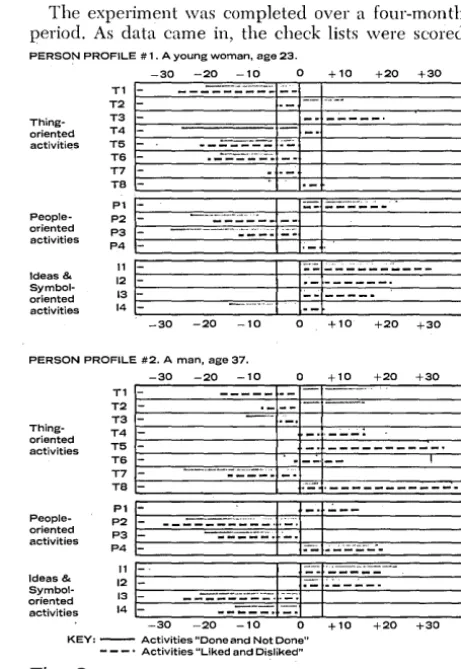
Male or female, black or white, urban or rural, high school graduate or elementary school drop out, hard-core unemployed or steadily employed-all can be
described in terms of both an activities experience profile and an activities preference profile. Both pro..; files can be computer-matched against either wpite collar or blue collar job profiles written in the same language.
Further, this language permits mathematical com-parison not only of job and job applicant, but of job and job (within and between companies), and appli-cant and appliappli-cant.
\Vhat follows is a brief technical description of how the Cleff Joh ~latchil1g System was developed and how it can he applied to the mutual benefit of em-ployers with johs to fill and the applicants seeking jobs. Detailed statistical reviews of all reported find-ings are availahle in a technical paper.
Neither the employer who has gone through l}alf-a-dozen hires to fill a single job satisfactorily nor the five misplaced previous hires need to be convinced that something is wrong with the. system. In fact, a lot is wrong with it.
\Vhile Project Indianapolis was still in the early discussion stage, certain basic facts demanded recog-nition:
1. Not only was available research scanty, but no successful attempt had ever been made to build a system of organizing concepts which treated the field of hum·an resources management in a systematic way, with experimentally testable solutions to problems faced daily by employers, employees and job seekers. 2. Job titles, which now total 42,500 as listed in the U.S. Employment Services' Dictionary of Occupa-tional Titles, have more and more become social labels, and less and less useful in describing the job itself. Thus, a "building engineer" mops down the halls and a "fireman" on a diesel locomotive does-what???
For these and related reasons, it was agreed at the outset that standard hiring and job seeking methods, with their reliance on hope, hunch and tradition, had become increasingly obsolete. The research and de-velopment objectives for Project Indianapolis there-fore were drawn as follows:
1. To investigate an analytical approach and de-velop the basic methodology for matching people and jobs at the low- and semi-skilled levels.
2. To validate these concepts and methods and to develop a mechanizable operational model for match-ing people and jobs at these levels.
A systems analysis approach was taken toward meeting these objectives. Statisticians familiar with Indianapolis were hired to develop representative samples of available jobs and chronically unemployed job seekers. \Vith the help of the 29 cooperating employers, a sample of 57 open job categories was se-lected. Then social workers from Flanner House inter-viewed a sample of 150 chronically unemployed
peo-pIe, black and white, male and female, who might he considered for those jobs.
Both the jobs (through incumbents and super-visors) and the job seekers were interviewed in depth. All interviews were taped and transcribed verbatim. The interviews when analyzed produced an ex-haustive sample of 2,400 human activities or behav-ioral units required on the jobs; and an even larger group of 3,500 behavioral units from the 150 people interviewed. It was then possible to attempt to de-velop a set of dimensions common to both pools of behavioral units.
All the behavioral units gleaned from the people interviews were initially grouped according to their relation to one of the three basic orientations common to all behavior: Things, People, and Ideas. This triad
is as old as Plato and is also used by the U.S.
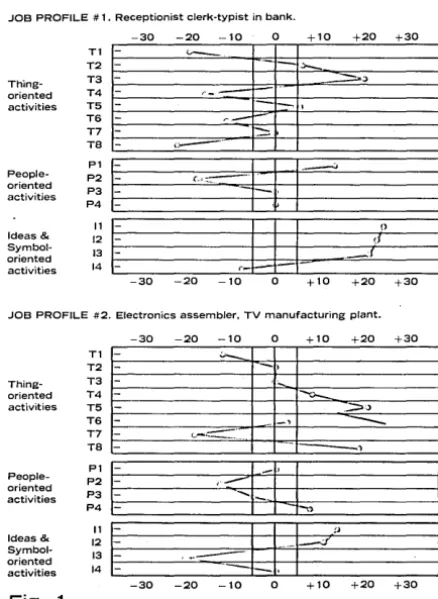
SAMPLE "DIMENSIONS OF WORK" T -Things-behavior most immediately and
directly oriented toward concrete things.
Examples: T1. ATHLETIC
Job activities which immediately and di-rectly involve the worker with things such that:
* * he uses the large muscles of his body in hard phySical labor
* * he pays attention to broad overall results only
(dig ditches, shovel coal, load trucks) T7. CORRECTION
Job activities which immediately and di-rectly involve the worker with things such that:
* * he corrects the quality in his own work or in the work of others
* * he ensures quality performance of machinery and equipment
(set up machinery, repair parts and equipment, inspect work of others or self.)
P-People-worker behavior most immedi-ately and directly oriented toward other people and animals
Example:
P3. MANAGEMENT
Job activities which immediately and di-rectly involve the worker with people such that:
* * he guides, influences, or directs the present and/or future ongoing behav-ior of others
* * he takes or shares responsibility for results of that behavior, including their work
* * there is high potential for emotional relationships
(train new workers, supervise work-ers, monitor or guard, hire employ-ees)
I-Ideas & Information-worker behavior most immediately oriented toward ideas, sym-bols and information. Example:
13. CLERICAL
Job activities which immediately and di-rectly involve the worker with ideas and symbols such that:
* * he records or orders data of any kind
* * processes paper work intended to do that
(file letters ,or cards, update stock records, keep records of transactions, etc.)