management
standards
for
data
•
processing
T
of data processing equipment-inten years computer installations have
grown from 1,000 to 10,000 in the United States - depends almost en·
tirely on overall methods and perform·
ance standards to prevent costly pro·
gramming waste, personnel turnover,
and ineffectual performance or mao chine operation. Here, in this unique volume is a complete discipline of methods standards, covering the func· tions of systems analysis, program· ming and computer operation; and a complete methodology for perform·
ance standards for personnel and equipment. There is no other book now available as a guide to these aspects of computers and punched card data processing.
Based on the author's extensive ex·
perience in the field, the book details the specific manner in which various tasks should be undertaken and pro· vides definite criteria and an approach to the evaluation of personnel and mao
chine performance. A system of stand·
ard nomenclature and symbols is pro·
posed to insure that the work of pro·
grammers and analysts is understood by all others in the installation. The normal length of time required for each task is given, as well as various measures to judge and upgrade quan·
tity and quality of work conducted. Throughout, appropriate illustra·
tions are provided using forms and
procedures taken from standards now in successful use. Numerous tech·
niques for making a computer or punched card installation more effec·
tive are included, and an appendix pro·
vides a complete sample manual of
standards for a typical 1401 computer installation.
Data processing managers, super·
visors, analysts and computer techni· cians, corporate controllers and others in top management with functional reo sponsibility will find this book an in·
valuable guide to implementing stand· ards, a reference for control and im· provement of systems in either busi· ness or scientific installations.
1530
Applied Systems, Inc., a New York consult·
ing firm. Prior to this Mr. Brandon was
Director, Data Processing Services for The
Diebold Group, Inc. A graduate industrial
and management engineer from Columbia
University, where he received his B.S. and
M.S. degrees, Mr. Brandon has taught at
both Columbia and New York Universities. He was previously Director, Computer
Serv-ices, Management Assistance, Inc.; Project
Coordinator with IBM; and Senior Industrial Engineer and Data Processing Manager,
Photocircuits Corporation. Among the
pro-fessional journals to which he has contrib-uted are the Journal of Machine Accounting, Computers and Automation and Banking
Magazine. He is President, Metropolitan
Computer Association and a member of the Data Processing Management Association.
MANAGEMENT STANDARDS
FOR DATA PROCESSING
DICK H. BRANDON
Brandon A ppZied Systems} Inc.
D. VAN NOSTRAND COMPANY, INC.
PRINCETON, NEW JERSEY
D. VAN NOSTRAND COMPANY, LTD., London
D. VAN NOSTRAND COMPANY (Canada), LTD., Toronto
Copyright © 1963, by D. VAN NOSTRAND COMPANY, INC.
Published simultaneously in Canada by D. VAN NOSTRAND COMPANY (Canada), LTD.
No reproduction in any form of this book) in whole or in part (except for brief quotation in critical articles or reviews)) may be made without written authorization from the publisher.
06675a30
Preface
The purpose of this book is to provide a practical guide for data processing managers, supervisors, and analysts in the development of a methodology and measurement yardsticks for the operation of an ADP program. It has been written to fill a definite gap in the technology and literature, and to provide a more formal approach to a problem which to date has been largely neglected.
The growth of information technology in the last decade has been overwhelming, and has changed the scope and technical requirements of management. The installation of automatic data processing equip-ment has become almost a competitive necessity in this age of growing paperwork, as witnessed by the incredible number of true computers currently being installed. These installations are accompanied by mount-ing costs, and ever-increasmount-ing hardware capacity and complexity.
There is no question that the installation of ADP equipment is in many industries the most technical task that management has ever faced. The complexity of this technology is such that few management· men have the time, inclination, or training to obtain sufficient knowledge to direct its use adequately. As a result, there has been no organization j or control applied to the installation program. The absence of these, the rapid change in the technology, and the "crash program" basis on which most installations are founded, have resulted in installations of question-able efficiency and economy. The same pressures prevent the possibility of ever creating true measurement techniques, so that they are self-perpetuating. The primary objective of this book is to outline formal methods for organizing the data processing program. It provides formal guidelines for every aspect of the program and for the techniques neces-sary to evaluate the progress and performance on a controlled basis. The book has been designed to achieve the following:
• Provide data processing management with a definitive method-ology for the installation of good standards and procedures.
• Provide the skilled data processing technician with the proper methods for organizing his own work.
• Provide top management with a guide for the continued review of progress.
Many organizations have contributed to the materials used as
tions throughout this volume and my gratitude is expressed to these organizations, specifically
The Bowery Savings Bank General Dynamics/Astronautics The State Street Bank and Trust
Company
National Cash Register Co. General Electric Corp.
Metropolitan Life Insurance Co. Autographic Business Forms Advance Data Systems, Inc. Chrono-Log Corp.
Financial Publishing Co. The Bulova Watch Company
Lockheed Aircraft Corporation The U. S. Post Office
UNIVAC Division of Sperry-Rand International Business Machines
Corp.
Northwestern National Life In-surance Co.
Prudential Life Insurance Co. Atlantic Refining Co.
Engler Instrument Co. Electronic Associates, Inc.
Standard Instrument Corporation
In all of this work, The Diebold Group, Inc. has played a major role: it is the organization that allowed me to develop my ideas; it has been the prime source of much of the industry experience in this area; and most importantly, it consists of a group of human, incisive, and capable people. Mr. John Diebold deserves much of the credit for this, and for his major contribution to the book; Mr. Ralph Weindling, the "Exec" in many ways, has also earned my deepest appreciation and respect for his many-sided support.
My further thanks are due to a number of helpful clients, whose technical and personal support made this book possible. Mr. Ben Natchez, of Bulova Watch Company; Mr. David Thorndike, of Financial Publish-ing Co., Messrs. John Larsen, Peter Andre, and Arthur Hutt of the Bowery Savings Bank; Messrs. Tom Morrow and Walt Cannon of Lockheed-Georgia Company; Mr. Carl Diesen at General Dynamics/-Astronautics; and Mr. William Smith at Fireman's Fund Insurance Co., are but a few who contributed far beyond my expectations.
I have always marveled at the many ways in which authors express their gratitude to their most important contributors. In thanking my editor, associate, and critic, Mr. Arnold D. Palley, I have exhausted my resources, perhaps as he did in listening to me for many hours. The book itself is ample evidence of his contribution: he read the original manuscript in its entirety and extensive changes in style and emphasis were made in accordance with his suggestions.
And in the last analysis, as always, if words alone were used to thank my wife, Sonya, for her inspiration and assistance, I would be wholly inadequate to the task. I am lucky to have her understanding; without this there would be no preface.
DICK H. BRANDON
Table of Contents
Preface vii
CHAPTER
I BACKGROUND OF STANDARDS DEVELOPMENT 1
II THE ROLE OF STANDARDS IN MANAGEMENT CONTROL 16
III METHODS STANDARDS: SYSTEMS ANALYSIS 33
IV METHODS STANDARDS: PROGRAMMING .. PART 69
V METHODS STANDARDS: PROGRAMMING) PART 2 110
VI METHODS STANDARDS: OPERATION 150
VII INSTALLATION AND ENFORCEMENT OF METHODS STANDARDS 182
VIII PERFORMANCE STANDARDS: EQUIPMENT 204
IX PERFORMANCE STANDARDS: PERSONNEL 249
X OTHER USES OF PERFORMANCE STANDARDS 299
XI METHODS AND PERFORMANCE STANDARDS FOR PUNCHED CARD
INSTALLATIONS 317
APPENDIX A: JOB DESCRIPTIONS IN DATA PROCESSING 345
APPENDIX B: LEVELS OF PROGRAMMING LANGUAGES 348
APPENDIX C: PERSONNEL REQUIREMENTS 350
APPENDIX D: MANUAL OF DATA PROCESSING STANDARDS FOR
FINANCIAL PUBLISHING COMPANY 353
Index 400
Chapter
I
BACKGROUND OF STANDARDS
DEVELOPMENT
INTRODUCTION
The use of computers to solve business or engineering problems is now commonly accepted as practical. Largely because of the rapidity of this acceptance, the data processing industry has reached economic maturity without developing proper working methods, procedures, and disciplines. This has given rise to serious operating problems, charac-terized by loss of managemen t con trol.
The data processing profession now has the responsibility for restoring the control function to management. To do this, each computer installa-tion, present and planned, must adopt an internal set of rules and procedures; these rules and procedures may be referred to as management control standards.
This book has been written to outline the method to be used in devel-oping such rules and procedures; it includes examples and guides, as well as the reasons for the different kinds of standards that are required. This book has been written for the executive who wants to improve his data processing operations, for the data processing manager who wants to install effective standards, and for the technician who wants to under-stand the reasons for and benefits of a better methodology.
2
DEFINITIONS
The term "standards," as used in this book, denotes a discipline which provides both guides and yardsticks:
• As guides, standards are used to establish uniform practices and common techniques
• As yardsticks, standards are used to measure the performance of the data processing function
This book describes both types of standards; the first are methods
standards: in data processing these prescribe the complete methodology
to be followed in
• Systems analysis
• Programming
• Computer operations
The second kind of standards are performance standards-measures that make it possible to review performance of personnel and equipment.
To illustrate the importance of methods standards, it is only necessary to observe a programmer trying to change a program that he did not write; the absence of uniformity of language, lack of proper documenta-tion, and the limited organization of the program all contribute to the difficulty of understanding. The importance of performance standards is illustrated daily by those installations whose development budgets and schedules far exceed the original estimates. All of this can be avoided with proper management planning through the initial installation of standards. This book describes the hows and whys of standards ins tallation.
THE GROWTH OF DATA PROCESSING
Mechanical data processing was introduced in the 1880's, when the first punched card system was developed by Dr. Hollerith. In the 1940's electronics was first used to handle large volumes of data, and in March 1951, the first commercial installation of a computer was made. At that time the United States Bureau of the Census took delivery of the first UNIV AC®, manufactured by the Remington Rand Corporation.
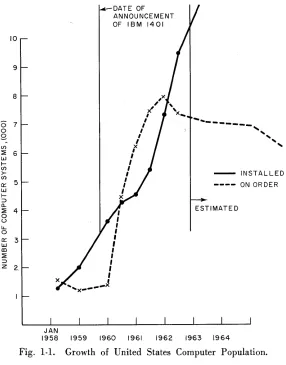
more on order. These figures are shown, and plotted graphically in the table below and in Fig. I-I, respectively. An extrapolation of these curves indicates that the growth is not yet over: the installed computer popu-lation of the United States will be over 14,000 by 1965 and an estimate of such growth through 1970 shows the possibility of almost 20,000 operating installations in that year.
GROWTH OF UNITED STATES COMPUTER POPULATION >I«
Total N urn ber Most Popular
Date Installed On Order Unit Installed On Order
March, 1958 1,277 1,601 IBM 650 750 1,200
January, 1959 2,034 1,237 IBM 650 800 1,100
January, 1960 3,612 1,364 IBM 650 1,200 150
IBM 1401 0 750
July, 1960 4,257 4,377 IBM 650 1,280 100
IBM 1401 0 3,000
January, 1961 4,528 6,246 IBM 650 1,090 20
IBM 1401 75 4,000
July, 1961 5,371 7,437 IBM 1401 510 4,800
January, 1962 7,305 7,904 IBM 1401 1,750 5,200
July, 1962 9,495 7,286 IBM 1401 3,225 4,750 January, 1963 11,078 7,097 IBM 1401 4,300 4,275
COMPARABLE FIGURES FOR EUROPE >I«
April, 1962 1,359 1,301 IBM 1401 233 677
>I« Source: Semi-Annual Computer Census, ADP Newsletter. © 1962, 1963, ADP
Company, Inc., A Division of The Diebold Group, Inc. By permission of the Publisher.
These figures have been extrapolated on the basis of current trends. One of these trends has been a recent, sharp split of computer market re-quirements. The two directions which the market appears to favor are toward the very small computer, renting for $2,000 to $5,000 per month, and the extremely large system, renting for $40,000 to $100,000 per month. The number of applications has been rapidly expanding, with numerous smaller companies suddenly finding practical and economic uses for computational power. Since the technology is far from ex-hausted, the future of the data processing industry remains extremely bright.
DATA PROCESSING PERSONNEL REQUIREMENTS
DATE OF ANNOUNCEMENT OF IBM 1401
10
9
8
,
,xx'
I
0 7
,
,
...
_--
----,
0
,
"
9
,
"
" I
...
CJ) X ....
::;E 6 I
W
,
~ I
CJ)
,
~
,
- - INSTALLEDCJ)
I
tl: 5
,
- - - - ON ORDERw I
~ X
:;:)
0.. ESTIMATED
::;E 4
,
0
,
U
LL
,
0 I
tl: 3
,
w
,
co
,
::;E
,
:;:)
,
z 2. I
I
x
"X----~
JAN
1958 1959 1960 1961 1962 1963 1964
Fig. 1-1. Growth of United States Computer Population.
frequently underestimated or completely misjudged. Very few executives are fully aware of
• Their own requirements for effective management
• The difficulties of incorporating existing clerical controls into a series of computer programs
• The technical complexities of computer installation
[image:18.414.78.364.63.428.2]• Aptitude: an uncanny ability to grasp all facts of a complex problem and translate this understanding into the language of the machine.
• Attitude: an outlook which insures that all conditions are provided for in the computer system.
• Interest: a consuming need to constantly refine and improve existing operations, using the most powerful tools available.
Mathematics, physics, or other advanced education are not required to become a skilled technician in commercial data processing. A college \ degree is not necessary if the aptitude, attitude, and interest are present. The degree is helpful in providing a certain amount of formal training; making it a prerequisite for the job is unnecessary, and markedly reduces the size of the available labor pool.
In scientific data processing, a degree in mathematics or physics is usually required. It is almost always necessary to understand the language of engineering, since most of the problems are stated in this language. The total labor pool is therefore smaller, while the demand has con-tinued to grow.
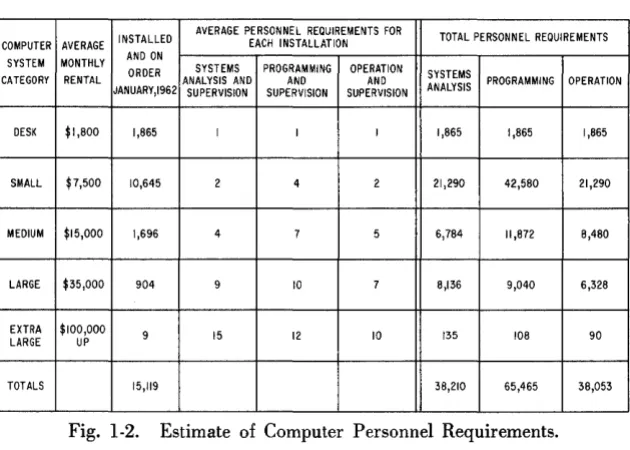
Appendix A, page 345, Job Descriptions in Data Processing, defines the jobs that must be filled in the average installation. To illustrate the demand which is generated by each potential computer installation, Figure 1-2 indicates the average number of people required in each category for five classes of computers. These figures have been extended on the basis of the total number of systems on order and installed as of January, 1962. This extension results in an artificial requirement of 38,000 systems analysts, 65,000 programmers and 38,000 operators.
*
This points up the real need in the field: massive educational programs, designed to attract talented people and build a store of experience. Because of the imbalance of supply and demand, salaries in the field have risen dramatically. The average annual salary of skilled data processing technicians has increased by almost 50<)10 since 1958. The turn-over rate in the industry has increased correspondingly, further causing severe problems in many established installations. Management has there-fore been forced to the realization that tighter control and managementinterven tion are both required in computer implementation. Management
must become more aware of the problems and of the solutions and exercise direct control over every aspect of the operation.
It is this control that demands the establishment and enforcement of standards.
THE COST OF DATA PROCESSING DEVELOPMENT
Early installations of computers were often made on an experimental basis, with costs charged to a research and development budget. A common practice in feasibility analyses has been to ignore the develop-ment cost rather than to amortize it over a recovery period. More recently, the computer has been expected to pay its own way. Manage-ment has become aware that the true costs of installing a computer can vary from $50,000 to $25 million, depending on the complexity, scope, size, and the overall schedule.
Typical installation costs, for all elements preceding changeover are indicated below:
Cost Factor Low Average High Average
Site Preparation and Air Conditioning $25,000 $250,000
Systems Analysis 4 man-years 60,000
15 man-years 225,000
Programming 8 man-years 80,000
20 man-years 200,000
Personnel Training 5,000 25,000
Machine Time for Testing 4,000 40,000
Conversion Costs 15,000 150,000
Supplies and Services 2,500 20,000
Magnetic Tapes 2,000 10,000
Con tingencies 5,000 15,000
Total $198,500 $935,000
The cost of personnel is still the largest single cost. This cost has risen an average of 50% since 1958, so that the overall installation cost has increased by some 20-25% since that period.
This increase and the equivalent increase in operating the installation has made management more and more aware of computer costs. Accord-ingly, management demands a return for its money which it can only obtain under tight control. It has taken the computer out of research and development, and placed it directly under operations-so that the costs are subjected to the same management control used in other operations.
INSTALLED AVERAGE PERSONNEL REQUIREMENTS FOR TOTAL PERSONNEL REQUIREMENTS
COMPUTER AVERAGE EACH INSTALLATION
SYSTEM MONTHLY AND ON
ORDER SYSTEMS PROGRAMMING OPERATION SYSTEMS
CATEGORY RENTAL ANALYSIS AND AND AND PROGRAMMING OPERATION
JANUARY,I962 SUPERVISION SUPERVISION SUPERVISION ANALYSIS
DESK $1,800 1,865 I I I 1,865 1,865 1,865
SMALL $7,500 10,645 2 4 2 21,290 42,580 21,290
MEDIUM $15,000 1,696 4 7 5 6,784 11,872 8,480
LARGE $35,000 904 9 10 7 8,136 9,040 6,328
EXTRA $100,000
9 15 12 10 135 108 90
LARGE UP
TOTALS 15,119 38,210 65,465 38,053
Fig. 1-2. Estimate of Computer Personnel Requirements.
IMPLEMENTATION TASKS IN DATA PROCESSING
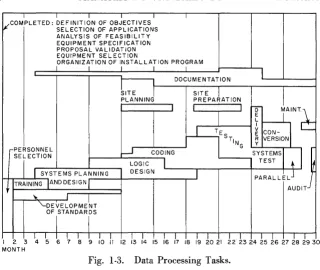
Installation of a computer first requires definition of the tasks that must be undertaken to achieve objectives. Unfortunately, too many computers are installed without an understanding of objectives, and many more without a definition of the tasks to be performed. The first task, either to establish a set of standards or to plan an installation, must always be to define the steps required in implementing the installation. Figure 1-3 indicates a general time scale for the performance of the required tasks. It assumes a management-controlled development program of about 30 months; the equipment is selected in month 6 and the installation is made in month 24. The overall time will vary from installa-tion to installainstalla-tion-averages have been used to illustrate the require-ments. The indicated scales should not be used as a guide-an increase or decrease in the number of people used will make a sizable difference in the amount of lapsed time.
The planning and development steps are described below.
Definition of Objectives
[image:21.415.38.353.56.281.2]I I I I I I j/COMPLETEO: DEFINITION OF OBJECTIVES
SELECTION OF APPLICATIONS ANALYSIS OF FEASIBILITY EQUIPMENT SPECIFICATION PROPOSAL VALIDATION EQUIPMENT SELECTION
ORGANIZATION OF INSTALLATION PROGRAM
I I I I I
DOCUMENTATION
kiTE
J
SITE1
I
PLANNING PREPARATION
I I I
j-.,,-~
IAINT~
I
TES ECON- II
TIN ~ VERSIONG
rPERSONNEL
W
CODING SYSTEMS
• I
SELECTION
I
I
SYSTEMS PLANNINGLOGIC
I
TESTDESIGN
I
PARALL1:J~ TRAINING lAND DESIGN AUDIT.)
" I I
"-OEVELOPME NT OF (TANDARIDS
I I I I \ \ \ \ \ \ I
\ t i l I I I \ .\
I 2 3 4 5 6 7 8 9 10 II 12 13 14 15 16 17 18 19 2021 22 2324 25 26 2728 2930 MONTH
Fig. 1-3. Data Processing Tasks.
only be projected on a short range basis, management must further prepare a time schedule for the contemplated installation, so that sched-ule feasibility can be properly evaluated. Typical objectives include:
• A percentage reduction in the labor force, or in the amount of overtime, resulting in a minimum saving of x dollars
• Replacement of existing equipment, with an attendant cost
reduction
• Reduction of space requirements
• Change from post-billing to pre-billing, thus improving cash flow • Increase in customer service by increasing the frequency of
customer statements
• Reduction in lapsed time for the preparation of quotes on new models
• Overall reduction in engineering costs
• Greater management control through exception reporting • Edge over competition through faster determination of inventory
[image:22.415.56.376.52.322.2]Preliminary Study
After defining the objectives, a preliminary study should be made. The purpose of this study is to determine what applications should be considered, and what savings can be accomplished in each. The study will provide only general estimates; its major objective is to determine whether a detailed study is warranted. If a reasonable saving is indicated, or if other defined objectives can be met with reasonable certainty, the next step is undertaken. If the objectives are not met, the project is discontinued.
Feasibility Analysis
A complete feasibility analysis takes into account all of the costs and savings of the computer project. The study analyzes all variables and assesses the true feasibility of continuing the project. If it is feasible, the study then outlines a further plan of action and provides a detailed set of "functional specifications" from which equipment manufacturers can make proposals. The study provides a broad systems design, as well as a document that can be used ultimately to evaluate the effectiveness of the final installation.
Equipment Selection
Functional specifications have been established in the preceding step. The specifications are rarely limited to hardware because specific hard-ware features are relatively unimportant. The specifications will indicate the purposes which the equipment must fulfill,-for example, "the equipment must be capable of processing and updating 1 million master records per day, with an average activity rate of 7%. It should further be able to produce two sets of activity reports, with a total of 20,000 lines of print." Or, "the equipment must be able to handle the average computational requirement of a peak engineering staff of 280 engineers, each designing an average of 30 parts per year." At least three independent manufacturers should be asked to submit proposals. It is necessary to validate the proposed equipment against the specifica-tions. This prevents the submission of "off-the-shelf" proposals of equip-ment whose capability has little relationship to the requireequip-ments. It will also determine the processing time required to insure that the system is neither too large nor too small.
given a relative weight and each manufacturer is ranked in accordance with the equipment performance. Included in these factors may be:
• Speed
• Cost
• Ability to expand or contract as requirements change • Reliability of the manufacturer
• Systems support and other services supplied • Value of software or subroutines supplied • Availability of back-up equipment
• Cost of maintenance
• Compatibility with other equipment
lVIany other factors could be included according to individual req uiremen ts.
Selection of Personnel
Many techniques are used to select personnel for the development effort; they largely depend on the sources of personnel and policies of the organization. The group that performed the feasibility study should certainly be considered. In any case, professional selection tests and techniques should be used, just as they would be for any other pro-fessional posi tion. The selection of data processing personnel is no different from the selection of other professionals.
Personnel Training
Several kinds of training must be organized. These include • Company-wide orientation: to maintain employee morale • Top management orientation: to continue the active support of
top management
• Direct training: for the personnel selected as systems analysts, programmers and operators.
The manufacturer whose equipment has been selected can be of assistance in education, even though it will be limited to initial participation.
Establishment of Standards
standards manual, as discussed in detail in subsequent sections of this book. It is also necessary to establish initial performance standards to aid in determination of a meaningful schedule for the remaining tasks.
Scheduling and Coordination
In many installations, development scheduling has been done in reverse; that is, by working backwards from the delivery date of the equipment (generally from 12 to 24 months). This method unfortunately carries no guarantees since there is no correlation between the time necessary to produce the hardware (i.e. the delivery date) and the time to develop the required programs.
A better approach is to determine the actual total man-months neces-sary to accomplish the required tasks. If this total exceeds the time available until delivery, it is possible to postpone the delivery schedule, or to increase the staff.
Systems Planning and Design
This is the first task in the actual development program and the one least formally organized, often forgotten or done in a halfway manner. It is the development of an integrated, computer-oriented system of operations, designed to produce efficiently the required outputs from the available inputs. The planning part of the task involves the deter-mination of requirements, analysis of the existing system, and the review of reports. The design function consists of developing a new system, using the computer as a central information processor. The output of the systems planning and design phase is a complete specification of the job.
Logic Design
Coding
Taking the available inputs and producing the necessary outputs consists of writing computer instructions in the language of computer. This process is coding) consisting of the translation of a block diagram into serial instructions.
Assembly
Coding generally is not written in final machine language, primarily because the computer language normally consists of a meaningless jumble of letters and numbers. To simplify the coding task, an inter-mediate language is usually designed using mnemonic symbols. Thus, instead of writing the machine equivalent for each instruction, using a symbolic language one would be able to write ADD, SUB, MPY, etc. The computer is then used to translate this symbolism into its own language; that is to produce an object program. This process, the transla-tion of the symbolic language into the machine language is called program assembly.
Testing
Each program is tested to validate the logical steps and to determine that all conditions have been included in the program, using fabricated test data which simulates all possible actual conditions. This function ("debugging") is one of the most important, since all programs contain errors, and since all errors must be caught. An average program contains about 1,500 separate instructions, with an average of 50 errors of different types. These errors may be clerical (in transcribing from the coding to the punched card or tape), logical, technical, or analytical.
In actual practice, of course, it is impossible to test all of the possible permutations and combinations of conditions which might arise. It is very common, therefore, to find a program that has been operating suc-cessfully for several years suddenly encounter a condition it has not met before and cause erroneous handling of a situation.
Documentation
independent of the person who created the program. Documentation takes place throughout all phases of the project. It is especially important during the logical design, coding, and testing phases, where it is most often neglected.
Conversion
After the programs have been fully tested in conjunction with each other, the system is ready for data conversion. This generally consists of the reformatting of existing data, the keypunching of information not currently available in machine-processable form, and the creation of tape, disc, or card files in required formats. This task may require separate conversion programs, or it may use parts of the programs written for the system. In either case, it is important to maintain exact controls over the conversion, to insure that no data is lost. Back-up information should always be retained, so that files can be reconstructed if a failure occurs, either in the conversion or in the initial operation of the live system.
Parallel Operation
The operation of dual systems is generally expensive, but insures that the new system is operating accurately. The duration of parallel operation varies from one week to as much as six months. During the initial period of parallel operation the old system is used as the prime while the new system produces secondary output. After the totals and detail items of the new system agree with the old (errors will normally be found in both) the new system becomes the prime and the old the secondary or back-up system. Subsequently, after the two agree for a reasonable length of time, the old system is discontinued.
Audit
General Organization
A definite and formal organization must be established to operate the system once it is installed. It requires the designation of control clerks, operators, librarians, shift supervisors, and the like. The entire staff requires training as. part of the original program.
Physical Organization
The needs of site preparation vary according to location, type of equipment, and type of building. Some machines' require raising of the floor, still others require lowering of the ceiling. Most machines, despite transistorization, need careful temperature and humidity control and require special air conditioning. A tape vault must be provided with fireproof space for extremely important files. The computer site should be isolated from other operations, to prevent unauthorized personnel from damaging the equipment or the files. The site preparation costs vary from a low of $5,000 to a high of $500,000 depending on the factors outlined above.
The Data Processing Manager
His function in the development program is of prime importance. He must set up the rules and enforce them. He must set up the schedule and coordinate the activity so as to meet it. He must guide and act as an inspiration to all members of the team and act as the decision maker in cases where a dispute occurs between an operating department and the computer development group. His superiors must continually show interest and encouragement to the program and insure that all of the operating departments cooperate to the fullest extent possible. Finally, he must install and support capable administrative and technical supervisory personnel.
Organization of the Book
The development, installation and enforcement of methods standards occupy the first part of the book, Chapters III through VII. Chapters VIII through XI concern themselves primarily with the installation and evalua-tion of performance standards in all areas of data processing.
Chapter
II
THE ROLE OF STANDARDS
IN MANAGEMENT CONTROL
INTRODUCTION
The term management control often is used to refer to the function of the corporate controller, the auditor, or the strong line executive who demands a detailed accounting for all expenses. The term when used this way is a misnomer; the intent of the user is to refer to management's control function and not to management control as such. The definition of management control used in this book is management's ability to retain complete control over the operation. Management control depends on the flow of information in a feedback cycle. The cycle consists of
• A management action
• The results of that action
• Gathering of information about the results
• Evaluation of this information by management, followed by
another action where required
In applying the term management control to the operation of any department, it generally refers to the internal information system developed for the benefit of the department manager who, based on the information supplied, makes the decisions necessary to optimize the output of his department. A second responsibility of a department manager is to supply enough information to the next line qf command so that the manager of a group of departments is capable of optimizing
his output. This continues up the line, so that the manager at each level must establish his own control cycle as well as contribute to the control cycle of every level of management above him.
The data processing function, partly because of its rapid growth and partly because of its unusual technical nature, has been characterized by
a loss of management control. The manager under whom data processing falls is no longer capable of judging when an operation will be finished or should be finished. He must rely on the technicians below him, who in" turn may have only a limited capability for making judg-ments about completion dates or costs. Because of personnel scarcity and high salaries, capable performers in data processing tend also to be temperamental-at least more so than average. As a result, they will perform their tasks in accordance with their own special conception of methods and schedules.
There is no question that the cost of this loss of control is excessive. In such instances management must take rapid action to regain control by re-establishing these control functions lost in the rush to establish electronic data processing.
The first step in achieving management control is to establish stand-ards: standards that dictate methods of operation and standards that de-termine the amount of work to be produced in a given period of time. The former are methods standards-the guidelines set up to create a uni-form output; the latter are peruni-formance standards-the yardsticks created to measure the performance of the staff, the department and the manage-ment. Without these standards, management control is impossible. The development, enforcement, and proper use of these standards is the largest part of the entire management control function. The remainder is merely the establishment of a schedule, a budget, and a cost accounting system. These are discussed in later chapters, in limited detail.
THE NEED FOR STANDARDS
There are a number of compelling reasons why it is ne'cessary to have both methods standards and performance standards. Management should recognize these reasons, because management support is one of the prime prerequisites for standards establishment. Major reasons for the develop-ment of methods standards are
• A reduction of the effects of personnel turnover
• The fact that performance standards require the use of methods standards
• That economic future conversion planning can be achieved only through standardization
Reasons for the establishment of performance standards include
• The need for management control, attainable only through
measuremen t
• The ability to develop realistic costs and budgets
• The need for equitable review of personnel, and development of appropriate standards for hiring
Many other benefits will become obvious after the development program has been started.
A Reduction of the Effects of Personnel Turnover
A data processing manager who has just lost his first programmer will readily testify to the costs which he has incurred ih "taking over" the inherited programs, especially if that programmer was one of the more accomplished. The language used may be highly individual, the sym-bology not standard, and inconsistent; the abbreviations and mnemonics absolutely not understandable. If changes to these programs are required, the problems to be faced are so severe that many programs are com-pletely rewritten after the resignation of their authors.
In most difficult and lalge programs the complexity of the logic may be sufficiently difficult to confuse all but the most experienced program-mer. The use of individual symbology and terminology makes interpre-tation difficult, and if no documeninterpre-tation is provided, it becomes an almost impossible task to maintain a complex program without the original programmer.
These difficulties are quite understandable. The original development schedule is almost always geared to the equipment delivery schedule. This schedule is based upon the length of time it requires to make the hardware, not on the length of time required for programming. Because no realistic performance standards are available, the required manpower is usually underestimated. The schedule then developed is based on a low manpower estimate, a meaningless delivery and completion date, and may include a lack of understanding of all of the required tasks.
As a result of poor scheduling, and often because of a lack of detailed installation knowledge and experience, most recent computer installations have missed their target dates, and have cost well over the initial installa-tion budgets. The original programmers who have developed the key-stone programs without documentation, suddenly find themselves "in-dispensable," because they are the only ones capable of making the necessary changes to the programs they wrote.
To avoid this, methods standardization requires that each programmer create programs in a uniform manner, understandable to all others, with
the basic minimum of documentation produced during the programming
effort, not afterwards. This will ultimately result in much better per-sonnel relationships; programmers are no longer indispensable-there-fore they can now both be fired and promoted more easily.
Methods Standards are Required for Performance Standards
A fundamental rule of time and motion study is that the method must be completely standard before a time study can be taken. This same rule can be applied to data processing performance standards: if the method used varies from one person to the next, their output can never be equitably compared. The programmer who does not develop block diagrams will obviously complete many more pages of coding in a given unit of time than the programmer who first creates a detailed logical analysis, as documentation, prior to coding. The fact that the quality of the latter program is better, and that testing is much simplified will not affect the measurement if it is made based simply on pages of coding.
Planning for Economic Conversion
1. Reanalysis.---':'If the new machine represents a radical departure from the current machine, reanalysis is almost always necessary. Re-analysis also represents an advantage in cases where business methods have changed, or where the specific process has not been reviewed in a long time. The reanalysis process essentially requires that the entire system be redesigned. The value of methods standards in this instance is to provide a complete description of the existing system.
2. Reprogramming from Existing Logic.-If the system is not to be redesigned the existing programs may be used, after conversion to the new machine's logic and language. To do this, the easiest approach often is to use the existing block diagrams, which will then require only coding, testing and modification of the current documentation. However, the block diagrams must be done in a standard manner and kept strictly up-to-date.
3. Reprogramming from Existing Coding.-If block diagrams are not available, or not current, it may be necessary to reprogram using the existing program listing or machine language coding. This is often very expensive, since the machine coding is directly related to the machine, and must therefore undergo major revisions. It is difficult to use this method if the coding method and program organization have not been rigidly standardized.
4. Simulation or "Machine Compatibility."-Machine-to-machine sim-ulation, or even internal hardware compatibility devices· are inefficient
tools for an effective conversion. They are usable as "stopgap" measures, to assist in rapid initial conversion, but if the programs are not rapidly rewritten for the new machine, the new features will not be properly utilized, and the efficiency will be impaired.
5. Direct Machine Translation.-If no reanalysis is necessary, it may be feasible to accomplish direct machine translation in one of many possible forms. It is possible, for example, to develop a translation program that will translate the machine language of one machine into an approximation of the machine language of the new machine. This type of translator can never be made perfect; if 90% of the instructions can be translated directly, the remainder must still be manually repro-grammed. A ·similar translator translates from the symbolic language of one machine to the symbolic language of the second. A third form of translation, perhaps the most practical, uses an assembly or translation program to go from the symbolic language of the old machine to the machine language of the new machine. Although this is feasible for a higher percentage of instructions, it provides only a limited amount of documentation and "back-up."
current and the new machine, a large part of the problem of conversion has been resolved. However, high volume, high frequency programs will suffer considerably from the loss of efficiency that accompanies a state-ment language. (See Appendix B.) If the programs are not written in a statement language and such a language is available for the new machine, it may be feasible to translate the programs from the current listing or the block diagrams directly into the statement language; this retains the same disadvantages, while reducing the cost of reprogramming.
Each of these conversion methods requires that standardization be en-forced in the writing and maintenance of the programs currently under development.
Other strong reasons for the development of uniform methods stand-ards are:
• To enable the review of programs by a senior programmer or by a programming supervisor; it has been demonstrated to the author that the time needed for a detailed review can be reduced by more than half if the programming methods are completely standard.
• To allow segmentation of programs without encountering prob-lems in communications between programmers. Uniform methods make it possible to divide programs among a group of program-mers without concern about duplication of computer memory use.
There are similarly compelling reasons for the establishment of per-formance standards. These are summarized below:
The Extension of Management Control
By developing adequate personnel and equipment performance stand-ards, it is possible for management to estimate properly the costs and time required to complete a development program, to make changes to existing systems, and to establish controls. Further, management is able to evaluate the performance of the programmer, of the program, and of the entire data processing department, against a predetermined fair standard of productivity. Management can know the capacities of equipment and of available manpower, so that appropriate resources scheduling can be done.
Scheduling of The Development Program
22
develop a planned system. This is extremely important, as has been demonstrated.
Costing of The Development Program
To make effective decisions, management must be able to determine, well in advance, the costs of the development program and the costs of making changes to an existing system. This is frequently not done, with a resultant underestimate of overall costs. So, if management is aware of the costs of systems changes, it may be possible to avoid the causes which force the changes.
Personnel Evaluation
It is necessary to make equitable adjustments to the salaries of operat-ing and programmoperat-ing personnel. The data processoperat-ing labor market is sufficiently competitive to force management to consider salary adjust-ments carefully; the loss of an experienced programmer is the loss of a large investment, and creates a very heavy cost for program "takeover." It is good business to compensate each staff member in accordance with his contribution; a good programmer should therefore be compensated more. The difficulty has been that without performance standards it is hard to recognize the exact relationships between the outputs of different programmers.
Performance standards are also necessary in the hiring of experienced personnel and in the training of inexperienced personnel. In the former case, it is necessary to evaluate the extent of claimed experience and the amount of productivity which reasonably can be expected for this expe-rience level. In the latter case, promotion to a new grade or a change of status from trainee to junior requires a minimum performance' stand-ard which must be achieved.
BENEFITS OF STANDARDIZATION
The "Denefits which accrue to the user of good methods and per-formance standards are almost immediately obvious, so that a direct measurement can be made of the return which will be obtained from the investment in standards development. Among the measurable benefits are:
• A reduction of overall costs. The cost of personnel turnover, and the cost of training new personnel are markedly reduced. The more effective machine utilization which always results from enforcement techniques alone more than pays for the investment. • Increased control over personnel, machines and facility use. • Improved quality of output, by incorporating quality measures
right along with measures of performance.
• Reduced dependence on individuals, by incorporation of uniform methods and practices. Absenteeism no longer prevents changes from being made or progress from continuing.
• The improvement of overall management techniques. By including
evaluation techniques in the standards program, management obtains the ability to schedule, control and manage the program. • Reduction of future costs. Program change is simplified, and the
cost of a potential conversion is reduced considerably.
• Appropriate resources planning. Personnel requirements can be met scientifically, and not emotionally, through training, upgrad-ing, promotion and the proper requirements analysis.
• Corporate long-range planning. Planning for the future can be assisted by the knowledge of future data processing capabilities and costs.
All of these factors point to the need for the development of compre-hensive national, or even international standards for the effective develop-ment, utilization and operation of data processing equipment. These standards although necessary will take a long time to reach fruition. In the meantime, each installation must of its own accord develop the standards necessary for its own survival.
SOURCES OF STANDARDS
dis-tinctions are made between "scientific, or engineering" and "business, or commercial" data processing equipment, analog and digital, large and small, tape and card, alphameric, decimal, and binary, fixed word and variable, etc. For each of these different equipment systems, it may be possible to develop standards which cannot be applied to the other categories. Similarly, it may be difficult to cross manufacturer lines, since each manufacturer has his own ideas of the standard which is best. For example, IBM suggests that the symbol on the left (Fig. 2-1) be used to indicate a "decision" function; the Univac Division of Sperry Rand suggests the symbol on the right for the same function. Major differences exist:
• Across machine lines • Across manufacturer lines • Across industry lines • Across user lines
• Across departmental lines, for a given user.
Other influences affect the standards program; a specific template may be established as official symbology for block diagramming for an in-stallation. Because programming templates have undergone changes over the years, the use of an aged template is a status symbol which identifies the programmer as one of the "old-time" group.
Fig. 2-1.
Similarly, the hiring of experienced programmers from outside the organization introduces a new set of experiences, practices, and rules into the organization. There presently exists an installation where among twenty programmers there are three different methods of writing the alphabetic character O.
in languages and approaches used in various countries. Manufacturers are very concerned with standardization; their interest is limited to their own hardware and sometimes the continued use of their own products. The groups listed below are developing standards in the data process-ing field:
The United States Government
The Government spends in excess of 600 million dollars per year for data processing. The Government must purchase or lease equipment from all acceptable vendors, so that their main interest is in the develop-ment of compatible hardware and software. The COBOL effort, sparked by a Federal agency, and the policy which requires COBOL to be im-plemented by all vendors are outgrowths of this concern. The Govern-ment is just beginning to standardize its methods of developGovern-ment and operation; the development of performance standards for equipment and personnel will have to follow.
The A merican Standards Association
and the International Standards Organization
These groups are currently quite concerned with the development of standards to permit hardware compatibility among all users in all countries. Some work is also being done to develop a standard glossary and to develop a standard character set to be used by all manufacturers, but implementation is slow, cooperation is limited, and the work is at the present time wholly inadequate. The basic requirements of systems analysis, programming and machine operation are not presently served by these efforts. The difficulties which have been encountered so far in the standardization of the simplest items makes it hard to foresee the time when all methods of operation will be subject to one international standard.
Trade Organizations
The Association for Computing Machinery) the Systems and Procedures
Association) the Data Processing Management Association) and many
26
Manufacturers
Most manufacturers have been long aware that the best interests of the data processing industry wou1d be served by a cooperative stand-ards effort. The manufacturers have generally felt that it was up to the user to develop standard practices. Some efforts are beginning to be made, but this source of standards will remain limited in its scope.
User Groups
Many users have formed associations, grouped by machine type. These groups generally exchange programs, information, and a general interest in the problems and successes of each installation. Some standards have been established, primarily to enable the exchange of programs. In these cases, the standards have indicated the documentation which must be supplied, and the forms which are to be used. Examples of user's groups which have developed such standards are SHARE (for the IBM 704/709/7090/7094/7040/7044), GUIDE (for the 705/7080/7070) and the UNIVAC® users associations.
I ndustry Associations
Within certain industries trade associations have themselves recognized the need for standardization. Thus, the Aerospace Industry Association
monitors the APT III program for numerical tool control, and the
American Bankers Association established the E13B type font for the
magnetic encoding of all checks to be issued by banks. These standards are useful and necessary, but they do not usually go deep into the needs of the development program.
Management Consultants
Several major management consulting firms have developed complete installation standards in the interest of their clients. Since these standards are not freely available to the entire industry, this source of standards, although representing extremely competent and experienced personnel, will not solve the industry's problems.
THE MANUAL OF STANDARDS
A compilation of methods standards and the rules necessary to establish meaningful performance standards is required in each installation. This compilation should be made and enforced by the establishment of a Standards Manual (or a Manual of Standard Operating Practices) relating specifically to the Data Processing Department.
The manual of standards should consist of at least five major sections, each devoted to an area of special interest. These are:
• Systems analysis standards
• Programming standards
• Operating standards
• Performance standards
• Personnel standards
If a punched card installation is required for peripheral assistance to the computer, a separate section should be devoted to those standards applicable to punched card operation.
The main functions of the manual are:
• To serve as a compilation of all rules and regulations governing the operation of the department
• To serve as a manual of policy, for reference by all employees in determining the methods to be used
• To serve as a training manual for all new employees
• To enable management to review the performance of the staff in accordance with the established policy
• To settle disputes about procedure
The manual of standards must therefore prescribe all of the procedures to be followed, the methods to be used, and the information to be pro-duced. It should enforce rules and regulations and at the same time insure complete uniformity of output. Appendix D illustrates a manual of standards developed for a small computer installation.
THE EFFECT OF LANGUAGE STANDARDIZATION
28
• COBOL-the COmmon Business Oriented Language
• ALGOL-the ALGOrithmic Language
• FORTRAN-the FORmula TRANslation language
• JOVIAL-a separate version of the International Algorithmic
Language
• NELIAC-another dialect of the same language
Language standardization is indeed of great benefit to the user. If a specific compiler is implemented for all types of machines, all programs written in this language could in theory operate on any machine. This prevents a major problem in conversion planning and enhances the chances of lesser known computer manufacturers. The statement lan-guages above have other advantages; a major claim made for the state-ment languages is that they are far simpler to learn and far simpler to understand than the complex symbolic or lower level languages. Pro-ponents of the statement language claim that the language is in itself sufficient documentation of the program; no further block diagrams or other explanation is required.
Some of these claims are overstated, and perhaps even damaging to the common language effort. Management does not always recognize the problems that data processing implementation presents. If the advertising claims made by manufacturers (ascribing magical powers to the higher level languages) are misunderstood by management the data processing effort may well be seriously impaired. The higher level languages still require block diagramming; they also require considerable added docu-mentation, if they are to be properly understood by programmers and operators alike. Learning of the higher level language is indeed simpler, but a good programmer is still required to effectively use such a language, so that programming as a skill is far from eliminated. In addition, the most common disadvantages of these higher level languages is that they seriously increase program compiling time and considerably reduce the efficiency of the object program.
29
coding method: instead of coding in a rigidly restricted, single line symbolic notation the coding format is free-form, statement-like com-mands. This additional freedom is not necessarily constructive; the in-creased freedom which has been given to programmers has been one of the principal causes of the current problems of communications among programmers. It is therefore necessary that the same rigid standards applied to symbolic languages be included in the higher level languages to prevent a recurrence of the problems currently plaguing the industry.
STANDARDS AND
CREATIVITY
Most accomplished programmers are certain that programming is an art, not a science. This thinking is applied with equal force to systems analysts, and sometimes even to operators, who may be referred to as "playing the console like a piano." It is unfortunate that the artistic, in business, is usually regarded as remote from the profit motive; thus the qualified data processing analyst must justify his "art" as a science. Many experienced personnel argue against the establishment of stand-ards, much as they might argue against the benefits of documentation, or the value of "closed shop" program testing. A common myth among "creative" people is their feeling that creativity is inhibited by rules and regulations. This is entirely false. Good standards and good practices never inhibit creativity; creativity is greatly enhanced by good operating procedures. A diabolically clever programmer is far more inhibited by a lack of appreciation of the value of the understanding that he must leave behind him. Channeled and controlled by effective rules, the pro-grammer will increase his productivity and his own understanding.
A good programmer retains his awareness of the overall objective: to
produce a quality program in a given amount of time, minimizing the corollary costs of testing, documentation, and parallel operation, and optimizing the ability of others to understand the functions and workings of his program. This individual will contribute most to the development program, and will rapidly recognize the need for and value of a complete standards program.
ORGANIZATION STRUCTURE OF DATA PROCESSING
To avoid many of the problems of ineffective data processing, top management must consider the following at the time it initiates a conversion to electronic data processing:
• It must obtain a realistic education in at least the basic principles and planning steps of data processing.
• It must select the data processing manager on the basis of his ability to act as a manager, not on the basis of tenure. He must be capable as a technician, an administrator, and as a salesman of good practice.
• It must establish an internal data processing organization structure that lends itself to effective administration.
• It must enthusiastically support the development of methods and performance standards.
• It must require a standard method of progress reporting, enabling a rapid recognition of schedule slippage or poor performance.
• It must, in advance, provide for the establishment of alternatives to be available in the· event of schedule difficulties.
PERSONNEL HIRING
PERSONNEL TRAINING
METHODS STANDARDS
PERFORMANCE STANDARDS
BUDGET
SCHEDULING (DEVELOPMENT)
ESTIMATING
QUALITY EVALUATION
ADMINISTRATIVE SERVICES
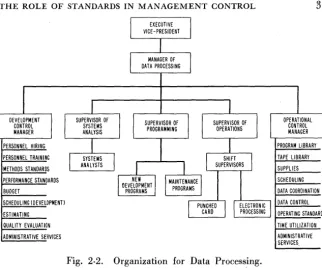
Fig. 2-2. Organization for Data Processing.
CHAPTER SUMMARY
PROGRAM LIBRARY
TAPE LIBRARY
SUPPLIES
SCHEDULING
DATA COORDINATION
DATA CONTROL
OPERATING STANDARDS
TIME UTILIZATION
ADMINISTRATIVE SERVICES.
Chapter II has developed the relationship in data processing between the concept of management control and the concept of standards. The major needs for standardization lie in the areas of methods and proce-dures, which today are often left to the discretion of the programmers, analysts and operators. Management's need for control is the most sig-nificant reason for the establishment of a good standards program. There are other reasons; included in these are the necessity for conversion plan-ning, the need to reduce dependence on key members of the staff, and to make promotion possible, and the need for effective scheduling and cost estimating.
It is recommended (and the entire text assumes) that a Manual of Data Processing Standards be established. Included in the manual will be all required good practices and all formulas and relationships for performance measurement. Management control can be applied to crea-tive people, and will assist in channeling the creativity into the most productive channels.
[image:45.422.23.346.40.310.2]