© 2019, IRJET | Impact Factor value: 7.211 | ISO 9001:2008 Certified Journal | Page 8220
PLASTIC INJECTION MOULDING MACHINE
Gaikwad Mahesh Digamber
1, Sharif Mohiuddin Akbar
2, Dhomase Datta Govind
3, Ravale
Shivshankar Ashokrao
4,Mr Bidve Mangesh Angadrao
5,Mr Devshette Ashish Rajkumar
61,2,3,4
Students, Diploma in Mechanical Engineering, Vishweshwarayya Abhiyantriki Padvika Mahavidyalay,
Almala, Maharashtra, India.
5
HOD, Department Of Mechanical Engineering, Vishweshwarayya Abhiyantriki Padvika Mahavidyalay, Almala,
Maharashtra, India.
6
Project Guide, Lecturer, Department Of Mechanical Engineering, Vishweshwarayya Abhiyantriki Padvika
Mahavidyalay, Almala, Maharashtra, India.
---***---Abstract -
Due to environment of competition, industries are into heavy pressure to produce products at a rapid rate. This led to evolve new technologies and production processes. Plastic injection moulding process is one of the production technique used to produce plastic products at a rapid rate with minimum defects, but it is a complex process in terms of product, process parameters, and production set-up. Injection moulding has been a challenging process for many manufacturers and researchers to produce products meeting requirements at the lowest cost. Faced with global competition in injection moulding industry, using the trial and error approach to determine the process parameters for injection moulding is no longer good enough. Factors that affect the quality of a moulded part can be classified into four categories: part design, mould design, machine performance and processing conditions. The part and mould design are assumed as established and fixed. During production, quality characteristics may deviate due to drifting or shifting of processing conditions caused by machine wear, environmental change or operator fatigue.Development of small injection moulding machine for forming small plastic articles in small-scale industries was studied. This work which entailed design, construction and test small injection moulding machine that was capable of forming small plastic articles by injecting molten resins into a closed, cooled mould, where it solidifies to give the desired products was developed. The machine was designed and constructed to work as a prototype for producing very small plastic components. Design concept, operation, and assembly of components parts were made.
Key Words
:
Development, Injection, Moulding,
Machine, Plastics, Industries, Quality,
1. INTRODUCTION
Plastic waste is one of the greatest sources of waste which has been increasing since the plastic was first used as a daily needproduct. But, most danger property of plastic is that is does not degrade with time which makes it difficult to dispose. Plastic are said to remain in the environment for
© 2019, IRJET | Impact Factor value: 7.211 | ISO 9001:2008 Certified Journal | Page 8221 Injection moulding process can be performed in four
Steps Step-1:
The process starts with selection of the product which is going to be produced and selection of suitable of plastic resin which fits in characteristics of the product such as tensile strength, compressive strength, stiffness etc.
Step-2:
Preparation of mold, runner, gate and process parameters. Step-3:
Injecting the melt resin into the cavity and allowing it to solidify.
Step-4:
Taking out the final product from the mold.
1.1 Plastic Injection Moulding
The process involves introducing raw materials in form of granules into one end of a heated cylinder, heating the materials in the heating chamber, and forcing the molten metal into a closed mould, where the final solidification of the molten metal in form of the configuration of the mould cavity takes [3]. The intending injection machine will be made from mild steel and medium carbon steel. It can only be used for the production of small components such as key holder, bottle cap, tally, ruler, and clothes peg. The mild steel is used for the construction of supporting plates, hopper, mainframe, mould, and platens, handle, and tie bars. This is because; they are not subjected to constant heat. It is easily weldable, and has good workability but show poor response to heat treatment. An injection moulding machine is a piece of equipment consists of two basic elements, the injection unit and the clamping unit. Injection moulding can be used with a variety of plastic resins. The chosen resins for this process are polyethylene; polypropylene, ABS, and fluorocarbons, because of characteristics of intricate shapes can easily be produced [4]. The advantages of small injection moulding process include good surface finish of the product can be produced, less scrap and flashes are produced, and the process has relatively low labour costs.
2. WORKING & PRINCIPLE OF MACHINE
The injection type molding machine works on the principal of heating plastic and make useful product out of it. In this project PID controller is used to set the required temperature to change the state of plastic from solid to semi solid and band heater are used to heat up the hollow tube which contain shredded plastic. First PID controller and band heaters are connected to the power supply through a MCB with the help of wires.
The band heaters are connected to the controller via a Solid State Relay which acts as a switch to turn on and off the supply to the band heaters by which the temperature is controlled. Controller takes temperature input from the thermocouple which is in contact with the hollow tube and continuously reads the temperature of tube.
As power supply is switched on, we have to set the required temperature in PID controller and then band heaters will start heating up and then heat is transferred by conduction to the barrels which contain the shredded plastic. As temperature increase plastic changes its state from solid to semisolid.
As plastic changes its state from solid to semi solid we inject the semi-solid plastic through the nozzle into a die with help of solid rod which acts as a plunger. The plastic which gets injected into the die takes shape of the cavity which is shape of our final products.
3. CONSTRUCTIONAL PARTS OF MACHINE
3.1 PID CONTROLLER
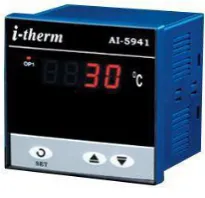
[image:2.595.382.485.337.436.2]PID controller is a control loop feedback mechanism commonly used in industrial control system. The combined operation of these three controllers gives control strategy for process control. PID controller manipulates the process variables like temperature in this case.
Fig. 3.1 PID controller
3.2 BAND HEATERS
Band heaters provide countless solution for cylindrical surface heating applications. Band heaters are most widely used heater because of their versatile design and rugged construction characteristics. Band heaters are designed to clamp to an exterior or interior cylindrical surface. Band heaters often have higher watt densities allowing fast heat-up and high operating temperatures. They generally include clamp assemblies making installation easy. Band heaters are used for injection molding barrels and nozzles, extrusion and molding presses, pipe heating, heat treating and autoclaves, food industry and other applications.
[image:2.595.312.555.619.725.2]© 2019, IRJET | Impact Factor value: 7.211 | ISO 9001:2008 Certified Journal | Page 8222 3.3 K-TYPE THERMOCOUPLE
[image:3.595.95.226.230.346.2]Due to its reliability and accuracy the Type K thermocouple is used extensively at temperatures up to 2300°F (1260°C). This type of thermocouple should be protected with a suitable metal or ceramic protection tube, especially in reducing atmospheres. In oxidizing atmospheres, such as electric furnaces, tube protection is not always necessary when other conditions are suitable; however, it is recommended for cleanliness and general mechanical protection. Type K will generally outlast Type J because the JP wire rapidly oxidizes, especially at higher temperatures
Fig. 3.3 K-Type Thermocouple.
Positive leg is non-magnetic (Yellow), negative leg is magnetic (Red). a positive leg, which is approximately 90% nickel, 10% chromium and a negative leg, which is approximately 95% nickel, 2% aluminum, 2% manganese and 1% silicon.
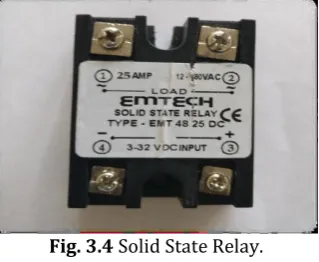
3.4 SOLID STATE RELAY
[image:3.595.364.504.329.544.2]A solid-state relay (SSR) is an electronic switching device that switches on or off when a small external voltage is applied across its control terminals. SSRs consist of a sensor which responds to an appropriate input (control signal), a solid-state electronic switching device which switches power to the load circuitry, and a coupling mechanism to enable the control signal to activate this switch without mechanical parts. The relay may be designed to switch either AC or DC to the load. It serves the same function as an electromechanical relay, but has no moving parts.
Fig. 3.4 Solid State Relay.
4. ASSEMBLY PROCEDURE OF MACHINE
First of all we gather together for making our project plastic recycling machine.
The assembly procedure is as below:
First step to bring out the parts which are required for assembly of plastic recycling machine
The parts are as below: 1. Frame
2. PID controller, SSR & MCB 3. Band heaters
4. K type thermometer
4.1 FRAME
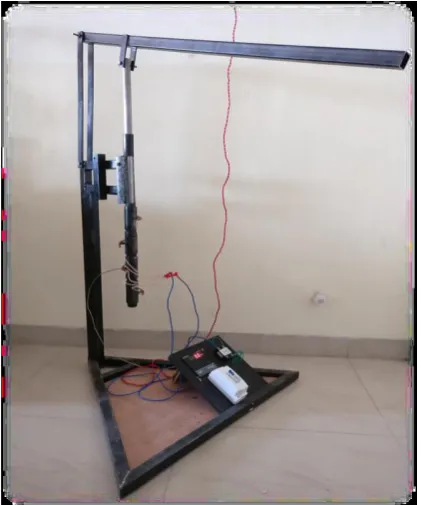
Being a mechanical model a sturdy & robust machine base was requiring. So, the base is made in triangle shape from Square shape pipe & one rectangular shape made by joining two square pipes welded perpendicular at one corner of the base triangle. The material for frame we used is mild steel. They are welded to form a support to hollow rod (barrel) and piston. A square pipe similar to that used in frame is used as a lever and screwed to top of the piston which helps in reciprocating the piston vertically. Bolt and nut are used at some movable joints creating rotating pair. The construction is as shown in figure below.
Fig. 4.1 Framework
4.2 BAND-HEATERS
We used 4 band heaters. The band heaters are connected externally to the hollow rod in which plastic is to be melt. The connections of heaters are made parallel and are joined to the PID controller via SSR. Band heaters often have higher watt densities allowing fast heat-up and high operating temperatures.
[image:3.595.83.243.553.684.2]© 2019, IRJET | Impact Factor value: 7.211 | ISO 9001:2008 Certified Journal | Page 8223 Fig. 4.2 Assembly of Band Heaters
4.3PID CONROLLER, SSR AND MCB
After assembly of frame we made connections of the electronics and mounted the whole circuit on plywood as it wouldn’t conduct electricity and can save current leakage avoiding shocks and made a box for the electronics assembly. The Electronics box was the mounted to the frame for ease of access. The PID controller is used to set the temperature of band heaters.
If the temperature exceeds than the Set value, then SSR will shut down the supply to the band heaters. The electrical connections are made between the MCB, SSR & PID controller for electric supply to flow within the band heaters. A solid-state relay (SSR) is an electronic switching device that switches on or off when a small external voltage is applied across its control terminals. All the connections made through a MCB for safety purpose as it continuously monitors the condition and trips off if any irregularities are found.
Fig. 4.3 Assembly of PID controller, SSR and MCB
4.4K –TYPE THERMOMETER
The other end of thermometer is connected to the ports of the PID controller Thermometer sensor is attached to the band heaters which senses the temperature of band heaters and reading will be shown on the PID controller down the temperature and to be control the temperature with the help of PID controller and SSR. The reading of temperature will be shown on a PID controller.
[image:4.595.329.540.270.523.2]Thermocouple is attached externally to the hollow tube using a strip of sheet metal at the bottom of hollow tube near the last band heater. Only the tip of the probe is connected to the tube, as we found was the best position to attain maximum sensitivity and thus better results.
Fig. 4.4 Plastic Injection Molding Machine Model
5. CALCULATIONS
Height of rod (L) = 550 mm
Internal diameter of hollow rod (d) = 26 mm Outer diameter of hollow rod (D) = 34 mm Diameter of piston rod (DP) = 25 mm Height of slot for hopper = 90 mm Height of hollow rod below slot = 365 mm Total volume of hollow rod = d * L
= 26 * 530 = 13780 mm2 Volume of plastic can be stored in hollow rod
= 191.13*103 mm3 OR 19.11cm3
[image:4.595.48.275.582.713.2]© 2019, IRJET | Impact Factor value: 7.211 | ISO 9001:2008 Certified Journal | Page 8224 raw material that can be accommodated is
between 17 cm3 to 18 cm3.
6. FIRST TRIAL
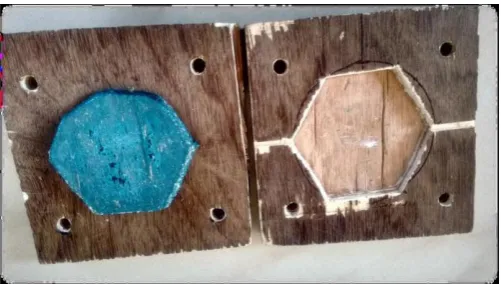
The first trial was done using raw material as Poly Propylene (PP). The plastic was taken from automobile oil cans shredded manually. As the temperature was within 200oC, so we decided to use wood as die material, which was easy to machine and shape the cavity as needed. Following figure shows the output of our first trial.
Fig 6. First trial product and die
7. APPLICATIONS
These are useful for recycling thermoplastics by suitable product.
Small objects can be manufactured.
Mechanical part can be made.
Injection machine is cheap enough to build at home and easy to build too.
Simple jobs can be made according to die.
Using this machine many useful products can be manufactured and can be commercialized to make profit.
The raw material required is free of cost and easy to find because we are recycling the plastic.
8. CONCLUSION
After completing our project we can conclude that the plastic injection machine can be constructed in less cost. If any part in our project breaks or gets damaged then we can replace it easily.
It does not require any special skills to operate the machine, except for the electronic connections included in the project. The Electronics circuit is easy to understand and anyone that can understand the given circuit diagram, the person can without any difficulty assemble the electronics.
All the parts that have been fabricated require only basic fabrication skills, and no special purpose machines are required to perform these.
All the equipments can be found in any basic workshop.
This machine is hand operated so it does not require any prime mover, only electrical supply is given to the band heaters to heat it. So finally our project is completed and our aim is concluded.
9. REFRENCES
www.preciousplastic.com
Elements of workshop Technology-Volume I & II by S. K. Hajra Chaudhary, Bose, Roy
Production Technology Volume- I & II by O. P. Khanna & Lal
A text book of Foundry Tech. by O.P. Khanna www.protolabs.com
[image:5.595.36.287.234.376.2]