warwick.ac.uk/lib-publications
Original citation:
Oswald, Josef and Roemer, Rudolf A.. (2017) Exchange-mediated dynamic screening in the
integer quantum Hall regime. Europhysics Letters, 117 (5). 57009.
Permanent WRAP URL:
http://wrap.warwick.ac.uk/87897
Copyright and reuse:
The Warwick Research Archive Portal (WRAP) makes this work of researchers of the
University of Warwick available open access under the following conditions.
This article is made available under the Creative Commons Attribution 3.0 (CC BY 3.0) license
and may be reused according to the conditions of the license. For more details see:
http://creativecommons.org/licenses/by/3.0/
A note on versions:
The version presented in WRAP is the published version, or, version of record, and may be
cited as it appears here.
LETTER • OPEN ACCESS
Exchange-mediated dynamic screening in the
integer quantum Hall effect regime
To cite this article: Josef Oswald and Rudolf A. Römer 2017 EPL 117 57009
View the article online for updates and enhancements.
Related content
Circuit type simulations of magneto-transport in the quantum Hall effect regime Josef Oswald and Manfred Oswald
-Compressibility stripes for mesoscopic quantum Hall samples
C Sohrmann and R A Römer
-Gate controlled narrowing of the quantum Hall effect plateau transitions
-March 2017
EPL,117(2017) 57009 www.epljournal.org
doi: 10.1209/0295-5075/117/57009
Exchange-mediated dynamic screening in the integer quantum
Hall effect regime
Josef Oswald1 and Rudolf A. R¨omer2
1 Institut f¨ur Physik, Montanuniversit¨at Leoben - Franz-Josef-Strasse 18, 8700 Leoben, Austria
2 Department of Physics and Centre for Scientific Computing, University of Warwick - Coventry, CV4 7AL, UK
received 17 February 2017; accepted in final form 12 April 2017 published online 10 May 2017
PACS 73.43.-f– Quantum Hall effects
PACS 73.43.Nq– Quantum phase transitions
PACS 73.23.-b– Electronic transport in mesoscopic systems
Abstract – We study many-body interaction effects in the spatially resolved filling factor (ν) distribution for higher Landau levels (LLs) via self-consistent Hartree-Fock simulations in the integer quantum Hall (IQH) regime. Our results indicate a strong, interaction-induced tendency to avoid the simultaneous existence of partially filled spin-up and spin-down LLs. Rather, we find that such partially filled LLs consist of coexisting regions of full and empty LLs. At the boundaries between the regions of full and empty LLs, we observe edge stripes of nearly constantν close to
half-filling. This suggests that the exchange interaction induces a behavior similar to a Hund’s rule for the occupation of the spin split LLs. The screening of the disorder and edge potential appears significantly reduced as compared to static Thomas-Fermi screening (Chklovskii D. B. et al.,
Phys. Rev. B,46(1992) 4026). Our results are consistent with a local, lateralν-dependence of the exchange-enhanced spin splitting. Hence, on quantum-coherent length scales as probed here, the electron system of the IQH effect behaves similarly to a non-interacting single particle system —not because of the absence, but rather due to the dominance of many-body effects.
open access Copyright cEPLA, 2017
Published by the EPLA under the terms of the Creative Commons Attribution 3.0 License (CC BY). Further distribution of this work must maintain attribution to the author(s) and the published article’s title, journal citation, and DOI.
Since its discovery more than 35 years ago [1], the inte-ger quantum Hall effect (IQHE) has attracted considerable research effort. The discovery of the fractional quantum Hall effect (FQHE), just a few years later [2], did little to diminish these efforts and the IQHE still remains an area of ongoing investigations due to its inherent richness in quantum phenomena. While the FQHE is often discussed in terms of quasi-particles (such as composite fermions [3]) in the highly correlated many-particle electron system [4], it is widely believed that the physics of the IQHE is dom-inated by single-particle interaction [5]. Up to date the widely accepted and state-of-the-art model for screening in the IQHE regime has been developed by Chklovskii, Shklovskii and Glazman (CSG), who addressed the elec-trostatics of the edge channel region [6]. Their key ingre-dient is the different screening capability of partially and fully filled Landau levels (LLs); instead of getting narrow quasi–one-dimensional channels [7–9] CSG find so-called compressible stripes (CS) of partially filled LLs that can
become up to hundreds of nanometer wide. These stripes are separated by usually narrow, incompressible stripes of fully filled LLs. The main result of CSG is that almost the entire slope of the electrostatic edge potential is screened out and terraces in the uprising electrostatic edge poten-tial are generated. At the same time the electron density changes continuously across the CS.
The CSG approach has been very successful in explain-ing many of the intricate features of IQHE physics [10–12]. However, recent scanning gate microscopy (SGM) experi-ments by Pascheret al.[13], who investigated edge stripes passing quantum point contacts at high magnetic field, indicate that the screening behavior within the compress-ible stripes is much weaker than predicted by the CSG approach. Their results fit even more closely to a sys-tem of non-interacting single carriers. On the other hand, a recent investigation of the local nature of compressibil-ity in the bulk of a IQHE sample strongly challenges the existing single-particle theories [14]. Such results raise
Josef Oswald and Rudolf A. R¨omer
Fig. 1: (Color online) Bare potential for a Hall bar of size 600×400 nm2. An edge confinement potential is created by repulsive Gaussian peaks of 1 V amplitude at the corners and in the middle of the longitudinal sides, leaving openings for current contacts at the ends and voltage probes along the sam-ple. An additional potentialdisorder of maximally±10 mV is generated by randomly distributed Gaussians. This disorder is color coded onto the surface of the total potential with red rep-resenting ∼ −10 mV and blue/purple representing ∼ 10 mV. The contour plot in the plane also shows this disorder with the same color scheme and indicative contours.
the question as to whether many-particle effects are in-deed effectively absent in the IQHE regime, or, quite the opposite, whether they are responsible for implying the physics of almost non-interacting single particles. The an-swer manifests itself, of course, in the screening properties of the electron system. The CSG approach is based on classical electrostatics and many-body exchange effects are not included. It is possible to add an exchange-enhanced g-factor as a semi-empirical parameter [15], which, how-ever, might still not be sufficient to capture all relevant many-particle physics. We note that the existence of an exchange-enhancedg-factor is well known and also widely accepted [16].
In order to revisit the many-body screening effects of a two-dimensional electron system (2DES) in the IQHE, we utilize a) a modeling of the many-particle ground state, for which we use a fully self-consistent Hartree-Fock im-plementation discussed in refs. [17–19]; b) we also need a model for electron transport close to equilibrium while driving the electron system out of equilibrium. In or-der to avoid any violation of the physics of coherent many-particle quantum transport, the model also must not make explicit use of single-carrier flow. We have shown previously that our non-equilibrium network model (NNM) [20] is able to meet these requirements [21,22]. We find that partially filled LLs appear as a mixture of clusters of locally full and empty LLs in contradistinction to the Thomas-Fermi approximation by CSG. Stripes of nearly constanthalf-fillingexist at the boundaries of these clusters at higher LLs and serve as transmitting chan-nels for charge transport. Our results can be interpreted in terms of a laterally varying filling-factor–dependent
2.25 2.5 2.75 3 3.25
B [T] 0
2000 4000 6000 8000
R
[
Ω
]
2.25 2.5 2.75 3 3.25
B [T]
RK-90/4
RK-90/5
RK-90/3
Fig. 2: (Color online) SimulatedRxx(lower traces) and Hall Rxy(upper traces) as a function of magnetic fieldBfor the two longitudinal and Hall contact pairs plotted in different colors.
enhanced g-factor. This reduces screening as compared to CSG in agreement with the aforementioned experimen-tal observations [13].
We consider a 2DES in the (x, y)-plane subject to a perpendicular magnetic fieldB =Bez. Within the plane
of the 2DES, we create a random, spatially correlated disorder potential usingNIGaussian-type “impurities” to model a high-mobility heterostructure. The number of flux quanta piercing the 2DES of size L×L is given by Nφ =L2/2πl2c, yielding a total number of M =NLLNφ
states per spin direction. The filling of the system is char-acterized by the filling factor ν =Ne/Nφ, with Ne being the number of electrons in the system and areal density n = Ne/L2. The total Landau level density is given by n0=eB/handlc=
¯
h/eB is the magnetic length. Figure 1 shows the bare model potential of a Hall bar structure of total size of 600×400 nm2that gets filled with 480 electrons, such thatn= 2×1011cm−2. The solution of the Hartree-Fock model at temperature T = 1 K for differentB fields delivers values of the local filling factors separately for electrons with spin-up and spin-down,i.e., ν↑andν↓, respectively. Those are transferred to the NNM which calculates the lateral distribution of the experimen-tally injected non-equilibrium electrochemical potentials. No local quantities such as local conductivities or local Ohm’s laws are used up to this point, avoiding the (forbid-den) possibility to track down the path of the individual carriers while moving from one current contact to the next. As can be seen from fig. 2 the obtained longitudinal, Rxx, and Hall, Rxy, resistances show the expected
be-havior, exhibiting Hall plateaus while Rxx = 0 and Rxx
peaks in the transition regime between QH plateaus. The average n = 2×1011cm−2 corresponds to an effective density of about 2.5×1011cm−2 in the active region of the Hall sample structure and the peaks and plateau po-sitions get shifted up in magnetic field. There appear strong resistance fluctuations in both Rxx and Rxy close
[image:4.595.311.543.81.228.2] [image:4.595.48.281.87.236.2]Exchange-mediated dynamic screening in the IQHE
(b) (c)
(a)
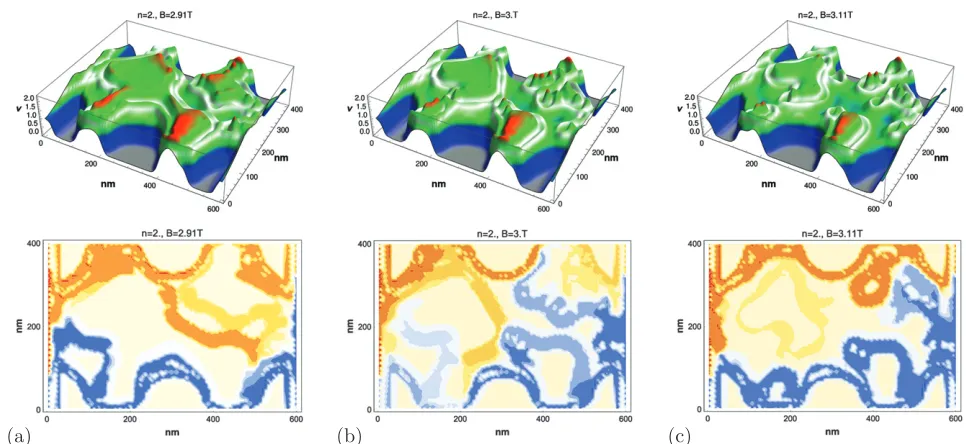
Fig. 3: (Color online) Top row: lateral filling factor distribution ofν↑ for the highest partly filled LL for the magnetic-field sweep withn= 2×1011cm−2, shown in fig. 2, (a) at the beginning of theν= 4→3 plateau transition atB= 2.91 T, (b) in the middle of the plateau transition atB= 3 T (lc≈15 nm), and (c) at the end of plateau transition atB= 3.11 T. The colors represent the filling factor, where blue means the first LL forν= 0→1, green the second LL forν= 1→2 and red the third, all for spin-up electrons. The filling factor range close toν = 1.5 is highlighted in light gray in order to identify the stripes appearing close to the half-filled top LL. The dark gray regions indicate the depleted edges regions withν≈0 corresponding to the large confining potentials in fig. 1. Bottom row: lateral non-equilibrium distribution of the injected chemical potential μat the corresponding threeB-field strengths as in the top row. The colors representμin arbitrary units with high potential in dark orange and low potential in dark blue. (We note that channels enter the metallic voltage probes with an incoming potential and reappear with a possibly different potential according to mixing with back-scattered bulk channels. The details of this mixing in the contacts are not visible in the plot, but handled correctly in the NNM.)
Figure 3 (top row) displays the local filling factor of the top spin-up LL during theν = 4→3 plateau transition. The spin-up level is higher in energy than the spin-down level and, therefore, depletion starts with the spin-up level that is initially at filling factorν↑= 2, while for spin-down we have alsoν↓ = 2, giving in total a filling factorν = 4. At the beginning of the plateau transition atB = 2.91 T (see also fig. 2) the initially completely filled spin-up LL starts to break up in sub-regions of filling factorν↑ = 2 and regions of filling factorν↑= 1, which gives an average filling factor between ν = 4 and ν = 3. This goes on for the entire plateau transition and the clusters of ν↑ = 2 shrink in size. At the boundaries of the ν↑ = 2 clusters stripes of the filling factor close toν↑= 1.5 are obtained in the spin-up LL. In fig. 3 (bottom row) we show the lateral distribution of the non-equilibrium electrochemical poten-tialμthat is injected at the current contacts and obtained from the NNM for all threeB cases with clockwise chiral-ity. One can see that the potentials are transmitted along the half-odd integer stripes appearing in fig. 3 (a)–(c). If the potentials mix up at some locations in the bulk region this generates dissipation as it is the case in the transition regime of the IQHE and indicated by the associated color changes in fig. 3. While this happens only weakly in (a) forB = 2.91 T and (c) forB = 3.11 T, this mixing appears to be quite strong forB= 3 T in (b), which represents the
QH transition close to the maximum of theRxx-peak. We
also observe dissipation at the voltage contacts. This is most clearly pronounced,e.g., in the upper right and the lower left voltage contacts in fig. 3(b). We note that the channels appear to merge into the metallic contact region and reappear with changed magnitude.
The mechanism for the de-population of the spin-up LL upon increasingB is now quite clear from fig. 3. Instead of an overall uniform decrease of the carrier density, we find locally shrinking clusters of fully filled spin-up LL at ν↑ = 2 and increasing regions of depleted spin-up LL at ν↑ = 1, which on average give a continuously decreasing ν. Therefore, a total filling factor of, say,ν↑= 1.5 is made up by half of the area taken up by clusters of filling fac-tor ν↑ = 2 and half of the area taken up by regions of ν↑= 1. The same happens subsequently if the spin-down LL gets de-populated, which stays at ν↓ = 2 while de-populating the top spin-up LL. This is quite in contrast to the CSG model and is purely a result of many-particle interactions (and does not happen for a Hartree calcula-tion,i.e., without the exchange term). But this suggests that even a half-filled LL may provide only poor screen-ing as compared to a Thomas-Fermi–like behavior that would predict a continuous carrier density variation over all the sample area. In addition, at the boundaries be-tween clusters of filling factor ν↑ = 2 and ν↑ = 1 there
[image:5.595.52.535.80.302.2]Josef Oswald and Rudolf A. R¨omer
0 0.5 1 1.5 2 2.5
Density [1011cm-2] 0
10 20 30
Enhanced
g
-factor
0 1 2 3 4
Filling factor
0 2 4 6 8
Energy splitting [m
e
V]
A A B
C D
(a) (b)
Fig. 4: (Color online) (a) Plot of theg-enhancement factor (alternatively ΔE) as a function ofn(andν). The open (blue) circles denote the mean and error bars indicate the standard error while closed (red) squares show the median. The dashed line is a guide to the eye for the mean values. Labels A, B, C, and D are used in the discussion in the text to identify certain behaviours. (b) Schematic screened edge potential according to CSG including the bare spin splitting (dashed lines); the shaded regions mark the spin-down/spin-up compressible stripes, respectively. The bold lines indicate the additional filling-factor–dependent exchange-driven Zeeman energy if the CS according to CSG were to remain stable. The dotted lines indicate the additional Zeeman energy after carrier redistribution. Red/blue indicate spin-down/-up as specified by the arrows. The vertical green arrow indicates the direction of theB-field.
appear terraces of almost constant filling factorν↑= 1.5, cf. fig. 3 (top row). The width of the half-odd integer stripes appears to be of the order of the magnetic length lc. We furthermore find two parallel stripes of widthlcat
the boundaries between clusters ν↑ = 3 andν↑ = 2 (not shown here). This suggests to us that the origin of the stripes lies in the spatial dependence of the Landau states similar to what was measured for the behavior of the lo-cal density of states [24]. The cluster boundaries and the boundaries of the fully filled LLs at the sample edge are the only regions where the many-particle electron system can exchange carriers close to equilibrium as in low exci-tation magneto-transport experiments. As a consequence, these boundaries are experimentally observed as transport channels [22].
The observed behavior during population and de-population results from a tendency of the many-particle system to avoid the simultaneous appearance of partially filled spin-up and spin-down LLs. A similar behavior would result by applying Hund’s rule, which seems to be the driving force also for many-particle effects in the QHE regime. During filling, electrons continue to be added to the laterally growing region of the filled top spin-split LL, even if its boundary already extends into regions of classi-cally not accessible elevated edge and random potentials. The process continues as long as possible and, therefore, the filling of the next upper level is considerably delayed at higher carrier densities as compared to single-particle considerations.
Let us now discuss our findings using the language of an enhanced g-factor. In this way, we can make contact with the single-particle picture by including the majority of the many-body physics in the renormalizedg. We have studied the energy splitting ΔE=g gspinμBB, whereμB
[image:6.595.81.511.84.253.2]Exchange-mediated dynamic screening in the IQHE
lower integer filling, which in this case is an even value at ν= 2. Again a narrow half-odd integer stripe in the step-like uprising spin-down level is left (dotted red line and narrow dark-shaded red bar). Now theg-enhancement al-most vanishes until we enter the next CS atν = 2→ 1 where the whole discussion starts over again on the basis of branches C and D in fig. 4(a). The only exception is the fact that such half-odd integer features do not appear in the lowest LL. The same discussion as done above for the edge region, of course, also applies for the boundaries of any clusters in the bulk region, that are caused by the random potential fluctuation.
Results showing the behaviour ofν↑ andν↓ upon vary-ingn can be found in the supplement [25] and reconfirm the above arguments. When increasing the temperature we find that the fine features shown in fig. 3 slowly vanish. Last, the features found at half-odd integer filling are not present when we restrict our calculations to include only the Hartree term [26].
In conclusion, we show that the IQH regime is dom-inated by many-particle physics that acts towards re-establishing the narrow quasi–one-dimensional channels of non-interacting single carriers as assumed by the early quite successful models of the IQHE [7–9]. The most strik-ing fact is that the many-body interactions replace the plateaus in the edge potential of CSG by narrowhalf-odd integer features in the local filling factor in higher LLs. The apparent modifications to the CSG model might have its reason in the fact that for the reduced system size of our simulations, that so far is in the sub-micron range, the CSG model breaks down. The validity of CSG might hold only for structures that are significantly larger where a smooth average filling factor is a good representation for our observed mixture of clusters of full and empty LLs in the HF results. In this context our model possibly provides a so far missing link between the quite successful semi-classical CSG approach and the microscopic many-particle world. However, this aspect is the goal of the ongoing and future work. Considering the recent developments in lo-cally resolved studies in the QH regime [13,24,27] it seems likely that the half-odd integer features can be detected experimentally in the near future.
∗ ∗ ∗
We gratefully acknowledge funding from the Austrian Science Foundation FWF Project P19353-N16, EPSRC grant EP/J003476/1 and provision of computing resources through the MidPlus Regional HPC Centre Warwick UK (EP/K000128/1). UK data statement: Data is available via [25].
REFERENCES
[1] Klitzing K. v., Dorda G.andPepper M.,Phys. Rev.
Lett.,45(1980) 494.
[2] Tsui D. C., Stormer H. L.andGossard A. C.,Phys.
Rev. Lett.,48(1982) 1559.
[3] Jain J. K.,Annu. Rev. Condens. Matter Phys.,6(2015)
39.
[4] Laughlin R. B.,Phys. Rev. Lett.,50(1983) 1395.
[5] Weis J. and von Klitzing K., Philos. Trans. R. Soc.
London A: Math. Phys. Eng. Sci.,369(2011) 3954. [6] Chklovskii D. B., Shklovskii B. I. and Glazman
L. I.,Phys. Rev. B,46(1992) 4026.
[7] Halperin B. I.,Phys. Rev. B,25(1982) 2185.
[8] B¨uttiker M.,Phys. Rev. B,38(1988) 9375.
[9] Chalker J. T. and Coddington P. D., J. Phys. C:
Solid State Phys.,21(1988) 2665.
[10] Cobden D. H., Barnes C. H. W. andFord C. J. B.,
Phys. Rev. Lett.,82(1999) 4695.
[11] Ilani S., Martin J., Teitelbaum E., Smet J. H., Mahalu D., Umansky V.andYacoby A.,Nature,427
(2004) 328.
[12] Martin J., Ilani S., Verdene B., Smet J., Umansky V., Mahalu D., Schuh D., Abstreiter G. and Yacoby A.,Science,305(2004).
[13] Pascher N., R¨ossler C., Ihn T., Ensslin K., Reichl C.andWegscheider W.,Phys. Rev. X,4(2014)
11014.
[14] Kendirlik E. M., Sirt S., Kalkan S. B., Ofek N., Umansky V. and Siddiki A.,Nat. Commun., 8(2017)
14082.
[15] Kendirlik E. M., Sirt S., Kalkan S. B., Dietsche W., Wegscheider W., Ludwig S.andSiddiki A.,Sci.
Rep.,3(2013) 494.
[16] Nomura S., Tamura H., Yamaguchi M., Akazaki T.
andHirayama Y.,Phys. Rev. B,87(2013) 085318.
[17] Sohrmann C., Oswald J. and R¨omer R., Quantum
Percolation, in the Quantum Hall Regime, in Quantum and Semi-classical Percolation and Breakdown in Disor-dered Solids, edited by Sen A. K., Bardhan K. K.
and Chakrabarti B. K. (Springer, Heidelberg) 2009,
pp. 1–31.
[18] Sohrmann C.andR¨omer R. A.,New J. Phys.,9(2007)
97.
[19] Sohrmann C.,Interactions in the integer quantum Hall
effect, PhD Thesis, University of Warwick (2007). [20] Oswald J.andOswald M.,J. Phys.: Condens. Matter,
18(2006) R101.
[21] Oswald J. and R¨omer R. A., Phys. Proc., 75 (2015)
314.
[22] Oswald J., Linking Non-equilibrium Transport with the
Many Particle Fermi Sea in the Quantum Hall Regime, in Recent Advances in Quantum Dynamics, edited by
Bracken P.(InTech, Rijeka) 2016, pp. 131–163.
[23] Simmons J. A., Hwang S. W., Tsui D. C., Wei H. P., Engel L. W.andShayegan M.,Phys. Rev. B,44(1991)
12933.
[24] Hashimoto K., Champel T., Florens S., Sohrmann C., Wiebe J., Hirayama Y., Roemer R. A., Wiesendanger R. and Morgenstern M.,
Phys. Rev. Lett.,109(2012) 116805.
[25] R¨omer R. A. and Oswald J., http://wrap.warwick.
ac.uk/id/eprint/86004(2017).
[26] Oswald J.andR¨omer R. A., in preparation (2017).
[27] Hashimoto K., Sohrmann C., Wiebe J., Inaoka T., Meier F., Hirayama Y., R¨omer R. A., Wiesendan-ger R. and Morgenstern M., Phys. Rev. Lett., 101
(2008) 256802.