warwick.ac.uk/lib-publications
Original citation:
Rolls, Edmund T. (2017) The storage and recall of memories in the hippocampo-cortical
system. Cell and Tissue Research. doi:
10.1007/s00441-017-2744-3
Permanent WRAP URL:
http://wrap.warwick.ac.uk/96754
Copyright and reuse:
The Warwick Research Archive Portal (WRAP) makes this work of researchers of the
University of Warwick available open access under the following conditions.
This article is made available under the Creative Commons Attribution 4.0 International
license (CC BY 4.0) and may be reused according to the conditions of the license. For more
details see:
http://creativecommons.org/licenses/by/4.0/
A note on versions:
The version presented in WRAP is the published version, or, version of record, and may be
cited as it appears here.
REVIEW
The storage and recall of memories in the hippocampo-cortical system
Edmund T. Rolls1,2
Received: 26 July 2017 / Accepted: 12 November 2017
#The Author(s) 2017. This article is an open access publication
Abstract
A quantitative computational theory of the operation of the hippocampus as an episodic memory system is described. The CA3 system operates as a single attractor or autoassociation network (1) to enable rapid one-trial associations between any spatial location (place in rodents or spatial view in primates) and an object or reward and (2) to provide for completion of the whole memory during recall from any part. The theory is extended to associations between time and object or reward to implement temporal order memory, which is also important in episodic memory. The dentate gyrus performs pattern separation by compet-itive learning to create sparse representations producing, for example, neurons with place-like fields from entorhinal cortex grid cells. The dentate granule cells generate, by the very small number of mossy fibre connections to CA3, a randomizing pattern separation effect that is important during learning but not recall and that separates out the patterns represented by CA3 firing as being very different from each other. This is optimal for an unstructured episodic memory system in which each memory must be kept distinct from other memories. The direct perforant path input to CA3 is quantitatively appropriate for providing the cue for recall in CA3 but not for learning. The CA1 recodes information from CA3 to set up associatively learned backprojections to the neocortex to allow the subsequent retrieval of information to the neocortex, giving a quantitative account of the large number of hippocampo-neocortical and neocortical-neocortical backprojections. Tests of the theory including hippocampal subregion analyses and hippocampal NMDA receptor knockouts are described and support the theory.
Keywords Completion
Introduction
A computational theory of the operation of networks in the hippocampus in memory (Kesner and Rolls2015; Rolls2010,
2016a) is described. The type of memory is episodic, referring
to the memory of a particular event or linked group of events occurring typically at the same time and place. An example might be where dinner was yesterday, who was present, who sat where, what the menu was and the discussion. This must be kept separate from, for example, what happened the day before that. Episodic memory almost always has a spatial component (Dere et al.2008; Rolls2017) and a spatial representation in the hippocampus can be updated by self-motion to produce path integration (McNaughton et al.1996; Robertson et al.1998; Rolls2016a; E.T. Rolls and S. Wirth in preparation).
Episodic memory can be operationally investigated in an-imals including humans in the following ways. First is the ability to store rapidly, on a single trial, a unique combination of inputs that typically involve place or time and objects in-cluding people and, later, to recall the whole memory from any part. The episodic memory, in being formed rapidly, is relatively unstructured and may be formed simply by associ-ating together the spatial or temporal and object representa-tions. In contrast, a semantic memory has structure and may require many exemplars to learn the representation, as excep-tions might occur, such as that an ostrich is a bird but cannot fly (McClelland et al. 1995). The recall of many episodic
A useful source for some of the papers referred to below iswww.oxcns. org. A fuller description than is possible here of the operation of autoassociation or attractor networks, pattern association networks and competitive networks is provided by Rolls (2016a) in Appendix B, which is available onlinehttp://www.oxcns.org/papers/Cerebral%20Cortex% 20Rolls%202016%20Contents%20and%20Appendices.pdf
More extensive citations of the literature are available elsewhere (Kesner and Rolls2015; Rolls2016a).
Electronic supplementary materialThe online version of this article (https://doi.org/10.1007/s00441-017-2744-3) contains supplementary material, which is available to authorized users.
* Edmund T. Rolls
[email protected];http://www.oxcns.org
1
Oxford Centre for Computational Neuroscience, Oxford, England 2 Department of Computer Science, University of Warwick,
Coventry, England
memories from the hippocampus may help to build semantic memories in the neocortex, for example, a map of the world based on the journeys that one has made. An example of a semantic representation is a Jennifer Aniston neuron, which may respond not only to Jennifer Aniston but also to other actors in the same movie and the places with which they are associated (Quiroga2012; Rey et al.2015). These neurons are probably formed in high-order neocortical areas in the tempo-ral lobes and their junction with the parietal lobes; and their presence in the medial temporal lobe (Quiroga2012), for ex-ample, the parahippocampal gyrus, is probably because the hippocampal system receives input from these high-order neo-cortical areas. Autobiographical memory is a semantic memo-ry that involves representations of the self, frequently involv-ing the precuneus (Bubb et al.2017; Cavanna and Trimble
2006; Fossati2013) and that might be built by using the recall of episodic memories. A second property of an episodic mem-ory is that it may involve a temporal sequence of events. The hippocampus has mechanisms that help to implement this (Eichenbaum2014; Howard and Eichenbaum2015; Kesner and Rolls2015; Kraus et al.2013b), as described below.
The theory of the hippocampus and episodic memory is based on the remarkable neural architecture of the hippocam-pus, on the effects of damage to it and on the neuronal activity recorded in it. Once memories have been stored in the hippo-campus, they may later need to be recalled to the neocortex; a theory of the recall mechanism is part of the overall theory (Treves and Rolls 1994; see also Backprojections to the neocortex and memory recall). Once recalled to the neocortex, the memories of particular events or episodes can be reported verbally and, hence, this is a type of declarative memory (Squire and Wixted2011). The recalled information may also be combined with other information to be reorganized and stored semantically in the neocortex, i.e., in a form that reflects meaning and structure, in contrast to the episodic memories captured as discrete memories by the hippocampus (McClelland et al.1995). An example of a semantic represen-tation might be a mental map that includes and describes the relationships between the places to which one has made par-ticular journeys. I start with a description of the underlying architecture and functions of the hippocampus in order to provide a firm foundation for the theory and then show ways in which the theory is being tested experimentally.
Overview
Some of the key points in the computational theory are as follows. The hippocampal CA3 system operates as a single attractor or autoassociation network (1) to enable rapid one-trial associations between any spatial location (place in rodents or spatial view in primates) and an object or reward and (2) to provide for completion of the whole memory during recall from
any part. The theory is extended to associations between time and object or reward to implement temporal order memory, which is also important in episodic memory. The dentate gyrus performs pattern separation by competitive learning to produce sparse representations, producing, for example, neurons with place-like fields from entorhinal cortex grid cells. The dentate granule cells produce, by the very small number of mossy fibre connections to CA3, a randomizing pattern separation effect that is important during learning but not recall and that separates out the patterns represented by CA3 firing as being very differ-ent from each other; this is optimal for an unstructured episodic memory system in which each memory must be kept distinct from other memories. The direct perforant path input to CA3 projection is quantitatively appropriate to provide, as a pattern association mechanism, the cue for recall in CA3. The CA1 recodes information from CA3 in order to set up associatively learned backprojections to the neocortex to allow the subse-quent retrieval of information to the neocortex, providing a quantitative account of the large number of hippocampo-neocortical and hippocampo-neocortical-hippocampo-neocortical backprojections. Empirical tests of the theory including hippocampal subregion analyses and selective hippocampal NMDA receptor knockouts are described and support the theory.
Structure and function of the hippocampal
system
Effects of damage to the hippocampus
In the patient H.M., bilateral damage to the hippocampus per-formed to treat epilepsy produced an inability to remember
2012c,2016a), impairs a different type of memory more closely related to perceptual functions, namely recognition memory for objects (Buckley2005).
These deficits produced by hippocampal damage underlie the importance of the hippocampus in event memory in which there is frequently an association of a place with an object. This provides a prototypical paradigm in which to analyse and conceptualize hippocampal computation.
Systems-level anatomy
To understand the functions of the primate hippocampus in event or episodic memory, we need to understand from which other parts of the brain it receives information and to what it in turn connects. The primate hippocampus receives inputs via the entorhinal cortex (Brodmann area 28), via the highly de-veloped parahippocampal gyrus (areas TF and TH) and via the perirhinal cortex from the ends of many processing streams of the cerebral association cortex, including the visual and audi-tory temporal lobe association cortical areas, the prefrontal cortex and the parietal cortex (Lavenex and Amaral2000; Lavenex et al.2004; Rolls2016a; E.T. Rolls and S. Wirth in preparation; Suzuki and Amaral1994b; Van Hoesen 1982; van Strien et al.2009; see Figs.1,2b). The hippocampus is thus, by its connections, potentially able to associate together object and spatial representations. In addition, the entorhinal cortex receives inputs from the amygdala and the orbitofrontal cortex, which could provide reward/valence-related informa-tion to the hippocampus (Carmichael and Price 1995; Pitkanen et al.2002).
The primary output from the hippocampus to neocortex originates in CA1 and projects to the subiculum, entorhinal cortex and parahippocampal structures (areas TF-TH) and to the prefrontal cortex (Delatour and Witter2002; van Haeften et al. 2003; Van Hoesen1982; van Strien et al. 2009; see Figs.1,2b), although other outputs have been found (Kesner and Rolls2015). These are the pathways that are likely to be involved in the recall of information from the hippocampus back to the rest of the neocortex.
Neurophysiology of the hippocampus
The systems-level neurophysiology of the hippocampus shows the information that could be stored or processed by the hippocampus. To understand the way that the hippocam-pus works, we need to state more than just that it can store information - one needs to know what information.
Rodent place cells
In rodents, place cells, which respond when a rat is near a particular place, are found in the hippocampus (Hartley et al.
2014; Jeffery2011; McNaughton et al.1983; O’Keefe and
Fig. 1 Connections of the primate hippocampus with the neocortex. Macaque brain. Top Lateral view. Bottom Medial view. The hippocampus receives its inputs via the parahippocampal gyrus (areas
TFandTH) and the perirhinal cortex (areas 35 and 36), both of which in turn project to the entorhinal cortex (area 28), send inputs to the hippocampus and receive backprojections from the hippocampus, as shown in Fig.2. The forward inputs towards the entorhinal cortex and hippocampus are shown withlarge arrowheadsand the weaker return backprojections withsmall arroweads. The hippocampus receives input via the perirhinal cortex areas 35 and 36, which project to the lateral entorhinal cortex areas 28 from the ends of the hierarchically organized ventral visual system pathways (V1,V2,V4,PIT,AIT) that represent Bwhat^object is present (including faces and even scenes), from the anterior inferior temporal visual cortex (AIT, BA21, TE) where objects and faces are represented and that receives input from the posterior inferior temporal cortex (PIT, BA20, TEO), from the reward system in the orbitofrontal cortex (OFC) and amygdala, from an area to which the OFC projects, namely the anterior cingulate cortex BA32 and subgenual cingulate cortex (BA25), from the high-order auditory cortex (BA22) and from olfactory, taste and somatosensoryBwhat^areas (not shown). These ventralBwhat^pathways are shown inblue. The hippocampus also receives via the parahippocampal cortex areas TF and TH inputs (shown inred) from the dorsal visualBwhere^orBaction^pathways, which reach parietal cortex area 7 via the dorsal visual stream hierarchy, including V1, V2, MT, MST, LIP and VIP and from areas to which they are connected, including the dorsolateral prefrontal cortex BA46 and the posterior cingulate and retrosplenial cortex (asarcuate sulcus,cscentral sulcus,
ipsintraparietal sulcus,iosinferior occipital sulcus,lslunate sulcus,sts
Dostrovsky1971). Place cells are found in regions CA3 and CA1 (with smaller place fields in the dentate granule cells; Neunuebel and Knierim2012; see Fig.2a for the architecture
direction of the rat. In the medial entorhinal cortex, grid cells are present that have regularly spaced peaks of firing in an environ-ment, so that as a rat runs through an environenviron-ment, a single neuron increases then decreases its firing a number of times as the rat traverses the environment (Moser et al.2015; see alsobelow). The grid cell system appears to provide ring con-tinuous attractors that would be useful not only for spatial path integration (computing position based on self-motion; Giocomo et al.2011; McNaughton et al.2006) but also for the timing information during sequence encoding for non-spatial and non-spatial information (Kesner and Rolls2015), as described in the sectionEntorhinal cortex grid cells.
Primate spatial view cells and object-spatial view cells
In monkeys, which are used as a model to help understand human memory, there is a prominent representation of spatial view, the location at which the primate is looking (E.T. Rolls and S. Wirth in preparation; Rolls and Xiang2006; for example, see Fig.3). The representation of spatial view is allocentric, in that it is independent of the place at which the monkey is located in the room or of the eye position in the head (left gaze vs right gaze) and of the head direction but depends on the location in space being viewed (Georges-François et al.1999). The spatial view cells are updated by self-motion (e.g., moving the eyes or run-ning to a new part of the environment) indicating that path inte-gration is implemented (Robertson et al.1998). This type of representation is much more appropriate for a human memory system than that in rodents, because a human can remember where an object or person has been seen based just on looking at the place, without necessarily ever having been at that place
(Rolls2017); for example, you may remember where you have seen a lecturer in a lecture theatre, without ever having visited the precise place where the lecturer is standing. Moreover, some spatial view neurons respond to particular combinations of ob-ject and place, such as that obob-ject 1 is in place 1 on a screen (Rolls et al.2005) or that reward 1 is at place 1 on a screen (Rolls and Xiang2005) and thus seem to encode what is necessary for an object-place memory representation system in the brain (Rolls2016a,2017; Rolls and Xiang2006). Further, some of these neurons reflect the completion during recall of a whole memory from a part, for example, of the spatial location at which an object has previously been shown (Rolls and Xiang2006). Consistent with these findings and with the computational theo-ry, human hippocampal neurons have now been reported to be activated during recall (Gelbard-Sagiv et al.2008). View cells modulated by place have been found in monkeys (Rolls and O’Mara 1995; E.T. Rolls and S. Wirth in preparation; Wirth et al.2017) and great care is needed to establish, by eye position recordings taken together with recordings of the place where the monkey is located during locomotion (Georges-François et al.
1999; Robertson et al.1998; Rolls1999; Rolls et al. 1997a,
1998), that there is information about place as well as about spatial view in primates (E.T. Rolls and S. Wirth in preparation). Evidence consistent with the presence of spatial view cells in the primate hippocampus is that spatial view grid cells have been described in the monkey entorhinal cortex (Buffalo2015; Killian et al.2012; Rueckemann and Buffalo2017). These neurons correspond to place-related grid cells in rodents but, in primates, the grid is for the space being looked at, instead. In humans, places being viewed on a video monitor (i.e., spatial views being looked at), not places where the human is actually located, can activate hippocampal neurons (Ekstrom et al.2003).
Results consistent with object-place neurons in primates (Rolls and Xiang2006; Rolls et al.2005) are that some hip-pocampal neurons in rats respond on the basis of the conjunc-tion of locaconjunc-tion and odour (Wood et al. 1999). Further, Diamond and colleagues showed, by using the vibrissa so-matosensory input for theBobject^system, that rat hippocam-pal neurons respond to object-place combinations, objects or places (Itskov et al.2011).
Reward-related inputs to the hippocampus
The primate anterior hippocampus (which corresponds to the rodent ventral hippocampus) receives inputs from brain regions involved in reward processing such as the amygdala and orbitofrontal cortex (Carmichael and Price 1995; Pitkanen et al.2002; Stefanacci et al.1996; Suzuki and Amaral1994a). To investigate how this affective input is incorporated into pri-mate hippocampal function, Rolls and Xiang (2005) recorded neuronal activity while macaques performed a reward-place as-sociation task in which each spatial scene shown on a video monitor had one location that, if touched, yielded a preferred
Fig. 2 aRepresentation of connections within the hippocampus. Inputs reach the hippocampus through the perforant path (1), which makes synapses with the dendrites of the dentate granule cells and also with the apical dendrites of the CA3 pyramidal cells. The dentate granule cells project via the mossy fibres (2) to the CA3 pyramidal cells. The well-developed recurrent collateral system of the CA3 cells is indicated. The CA3 pyramidal cells project via the Schaffer collaterals (3) to the CA1 pyramidal cells, which in turn have connections (4) to the subiculum.b,cForward connections (solid blue lines) from areas of the cerebral association neocortex via the parahippocampal gyrus and perirhinal cortex and entorhinal cortex to the hippocampus and backprojections (dashed green lines) via the hippocampal CA1 pyramidal cells, subiculum and parahippocampal gyrus to the neocortex. Great con-vergence occurs in the forward connections down to the single network implemented in the CA3 pyramidal cells and great divergence again in the backprojections.bBlock diagram.cMore detailed representation of some of the principal excitatory neurons in the pathways. The CA3 re-current collateral connections are shown inred(Ddeep pyramidal cells,DGdentate granule cells,Fforward inputs to areas of the association cortex from preceding cortical areas in the hierarchy,mfmossy fibres,
PHGparahippocampal gyrus and perirhinal cortex,ppperforant path,rc
recurrent collateral of the CA3 hippocampal pyramidal cells,Ssuperficial pyramidal cells,2pyramidal cells in layer 2 of the entorhinal cortex,3
pyramidal cells in layer 3 of the entorhinal cortex). Thethick lines above
fruit juice reward and a second location that yielded a less pre-ferred juice reward. Each scene had different locations for the different rewards. Of 312 hippocampal neurons analysed, 18% responded more to the location of the preferred reward in differ-ent scenes and 5% to the location of the less preferred reward (Rolls and Xiang2005). When the locations of the preferred rewards in the scenes were reversed, 60% of 44 neurons tested reversed the location to which they responded, showing that the reward-place associations could be altered by new learning in a few trials. The majority (82%) of these 44 hippocampal reward-place neurons tested did not respond to object-reward associa-tions in a visual discrimination object-reward association task. Thus, the primate hippocampus contains a representation of the reward associations of placesBout there^being viewed; this is a way in which affective information can be stored as part of an episodic memory and in which the current mood state can influ-ence the retrieval of episodic memories. Consistent evidinflu-ence has been presented showing that rewards available in a spatial envi-ronment can influence the responsiveness of rodent place neu-rons (Hölscher et al.2003; Redila et al.2014; Tabuchi et al.
2003). Further evidence that reward-related information reaches the primate hippocampus is that when macaques learn a novel object-place task, some hippocampal neurons respond to correct outcomes, and others to error outcomes (Wirth et al.2009).
In humans, reward and non-reward information reaches the hippocampus and appears to be related to the ruminating sad memories present in depression. In depression, there is reduced functional connectivity of the medial orbitofrontal cortex reward-related system with the parahippocampal gyrus and in-creased functional connectivity of the lateral orbitofrontal cor-tex non-reward related system, which is implicated in depres-sion (Rolls2016b), with the precuneus (W. Cheng et al. in preparation) and posterior cingulate cortex (W. Cheng et al. in preparation), areas that provide access to the hippocampal sys-tem and that are involved in representations of space and of the self (Cavanna and Trimble2006; Rolls2015b).
Internal structure and connectivity
of the hippocampus
The internal hippocampal circuitry is shown in Fig. 2a (Amaral et al. 1990; Amaral and Witter 1989; Andersen
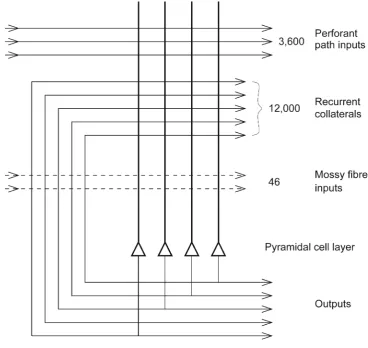
et al. 2007; Kondo et al. 2009; van Strien et al.2009). Projections from the entorhinal cortex layer 2 reach the gran-ule cells (of which there are 106in the rat) in the dentate gyrus (DG), via the perforant path (pp; Witter1993). The granule cells project to CA3 cells via the mossy fibres (mf), which provide a sparse but possibly powerful connection to the 3.105CA3 pyramidal cells in the rat. Each CA3 cell receives approximately 46 mossy fibre inputs, so that the sparseness of this connectivity is thus 0.005%. By contrast, there are also many more, possibly weaker, direct perforant path inputs from layer 2 of the entorhinal cortex onto each CA3 cell: in the rat, of the order of 4.103. The largest number of synapses (about 1.2.104in the rat) on the dendrites of CA3 pyramidal cells is, however, provided by the (recurrent) axon collaterals of CA3 cells themselves (rc; see Fig. 3). Remarkably, the recurrent collaterals are distributed to other CA3 cells largely through-out the hippocampus (Amaral et al.1990; Amaral and Witter
1989,1995; Ishizuka et al.1990; Witter2007), so that effec-tively the CA3 system provides a single network with a con-nectivity of approximately 2% between the different CA3 neurons given that the connections are bilateral. The CA3-CA3 recurrent collateral system is even more extensive in macaques than in rats (Kondo et al.2009). The neurons that comprise CA3, in turn, project to CA1 neurons via the Schaffer collaterals. In addition, projections that terminate in the CA1 region originate in layer 3 of the entorhinal cortex (see Fig.2b; van Strien et al.2009).
Theory of the operation of hippocampal
circuitry as a memory system
Introductory remarks
In this section, I consider the way that an event or episodic memories might be stored in and retrieved by hippocampal circuitry and in addition retrieved back into the neocortex where they may be incorporated into long-term semantic or autobiographical memory (Kesner and Rolls2015). The the-ory has been developed through many stages (Rolls 1987,
1989b; Rolls1995; Treves and Rolls1992,1994) with fuller accounts and recent developments available (Kesner and Rolls
2015; Rolls2016a). The theory illustrates the importance of taking into account the details of the circuitry involved in the development of theories of brain function. Some background is that many of the synapses in the hippocampus show asso-ciative modification, as revealed by long-term potentiation and that this synaptic modification appears to be involved in learning (Andersen et al.2007; Takeuchi et al.2014; Wang and Morris2010). Early work by David Marr (1971) showed the manner in which associatively modified recurrent connec-tivity could support pattern completion but he did not identify the CA3 network of the hippocampus as being the crucial
Fig. 3 Examples of the firing of a hippocampal spatial view cell (av216) when the monkey was at various positions in the room, with various head directions, looking at wall 1 of the room. The details of the spatial view field are shown by the different firing rates with thecolour calibration barnetwork with an appropriate architecture for this to occur. This type of network became known as an autoassociation network (because a pattern is associated with itself by using the recur-rent collaterals) in further work by Kohonen (1977) and also became known as an attractor network following the quanti-tative approach in which partial patterns could be attracted into a basin of attraction (Amit1989; Hopfield1982).
A description of the operation of autoassociation networks is provided elsewhere (Amit1989; Hertz et al.1991; Rolls and Treves 1998) including Cerebral Cortex: Principles of Operation(Rolls2016a), the Appendices of which are online
at www.oxcns.org and a summary is provided in
Supplementary Material Box1, with illustrative simulations available as exercises (Rolls2016a).
CA3 as an autoassociation or attractor memory
Arbitrary associations and pattern completion in recall
On the basis of the evidence summarized above concerning the connectivity of the hippocampus, on the autoassociation networks and on the role of synaptic modification in memory, Rolls (1987,1989b) at the Dahlem Conference in 1985 on The
Neural and Molecular Bases of Learning (Rolls 1987) and others (Levy 1989; McNaughton 1991; McNaughton and Morris 1987) suggested that the CA3 stage acts as an autoassociation memory that enables episodic memories to be formed and stored in the CA3 network and that, subse-quently, the extensive recurrent collateral connectivity allows for the retrieval of a whole representation to be initiated by the activation of some small part of the same representation (the cue). The crucial synaptic modification for this is in the CA3 recurrent collateral synapses (see Figs.1,2,4).
The hypothesis is that because the CA3 operates effectively as a single network, it can allow arbitrary associations be-tween inputs originating from very different parts of the cere-bral cortex to be formed. These might involve associations between information originating in the temporal lobe visual cortex about the presence of an object (Rolls2012c) and in-formation originating from scene-selective representations about where the object is (Kornblith et al.2013; Nasr et al.
2011). Each event might be stored in as little as 1 s (because autoassociation memories require only one-shot learning and long-term potentiation needs only brief inputs) and each event would consist of the vector of neurons firing at the inputs to the hippocampus. An episodic memory might be a single
[image:9.595.176.545.353.701.2]event or a sequence of events. Although some spatial gradient is present in the CA3 recurrent connections, so that the con-nectivity is not fully uniform in the rat (Ishizuka et al.1990; Witter2007) with, very interestingly, there being less gradient in primates (Kondo et al.2009), the network will still have the properties of a single interconnected autoassociation network allowing associations between arbitrary neurons to be formed, given the presence of many long-range connections that over-lap from different CA3 cells and given the ability of attractor networks to operate with diluted connectivity shown in our computational studies prompted by this problem (Treves
1990; Treves and Rolls1991). The connectivity of the CA3 network is diluted (as contrasted with fully connected) in that there are only approximately 12,000 recurrent collateral syn-apses on each CA3 neuron and 300,000 CA3 neurons (as shown in Fig. 4). Indeed, diluted connectivity in autoassociation networks in the brain, for example, those in CA3 and those implemented by recurrent collaterals in the neocortex, have been suggested to be advantageous by reduc-ing the probability of multiple connections between any pair of neurons; such multiple connections, if present, would dis-tort the basins of attraction and considerably reduce the num-ber of memories that can be stored (Rolls2012a,2016a). The diluted connectivity is also advantageous in the pattern asso-ciation and competitive networks in the hippocampal system (Rolls2015a,2016a,c; Rolls and Webb2012).
Crucial issues include: how many memories can be stored in this system (to determine whether the autoassociation hy-pothesis leads to a realistic estimate of such number of mem-ories that the hippocampus can store); whether the whole of a memory can be completed from any part; whether the autoassociation memory can act as a short-term memory, for which the architecture is inherently suited; whether the system can operate with spatial representations that are essentially continuous because of the continuous nature of space; and when the system stores or recalls information. These and re-lated issues are considered below and in more detail elsewhere (Kesner and Rolls2015; Rolls2010,2013a,2013b,2016a).
Storage capacity
We performed quantitative analyses of the storage and retrieval processes in the CA3 network (Treves and Rolls
1991, 1992). We extended previous formal models of autoassociative memory (Amit1989; Hopfield 1982) by analysing a network with graded response units, so as to rep-resent more realistically the continuously variable rates at which neurons fire and with incomplete connectivity (Rolls
2016a; Rolls and Treves 1998; Rolls et al.1997b; Treves
1990; Treves and Rolls1991). We found that, in general, the maximum number pmax of firing patterns that can be (individually) retrieved is proportional to the numberCRCof (associatively) modifiable recurrent collateral synapses on to
each neuron, by a factor that increases roughly with the in-verse of the sparsenessaof the neuronal representation (de-fined below). Each memory is precisely de(de-fined in the theory: it is a set of firing rates of the population of neurons (which represent a memory) that can be stored and later retrieved, with retrieval being possible from a fraction of the originally stored set of neuronal firing rates (Rolls2016a). The neuronal population sparsenessaof the representation can be measured by extending the binary notion of the proportion of neurons that are firing to any one stimulus or event as:
a¼ ∑i¼1;Nri=N
2
=∑i¼1;N ri2=N
ð1Þ
whereriis the firing rate (e.g., spikes/s, typically in the range 0–100 spikes/s) of thei’th neuron in the set ofNneurons. The sparseness ranges from 1/N, when only one of the neurons responds to a particular stimulus (a local or grandmother cell representation; Rolls and Treves 2011), to a value of 1.0, attained when all the neurons are responding at the same rate to a given stimulus (Franco et al.2007; Rolls and Treves2011; Treves and Rolls1991). The maximum number of patterns,
pmax, that can be stored and correctly retrieved is ap-proximately:
pmax≅ C
RC
aln 1ð =aÞk ð2Þ
whereCRCis the number of recurrent collateral connections onto each neuron andkis a scaling factor that depends weakly on the detailed structure of the rate distribution, on the con-nectivity pattern, etc., but that is roughly in the order of 0.2– 0.3 (Treves and Rolls1991). For example, forCRC= 12,000 associatively modifiable recurrent collateral synapses onto each neuron and a= 0.02,pmaxis calculated to be approxi-mately 36,000. This analysis emphasizes the utility of having a sparse representation in the hippocampus, for sparse distrib-uted representations increase the number of different memo-ries that can be stored (Treves and Rolls1991), a feature that is essential for an episodic memory (Rolls2010,2016a).
In order for most associative networks to store informa-tion efficiently, both heterosynaptic Long Term Depression (LTD) in which a synapse decreases in strength when the presynaptic term is low and the postsynaptic term is high and Long Term Potentiation (LTP) in which an increase occurs in synaptic strength when both the pre- and post-synaptic terms are high are required (Collingridge et al.
Several points that arise, including the measurement of the total amount of information (in bits per synapse) that can be retrieved from the network, the computational definition of a memory, the computational sense in which CA3 is an attractor network and the possible computational utility of memory reconsolidation, are treated elsewhere (Rolls2016a). Here, I note that, given that the memory capacity of the hippocampal CA3 system is limited, some form of forgetting is needed in this store or some other mechanism to ensure that its capacity is not exceeded. Exceeding the capacity can lead to a loss of much of the information retrievable from the network. Heterosynaptic LTD could help this forgetting, by enabling new memories to overwrite old memories (Rolls 2016a). The limited capacity of the CA3 system also provides one of the arguments that some transfer of information from the hip-pocampus to neocortical memory stores are useful (see Treves and Rolls1994). Given its limited capacity, the hippocampus might be a useful store (e.g., for episodic memories) for only a limited period, which might be in the order of days, weeks or months. This period may well depend on the acquisition rate of new episodic memories. If the animal were in a constant and limited environment, then as new information is not being added to the hippocampus, the representations in the hippo-campus would remain stable and persistent. These hypotheses have clear experimental implications, both for recordings from single neurons and for the gradient of retrograde amne-sia, both of which might be expected to depend on whether the environment is stable or frequently changing. They show that the conditions under which a gradient of retrograde amnesia might be demonstrable would be when large numbers of new memories are being acquired, not when only a few memories (a few in the case of the hippocampus being less than a few hundred) are being learned (Rolls2016a).
Recall and completion
A fundamental property of the autoassociation model of the CA3 recurrent collateral network is that the recall can be sym-metric, i.e., the whole of the memory can be retrieved and completed from any part (Amit 1989; Hopfield 1982; Kesner and Rolls2015; Rolls 2016a; Rolls and Treves
1998). For example, in an object-place autoassociation mem-ory, a place can be recalled from an object retrieval cue (and potentially vice versa). In a test of this, Day et al. (2003) trained rats in a study phase to learn, in one trial, an association between two flavours of food and two spatial locations. During a recall test phase, they were presented with a flavor that served as a cue for the selection of the correct location. They found that injections of an NMDA receptor blocker (AP5) or AMPA/kainate receptor blocker (CNQX) to the dor-sal hippocampus prior to the study phase impaired encoding but that injections of AP5 prior to the test phase did not impair the place recall, whereas injections of CNQX did impair the
place recall. The interpretation is that, somewhere in the hip-pocampus, NMDA receptors are necessary for forming one-trial odour-place associations and that recall can be performed without further involvement of NMDA receptors. The impli-cation, consistent with investigations of LTP (Takeuchi et al.
2014), is that NMDA glutamate receptors are necessary for synaptic modification but that recall may use the AMPA re-ceptors modified by the learning.
Evidence that the CA3 system is not necessarily required during recall in a reference memory (previously learned) spa-tial task, such as the water maze spaspa-tial navigation for a single spatial location task, is that CA3 lesioned rats are not impaired during recall of a previously learned water maze task (Brun et al.2002; Florian and Roullet2004). However, if completion from an incomplete cue is needed (e.g., finding a place with only a few room cues), then CA3 NMDA receptors are nec-essary (presumably to ensure satisfactory CA3-CA3 learning) even in a reference memory task (Gold and Kesner 2005; Kesner and Rolls 2015; Nakazawa et al. 2002). Thus, the CA3 system appears to be especially needed in rapid one-trial object-place recall and when completion from an incom-plete cue is required (see below). Note that an object-place task is a model of episodic memory, episodic memory usually has a spatial component and place cells in rats and spatial view cells in primates provide the spatial representation that is need-ed (Rolls2016a; E.T. Rolls and S. Wirth in preparation).
Continuous spatial patterns and CA3 representations
The finding that spatial patterns, which imply continuous rep-resentations of space, are represented in the hippocampus has led to the application of continuous attractor models to help us to understand hippocampal function. This has been necessary, because (1) space is inherently continuous, (2) the firing of place and spatial view cells is approximately Gaussian as a function of the distance away from the preferred spatial loca-tion, (3) these cells have spatially overlapping fields and (4) the theory is that these cells in CA3 are connected by Hebb-modifiable synapses. This specification would inherently lead the system to operate as a continuous attractor network. Continuous attractor network models have been extensively studied (Amari1977; Battaglia and Treves1998a; Rolls and Stringer2005; Samsonovich and McNaughton1997; Stringer and Rolls 2002; Stringer et al. 2004,2002a,b) and are de-scribed briefly next (see also Rolls2016a).
A Bcontinuous attractor^ neural network (CANN) can maintain the firing of its neurons to represent any location along a continuous physical dimension such as spatial view, spatial position and head direction. The network architecture is the same as that illustrated in Supplementary Material Box1
has a spatial field that is offset from its neighbours’in the state space, as illustrated in Fig.5. The CANN uses the excit-atory recurrent collateral connections between the neurons as set up by associative learning to reflect the distance between the neurons in the state space of the animal (e.g., place or spatial view or head direction). These networks can maintain the bubble or packet of neural activity constant for long pe-riods, wherever it is started to represent the current state (head direction, position, etc) of the animal and are likely to be involved in many aspects of spatial processing and memory, including spatial vision and navigation. Global inhibition is used to keep the number of neurons in a bubble or packet of actively firing neurons relatively constant and to help to en-sure that only one activity packet is present (see example in Fig.5).
Continuous attractor networks can be thought of as being very similar to autoassociation or discrete attractor networks (Rolls2016a) and have the same architecture (Supplementary
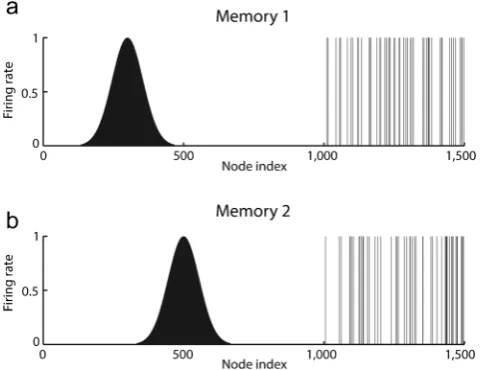
Material Box1). The main difference is that the patterns stored in a CANN are continuous patterns, with each neuron having broadly tuned firing that decreases with, for example, a Gaussian function as the distance from the optimal firing lo-cation of the cell is varied and with different neurons having tuning that overlaps throughout the space. Such tuning is il-lustrated in Fig.5. The connections set up by associative learn-ing between the neurons in the bubble of activity can later maintain that bubble of activity (Rolls2016a). For compari-son, autoassociation networks normally have discrete (separate) patterns (each pattern implemented by the firing of a particular subset of the neurons that can overlap with other subsets), with no continuous distribution of the patterns throughout the space (see Fig.5). A discrete sparse distributed representation with graded firing rates is used to encode and store representations of objects (Rolls2016a; Rolls and Treves
2011). A consequent difference from a discrete attractor net-work is that the CANN can maintain its firing at any location in the trained continuous space, whereas a discrete attractor or autoassociation network moves its population of active neu-rons towards one of the previously learned separate attractor states and thus implements the recall of a particular previously learned pattern from an incomplete or noisy (distorted) ver-sion of one of the previously learned patterns.
Space is continuous and object representations are discrete. If these representations are to be combined in, for example, an object-place memory (Leutgeb et al.2005; Rolls and Xiang
2005,2006; Rolls et al.2005), then we need to understand the operation of networks that combine these representations. Rolls et al. (2002) showed that attractor networks can store both continuous patterns and discrete patterns (as illustrated in Fig.5) and can thus be used to store, for example, the location in a (continuous, physical) space (e.g., the placeBout there^in a room represented by spatial view cells) where an object (a discrete item) is present. We demonstrated this by storing as-sociated continuous and discrete representations in the same single attractor network and then by revealing that the repre-sentation in the continuous space can be retrieved by the dis-crete object that is associated with that spatial position and that the representation of the discrete object can be retrieved by providing the position in the continuous representation of space.
If spatial representations are stored in the hippocampus, an important issue arises in terms of understanding memories that include a spatial component or context of how many such spatial representations can be stored in a continuous attractor network. One very interesting result is that, because correla-tions between the representacorrela-tions of places in different maps or charts (where each map or chart might be of one room or locale by using, for example, cues in the room) are generally low, very many different maps can be simultaneously stored in a continuous attractor network (Battaglia and Treves 1998a; Rolls2016a).
[image:12.595.50.291.298.483.2]We considered how spatial representations can be stored in continuous attractor networks and how the activity can be maintained at any location in the state space in a form of short-term memory when the external (e.g., visual) input is removed. However, many networks with spatial representa-tions in the brain can be updated by internal self-motion (i.e., idiothetic) cues even when no external (e.g., visual) input is present. The ways in which path integration can be imple-mented in recurrent networks such as the CA3 system in the hippocampus or in related systems including the entorhinal cortex (seebelow) are described elsewhere (Giocomo et al.
2011; McNaughton et al. 2006; Samsonovich and McNaughton1997; Stringer et al. 2002a,2002b) and have been applied to primate spatial view cells by Rolls and col-leagues (Rolls and Stringer2005; Stringer et al.2004,2005).
BCognitive maps^ (O’Keefe and Nadel1978) can be under-stood by the operation of these attractor networks and the way that they are updated by learning and by self-motion (Rolls
2016a). However, those who have focused on spatial and nav-igation processing in the hippocampus rather than memory processing do now envisage that attractor networks are in-volved in hippocampal function (Hartley et al.2014).
Mossy fibre inputs to the CA3 cells
We hypothesize that the mossy fibre inputs force efficient information storage by virtue of their strong and sparse influence on the CA3 cell firing rates, in order to produce pattern separation, as described next. The strong effects likely to be mediated by the mossy fibres have also been emphasized by McNaughton and Morris (1987) and McNaughton and Nadel (1990). We (Rolls1987, 1989c,
2013a, 2016a; Rolls and Treves 1998; Treves and Rolls
1992) hypothesize that the mossy fibre input is particularly appropriate in several ways. First, the finding that mossy fibre synapses are large and located very close to the soma makes them relatively powerful in activating the postsynaptic cell. Second, the firing activity of dentate granule cells appears to be very sparse (Jung and McNaughton1993; Leutgeb et al.
2007; Neunuebel and Knierim2012) and this, together with the small number of connections on each CA3 cell, produces a sparse signal that can then be transformed into sparse firing activity in CA3 by a threshold effect. The hypothesis is that the mossy fibre sparse connectivity solution performs the ap-propriate function to enable learning to operate correctly in the CA3 to CA3 synaptic connections (Cerasti and Treves2010; Treves and Rolls1992). Quantitative analysis shows that the perforant path input would not produce a pattern of firing in CA3 that contains sufficient information for learning (Treves and Rolls1992).
The particular property of the small number of mossy fibre connections onto a CA3 cell, approximately 46 (see Fig.4), is that this has a randomizing effect on the representations set up
in CA3, so that they are as different as possible from each other (Cerasti and Treves2010; Rolls1989b,2013a,2016a; Rolls and Treves 1998; Treves and Rolls1992). This is a pattern separation effect, which means, for example, that place cells in a given environment are well separated to cover the whole space and that any new object-place associations formed are different from earlier episodic memories. The re-sult is that any one event or episode will set up a representation that is very different from other events or episodes, because the set of CA3 neurons activated for each event is random. This is then the optimal situation for the CA3 recurrent collat-eral effect to operate, because it can then associate together the random set of neurons that are active for a particular event (for example, an object in a particular place) and later recall the whole set from any part. It is because the representations in CA3 are unstructured or random, in this way, that large num-bers of memories can be stored in the CA3 autoassociation system and that interference between the different memories is kept as low as possible, in that these memories are maximally different from each other (Hopfield1982; Rolls and Treves
1998; Treves and Rolls1991). If some stored memory patterns were similar, they would tend to interfere with each other during recall. For an episodic memory, each stored memory pattern should be different from the others, so that each epi-sode can be separately retrieved.
The requirement for a small number of mossy fibre con-nections onto each CA3 neuron applies not only to discrete (Treves and Rolls1992) but also to spatial representations and some learning in these connections, whether associative or not, can help to select out the small number of mossy fibres that may be active at any one time in order to chose a set of random neurons in the CA3 (Cerasti and Treves2010). Any learning may help by reducing the accuracy required for a particular number of mossy fibre connections to be specified genetically onto each CA3 neuron. The optimal number of mossy fibres for the best information transfer from dentate granule cells to CA3 cells is in the order of 35–50 (Cerasti and Treves2010; Treves and Rolls1992). The mossy fibres also make connections useful for feedforward inhibition (Acsady et al.1998), which may help to normalize the inputs and to help stability (Rolls2016a).
We (Rolls and Kesner 2006) hypothesized that the nonassociative plasticity of mossy fibres (i.e., synaptic potentiation that does not depend on the activity of the postsynaptic neuron; see Brown et al.1990) might have a useful effect in enhancing the signal-to-noise ratio of the effects of the dentate input to CA3 in that a consistently firing mossy fibre would produce nonlinearly amplified currents in the post-synaptic cell, an effect that would not happen with an occa-sionally firing fibre (Treves and Rolls1992). This plasticity and the competitive learning in the dentate granule cells would also have the effect that similar fragments of each episode (e.g., the same environmental location) recurring on subsequent oc-casions would be more likely to activate the same population of CA3 cells. This would have potential advantages in terms of economy of use of the CA3 cells in different memories and in making some link between different episodic memories with a common feature, such as the same location in space. Consistent with this, dentate neurons that fire repeatedly are more effective in activating CA3 neurons (Henze et al.2002). As acetylcholine turns down the efficacy of the recurrent collateral synapses between CA3 neurons (Giocomo and Hasselmo2007; Hasselmo and Sarter2011; Hasselmo et al.
1995; Newman et al.2012), then cholinergic activation also might help to allow external inputs rather than the internal recurrent collateral inputs to dominate the firing of the CA3 neurons during learning, as the current theory proposes (Rolls
2013a; Rolls and Deco2015). If cholinergic activation at the same time facilitated LTP in the recurrent collaterals (as it appears to in the neocortex), then cholinergic activation might have a useful double role in facilitating new learning at times of behavioural activation and emotional arousal, when pre-sumably it may be particularly relevant to allocate some of the limited memory capacity to new memories. Acetylcholine may also facilitate memory storage (versus recall) by enhanc-ing firenhanc-ing in dentate granule cells (see Kesner and Rolls (2015)).
Perforant path inputs to CA3 cells
By calculating the amount of information that would end up being carried by a CA3 firing pattern produced solely by the perforant path input and by the effect of the recurrent connec-tions (i.e., without dentate input), we showed (Treves and Rolls1992) that an input of the perforant path type, alone, is unable to direct efficient information storage. Such an input is too weak, it turns out, to drive the firing of the cells, as the
Bdynamics^of the network is dominated by the randomizing effect of the recurrent collaterals. On the other hand, an autoassociative memory network needs afferent inputs to ap-ply the retrieval cue to the network. We have shown that the perforant path system is likely to be the one involved in relay-ing the cues that initiate retrieval in CA3. The concept is that, in order to initiate retrieval, a numerically large input through
associatively modified synapses is useful, so that even a par-tial cue is sufficient and that the retrieval cue need not be very strong, as the recurrent collaterals then take over in the retriev-al process (Rolls2016a; Treves and Rolls1992). In contrast, during storage, strong signals, in the order of millivolts for each synaptic connection, are provided by the mossy fibre inputs to dominate the recurrent collateral activations, so that the new pattern of CA3 cell firing can be stored in the CA3 recurrent collateral connections (Rolls 2016a; Treves and Rolls1992).
The associatively modified synapses required in the perforant path to CA3 synapses make this a pattern association network. The architecture and properties of pattern association networks are described briefly in Supplementary Material Box
2and in more depth elsewhere (Rolls2016a). These synapses need to be modified during the storage of an event memory, with the entorhinal input to CA3 becoming associated with whatever subset of neurons in CA3 is firing at that time (Treves and Rolls1992).
Noise in memory recall
Randomness (sometimes referred to as noise) is present in the spiking times of individual neurons, i.e., for a given mean firing rate, the spike times often have a close to Poisson dis-tribution. The noise arises from synaptic and neuronal pro-cesses in ion channels, the quantal release of transmitter, etc. (Faisal et al. 2008). A result is that, in an autoassociation network, if one population of neurons for one attractor or memory state has by chance more spikes from its neurons than the other populations, then the memory with more spikes is more likely to be recalled, especially when the recall cue or cues for the various neurons are relatively similar in strength. The operation of such systems has been described in The Noisy Brain: Stochastic Dynamics as a Principle of Brain Science (Rolls and Deco2010) in the context of decision-making (Wang 2008) but the approach applies equally to memory recall in an autoassociation memory, as the network architecture and operation for memory and for decision-making is the same (Rolls2016a). This noisy operation of the brain has been proposed to have many advantages, for example, in promoting the recall of different memories or different associations on different occasions, even when the inputs are similar and this is proposed to be an important contributor to original thought and creativity (Rolls2016a; Rolls and Deco2010). Too much noise and therefore the in-stability of memory and decision systems might promote un-stable attention and loose thought associations in schizophre-nia (Loh et al.2007; Rolls2012b; Rolls et al.2008b). Too little noise and therefore too much stability may contribute to some of the symptoms of obsessive-compulsive disorder (Rolls
evidence concerning the transmitters present in these states is leading to interesting new approaches to understanding these disorders and perhaps to treating them more successfully (Rolls2012b,2016a), together with the cognitive effects in normal aging (Rolls and Deco2015).
Dentate granule cells
Pattern separation
We now turn to the hypothesis that the dentate granule cell stage of hippocampal processing, which precedes the CA3 stage, acts as a competitive network in a number of ways to produce, during learning, the sparse yet efficient (i.e., non-redundant) representation in CA3 neurons that is required for the autoassociation implemented by CA3 to perform well (Rolls1989b, 2016a; Rolls et al. 2006; Treves and Rolls
1992). The properties of competitive networks are summa-rized in Supplementary Material Box3 and in more detail by Rolls (2008,2016a). An important property for episodic memory is that the dentate, by acting in this way, performs pattern separation (or orthogonalization; Rolls1989b,2013a; Rolls et al.2006; Treves and Rolls1992), enabling the hippo-campus to store different memories of even similar events; this prediction has been confirmed (Gilbert et al.2001; Goodrich-Hunsaker et al.2008; Kesner and Rolls 2015; Leutgeb and Leutgeb2007; McHugh et al. 2007; Rolls2016a; see also
Tests of the theory). The term pattern separation refers to the property that the output patterns are less correlated with each other than the input patterns, i.e., orthogonaliztion has been produced.
As just described, the dentate granule cells might be impor-tant in helping to build and prepare spatial representations for the CA3 network. The actual representation of space in the primate hippocampus includes a representation of spatial view (E.T. Rolls and S. Wirth in preparation; Rolls and Xiang
2006), whereas in the rat hippocampus, it is of the place where the rat is. The representation in the rat may be related to the fact that, with a much less developed visual system than the primate, the rat’s representation of space may be defined more by the olfactory, tactile and distant visual cues present and may thus tend to reflect the place in which the rat finds itself. However, the spatial representations in the rat and primate could arise from essentially the same computational process as follows (de Araujo et al.2001; Rolls1999). The starting assumption is that, in both the rat and the primate, the dentate granule cells (and the CA3 and CA1 pyramidal cells) respond to combinations of the inputs received. In the case of the primate, a combination of visual features in the environment will result, because of the fovea providing high spatial reso-lution over a typical viewing angle of perhaps 10–20 degrees, in the formation of a spatial view cell, the effective trigger for which will thus be a combination of visual features within a
relatively small part of space. In contrast, in the rat, given the very extensive visual field that is subtended by the rodent retina and that may extend over 180–270 degrees, a combina-tion of visual features formed over such a wide visual angle would effectively define a position in space that is a place (de Araujo et al.2001).
Entorhinal cortex grid cells transformed to hippocampal place and spatial view cells
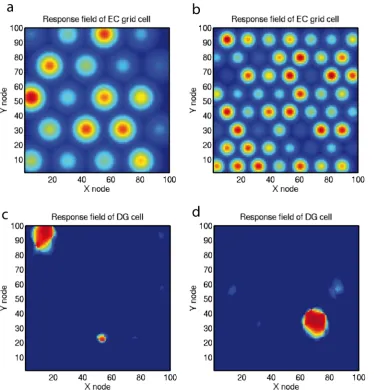
The entorhinal cortex contains grid cells that have a high firing rate in the rat in a two-dimensional (2D) spatial grid as the rat traverses an environment, with larger grid spacings in the ven-tral entorhinal cortex (Moser et al.2015). This may be a sys-tem optimized for path integration (McNaughton et al.2006), which may self-organize during locomotion with longer time constants producing more widely spaced grids in the ventral entorhinal cortex (Kropff and Treves2008). How are the grid cell representations, which would not be suitable for the asso-ciation of an object or reward with a place to form an episodic memory, transformed into a place representation that would be appropriate for this type of episodic memory? I have proposed that this might be implemented by a competitive network (Rolls 2016a) in the dentate gyrus operating to form place cells and implemented by each dentate granule cell learning to respond to particular combinations of entorhinal cortex cells firing, where each combination effectively specifies a place; this has been shown to be feasible computationally (Rolls et al.2006). The sparse representations in the dentate gyrus, implemented by the mutual inhibition through inhibi-tory interneurons and competitive learning, help to implement thisBpattern separation^ effect (Rolls1989b,1989c,2016a; Rolls and Treves1998). Results of this competitive learning model are illustrated in Fig.6. Figure6a, b show simulated (entorhinal cortex) grid cells with Gaussian firing rate re-sponse profiles, whereas Fig.6c, d illustrate the place cells formed in the hippocampus by competitive learning (Rolls et al. 2006). Similar processes are involved in some later models of this transformation (Giocomo et al. 2011; Zilli
2012).
In primates, there is now evidence for the presence of a grid-cell like representation in the entorhinal cortex, with neu-rons having grid-like firing as the monkey moves its eyes across a spatial scene (Buffalo 2015; Killian et al. 2012; Rueckemann and Buffalo2017). Similar competitive learning processes may transform theseBspatial view grid cells^of the entorhinal cortex into hippocampal spatial view cells and may help with the idiothetic (produced in this case by movements of the eyes) update of spatial view cells (Robertson et al.
1998).
position of features in a scene is encoded? I have proposed that this involves competitive learning analogous to that used to form place cells in rats but, in primates, operating on the rep-resentations of objects that reach the hippocampus from the inferior temporal visual cortex (Rolls et al.2008c). We have shown that, in complex natural scenes, the receptive fields of inferior temporal cortex neurons become reduced in size and asymmetric with respect to the fovea (Aggelopoulos and Rolls
2005; Rolls2009) and we have demonstrated, in a unifying computational approach, that competitive network processes operating in areas such as the parahippocampal cortex, the entorhinal cortex and/or the dentate granule cells might form unique views of scenes by forming a sparse representation of these object or feature-tuned inferior temporal cortex ventral visual stream representations that have some spatial asymme-try providing a foundation for building scene representations that incorporate the relative spatial positions of landmarks within a scene (Rolls et al.2008c). In this theory, it is the spatial asymmetry with respect to the fovea of different neu-rons that solves the binding problem, for the neuneu-rons indeed
respond to an object and to its location with respect to the fovea (Aggelopoulos and Rolls 2005; Rolls 2009; Rolls et al.2008c). Another input to hippocampal spatial view cells may come from the parahippocampal place area (Nasr et al.
2011).
CA1 cells
The CA3 cells connect to the CA1 cells by the Schaeffer collateral synapses. The associative modifiability in this con-nection helps the full information present in CA3 to be re-trieved in the CA1 neurons (Rolls 1995; Schultz and Rolls
1999; Treves1995; Treves and Rolls1994). Part of the hy-pothesis is that the various sub-parts of an episodic memory, which have to be represented separately in CA3 to allow for completion, can be combined together by competitive learn-ing in CA1 to produce an efficient retrieval representation for the recall via the backprojection pathways to the neocortex of memories stored in the neocortex (Rolls1989b,2016a; Treves and Rolls1994).
Fig. 6 Simulation of competitive learning in the dentate gyrus to produce place cells from the entorhinal cortex grid cell inputs. a,bFiring rate profiles of two entorhinal cortex (EC) grid cells with frequencies of 4 and 7 cycles. The colours show the firing rates withbluebeing the lowest andredthe highest in the test environment (e.g., a room) in which the spatial coordinates are
[image:16.595.178.553.52.443.2]Backprojections to the neocortex and memory recall
The need for information to be retrieved from the hippocam-pus to affect other brain areas was noted in theIntroduction. The way in which this could be implemented via backprojections to the neocortex is now considered.
The modifiable connections from the CA3 neurons to the CA1 neurons have been suggested to allow the whole episode in CA3 to be produced in CA1. The CA1 neurons would then activate, via their termination in the deep layers of the entorhi-nal cortex, at least the pyramidal cells in the deep layers of the entorhinal cortex (see Fig.2). These entorhinal cortex layer 5 neurons would then, by virtue of their backprojections (Lavenex and Amaral2000; Witter et al.2000) to the parts of the cerebral cortex that originally provided the inputs to the hippocampus, terminate in the superficial layers (including layer 1) of those neocortical areas, where synapses would be made onto the distal parts of the dendrites of the (superficial and deep) cortical pyramidal cells (Rolls1989a,1989b,1989c,
2016a; see Fig.2). The areas of neocortex in which this recall would be produced could include multimodal cortical areas (e.g., the cortex in the superior temporal sulcus, which receives inputs from temporal, parietal and occipital cortical areas and from which it is thought that cortical areas such as 39 and 40 related to language have developed) and also areas of unimodal association cortex (e.g., inferior temporal visual cor-tex). The backprojections, by recalling previous episodic events, could provide information useful to the neocortex in the building of new representations in the multimodal and unimodal association cortical areas, which by building new long-term and structured representations can be considered as a form of memory consolidation (Rolls 1989a,1989b,
1989c,1990a,b,2016a), or in organizing actions.
The hypothesis of the architecture whereby this multistage recall from the hippocampus to the neocortex is achieved is shown in Fig.2. The feedforward connections from associa-tion areas of the cerebral neocortex (solid lines in Fig.2) show major convergence as information is passed to CA3, with the CA3 autoassociation network having the smallest number of neurons at any stage of the processing. The backprojections allow for divergence back to neocortical areas. The way in which I suggest that the backprojection synapses are set up to have the appropriate strengths for recall is as follows (Kesner and Rolls2015; Rolls1989a,1989b,1989c,2016a). During the setting up of a new episodic memory, strong feedforward activity progresses towards the hippocampus. During the episode, the CA3 synapses are modified and, via the CA1 neurons and the subiculum, a pattern of activity is produced on the backprojecting synapses to the entorhinal cortex. Here, the backprojecting synapses from active backprojection axons onto pyramidal cells, being activated by the forward inputs to entorhinal cortex, are associatively modified. A similar process would be implemented at
preceding stages of the neocortex, i.e., in the parahippocampal gyrus/perirhinal cortex stage and, in association, cortical areas, as shown in Fig.2.
The concept is that, during the learning of an episodic memory, cortical pyramidal cells in at least one of the stages would be driven by forward inputs from earlier cortical areas but would simultaneously receive backprojected activity (indirectly) from the hippocampus. This activity would, by pattern association from the backprojecting synapses to the cortical pyramidal cells, become associated with whichever cortical cells were being made to fire by the forward inputs. Then, later on, during recall, a recall cue from perhaps another part of the neocortex might reach CA3, where the firing during the original episode would be completed. The resulting backprojecting activity would then, as a result of the pattern association learned previously in the hippocampo-cortical backprojections, bring back the firing in any cortical area that was present during the original episode. Thus, retrieval in-volves the reinstating of the neuronal activity that was present in different cortical areas and that was present during the learning of an episode. The pattern association is also called heteroassociation in order to contrast it with autoassociation. The pattern association operates at multiple stages in the backprojection pathway, as is made evident in Fig.2. If the recall cue was an object, this might result in the recall of the neocortical firing that represented the place in which that ob-ject had been seen previously. As noted elsewhere in this review and by McClelland et al. (1995), that recall might be useful to the neocortex to help it build new semantic memo-ries, which might inherently be a slow process and is not part of the theory of recall from the hippocampus (see below).
Overall, this is thus a theory of the way that different events, linked together in CA3 during the formation of an episodic memory, could produce completion in CA3 if only one of those events is presented later in recall. This would then in turn via CA1 address, by multistage pattern association, the cortical areas in which activity was present during the original learning of the episodic memory and would reinstate the neo-cortical neuronal activity that was present when the episodic memory was formed. This theory is supported by a computa-tional neuroscience model of the operation of the whole of this system (Rolls1995).
generated activity patterns that can be retrieved is given, es-sentially, by the same formula as above where, however,ais now the sparseness of the representation at any given stage andCis the average number of (back-)projections that each cell of that stage receives from cells of the previous one (k’is a similar slowly varying factor to that introduced above). Ifpis equal to the number of memories held in the hippocampal memory, it is limited by the retrieval capacity of the CA3 network,pmax. Putting together the formula for the latter with that shown here, one concludes that, roughly, the requirement implies that the number of afferents of (indirect) hippocampal origin to a given neocortical stage (CHBP), must beCHBP=
CRCanc/aCA3, whereCRCis the number of recurrent collaterals to any given cell in CA3, the average sparseness of a repre-sentation isancandaCA3is the sparseness of memory repre-sentations in CA3 (HBP refers to hippocampal back projections; the implication of the argument is that there must be very many backprojection synapses onto each neocortical neuron; Treves and Rolls1994).
The above requirement is very strong: even if representa-tions were to remain as sparse as they are in CA3, which is unlikely, to avoid degrading the signal,CHBPshould be as large asCRC, i.e., 12,000 in the rat. If thenCHBPhas to be of the same order asCRC, one is led to a very definite conclusion: a mechanism of the type envisaged here could not possibly rely on a se t of mo nosy nap tic CA3-to -neo cor tex backprojections. This would imply that, to make a sufficient number of synapses on each of the vast number of neocortical cells, each cell in CA3 has to generate a disproportionate number of synapses (i.e.,CHBP times the ratio between the number of neocortical and that of CA3 cells). The required divergence can be kept within reasonable limits only by as-suming that the backprojecting system is polysynaptic (i.e., involves several connected cortical stages), provided that the number of cells involved grows gradually at each stage, from CA3 back to neocortical association areas (Treves and Rolls
1994; cf. Fig.2).
The theory of recall by the backprojections thus provides a quantitative account of why any neocortical area has as many backprojection as forward projection connections. Further as-pects of the operation of the backprojecting systems are de-scribed elsewhere (Rolls2016a).
The theory described by McClelland et al. (1995) is similar to the theory described above, except that it holds that the last set of synapses that are modified rapidly during the learning of each episode are those between the CA3 and the CA1 pyra-midal cells (see Fig.2). Their theory also emphasizes the important point that the hippocampal and neocortical memory systems may be quite different, with the hippocampus being specialized for the rapid (Bone-shot^) learning of unstructured single events or episodes and the neocortex for the slower learning of semantic representations (structured representa-tions in which the components are linked), which may
necessarily benefit from the many exemplars needed to shape the semantic representation, a process that is helped by the recall of episodic memories from the hippocampus. The par-ticular model on which they focus for the learning of semantic representations by interleaved learning is the connectionist model of Rumelhart (Rumelhart1990; Rumelhart and Todd
1993), which is trained by error backpropagation (Rumelhart et al.1986).
Temporal order memory in the hippocampus
and episodic memory
For some time, evidence has been available that the hippo-campus plays a role in temporal order memory, perhaps for a sequence of spatial locations but also even when there is no spatial component (Kesner and Rolls 2015). In humans, the hippocampus becomes activated when the temporal order of events is being processed (Lehn et al. 2009) and temporal context is important in episodic memory (Howard et al.
2012). One approach regarding the way that the hippocampus might be involved in temporal order memory is by encoding temporal order into each gamma cycle nested into a theta cycle (Lisman and Buzsaki2008; Lisman and Redish2009). A very different approach is to use firing rate encoding in attractor networks (Rolls2010; Rolls and Deco2010) and is based on evidence that neurons in the rat hippocampus have firing rates that reflect which temporal part of the task is current (Macdonald et al.2011). In particular, a sequence of different neurons is activated at successive times during a time delay period. The tasks used include an object-odour paired associ-ate non-spatial task with a 10 s delay period between the visual stimulus and the odour. The evidence also shows that a large proportion of hippocampal neurons fire in relation to individ-ual events in a sequence being remembered (e.g., a visindivid-ual object or odour) and some to combinations of the event and the time in the delay period (Eichenbaum2014; Macdonald et al.2011).
These interesting neurophysiological findings indicate that rate encoding is being used to encode time, i.e., the firing rates of different neurons are high at different times within a trial, delay period, etc. (Eichenbaum2014; Macdonald et al.2011). These findings suggest several possible computational pro-cesses (Kesner and Rolls2015; Rolls2010).
First, because some neurons fire at different times in a trial of a temporal order memory task or delay task, the time in a trial at which an object (e.g., a visual stimulus or odour) was presented could become encoded in the hippocampus by an association implemented in the CA3 recurrent collaterals be-tween the neurons that represent the object (previously known to be present in the hippocampus for tasks for which the hippocampus is required; Rolls and Xiang2006; Rolls et al.