For Peer Review
Cognitive control structures in the imitation learning of spatial sequences and rhythms – a fMRI study
Journal: Cerebral Cortex
Manuscript ID CerCor-2016-00976.R1
Manuscript Type: Original Articles
Date Submitted by the Author: n/a
Complete List of Authors: Sakreida, Katrin; University Hospital RWTH Aachen, Department of Neurosurgery
Higuchi, Satomi; Lancaster University, Department of Psychology;
University of Liverpool, Magnetic Resonance and Image Analysis Research Centre; Hokkaidō University, Center for Experimental Research in Social Sciences
Di Dio, Cinzia; Universita Cattolica del Sacro Cuore, Department of Psychology
Ziessler, Michael; Liverpool Hope University, Department of Psychology Turgeon, Martine; Centre-Est-de-l’Ile-de-Montréal, Centre de recherche interdisciplinaire en réadaptation (CRIR), Centre intégré universitaire de santé et de services sociaux (CIUSSS)
Roberts, Neil; University of Edinburgh, School of Clinical Sciences, Clinical Research Imaging Centre (CRIC)
Vogt, Stefan; Lancaster University, Department of Psychology; University of Liverpool, Magnetic Resonance and Image Analysis Research Centre
Keywords: cognitive control, fronto-parietal mirror circuit, motor imagery, musical expertise, performance monitoring
For Peer Review
Cognitive control structures in the imitation learning of spatial sequences
and rhythms – a fMRI study
Katrin Sakreida1*, Satomi Higuchi2,3,4, Cinzia Di Dio5, Michael Ziessler6, Martine Turgeon7, Neil Roberts8, Stefan Vogt2,3*
1
Department of Neurosurgery, Medical Faculty, RWTH Aachen University, Aachen, Germany
2
Department of Psychology, Lancaster University, Lancaster, United Kingdom
3
Magnetic Resonance and Image Analysis Research Centre, University of Liverpool, Liverpool, United Kingdom
4
Center for Experimental Research in Social Sciences, Hokkaidō University, Sapporo, Japan
5
Department of Psychology, Universita Cattolica del Sacro Cuore, Milan, Italy
6
Department of Psychology, Liverpool Hope University, Liverpool, United Kingdom
7
Centre de recherche interdisciplinaire en réadaptation (CRIR), Centre intégré universitaire de santé et de services sociaux (CIUSSS) du Centre-Est-de-l’Ile-de-Montréal, Montréal, Québec, Canada
8
Clinical Research Imaging Centre (CRIC), School of Clinical Sciences, University of Edinburgh, Edinburgh, Scotland, United Kingdom
*Corresponding authors:
University Hospital of RWTH Aachen University Department of Neurosurgery
Pauwelsstr. 30
52074 Aachen, Germany
Tel. +49-241-80 80233 Fax: +49-241-80-82420 Dr. Stefan Vogt
Department of Psychology Lancaster University Lancaster LA14YF, UK
Tel. +44-1524-594625 Fax: +44-1524-593744
Running title: Cognitive control structures in imitation learning
Revised for Cerebral Cortex
Number of words in abstract: 193
Update number of words in main text: 10195 [originally 12670] Update number of words for introduction: 1658 [originally 1778]
Update number of words for discussion / conclusion: 4305 [originally 5387] Number of figures: 6 (plus 3 supplementary figures)
Update number of tables: 2 (plus 4 supplementary tables)
For Peer Review
Abstract
1
Imitation learning involves the acquisition of novel motor patterns based on action observation. 2
We used event-related functional magnetic resonance imaging to study the imitation learning 3
of spatial sequences and rhythms during action observation, motor imagery, and imitative 4
execution in non-musicians and musicians. Whilst both tasks engaged the fronto-parietal 5
mirror circuit, the spatial sequence task recruited posterior parietal and dorsal premotor 6
regions more strongly. The rhythm task involved an additional network for auditory working 7
memory. This partial dissociation supports the concept of task-specific mirror mechanisms. 8
Two regions of cognitive control were identified: (1) Dorsolateral prefrontal cortex (DLPFC) 9
was found to be more strongly activated during motor imagery of novel spatial sequences, 10
which allowed us to extend the two-level model of imitation learning by Buccino et al. (2004) 11
to spatial sequences. (2) During imitative execution of both tasks, the posterior medial frontal 12
cortex was robustly activated, along with the DLPFC, which suggests that both regions are 13
involved in the cognitive control of imitation learning. The musicians’ selective behavioural 14
advantage for rhythm imitation was reflected cortically in enhanced sensory-motor processing 15
during action observation and by the absence of practice-related activation differences in 16
DLPFC during rhythm execution. 17
18
Keywords: cognitive control, fronto-parietal mirror circuit, motor imagery, musical expertise, 19
performance monitoring 20
For Peer Review
Introduction
21 22
Imitation learning involves the acquisition of novel motor patterns based on action observation 23
and motor execution, and it is one of the most frequently used forms of skill acquisition in 24
occupational, sports, musical, and rehabilitation settings. In the present study we explore the 25
neuro-cognitive mechanisms underlying imitation learning for a prototypical task domain, 26
namely imitation of sequences of finger movements. The central motivation for this study was 27
to test Buccino et al.’s (2004) two-level model of imitation learning with sequential actions. 28
This model comprises a core task network for sensorimotor encoding and the dorsolateral 29
prefrontal cortex (DLPFC) as cognitive control hub. It has been supported in a series of 30
functional magnetic resonance imaging (fMRI) studies (Buccino et al. 2004; Vogt et al. 2007; 31
Higuchi et al. 2012), which used the learning of guitar chords as an example of complex skill 32
acquisition. However, such configural actions, or bodily postures, represent just one class of 33
motor skills (for review see Vogt and Thomaschke 2007). With the present work we were 34
therefore seeking to establish if Buccino et al.’s model can be extended to sequence learning. 35
We pursued three main research objectives: (1) to delineate the core task networks for 36
two different forms of motor sequencing, namely sequences of spatially oriented finger 37
movements (SEQ) and rhythmical sequences (RHY), (2a) to describe the functional 38
reorganisation in both task networks after a moderate amount of practice as well as (2b) at 39
different levels of expertise, and, crucially, (3) to explore, on this basis, the involvement of 40
cognitive control structures, including the DLPFC, in the early stages of sequence learning. 41
Here we were interested (3a) in the specific cognitive control structures involved in the two 42
tasks and (3b) in task-specific expertise effects. To this end, we studied both musically naïve 43
and expert participants. The latter group generally exhibits advanced capabilities of encoding 44
For Peer Review
rhythmical patterns (Matthews et al. 2016), whilst for the spatial sequences we expected (and 45
found) similar levels of performance in both groups. In the SEQ task, participants observed 46
and then imitated an index finger pressing a series of eight keys on a four-key keyboard, and 47
in the RHY task, they imitated the same finger producing a series of eight intervals on the 48
same key with a mix of long, medium, and short durations. Half of these patterns had been 49
practised one day before the scanning, the other half was novel. 50
The available neuroimaging literature on imitation learning is remarkably sparse. 51
However, two clusters of research are directly relevant to the present study, first the extensive 52
neuroimaging work on action observation and on the imitation of familiar actions (‘familiar 53
imitation’, Subiaul 2010), and second the neuroimaging literature on the acquisition, 54
consolidation, and retention of motor skills, where a good part of this literature concerns motor 55
sequencing. In the following, we develop the predictions regarding the three research 56
objectives from key findings in these two research areas. 57
From action observation and familiar imitation to imitation learning. There is 58
substantial evidence that observing the actions of others can induce processing in motor 59
cortical regions of the observer’s brain (Rizzolatti et al. 2014; see also meta-analyses by 60
Caspers et al. 2010, and Molenberghs et al. 2012). A plausible general account is that this 61
motor cortical ‘mirroring’ is part of a generative model that predicts the sensory input (Kilner 62
et al. 2007; Kilner and Lemon 2013). When imitating familiar actions (or ‘behavioural 63
mimicry’, Chartrand and van Baaren 2009), this generative model can also be used to guide 64
motor execution of the observed behaviour (Vogt 2002; Caspers et al. 2010). 65
In contrast to familiar imitation, imitation learning requires the generation of novel 66
behaviour which is not readily available in the observer’s motor repertoire. In the first 67
neuroimaging study on this topic, Buccino et al. (2004) found that the classic regions of the 68
For Peer Review
human fronto-parietal mirror circuit, namely ventral premotor cortex (PMv), pars opercularis 69
of the inferior frontal gyrus (IFG), and inferior parietal lobule (IPL), were strongly activated 70
from the very outset of imitation learning. Most likely, this reflects the segmentation of the 71
observed action into its constituent elements (e.g., individual fingers), which would normally 72
be present in the observer’s motor repertoire (Byrne 2003; Rizzolatti 2014). Whilst the 73
majority of studies on action observation have focused on prehensile actions, recent research 74
indicates that the task networks for action observation can substantially vary with the nature of 75
the task. Regarding the task networks subserving the present SEQ and RHY tasks, we 76
expected areas of overlap in the fronto-parietal mirror circuit (Caspers et al. 2010; Konoike et 77
al. 2012), and the supplementary motor area (SMA, Vogt et al. 2007; Mukamel et al. 2010; 78
Dayan and Cohen 2011; Hardwick et al. 2013), as well as task-specific differences (research
79
objective 1). Regarding the latter, we expected a stronger involvement of posterior parietal 80
regions for the SEQ task than for the RHY task, and the recruitment of additional brain 81
regions for encoding temporal information in the RHY task. Such dissociations between the 82
present, visually well-matched SEQ and RHY tasks would directly support the concept of 83
task-specific mirror mechanisms (Subiaul 2010; Rizzolatti et al. 2014). 84
In addition to the core fronto-parietal mirror circuit, Buccino et al. (2004) found the 85
DLPFC activated during motor preparation of imitative execution. In a follow-up study (Vogt 86
et al. 2007), the DLPFC was more strongly involved during observation and preparation of 87
novel hand postures, compared to previously practised hand postures. Using a rapid imitation 88
task Higuchi et al. (2012) confirmed the latter finding for imitative execution and 89
demonstrated a robust connectivity between left DLPFC and the fronto-parietal mirror circuit. 90
In addition, the behavioural benefit of imitation learning was significantly correlated with 91
prefrontal activation intensities during observation of novel actions. Taken together, this set of 92
For Peer Review
results provides compelling evidence for a crucial role of prefrontal cortex in the early stage of 93
imitation learning. We concluded that the visuo-motor representation of an observed action, as 94
provided by the fronto-parietal mirror circuit, “only serves as the ‘raw material’ for higher-95
order supervisory and monitoring operations associated with the prefrontal cortex” (Higuchi et 96
al. 2012, p. 1668; Rizzolatti 2014). A structurally similar two-level model of imitation control 97
was recently proposed by Wang and Hamilton (2012; see also Hamilton 2015), with reference 98
to findings indicating the involvement of medial prefrontal cortex in the inhibition and 99
selection of imitative behaviour based on social context. As already indicated, the core 100
objective of the present study is to delineate the cognitive control hubs involved in the 101
imitation learning of sequencing tasks. In addition to action observation (AO) and imitative 102
execution (EXE) we also used a motor imagery (MI) condition, which replaced the motor 103
preparatory event in our earlier studies. 104
From motor skill learning to imitation learning. Motor sequencing is one of the best 105
studied task domains in the neuroimaging literature on skill learning (Doyon and Benali 2005; 106
Dayan and Cohen 2011). There are now detailed accounts of ‘fast’ versus ‘slow’ motor 107
learning and of the plastic redistribution of activations associated with each timescale (see also 108
Kelly and Garavan 2005; Lohse et al. 2014). In keeping with our earlier work (Buccino et al. 109
2004; Vogt et al. 2007; Higuchi et al. 2012) the focus of the present study is on the initial 110
stage of imitative skill learning, that is, the very first attempts at imitating a given action. 111
Curiously, this aspect of sequence learning has been neglected in mainstream neuroimaging 112
research. One reason for this is that research has focussed on the distinction between explicit 113
and implicit sequence learning, with the widespread use of Nissen and Bullemer’s (1987) 114
serial reaction time (SRT) task. Here participants respond, keypress by keypress, to individual 115
location or colour stimuli. This procedure does not represent the more typical everyday 116
For Peer Review
scenario where at first a whole melody, phrase, or rhythm is attended to, before this is 117
reproduced as a whole. Our tasks resemble this scenario. In contrast, the majority of 118
neuroimaging studies on explicit sequence learning either used variants of the SRT task, or 119
where this was not the case, the to-be-learned sequences were often taught informally outside 120
the scanner (Lohse et al. 2014). 121
For deriving predictions regarding the to-be-expected practice effects in the present 122
study (research objective 2), the following general trends observed for fast motor skill 123
learning are relevant (Dayan and Cohen 2011): (1) the initial activation of high-level 124
‘scaffolding’ areas such as the DLPFC involved in cognitive control (Petersen et al. 1998; 125
Shallice et al. 2004), associated with (2) the early upregulation of information processing in 126
task-related sensory-motor regions, or task networks (Kelly and Garavan 2005; Halsband and 127
Lange 2006), and (3) a subsequent trend towards ‘neural efficiency’ (see also Babiloni et al. 128
2009, 2010), that is, decreases in the extent and intensity of activations in cognitive control 129
structures as well as in most, but not all components of the relevant task network. Since we 130
had observed exactly these trends previously in action observation, motor execution, or both 131
(Vogt et al. 2007; Higuchi et al. 2012), we expected the same overall trends in the present 132
study. Two qualifications, however, are worth flagging here: First, Robertson et al. (2001) 133
found that disruption of DLPFC prevented implicit sequence learning when this was guided by 134
spatial cues, but not with guidance by colour cues. Given that spatial information was only 135
critical in our SEQ task, it is then conceivable that the RHY task might rely less on cognitive 136
control by the DLPFC. Second, in their recent network-analysis of explicit learning of 137
complex, ten-element sequences, Bassett et al. (2015), found, in line with Petersen et al.’s 138
(1998) scaffolding-storage framework, an increasing autonomy of sensorimotor systems along 139
with a “release of cognitive control hubs” in frontal and cingulate cortices, where both regions 140
For Peer Review
predicted individual differences in learning. For the present study, we were thus open-minded 141
regarding the involvement of frontal regions other than DLPFC, and notably the posterior 142
medial frontal cortex (pMFC), given its prominent role in performance monitoring 143
(Ridderinkhof et al. 2004; Ullsperger et al. 2014). 144
145
Materials and Methods
146 147
Participants
148
Sixteen volunteers without musical experience (nine female, seven male, age range 18–23 149
years, mean age 20.4 ± 1.5 years) and 15 musicians (seven female, eight male, age range 18– 150
25 years, mean age 20.8 ± 2.3 years) participated in the study. None of them had any MRI 151
specific contraindications, or any history of neurological or psychiatric disposition. 152
The data of three musically naïve participants were excluded from the fMRI analysis: 153
Two participants showed excessively large head movement during scanning, whereby the 154
degree of movement exceeded the image voxel size, and one participant showed exceptionally 155
poor performance for the practised patterns during scanning. Thus, the analysis comprised data 156
of 13 participants without musical experience, and all 15 musicians. Another two musically 157
naïve volunteers were excluded from the outset since they showed poor rhythm imitation skills 158
in an initial screening. 159
Written informed consent was obtained from all participants. All had normal or 160
corrected-to-normal visual acuity, and were strongly to moderately right-handed (mean 161
Laterality Quotient for the non-musicians 96.9, and for the musicians 82.7) according to the 162
Edinburgh Handedness Inventory (Oldfield 1971). Two of the musicians were ambidextrous. 163
For Peer Review
The experimental procedures were approved by the local ethics committee. Data were handled 164
anonymously, and participants were paid to compensate for their time. 165
The non-musicians were primarily students at the University of Liverpool. The inclusion 166
criterion was that they should not have played any musical instrument in the last five years 167
prior to the experiment, and have less than three years of musical experience in total. The 168
musicians were recruited from the Liverpool Institute of Performing Arts, and from the Music 169
department at the University of Liverpool. They had been practising the following musical 170
instruments for 11.6 ± 3.4 years overall: guitar (n = 4), drums/percussion (n = 3), voice (n = 171
3), cello, flute, oboe, piano, and saxophone (n = 1 each). At the time of testing the musicians 172
were practising their instruments on 5.1 ± 1.8 days per week for approx. 10.9 hours. 173
174
Stimuli and apparatus
175
Presentation software (NeuroBehavioral Systems, Berkeley, CA, USA, Version 10.1) was 176
used for display of the stimuli and collection of responses on a custom-made four-key 177
keyboard (see Figure 1). A total of four sets of three spatial sequences (SEQ), and four sets of 178
three rhythms (RHY) were used, where each participant was assigned one SEQ set and one 179
RHY set as practice sets. The to-be-practised and non-practised stimulus sets were 180
counterbalanced across participants. The stimuli were soundless video clips of 4.7s duration, 181
showing a right index finger performing either a SEQ or a RHY pattern on the same keyboard 182
that was used for collecting the responses in the scanner. In each clip, the index finger started 183
moving from a centre position between the second and third key. The SEQ stimuli consisted of 184
eight keypresses with a fixed interval of 500 ms between keypresses. After each of the four 185
keys was pressed once in a certain order, each key was pressed again in a different order, and 186
the same key was never used twice in a row. For the RHY stimuli, only the third key (from left, 187
For Peer Review
see Figure 1) was used, where the index finger tapped eight time intervals in a given order, 188
comprising one long interval (L, 1000 ms), three medium intervals (M, 500 ms), and four 189
short intervals (S, 250 ms). For instance, a spatial sequence comprised keys 1, 4, 3, 2, 3, 2, 1, 4, 190
and a rhythm comprised the intervals M, S, S, M, L, M, S, S. 191
In order to ensure the comparability of performance levels in the SEQ and RHY tasks, 192
patterns of similar difficulty were selected on the basis of a pilot study with twelve musically 193
naïve participants, comprising a larger set of stimuli than required for the actual experiment. 194
195
Design and procedure
196
All participants attended a practice session outside the MRI scanner, followed by the main 197
scanning session one day thereafter. This procedure (e.g., Vogt et al. 2007; Higuchi et al. 198
2012) allowed us to directly contrast patterns which had been previously practised with non-199
practised patterns. In the scanning session, we used a 3 x 2 x 2 experimental design (AO / MI / 200
EXE; SEQ / RHY; practised / non-practised; see section ‘Scanning session’ below). 201
202
Practice session
203
In this session each participant was given extensive practice with one SEQ set and one RHY 204
set in a separate room. In order to accustom participants to the scanner setup, they were lying 205
on a bed, and stimuli were presented on a 15 inch display that was mounted approximately 75 206
cm above their head. Participants used their left index finger for imitation on a similar 207
keyboard as that shown in the videos and were instructed to imitate each pattern as a mirror 208
image of the observed pattern. This spatial arrangement preserved the spatial compatibility 209
between display and imitation (e.g., Koski et al. 2003). 210
For Peer Review
The practice session began with repeated imitation of each of the six to-be-practised 211
patterns until this was correctly imitated over three consecutive trials. Each trial involved 212
observation followed by execution. In order to enhance imitation accuracy, this procedure was 213
repeated with the addition that participants were asked to perform each pattern in synchrony 214
with the model. The second part of the practice session comprised imitation of the six to-be-215
practised patterns in random order for 2 x 24 trials, as well as six free recall trials. Throughout 216
the experiment participants were discouraged from using counting or verbal labels to encode 217
the stimuli. Finally, participants were introduced to motor imagery (MI) trials, which involved 218
imagining the just observed sequence or rhythm and how it would feel to perform it (for 219
further details on motor imagery see Vogt et al. 2013). They were then given a mix of trials 220
comprising motor imagery and imitative execution of the practised patterns. In a last practice 221
block, non-practised patterns were added so that participants experienced a similar trial 222
composition as in the scanning session on the following day. Overall, each of the six to-be-223
practised patterns was imitated approx. 27 times (15 times on average in the initial imitation 224
blocks, nine times in the trials with random order, and three times in the final set of MI and 225
execution trials). 226
227
Scanning session
228
Before entering the scanning room, participants received a short booster session in the practice 229
room, where they imitated the six practised patterns in random order for approx. 6 min and 230
then received a short run with the same trial composition as in the scanning sessions. During 231
scanning, participants were positioned supine with their left index positioned on the custom-232
made keyboard. Form-fitting cushions were used to prevent arm, hand, and head motion. 233
Participants were provided with earplugs to attenuate scanner noise. Visual stimuli were 234
For Peer Review
displayed by a LCD data projector (Panasonic PT-L785U) onto a rear-projection screen at the 235
head end of the scanner. Participants could watch this screen via a mirror above their head. 236
They did not see their hand during scanning. In addition to the logging of key presses via 237
Presentation software, participants’ hand movements were videotaped on MiniDV cassettes, 238
together with an image of the displayed stimuli. In preparation of the functional analysis, the 239
videos served the elimination of events in which the participant did not follow instructions, 240
i.e., performing any overt movement during the AO and MI events, or during the cue events 241
and rest period. As a result, the percentage of excluded events was below 2 % overall, and for 242
individual participants this percentage was always below 7 %. 243
The scanning session was divided into four functional runs of approximately 11 min 244
each, with an anatomical scan interspersed after the first two functional runs and short pauses 245
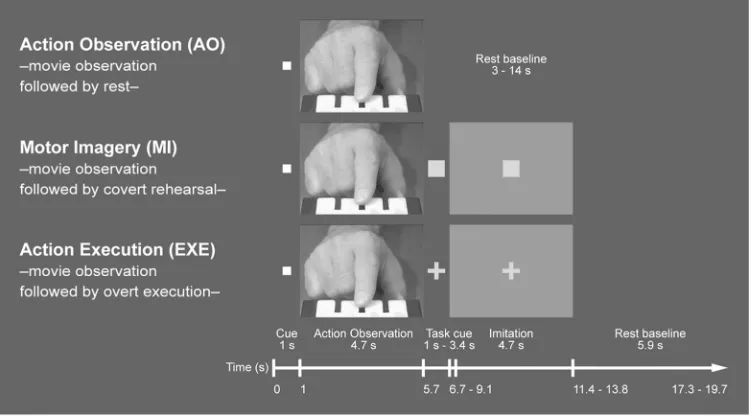
between the other runs. As shown in Figure 1, three types of trials were used during scanning: 246
pure Action Observation (AO: video presentation followed by rest), Motor Imagery (MI: 247
video presentation followed by motor imagery), and Action Execution (EXE: video 248
presentation followed by imitative execution). This layout allowed us to study action 249
observation directly followed by motor imagery or execution, whilst the pure AO condition 250
served to minimise potential contaminations of the AO regressor by the subsequent MI or 251
EXE events. Participants were only cued whether to rest or to engage in motor imagery or 252
execution of the observed sequence or rhythm after the video presentation. This assured that 253
they attentively observed each video clip regardless of condition. 254
In each run, 36 trials were presented consisting of 18 SEQ trials (three non-practised and 255
three practised AO trials, three non-practised and three practised MI trials, three non-practised 256
and three practised EXE trials) and of 18 equivalent RHY trials. Accordingly, each of the 257
three practised spatial sequences and of the three practised rhythms was shown three times per 258
For Peer Review
run, once each in an AO, MI, and EXE trial. In order to minimise opportunities for practice of 259
the non-practised stimuli within the scanning session, the remaining sets of nine SEQ and nine 260
RHY stimuli were used as non-practised patterns. All conditions were presented in pseudo-261
randomized order (for further details of the trial structure see the legend of Figure 1). 262
263
< please enter Figure 1 about here > 264
265
Data acquisition
266
Functional imaging was performed at 3 T MAGNETOM Trio whole-body magnetic resonance 267
imaging scanner (Siemens Medical Systems, Erlangen, Germany) equipped with an eight-268
channel head coil. Thirty-two axial slices (field of view = 192 mm, 64 x 64 pixel matrix, slice 269
thickness = 3 mm, inter-slice gap = 1.2 mm, in-plane resolution = 3 x 3 x 4.2 mm, bandwidth 270
= 2604 Hz/Px, echo spacing = 0.45 ms) covering the whole brain from the cerebellum through 271
to the vertex were acquired using a fast single-shot gradient echo-planar imaging (EPI)-272
sequence (repetition time = 2000 ms, echo time = 30 ms, flip angle = 90°) sensitive to blood 273
oxygenation level-dependent (BOLD) contrast. The field of view was tilted to encompass the 274
whole brain and to avoid sinus-induced susceptibility artefacts in the frontal cortex. Four 275
functional runs with n=333 T2*-weighted scans were performed with each scan sampling over 276
the 32 slices. For the anatomical T1-weighted images we used a field of view = 224 mm, 224 277
x 256 pixel matrix, 176 slices, slice thickness = 1 mm, no inter-slice gap, in-plane resolution = 278
1 x 1 x 1 mm, repetition time = 2040 ms, echo time = 5.57 ms, flip angle = 8°, with SENSE 279
factor in Parallel Acquisition Technique = 2. The total scanning time for each participant was 280
approx. one hour. 281
282
For Peer Review
Data analysis
283
Functional imaging data were analyzed using Statistical Parametric Mapping software SPM8 284
(Wellcome Trust Centre for Neuroimaging, London, UK; http://www.fil.ion.ucl.ac.uk/spm/) 285
running under Matlab 7.10 (MathWorks, Inc.; Natick, MA; USA). The first five volumes of 286
each participant’s scan were discarded to allow for T1 equilibration effects. For each 287
participant, spatial preprocessing included realignment to the first scan, and co-registration to 288
the T1 anatomical volume images. T1-weighted images were segmented into gray and white 289
matter. This segmentation was the basis for spatial normalization to the Montreal Neurological 290
Institute (MNI) template, which was then resliced and smoothed with a 9 × 9 × 9 mm full 291
width at half maximum Gaussian Kernel filter to improve the signal-to-noise ratio. To correct 292
for low-frequency components, a temporal high-pass filter with a cut-off frequency of 1/128 293
Hz (= 128 s) was applied. 294
Statistical analyses were performed using the general linear model as implemented in 295
SPM8. In the first-level analysis, for each participant onsets of the action observation events 296
across the three trial types and onsets of the motor imagery and execution events with a 297
duration of 4.7 s were used as regressors to the model including the following 12 conditions: 298
(1) non-practised SEQ–AO, (2) practised SEQ–AO, (3) non-practised SEQ–MI, (4) practised 299
SEQ–MI, (5) non-practised SEQ–EXE, (6) practised SEQ–EXE, (7) non-practised RHY–AO, 300
(8) practised RHY–AO, (9) practised RHY–MI, (10) practised RHY–MI, (11) non-301
practised RHY–EXE, (12) practised RHY–EXE. The second-level analysis was carried out 302
using the flexible factorial design with the first two-level factor SUBJECT (non-musicians, 303
musicians) and the second 12-level factor CONDITION (see above). For basic contrasts and 304
conjunction analyses the significance level was set to p < .05, FWE-corrected for the whole 305
brain volume. A cluster size of ≥ 20 contiguous voxels (160 mm3) extended the threshold. 306
For Peer Review
Direct contrast analyses used an uncorrected threshold of p < .001 with an extent of k = 70 307
voxels (560 mm3). In order to exclude false positive activations, direct contrasts were 308
inclusively masked by the relevant minuend contrast, thresholded at p = 0.05. The SPM 309
Anatomy toolbox v1.8 (Eickhoff et al. 2005, 2007) was employed for anatomical assignments 310
by reference to probabilistic cytoarchitectonic maps. 311
312
Results
313 314
Behavioural data
315
We analysed the imitation performance in the execution trials by means of a sliding window 316
over three consecutive responses (‘triplets’), starting with responses 1 to 3, then 2 to 4, etc. up 317
to 6 to 8 (Werheid et al. 2003). The performance of any three responses in an order entailed in 318
the correct sequence counted as one correct triplet. A correct imitation of the eight required 319
positions (SEQ) or intervals (RHY) resulted in six correct triplets. Prior to this analysis, the 320
raw interval durations from the rhythm trials were categorised into long, medium, and short 321
classes using the default k-means clustering algorithm as implemented in Matlab. 322
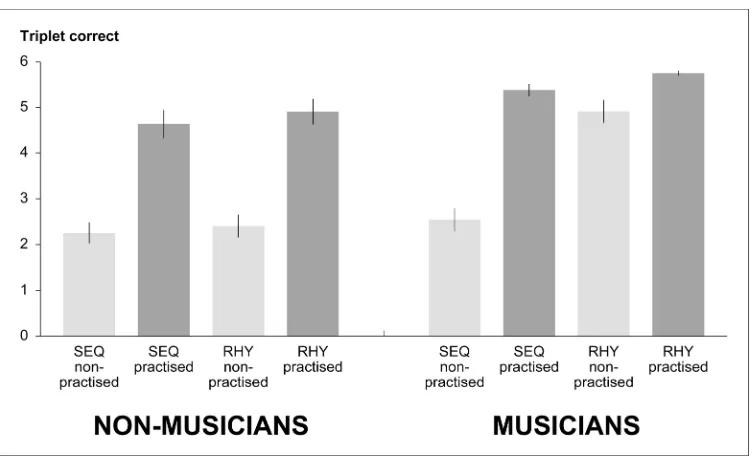
Figure 2 shows the imitation performance separately for sequences and rhythms, non-323
practised and practised patterns, and the two groups. In the non-musicians, the non-practised 324
sequences and rhythms were of similar difficulty, and these participants showed comparable 325
improvements for both pattern types. The musicians showed comparable performance to the 326
non-musicians in the sequences, whilst their imitation performance for the rhythms was 327
substantially better. These trends were confirmed via a three-factorial ANOVA, where the 328
main effects of task (SEQ versus RHY), practice, and group were highly significant, Fs (1, 26) 329
> 22.6, ps < .001. The interactions between task and practice, task and group, and the three-330
For Peer Review
way interaction were also highly significant, Fs (1, 26) > 18.4, ps < 0.001. Planned 331
comparisons (Rosenthal and Rosnow 1985), run separately for the sequences and rhythms, 332
indicated that the effect of practice was highly significant for each task, Fs (1, 26) > 75.8, ps < 333
0.001. For the sequences, the effects of group and the interaction between practice and group 334
were not significant, whilst for the rhythms both effects were highly significant, Fs (1, 26) > 335
18.7, ps < .001. In addition, for the musicians the effect of task and the interaction between 336
task and practice were highly significant, Fs (1, 14) > 57.9, ps < .001, whilst for the non-337
musicians both effects were, reassuringly, non-significant. This pattern of results confirms that 338
the musicians were selectively advantaged for rhythm imitation. In summary, the behavioural 339
data met all prerequisites for the interpretation of the functional imaging data. 340
We also analysed the behavioural data separately for each triplet (n = 6) and scanning 341
session (n = 4). As shown in Supplementary Figure 1, in the non-practised trials the first two 342
triplets (i.e., the first four responses) were imitated with higher accuracy than the subsequent 343
responses, indicating a primacy effect. For the practised trials, performance was clearly 344
improved and level across the eight required positions and intervals. Importantly, these results 345
were stable across the four sessions, as indicated by the absence of main effects of session (Fs 346
< 1.3, ps > .30) in the related four-factorial ANOVAs (for details, see legend of 347
Supplementary Figure 1). 348
349
< please enter Figure 2 about here > 350
351
FMRI results (1): Task networks for sequence and rhythm imitation
352
For the present purposes, we pragmatically define a task network as those brain regions which 353
are jointly activated during action observation (AO) and motor execution (EXE) events. 354
For Peer Review
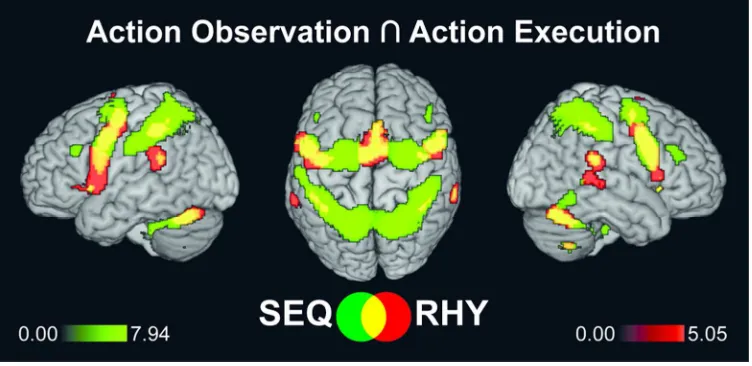
Figure 3 and Table 1 show the related conjunction analyses separately for the SEQ and RHY 355
tasks, each collapsed across practised and non-practised performances, and irrespective of 356
musical expertise. 357
Observation and execution of the sequences jointly involved two extensive bilateral 358
parieto-frontal activation clusters; the first comprising the superior and inferior parietal lobules 359
(SPL and IPL, respectively), and the second comprising Area 6 with dorsal and ventral sectors 360
of the precentral gyrus and the Supplementary Motor Area (SMA). In addition, we found two 361
large subcortical activation clusters in the cerebellum and the thalamus, as well as activation 362
foci in the pars triangularis of inferior frontal gyrus (IFG) bilaterally, where the right cluster 363
extended to the middle frontal gyrus. There were also activations in the temporoparietal 364
junction (TPJ) bilaterally and in the right middle and inferior temporal gyrus. 365
In comparison to the sequences, observation and execution of the rhythms jointly 366
activated relatively small sectors of posterior parietal cortex (PPC), namely the IPL bilaterally. 367
Rhythm-related activations were mainly found in bilateral ventral precentral gyrus (Area 6), in 368
pars opercularis of IFG, in the SMA with a large cluster, and in the superior temporal gyrus / 369
TPJ bilaterally. In addition, extensive subcortical activations involved the cerebellum and the 370
basal ganglia bilaterally. 371
In summary, both sequence and rhythm tasks activated the classic mirror regions 372
comprising inferior parietal and ventral premotor cortex extending to IFG, as well as the SMA 373
and subcortical regions. Compared to the rhythm task, the sequence task activated 374
considerably larger sectors of the PPC, and it also showed stronger activations in dorsal and 375
ventral premotor cortex, as confirmed by a series of direct contrasts run separately for the AO 376
and EXE events (see Supplementary Figure 2). In contrast, the rhythm task dominantly 377
involved the superior temporal gyrus / TPJ, the SMA, and pars opercularis of IFG. Thus, 378
For Peer Review
although the two task networks were not entirely distinct, we found clear differences regarding 379
the dominant regions activated by each task across the AO and EXE events. 380
381
< please enter Figure 3 about here > 382
< please enter Table 1 about here > 383
384
FMRI results (2): Main effects of practice
385
Next, we analysed the main effects of practice, irrespective of musical expertise, by directly 386
contrasting both non-practised > practised (np>pr), and practised > non-practised (pr>np) 387
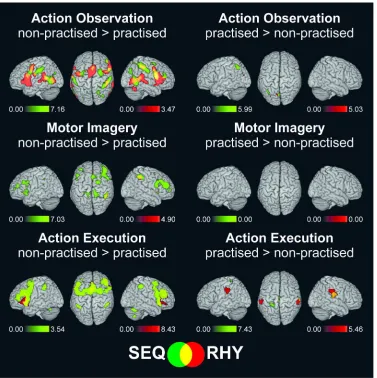
sequences and rhythms separately for the AO, MI, and EXE events (see Figure 4 and 388
Supplementary Table 1). As expected, activations in most regions were stronger for the non-389
practised compared to the practised patterns, indicating neural efficiency effects. 390
During action observation, these practice effects for sequences and rhythms overlapped 391
in the core fronto-parietal mirror regions. In addition, SPL and dorsal premotor cortex were 392
dominantly activated during sequence observation, whilst superior temporal gyrus / TPJ, SMA, 393
and IFG were dominantly activated during rhythm observation (for further details see legend 394
of Figure 4). These practice effects corresponded closely to the two respective task networks 395
as identified in the previous section. 396
During motor imagery, the practice effects for the sequences were more pronounced 397
than those for the rhythms. These effects were found in bilateral IPL and in different frontal 398
regions including the SMA, IFG, insula, anterior and middle cingulate cortex, as well as the 399
middle frontal gyrus (MFG) bilaterally. 400
During motor execution, the practice effects for sequences and rhythms largely 401
overlapped and included the SMA, precentral gyrus, IFG, as well as MFG, anterior and middle 402
For Peer Review
cingulate cortex, and the insula. In summary, during both MI and execution, the reduced 403
activations with practice were largely restricted to the frontal lobe and were more extensive for 404
the sequences than for the rhythms. 405
Activation increases with practice. In addition to the dominant trend for neural 406
efficiency effects reported above, we only found a small number of regions where activations 407
increased with practice (see legend and right panels of Figure 4, and Supplementary Table 1, 408
Sub-tables 7 to 12). 409
410
< please enter Figure 4 about here > 411
412
FMRI results (3): Cognitive control structures
413
We address the third and main research objective in two parts, first irrespective of musical 414
expertise (this section), and subsequently with a focus on expertise-related effects in section 415
‘FMRI results (4)’. Since cognitive control should be primarily required for the imitation of 416
novel patterns and decrease with practice (Dayan and Cohen 2011), we base these analyses on 417
contrasts of non-practised > practised patterns (‘np>pr’, e.g., Vogt et al. 2007, Higuchi et al. 418
2012). For the DLPFC, the related comparisons in the previous section did not show 419
differential activations during action observation, whilst such effects were indeed present 420
during both MI and EXE events. To recapitulate, during motor imagery bilateral MFG was 421
activated more strongly for non-practised sequences, compared to the practised sequences, 422
whilst for the rhythms, activation differences in MFG were absent. During execution, 423
activation differences were present in MFG for both tasks. For sequence execution, these were 424
found in MFG bilaterally; whilst during rhythm execution these were restricted to the right 425
MFG (Figure 4 and Supplementary Table 1). 426
For Peer Review
We extended the search for cognitive control structures by analysing regions that were 427
jointly activated by the SEQ and RHY tasks. This contrast should indicate overlapping 428
superordinate control mechanisms, e.g., for scheduling the relevant cognitive operations in the 429
different events of each trial. In addition, this contrast should also reflect the overlapping 430
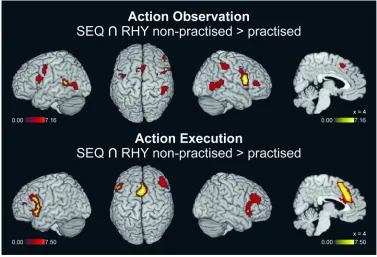
regions of the two task networks. Figure 5 and Table 2 show the results of the conjunctions of 431
the np>pr contrasts for each task separately for observation and execution. 432
During action observation, activation differences across both tasks were found in 433
bilateral BA44 and adjacent PMv, the SMA, right BA45, bilateral middle temporal gyrus, and 434
right IPL. These activations primarily indicate regions that were overlapping between the two 435
task networks, as shown in Figure 3. During motor imagery (not shown in Figure 5), the 436
corresponding conjunction yielded a single differential activation in the right IPL, which was 437
coextensive with that for OBS. This reflected the sparse practice effects during MI of the 438
rhythms. 439
In contrast, the conjunction across tasks for execution (Figure 5, bottom panel) indicated 440
strong differential activations (np>pr) in a large cluster centred on the anterior midcingulate 441
cortex (aMCC; Vogt 2009) and extending to the SMA, as well as in bilateral insula, IFG, and 442
MFG. These results highlight the robust differential involvement of the aMCC and SMA and 443
their likely role in performance monitoring across the two tasks. Henceforth, we refer to this 444
activation cluster comprising the aMCC up to the SMA with the descriptive term ‘posterior 445
medial frontal cortex’ (pMFC; see Discussion). By comparison, the activation differences in 446
MFG were less prominent and only became apparent at the lower of the two statistical 447
thresholds used for this contrast. 448
449
< please enter Figure 5 about here > 450
For Peer Review
< please enter Table 2 about here > 451
452
FMRI results (4): Musical expertise
453
The behavioural data indicated that musical expertise primarily facilitated the encoding and 454
imitation of the rhythms, whilst both groups showed similar results for the spatial sequences. 455
Accordingly, we were particularly interested if the practice effects in prefrontal regions would 456
also be modulated by musical expertise. For each event, we thus summarise the whole-brain 457
results only briefly and consider the cognitive control hubs in greater detail. Practice effects 458
were analysed separately by task and group, as well as via the interactions between group and 459
practice. A more detailed account of the whole-brain results can be found in Supplementary 460
Materials 1. 461
462
< please enter Figure 6 about here > 463
464
Action observation. During SEQ observation, the musicians showed relatively weak 465
practice effects in the parieto-frontal task network, whilst they exhibited stronger and more 466
extensive practice effects than the non-musicians for RHY observation in the related temporo-467
frontal task network, see Figure 6 and Supplementary Table 2. Regarding the cognitive control 468
hubs, none of the four interaction contrasts between group and practice indicated group-469
specific effects for either the MFG or pMFC. 470
Motor imagery. During MI of the SEQ patterns, the overall activation differences for the 471
musicians closely resembled those shown in Figure 4 for the combined groups, whilst the 472
practice effects in the non-musicians were less extensive. More important in the present 473
context, practice effects for the MFG and pMFC were present in each group individually, and 474
For Peer Review
the related interactions did not indicate differences between groups in these regions, or in the 475
task networks (see Supplementary Table 3). During MI of the RHY patterns, practice effects in 476
the musicians were restricted to the right IPL as well as bilateral cerebellum, and in the non-477
musicians practice effects were practically absent. It is thus not surprising that differential 478
activations in MFG and pMFC were also absent during rhythm imagery in both groups. 479
Execution. As expected, both groups showed similar practice effects on the whole-brain 480
level during SEQ execution. Furthermore, both pMFC and bilateral MFG were differentially 481
activated in each group individually (see white circles in Figure 6 and Supplementary Table 4). 482
In contrast, during RHY execution the musicians exhibited weaker and less extensive practice 483
effects than the musicians. Here, the MFG was only differentially activated in the non-484
musicians. This pattern of results is mirrored in the parameter estimates for MFG 485
(Supplementary Figure 3, bottom panels), and it essentially reflects the rhythm-specific 486
expertise of the musicians. 487
However, expertise-related differences during motor execution were not found for the 488
pMFC, which was absent in the related interaction contrasts (Supplementary Table 4). Also 489
the parameter estimates for the pMFC indicate equivalent practice effects for SEQ and RHY in 490
both groups (Supplementary Figure 3, panels for anterior cingulate cortex and SMA). Thus, 491
whilst the pMFC exhibited more robust practice effects in the cross-task conjunction than the 492
MFG (Figure 5), only the MFG reflected the task-specific expertise effects observed in the 493
behavioural data. 494
495
Discussion
496 497
For Peer Review
This study makes three main contributions: one to the literature on mirror mechanisms, and 498
the other two regarding the cognitive control structures involved in imitation learning. First, 499
the two sequencing tasks engaged task networks which partially overlapped but which also 500
substantially dissociated. Given that both tasks were carefully matched for difficulty and 501
visual appearance, our data provide striking support for the concept of task-specific mirror
502
mechanisms (Subiaul 2010; Rizzolatti et al. 2014). Second, we found that the DLPFC was 503
involved during motor imagery of the sequences, but not for the rhythms, thus providing fresh
504
support for Buccino et al.’s (2004) model of imitation learning. The DLPFC was also involved 505
during execution of both tasks, indicating a wider, less task-specific role during motor 506
execution. Third, the posterior medial frontal cortex (pMFC), known for its role in 507
performance monitoring, was also involved during imitative execution of the SEQ and RHY 508
tasks, where activations were more pronounced than those in DLPFC. This dominant 509
involvement of the pMFC in the present study, compared to the dominant role of the DLPFC 510
in the imitation learning of hand postures (e.g., Buccino et al. 2004), indicates that the
511
dominant cognitive control hubs for imitation learning can also vary with the task. In addition 512
to these three main findings, we replicated and extended earlier results regarding neural 513
efficiency effects in action observation and execution, and regarding the effects of musical 514
expertise on imitation performance. 515
516
Behavioural data: Effects of practice and musical expertise
517
The behavioural data of imitation performance in the scanner (Figure 2) provide a crucial 518
background for the interpretation of the functional data. Results confirmed that (1) SEQ and 519
RHY patterns were equally difficult for the non-musicians, (2) the practice effects were 520
comparable across the two tasks, (3) the musicians were only marginally more accurate than 521
For Peer Review
the non-musicians in sequence imitation, and (4) the musicians were substantially more 522
accurate than the non-musicians in the imitation of novel and practised rhythms, confirming 523
the domain-specificity of expertise (Chase and Simon 1973; see also Matthews et al. 2016). 524
Further analysis of the behavioural data confirmed that no substantial learning occurred 525
within the scanning session. This likely resulted from the randomised order of patterns across 526
trials during scanning, and from the use of a sufficiently large pool of non-practised patterns. 527
Finally, we found that participants’ imitation accuracy was initially not uniform across the 528
eight positions or intervals. Instead, for the non-practised patterns, the first four responses 529
were performed with greater accuracy than the subsequent ones, whereas accuracy was 530
consistently high across all responses for the practised patterns. Most likely, participants had 531
learned to group the observed elements of a given sequence, as well as their responses, into 532
larger units or ‘chunks’ (Gobet et al. 2001; Keele et al. 2003; Hard et al. 2011). 533
534
Dissociable task networks for sequence and rhythm imitation
535
We begin the discussion of the imaging data with the two task networks (research objective 1), 536
defined here as the activated areas during both observation and execution. In the two 537
subsequent sections, we consider the effects of practice (research objective 2a) and expertise 538
(research objective 2b) within the task networks. On this basis, we then proceed to discuss the 539
effects of practice and expertise on the cognitive control structures (research objectives 3a and
540
3b), separately for the DLPFC and the pMFC. 541
Spatial sequence imitation. The task network for SEQ imitation essentially comprised 542
the SMA, PMv and dorsal premotor cortex (PMd), large sectors of the PPC, smaller sectors in 543
temporal cortex and in the pars triangularis of IFG, and the cerebellum (Figure 3). In particular, 544
PMv and IPL form the classic fronto-parietal mirror circuit (Rizzolatti et al. 2014), and PMd 545
For Peer Review
and SPL have been reported as a separate, reaching-related mirror circuit (DiDio et al. 2013; 546
Filimon et al. 2015). In addition, the SMA is one of the regions for which mirror properties 547
have been shown via single-cell recordings in the human brain (Mukamel et al. 2010), and its 548
role in sequence learning is well-documented (Dayan and Cohen 2011). Our results are 549
therefore consistent with the existing work on action observation and on the imitation learning 550
of hand postures (Buccino et al. 2004; Vogt et al. 2007). 551
Rhythm imitation. The SEQ and RHY task networks overlapped in the PMv, IPL, SMA 552
and cerebellum (Figure 3). Differences between tasks were observed in the pars opercularis of 553
IFG (as part of Broca’s region), the TPJ, the SMA, and the left insula, where rhythm imitation 554
evoked stronger activations than the SEQ task (Supplementary Figure 2 and Table 1). In 555
contrast, the SEQ task engaged the premotor regions more strongly, as well as considerably 556
larger sectors of the PPC. In summary, whilst the SEQ task showed remarkable overlap with 557
the posture imitation task of Buccino et al. (2004), and whilst all three tasks (SEQ, RHY, and 558
posture imitation) exhibited overlap with respect to the fronto-parietal mirror circuit, the RHY 559
task further recruited a different network essentially comprising Broca’s region and the TPJ. 560
A tentative explanation for this partial dissociation between the SEQ and RHY tasks is 561
that participants employed different components of working memory (Baddeley 2010). 562
Encoding a sequence of locations is a classic task associated with visuo-spatial working 563
memory. In contrast, rhythmical patterns are typically encoded in a separate, auditory working 564
memory system for phonological, rhythmical-temporal, and pitch information (Schulze and 565
Koelsch 2012). For example, Hickok et al. (2003) found two main regions activated for 566
listening and covert rehearsal of both speech and rhythmical melodies, namely a region in the 567
left posterior Sylvian fissure at the TPJ, as well as Broca’s region. Both regions are 568
coextensive with the present, RHY-specific task network. Interestingly, we found this overlap 569
For Peer Review
between Hickok et al.’s and our results even though we had presented, for reasons of 570
comparability between tasks, the RHY task in the visual modality. A plausible explanation is 571
that our participants recoded the visual rhythms into subvocal articulatory gestures (for 572
example, ‘da, da, daaa, da-da-da-da, da-da’ for M, M, L, S, S, S, M, S), which made the 573
rhythms accessible to the auditory working memory system. Indeed, the majority of 574
participants in either group reported that they memorised the rhythms using such covert 575
articulations. Since Broca’s region and TPJ were already involved during action observation, it 576
is likely that participants recoded the visual gestures into subvocal articulatory gestures on-line, 577
that is, whilst observing the visual rhythms. 578
To summarise, we suggest that the task network for rhythm imitation consists of two 579
sensory-motor circuits, (1) the initial visuo-motor encoding of the observed finger movements 580
in the fronto-parietal mirror circuit, from which (2) the movements are recoded on-line as 581
subvocal articulatory gestures in an auditory working memory circuit comprising Broca’s 582
region and the TPJ (Hickok et al. 2003, see also Lahav et al. 2007). In line with Haslinger et al. 583
(2005), who reported the recruitment of auditory areas during pianists’ observation of silent 584
piano playing, our findings can be interpreted as transmodal sensorimotor encoding (for a 585
general framework for simultaneous processes of AO and MI, see Vogt et al. 2013). As in 586
Haslinger et al.’s study, our musicians showed stronger practice effects in the Broca-TPJ 587
circuit than the non-musicians. The fact that our non-musicians also engaged in this recoding 588
is most likely due to the relatively simple visual rhythms in the present study for which 589
musical expertise is not essential. 590
Whilst delineating the precise mechanisms of transmodal sensorimotor encoding of 591
visually presented rhythms is beyond the scope of the present study, the partial dissociation of 592
the SEQ and RHY task networks is in itself an interesting and important finding: It supports 593
For Peer Review
the concept of task-specific mirror mechanisms (Subiaul 2010; Rizzolatti et al. 2014, p. 671) 594
in a single experiment using visually well-matched action stimuli. For example, Abdollahi et 595
al. (2013) recently reported action-specific processing in PPC for observation of climbing and 596
object manipulation. 597
598
Activation changes with practice in the task networks
599
The main purpose of contrasting non-practised and practised patterns, as well as the purpose 600
of contrasting non-musicians and musicians, was to assess the differential involvement of 601
cognitive control structures (see dedicated discussion sections below). For this reason, we 602
keep the discussion of practice and expertise effects on the task networks brief (a more 603
detailed account can be found in Supplementary Materials 2, where we also link these findings 604
to the literature on sequence learning). 605
First, across groups and AO, MI, and EXE events, most regions of the SEQ and RHY 606
task networks exhibited neural efficiency effects, that is, stronger activations for the non-607
practised patterns than for the practised patterns (Figure 4). In contrast, increases with practice 608
were sparse, and the ratio of activated voxels showing neural efficiency effects, relative to 609
those exhibiting increases with practice, exceeded 4:1 in all comparisons displayed in Figure 4 610
and Supplementary Table 1. A similar prevalence of practice-related activation decreases was 611
reported by Vogt et al. (2007) and Higuchi et al. (2012), where the literature on practice 612
effects during action observation is discussed in greater detail. Second, the neural efficiency 613
effects for each task essentially mirrored the two task networks as identified in the previous 614
section (compare Fig. 3 and 4 and related Tables). This provides convergent evidence for the 615
partial dissociation of the SEQ and RHY task networks. Third, during both MI and EXE 616
events, the neural efficiency effects were predominantly found in the frontal lobe. Again they 617
For Peer Review
resembled the related sectors of the two task networks, and they were more extensive for the 618
sequences than for the rhythms. Overall, these practice effects are consistent with the available 619
literature on ‘fast’ sequence learning (for details, see Supplementary Materials 2). Importantly, 620
also the MFG and pMFC showed significantly reduced activations with practice during MI 621
and EXE events (see discussion of cognitive control structures). Fourth, the practice effects 622
for MI clearly dissociated from those during AO and were a fair subset of those during 623
execution (Figure 4). This activation overlap between MI and EXE is in line with the widely 624
accepted view of motor imagery as a form of motor simulation that engages neural structures 625
used in execution (Jeannerod 2001; Vogt et al. 2013). In the interest of brevity, we reserve an 626
in-depth comparison of the activation differences between AO, MI, and EXE for a separate 627
report. 628
629
Expertise-related practice effects in the task networks
630
Action observation. As shown in Figure 6, the results for the non-musicians largely resembled 631
the results across groups (Figure 4) for both tasks. One difference was that during rhythm 632
observation the practice effects for the Broca-TPJ circuit were less extensive, although clearly 633
present. In contrast, the musicians exhibited more extensive neural efficiency effects during 634
rhythm observation, whilst they exhibited considerably less extensive effects than the non-635
musicians during sequence observation. The stronger activations for rhythm observation in the 636
musicians, both in direct comparison to the non-musicians for novel rhythms and when 637
comparing the neural efficiency effects between groups, replicate expertise effects as 638
demonstrated in earlier studies (e.g., Haslinger et al. 2005; Calvo-Merino et al. 2005, 2006). In 639
addition, the present study highlights a clear functional role of the musicians’ enhanced 640
activations during rhythm observation, namely to enable their exquisite imitation performance 641
For Peer Review
in subsequent execution. As such, the present results demonstrate experts’ enhanced capacity
642
to encode novel observed actions for subsequent imitation in their domain of expertise.
643
Motor imagery. In the task networks, the musicians tended to show more extensive 644
activation differences during MI than the non-musicians. Apart from this trend, the group 645
differences during MI were negligible. 646
Execution. Again, both participant groups showed similar results for spatial sequence 647
execution. In contrast, for the rhythms the musicians showed less extensive neural efficiency 648
effects than the non-musicians (Supplementary Table 4 and Figure 6, bottom panels) in the 649
cerebellum, sensorimotor cortex, right superior and middle frontal gyrus, angular gyrus, and 650
insula. 651
In summary, compared to the non-musicians, the musicians exhibited particularly strong 652
activations during observation of the novel rhythms, associated with more extensive practice 653
effects in the related task network. This set of findings is in line with earlier research on 654
expertise effects in action observation (e.g., Haslinger et al. 2005; Calvo-Merino et al. 2005, 655
2006), In addition, it highlights experts’ enhanced capacity for visuo-motor encoding during 656
action observation in the context of imitation. During subsequent execution, the musicians 657
showed relatively small differences between non-practised and practised rhythms, which we 658
would interpret as a ‘pay-off’ related to the enhanced processing during rhythm observation. 659
We shall revisit this rhythm-specific asymmetry between groups in the context of cognitive 660
control structures, to which we turn next. 661
662
Dorsolateral prefrontal cortex in motor imagery and execution
663
The main motivation for the present study was to explore the involvement of the DLPFC and 664
other cognitive control structures in the imitation learning of spatial sequences and rhythms 665
For Peer Review
(research objective 3). Since cognitive control is primarily required in the early stages of 666
learning and reduces with practice (Kelly and Garavan 2005; Dayan and Cohen 2011), we 667
assessed this via the within-session activation differences between non-practised and practised 668
patterns (see also Vogt et al. 2007; Higuchi et al. 2012). The analyses of practice effects across 669
groups, both conjunct and run separately for each task, consistently revealed no differential 670
activations during action observation. During motor imagery, practice effects were found for 671
the SEQ task but not for the RHY task, and during execution, practice effects were present in 672
DLPFC bilaterally for the SEQ task and in right DLPFC for rhythm execution. When the 673
practice effects were examined separately for each group, during action observation DLPFC 674
was found differentially activated only in a small cluster when the musicians observed the 675
rhythms. During motor imagery, again each group showed differential practice effects for the 676
sequences only. During execution, activations in DLPFC reduced bilaterally with practice in 677
each group for the sequences, whilst during rhythm execution only the non-musicians showed 678
this effect reliably, where it was largely right-lateralised (see also parameter estimates in 679
Supplementary Figure 3, bottom panels). These results inform Buccino et al.’s (2004) model 680
of imitation learning in the following ways: 681
First, the paucity of DLPFC activations during action observation is not entirely 682
surprising: in the present SEQ and RHY tasks, action observation primarily required the 683
sustained encoding of the sequence of stimuli throughout the observation interval, which 684
provided little opportunity for cognitive control. In contrast, in the posture imitation studies by 685
Buccino et al. (2004) and Vogt et al. (2007), participants watched the same hand posture over 686
a period of 4 to 10 s, which allowed them to apply various cognitive-exploratory strategies 687
already during action observation, as well as during the subsequent motor preparatory period. 688
For Peer Review
This was reflected in the differential practice effects in DLPFC previously found for these two 689
events (Vogt et al. 2007). 690
Second, DLPFC was differentially activated during motor imagery of the sequences, but 691
not for the rhythms. This second main finding of the present study provides an important 692
extension of Buccino et al.’s (2004) two-level model of imitation learning, namely to spatial 693
sequences. A number of qualifications are appropriate here. In a given trial, our participants 694
either engaged in MI or in imitative execution, but not in both in direct succession (see Figure 695
1). We had chosen this design in order to eliminate possible contaminations of the BOLD 696
signal between the two events. In contrast, Buccino et al. (2004) and Vogt et al. (2007) 697
inserted a motor preparatory event between observation and execution. Whilst it is likely that 698
participants engaged in MI in both situations, this cannot be known for certain for the two 699
earlier studies. In addition, further behavioural research will be required to establish to what 700
extent such a preparatory / MI period actually facilitates imitation learning behaviourally. In 701
the present study, participants were certainly capable of imitating immediately after action 702
observation (see also Vogt 1996; Higuchi et al. 2012), however, the absence of between-703
session effects for the non-practised patterns in the behavioural data might indicate that such a 704
“see – do” scenario is not particularly suitable for supporting learning. For the time being, we 705
would thus maintain that a preparatory / MI interval facilitates imitation learning, by allowing 706
for the mental rehearsal and cognitive control of the to-be executed action. The present study 707
then suggests the involvement of DLPFC as a likely neural mechanism. Its primary role is 708
most likely not the maintenance of visuo-spatial information but rather the selection and 709
preparation of such information for motor execution (Pochon et al. 2001; Passingham and 710
Sakai 2004; Sakai 2008), as well as potentially the monitoring of MI (see below). 711
For Peer Review
Third, DLPFC was not activated during MI of the rhythms. Interestingly, in their elegant 712
TMS study, Robertson et al. (2001) found that the critical role of the DLPFC in their sequence 713
learning task was also restricted to spatially cued sequences. Taken together, these findings 714
indicate a possible qualification of Buccino et al.’s (2004) model of imitation learning, which 715
was solely based on the imitation of hand postures: According to the available evidence, the 716
supervisory role of DLPFC during motor preparation (Buccino et al. 2004; Vogt et al. 2007) 717
and motor imagery (this study) is likely restricted to visuo-spatial patterns. Indeed, whilst in 718
principle, a sequence of locations can be cognitively manipulated (e.g., interrupted, corrected 719
and ‘restarted’), such operations are more difficult to apply to rhythmical patterns, as they are 720
defined by their temporal structure. This might also explain the relatively small overall 721
practice effects during MI of the rhythms. The dissociation between spatial and rhythmical 722
patterns, as reported here regarding prefrontal involvement, also informs future meta-analytic 723
work. For example, in the meta-analysis of MI by Hétu et al. (2013), MFG was found to be 724
involved during MI of motor sequences, but no distinction between spatial and rhythmical 725
sequences was made. 726
Fourth, the involvement of DLPFC during execution of the present SEQ and RHY tasks 727
presumably reflects sustained monitoring and cognitive control throughout imitative execution. 728
Shallice (2004) proposed that the right DLPFC is primarily involved in monitoring whether a 729
newly configured motor plan is executed in accordance with the task goals. The right-730
hemispheric dominance of the present DLPFC activations suggests that DLPFC was indeed 731
primarily engaged in monitoring motor execution (see also Vogt et al. 2007). 732
Finally, the execution-related practice effects in DLPFC were similarly pronounced in 733
both groups for the SEQ task, but for the RHY task, they were reduced in the musicians, 734
compared to the non-musicians (Figure 6). These results mirror the behavioural findings, 735