Throughput Analysis of Full-Duplex Communication
Cognitive Radio Network
Mir Muhammad Lodro1•Steeve Greedy2•Naeem A. Mahoto3• Mukhtiar A. Unar3
ÓThe Author(s) 2017. This article is an open access publication
Abstract In this paper we deal with the throughput of full-duplex cognitive communi-cation radio which exploits unused band of primary user (PU) network. Classical cognitive radio uses half-duplex communication spectrum sensing to perform spectrum sensing and data transmission at different time intervals. It’s well-established fact that in half-duplex communication cognitive radio spectrum sensing time increases at low SNR which gives rise to lesser data transmission time for secondary user (SU) and hence results in less throughput for SU. It’s useful idea to do spectrum sensing and data transmission at the same time with two different antennas co-located on the SU transceiver. This shall not only guarantee high probability of detection of PU but also increased data transmission which means more throughput for SU. However, simultaneous sensing and data transmission has inherent problem of self-interference. One of the possible solution is to use polarisation discrimination in which sensing and data transmission antennas must use different polar-isation. This is feasible if there is prior information about the polarisation of the signals emitted by the PUs. It shall be of special interest to assess throughput using analytical expressions for probability of detectionPD, probability of false alarmPFAat various values of SNR for time-slotted cognitive radio which uses half-duplex spectrum sensing and non-time-slotted cognitive radio which uses full-duplex communication cognitive radio.
Keywords Full-duplex cognitive radioSpectrum sensingSensing-throughput TV white space
& Mir Muhammad Lodro
[email protected]; [email protected]
1
The Department of Electrical Engineering, Sukkur Institute of Business Administration, Sukkur 65200, Sindh, Pakistan
2 The University of Nottingham, Nottingham, UK
3
1 Introduction
Recently because of the influx of smartphone and due to digital dividend there has been increased trend for application that demand high data rates. Due to digital dividend and shift in user pattern a lot of under-utilised spectrum is observed typically in VHF and UHF band of electromagnetic spectrum and such sparsely used bands are also known as TV white spaces (TVWS). Cognitive radio (CR) has been considered as a powerful technique to increase the spectral efficiency by enabling unlicensed secondary users to access underutilized spectrum opportunistically. Federal Communication Commission (FCC) in USA and Office Communication (Ofcom) in UK have legalised the usage of TVWS in VHF and UHF part of the spectrum. In USA non-contiguous TVWS are located in fre-quency range of 54–698 MHz and portion of frefre-quency ranging from 470 MHz to 790 MHz exists in Europe. There are some new standards which involve cognitive radio principle few to mention are wireless metropolitan area network (WMAN) IEEE 802.22 for broadband applications in remote areas, wireless local area network (WLAN) standard known as IEEE 802.11af which uses master and slave architecture and notion of white space database, IEEE 802.15.4m an low data rate short range wireless personal area network (WPAN) system with cognitive radio and a host of other network types shall experience cognitive radio based transformation. Performance of cognitive radio is assessed by the type of detector it uses and the number of sub-bands it can harness and relinquish if the incumbent user reactivates and reclaims its licensed band. A number of detectors has been considered for the implementation in CR transceivers for example energy detector [1,2], matched filter detector [3,4], Eigen-value based detector [5, 6], detectors involving cyclostationarity [7] and wavelet-based detection [8] etc.
2 Background Study
The problem of reactivation failure is associated with the non-time-slotted cognitive radio networks (NTS-CRN) where the PU and SU traffic is not synchronised i.e. PU randomly leaves and reclaims its licensed channel. In time-slotted CRN PU and SU traffic is syn-chronised i.e. SU transmits after its senses that there is no incumbent user present on that band. In non-time-slotted CRN PU may sense the busy channel since it can’t distinguish between PUs traffic and SU traffic and thus goes into back off stage and retransmits with persistent carrier sense multiple access (p-CSMA) which might result in collision and ultimately affect the PU throughput if the SU doesn’t sense the PU reactivation and leave licensed PU sub-channel. For time-slotted CRN we use half-duplex spectrum sensing scheme and medium access control (MAC) protocol. Similarly, for non-time-slotted CRN a novel full-duplex spectrum sensing scheme and a novel cognitive medium access control (CMAC) protocol can be used.
Nakagami fading channels and suggests beacon placement at transmitter and receiver. Novel and computationally efficient detection algorithm for OFDM based PUs is discussed in [13] where the performance of various detectors in AWGN and Rayleigh fading channels is also assessed. Multi-antenna sensing and Generalized Likelihood Ratio (GLR) detector is investigated when channel gain, noise variance and PU signal values are unknown [14]. Ghassemi et al. [15] proposes peak-to-average-power ratio (PAPR) reduction in non-contiguous OFDM (NC-OFDM) using selected mapping (SLM) sequence which results in out-of-band (OOB) reduction and improved PAPR and bit error rate (BER) for NC-OFDM signals, whereas PAPR reduction in OFDM based CR using clockwise subcarrier activation is presented in [16] and a novel signal cancellation method is pro-posed in [17] for joint PAPR reduction and sidelobe suppression in NC-OFDM based CR network. Work in [18] deals with cooperative spectrum sensing with energy-detector over multipath fading and shadowing with different fusion strategies and using single and multiple cognitive relays. Work in [19] calculates energy efficiency versus optimal sensing time for CR network. Reference [20] presents the cooperative wideband spectrum sensing over fading channels and models the aliasing effects of sub-Nyquist sampling. Yunfei Chen [21] gave an energy detector with enhanced performance for random signals in Gaussian noise. Energy efficient cognitive radio for joint spectrum sensing and data transmission which uses co-located layer of relays with amplify-and-forward strategy to relay data from source to destination has been proposed in [22].
The remainder of the paper is structured as follows: Sect.3 explains Full-duplex communication for non-time-slotted cognitive radio and the control model for NTS-CR and TS-CR. It also presents the Full-duplex spectrum sensing algorithm for FDC-CR with which it declares the absence and presence of PU. Section1defines the system model for NTS-CR and presents the probability of detection and probability of false alarm used for receiver operating characteristic curve (ROC) to see the detector performance and the throughput for secondary user. Following this Sect.5 compares the throughput of half-duplex and full-half-duplex communication cognitive radio. Finally, Sect.6 contains the numerical results on probability of detection, probability of false alarm, probability of missed detection and throughput of the HDC and FDC cognitive radio.
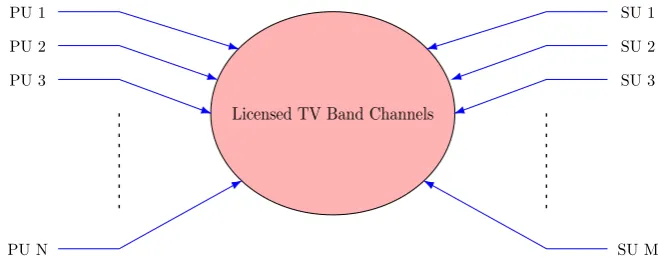
Licensed TV Band Channels
PU 1
PU 2
PU 3
PU N
SU 1
SU 2
SU 3
SU M
-N PUs have high priority to access the licensed TV band
-M PUs maximise their throughput given that PUs are protected
[image:3.439.60.390.426.565.2]3 Full-Duplex Communication Non-time Slotted CR
In NTS-CR using FDC-SS we use two antennas for sensing and transmission simultane-ously in contrast to TS-CR in which one antenna is used for periodic sensing and trans-mission. In TS-CR MAC frame is divided into sensing-time and data transmission time. It is a proven fact that PU protection is guaranteed at increased sensing time which reduces the data transmission time, thereby affecting the throughput of SU. In the following section we discuss problem of reactivation failure for NTS-CR network (NTS-CRN).
3.1 NTS-CRN Control Model
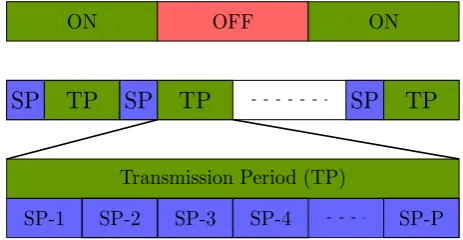
In TS-CRN PU traffic and SU traffic is synchronous i.e. SU scans for the availability of under-utilised channel in its fixed sensing duration and quits after it performs data trans-mission in a fixed transtrans-mission time. Figure2shows control model of the NTS-CRN where we can see the PU traffic and SU traffic is asynchronous because PU and SU don’t quit and reclaim the channel within fixed time interval. In NTS-CRN we divide transmission period of the SU intoPsensing periods for sensing the channel with different antenna.
3.2 Reactivation Failure of NTS-CRN
In NTS-CRN since the PU and SU arrive and quite channel randomly therefore collision may take place if the PU wants to reclaim licensed channel when SU is transmitting. In this scenario PU can’t recognise the traffic of peer PU or SU i.e. whether licensed channel is occupied by peer PU or SU, therefore PU goes in back-off stage and transmits with p-CSMA. If the licensed channel is occupied by SU then collision takes place and PU goes into back-off stage and senses the channel but if the network time is expired PU discards the traffic. PU’s such failure to reclaim its licensed channel is known as reactivation failure. This problem of reactivation failure can be solved with FDC-SS algorithm as shown in Algorithm 1 in which SU senses for the arrival of PU during transmission phase.
ON OFF ON
SP
TP
SP
TP
SP
TP
Transmission Period (TP)
SP-1 SP-2 SP-3 SP-4 SP-P
[image:4.439.103.335.58.178.2]3.3 FDC-SS Scheme
Figure4shows non-slotted multi-channel cognitive radio network model where PUs use their L licensed sub-channels and M SUs opportunistically contend for the PU licensed sub-channels.
4 FDC-SS System Model
We can write the sampled output of CR employing energy-detector as follows:
yðnÞ ¼pffiffiffikhsðnÞ þwðnÞn¼0;1;2;. . .;N1 ð1Þ wherehis channel gain between PU and SU and has Rayleigh distribution.s(n) is sampled PU signal,w(n) is sampled AWGN with zero mean and variancer2
wi.e.N ð0;r2wÞandk is self-interference introduced because of the simultaneous sensing and transmission that takes place in NTS-CR. Wherek¼0 means maximum self-interference is introduced and no self-interference fork¼1. The test statistics using FDC-SS at the output of the energy detector of NTS-CR can be given as in Eq.2.
TNðyÞ ¼ 1 N
Xu
n¼0
jpffiffiffikhsðnÞ þwðnÞ j2þ X
N
n¼uþ1
jwðnÞ j2
!
; if H10
1 N
Xv
n¼0
jwðnÞ j2þ X
N
n¼vþ1
jpffiffiffikhsðnÞ þwðnÞ j2
!
; if H01
8 > > > > > < > > > > > :
ð2Þ
Where hypothesisH10means PU is active for firstusamples and then becomes inactive for
rest of the samplesn¼uþ1 toN. and hypothesisH01means the PU was inactive for the
firstv samples and then became active for rest of the samplesn¼vþ1 toN.Nis total number of samples for entire sensing period. Here we consider PU signals(n) and noise w(n) as circularly symmetric complex Gaussian (CSCG) which represents signals with rich-ISI such as OFDM. For large number of samples N we can invoke central limit theorem (CLT) under hypothesisH10and the PDF of the test statisticsTNy,p10ðxÞcan be
PFAðn;N;u;kÞ ¼Pr
TNðyÞ[nj H10
¼
Z 1
n
p10ðxÞdx
¼Q
n r2
w
u Nkcps1 ffiffiffiffiffiffiffiffiffiffiffiffiffiffiffiffiffiffiffiffiffiffiffiffiffiffiffiffiffiffiffiffiffiffiffiffiffiffiffiffi
u N2
kcpsþ12þNu N2
q
! ð3Þ
PDðn;N;v;kÞ ¼Pr
TNðyÞ[nj H01
¼
Z 1
n
p01ðxÞdx
¼Q
n r2
u
Nv N kcps1 ffiffiffiffiffiffiffiffiffiffiffiffiffiffiffiffiffiffiffiffiffiffiffiffiffiffiffiffiffiffiffiffiffiffiffiffiffiffiffiffi Nv
N2
kcpsþ12þ v N2
q
! ð4Þ
wherenis the threshold of the energy detector employed at the receiver. Now we can set u¼0;v¼0 and k¼1 in above equations and we can obtain PFAðn;N;u;kÞ and PDðn;N;v;kÞfor TS-CR as follows:
PFAðn;N;u;kÞ ¼Q n
r2
w
1 ffiffiffiffipN !
ð5Þ
PDðn;N;v;kÞ ¼
n r2
w
cps1
ffiffiffiffi N p
cpsþ1 !
ð6Þ
From above two equations we can see that thePFAandPDfor TS-CR are special case of NTS-CR. For a given PD, PFA relates to PD and for a given PFA,PD relates to PFA respectively as follows [9]:
PFA¼Q
ffiffiffiffiffiffiffiffiffiffiffiffiffi 2cþ1 p
Q1PD
þ ffiffiffiffiffisfs p
c
!
ð7Þ
PD¼Q 1 ffiffiffiffiffiffiffiffiffiffiffiffiffi 2cþ1 p
Q1PFA
ffiffiffiffiffisfs p
c
!
ð8Þ
Similarly, for givenðPD;PFAÞ, the minimum number of samples are given by:
Nmin¼ 1 2 Q
1ðP
FAÞ Q1ðPDÞ
ffiffiffiffiffiffiffiffiffiffiffiffiffi 2cþ1
p 2
ð9Þ
5 HDC-SS and FDC-SS Sensing-Throughput Comparison
Scenario IWhen PU is not present and no false alarm is generated by SU Scenario IIWhen PU is present but it’s not detected by SU.
In both scenarios the achievable throughputs of the SU link areTs T
log2
1þPs
N0
andTs T
log21þPsPoþN0
respectively. WherePs = received power of SU,Pp = PU power as an interference to SU andN0 is the noise power. The probability of
occur-rence of scenario I and scenario II are 1PFAðn;N;u;kÞ
PðH0Þ and
1PDðn;N;v;kÞ
PðH1Þ. Let us say if:
R0ðn;N;u;kÞ ¼
Ts
T
log2
1þSNRs
1PFAðn;N;u;kÞ
PðH0Þ
ð10Þ
R1ðn;N;v;kÞ ¼
Ts
T
log2
1þSNRs SNRp
1PDðn;N;v;kÞ
PðH1Þ
ð11Þ
Then the average throughput of the SU is:
R¼R0ðn;N;u;kÞ þR1ðn;N;v;kÞ ð12Þ
Now for HDC-SS longer the sensing time s, shorter is the data transmission timeTs
which results in less throughput for SU. Similarly for FDC-SS let us assume that there is no self-interference and SU operates over entire frame durationT. Following the same steps we can derive average throughout for NTS-CR with HDC-SS. Now average throughput of the TS-CR and NTS-CR with HDC-SS and FDC-SS respectively is as follows:
R0ðn;N;u;kÞ þR1ðn;N;v;kÞ\RF0ðn;N;u;kÞ þR
F
1ðn;N;v;kÞ ð13Þ
Ts
T (
log2
1þSNRs
1PFAðn;N;u;kÞ
PðH0Þ
þlog2
1þ SNRs 1þSNRp
1PDðn;N;v;kÞ
PðH1Þ
)
\log2
1þSNRs
1PFAðn;N;u;kÞ
PðH0Þ
þlog2
1þ SNRs 1þSNRp
1PDðn;N;v;kÞ
PðH1Þ
ð14Þ
6 Numerical Results and Discussion
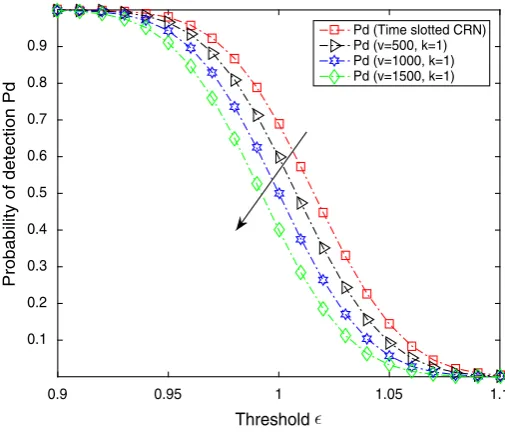
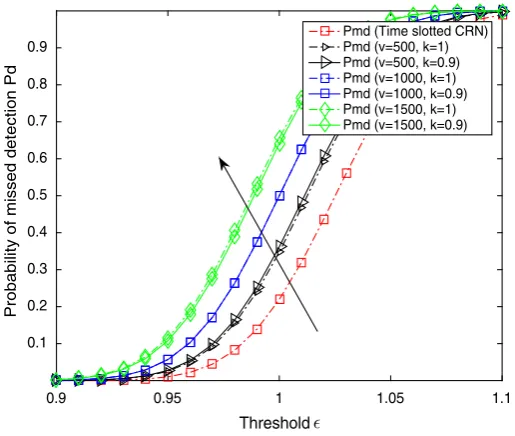
Figure3shows the probability of detection versus energy-detection threshold for the for NTS-CR without self-interference i.e.k¼1. We can see that the probability of detection decreases as the threshold increases. It also decreases with the increase in number of samples for which PU is initially absent i.e fromv¼500 tov¼1500. Figure4shows the probability of missed detection versus threshold for NTS-CR with no self-interference. We can see the probability of missed detection increases with the increase in threshold. It also increases with the increase in number of samples assigned to PU for which initially remains inactive.
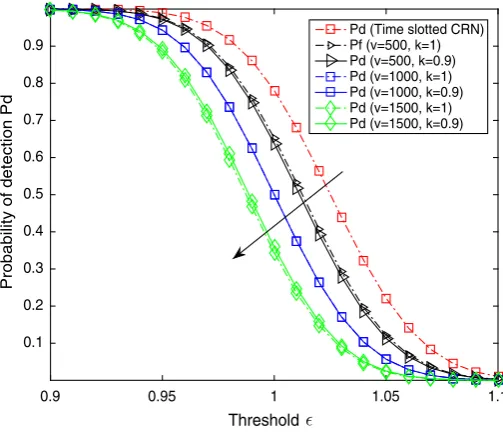
Figure5shows the probability of detection of TS-CR and NTS-CR with HDC-SS and FDC-SS spectrum sensing scheme. Here we consider the effect of self-interference and compare the probability of detection with self-interference and without self-interference. We can see thePDfor TS-CR outperforms all the cases of NTS-CR because the PU exists for some samples. Moreover, thePDdecreases as the energy-detector threshold increases, it also decreases for NTS-CR with the self-interference and without self-interference. However, thePDwithout self-interference is higher than thePDwith self-interference, but the performance gap is very small. Similarly, Fig.6 shows the probability of missed detection which increases with the increase in energy-detection threshold. It also increases with the increase in number of initial sample values for which PU remains inactive. The probability of missed detection also increases with the increase in self-interferencek. There is small performance gap between probability of missed detection with self-interference and without self-interference, but there is significant difference in probability of missed detection for TS-CR and the probability of missed detection when the number of initial samples for which PU is inactive increase tov¼1500. For example at energy-detection threshold ofn¼1 the probability of missed detection is 0.2 which increases toPMDvalue
Threshold
0.9 0.95 1 1.05 1.1
Probability of detection Pd
0.1 0.2 0.3 0.4 0.5 0.6 0.7 0.8 0.9
Pd (Time slotted CRN) Pd (v=500, k=1) Pd (v=1000, k=1) Pd (v=1500, k=1)
[image:8.439.92.345.374.590.2]of 0.55 for PU which remains inactive for initial sample values ofv¼1500. We sum-marise different values of PD, PMD and PFA in the following Table1. Note that we calculate thePFA when he PU is active initially forusamples and then leave the channel for rest of the sample values (Tables1,2).
Threshold
0.9 0.95 1 1.05 1.1
Probability of missed detection Pmd
0.1 0.2 0.3 0.4 0.5 0.6 0.7 0.8 0.9
Pmd (Time slotted CRN) Pmd (v=500, k=1) Pmd (v=1000, k=1) Pmd (v=1500, k=1)
Fig. 4 Probability of missed detection versus threshold of TC-CR with HDC-SS and NTS-CR with FDC-SS without self-interference
Threshold
0.9 0.95 1 1.05 1.1
Probability of detection Pd
0.1 0.2 0.3 0.4 0.5 0.6 0.7 0.8 0.9
Pd (Time slotted CRN) Pf (v=500, k=1) Pd (v=500, k=0.9) Pd (v=1000, k=1) Pd (v=1000, k=0.9) Pd (v=1500, k=1) Pd (v=1500, k=0.9)
[image:9.439.91.347.54.276.2] [image:9.439.93.345.317.533.2]Figures7and8on probability of false alarm follows our intuition developed after our earlier discussions onPDandPMDwith and without self-interference for TS-CR and NTS-CR. We can see the probability of false alarm of TS-CR is less when the PU is initially active foru¼500 tou¼1500 samples and later subsides and leaves the channel empty. This is also true for thePFAvalues with self-interference and without self-interference. For
Threshold
0.9 0.95 1 1.05 1.1
Probability of missed detection Pd
0.1 0.2 0.3 0.4 0.5 0.6 0.7 0.8 0.9
Pmd (Time slotted CRN) Pmd (v=500, k=1) Pmd (v=500, k=0.9) Pmd (v=1000, k=1) Pmd (v=1000, k=0.9) Pmd (v=1500, k=1) Pmd (v=1500, k=0.9)
[image:10.439.91.349.57.275.2]Fig. 6 Probability of missed detection versus threshold of TS-CR with HDC-SS and NTS-CR with FDC-SS with and without interference
Table 1 PD, PMD and PFA values for non-time slotted CRN with interference and without self-interference
Threshold (n) #of samples (v)
Self-interference (k)
PD PMD u PFA
1 500 1 0.68 0.32 500 0.70
1 500 0.9 0.65 0.35 500 0.68
1 1500 1 0.28 0.72 1500 0.92
[image:10.439.48.393.342.421.2]1 1500 0.9 0.25 0.75 1500 0.90
Table 2 Throughput of TS-CR with HDC-SS and NTS-CR with FDC-SS at SNR values of-2 dB
Sensing time (s) (ms)
Throughput (b/s/Hz ):TS-CR with HDC-SS
Throughput (b/s/Hz): NTS-CR with FDC-SS
Percent increase in throughput (%)
6 3.6367 3.8688 5.9
10 3.5899 3.9888 10
12 3.5145 3.9937 11.9
[image:10.439.48.392.456.537.2]fixed sample values let us sayu¼500 thePFA with interference is little higher than the PFA without self-interference i.e. k¼0:9, however the performance gap is very small (Fig. 9). We can expect more degradation in PFA when the self-interference factor is
Threshold
0.9 0.95 1 1.05 1.1
Probability of false alarm P
f
0.1 0.2 0.3 0.4 0.5 0.6 0.7 0.8 0.9
Pf (time-slotted CRN) Pf (u=500, k=1) Pf (u=1000, k=1) Pf (u=1500, k=1)
Fig. 7 Probability of false alarm versus threshold of TS-CR with HDC-SS and NTS-CR with FDC-SS without self-interference
Threshold
0.9 0.95 1 1.05 1.1 1.15
Probability of false alarm P
f
0.1 0.2 0.3 0.4 0.5 0.6 0.7 0.8 0.9
Pf (time-slotted CRN) Pf (u=500, k=1) Pf (u=500, k=0.9) Pf (u=1000, k=1) Pf (u=1000, k=0.9) Pf (u=1500, k=1) Pf (u=1500, k=0.9)
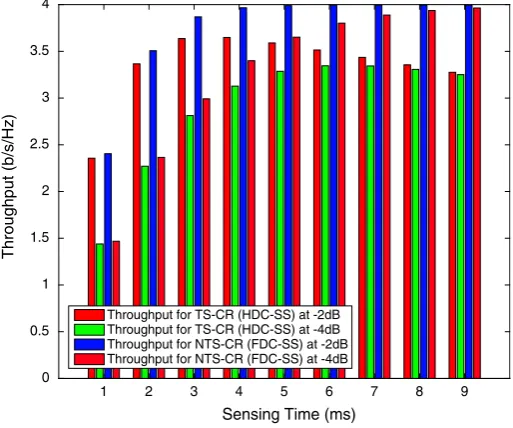
[image:11.439.90.346.54.270.2] [image:11.439.93.344.318.532.2]reduced from k¼0:9 to k¼0:1 where sever interference can be expected. Figure10 shows the statistical attestation of the throughput of NTS-CR which uses FDC-SS is greater than the throughput of TS-CR at different vales of SNRs.
Sensing Time (τ)
2 4 6 8 10 12 14 16 18 20
Throughput (b/s/Hz)
1 1.5 2 2.5 3 3.5
TS-CR with HDC-SS γps=-2dB
TS-CR with HDC-SS γps=-4dB
NTS-CR with FDC-SS γps=-2dB
NTS-CR with FDC-SS γps=-4dB
Fig. 9 Throughput versus sensing time of TS-CR with HDC-SS and NTS-CR with FDC-SS at SNR values of-2 and4 dB respectively
Sensing Time (ms)
1 2 3 4 5 6 7 8 9
Throughput (b/s/Hz)
0 0.5 1 1.5 2 2.5 3 3.5 4
[image:12.439.92.348.57.271.2]Throughput for TS-CR (HDC-SS) at -2dB Throughput for TS-CR (HDC-SS) at -4dB Throughput for NTS-CR (FDC-SS) at -2dB Throughput for NTS-CR (FDC-SS) at -4dB
[image:12.439.92.349.324.538.2]7 Conclusion
Cognitive Radio revolves around two basic and important QoS indicators which is increased throughput yield for SU and maximum protection to PU. Half-duplex commu-nication cognitive radio which first senses and then according to sensing statistics performs data transmission. This shall reduce data transmission time for half-duplex communication cognitive radio at low SNR regimes which means throughput compromise for SU. We have seen that Full-duplex communication cognitive radio with full-duplex spectrum sensing outperforms half-duplex with half-duplex spectrum sensing schemes. We have calculated thePD,PFA,PD and throughput of the TS-CR and the NTS-CR with half and full duplex spectrum sensing. It has been proved that full-duplex cognitive radio yields more throughout than the half-duplex spectrum. We obtain approximately 5:9% increase for NTS-CR with FDC-SS at sensing time of 6 ms. Similarly, 10%of increase in throughput at sensing time of 10 ms has been observed for NTS-CR with FDC-SS for SNR values of-2 dB.
Open Access This article is distributed under the terms of the Creative Commons Attribution 4.0 Inter-national License (http://creativecommons.org/licenses/by/4.0/), which permits unrestricted use, distribution, and reproduction in any medium, provided you give appropriate credit to the original author(s) and the source, provide a link to the Creative Commons license, and indicate if changes were made.
References
1. Digham, F. F., Alouini, M.-S., & Simon, M. K. (2007). On the energy detection of unknown signals over fading channels.IEEE Transactions on Communications,55(1), 21–24.
2. Zhang, W., Mallik, R. K., & Letaief, K. (2009). Optimization of cooperative spectrum sensing with energy detection in cognitive radio networks.IEEE Transactions on Wireless Communications,8(12), 5761–5766.
3. Fuhrmann, D. R., Kelly, E. J., & Nitzberg, R. (1992). A CFAR adaptive matched filter detector.IEEE Transactions on Aerospace and Electronic Systems,28(1), 208–216.
4. Kapoor, S., Rao, S., & Singh, G. (2011). Opportunistic spectrum sensing by employing matched filter in cognitive radio network. In 2011 International conference on communication systems and network technologies (CSNT)(pp. 580–583). IEEE.
5. Zeng, Y., & Liang, Y.-C. (2007). Maximum–minimum Eigenvalue detection for cognitive radio. In
IEEE 18th international symposium on personal, indoor and mobile radio communications, 2007. PIMRC 2007(pp. 1–5). IEEE.
6. Zeng, Y., & Liang, Y.-C. (2009). Eigenvalue-based spectrum sensing algorithms for cognitive radio.
IEEE Transactions on Communications,57(6), 1784–1793.
7. Xu, S., Zhao, Z., & Shang, J. (2008). Spectrum sensing based on cyclostationarity. InWorkshop on power electronics and intelligent transportation system, 2008. PEITS’08(pp. 171–174). IEEE. 8. Tian, Z., & Giannakis, G. B. (2006). A wavelet approach to wideband spectrum sensing for cognitive
radios. In1st international conference on cognitive radio oriented wireless networks and communi-cations, 2006(pp. 1–5). IEEE.
9. Liang, Y.-C., Zeng, Y., Peh, E. C., & Hoang, A. T. (2008). Sensing-throughput tradeoff for cognitive radio networks.IEEE Transactions on Wireless Communications,7(4), 1326–1337.
10. Cheng, W., Zhang, X., & Zhang, H. (2015). Full-duplex spectrum-sensing and MAC-protocol for multichannel nontime-slotted cognitive radio networks.IEEE Journal on Selected Areas in Commu-nications,33(5), 820–831.
11. Sharkasi, Y. F., Ghogho, M., & McLernon, D. (2012). Sensing-throughput tradeoff for OFDM-based cognitive radio under outage constraints. In2012 International symposium on wireless communication systems (ISWCS)(pp. 66–70). IEEE.
13. Chaudhari, S., Koivunen, V., & Poor, H. V. (2009). Autocorrelation-based decentralized sequential detection of OFDM signals in cognitive radios. IEEE Transactions on Signal Processing, 57(7), 2690–2700.
14. Taherpour, A., Nasiri-Kenari, M., & Gazor, S. (2010). Multiple antenna spectrum sensing in cognitive radios.IEEE Transactions on Wireless Communications,9(2), 814–823.
15. Ghassemi, A., Lampe, L., Attar, A., & Gulliver, T. A. (2010). Joint sidelobe and peak power reduction in OFDM-based cognitive radio. In 2010 IEEE 72nd vehicular technology conference fall (VTC 2010-Fall)(pp. 1–5). IEEE.
16. Ghassemi, A., & Gulliver, T. A. (2012). PAPR reduction in OFDM based cognitive radio with blockwise-subcarrier activation. In2012 IEEE international conference on communications (ICC)(pp. 5598–5602). IEEE.
17. Ni, C., Jiang, T., & Peng, W. (2015). Joint PAPR reduction and sidelobe suppression using signal cancelation in NC-OFDM-based cognitive radio systems.IEEE Transactions on Vehicular Technology,
64(3), 964–972.
18. Atapattu, S., Tellambura, C., & Jiang, H. (2011). Energy detection based cooperative spectrum sensing in cognitive radio networks.IEEE Transactions on Wireless Communications,10(4), 1232–1241. 19. Li, X., Cao, J., Ji, Q., & Hei, Y. (2013). Energy efficient techniques with sensing time optimization in
cognitive radio networks. In2013 IEEE wireless communications and networking conference (WCNC)
(pp. 25–28). IEEE.
20. Sun, H., Nallanathan, A., Cui, S., & Wang, C.-X. (2015). Cooperative wideband spectrum sensing over fading channels.IEEE Transactions on Vehicular Technology,65(3), 1382–1394.
21. Chen, Y. (2010). Improved energy detector for random signals in Gaussian noise.IEEE Transactions on Wireless Communications,9(2), 558–563.
22. Chatterjee, S., Maity, S. P., & Acharya, T. (2014). Energy efficient cognitive radio system for joint spectrum sensing and data transmission.IEEE Journal on Emerging and Selected Topics in Circuits and Systems,4(3), 292–300.
Steeve Greedywas born in Cardiff, UK in 1966. He received the MEng and Ph.D. degrees in electrical and electronic engineering from the University of Nottingham, UK, in 1998 and 2002 respectively. In 2003 he was appointed as a Senior Experimental Officer within the George Green Institute for Electromagnetics Research at the Univer-sity of Nottingham, UK. His areas of research interests are computa-tional electromagnetics and communications. He has recently focused on Cognitive Radio, SDR-based Short Range Communication Systems.
Naeem A. Mahotoreceived his M.E. from MUET, Pakistan. He was awarded Ph.D. scholarship under UESTPs Project for higher studies and received his Ph.D. from Politecnico Di Torino, Italy. He is cur-rently working an Assistant Professor at MUET Pakistan. Naeem is a co-author of several research articles published in national as well as international journals. He works in the field of data mining and bioinformatics and his research interests are focused on pattern extraction, classification of electronic records in the medical domain and software engineering.