
Policy options to achieve the 80% cut (part 2)
5
0
0
Full text
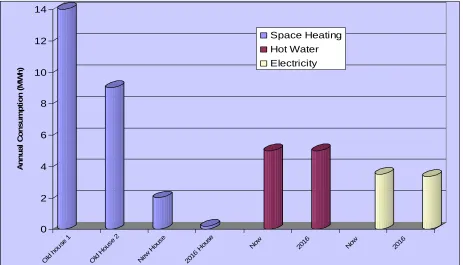
(2) more transport could be powered by electricity or hydrogen drawn from renewable sources. Such an approach will of course require far greater generation of renewable energy than is currently envisaged and this in turn requires Government to invest significantly in the infrastructure that could deliver such a transformation of the economy. 14 Space Heating. Annual Consumption (MWh). 12. Hot Water Electricity. 10 8 6 4 2. 20 16. N ow. 20 16. N ow. H ou se 20 16. H ou se N ew. H ou se O ld. O ld. ho us e. 1. 2. 0. Figure 1: Potential for reductions in energy use for space heating, hot water and electricity for current and future design specifications. Transport Transport is a policy area where emissions and many other indicators of sustainability continue to go in the wrong direction – between 1990 and 2003 transport emissions in Scotland grew by 6% while total Scottish emissions fell by 14% (see table overleaf). Transport accounts for 23% of Scotland’s emissions (2005 figure) making it the second largest source of emissions. Even excluding international air transport, if transport trends continue as they are then in 20 years time sectoral emissions will be 60% higher than at present. The current Scottish Transport Strategy does include a high level commitment to cut emissions but neither current transport trends or expenditure (over the next few years road spending is set to increase while public transport remains static) are likely to achieve this objective..
(3) For surface transport the levels of GHG emissions are determined by a range of factors including population, vehicle technology, trip frequency and length, carbon intensity of fuel, mode of transport and level of vehicle occupancy. Modelling shows that it is only by addressing all these factors that significant cuts in transport emissions can be achieved. Specific actions, not all of which are in the remit of the Scottish Government, should include: . . Encouragement of a shift to smaller vehicles through fiscal measures (as has happened in Italy and the Netherlands) Incentives to use 2nd generation biofuels Mode shift through cheaper, more frequent public transport with cheap integrated ticketing, measures to make public transport faster than car travel, the provision of safe infrastructure for walking and cycling and information to help people make smarter choices Trip reduction and trip shortening through land use policies encouraging slow modes (walking and cycling), the provision of employment and services closer to where people live and through road pricing/parking restraint. Most importantly it is worth placing far greater emphasis than at present on local transport rather than large national infrastructure projects. Such measures have already been applied in many European cities including Copenhagen and Freiburg with positive outcomes..
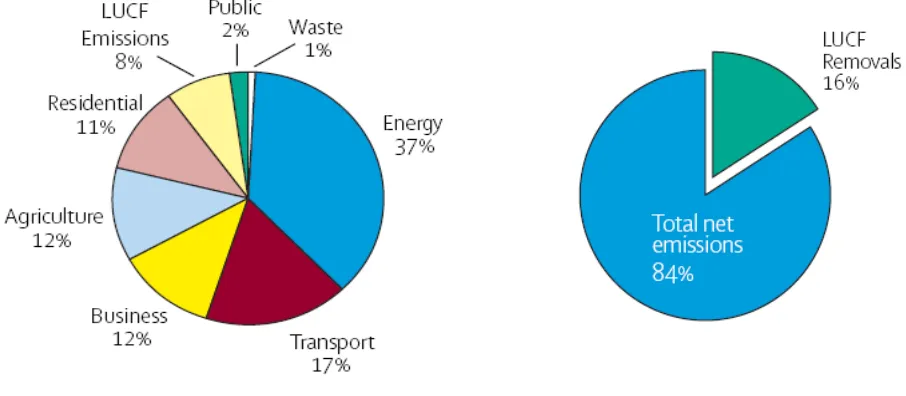
(4) Land Management, Sequestration and Sinks The impact of land management on Scotland’s greenhouse gas emissions is often overlooked. At present around 20% of Scotland’s emissions are from agriculture and land use; at the same time 16% of Scotland’s total emissions are sequestered by land and there is potential to enhance this significantly (Fig 2 and 3). It is also worth noting that for land, the most significant GHG emissions are not of carbon dioxide but of other gases namely Nitrous Oxide (N2O) and Methane (CH4).. Fig 2 and 3: Emissions by sector and also removals from Land Use Change and Forestry (LUFC) An analysis of trends in land emissions shows that there has been a 60% decline in net emissions from land use since 1990 and also a large (78%) increase in sequestration from land use and forestry. This has made an important contribution to reducing Scotland’s overall emissions but there is much that can still be achieved. Looking forward the important actions on agricultural management that could be taken include:. 1. •. The development of energy crops that are carbon neutral 1. •. Further enhancement of sequestration through changes in land cover and land management. •. Reducing methane emissions from livestock. There has been a lot of controversy about energy crops but there still remains potential for the development of crops which do have a positive carbon impact and which minimise wider negative impacts.
(5) •. Enhancing the efficiency of fertiliser use – this could also yield financial savings to farmers. It is calculated that together these actions could save 1.57MtC02e (million tonnes carbon dioxide equivalent) making a significant contribution to reducing overall emissions. Further savings could be achieved by converting arable land to grass, although the impacts of this (in terms of increased need for food imports etc) would have to be factored into the overall appraisal of the carbon benefit. Enhanced forest cover could also play an important role in coming decades. The Scottish Forestry Strategy sets out an intention to increase forest cover to 25% of Scotland’s land area. The achievement of this could sequester an additional 6.8MtCO2e per annum. To maximise carbon benefits it is however important that afforestation occurs on suitable soils – in general these are found in land currently used for agriculture – disturbing peatlands could actually lead to a net increase in emissions. Sink potential can also be enhanced by maximisation of the carbon uptake of woodlands through better management.. Looking forward other challenges present themselves in delivering enhanced sinks. Land in Scotland is finite. The question is therefore how we balance the competing priorities for land – as a source of food, bioenergy, carbon storage and biodiversity and also as a place for leisure and recreation..
(6)
Figure
Related documents
Although Church leaders did not relate to liturgical music as their property, they did consider it their right and responsibility to stimulate production and performance of
Em decorrência desta questão, surgiu a necessidade de um estudo cujo objetivo é com- parar o emprego de procedimentos linguísticos de atenuação, na produção de atos de fala
III. EYE MOVEMENTS FROM CHILDHOOD TO ADULTHOOD In this section, we analyzed an eye tracking data collected from observers of a wide range of ages. The main purpose was to
Similarly these normalized rank-1 CP matrices together with the normalized extremely bad matrices constitute the extreme points of ( 23 ).. We prove
excluding skull samples found little evidence of sexual dimorphism in faces.. Again,
GET READY. LAUNCH Outlook if it is not already running. The contacts used in this exercise were created in Lesson 6. If necessary, click the People button in the Navigation
WinReporter ® offers a set of 58 predefined reports that will help the network administrator in his audit and monitoring tasks: hardware upgrades, software
Figure 69 - Filament heating and extrusion test setup .... Figure 71 - 0.5MN extrusion press and recorded processing parameter ... 88 Figure 77 - Cracked nozzle insulation due
