Creativity Bento Box
A Physical Resource Pack to Support Interaction in Virtual Space
Corresponding Author
Holger Schnädelbach Nottingham Research Fellow
www.mrl.nott.ac.uk/~hms
Mixed Reality Laboratory Computer Science
Jubilee Campus University of Nottingham
Nottingham NG81BB UK
Tel.: (+44) 0115 9514094 Fax.: (+44) 0115 8466416
This is the author-‐version of the paper, not including publisher edits. The original publication can be found here:
Creativity Bento Box: A Physical Resource Pack to Support
Interaction in Virtual Space
Holger Schnädelbach , Tim Coughlan , Genovefa Kefalidou , Derek
McAuley , Rupert Meese
International Journal of Human-Computer Interaction
Vol. 31, Iss. 11, 2015
http://www.tandfonline.com/doi/abs/10.1080/10447318.2015.1067478?journalCode =hihc20
Creativity Bento Box
A Physical Resource Pack to Support Interaction in Virtual Space
Abstract
The Creativity Bento Box is a physical resource pack, designed to support casual social interaction and break taking in an intensive, computer-‐mediated social activity. It was developed within the Creativity Greenhouse project, which piloted a mechanism to create research proposals and distribute funding at a distance. This involved facilitated phases of collaboration and competition over multiple days of computer-‐mediated work, where participants communicate and interact through a virtual world. During the
iterative development process, the lack of time for socialising, the intense focus on virtual resources, and a lack of time spent away from the screen were reported as negative issues in feedback from participants. We report on the development of the Creativity Bento Box and how it helped to address these issues. By providing physical resources that contrasted with the properties of the virtual world, it supported people to socialise and take breaks from their primary activity, allowed them to include physical space and artefacts in their interactions, and provoked moves away from the otherwise intense focus on the computer. We reflect on the roles of the Bento Box as a gift, in bridging between physical and virtual contexts, its higher suitability during the earlier phases of ideation and group development, and its perception by participants as something ‘framed’. Through this, we highlight the underexplored potential of using physical, offline resources as a means to solve difficulties in distanced social interactions.
Keywords: Group Forming, Social Interaction, Ideation,
Introduction
CG is distinct from this in that most of the activity is conducted with participants and facilitators at a distance from each other. The activity is therefore supported by a specially adapted set of communication technologies. During CG, a group of researchers are invited to first collaborate to develop themes and ideas in connection with a given challenge, and then to compete for funding resources in self-‐selected sub-‐groups. A dedicated facilitation team guides the event, drawing on the Creative Problem Solving (CPS) process (Osborn, 1953) (Creative Education Foundation, 2013). During the iterative development process of the CG format (Schnädelbach, 2013) (Schnädelbach et al., 2011), it became increasingly clear that supporting our distributed participants posed specific challenges, such as the intensive and potentially stressful nature of the activity, and the common lack of prior relationships between participants. It also became clear that there was potential to overcome these difficulties, not through changes in the design of the communication technologies or virtual spaces, but by thinking more broadly about physical resources and the activities they could support.
The Creativity Greenhouse
There are two parts to a CG event. Part 1 begins with a co-‐located day, where
participants are physically located. This is followed by two days of distanced interactions conducted across a set of communication technologies (see below for a description). During part 1, participants get to know each other and generate and describe ideas around the theme set for the event. Part 2 continues the distanced interaction, but is characterised by group formation, some changes of group membership and then by competition amongst the newly formed groups. During this part, groups that have formed around newly developed ideas, work intensely to develop a funding bid, pitch their final proposals, and receive funding decisions made by the director, mentors, and funders (EPSRC, 2008).
Designing successful creativity support requires a deep understanding of group
requirements, iterations and a mixed method approach (Shneiderman et al., 2006), and the particular set-‐up of process, resources and communication infrastructure was iteratively developed over roughly 2 years. It is worth emphasising that this
development was conducted ‘In the Wild’, increasing the complexity and ambition along the way, with real research funding being distributed.
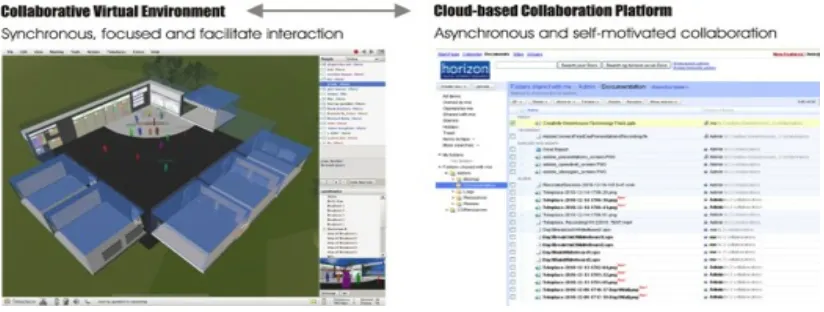
The devised communication platform combined a 3D collaborative virtual environment (CVE) with a document-‐sharing platform (Groupware), see Figure 1 below. We deployed the open-‐source CVE OpenQwaq (OQ) (OpenQwaq open source community, 2013). Within OQ, people are represented by an avatar with which they can move freely in relation to resources and in relation to others. OQ also provides audio and video channels.
Figure 1 The Creativity Greenhouse communication infrastructure combining a CVE and groupware
A key reason for choosing OQ was that the resources that it provided were directly relevant to the Sandpit process: there are rooms that can be used as breakouts, virtual sticky notes useful for ideation and OQ has the capability to display live web pages. Alongside the OQ core infrastructure, Google Drive was used as groupware, to allow asynchronous interaction around more permanent resources (for example the document and the presentation of the final developed pitch) (Google Inc., 2014).
We began with an in-‐house technology comparison trial and followed this with the distribution of internal funding resources through a two-‐day event format. A first externally facing Creativity Greenhouse resulted in the funding of a first full EPSRC project (EP/J021601/1 SERTES). The final and most ambitious event led three further EPSRC funded projects (EP/K025201/1 Digital Brain Switch; EP/K025392/1 Digital Epiphanies; EP/K025678/1 Family Rituals) and one funded network (EP/K025619/1 Balance Network, Exploring Work-‐Life Balance in the Digital Economy), with a total value of £1.85 Million across the two externally facing events.
The Ideas Factory Sandpit
[image:5.595.80.492.65.221.2]government-‐sponsored funding body in the UK. The Ideas Factory Sandpit is a direct outcome of this strategy (EPSRC, 2008). The mission is the creation of multi-‐disciplinary teams around ideas that would probably not be funded through other routes. This is reflected in the participant selection process, which commonly brings together individuals who have not met previously (Maldé, 2010). Team building is seen as critically important as the longer-‐term aim is for consortia to remain together and bid for larger research grants. To date, EPSRC have run over 40 sandpits, with a large number of projects funded from this process. The concept has gained traction in wider UK academia where shorter funding events with often lower amounts of funding are facilitated within a single institution (Dale, 2009), as well as internationally (Collins et al., 2013). However, critical issues have included the way that interactions are managed (Corbyn, 2009) and the difficulties to bridge interdisciplinary divides in short time periods (Giles, 2004). The high cost of conducting sandpits and the fact that because of their residential nature sandpits could only ever be attractive for those who could
manage to be away for a lengthy period of time (a point also raised by (Goldberg, 2011)), prompted the EPSRC to consider a distributed approach, that became CG.
The Creativity Bento Box
Rationale
While overall feedback from participants in the first externally facing Creativity
Greenhouse was generally positive, a number of issues were mentioned repeatedly. The first issue was a lack of support for the social dynamics that emerge during physical meetings and the lack of time for socialising to underpin those dynamics. In end-‐of-‐day questionnaires participant statements included:
‘ … one thing that is missing in a virtual meeting is the casual interaction that normally happens during lunches and after dinner. I suppose the building of this social network at social hours in an important activity to succeed in any research project.’
There were also more direct concerns around the physical wellbeing of participants. People felt that they were too constrained to be at their desks for extended periods of time, leading to physical discomfort, and recent research has highlighted the issues caused by our sedentary behaviours (Owen et al., 2009). Participant statements in end-‐ of-‐day questionnaires included:
‘… I would have liked more defined and enforced coffee breaks. It was hard to walk away from on-‐going discussions and work … but I needed a break (… I have to go three floors down to the coffee bar!)’
‘My back was a bit sore and my eyes were tired by the end of the day.’
In their aim to keep the process on track and on time, the facilitation team faces a difficult challenge to keep things in balance. One of the facilitators stated:
‘Groups were keen to explore the topics this afternoon and probably would have liked more time … however, this is off set with making sure the participants have breaks away from the system.’
Together, the technical and event facilitation team also observed something not captured in direct feedback. Participants including directors and mentors seemed to ‘forget’ the utility of their physical surroundings as resource. The focus was so much on interaction with the process and others through the virtual infrastructure that people did not seem to take notes on paper, whiteboards, or even another computer in the room, which might have helped them to off-‐load some tasks. Our detailed experience with three iterations of the Creativity Greenhouse concept and the concrete participant feedback summarised above, led us to consider ways of improving the participant experience.
increase the time away from sitting at the desk and in front of a screen to improve participants’ well-‐being. We anticipated that successfully addressing these would be beneficial across all phases of the Creativity Greenhouse.
The Brief for the Creativity Bento Box
We responded to the above with the development of a physical resource pack that participants would use during the distributed event days. A first brief was developed, which already included some of the core ideas for the resource. Participants would take the resource away at the end of the physical day and it would be designed to be personal to each participant in some way. As well as any other items, it would contain a USB camera and headset to standardise the equipment each participant used, and a way to return this. We discussed the role of the box compartments, activities to get people to move away from the screen, physical interaction props and how items such as food or drink could support socialising. This first brief was discussed with EPSRC and then presented to a local design agency for further development. In a series of meetings and exchanges, the agency helped us to formalise our ideas into a second production brief with the following high-‐level aims. The resource was to: 1) Stimulate ideas and
inspiration outside and within of the project development process, 2) Get people away from their screens 3) Embed fun within the process 4) Help ‘break the ice’ 5) Aid communication 6) Support well-‐being and 7) Provide items to test people with.
We decided to embed the CG Bento Box resources within the process, rather than utilise it only as an ‘end-‐of-‐day’ activity, this offered more flexibility and integration with the event. On a practical level, items to document things with were proposed in the brief, such as pens, post it notes, boxes to write on and simply a note book. In addition, the brief included more concrete suggestions for making things with, for example Plasticine, Lego or other building blocks that facilitate creative, ‘free-‐play’ engagement activities. The brief included suggestions for specific tasks, for example to go photograph
would comply with instructions. Finally, we settled on the provision of high quality teas from different parts of the world, as this would allow the framing of shared breaks during the event.
The Final Design
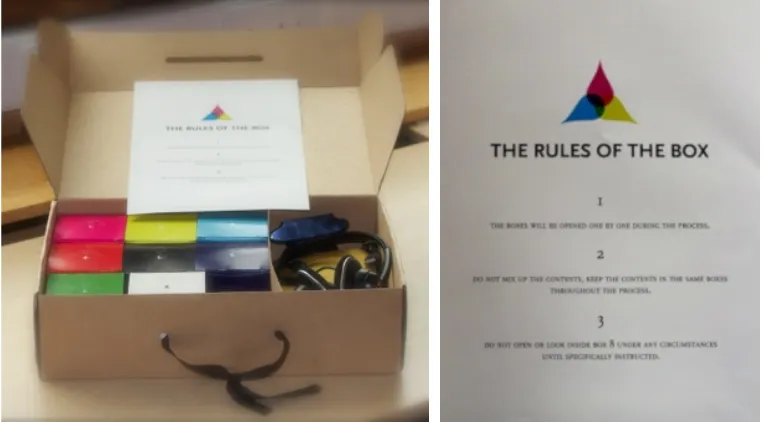
Each Creativity Bento box was roughly 40 cm x 25 cm x 10 cm with two main
compartments inside. Each box carried the Creativity Greenhouse logo and an individual quote for each participant on the topic of creativity. The smaller compartment held the communication technology and return envelope for that technology. The larger
compartment provided space for nine smaller boxes, which each contained a resource, a task and selected tea (see Figure 2 left).
Figure 2 Creativity Bento box with equipment compartment and space for the nine smaller boxes and the
rules of the box
The box contained a set of rules. These stated that internal boxes were to be opened one by one during the event; it asked participants to not mix up the contents of the boxes. Finally, it stated that box 8 is not to be opened under any circumstances unless instructed during the event (see Figure 2 right).
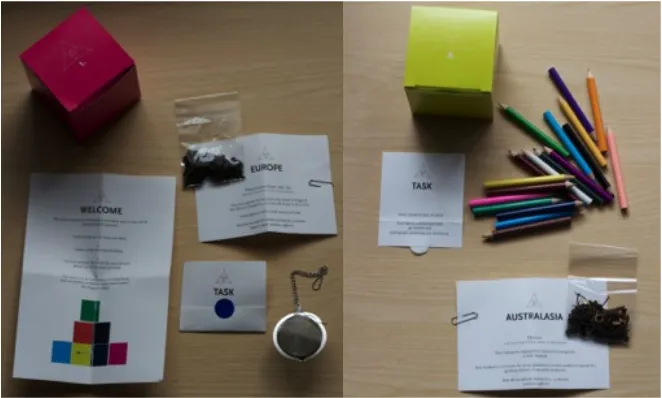
[image:9.595.107.489.330.541.2]strainer to go with the tea in the other boxes and the first task. The welcome message was: Welcome. The Boxes contain the following items, which may or may not be used during the process: 1. Tools to help you develop your ideas. 2. Tasks to help stimulate
thinking. 3. Tea from around the world for your pleasure, please us the strainer provided. 4.
The boxes can also be used as building blocks and can be written on with a ‘white board
marker’.
Figure 3 Creativity Bento boxes 1 including the tea strainer, tea, a task and a welcome message. Box 2
contained some crayons, another task and more tea.
As the message above already suggested to participants, the use of the boxes was
flexible. Box 2 added some crayons to use for scribbling down ideas, yet more tea and the following task: ‘Find something Funny: Your task is to leave your desk to go outside and photograph something you find funny.’
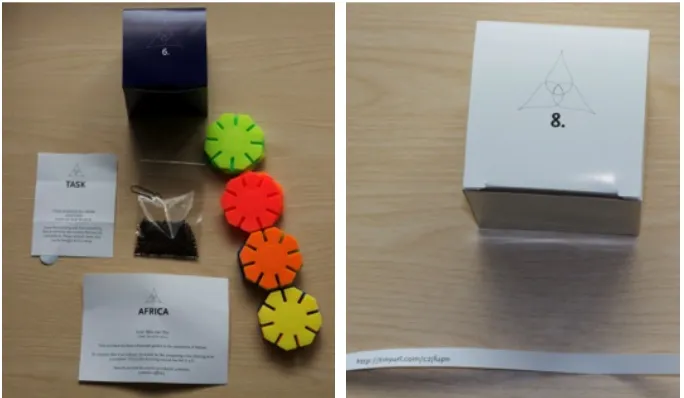
Box 6 contained some Octons that people could use to make things with. And, the
following task: ‘Find something from another part of the world: Leave the building and find something from a country that you are not currently in. Please exclude items that can be
bought from a shop.’ There were clear instructions not to open box 8, which only
contained a link to a web page. The linked webpage simply displayed the message: ‘You shouldn’t have! (Subtly announce that you have seen this message to other participants and
[image:10.595.132.463.221.420.2]about adherence to event rules, and hopefully prompt discussion about their personal approach to following rules.
Figure 4 Creativity Bento box 6 contained a set of Octons toys, tea and a new task, while box eight only contained
a note of a URL
The box was to be taken away by participants on the physical meeting day and was designed to be personal to each participant.
Related Work
To the best of our knowledge, there are no physical resource boxes that support
distributed interaction in a similar way, and therefore no evaluations of them. However, we can relate the design to existing work in a number of ways. There are clear parallels in design and content, if not purpose, with the Subscription series of high value
[image:11.595.127.469.118.317.2]material to frame a particular topic, for example a period in history (Chertsey Museum, 2014) (African Initiatives, 2014). There are also learning resource boxes that integrate links to digital media, and which therefore bridge between the physical and digital in one particular direction (Shaw Jr et al., 2005). We also found a number of designed resources to present dilemmas, concepts or techniques in an accessible card format. The
Metamemes Thinkcube is one example of in this space, specifically designed to be used in brainstorming sessions (Baldwin, 2011). No evaluation of this approach seems to be available nor are they being used for distance collaboration. Finally, there has been a recent set of online games that include game play through physical game figures. The physical figures have to be purchased separately, can be given as gifts and enable access to certain in-‐game content (Johnson, 2013). Even though there appears to be no direct precedent to the Bento Box, HCI research into tangible interaction clearly emphasises the relevance of physical artefacts in Human Computer Interaction (Ishii and Ullmer, 1997). Very early on, this work found application in remote collaboration, supporting people interacting at a distance in various contexts (Brave et al., 1998). In a review of more than a decade of work in this space, Hassenzahl et al have then focussed on
relatedness as it applies in long-‐distance and close relationships. Even though the context
of this work is very different, the principles of gift giving and joint action can provide useful lenses on the work described here (Hassenzahl et al., 2012).
Creativity Bento Box in-‐event use
The Creativity Greenhouse in which the resource was being used
For the final event in our series, participation was invited through an open call to all UK academics. Following a panel decision by the director, mentors and event facilitators, 18 academics were invited, 16 took part and 15 gave us consent to use their data in the evaluation. The size and ambition of the event was now comparable to the standard Ideas Factory Sandpit in terms of size and available funding (£1.5 Million). Throughout the development of the approach feedback clarified that meeting everyone in person at the outset was essential. Day 1 of the Creativity Greenhouse was therefore spent
together, beginning to explore the set theme, stepping through group building exercises and getting training on the communication platform. At the end of the co-‐located day, the Bento Box was handed to participants (see a fuller description further below). For the next four days (Days 2 – 5), participants connected with each other via the
communications platform. Each day began at 9am with a login period, and the facilitated time ended between 5pm and 6pm. Participants were also free to use the platform as they wished during other times.
The use of the Bento Box was carefully discussed amongst the facilitation team, who scheduled specific points during the event days for it use. Two boxes were scheduled for day 2, for the lunch and afternoon tea breaks respectively. Two boxes were scheduled for day 3, for the morning and lunch breaks. There were a further two boxes scheduled for day 4 and none were scheduled for the final day. Discounting box eight, this left three boxes unscheduled. In our analysis we are concentrating on understanding the
introduction on day 1 and the use during days 2 and 3, the first two distributed days. For the final part of the event, boxes were only scheduled once and they had a low profile.
Initial introduction of the concept and box
nature, before explaining the practical use of the resource (the following is a transcription from video footage):
‘Because you are a lovely group of people, we actually have a gift for you to take away. A gift for everybody. And, it’s actually a really important gift. And, it’s really for next week. And, it’s all about blending the virtual with the physical and the real world wherever you are at. … But before I give you the gift, you have to promise me something. If I give you a box and it has a bright red button on the top and on the box it says ‘do not push’ until Tuesday, how many honestly of you will not push that button?’ (Looking around for a reaction) ‘You will not push that button, honestly, you will not push the button ...’ (Pointing into the room at participants; participants laughing).
Once they had a reaction from everyone, the facilitators introduced the resource,
opening a sample box and reading out the three rules. Reading the rule for box 8 (i.e. not to open it), the connection to the earlier promise is evidently clear to participants. The facilitator further states that the boxes and resource will be used throughout the virtual event days. Individualised, named boxes were ready to be picked up on the way out. Immediate feedback from the director and mentors made it clear that they were disappointed at not having received a box themselves, but we had only made enough boxes for the participants, plus one for the facilitation team co-‐located in our research lab so that they were aware of the contents.
In-‐event use of the Bento Box
lasted for between 5 and 6:30 minutes, whereas the first feedback session lasted for 15 minutes.
While the amount of time given to the Bento Box seemed appropriate (reviewing the video as described below), the numbers indicate that relatively little of the overall facilitated time was spent with it. However, the amount of time that participants spent with the resource was significantly higher, as they were engaged with tasks, enjoying the tea, and engaging with resources that were made available to them outside facilitated time as well. Those times were not directly observable to us. In what follows, we will introduce the first and very typical use of the Bento Box resource, before concentrating on the way that participants’ contexts are drawn into the conversation and the ways that resources becomes useful outside facilitation.
Day 2 – Midday – The first use of the Bento Box and Task Presentations
A first use of the Bento Box is instigated by the facilitation team, close to lunchtime on the first distributed day of the event. Participants were asked to open boxes one and six.
Intro and Task
The facilitation team retrieved and then showed the tea strainer into the camera and asked participants to have a cup of tea on the organisation team. In addition, the set of boxes were introduced as resource to be written on. Their surface material allowed them to be used as ‘mini white boards’, stackable to allow re-‐organisation of ideas written on them. The facilitation team then also opened Box 6 to retrieve its task as this was chosen to be relevant for this stage of the event. The task was being read out: ‘Find something from another part of the world. Leave the building and find something that is not from the
country that you are currently in. Please exclude items that can be bought from a shop.’
Participants were asked to conduct this task over lunchtime. The Octons toy also
Presentation of task results
Before the session officially re-‐opens, some participants discuss what they will present via text chat. The following is a short excerpt:
P1: What did you get from around the world? P2: Pens from Taiwan on my desk & gift from Japan.
P3: I'll show mine on the vid[eo], I borrowed it from the Chinese we ate at... Promised to give it back tomorrow...
P1: Photos of exotic plants from Africa, Brazil and Russia P4: I'm wearing mine...
P1: Sounds intriguing.
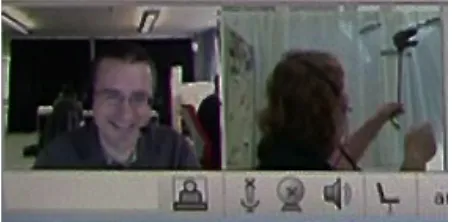
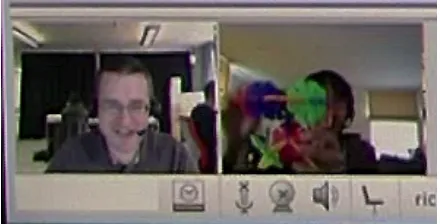
Once facilitation had resumed, participants gathered in the virtual presentation space. They were then spending time to explain what they had found, using video to show found objects by holding them into the camera. One of the facilitators kicks this off with a cuddly toy found in the research lab. By doing this they (may be incidentally) set the tone, determining that the task does not have to be taken too literally. Most of the objects shown were bought in some form or another and were often found in the same building. In total, 16 others take a turn. The objects themselves were often combined with stories that situated them in personal lives and interests, research activities or the Creativity Greenhouse event, and these often raised comments from other participants. For
Figure 5 'No Stress -‐ Bahia' T-‐Shirt worn by one of the participants (left) and statue of Virgin Mary held
into camera by another participant (right)
The relationship of physical and virtual interaction was a recurring theme of discussions, highlighting the limitations of the communication technology. For example, one
participant showed an Indian Sari, professing that they did not know how to tie it. Another offered to teach them to do this somehow in the virtual space.
For some of the participants, the audio failed and they could be seen on the video panel but not heard. This was often because they had not fully understood interaction with the audio tools yet (e.g. the difference between ‘audio always-‐on’ and ‘push-‐to-‐talk’). This early group session then also provided a light-‐hearted way to identify technical problems and resolve those, or develop coping mechanisms.
Day 2 – Afternoon – Introducing Play-‐Do, new tea and a new task
The afternoon of the second day sees the introduction of box number 4. The facilitator announces which box it is, before listing the contents. Some Play-‐Doh (unconnected to any task, similar to the Octons introduced above), some new tea to try and the task: ‘Find the closest thing: Find something that is round, orange, made of a man-‐made material.’
Participants are given the afternoon break to complete the task. When participants return, there are around five minutes of presentations back to everyone.
Day 3 – Morning – Context and Off-‐task use of resources
[image:17.595.96.501.65.195.2]context that participants are connecting from and the way that resources can be used away from facilitation.
Intro and Task
In a very similar way to before, the particular box to use is introduced by the facilitation team, starting with the tea that is included, advertising this to be consumed during the break. The resource and the task go hand-‐in-‐hand in this case. The box included a small sachet of Sugru, a product that is a combination of glue and modelling clay. Using this material, participants were then asked to: Fix Something: Sugru is a silicone rubber that moulds and sticks permanently. Your task is to identify something that needs fixing and fix
it with Sugru. Everyone is given the break time to fix something and present it back to
the group.
Presentation of task results – Drawing in Context and Environment
As is now routine, people are getting ready to feed back by being present in the virtual space a little before the facilitated process continues. Participants are having a quick chat over audio, a brief excerpt of which is included below:
P1: How is everyone enjoying the teas? P2: Who is that? You are very quiet.
P3: I have only had the African one. That was really nice.
P1: Having, I think, the African one now … I had the [inaudible] yesterday and the Earl Grey. P4: Yeah, the tea’s nice?
P3: It’s my son’s Birthday next week and I am going to recycle this box into a game for his party.
P4: Fantastic
P1: I thought you were gonna say, you give him all the tea Everyone: Laughter
P3: No, not that mean. I am pretty mean, but not that mean.
people did not get to use the Sugru in their task, while fixed for example a towel rail, an umbrella and some shoes. The following excerpt then shows in more detail how the context that one participant was embedded within became highlighted through the use of the Bento Box:
P1: I tried to fix this, which is a Dinosaur (holding dinosaur into camera, opening and closing the mouth of this children’s toy) … and, but it’s handle is broken. But if this doesn’t go hard, this isn’t going to work … and it’s not gone hard yet.
P2: Ohh …
Facilitator: I think it does, you just need to give it a bit of time.
P3: Does that eat the fish above your head (reference to curtain in the background) Group: Laughter
P1: They are actually quite far from me (leaning backwards and pretending to reach the curtain with the dinosaur toy).
Figure 6 Facilitator observing P1 reaching back with Dinosaur, pretending to capture fish printed on
curtain.
Everyone: Laughter
P1: Is everyone else in a Fish Bowl or just me Everyone: Laughter
Facilitator: Does anybody else have any fixes they want to share?
[image:19.595.185.411.352.463.2]Presentation of task results – Using resources away from Facilitation
The same episode also presents the opportunity to two people to mention how they have used the resources supplied in the Bento Box to create something new. The following is another brief excerpt:
P1: Ahm, I didn’t fix anything, but I have been making … you know we have been given some … ahm … Play Do yesterday (taking off camera from its default position, turning it to face the desk). Let me see, if I can do this (the desk coming into view). Can you see?
Figure 7 FM observing PF2 demonstrating model of Bento Box made from Play-‐Doh
P: Ah
Mentor: Oh, wow.
P2: I have re-‐created (laughing) … (showing her model of the Bento Box contents made from Play-‐Doh). I have even made a little box (laughing).
Facilitator: That is fantastic
Another participant decides not to show the item they fixed but instead something that they made with the Octons supplied on day two.
P: Ahm … I used the Sugru to fix my shoes, but I think they are quite dirty … I didn’t want to close you all out. Ahm … but … I show you this thing (starting to hold Octon structure into the camera view) …
[image:20.595.180.413.261.374.2] [image:20.595.195.415.634.746.2]P: … as I made this scale … that represents … ahm … work-‐life balance (demonstrating the movement of the scale arm on its base).
Mentor: Very nice
Facilitator: Oh, very good P2: Laughing
P3: Very good
Day 3 – Midday – A final scheduled use
Just before lunchtime on Day 3, we can observe the final scheduled use of the Bento Box resource. As before, the contents were being introduced with the task being: ‘Find
something funny: Your task is to leave your desk, go outside and photograph something you
find funny.’ The resulting photos were being emailed to the facilitation team during the
break and then assembled for presentation directly after.
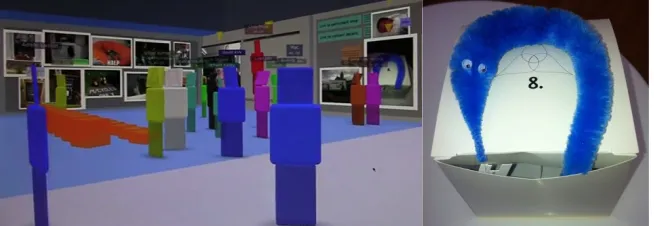
Figure 9 Presentation of 'Find Something Funny Task' and teaser image in relation to box eight)
Following the break, the task results are presented back, which is lead by the facilitation team in this instance, in a short session lasting around 5 minutes. The results can be seen being presented in Figure 9 (left)). One of the participants produced a teaser image, suggesting what box 8 might contain Figure 9 right) to the great amusement of other participants and the organisation team.
Feedback from participants
We now turn our attention to the feedback provided in surveys and the focus group.
Feedback from end-‐of-‐day surveys
[image:21.595.136.463.341.454.2]participants as well as the organisation team. This included questions about the use of the Bento Box.
Enjoyment
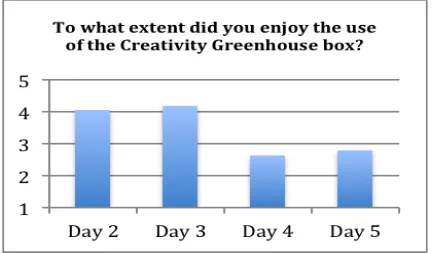
On each day, we asked participants: ‘To what extent did you enjoy the use of the Creativity Greenhouse box?’. On a Likert Scale of 1-‐5, responses can be charted as shown below,
with mean scores at around 4 for the first two days and between 2.5 and 3 for the final two days, a clear drop-‐off.
Figure 10 Enjoyment of the Creativity Bento Box -‐ Responses on Likert scale of 1-‐5 ranging from 1(very
small extent) to 5 (very large extent) – Day 2: N=15, Day 3: N=10, Day 4: N=10, Day 5: N=13
The open comments provided by participants allow a more detailed look. Combining days two and three when four boxes in total were opened, participants certainly appreciated the overall concept and the fact that it got them away from the computer.
‘I thought this was a really nice touch.’
‘Highlight of the day -‐ even if my computer broke, I could always drink more tea.’
‘ It was a good way to try and get you away from the computer and do something else …’
However, not all resources seemed to get used to their full effect. Some participants reported that the tasks acted as an interference with having an actual break, especially when some of its tasks required more computer use (e.g. to upload an image).
‘It was actually a bit of an impediment when I had other things to do in the breaks.’ ‘I liked it, but not when it means we have to use the computer again in the break times.’
[image:22.595.190.406.250.377.2]‘Didn’t really feel we used the content enough.’
‘I think this was a lovely idea, but sometimes there were things in the box that we weren't giv en any instructions for?’
The lower ratings for days three and four partly reflect that only one new box was being
introduced and that people generally felt there wasn’t the place for more interactive
creativity, while the tea remained appreciated.
‘I did not manage to play with it. Only had tea.’
‘Not that it is not enjoyable but I didn't have time for it.’ ‘Flowering tea was very calming -‐ beautiful flower.’
Collaboration
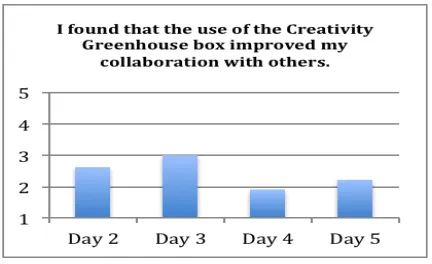
In addition, we also asked participants to react to the following statement: ‘I found that the use of the Creativity Greenhouse box improved my collaboration with others’. On a Likert Scale of 1-‐5, responses can be charted as shown below, with mean scores at around 2.5 and 3 for first two days and hovering around 2 for the final two days, already pointing at the fact that people thought that Bento Box did not help much with
collaboration.
Figure 11 Role of Creativity Bento Box in improving collaboration -‐ Responses on Likert scale of 1-‐5
ranging from 1(very small extent) to 5 (very large extent) – Day2: N=15, Day 3: N=10, Day 4: N=10, Day 5:
N=13
[image:23.595.190.406.452.584.2]themselves (away from desks) were conducted separately, which seems to indicate that they did not include the feedback sessions into account.
‘It was fun, but didn't prompt collaboration.’
‘I don't think it really helped the collaborative process, as we were all doing the activities on our own.’
The facilitation team focussed on using the box on structuring the break and it seemed to be seen as valuable in that role.
‘Good conversation-‐starters.’
‘It improves the social aspects of the experience -‐ it's really quite effective at providing the shared coffee break experience’
‘It was fun, but didn't do more than encourage you to try and do something else in the break’
‘The tasks can be more challenging and require collaboration e.g. each person can make something with the orange play dough and then make up a story ’
The lower scores for the days four and five are again at least partly a result of the Bento Box playing only a minor role during that time.
Feedback from participants’ focus group
As a final data point, we summarise feedback collected during the post-‐event focus group, held at the end of day 5 while the funding decision was being made. Several participants stated that the Bento Box was a “great idea”, another saying that “the value of being given something, of being given something tangible, was really, really nice, I
thought…there was real value in that, in having something to play with”. There were a lot
of suggestions about how it could be used in other ways, and also some sense that the purpose of the box was unclear, as is illustrated in through the following quotes:
P1: Sorry, can I also say something about the Bento Box? I absolutely loved the Bento Box, but I don't think it's really helping with our creativity, because I think the tasks are not so relevant to what we are trying to do?
It was clear that the boxes had a purpose of drawing participants away from the screen and relaxing them, with one stating that “there's tea and you can relax, there's something I found unconsciously I'm playing with something by hand, so it does relax you a bit, but it
doesn't promote collaborative work, because we all do it, but by ourselves”. As suggested
here, participants assumed the box would form part of collaborative activities as well and there were clear suggestions to do more of that.
P1: ‘… if each person made something, and then we made up a story in a group, or, you know, then when we see other people's work, how we can actually make some other group activity rather than an individual activity? And some maybe some energy snacks would be useful as well, because it wastes time just a little bit, to give you energy?
P2: ‘Yes, I was hoping that we would actually use what we brought back for the next session, that's what I was hoping.’
The nature of the box contents, and the survey questions, also led participants to expect activities more related to creative ideation, with one saying that they were:
P: “… expecting that we might be doing some sort of really creative ideation tasks, and some of the stuff that is in the box actually feels like it plays into that, like, you know, coloured pens and kind of like bits of plastic you can stick together, … actually, we didn't really do that …”.
There was also a problematic tension -‐ resentment towards filling the breaks between facilitated times with more activities and structure:
P1: ‘Sometimes the tasks felt like yet another thing that we had to do, having been asked throughout the day to do things, you know, so then finally we get our break and it's, oh, you've got to go and, you know, find a photograph, or do this or do that, so, as opposed to, actually, I just want to go for a walk and not have to do anything.’
P2: ‘Yes, that's true, I don't need to be told to go outside, I'm more than capable of deciding I need some fresh air.’
‘I think [the facilitator] played her cards too well in actually emphasising that, yes, really you shouldn't, because it like really made it seem like a feature, so, like the joke kind of fell flat a bit.’
During the focus group there are four people who proclaimed that they had not opened the box yet.
Feedback from the organisers
The organisation team also responded to end-‐of-‐day surveys. As before, the focus of the material below is on days 2 and 3, as the Bento Box was used much less on the final two days.
Demonstration
We asked the two facilitators: ‘Please describe and reflect on the way you demonstrated and used the Creativity Greenhouse box today.’ First we report on responses provided at
the end of days two and three. Facilitators see this as very positive overall:
‘I was pleasantly surprised at how the participants took to the tasks and the 'gifts'. Looking forward to using it again tomorrow.’
‘The box has been a good tool to engage with the participants, linking them and sharing a common experience virtually.’
Responses for days four and five then very much reflect that adding more activities to inspire creative exploration would be inappropriate at the given time. One facilitator proposes to use the Box differently as a form of celebration at the end of the overall event.
‘We didn't use the boxes as much as in previous days as it was a tense environment and you need to exercise judgement as to whether a fun task is really the right thing to do at that time. We did use the box at a point today to inject a light moment and it worked …’
‘We used the box once today. [It was] difficult to use the box when tensions and anxiety are high. [The] focus changed overnight so [we] might need to think in future how we might use the last box as a good closing box to celebrate everyone’s involvement in the week …’
Use by Director and Mentors as seen by facilitators
despite the director and mentors not having the resource, they tried to join in where possible:
‘They seem genuinely upset that they didn't get a box -‐ must make sure in future that they get a box -‐ they are missing out playing along. Although I thought it was great that [the director] played along with the tasks anyway.’
Use by participants as seen by whole organisational team
Finally, we asked the entire organisational team (director, mentors and facilitators): ‘Please describe and reflect on the way users/participants used the Creativity Greenhouse
box today.’ During days two and three, the organisational team seemed to be clear that
participants engaged with the resource very well, while some also state that some of the actual activity is not visible to them. Participants might have been slightly cautious initially about the best ways of including the box and they used it very much as instructed:
‘They seemed to really engage with the tasks, bringing in things to show everyone on the webcams. No idea how the tea went down -‐ no-‐one has mentioned it.’
‘Most of them seemed to enter into the spirit of the fun tasks, but it's not easy to see whether anybody is standing back and not engaged with the group’
‘Much as instructed/guided -‐ some seem rather too anxious that there is a right and a wrong approach to what is a much more recreational task!’
Discussion
fundamentally ‘framed’, before 5) highlighting the potential of the Bento Box to transition from work to non-‐work activities. Our findings are directly relevant to
contexts where group interaction is facilitated at a distance, whether that is in academic research settings where distributed partners are the norm, distance learning where a sense of peer community is important, or work settings that require distributed groups to form and work effectively.
Gift giving
As already mentioned, Hassenzahl et al. identified the importance of gift giving in the support of long-‐distance interaction in close interpersonal relationships (Hassenzahl et al., 2012). In addition, Sutcliffe et al. report on the value of gifts (even though they are virtual in the reported work) to establish common ground in social media such as Facebook, with this common ground being the basis for all interaction (Sutcliffe et al., 2011). In a very different context, we have seen a similar effect during the Creativity Greenhouse event. The way that the Bento Box was introduced at the beginning of the event, and the way it was personalised for each participant served as an outward
demonstration of care for the participants. They were made to feel special in this way. In addition, the communication process through an otherwise mundane technology was also being enhanced. This was achieved by providing carefully designed artefacts, in an echo of Dissanyake’s description of ‘making special’ life’s routine activities in the context of cultural production more generally (Dissanayake, 1992). The Creativity Greenhouse participants very much appreciated this aspect of the Creativity Bento box.
The potential of physical artefacts and activities in mixing realities
participants and they used it deliberately to help people to come together even though they were physically separated. This was mainly achieved by providing people with artefacts that ‘… allow for carrying out an action together, which usually requires being physically collocated.’ (Hassenzahl et al., 2012, p.5), evident both in the sharing of teas
and in the shared tasks.
Participants themselves then also actively expanded the designed use of the provided resources to support them to include their local context. As Bowers et al have pointed out, the physical context remains influential, even when immersed in an activity staged in virtual space (Bowers et al., 1996). In response to this work, a number of technologies have then explored longer-‐term deployments of communication technologies
deliberately reaching into physical places, and physical context has proven to remain highly relevant, e.g. (Benford et al., 1998, Schnädelbach et al., 2006). In this case, the Bento Box provided offline, physical prompts and opportunities to share personal context with the others in the group via computer-‐mediated communication. People actively showed their surroundings and objects that they cared about. They also allowed a more direct window into their lives triggered by the activities and related objects. The playfulness and distinction from the functional activities within the event structure helped participants to understanding other’s personalities, for example by learning where, how and with whom they might live.
Although entirely physical, the Creativity Bento box drew out the otherwise entirely on-‐ screen interaction into a Mixed Reality environment. This is in contrast to a
technologist’s instinct to enhance the (communication) technology to enhance
any computation built in. These objects and activities related to them might have advantages in getting us away from the screen and also from norms of behaviour that occur when interacting through technology. Resources that are not designed to be computational can also feature sensory experiences that are difficult or impossible to control with computers (e.g. sharing the taste of an unusual tea). In this way, the Bento box helps create a joint interaction space, the availability of which is a core requirement for the support of group creativity online (Sarmiento and Stahl, 2008).
Forming versus storming, norming and performing
The Creativity Bento Box was clearly more useful during the early part of the event, focussed on collaborative ideation, covering the forming phase of Tuckman’s stages of group development (Tuckman, 1965). There was simply more time during the earlier phase and people were more relaxed, willing to try things out and be playful. During group formation, socialising is important to understand other people from multiple different perspectives, not just the one surfaced through facilitated activities. In addition, the introduction of play helped participants to cope with a new set of technologies. They learned to use the communication technologies and how to deal with technology
problems during a period of the event, when things did not ‘count’ as much as during the later stages. During the competitive consolidation phase, which rapidly took participants into Tuckman’s later group development stages of norming and performing, there was less time and requirement for the use of the resource. In the eyes of the event team and participants, the boxes proved to be less relevant toward the end of the event.