PROOF-THEORETIC INVESTIGATIONS INTO INTEGRATED
LOGICAL AND FUNCTIONAL PROGRAMMING
Luis Filipe Ribeiro Pinto
A Thesis Submitted for the Degree of PhD
at the
University of St Andrews
1997
Full metadata for this item is available in
St Andrews Research Repository
at:
http://research-repository.st-andrews.ac.uk/
Please use this identifier to cite or link to this item:
http://hdl.handle.net/10023/13430
P roof-T heoretic Investigations into Integrated
Logical and Functional Program m ing
Luis Filipe Ribeiro Pinto
June 1996
ProQuest Number: 10167177
All rights reserved
INFORMATION TO ALL USERS
The quality of this reproduction is dependent upon the quality of the copy submitted.
In the unlikely event that the author did not send a com plete manuscript and there are missing pages, these will be noted. Also, if material had to be removed,
a note will indicate the deletion.
uest
ProQuest 10167177
Published by ProQuest LLO (2017). Copyright of the Dissertation is held by the Author.
All rights reserved.
This work is protected against unauthorized copying under Title 17, United States C ode Microform Edition © ProQuest LLO.
ProQuest LLO.
789 East Eisenhower Parkway P.Q. Box 1346
D edication
A bstract
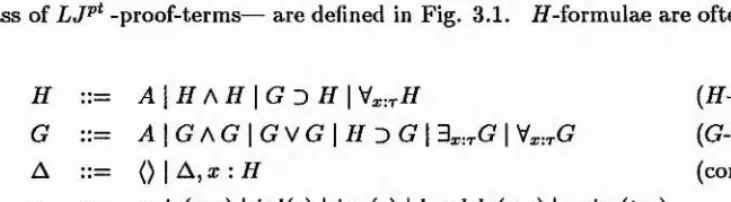
This thesis is a proof-theoretic investigation of logic programming based on hereditary Harrop logic (as in AProlog). After studying various proof systems for the first-order hereditary Harrop logic, we define the proof-theoretic semantics of a logic LFPL, intended as the basis of logic programming with functions, which extends higher-order hereditary Harrop logic by providing definition mechanisms for functionis in such a way that the logical specification of the function rather than the function may be used in proof search.
In Chap. 3, we define, for the first-order hereditary Harrop fragment of LJ, the class of
uniform linear focused (ULF) proofs (suitable for goal-directed search with backchaining and unification) and show that the ULF-proofs are in 1-1 correspondence with the expanded normal deductions, in Prawitz’s sense. We give a system of proofAerm annotations for LJ-proofs (where proof-terms uniquely represent proofs). We define a rewriting system on proof-terms (where rules represent a subset of Kleene’s permutations in LJ) and show that: its irreducible proof- terms are those representing ULF-proofs; it is weakly normalising. We also show that the composition of Prawitz’s mappings between LJ and NJ, restricted to ULF-proofs, is the identity.
We take the view of logic programming where: a program P is a set of formulae; a goal G is a formula; and the different means of achieving G w.r.t. P correspond to the expanded normal deductions of G from the assumptions in P (rather than the traditional view, whereby the different means of goal-achievement correspond to the different answer substitutions).
LFPL is defined in Chap. 4, by means of a sequent calculus. As in LeFun, it extends logic programming with functions and provides mechanisms for defining names for functions, maintaining proof search as the computation mechanism (contrary to languages such as ALF, Babel, Curry and Escher, based on equational logic, where the computation mechanism is some form of rewriting). LFPL also allows definitions for declaring logical properties of functions, called definitions of dependent type. Such definitions are of the form: (/, z) (A, w) : "ExirPt
where / i s a name for A and a; is a name for w, a proof-term witnessing that the formula [A/x]F
holds {i.e. A meets the specification When searching for proofs, it may suffice to use the formula [A/x]F rather than A itself.
We present an interpretation of LFPL into a natural deduction system for hered itary Harrop logic with A-terms. The means of goal-achievement in LFPL are interpreted in
j^j^Xnorm essentially by cut-elimination, followed by an interpretation of cut-free sequent cal culus proofs as normal deductions.
D eclarations
I, Luis Filipe Ribeiro Pinto, hereby certify that this thesis, which is approximately 45,000 words in length, has been written by me, that it is the record of work carried out by me, and that it has not been submitted in any previous application for a higher degree.
date ,b signature of candidate _ __________________________ _
I was admitted as a research student in October 1991 and as a candidate for the degree of doctor of philosophy in October 1992; the higher study for which this is a record was carried out in the University of St Andrews between 1991 and 1996.
d a te b__ iung 4^*1 C_________ signature of candidate ____________
I hereby certify that the candidate has fulfilled the conditions of the Resolution and Regu lations appropriate for the degree of doctor of philosophy in the University of St Andrews and that the candidate is qualified to submit this thesis in application for that degree.
date ^ J signature of supervisor__ _____
In submitting this thesis to the University of St Andrews I understand that I am giving permission for it to be made available for use in accordance with the regulations of the University Library for the time being in force, subject to any copyright vested in the work not being affected thereby. I also understand that the title and abstract will be published, and that a copy of the work may be made and supplied to any bona fide library or research worker.
A cknow ledgm ents
My sincere thanks;
• to Roy Dyckhoff for his expertise and patience in guiding my research and for his friendly support in my difficulties;
• to Paula and Michael Smith for their constant help and encouragement;
• to my long-suffering office-mate Nick, who always had a pertinent saying to my problems;
• to Joao, Charlie, T6-ze and Shaun for putting up with such an inquisitive flat-mate;
• to Cristina, Julia, Adalberto, Jose Luis and Thanasis for their friendship;
• to the Computer Science Division of St Andrews University, very specially to the Theory Group, and to the Department of Mathematics of Minho University, for making research possible;
• to JNICT for sponsoring this research (grant BD/1423/91-IA) and to ESPRIT for funding my participation in various research meetings (grant BRA 7232 “GENTZEN”);
• to Helena for her love;
C ontents
A b stract... i
Declarations... ii
Acknowledgements... iii
Contents... iv
Introduction 1 1.1 Logical F o u n d atio n s... 1
1.2 Functional Programming... 2
1.3 Logic Programming ... 3
1.4 Integrated Logical and Functional P ro g ram m in g ... 6
1.5 Overview of the Thesis and Related W o rk ... 7
Logical Prelim inaries 11 2.1 Introduction... 11
2.2 Simply Typed A-calculus... 12
2.2.1 The Calculus A ^ ... 12
2.2.2 Properties of A^^ 15
2.3 The calculi ATJp* and L Jp^ ... 17
2.3.1 The calculus N J P ^...17
2.3.2 The calculus L Jp* ... 21
2.3.3 Permutations in L Jp^ ... 22
2.3.4 Relating L Jp* and N Jp* ... 28
P roof Theory and Pure Logic Program ming 31 3.1 Introduction...31
3.2 The Calculus hH for First-Order Hereditary Harrop L ogic...32
3.3 Uniform, Uniform Focused and Uniform Linear Focused D eriv atio n s...37
3.4 The Calculus 47 3.5 On the Bijection between Uniform Linear Focused Derivations and Expanded Normal Deductions. ... 53
3.7 Towards an Implementation of FOPLP ... 65
3.8 Higher-Order Logic Programm ing... 70
3.8.1 The Calculus H H for Higher-Order Hereditary Harrop L o g ic ... 70
3.8.2 Proof-Theoretic Semantics of H O P L P ...76
3.8.3 A Natural Deduction Interpretation of HOPLP ...77
3.9 S u m m a ry ...80
4 Logical and Functional Program m ing 82 4.1 Introduction...82
4.2 Simple Definitions and the Calculus H W ... 83
4.3 The calculi H H ^^^ and H H ^^^‘ ... 93
4.4 Definitions in Integrated Logical and Functional Programming and E-types . . . 102
4.5 The Calculus H H ^^f ... 105
4.6 Proof-Theoretic Semantics of the Integrated Logical and Functional Program ming Language L F P L ... 119
4.7 Solving Problems in LFPL: an E x a m p le ...121
5 Im plem enting LFPL 128 5.1 Introduction...128
5.2 The Calculus H H ^ ^ f...129
5.3 A Complete Class of H H ^^^ -derivations for LFPL ...137
5.3.1 Extended Uniform Linear Focused D eriv atio n s... 137
5.3.2 The Calculus 141 5.4 Towards an Implementation of LFPL ... 145
6 Conclusions and Open Problem s 157 6.1 Conclusions... 157
6.2 Open P roblem s...159
C h ap ter 1
Introduction
1.1 Logical Foundations
The A-calculus is a model of computation introduced by Church [Chu40]. It resulted from an attem pt to provide a foundation for mathematics [Chu32, Chu33], which proved to be incon sistent [KR36]. (For books on A-calculus, see e.g. [BarSl, HS86].) A-calculus is often regarded as the precursor of current practice in functional programming [Jon87, Tho91]. Section 1.2 describes an abstract model of functional programming, based on typed A-calculus, followed in this thesis.
Proof theory also has its roots in foundational studies, mainly those of Hilbert and his followers, in the first decades of the century. Unsatisfied with axiomatic systems, Gentzen devoted part of his work to formalisations of logic, reflecting more closely the logical principles of reasoning used by mathematicians. He introduced the natural deduction and the sequent calculus
systems for first-order classical and intuitionistic logic in [Gen35]. For this thesis, L J means the cut-free fragment of Gentzen’s sequent calculus LJ; LJ^"^ means the unrestricted calculus, using the cut rule. In [Gen35], Gentzen described how to transform each LJ^’^^-derivation into a LJ-derivation, i.e. how to perform cut elimination. He also described a mapping from deductions in N J (Gentzen’s natural deduction system for first-order intuitionistic logic) to LJ^"*-derivations.
Prawitz in [Pra65] revived the interest in Gentzen’s systems. He described a normalisation
procedure for N J , that was later realised, through the Curry-Howard correspondence, to be a counterpart of normalisation in functional systems [Tai67]. He defined a mapping from
LJ-derivations to normal deductions in N J and a mapping from normal deductions in N J to LJ-derivations.
Miller et al [NM88, MNPS91] and Beeson [Bee89] are amongst the proponents of using LJ~
w.r.t. a program are defined by means of sequent calculi systems for intuitionistic logic. Typed theories were introduced in the beginning of the century, motivated by foundational studies [RWIO]. Type theory has seen a resurgence of interest in the last 30 years or so, mainly for its applications to computer science, see e.g. [ML82, Hue90, NPS90, Tho91].
The view of Curry [CF58] and Howard [How69] of propositions as types motivated a suc cession of works following this idea, the prominent works being de Bruijn’s Automath pro ject [dB80] and MartinLof’s predicative type systems [ML84, NPS90]. As in other works
[Pot77, TvD88, Min94], we follow the view of propositions as types for assigning proofAerms
to derivations in formal systems. Section 2.3.2 defines the calculi L Jp* and N Jp^ which are, respectively, natural deduction and sequent calculus systems for first-order intuitionistic logic with proof-term annotations.
Parallel investigations into type theory, based on Church’s simple theory of types, led Girard to his impredicative systems F and Fw [Gir72, GLT89]; Reynolds discovered independently a system equivalent to system F [Rey74]. In [CH88], Coquand and Huet presented the Calculus of Constructions, which combines Girard’s impredicative systems with de Bruijn’s and Martin Lof’s proposal for dependent types. Luo extended the Calculus of Constructions with Martin Lof’s predicative type universes into the Extended Calculus of Constructions [Luo94]. Church’s simple theory of types, systems F and Fu, the Calculus of Constructions and some of de Bruijn’s systems have equivalent systems in Barendregt’s X-cube [Bar93j.
An application of type theory relevant for this thesis is the use of type theory as an integ rated framework for developing specifications and programs. In particular, in our proposal for integrating logic and functional programming, we use ideas similar to the theory of deliver ables [MB93], based on the Extended Calculus of Constructions, for attaching logical properties (specifications) to the functions defined in programs.
1.2 Functional Program m ing
This section describes an abstract model of functional programming, based on simply typed A-calculus. This simplistic view of functional programming may be described as follows. A
program is a list of definitions of the form x =acf A : r, where: æ is a variable, the definiendum,
that may be thought of as a name for a function; A is a A-term, that may be thought of as the
definiens of the function; and r (the type of the definition) is a simple type. (See Sec. 2.2.1 for a definition of the syntactic categories of A-terms and simple types.)
is used for gathering the types of the definienda occurring before in the program.)
Given a program P and a A-term A of type r, the evaluation of A w.r.t. P consists of the replacement of the occurrences of the definienda of P in A by their definientia and normalisation.
The strategy followed for combining these two operations is irrelevant for the purposes of this thesis. A fundamental property of this abstract model is that each valid term of a type has a unique normal form. The result of an evaluation is the normal form of the original term.
This abstract view of functional programming may be rephrased proof-theoretically. Through the Curry-Howard correspondence between formulae and types, A-terms may be regarded as proofs in a natural deduction formulation of intuitionistic implicational logic, as in [Coq90]. Then, a program is a list of definitions of the form x =de/ 6 : P, where æ is a name for the proof e of formula F. The evaluation mechanism may be described as the replacement of defined names for proofs by their definientia together with proof-normalisation, as described in Prawitz’s [Pra65],
There are some other important features, usually present in functional programming lan guages, e.g. [Pau91, Tur86, HW90], not considered in the abstract model described above. Usually functional languages allow richer type theories. Polymorphism is often allowed, by introducing type variables. (See [Rey74, Gir72], for extensions of A-calculus with polymorph
ism.) Another form of types usually provided in functional programmming is the datatype. | Roughly, datatypes combine primitive types, sum types and well-founded recursion for building j new types. Datatypes induce the use of patterns as a means for performing case analysis in a i definition involving terms whose type is a datatype. Another ubiquitous feature in functional | programming is the use of recursive function definitions. However, the uncontrolled use of re- | cursive definitions is a source of non-terminating computations. We intend in future work, by
adding some of the features mentioned above to our abstract model of functional programming, to extend our proposal for integrating logic and functional programming.
1,3 Logic Program m ing
|
Like the functional programming paradigm, the logic programming paradigm provides more readable and expressive languages for programming, as compared to imperative languages; in
addition, logic programming provides search mechanisms for solutions to queries. The origins | of logic programming and the first developments of the leading exponent in the paradigm, Prolog
[SS86], are described in [Kow88, Coh88]. For the purposes of this thesis, we concentrate on pure logic programming, i.e. non-logical features, such as control strategies, are left aside, even though they have an important role in the semantics of a concrete implementation [And92b].
first-order terms. As usual, first-order terms are built up from a set of variables and a set of function symbols and a first-order term is either a variable or a function symbol applied to first-order terms. A program is a set of Horn clauses and a goal is an atom. (See e.g. [Hod93] for a proof that the problem of whether or not a formula is a theorem of first-order classical logic may be encoded as the problem of whether or not a set of Horn clauses is inconsistent.)
A Horn clause A f - A i,..., A„ is interpreted as the formula ...Va;,„((Ai A ... A A„) D A), where x i, ..., x ^ is the set of variables occurring in the atomic formulae A, A i,..., A„. The logical interpretation of a goal A is the formula 3 a , j w h e r e Xi,...,Xm is the set of variables occurring in A.
An atom Ai is an instance of an atom Ag iff there exists a substitution 0 s.t. ^(Ag) = Ai, where: a substitution ^ is a mapping from variables to terms equal to the identity except for a finite set of variables x, for which x has no occurrences in 0{x); and the notation ^(Ag) represents the atom obtained from Ag by replacing each occurrence of x by ^(æ), for all variables. The
ground instances of an atom A are all the instances of A that contain no variable. An atom is ground if it contains no variables. A set S of ground atoms is a model for a logic program if for each ground instance of a clause A f- A i,..., A„ in the program it is the case that A is in if A i,..., An are in S. The least model of a program is the intersection of all models of the program.
The tradition in logic programming semantics [vEK76, Llo84] has been to give an operational semantics, usually based on some form of resolution [Rob65], and a declarative semantics based on model-theory. (Sometimes [Wol93] a fixpoint semantics is used for bridging the gap between operational and declarative semantics.) Usually in declarative semantics [Llo84], the denotation of a program is the least model of the program. A goal is achievable w.r.t. the program iff some ground instance of it is in the least model.
More recently have appeared some studies giving proof-theoretic characterisations of logic programming, amongst others [NM88, Bee89, HSH90, Pym90, MNPS91, Pfe92, Ker92, And92b, Har94, NL95]. The proof-theoretic approach uses formal systems {calculi) for describing the semantics of logic programming, where computation is regarded as proof-search. As argued in [MNPS91, Bee89], proof-theoretic semantics presents a clear logical account of semantics which is closer to operational semantics than model-theoretic semantics.
We take the following proof-theoretic view of logic programming. A program is a set of closed formulae. A goal is a closed formula. Achieving a goal w.r.t. a program consists of a search for a proof of the goal w.r.t. the program in a formalisation of the logic underlying the language. Following Miller et al [MNPS91]’s view, we consider: the calculus to be a cut-free sequent calculus system for first-order intuitionistic logic; program formulae to be hereditary
theory of hereditary Harrop formulae is a conservative extension of the theory of Horn clauses, in the sense that any Horn clause is an hereditary Harrop formula and, for a Horn program (set of Horn formulae), hereditary Harrop logic does not allow any new form of deriving formulae, as compared to Horn logic. Languages based on hereditary Harrop logic provide important abstraction mechanisms, such as modules and abstract datatypes. However, for these languages resolution is no longer an adequate implementation method, essentially because of implicational goals that augment the program; instead, goal-directed proof-search is used.
Traditional model-theoretic semantics capture the ideas about the number of solutions to a query (the different means of goal-achievement) only in a restricted manner. In model-theoretic semantics the different means of goal-achievement correspond to the ground instances of the goal in the least model. In proof-theoretic semantics the different means of goal-achievement may be captured more conveniently, since proofs are themselves the results of computations. For defining what are the different means of goal-achievement, it suffices to define an equality relation on proofs and regard the different means of goal-achievement as the different proofs under such equality relation. In the language AProlog [NM88] this issue is addressed by fixing the means of goal-achievement as the proofs which are uniform and use backchaining for dealing with atomic goals.
Section 3.6 presents a proof-theoretic semantics of a logic programming language called FOPLP, based on the theory of first-order hereditary Harrop formulae. This language follows closely Miller e t a/’s [M1190, MNPS91] proof-theoretic view of logic programming. (We give a detailed presentation of the proof-theoretic semantics of FOPLP not for its novelty, but as a foundation to our proposal for integrating logic and functional programming.) For describing hereditary Harrop logic, we use a sequent calculus with proof-term assignment. We assign distinct variables to formulae in the antecedent of a sequent and assign a proof-term to the succèdent formula of a derivable sequent, so that the proof-term determines uniquely the derivation. So, the result of a computation in FOPLP may be described as a proof-term, from which the instantiations for the existentially quantified variables of the goal may be obtained. Pfenning’s encoding of the Logical Framework [HHP93], Elf [Pfe89], may be regarded as a logic programming language where the programmer has access to the proof-terms and the result of a computation is a proof-term.
There are many works extending logic programming, based on Horn clauses, in various directions; below a few are mentioned. Several works, e.g. [Cla78, GL90], address extensions of Prolog that allow some form of negation. Some languages, such as Godel [HL94], have considered multi-sorted extensions of Horn logic. Some works propose extensions of logic programming with mechanisms for defining functions. (We analyse some of these proposals in Sec. 1.4.) In [GR84] Horn clauses are extended with hypothetical reasoning. Miller et al.
Loveland and his colleagues have been studying disjunctive logic programming [Lov91, NL95]. In [HSH90], Horn clauses are considered as rules of a formal system and the inference schema of
definitional reflection is allowed. Logic programming languages based on Girard’s linear logic
[Gir87] are also flourishing [AP91, HM94, Mil94, HW95], see the survey [Mil95]. These languages provide a means for writing directly in the language some operations typically described in other languages by means of extra-logical predicates, such as resource management and concurrency.
1.4 Integrated Logical and Functional Program m ing
Logic programming and functional programming are two distinct approaches to declarative programming. From a type-theoretic perspective, these two styles of programming may be described as follows. In functional programming is given a terra t oî & type and the result of a computation is the canonical form of t. In logic programming is given a type T and the result of a computation is a term of type T; as opposed to functional programming, there may exist several terms of type T that may be computed as result.
There have been many proposals for integrating logic programming and functional pro gramming, see pDL86, BL86, Han94] for surveys. We call the languages obtained from such integration integrated logical and functional languages. Often, when encoding a problem in a programming language we realise that parts of the problem are typically functional whereas other parts of the problem are relational in nature. Compared to functional programming, integrated logical and functional programming provides a more direct means of encoding a problem, since arbitrary relations need not be forcefully encoded as functions. So, integrated logical and functional programming may provide a clearer form of programming.
In integrated logical and functional programming there is no need for abstracting away from
the functional specificity of a relation or need for imposing a functional behaviour on a relation j by using extra-logical arguments. For example, if there is a relation in a program that is solely j used in a functional form such relation could be described as a function. Then, during search | there would be no need for attempting alternative forms of using such relation for achieving a
goal. In [Han92] are shown examples of logic programs that when interpreted into an integrated logical and functional programming language acquire a better operational behaviour, becoming more efficient.
(The definienda of A may be used in building up the logical formulae in F, just as any other variables.) A goal G is achievable w.r.t. a program (A, F) iff [A]G is achievable w.r.t. [A]F in the underlying logic programming language, where [A]G stands for the formula obtained from
G by replacing the definienda of A by their definientia and subsequent normalisation ([A]F has a similar interpretation). Sec. 4.2 presents a proof-theoretic semantics for a language following these ideas of integrating logic and functional programming. The programming language LeFun [AKN89] essentially implements the ideas described above.
This thesis proposes an integration of logic and functional programming beyond the ideas described above. Our proposal provides a new form of definitions, definitions of dependent type. By using such definitions, when defining a function we may declare more properties about functions than merely the type of their arguments. Then, during proof-search, such properties may be used as lemmas for goal-achievement.
Section 4.6 describes a proof-theoretic semantics of the language LFPL that implements the ideas mentioned above. The language is described by means of a sequent calculus system with
cuts for higher-order hereditary Harrop logic. Cut elimination is then the interpretation of LFPL into pure logic programming.
1.5 O verview o f the T hesis and R elated W ork
This thesis presents the language LFPL as a novel approach for integrating logic and func tional programming. This language extends ideas first presented in [Pin94, PD94]. There are approaches for integrating logic and functional programming, such as ALF [Han90], Babel [MNRA92], Curry [Han95], Escher [Llo94], which are based on equational logic, where predic ates and logical operations are seen as boolean functions. These languages use narrowing (ALF, Babel, Curry) or some other form of rewriting (Escher) as the basic computation mechanism. The language LFPL follows a different form of integration. As in the integrated logical and functional language LeFun [AKN89], LFPL maintains functions and predicates at distinct levels and extends logic programming by allowing a mechanism for defining names for functions and by allowing function names for building terms and formulae. LFPL takes this extension even further, by allowing a mechanism for declaring specifications of functions, which may be used as lemmas in goal-achievement.
Chapter 2 lays down the logical foundations required for this thesis. Section 2.2 presents a simply typed A-calculus, called . We recall some properties of A-calculus and review some properties of unification of A-terms, following the works [Hue75, NM94]. Section 2.3 presents two calculi, based upon Gentzen’s N J and L J, with proof-term assignment, called respectively
of assigning terms to L J, motivated by applications to functional programming.) L Jp* allows no explicit structural rules, but these rules are admissible in the calculus. In Sec. 2.3.3 is given an encoding of Kleene’s permutations for L J [Kle52] by means of transformations on proof- terms of LJP* and is shown that the image of proof-terms under the mapping <f> (an encoding of Prawitz’s interpretation of sequent calculus proofs as natural deductions) is invariant under such transformations.
Chapter 3 presents two logic programming languages FOPLP and HOPLP. The semantics of these languages are defined by means of the cut-free sequent calculi hH and H H , which are systems of first-order and higher-order^ hereditary Harrop logic, respectively. This view of first-order and higher-order logic programming has its roots in the works of Miller et al
[NM88, MNPS91]. A departure point from Miller’s work is the use of proof-terms for encoding derivations. The use of proof-terms permits to regard them as the results of computations, an idea followed in type-theoretic accounts of logic programming, such as [Pfe92].
We build on Miller et a/’s idea of uniform proofs [MNPS91], Pfenning’s idea of immediate entailment [Pfe91, Pfe94] and Andreoli’s idea of focusing proofs, in the context of linear logic, arriving at the notion of uniform linear focused (ULF) derivations for first-order hereditary Harrop logic, in Sec. 3.3. It is shown that each derivation is permutable (in the sense of Sec. 2.3.3) to a ULF derivation. The calculus h H ^^^ is introduced as a calculus that captures exactly ULF derivations. Section 3.5 shows a 1-1 correspondence between ULF derivations and expanded normal deductions [Pra65] for first-order hereditary Harrop logic. (This work was in collaboration with Dyckhoff, see [DP94, DP96b]. In [DP96b] the 1-1 correspondence is extended to full first-order intuitionistic logic.) Other proofs of essentially the same result may be found in [Pfe94, Min94]. The semantics of a logic programming language needs to define what are the different means of goal-achievement. Traditionally [Llo84], the different means of goal-achievement correspond to the ground instances of the goal in the least model. In FOPLP the different means of goal-achievement correspond to the expanded normal deductions of the goal. So, FOPLP has a clear interpretation by means of Gentzen’s NJ. The language HOPLP, defined by means of the system H H , is obtained by extending the ideas above to higher-order hereditary Harrop logic. The natural deduction system higher-order hereditary Harrop logic, is used for interpreting HOPLP.
Chapter 4 presents the integrated logical and functional language LFPL. This language is an extension of the language HOPLPD, defined in Sec. 4.2, which in turn is an extension of HOPLP with a mechanism for defining names for A-terms. (The language HOPLPD essentially corresponds to LeFun.) The language LFPL extends HOPLPD by allowing definitions of the form x =de/ e : Yiy^rF, where z is a name for the proof-term e, which is essentially a deliverable
[MB93], i.e. e is a pair (A, ei) where A is a A-term of type r, usually a function, and e\ is a witness for [A/y]F, i.e. a proof that A satisfies the specification The semantics of LFPL is defined by means of , a sequent calculus system with proof-term annotations for higher-order hereditary Harrop logic that allows definition mechanisms. Section 4.5 presents
an interpretation of into H H , so there is an interpretation of LFPL into HOPLP. The mapping from H H ^^^ into H H \s essentially cut elimination. (See Appendix A for a summary of the relations amongst various calculi used throughout this thesis.)
Chapter 5 studies methods of implementing LFPL. The semantics of LFPL is redefined by means of the calculus HH'^^^ , a calculus where proof-search becomes more efficient. Section 5.3 describes a class of H H ^^^ -derivations complete for LFPL, i.e. a class of derivations where all means of goal-achievement may be found. The concept of extended uniform linear focused
(EULF) derivations is an extension of the concept of ULF derivations to H H ^^^ , by regarding specifications of functions just as any other program formulae. The class of sensible derivations
only allows the use of the specification attached to a function in case the name of the function occurs in the goal.
The semantics of LFPL is defined in such a way that given a goal G and a program P,
the means of achieving G w.r.t. P in LFPL are in a 1-1 correspondence with the means of achieving G' (the interpretation of G in HOPLP) w.r.t. P' (the interpretation of P in HOPLP) in HOPLP. The class of EULF derivations which are sensible is excessive for LFPL, i.e. there are derivations which are EULF and sensible that are regarded as the same means of goal- achievement in LFPL. So, an implementation needs to get rid of this redundancy. Our proposal for implementing LFPL simply collects the various means of goal-achievement and compares them with other means already obtained, discarding those which have the same interpretation in HOPLP as another found before, as described in Sec. 5.4.
Following [Pfe92], where a type-theoretic account of logic programming is given, in LFPL, we may think of: a program as a type assignment (context); a goal as a type; and achieving a goal G w.r.t. a program F as a search for a term of type G under type assignment P. Thus, the formal system underlying LFPL, H H ^^^, may be seen as a type system and an implementation of LFPL may be seen as a method to search for inhabitants of types.
found in the calculus inducing the smallest search space are long Prj-noimal forms.
In [TS96] is presented an approach to proof-search in a type system allowing definitions. There, the problem of inhabitedness in fragments of Martin-Lof’s type system [NPS90] is en coded as a first-order Horn logic theory, whereby: terms in the type system are translated as first-order terms; implicit definitions are translated by using first-order equality; and expli cit definitions are not translated, instead they are used for expanding definienda, followed by normalisation. Under this translation, the rules for application and substitution in the type system are encoded by hyperresolution. The implementation we present for LFPL uses simple definitions for expanding definientia, as in the method above, but uses definitions of dependent type only for suggesting their types as lemmas in proof-search.
C h ap ter 2
Logical Prelim inaries
2.1 Introduction
In this chapter are introduced various definitions and results used throughout this thesis. Each formal system (calculus) presented in this thesis is defined by following LF’s method ology [HHP93] for encoding logics, which is based on ideas pioneered by de Bruijin [dB80] and Martin-Lof [ML85] for describing logics. For each calculus there is a definition of: (i) the classes of objects used by the calculus; (ii) the notion of equality for each class of objects; (iii) the forms of judgement of the calculus; (iv) the derivable judgements of the calculus. The symbol = is used for equality between objects.
Section 2.2 defines the typed A-calculus A^^ and recalls some of its properties. Some aspects of higher-order unification, following [Hue75, NM94], are also recalled.
Section 2.3 introduces the calculi N Jp*^ and which are formalisations of first-order intuitionistic' typed logic, where typing of first-order terms is according to A*®^. The cal culus NJP* is a sequent-style formalisation of first-order intuitionistic typed logic, based on Gentzen’s NJ [Gen35]. As in NJ, N Jp* has introduction and elimination rules for each connect ive. N JP'’ uses proof-terms to annotate logical formulae. The proof-terms used in N Jp'’ are es sentially forms of encoding deductions in NJ; the proof-term annotation follows closely [TvD88]. The calculus N Jp^ may also be seen as a type system, where formulae are seen as types and proof-terms are the inhabitants of the types.
The calculus L Jp* is a sequent calculus also formalising first-order intuitionistic typed lo gic, based on Gentzen’s sequent calculus LJ [Gen35]. The calculus L Jp'’ uses proof-terms for annotating logical formulae. The calculus L Jp^ follows closely the formalisation of first-order intuitionistic typed logic in [Mil90], except for the use of proof-term annotations. In [Mil90] is shown that this formalisation of typed logic only coincides with traditional formalisations if all types are inhabited. The proof-terms used in L Jp* essentially constitute a means of encoding
derivations in LJ. In L Jp^ for each logical connective there are rules to introduce the logical connective in the antecedent of a sequent and rules to introduce the logical connective in the succèdent of a sequent.
Following Kleene’s [Kle52], a study of permutability in LJ and LK^ , we present a list of transformations on proof-terms, encoding permutations, used for showing completeness of some classes of derivations.
Another concept used in this thesis is Prawitz’s mapping (f> [Pra65], from LJ-derivations to NJ-deductions. This mapping is defined in Subsec. 2.3.4 by means of a transformation on proof-terms.
2.2 Sim ply T yped A-calculus
2.2.1 T h e C alculus
There are two classes of objects in the calculus the class r of (simple) types and the class A of X-terms. Types are used to classify terms. For defining the class r of simple types, a fixed set S of primitive types is assumed. The grammar defining simple types r is as follows:
r ::= s I (r r),
where s G «S. Below, r, possibly indexed, is used as a meta-variable ranging over simple types. In a type of the form (ri —> Tg), parentheses are usually omitted, in which case association is to the right. So, any type may be written in the form ri — r„ —> r, where each r,-, for 1 < i < n, is an arbitrary type and r is a primitive type.
We assume a denumerable fixed set X of variables and use x ,y ,z ,w , possibly indexed, as meta-variables ranging over X . The grammar defining the set of A-terms A is as follows:
A ::= æ j Aæ : r.A | (AA).
As usual, terms of the form Xx : r.A are called abstractions and terms of the form (A^Ag) are called applications. In an application usually parentheses are omitted, in which case association is to the left.
The class t of first-order terms is the subclass of A-terms of primitive type containing no abstractions. Sometimes, A-terms are also called higher-order terms, t and A, possibly indexed, are used as meta-variables ranging over first-order and higher-order terms, respectively.
The concepts of free and bound occurrences of variables and capture-avoiding substitution,
notation [Ai/zjAg, are defined as usual, see e.g. [Bar93]. We use the notation x ^ A meaning j that the variable x has no free occurrences in the A-term A. Two A-terms are called !
A-terms have the same representation using de Bruijn’s indices [dB72]. As usual, we consider «-convertible terms to be equal.
Signatures S are sets of pairs {x,r), usually written x : r, where æ is a variable and r a simple type. We use the notation () for the empty signature and the notation E,æ : r for the signature E U {æ : r}.
The forms of judgement of the calculus A^^ are shown in Fig. 2.1.
0) h E signature (signature) (ii) E l - A : r (term of a type) (iii) E b A > T A (one step reduction)
(iv) E f- At>+A (one or more steps reduction) (V) E 1- A>* A (zero or more steps reduction)
[image:23.614.156.404.210.314.2](vi) E I- A A (conversion)
Figure 2.1: Forms of judgement of X^^.
A derivation of a judgement 5 is a tree of judgements, constructed by using instances of inference rules verifying the side conditions, whose root is the judgement S and whose leaves are axiom judgements, i.e. instances of rules with no premises. A judgement is said to be derivable
iff there is a derivation of that judgement. (These notions of a derivation of a judgement and derivable judgements are common to all the other calculi used throughout this thesis.)
The rules defining derivable signatures are shown in Fig. 2.2. The notation x ^ 'L means that there is no type r s.t. æ : r is a member of E. Roughly, a signature is derivable if different types have not been assigned to the same variable.
h E signature z 0 E }- 0 signature h S, a; : r signature
Figure 2.2: Derivable signatures.
The rules defining derivable judgements of the form E h A : r are shown in Fig. 2.3; they depend upon derivable signatures. Briefly, a derivable judgement of this form signifies that the term A is of type r under the assignment of types to variables E. If E h A : r is derivable, A is said to be well-formed (of type r) w.r.t. E.
Observe that a judgement of the form E h Aæ : r.A : r —> ri is not directly derivable in A^^, case æ € E. However, since Xx : r.A is equal («-convertible) to Aæi : t.[xi/x]A, when x\ has no free occurrences in A, the original judgement may be derivable in X^^ .
h s , a; : r signature
E, ar : r h ar : r
E, a; : r h A : n ar ^ E E h A : ri -> r E h Ai : ri
E h Aa? : r.A : r -Y t\ E h AAi : r
Figure 2.3: Derivable A-terms of a type.
relation on A-terms; they depend upon derivable terms of a type. In A^^ there is a notion of reduction for each type. Derivable judgements of form (iv) capture the transitive closure of the one step reduction relation and derivable judgements of form (v) capture the reflexive and transitive closure of the one step reduction relation.
E, a; : r h A : ri E h Ai : r X ^.
E h (Aar : r.A)Ai >n [Ai/ar]A E, ar : r h A >n Ai ar^E
E h Aar : r.A Aar : r.Ai
E h A t>T-4n A-i E h A»j : r E h A >r Ai E h Ag : r -4 ri
E h AAg >n AiAg E h AgA AgAi
E h A >r Ai E h A>+Ai E h Ai>+Ag
E h A>+Ai E h A>+Aa
E h A >r Ai
E h A>* Ai
E h A : r S h A>* Ai E h Ait>* A2
[image:24.613.137.433.289.561.2]E h a>;a E h A>;Aa
Figure 2.4: Derivable reduction judgements.
It may be easily proved that: if a judgement S h Ai^^Ag is derivable in A*^^, then both E h Ai : r and E h Ag : r are derivable in A^^.
s h
a>;
aiE I- A - r Al
E h Al = r A E h A = r Ag E h Ag = r Ai
[image:25.614.174.388.95.164.2]E (- A =T Al E h A =T Al
Figure 2.5: Derivable convertibility judgements.
2.2.2 Properties of
In this section are reviewed some definitions and properties of the A-calculus needed in sub sequent material of this thesis.
Definition 2.1 (normal forms) A \~term is called a normal form if it contains no subterms of the form (Aæ : r.A)Ai, called /J-redexes.
Normal forms can be syntactically characterised as the A-terms of the form:
A3/1 . . 7*1^.3/A.1...A,^,
where n, m > 0, 3; is a variable that may or may not be one of the Xi, n > i > 1, and A i,..., Am are themselves normal forms, see e.g. [CHS72] for a proof of this result.
Theorem 2.1 (Strong Norm alisation) Let E h Ai : r 6e derivable in X^'^. Then, every sequence of terms Ai, Ag, A3,..., A „,... s.t., for every n > 1, S h An>r An+i is derivable in A^^, is finite.
A proof of this result may be obtained by adapting the methods, for example, in [Tai67] or in [GLT89] to A ^ .
Theorem 2.2 (Church-Rosser) Let the judgements E h A>*Ai and E f- A>*Ag be derivable in X^^. Then, there exists A3 s.t. the judgements E h Ait>*A3 and E h Ag>*A3 are derivable
in X^^. I
For proving this result, by using Newman’s lemma and Theorem 2.1, it suffices to show that is weakly Church-Rosser, see e.g. [Bar81, Bar93].
From Theorems 2.2 and 2.1, it may be shown that if E h Ai : r is derivable then there exists a unique normal form Ag s.t. E h Ai Ag is derivable; Ag is called the normal form of Ai.
A term A^i : ri...æ„ : Tn.xAi...Am, well-formed w.r.t. a signature E, is an expanded normal form under S if: æ : r( —> ... —>• —)• r, where r is a primitive type; x G {æi,..., 3;%} or 3; G E,
D efinition 2 .2 (T^-convertibility) Two \-term s are 77-convertible if they are in the congru ence closure of the relation: Xx.Ax =rj A, if x has no free occurrences in A.
Every normal form is 7?-convertible to an expanded normal form, which is unique up to renaming of bound variables, see [CHS72, BarSl] for proofs of this result. We write Anorm(A) for the expanded normal form of A. We consider normal forms to be equal if they have the same expanded normal form. It is decidable whether or not a judgement of the form S h Aj = t Ag is derivable in X^^ . It suffices to calculate Anorm(Ai) and Anorm(Ag) and check whether or not they are the same.
One property used several times below is the substitution property, i.e. if x ^ xi and x% 0 A then
[A /x]([A i/xi]A g) = [[A /x ]A i/x i]([A /x ]A g ).
See [BarSl] for a proof of this result.
We now review some aspects of unification of A-terms. As opposed to unification of first- order terms [Her67, Rob65, BS94], unification of A-terms is only semi-decidable and for unifiable A-terms there is a recursively enumerable set of unifiers which are “most general” , but, in contrast to the first-order case, such set may have more than one element, see [Hue75]. In [Hue75] is presented a semi-decision procedure for the existence of unifiers of A-terms. The procedure enumerates some^ unifiers, when A-terms are unifiable modulo a/377-convertibility, but may fail to terminate if there is no unifier. Further, this enumeration is non-redundant, i.e.
no unifier in the enumeration may be obtained from another unifier in the enumeration. Below we use a formula
unify{S, 0,„, Qouu Kn, Kuf"', E) meaning that:
• E, Vin and Vout are signatures s.t. Vin Ç and no variable is simultaneously in E and in Vout\
• 5 is a set of pairs (Ai, Ag) s.t. the judgements E, Vfn H Ai : r and 12, Vin H Ag : r are derivable, for some r;
• 0,n and Qout are substitutions, i.e. mappings from variables to A-terms s.t., there exists 0 s.t. Bout ~ BoBin, where if x : r ^ Vout then 0o«<(a:) = x, otherwise E, Vont F 0o«<(x) : r is derivable;
• for each pair (Ai, Ag) of S, Xnorm{Bout{^\)) — Xnorm{Bout{A2)).
^Only some unifiers are enumerated; in the problem of unifying flexible-flexible pairs is acknowledged the existence of unifiers but there is no search for them.
■*The procedure described in [Hue75], for unification of A-terms, introduces new free variables at the im itation
Thus, for checking whether or not two A-terms Ai and A2, for which the judgements S, Vi„ h Ai : r and S, Vin H A2 : r are derivable, are unifiable (may be made equal by replacing free occurrences of variables in VJ„) it suffices to check whether or not there exists © and Vout s.t. the formula
um/s/((Ai, A2), id, ©, Vi„, Vout, S)
holds.
A procedure for finding unifiers for A-terms satisfying the predicate unify may be obtained by following the works [Hue75, NM94], The predicate unify is used in Secs. 3.7, 3.8.2 and 5.4 for describing means of implementing first-order and higher-order logic programming languages.
2.3 T he calculi
and
2.3.1 T h e calculus N Jp*
We assume the set S of primitive types to have a special type prop, called the type of formulae.
We assume a fixed set V of pairs {p, r), usually written as p :r , where: r is a type of the form
Ti -4 ... —> r„ —> prop, where n > 0 and, for 1 < i < n, is a type with no occurrences of prop;
jp is a symbol, called a predicate symbol. The set V is called the set of predicate symbols. Atomic formulae are of the form p t \ . . . t n , where p is a predicate symbol and fi, ...,tn are first- order terms. An atomic formula p t \ . . . t n is well-formed w.r.t. a signature S if p : Ti -)■ prop € V, and for 1 < i < n, E h : r, is derivable in A^^. A, A \, A2, ... are used as meta-variables ranging over atomic formulae.
The set F of (logical) formulae is defined by the grammar:
F ::== A I F A F 1 F V F I F D F I 3^:rF | ^x^tF.
As usual, in a formula of one the forms 3x:tF, ^x-.tF, x is called a bound variable. Two formulae are equal if they are the same up to renaming of bound variables.
The set of well-formed formulae w.r.t. a signature S is inductively defined as follows. (i) The well-formed atomic formulae w.r.t. S are well-formed w.r.t. E.
(ii) Fi A F2, Fi V F2 and Fi D F2, where Fi and F2 are well-formed w.r.t. E, are well-formed w.r.t. E;
(iii) HjcitF and \/x;tF, where £ U {x : r} is a derivable signature and F is well-formed w.r.t. EU {x : r}, are well-formed w.r.t. E.
different formulae are annotated with different variables. A, possibly indexed, is used as a meta-variable ranging over contexts. The notation æ € A is used when there is a formula F in A whose annotation is the variable x, i.e. x : F is an element of A. The notation A, x : F is used for the context A U {x : F}.
The set of d-proof-terms, also called N J^^-proof-terms, is defined by the grammar:
d ( d , d )
|
i{ d)|
j { d ) | Xx.d | (i, d) | X qX. dI X \fst{d) I snd{d) j wn{d,x.d,x.d) | app{d,d) | exists{d,x.x.d) | appg(d,t),
where x ranges over the set X of variables. For the purposes of this thesis, a distinction could have been made between simply typed variables, i.e. variables used for building terms of simple type and variables that occur at the underlined position in proof-terms of the form X qX .d and exists{d,x.x\.d), and variables of formula type, i.e. variables used for annotating formulae in derivations. However, we have chosen to share the set X of variables for variables of both kinds.
The d-proof-term constructors fst, snd, wn, app, exists, appq are called left constructors.
The other d-proof-term constructors are called right constructors. (In a functional programming setting left constructors are usually called destructors.)
In proof-terms of one of the forms Xx.d, u;n(di, x.d,xi.da), W7t(di, Xi.dg, x.d), XqX.d,
exists{d\,x\.x.d), x is called a hinder whose scope is d and an occurrence of x in d is called
hound. Also, in proof-terms of the form exists{di,x.x\.d), x is called a hinder whose scope
is xi.d and an occurrence of x in d is called bound. A non-bound occurrence of a variable x is called free. The notation x ^ d means that the variable x has no free occurrences in the proof-term d.
Two proof-terms d i, dg are equal if they are the same up to renaming of bound variables. A sequent in NJ'^* is a quadruple (S, A, d, F ), written as S; A h d : F , where S is a signature, as defined in X^^, A is a context, d is a d-proof-term and F, the succèdent formula, is a logical formula. A sequent S; A h d : F is well-formed if h E signature is derivable and all formulae in A and the formula F are well-formed w.r.t. E. The only judgement form of ATJp* is that of being a derivable (well-formed) sequent. The rules defining derivable sequents of iV are presented in Fig. 2.6.
In Fig. 2.6, rules of the form C — In tr are called introduction rules and rules of the form
C — E lim are called elimination rules. The leftmost premiss of an elimination rule is called its
main premiss.
In order to distinguish between derivations in and derivations in LJ^*, usually deriva tions in NJ^* are called deductions.
Let 7T be a deduction of E; A h d : F. tt is called a deduction for deducing F from E; A and d is called the proof-term of T T. It is noteworthy that in a NJ^^-deduction of a well-formed sequent all occurrences of a sequent are well-formed. The traditional eigenvariable conditions on
E ; A , a? : F j- x : F a x i o m
h S s i g n a t u r e d er iv a b le , ( A , X : F ) w e l l - f o r m e d w . r . t . E
E ; A h d i : F i E ; A h da : Fa
E ;A h (d i,d2):F iA F2 A — I n t r
E ; A b d : F . A F , ^ __ j , , . , , 2 ; A b d : ^ ^ ^ _ j , , . . . E ; A h / s i ( d ) : F i
E ; A h d : F i E ; A t - » ( d ) : F i V F z
E ; A h d : F2
E ; A f- s n d ( d ) : F2
Vf — I n t r
Vr — I n t r E ; A f - i ( d ) : Fi V F 2
E ; A b d : F i V F2 E ; A , a?i : F i b d i : F E ; A , Z 2 : F2 b d2 : F E ; A b w n { d , x i . d i , X2-d2) : F
E ; A , x : F i b d : F2
F2 w e l l - f o r m e d w .r . t . S
F i w e l l - f o r m e d w .r . t . E
V — E l i m
D —I n t r E ; A b A x . d r F i D F2
S ; A b d i ; F i 3 F a E ; A b da : F i E ; A b a p p ( d i , da) : Fa
E ; A b d : [ < / x ] F
E;Ab(<,d):B.:TF ^
E ; A b d : 3a;:rFi E , x : r ; A , x i : F i b d i : F E ; A b e x i s t s { d , x . x i . d i ) : F
E , x ; r ; A b d : F
D —E l i m
3 — F/tm
E ; A b A gX .d : Vj;:tF
E ; A b d : V ^ : r F E ; A b a p p q { d , t ) : [ f / x ] F
V — I n t r
V — F/im
E b < ; r d e r iv a b le
x i ^ A , X 0 E
x ^ E
[image:29.612.73.515.43.669.2]E b f : r d e r iv a b le
The proof-term d and the context of a deduction’s endsequent determine uniquely the de duction up to the naming of bound variables of d, as shown below.
T h eo rem 2.3 Any N -deductions of the sequent E; A h d : F differ at the most up to the names of the bound variables of d.
P roof: By induction on the structure of d.
Case d is a variable. Then, if E; A h d : F is derivable, by inspection of the rules allowed for deriving sequents, d : F € A and the only possible deduction of E; A h d : F is:
E ; A b d ; F axiom.
Case d = Xx.dy. (Recall that d = Axi.[xi/x]di, for every Xj ^ di.) Then, if E; A h d : F is derivable, by inspection of the rules allowed for deriving sequents, F is of the form Fi 3 F2 and any deduction of E; A h d : F must be of the form:
E; A, xi : Fi h [xi/x]di : F2
E; A h X xi.[xilx\di : Fi D F2 3 —Intr,
for some variable xi, possibly x, s.t. xi ^ A. So, by I.H., any deductions of the premiss differ at the most up to the names of the bound variables of [xi/x]di. Thus, since x is bound in d, any deductions of E; A h d : F differ at the most up to the names of the bound variables of d.
The other cases follow by similar arguments. □
Proof-terms differing only up to renaming of bound variables are equal. The theorem above justifies our notion of equality for deductions. Given a formula F and a pair E; A, we consider N J^^-deductions for deducing F from E; A to be equal if their proof-terms are equal. So, any two deductions of a sequent in are equal. It is enough to concentrate on the proof-term of a deduction rather than having to deal with deductions themselves.
The subclasses N and a of d-proof-terms, whose members are respectively called normal proof-terms and atomic normal proof-terms, are defined as follows:
N ::= (AT, N ) j i{N) | j{N ) | Xx.N | {t, N ) | XqX.N \ a
a ::— X I fst{a) | snd{a) | wn{a, x.N ,x.N ) | app{a, N) | exists{a,x.x.N ) | appg{a,t).
A deduction whose proof-term is normal is called a normal deduction. It may be shown that normal deductions are deductions with no maximal segment, i.e. a branch Si, ...,Sn, with one or more sequents, where: all the sequents Si (1 < « < n) have the same succèdent formula. Si is the conclusion of an introduction rule and Sn is the main premiss of an elimination rule® .
Theorem 2.4 (normalisation) If'E; A h d : F is derivable in then there exists a normal proof-term N s.t. E; A h iV : F derivable in NJ^*.
This result may be proved by adapting to the method for proving the normalisation theorem in [Pra65, PraVO], or, by regarding propositions as types, by adapting the methods for proving normalisation theorems in [Tai67, GLT89],
The normal deductions mentioned above correspond to ^-normal forms on A-terms. There are other kinds of normal forms on A-terms, most notably /3ï/-normal forms and long (Irj-noTmal
forms [BarSl, HS86]. In [Pra70], the deductions corresponding to long /ÎTy-normal forms are called expanded normal deductions, a terminology that we adopt in this thesis. Deductions with no V — E lim nor 3 — E lim rules in expanded normal form are those normal deductions s.t. the succèdent formula of each sequent which is simultaneously the conclusion of an elimination rule and a premiss of an introduction rule is atomic. As for A-terms, from the expanded normal form of a deduction D one may easily compute all the /3-normal forms /37/-equivalent to D and D ’s /3?;-normal form.
2.3.2 T h e calculus
The set of e-proof-terms, also called -proof-terms, is defined by the grammar:
e ::= pair{e,e) | inl{e) | inr{e) | lamhda{x.e) | pairq(t,e) | lambdaq{x.e)
I X I splitl{x,x.e) I splitr{x,x.e) | w hen{x,x.e,x.e) | apply{x, e,x.e)
I exists{x,x.x.e) | applyq{x,t,x.e).
The e-proof-term constructors spliti, splitr, when, apply, exists, applyq are called left con structors. The e-proof-term constructors pair, ini, inr, lambda, pairq, lambduq are called right constructors, e, possibly indexed, is used as a meta-variable ranging over e-proof-terms.
In proof-terms of one of the following forms: lambda{x.e), lambdaq{x.e), spliti{xi,x.e), 1
splitr{xi,x.e), w hen{xi,x.e,X2.ei), when{xi,X2.ei,x,e), apply{xi, Ci,x.e), applyq{xi,t,x.e), j exists{xi, X2.x.e), the variable x is called a binder of scope e; an occurrence of æ in e is called | bound. Also, in proof-terms of the form exists{xi,x.x2.e), x is called a binder whose scope is I X2*e; an occurrence of x in e is called bound. A non-bound occurrence of a variable is called { free. The notation x ^ e means that the variable x has no free occurrences in the proof-term
e. Two e-proof-terms are equal if they are the same up to renaming of bound variables.
In proof-terms of one of the following forms: splitl{x,xi.e), splitr{x,x\.e), j
when{x,xi.ei,X2.e2), apply[x,e,xi.e\), exists{x,xi.X2.e), applyq{x,t,xi.e), the variable x is ! called the head variable of the proof-term.
A sequent in LJ^* is a quadruple (E, A, e, F), written as E; A e : F , where E is a signature, j as defined in A^^, A is a context, as defined for NJ^*, e is an e-proof-term and F is a logical I formula, as defined for NJ^^. In a sequent E; A => e : F, A is called the antecedent (context), | F is called the succèdent (formula) and e the proof-term of the sequent.
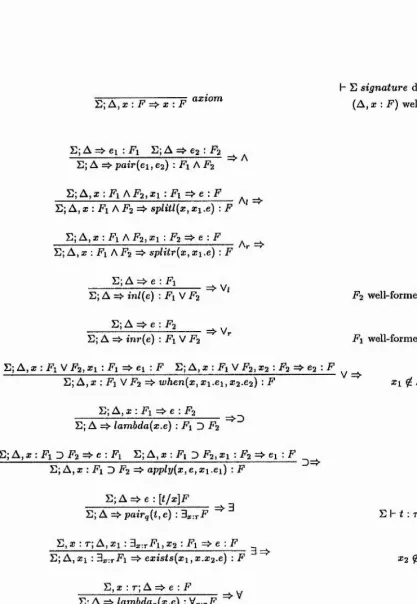
derivable (well-formed) sequent. The rules defining derivable sequents of are presented in Fig. 2.7.
As usual, rules of the form => C are called right rules and rules of the form C => are called
left rules. Observe that the outermost constructor of the proof-term of the conclusion of a right (left) rule is a right (left) constructor. In the rules for deriving sequents in Fig. 2.7: each of the formulae F, Fj A F2, Fi A F2, Fi V F2, Fi 3 F2, B^îtFi and 'ixirFi is, respectively, the main formula of axiom, Aj =>, Ar =>, V =*-, 3=>, 3 =>■ and V =>; Fi is the side formula of A{ =*-, F2 is the side formula of Ar =>, F\ and F2 are the side formulae of V =>•, F2 is the side formula of 3=>, Fi is the side formula of 3 => and [t/x]Fi is the side formula of V =*-.
Let TT be a derivation of the sequent E; A e : F. tt is called a derivation for deriving F
from E; A and e is called the proof-term of t t and is also called a proof-term for deriving F w.r.t. E; A. As for NJ^*, the proof-term e and the context of the endsequent of a derivation t t determine uniquely, up to renaming of bound variables of e , the derivation t t . So, we consider L J^^-derivations for deriving a formula F from a pair E; A to be equal if their proof-terms are equal.
T h eo rem 2.6 (w eakening adm issibility) Let E; A => e ; F 5e derivable in LJ^^, x ^ A and
let Fi be a well-formed formula w.r.t. E. Then, E; A, x : Fi e : F is also derivable in LJ^*.
P roof: Follows easily by induction on the derivation of E; A =)> c : F. Observe that (A, x : Fi) is a well-formed context w.r.t. E, since A is well-formed w.r.t. E, x ^ A and Fi is well-formed
w.r.t. E. □
2.3.3 P e rm u ta tio n s in
Kleene introduced in [Kle52] a notion of permutation on derivations, for Gentzen’s LK and LJ. Roughly, permutations are transformations on derivations that reverse the order in which inference rules occur in a derivation. As shown in [Kle52, Sha92], there are cases where reversing the order in which inference rules occur in an LJ-derivation is not possible. In the calculus LJ^^,
since the proof-term of a derivation determines uniquely the derivation up to renaming of bound variables, permutations on derivations may be captured at the level of proof-terms, as is shown below.
The rules on proof-terms shown in Figs. 2.8, 2.9, 2.10 and 2.11 are called permutations.
S; A, X : F =>• X : F axiom
h E signature derivable, (A, X : F) well-formed w.r.t. E
E; A =»• Cl : Fi E; A =»- eg : Fg E; A => pair(ei,cg) : Fi A Fg
E; A, X : Fi A Fg, xi : Fi => e : F
E; A,x : Fi A Fg => sp/t</(x,xi.e) : F E; A, X : Fi A Fg, xi : Fg =>• e : F E; A, X : Fi A Fg => splitr{x, xi.e) ; F
E; A e : Fi
A/ =>
Ar
E; A => in/(e) ; Fi V Fg
E; A e : Fg
V<
Vr E ; A => in r(e ) : F i V Fg
E ; A , X ; F i V Fg, x i : F j =» ei : F E ; A , x ; F i V Fg, xg : Fg =» eg : F E ; A ,x : F i V Fg => when{x,x i.ei,x g .e g ) : F
E; A , X : F i =» e : Fg E; A => lambda{x.e) ; F i 3 Fg
E; A , X : F i 3 Fg => e : F i E; A , x : F i 3 Fg, x i : Fg => ei : F
xi ^ A
xi ^ A
Fg well-formed w.r.t. E
Fi well-formed w.r.t. E
E; A,x : Fi 3Fg app/j/(x,e,xi.ei) : F
E; A => e : [</x]F E; A =>» pa i r q { t , e ) : 3 j ; :t F ^
E, X : r; A, Xj : 3r:rFi, xg : Fi e : F E; A ,xi : BajtrFi exists(xi,x.xg.e) : F
E, X : r; A =»• e : F E; A => lambdaq{x.e) : ^ E; A,xi : Va;:rFi,X2 : [</x]Fi =» e : F E; A,xi : VxjrFi =*- applyq{xi,t,X2.e) : F
3=^
xi ^ A, xg A
X ^ A
xi ^ A
E H i : r derivable
xg ^ A, X ^ E
X E
[image:33.612.82.500.62.667.2]xg ^ A, E h t : r derivable