Hyper-heuristics
Ahmed Kheiri1(B), Mustafa Mısır2, and Ender ¨Ozcan3
1 Operational Research Group, School of Mathematics, Cardiff University,
Senghennydd Road, Cardiff CF24 4AG, UK
2 Nanjing University of Aeronautics and Astronautics,
College of Computer Science and Technology, 29 Jiangjun Road, Nanjing 211106, China
3 ASAP Research Group, School of Computer Science, University of Nottingham,
Jubilee Campus, Wollaton Road, Nottingham NG8 1BB, UK
Abstract. Selection hyper-heuristics are high level search methodolo-gies which control a set of low level heuristics while solving a given problem. Move acceptance is a crucial component of selection hyper-heuristics, deciding whether to accept or reject a new solution at each step during the search process. This study investigates group decision making strategies as ensemble methods exploiting the strengths of mul-tiple move acceptance methods for improved performance. The empirical results indicate the success of the proposed methods across six combina-torial optimisation problems from a benchmark as well as an examination timetabling problem.
Keywords: Metaheuristic
·
Optimisation·
Parameter control·
Timetabling·
Group decision making1
Introduction
A selection hyper-heuristic is an iterative improvement oriented search method which embeds two key components;heuristic selectionandmove acceptance[3]. The heuristic selection method chooses and applies a heuristic from a set of low level heuristics to the solution in hand, producing a new one. Then the move acceptance method decides whether to accept or reject this solution. The mod-ularity, use of machine learning techniques and utilisation of thedomain barrier make hyper-heuristics more general search methodologies than the current tech-niques tailored for a particular domain are. A selection hyper-heuristic or its components can be reused on another problem domain without requiring any change. There is a growing number of studies on selection hyper-heuristics com-bining a range of simple heuristic selection and move acceptance methods [6,13].
c
The Author(s) 2016
More on any type of hyper-heuristic, such as their components and application areas can be found in [3].
Hyper-heuristics Flexible Framework(HyFlex) [11] was proposed as a soft-ware platform for rapid development and testing of hyper-heuristics. HyFlex is implemented in Java along with six different problem domains: boolean sat-isfiability, bin-packing, permutation flow-shop, personnel scheduling, travelling salesman problem and vehicle routing problem. HyFlex was used in the first Cross-Domain Heuristic Search Challenge, CHeSC 2011 (http://www.asap.cs. nott.ac.uk/chesc2011/) to detect the best selection hyper-heuristic. Following the competition, the results from twenty competing selection hyper-heuristics across thirty problem instances (containing five instances from each HyFlex domain) and the description of their algorithms were provided at the compe-tition web-page.
A recent theoretical study on selection hyper-heuristics in [10] showed that the mixing of simple move acceptance criteria could lead to an improved running-time complexity than using each move acceptance method standalone on some simple benchmark functions. In [1,8] different move acceptance criteria were used under an iterative two-stage framework which switches from one move acceptance to another at each stage. The previous work [2,13] indicates that the overall performance of a heuristic depends on the choice of selection hyper-heuristic components. This study extends the initial work in ¨Ozcan et al. [12] by applying and evaluating four group decision making strategies as ensemble methods using three different move acceptance methods in combination with seven heuristic selection methods on an examination timetabling problem [2]. The same selection hyper-heuristics are then tested on thirty problem instances from six different domains from the HyFlex benchmark.
2
Group Decision Making Selection Hyper-heuristics
An overview of heuristic selection and move acceptance methods as a part of the selection hyper-heuristics as well as the group decision making methods forming an ensemble of move acceptance used in this study is described in this section.
This paper studies ensemble move acceptance methods combining them under a group decision making framework. Considering that a constituent move acceptance method returns either true (1) or false (0) at each decision point, Eq.1 provides a general model for an ensemble of k methods. In this model, each move acceptance carries a certainstrength (si) which adjusts its contribu-tion towards a final acceptance decision.
k
i=1
si×D(Mi)≥α (1)
where Mi is the ith move acceptance (group member), D(m) returns 1, if a solution is accepted by the move acceptance methodm, and 0, if rejected.
In this study, we use group decision making strategies which make an accept/reject decision based onauthority, minorityand majority rules, namely G-OR (the move acceptance method which accepts the solution has the author-ity), G-AND (minority decides rejection), G-VOT and G-PVO (considers major-ity of the votes for the accept/reject decision). G-PVO probabilistically makes the accept/reject decisions. The probability that a new solution is accepted changes dynamically in proportional to the number of members that voted to the acceptance of the new solution. For instance, assuming 6 members in the group out of 10 move acceptance methods accepts a solution at a given step, then G-PVO accepts the solution with a probability of 60 %. It is preferable in G-VOT to have an odd number of members for the group decision making move acceptance criteria, where none of the other strategies requires this. More formally, using Eq.1, assuming k move acceptance methods, then for G-AND, G-OR and G-VOT,αisk, 0.5 andk/2, respectively, where allsi values are set to 1. For G-PVO, αequals k∗r, wherer is uniform random number in [0, 1], andsi values equal 1/k.
In this study, the heuristic selection methods in {SR, RD, RP, RPD, CF, GR, TABU}are paired with four group decision making move acceptance mech-anisms{G-AND, G-OR, G-VOT, G-PVO}, generating twenty eight group deci-sion making selection hyper-heuristics. From this point forward, a selection hyper-heuristic will be denoted as “heuristic selection method” “move accep-tance method”. For example, SR G-AND denotes the selection hyper-heuristic using SR as the heuristic selection method and G-AND as the move acceptance method.
Each group decision making move acceptance ensemble tested in this study embeds three move acceptance methods: Improving and Equal (IE), Simulated Annealing (MC) and Great Deluge (GD). These group members are chosen to form the ensemble move acceptance due to their high performance reported in [13]. IE accepts all non-worsening moves and rejects the rest. Simulated Anneal-ing [9] move acceptance criterion, denoted as MC in this paper, accepts all improving moves but the non-improving moves are accepted with a probabilistic formula,pt, shown in Eq.2.
pt=e−
Δf ΔF(1−t
where Δf is the fitness change at time or step t, T is the time limit or the maximum number of steps and ΔF is an expected range for the maximum fitness change. GD acceptance criterion accepts all the improving moves but the non-improving moves are accepted if the objective value of the current solution is not worse than an expected value, named as level [7]. Equation3 is used to update the threshold levelτt at time or stept.
τt=F+Δf×(1−Tt) (3)
where T is the time limit or the maximum number of steps, Δf is an expected range for the maximum fitness change andF is the final objective value.
3
Computational Experiments
Pentium IV 3 GHz LINUX machines having 2.00 GB memories are used during the experiments. Following the rules of CHeSC 2011, each trial is run for 10 nom-inal minutes with respect to the competition machine respecting the challenge rules. The group decision making selection hyper-heuristics are tested on an examination timetabling problem as formulated in [2] and the same termination criterion as in that study is used for the examination timetabling experiments to enable a fair performance comparison of solution methods. The GD and SA move acceptance methods use the same parameter settings as provided in [12].
Two sets of benchmarks are used for examination timetabling: Yeditepe
[14,15] and Toronto benchmarks [4] consisting of eight and fourteen instances,
[image:4.439.143.282.481.566.2]respectively. The mean performance of each group decision making move accep-tance method in a selection hyper-heuristic regardless of the heuristic selection method is compared to each other based on their ranks. The group decision making move acceptance methods are ranked from 1 to 4 for each problem instance and heuristic selection method from best to worst based on the mean cost over fifty runs. The approaches are assigned to different ranks if their perfor-mances vary in a statistically significant manner for a given instance. Otherwise, their performances are considered to be similar and an average rank is assigned to them all. A similar outcome is observed for the online performances of the
Fig. 2. Mean rank (and standard deviation) of the group decision making hyper-heuristics that generate statistically significant performance variance from the rest over all examination timetabling problems.
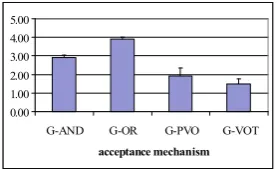
group decision making strategies as in the benchmark functions reported in [12]. G-VOT is the best acceptance mechanism based on the average rank over all the problems, while G-PVO, G-AND and G-OR follows it in that order, respectively as illustrated in Fig.1.
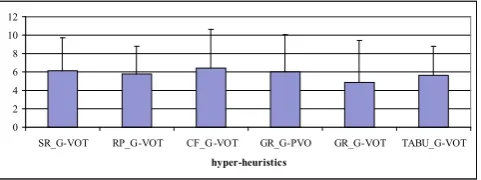
Similarly, all twenty eight hyper-heuristics are ranked from 1 to 28 (best to worst) based on the best objective values obtained over fifty runs for each instance. The ranks are averaged/shared in case of a tie. Figure2 illustrates the performance of six group decision making selection hyper-heuristics with a better mean performance that are significantly better as compared to the rest, from the best to the worst; GR VOT, TABU VOT, RP VOT, GR G-PVO, SR G-VOT and CF G-VOT.
Table 1.%imp. denotes the percentage improvement over the average best cost across fifty runs that the ‘current’ best hyper-heuristic(s) (investigated in this work) produces over the ‘previous’ best hyper-heuristic (reported in [2]) for each problem instance. If a hyper-heuristic delivers a statistically significant performance, it appears in the ‘cur-rent’ column. Bold entries highlight the best performing method. The hyper-heuristics that have a similar performance to the bold entry are displayed in parentheses. “+” indicates that all hyper-heuristics in{GR VOT, TABU VOT, RP VOT, GR G-PVO, SR G-VOT, CF G-VOT} has similar performance. “/” excludes the hyper-heuristic from this set that is displayed afterwards
instance current previous %imp.
yue20011 GR G-VOT+ SR GD 20.84
yue20012 RP G-VOT+ SR GD 24.93
yue20013 + SR MC 0
yue20021 TABU G-VOT+ SR GD 17.97
yue20022 GR G-PVO CF MC 3.97
yue20023 GR G-PVO CF MC 1.97
yue20031 GR G-PVO(GR G-VOT, SR G-VOT) CF MC 4.4
yue20032 n/a CF MC n/a
car91 I GR G-VOT+ TABU IE 81.37
car92 I GR G-VOT+/GR G-PVO TABU IE 196.89
ear83 I GR G-PVO(GR G-VOT) CF MC 1.1
hecs92 I GR G-PVO(GR G-VOT, SR G-VOT, TABU G-VOT) CF MC 21.46
kfu93 GR G-VOT+ SR GD 30.88
lse91 GR G-PVO+ CF MC 13.38
pur93 I GR G-PVO(SR G-VOT) SR IE 15.6
rye92 TABU G-VOT+ CF MC 41.67
sta83 I + SR MC 0
tre92 GR G-VOT+ SR GD 92.93
uta92 I GR G-VOT+/GR G-PVO TABU IE 36.36
ute92 GR G-PVO CF MC 0
yor83 I GR G-PVO+ CF MC 9.01
The twenty eight hyper-heuristics are implemented as an extension to HyFlex to check their level of generality across the CHeSC 2011 problem domains. Each experiment is repeated thirty one times following the competition rules. All heuristics are ranked using the Formula 1 scoring system. The best hyper-heuristic obtaining the best median objective value over all runs for each instance gets 10 points, the second one gets 8, and then 6, 5, 4, 3, 2, 1 and the rest gets zero point. These points are accumulated over all instances across all domains forming the final score for each hyper-heuristic.
Fig. 3. Median performance comparisons between different group decision making hyper-heuristics based on their Formula 1 scores.
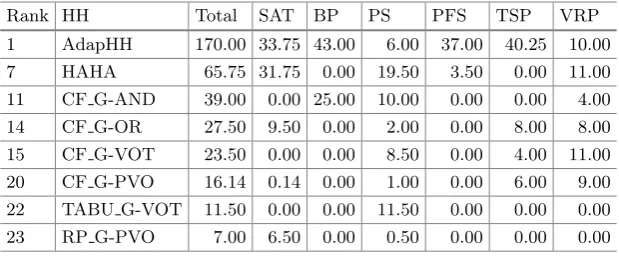
GR G-OR are the worst. RP G-PVO, CF G-AND, CF G-OR, TABU G-VOT, CF G-PVO and CF G-OR perform the best on boolean satisfiability (SAT), bin-packing (BP), personnel scheduling (PS), permutation flow-shop (PFS), travel-ling salesman (TSP) and vehicle routing problems (VRP), respectively. Table2 summarises the ranking of those six group decision making hyper-heuristics and all competing hyper-heuristics at CHeSC 2011, including the top ranking method, denoted as AdapHH. The top ten ranking hyper-heuristics from the competition remains in their positions and group decision making methods per-form relatively poor. CF AND is the third best approach for BP. TABU G-VOT comes sixth for PS. TABU G-G-VOT, CF G-AND and CF G-G-VOT score better than the CHeSC 2011 winner for the same problem. CF G-OR is the best among the group decision making methods for SAT, ranking the eighth. The best group decision making hyper-heuristic for TSP, i.e. CF G-OR, takes the ninth place. For VRP, CF G-VOT as the best hyper-heuristic with group decision mak-ing is the sixth best approach among the CHeSC 2011 competitors. However, its performance on VRP is still better than the winning approach. The performance
Table 2. Ranking of selected group decision making hyper-heuristics to the CHeSC 2011 competitors based on Formula1
Rank HH Total SAT BP PS PFS TSP VRP
1 AdapHH 170.00 33.75 43.00 6.00 37.00 40.25 10.00
7 HAHA 65.75 31.75 0.00 19.50 3.50 0.00 11.00 11 CF G-AND 39.00 0.00 25.00 10.00 0.00 0.00 4.00
14 CF G-OR 27.50 9.50 0.00 2.00 0.00 8.00 8.00
15 CF G-VOT 23.50 0.00 0.00 8.50 0.00 4.00 11.00 20 CF G-PVO 16.14 0.14 0.00 1.00 0.00 6.00 9.00
22 TABU G-VOT 11.50 0.00 0.00 11.50 0.00 0.00 0.00
[image:7.439.72.382.470.598.2]of all group decision making methods is poor on the PFS problem. CF G-AND is the group decision making hyper-heuristic winner and it ranks the eleventh when compared to the CHeSC 2011 hyper-heuristics with a total score of 39.00.
4
Conclusion
The experimental results show that the ensemble move acceptance methods based on group decision making models can exploit the strength of constituent move acceptance methods yielding an improved performance. In general, learning heuristic selection performs well within group decision making hyper-heuristics. Considering their performance over the examination timetabling benchmark problems, Greedy performs the best as a heuristic selection method. Combining multiple move acceptance methods using a majority rule improves the perfor-mance of Greedy as compared to using a single move acceptance method. On the other side, CF outperforms other standard heuristic selection schemes on the CHeSC 2011 benchmark, performing reasonably well in combination with AND-operator group decision making move acceptance. The proposed ensem-ble move acceptance methods enaensem-ble the use of the existing move acceptance methods and do not introduce any extra parameters other than the constituent methods have. Discovering the best choice of move acceptance methods in the ensemble as well as their weights is left as a future work. More interestingly, new adaptive ensemble move acceptance methods, which are capable of adjusting the weight/strength of each constituent move acceptance during the search process, can be designed for improved cross domain performance.
Open Access. This chapter is distributed under the terms of the Creative Com-mons Attribution 4.0 International License (http://creativecommons.org/licenses/by/ 4.0/), which permits use, duplication, adaptation, distribution and reproduction in any medium or format, as long as you give appropriate credit to the original author(s) and the source, a link is provided to the Creative Commons license and any changes made are indicated.
The images or other third party material in this chapter are included in the work’s Creative Commons license, unless indicated otherwise in the credit line; if such mate-rial is not included in the work’s Creative Commons license and the respective action is not permitted by statutory regulation, users will need to obtain permission from the license holder to duplicate, adapt or reproduce the material.
References
1. Asta, S., ¨Ozcan, E.: A tensor-based selection hyper-heuristic for cross-domain heuristic search. Inf. Sci.299, 412–432 (2015)
2. Bilgin, B., ¨Ozcan, E., Korkmaz, E.E.: An experimental study on hyper-heuristics and exam timetabling. In: Burke, E.K., Rudov´a, H. (eds.) PATAT 2006. LNCS, vol. 3867, pp. 394–412. Springer, Heidelberg (2007). doi:10.1007/978-3-540-77345-0 25
4. Carter, M.W., Laporte, G., Lee, S.Y.: Examination timetabling: algorithmic strate-gies and applications. J. Oper. Res. Soc.47(3), 373–383 (1996)
5. Cowling, P., Chakhlevitch, K.: Hyperheuristics for managing a large collection of low level heuristics to schedule personnel. In: IEEE Congress on Evolutionary Computation, pp. 1214–1221 (2003)
6. Cowling, P.I., Kendall, G., Soubeiga, E.: A hyperheuristic approach to scheduling a sales summit. In: Burke, E., Erben, W. (eds.) PATAT 2000. LNCS, vol. 2079, p. 176. Springer, Heidelberg (2001)
7. Kendall, G., Mohamad, M.: Channel assignment optimisation using a hyper-heuristic. In: IEEE Conference on Cybernetic and Intelligent Systems, pp. 790–795, 1–3 December 2004
8. Kheiri, A., ¨Ozcan, E.: An iterated multi-stage selection hyper-heuristic. Eur. J. Oper. Res.250(1), 77–90 (2016)
9. Kirkpatrick, S., Gelatt, C.D., Vecchi, M.P.: Optimization by simulated annealing. Science220, 671–680 (1983)
10. Lehre, P.K., ¨Ozcan, E.: A runtime analysis of simple hyper-heuristics: to mix or not to mix operators. In: Workshop on Foundations of Genetic Algorithms XII, pp. 97–104 (2013)
11. Ochoa, G., et al.: HyFlex: a benchmark framework for cross-domain heuristic search. In: Hao, J.-K., Middendorf, M. (eds.) EvoCOP 2012. LNCS, vol. 7245, pp. 136–147. Springer, Heidelberg (2012)
12. ¨Ozcan, E., Misir, M., Kheiri, A.: Group decision making hyper-heuristics for func-tion optimisafunc-tion. In: The 13th UK Workshop on Computafunc-tional Intelligence, pp. 327–333, September 2013
13. ¨Ozcan, E., Bilgin, B., Korkmaz, E.E.: A comprehensive analysis of hyper-heuristics. Intell. Data Anal.12(1), 3–23 (2008)
14. ¨Ozcan, E., Ersoy, E.: Final exam scheduler - fes. In: Corne, D., Michalewicz, Z., McKay, B., Eiben, G., Fogel, D., Fonseca, C., Greenwood, G., Raidl, G., Tan, K.C., Zalzala, A. (eds.) IEEE Congress on Evolutionary Computation, pp. 1356– 1363 (2005)
![Table 1. %PVO, SR G-VOT, CF G-VOTimp. denotes the percentage improvement over the average best cost acrossfifty runs that the ‘current’ best hyper-heuristic(s) (investigated in this work) producesover the ‘previous’ best hyper-heuristic (reported in [2]) fo](https://thumb-us.123doks.com/thumbv2/123dok_us/8649854.373326/6.439.44.380.158.445/percentage-improvement-acrossfty-heuristic-investigated-producesover-previous-heuristic.webp)