ON THE CONSTRUCTION OF PERSISTENT PROGRAMMING
ENVIRONMENTS
Alan Dearle
A Thesis Submitted for the Degree of PhD
at the
University of St Andrews
1988
Full metadata for this item is available in
St Andrews Research Repository
at:
http://research-repository.st-andrews.ac.uk/
Please use this identifier to cite or link to this item:
http://hdl.handle.net/10023/13490
THE BRITISH LIBRARY
DOCUM ENT SUPPLY CENTRE
PhD Thesis by
We have given the above thesis the Document Supply Centre
identification number:
D x ‘S U)
ProQuest Number: 10167268
All rights reserved
INFORMATION TO ALL USERS
The quality of this reproduction is dependent upon the quality of the copy submitted.
In the unlikely event that the author did not send a com plete manuscript and there are missing pages, these will be noted. Also, if material had to be removed,
a note will indicate the deletion.
uest
ProQuest 10167268
Published by ProQuest LLO (2017). Copyright of the Dissertation is held by the Author.
All rights reserved.
This work is protected against unauthorized copying under Title 17, United States C ode Microform Edition © ProQuest LLO.
ProQuest LLO.
789 East Eisenhower Parkway P.Q. Box 1346
On the Construction of
Persistent Programming Environments
Alan Dearie
Computational Science Department
University of St. Andrews
St. Andrews
Declaration
I Alan Dearie hereby certify that this thesis has been composed by myself, that it is a record of my own work, and that it has not been accepted in partial or complete fulfilment of any other degree or professional qualification.
I was admitted to the Faculty of Science of the University of St. Andrews under Ordinance General No. 12 on l^f October 1983 and as a candidate for the degree of Ph.D. on l^t Febuary 1985.
I hereby certify that the candidate has fulfilled the conditions of the Resolution and Regulations appropriate to the Degree of Ph.D.
I
i
I
*'1*1
In submitting this thesis to the University of St. Andrews I understand that I am giving permission for it to be made available for use in accordance with the regulations of the University Library for the time being in force, subject to any copyright vested in the work
not being affected thereby. I also understand that the title and abstract will be published, and $ that a copy of the work may be made and supplied to any bona fide library or research
Abstract
This thesis presents research into the construction of persistent programming systems. Much of the thesis is concerned with the design and implementation of persistent programming languages, in particular PS-algol and Napier. Both languages support machine independent vector and raster graphics data types. Napier provides an environment mechanism that enables the incremental construction and binding of programs. Napier has a
powerful type system featuring parametric polymorphism and abstract data types.
I
TThe machine supporting Napier, the Persistent Abstract Machine, is investigated. The machine supports an efficient implementation of parametric polymorphism and abstract data
types.The Persistent Abstract Machine has a layered architecture in which permits ÿ experimentation into language implementation and store design.
The construction of compilers in a persistent environment is explored. A flexible compiler architecture is developed. With it, a family of compilers may be constructed at relatively little cost. One such compiler is the callable compiler; this is a first class data object in the persistent environment. The uses of such a compiler are explored, in particular in the construction of an object browser.
Acknowledgements
A number of people must be thanked for their help during this project. Firstly, Professor Ron Morrison, my supervisor, for his constant patience, advice, encouragement and good humour. Fred Brown, my sparring partner for the last five years, who is always ready to #
„l "fix" problems that arise. Richard Connor, for his part in implementing the Napier type
checking module and for his suggestions on parametric polymorphism. The final member of the PISA project at St. Andrews, Ray Carrick, must also be thanked for his part in the research effort.
Others that must be mentioned are: Professor Malcom Atkinson for, amongst other things,
inventing persistence, Dr. Paul Cockshott for his advice in "the early days" and Pete Bailey || whose mark is unmistakeable on parts of the PS-algol and Napier abstract machine. f
The Apple Computer Corporation also deserve a mention for producing an excellent
f % document production vehicle.
Contents
1 Introduction 1
1.1 Writing Less Code 2
1.1.1 Language Design 3
1.2 Avoiding Rework 5
1.2.1 Uniform Treatment of Program and Data 6
1.2.2 Software Reuse 7
1,3 Using Integrated Project Support Environments 8
1.3.1 Public Common Tools Interface 10
1.3.2 Ada Programming Support Environment 10
1.4 Object Storage 11
1.4.1 Identification of Persistence 14
1.4.2 Persistence in PS-algol 15
1.5 The Napier System 16
1.6 Persistent Information Space Architecture 18
1.7 Thesis Browsing 19
1.7.1 Language Domain 19
1.7.2 System Building Domain 20
1.7.3 Applications Domain 20
1.8 Conclusions 21
2 Environments 22
2.1 Introduction 22
2.2 Contextual naming 23
2.3 Bindings 25
2.4 Programming in the large 27
2.5 Static Contexts 28
2.6 Language Approaches 28
2.6.1 Galileo 30
2.6.2 Namespaces 31
2.6.3 Program Editors 34
2.7 Environments 34
2.7.1 Type Checking 37
2.7.2 Binding to Environments 39
2.7.3 Simulation of Scope 41
2.7.4 Binding to the Persistent Store 42
2.7.5 Supporting incremental construction 44
3 Graphics 51
3.1 Introduction 51
3.2 Pictures 53
3.2.1 Storing a Picture in a Database 57
3.2.2 Retrieving a Picture From a Database 59
3.3 Raster Graphics 60
3.3.1 Pixels 60
3.3.2 Images 61
3.3.3 Raster-op 63
3.3.4 Aliasing 64
3.3.5 Colour Mapping 65
3.3.6 Mapping Pictures and Images to Output Devices 67
3.3.7 Fonts and Menus 68
3.4 User Interaction 70
3.5 Implementation 71
3.6 Conclusions 72
4 The System Building Domain 73
4.1 Introduction 73
4.2 History 73
4.2.1 The S-algol abstract machine 74
4.2,1.1 Object management 74
4.2.2 The PS-algol abstract machine 75
4.2.2.1 Frames 76
4.2.2.2 Addressing 76
4.2.2.3 Objects 77
4.2.2.4 The Standard Frame 78
4.2.2.5 The VO system 79
4.2.2.6 Persistent Object Support 79
4.2.2.7 Pids and Lons 80
4.3 The Persistent Abstract Machine 81
4.3.1 Design Principles 81
4.3.2 Heap Objects 83
4.3.3 PAM Object Formats 84
4.3.3.1 Strings 85
4.3.3.2 Files 85
4.3.3.3 Vectors 86
%
4.3.3.6 Code Vectors 87
4.3.3.7 Stack Frames 89
4.3.3.8 Abstract Data Types 90
4.3.3.9 The Root Object 91
4.3.4 Stable Storage 92
4.3.5 The Instruction Set 94
4.3.6 Types 94
4.3.7 Support for Infinite Unions 95
4.3.8 Implementation of Variants 97
4.3.9 Polymorphism 98
4.3.9.1 First Class Procedures 100
4.3.9.2 Parameter Passing 101 ?
4.3.9.3 Returning Values 102 |
4.3.9.4 Structure Creation 103
4.3.9.5 Implementation Approaches 103 2
4.3.9.6 PAM Implementation of polymorphism 104
4.3.10 Abstract Data Types 108
4.3.10.1 Potential Problem Areas 111
4.3.10.2 PAM Implementation of abstract data types 111
4.3.11 Debugging Support 112 |
4.4 Conclusions 113 1
5 Abstract Program Graphs 115 ||
5.1 Introduction 115
5.2 Traditional Compilation Systems 115 "
5.3 Persistent Systems 117
5.4 Persistent Architecture Intermediate Language 117
5.4.1 PAIL graphs 118
5.4.1.1 Basic tree structure 119
5.4.1.2 Symbol tables 119
5.4.1.3 Control 120
5.4.1.4 Assignment 121
5.4.1.5 Store Allocation 121
5.4.1.6 Indexing 122
5.4.1.7 Scoping 122
5.4.2 Support for system building 124
5.4.2.1 Code Generation 125
5.4.2.2 Debugging 126
S.4.2.4 Syntax Directed Editing 131
5.4.2.5 Distribution 132
5.4.Z6 Protection 133
5,5 Conclusions 135
6 The Compilation environment 136
6.1 Introduction 136
6.2 Advantages of using a persistent environment 137
6.3 Architecture Composition Rules 139
6.3.1 I/O independence 139
6.3.2 Plug Compatibility 140
6.3.3 Binding Independence 144
6.3.4 Information Hiding 146
6.4 Compiler Composition 147
6.5 First Class Compilers 150
6.6 Interactive Compilers 153
6.7 Conclusions 156
7 Browsing 157
7.1 Introduction 157
7.2 Graphics 158
7.3 A Simple Browser 158
7.4 A First Class Compiler 162
7.5 Binding 162
7.6 Fire Walls 165
7.7 Performance 166
7.8 Persistence 166
7.9 Browser Software Architecture 167
7.10 Browsers as a bootstrapping tool 168
7.11 Adaptive Databases 169
7.12 Conclusions 170
8 Conclusions 171
8.1 Programming Language Design 171
8.1.1 Graphics 171
8.1.2 Environments 172
8.1.3 Polymorphism 173
8.2 Abstract Machine Design 173
8.2.1 Modularisation 174
8.3 Compiler construction 175
8,3.1 Modularisation 175
8.3.2 PAIL 176
8.3.3 Optimisations 176
8.3.4 Callable Compilers 176
8.4 Adaptive Object Browsers 177
8.5 Future Research 177
8.5.1 Windows 178
8.5.2 Browsing Information Graphs 179
8.5.3 Debugging 180
8.6 Finally 181
Appendix I Persistent Abstract Machine Reference Manual 182
A l.l Introduction 183
A1.2 Abstract Machine Registers 185
A1.3 Heap Formats 186
Al.3.1 Headers 186
Al.3.2 Strings 186
Al.3.3 Files 187
Al.3.3.1 Disk Files 187
Al.3.3.2 Terminal Files 187
Al.3.3.3 Mouse and Tablet Files 187
Al.3.3.4 Raster Files 187
Al.3.4 Vectors 188
Al.3.5 Images 188
Al.3.6 Structures 189
Al.3.7 Code Vectors 190
Al.3.8 Frames 191
Al.3.9 Abstract Data Types 191
Al.3.10 Root Object 191
A1.4 Abstract Machine Code 192
Al.4.1 Jumps 194
Al.4.2 Stack Load and Assignment Instructions 197
Al.4.3 Polymorphic Operations 204
Al.4.4 Stack Duplicate Operations 204
Al.4.5 Stack Retract Operations 205
Al.4.6 Block Entry and Exit 205
Al.4.7 Procedure Entry and Exit 206
A l.4,9 Vector and Structure Creation Instructions 215 A1.4.10 Vector and Structure Accessing Instructions 218
Al.4.11 String Operations 222
Al.4.12 Load Literal Instructions 223
A1.4.13 Primitive VO Interface 223
Al.4.14 Comparison Operations 227
Al.4.15 Arithmetic and Boolean Operators 230
A1.4.16 Miscellaneous 235
A 1.5 Persistence Hooks 236
Al.5.1 Interpreter Interface to the Stable Store 236 Al.5.2 Interface Functions to the Napier Heap 236
A1.5.2,1 initialise_heap 236
Al.5.2.2. shutdown_heap 236
Al.5.2.3. create_object 236
Al.5.2.4. destroy_object 236
A l.5.2.5. illegal_address 237
Al.5.2.6. first_object 237
A1.5.2.7. checkpoint_heap 237
Al.5.2.8. garbage_collect 237
A 1.6 Abstract Machine Operation Codes 240
A 1.7 Code file format 244
Appendix II PAIL definition 245
1 Introduction
The constant decrease in the cost of hardware components has given rise to a proliferation of computer systems in every aspect of everyday life. Kettles, toys, aircraft, libraries, banks and nuclear power stations are all affected by the so called computer revolution. The dramatic reduction in the cost of hardware is unparalleled in the industrial revolution. In no other area have production costs halved and power doubled in an unerring four year cycle [bro87]. Consequently, it should be of no surprise that the software industry has failed to match this explosive growth.
The software crisis of the 1960's [bux69] brought into focus the fact that hardware development was advancing faster than the ability to produce software. The crisis was catalysed by the availability of the newly available third generation computer hardware. It was capable of providing hardware support for sophisticated systems at moderate costs. However, the production of software systems could not match the demand caused by the arrival of these systems.
Since the 1960's the problem has not diminished, in fact, software production costs have increased in the intervening period. This is largely due to the labour intensive nature of software production. Software cannot be mass produced like cars[weg84]. Unlike cars, no two pieces of software are identical, since if they are, they are merged into a single abstraction.
The real costs of software production are now astronomical. It has been estimated [joe83] that, in America, software production and maintenance now costs 2% of the gross national product. Therefore even small savings made to the software life cycle will result in a vast reduction in economic expenditure.
,1
Boehm [boe86] gives four strategies for improving software productivity:•I
Jj
1. Write less code t
2. Get the best from people
3. Avoid re-work -|
4. Develop and use integrated project support environments
Getting the best from people is the domain of managers. The other three topics provide the thrust for the work documented in this thesis. This view point is retrospective since Boehm had not given his address when the work was started.
1.1 Writing Less Code
A program satisfying some specification may be produced in less fewer of code if written in % a high level language rather than a low level one. For example, a ten line program written in # Ada may be equivalent to a few hundred lines of assembly code. An IBM survey [ibm78] *1 found that programmers produce approximately the same number of lines of code per day i no matter what languages are used. This in turn means that the cost of program is directly | proportional to its size. Therefore if a high level language is used to produce a product fewer programmer days are required to produce it - resulting in lower costs.
The provision of programming languages with a high degree of compile time type checking allows errors in programs to be detected early in the software life cycle. Systems written in languages with strong type systems take longer to write but contain fewer semantic errors [boe87]. This leads to less time being needed in the testing and debugging phase of software development and, perhaps most importantly, the resulting code requires less maintenance. ^
The production of a piece of software is highly labour intensive and its cost is directly
proportional to the amount of programmer time that is required to produce it. It is therefore ?i
perform more checks to ensure a program is well typed but this results in less time being spent by the programmer during the potentially expensive debugging cycle.
The advantages of using very high level languages motivated the U.S. Department of Defense to adopt Ada [ada83] as a standard language. One of the design aims of Ada was to provide a language in which the specification of programs was indistinguishable from their implementation. This has also been the aim of researchers designing so called executable specification languages [gog82,kre80].
The use of prototyping has been compared with specification techniques in experiments [boe87]. In these experiments it was found that the use of prototyping resulted in 40% less code being produced with 40% less effort. Furthermore, the resulting products were easier to understand and therefore maintain.
Balzer [bal87] stresses the need to be able to evolve prototypes into an operational system rather than discarding prototypes. This result suggests that the programming systems we develop should support a smooth transition between prototypes and products.Therefore, an incremental development facility is required to support prototyping Prototypes are highly complex, structured objects requiring more sophisticated support tools than a mere text editor. In general, such incremental development requires an integrated project support environment ( IPSE ).
1. command languages 2. filing systems 3. compilers 4. interpreters 5. linkers
6. symbolic debuggers 7. DBMS sublanguages 8. graphics libraries
The diversity of these mechanisms increases the cost of maintaining even the simplest software systems. The approach taken in designing PS-algol [ps87] and its successor, Napier [mor88b] is to attempt to provide a language capable of supporting all of the needs of the application programmer. The resulting simplification should result in an overall saving throughout the life cycle of the program [atk83].
1.1.1 Language Design
The provision of high level languages leads to a reduction in programmer time spent on a
given problem. A high level programming language should be capable of supporting the l|
development of a broad spectrum of applications, %%
I
1. development of data models |
2. generic toolsets 3. object based systems 4. adaptive systems 5. user interfaces
4
0
Simplicity is the cornerstone of programming language design. The addition of new featureswithout integrating them into an overall framework merely increases the complexity of the system. This complexity often overloads the programmer beyond his or her capability. In # contrast, a simple language allows the programmer to concentrate on the inherent problems of the task and not on the mapping between the solution and the programming vehicle. This view was epitomised by van Wijngarden [vw69] who states.
I
In order that a language be powerful and elegant it should not contain many concepts.
This message is restated by van Wijngarden as,
power through simplicity, simplicity though generality %
He argues that languages are too complex and that complexity is due, at least in part, to
languages being too restrictive. The PISA [atk86b] languages are designed using three % principles attributed to Landin [lan66], Strachey [stra67], Tennant [ten77] and Morrison
[mor73].
The Principle o f Correspondence: the use of names should be consistent within a system. In particular there should be a one to one correspondence between the method of introducing names in declarations and parameter lists
The Principle of Abstraction: all major syntactic categories should have abstractions defined over them. For example, functions are abstractions over expressions.
The Principle o f Data Type Completeness: all data types should be first class without arbitrary restriction on their use.
■■■I
... . . y,. .. ^ , ...
I
I
■i to step outside it for any computational task. Central to this ideology is the provision of
orthogonal persistence, which is discussed below.
1.2 Avoiding Rework
Parnas cites information hiding as one of the most effective ways of avoiding rework [par79]. If implementation decisions are hidden inside module interfaces, ripple-through effects may be avoided when changes are made to one part of a system. This approach has proved extremely effective in eliminating rework during system evolution.
The concept information hiding is central to the object-oriented methodology which is based on ideas originally developed in Simula [nyg70]. In this paradigm, methods may produce or modify members of a class of objects. Wegner [weg87] defines object-oriented languages as having three essential features:
1. the ability to define objects as a set of operations and a state that remembers '&
the effect of operations;
2. objects may be categorised by type; and
3. there is an inheritance mechanism for defining superclasses and subclasses.
The support of objects, which contain both methods ( procedures ) and instances ( data ) is in contrast with the traditional separation of code and data.
1.2.1 Uniform Treatment ofProgram and Data
The main advantage of providing first class procedures as data objects is that there is a simple and well understood mechanism for system construction. Therefore no special provision needs to be made for the provision of libraries and loaders. Separate compilation may also be achieved by running procedures ( a compiler ) that introduce procedures into the environment. This technique is discussed fully in chapter 6. The power that may be extracted from first class functions is fully discussed in [atk84] and [mor85].
The implementation of languages with first class functions provides some problems not otherwise encountered. Solutions to these problems are fully discussed in chapter 4
1.2.2 Software Reuse
The cheapest way of obtaining software is to reuse code that has already been produced. The most extreme form of this reuse is purchasing "off the shelf packages. If software is to be reused successfully, it is important that mechanisms are provided in the environment to support reuse. Several questions arise over how this support may be provided, some of these are:
1. How do you write programs that may be reused? 2. How do you store reusable programs?
3. How do you catalogue reusable programs? 4. How do you find a program to reuse?
The provision of a polymoiphic type system may be used to facilitate the writing reusable software [mor87a]. To support the reuse of software the system must be capable of storing
The power of first class functions has long been known to lisp [mcc62] programmers, Lisp 4 was the first programming language to have first class procedures. The technique of
applicative programming depends on the ability to have procedures as first class data
■| objects.
j
& the polymorphic and other functions that are produced. It is important that the storage of
Systems vary considerably in the amount and nature of integration that they support. Consider the Macintosh toolset [mac86] and the Unix programming environment [ker79].
The Macintosh toolset has regular sub-systems with well documented interfaces and conventions. For example, a set of facilities are provided for managing graphics data and another for managing system events. The application developer may combine these facilities to produce complex applications with ease. The toolbox functions interface most sthoothly with Pascal programs although they may be used from programs written in other languages with a little more trouble.
:>
I
]
code preserves the type information associated with it or many of the advantages of using a ’ strong type system may be lost.
Storing a potentially reuseable piece of code is of little use unless someone else may find it and reuse it. One of the most effective ways of discovering what code is available to reuse is by browsing over it. This technique has been used successfully in the design of the Smalltalk-80 [gold83] system and much its success may be attributed to it. Browsing has proved to be of utility in browsing strongly typed objects in PS-algol. The PS-algol object browser is discussed in chapter 7.
1.3 Using Integrated Project Support Environments
If IPSE's make software cheaper to produce it must be ascertained that the definition of an IPSE is clear. Boehm distinguishes an IPSE from a collection of ad-hoc tools by the amount of gross integration available [boe86]. The tools available in toolkits such as Unix work in isolation. Tools operate in isolation with no knowledge of other tools or of any special data structures being used. On the other hand in an IPSE the tools share common schemata. Each has specialised knowledge of the data being manipulated and tools may even use other tools in the system. The IPSE operates as a central depository where objects being manipulated
may be found and where schema information is stored. f
The Unix environment lacks the fine grain system integration of the Macintosh. Libraries of functions are provided to support various programming activities but do not have the coherent structure of the Macintosh toolkit. However, Unix provides much more global integration than the Macintosh, Tools are provided for a variety of tasks, for example,
C specific tools: cc, dbx, lint
documentation tools: spell, troff, wc configuration management tools: make,SCCS
help tools: apropos,man
These tools may be combined by the extremely powerful mechanism of the pipe. Pipes allow the output of one process to be connected to the input of another. Programmers may chain tools together to provide yet more powerful ones.
Unix does provide libraries of functions, typically these libraries provide mechanisms to support tasks such as mathematical functions and 1/0. When a programmer wishes to use these libraries a linker is employed to resolve addresses. The linker produces a new program with copies of the library functions bound into the program. This means that if a function is
heavily used many copies of it exist in the system resulting in large modules of executable | code. Furthermore, if a library function is changed for any reason all the code that uses that
function must be relinked. This is an expensive mechanism for supporting software reuse.
"I;
1
The need to map structured data to flat data and vice versa is aggravated in Unix by the lack of any ability to share data in primary memory. In most Unix systems it is impossible to share data structures in RAM between different processes. The first level of sharing data is therefore at the file system level which requires data to be mapped via the I/O system.
Due to the relative expense of process invocation in Unix, tools tend to be large objects. The tools are generally written in the language C and invoked from the command language known as the shell [bou78]. This results in many useful pieces of code being trapped within tools. Reuse in Unix is therefore good at the global level but poor at the subsystem level.
1.3.1 Public Common Tools Interface
The Public Common Tools Interface ( PCTE ) is an architecture designed to provide several important facilities to application developers, these include:
1. Reduce development costs of tools. 2. Facilitate the exchange of software tools.
3. Allow integration of tools in comprehensive, uniform and homogeneous Software Engineering Environments
The above considerations lead the designers naturally to the realization that a unified framework is required to support such an architecture. Furthermore, this architecture needs i to be based on powerful mechanisms, especially in the area of object management. However, one of the criteria placed upon the designers of PCTE was that a smooth
transition must be possible between current programming practices and the use of PCTE. %
Therefore, the system had the limitation that initially tools had to operate in the Unix
I
environment. The limitations of this design decision have already been discussed.
I
i
1.3.2 Ada Programming Support Environment
The developers of Ada recognised that in addition to a high level language a programming support environment was also necessary. Without such an environment, programs written in a high level language must depend on operating system facilities. This in turn reduces the portability advantages of using a high level programming language.
Another strong motivation for the provision of a common support environment was the observation that the size and complexity of support software often exceeds the size of the embedded system being supported. If the environment is shared between many developers this high support cost may also be shared resulting in a reduction of the total software cost.
A number of constraints were placed on the design of the APSE Architecture [dod83].
These constraints are similar to the constraints placed upon the design of the Persistent S Abstract Machine although the motivations were slightly different. To achieve portability the
following constraints were made upon the APSE design: |
1. All tools must be written in Ada
2. The APSE must be structured in layers, each layer being dependent on only ÿ the subsidiary layer.
3. One layer, the kernel layer, must provide access to a system database and facilitate communications
1.4 Object Storage
Boehm cites the provision of a project master data base or persistent object base as one of the important features distinguishing an IPSE from a collection of ad-hoc tools. The need for a uniform, homogeneous object storage facility is also identified by the PCTE and the ADA Apse designers.
f V-K.' .V 5 ' ""X -V> ,f# ., ' Y V •• ." . .. . ■• •. - • - ^ ' " ■ ' ' t ' ' " . . . . ..T.
' '
I
!'■Ï
I
Therefore, the programmer is faced with the task of mapping data onto long term storage; f this is usually provided by the file system or DBMS. The mapping of data between long and
However, if data falls into the second category it is managed by a file system or a database management system. Curiously, a completely different set of modelling techniques have developed to structure long term data. In this category, the methods adopted include relational [cod70], hierarchical [loc78], network [tay76] and functional data models [shiSl].
short term storage is expensive, both in terms of programmer design time and program run | time. In 1978, Atkinson [atk78] recognised this problem and isolated a property of data
:s
known as persistence. S
Persistence is defined to be the length of time for which data exists and is usable [atk83]. It is therefore an abstraction over a physical property of data; the length of time it is kept. Traditionally, programming languages partition data into two categories:
« 1. data whose lifetime does not exceed program invocation
2. data whose lifetime does exceed program invocation
If data falls into the first category, it is managed entirely by the programming language. Programming language designers have developed many different methods of structuring this
data, these vary from relatively simple objects such as arrays to more complex ones such as f
■f
abstract data types.
A second more serions disadvantage of maintaining two forms of data is that data type protection is lost across the mapping. A structure used to aid comprehension in the programming language domain may not be available in the DBMS or file system.
In persistent programming languages the issue of what data structuring techniques are required is separated from a concept known as persistence. For example, in a persistent system, relations could be used as a logical structuring technique without concern with their long term storage.
In accordance with the rules of Strachey, Landin and Tennant given above, three new rules for persistent data have been given in [atk83]. They are:
The Principle of Persistence Independence: The persistence of a data object is independent of how the program manipulates that data object and conversely a fragment of program is expressed independently of the persistence of data it
manipulates. For exanple, it should be possible to call a procedure with its parameters sometimes objects with long term persistence and at other times only
transient.
The Principle of Persistent Data Type Completeness: In line with the principle of data type completeness all data objects should be allowed the full range of persistence.
In a persistent system the use of all data is independent of its persistence. This notion of persistence may be extended to abstract over all the physical properties of data, for example, where it is kept, how long it is kept and in what form it is kept [mor87b]. The use of the persistence abstraction removes the need to explicitly program for the differences in the use of long and short term data.
environments. Indeed, the ability of a persistent store to transparently manage the long term storage of complex data objects makes it an ideal vehicle for building many applications and indeed, Atkinson's original motivation for investigating persistence was to support computer aided design ( CAD ) systems.
The problems in CAD systems are similar to the ones facing the designer of an IPSE. The most obvious similarity is the need to share potentially large amounts of structured information which may persist over arbitrary periods of time. This ability of a persistent store is in marked contrast to the unstructured byte streams supported by Unix. Another similarity is the inherent complexity of the problem domain. In such systems the management of long term data often makes a clean design, with the corresponding lower software maintenance costs, extremely difficult.
The problems associated with scale are often overlooked. Both CAD systems and IPSE's are large, complex pieces of software. If a system is small it is easy to maintain and understand. Systems such as those discussed are so large and complex that it is almost impossible to understand all of them except at the highest levels of abstraction. A persistent system must therefore provide support for programming in the large as well as programming in the small.
The persistent store serves as a unified repository of the entities created during the software development process. A persistent store is therefore an ideal vehicle for the construction of IPSE's [mor85] and other large systems.
system construction and mechanisms to control change must also be supported if the language is to be used for the construction of large software systems.
Two programming language systems have been used as vehicles to explore the problems outlined above. Both languages, PS-algol and Napier, treat persistence as an orthogonal property of data. The following sections introduce the research areas addressed in this thesis.
1.4.1 Identification of Persistence
There are three main methods for identifying this persistent data:
1. All data persists.
2. Only data explicitly marked persists.
3. All data reachable from one or more roots will persist.
The languages PS-algol [ps87] and Napier [mor88b] both use the third method of : identifying persistent data, the reasons for tliis are discussed in [bro88]. The implementation
j
mechanisms behind this are discussed in chapter 4. How persistence appears at a languagelevel is discussed below.
1.4.2 Persistence in PS-algol
In the language PS-algol, persistence is provided by an extendible number of roots known as databases. Every object reachable from the transitive closure of a database is persistent.
A named database may be opened for reading or writing by a function called open.database. It is defined as follows
let open.database = proc( string name, password, mode -> pntr )
third is the mode in which it is to be opened. Acceptable modes are "read" or "write". The procedure returns a pointer. In PS-algol the datatype pntr is comprised of the infinite union
of all labelled cross product types. By convention databases always point to an associative | structure, implemented within the language, known as a table.
In PS-algol a primitive transaction mechanism is provided called commit. Commit makes all changes made to the persistent store permanent. If a user operates against the persistent store and does not call commit no permanent changes are made to the store. Therefore not calling
commit from within a program is equivalent to aborting a transaction. Commit is an atomic % ■i
action - that is it either happens or it does not. Commit is defined as follows, 4
let commit = proc( -> pntr )
The pointer returned by commit is nil if the commit is successful or a pointer to a structure class, called error.record, containing error information. The class error.record is defined in PS-algol by writing down the following structure class definition.
structure error.record( string error.fault; error.explain ;
error.reason ) I
X
:t
In practice, this is predefined by PS-algol's prelude code. If a commit fails the fields of this
structure contain the reason for the failure. This includes trying to write to a database opened % in read mode, databases being locked by other users and various system errors such as
running out of disk space.
1.5 The Napier System
The persistent system is itself a large piece of software. The methodologies that apply to systems constructed within the persistent environment also apply to the construction of that environment. During the development of the PS-algol system boundaries between different parts of the system became blurred. This was mostly due to the fact that the system was a
research vehicle and grew in an uncontrolled manner. Development and research using the PS-algol system eventually became difficult due to this.
Much of the Napier system is similar to the PS-algol system, however, the system has been re-engineered breaking it into individual modules. Each of the modules in the system presents a functional interface to other modules in the system and uses the functions presented at the functional int^ace of other modules.
For example, in the PS-algol system all the modules in the system knew about the structure of objects. The compiler needed to know about them in order to plant code, the interpreter to execute instructions, the garbage collector so it could reclaim space and the persistent object manager so that objects could be saved. This meant that in order to add a new data structure to the system all the modules had to be changed. This task was aggravated by the inherent complexity of some modules, in particular, the persistent object manager.
If the observations of Boehm and Parnas are correct, the modularisation of the persistent system will result in reduced maintenance costs throughout the software life cycle. However, this re-engineering process was not performed purely as an exercise in software cost saving. The Napier system is an experimental one, it is not intended as a complete commercial implementation. The Napier system must therefore act as a research test bench on which various experiments may be performed. The modularisation of the system allows experiments to be carried out in language design, type systems, programming environments, abstract machine design, garbage collection, compiler design, optimisation techniques and object management to be performed concurrently.
■.h'.-. -4.
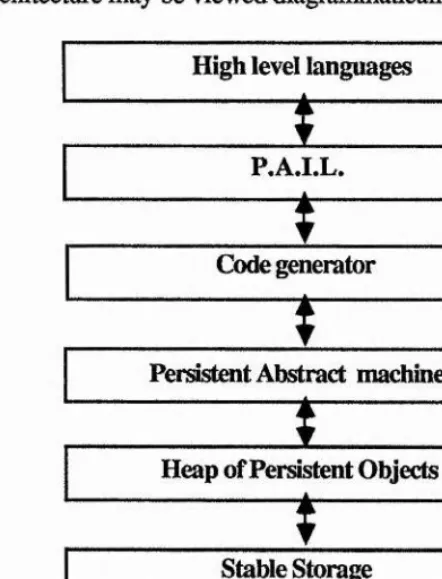
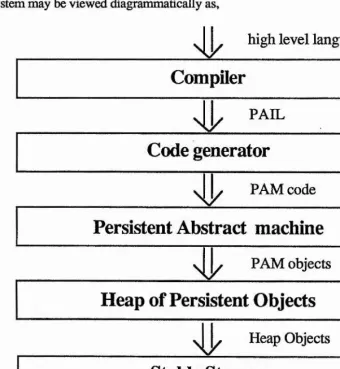
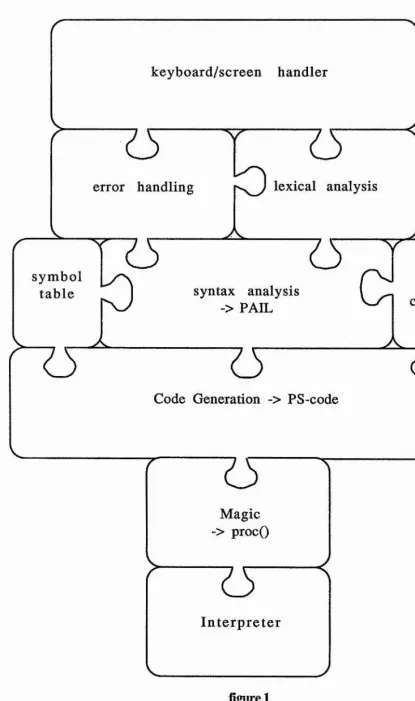
in each of the fields individually but also allowing assessment of the interaction of different strategies. This architecture may be viewed diagrammatically below.
Stable Storage Persistent Abstract machine
Code generator P.A.I.L.
[image:34.615.184.405.119.409.2]Heap of Persistent Objects High level languages
figure 1
layers in the Napier system
1.6 Persistent Information Space Architecture
The PISA architecture may be viewed as being divided into four domains [atk86b]:
1. The Store domain 2. The Language Domain 3. The System Building Domain 4. The Application Domain
The Store Domain is at the lowest level in the architecture. The storage architecture in PISA is stable, that is it is resilient to faults such as hardware failure and power loss. The store is object oriented in that it supports the storage of autonomous objects. Objects may reference other objects and in general the store will form a graph stmcture. It may be implemented on
disparate computing engines, therefore the store domain implements a distributed stable object store.
The language domain provides the facilities to construct applications in the applications domain. The languages must support all programming activity including the control of the programming environment. The major research issues in persistent languages are: finding type systems rich enough to capture all uses of data, discovering binding mechanisms suitable for modelling adaptive long lived data and discovering ways of overcoming the complexity inherent in large systems.
The system building domain supports the construction of the persistent language environment. The tools currently available in this domain are:
1. Compiler Components
2. Support for compilation and execution merging 3. Support for abstract program graphs
4. Persistent Abstract Machine 5. Demand driven optimisation
The top level in the architecture is the applications domain. The applications domain provides support for the construction of application programs. This domain includes generic tools which operate over a range of different types and data. It also provides adaptive programs that may modify their behaviour to suit data that had not been constructed when the component was implemented. These adaptive components are considered to be of importance for large scale data manipulation.
1.7 Thesis Browsing
1.7.1 Language Domain
I
language domain, four, five, and six discuss the system building domain and chapter seven discusses an experiment in the application domain.
■5 The Persistent Information Space Architecture ( PISA ) languages are strongly typed | languages with a high degree of compile time type checking. They are also required to
support their own environment. The requirements for such a class of languages are investigated in chapters 2 and 3.
The PISA languages provide machine independent raster and vector graphics. Chapter two describes the support for graphical operations in the PISA languages and discusses the data types provided and the operations that may be performed on them.
One of the aims of the PISA project was to provide better control of complexity in large systems, in particular, to support evolution of programs and data. One important aspect of this is the control of names and bindings within the system. Chapter three addresses these problems showing how they have been tackled in the past and proposing a new method of tackling the problem.
1.7.2 System Building Domain
Chapter four introduces the system building domain. This thesis concentrates on three areas within that domain they are: abstract machine design, intermediate code requirements and compilation system architecture. These are discussed in Chapters four, five and six respectively.
block level retention. This style of architecture is ideal for supporting object oriented languages.
Chapter five introduces the Persistent Architecture Intermediate Language ( PAIL ). The provision of such a language is an engineering decision in order to support many activities carried out within PISA. It is shown how PAIL may be used as a protection mechanism, as
an optimisation tool and as a debugging aid. |
1
The architecture is based upon the persistent languages. These languages are supported by | compilers resident in the persistent information space and are therefore written in the persistent languages. The implementation of this reflexive system is discussed in chapter six. In it, compilers that may be called as functions from within the persistent environment are discussed.
'iX
1.7.3 Applications Domain |
The applications domain comprises all the programs written within the persistent J environment. For example, the compilation architecture discussed in the system building domain may be considered to be an application program. Another architecture that hovers J between the application domain and the system building domain is the browsing architecture [dea88] which is discussed in chapter seven. The browser uses the compilation toolset to incrementally construct programs that operate against arbitrary data taken from infinite type space of the persistent languages.
I
1.8 Conclusions
The Napier system is still incomplete, the techniques discussed in this thesis provide the framework for the construction of a totally integrated environment. The lessons learned from building the PS-algol system are now being put to good use in this task. The final chapter provides a slightly speculative view of how these components may be combined to provide a fully
integrated environment.
2 Environments
2.1 Introduction
The primary objective of the research of the Persistent Information Space Architecture (PISA) project is stated, in [atk86b], as:
the exploitation of the opportunity provided by the dramatic shift in the cost of hardware relative to software, the removal of the incoherence between the various programming mechanisms and thus, the provision of a better environment for exploiting new computer systems. Specific technical objectives thus include:
1, Controlling complexity by establishing consistent rules which apply
throughout the design and system, and, by introducing new concepts into the architecture only very parsimoniously, preferring those new concepts which encapsulate or abstract existing concepts.
2, Introducing persistent data and separating the issue of what data structures
are best for a program from the issues of identifying and preserving the data; thereby allowing most file and database data to be processed using the same language constructs as those used for a program's local data.
3, Controlling system evolution even though the nature of data including
program is that it's uses are neither parochial nor predictable. In particular, persistent systems of data and program are to be partially reconstructable and
thus incrementally enhanceable.
provides a conceptually simple framework for manipulating bindings thus controlling complexity and system evolution from within a unified language framework.
2.2 Contextual naming
The persistent store is a conceptually unbounded space populated by objects. In such a space the naming of objects becomes a problem. This may be observed in programming systems which adopt a simple, flat object naming strategy such as Smalltalk-80 [gold83]. These systems have a single name space in which names may be introduced, resulting in the use of names being highly restricted by the names that have been previously used.
This problem may be overcome if contextual naming is used. In a contextual naming scheme names are introduced within some context. Names may be used many times within a system, one name denoting different things in different contexts. Contexts are used in everyday life to overcome naming problems, for example, when I say Ron has a beard to one of my colleagues they know by context to whom I am referring. The same sentence may mean something different or be meaningless to someone else. For example, to someone who knows a beardless person called Ron the sentence could be untrue. To a non-English
speaking alien the sentence could contain no meaningful information at all.
Many different contextual naming strategies may be found in the computer systems of the present day. Some examples of these strategies are:
1. block stmcture in programming languages; 2. file directories in filing systems; and 3. segments in operating systems.
begin
let a = 7 write a begin
let a = "hello" write a begin
let a =1.23 write a end
end begin
let a = "hi" write a end
end
example 1
block structures contexts
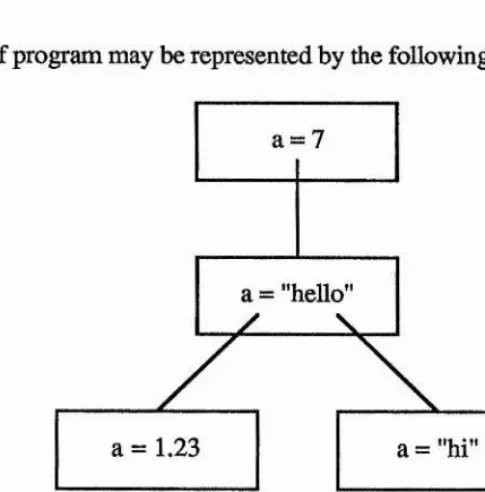
This static piece of program may be represented by the following tree:
a = "hello' a = 7
[image:40.619.187.430.322.568.2]a="hi’ a = 1.23
figure 2 A graph of block structures contexts
Notice that each instance of the clause "write a", displays a different value due to the imposition of the context tree.
binding mechanisms and their significance in the persistent environment is an important consideration in the provision of such contextual naming strategies. Binding mechanisms are discussed below.
2.3 Bindings
Bindings are comprised of a four-tuple [atk85a,mor86a] consisting of:
1. name 2. value 3. type 4. constancy
Thus the constant binding
let a = 7
may be written,
{a,7,int,true}
and the variable binding
let b := "hello mum"
may be written,
{b, "hello mum",string,false}
1. whether the binding is to location or value; 2. when the binding is performed;
3. when is type checking performed ( if at all ); and 4. what scoping is performed.
These categories are examined below.
Bindings may be made either to locations or values. When a binding is made to a location, it is traditionally known as an L value binding [stra67]. In this kind of binding, the location does not change although different values may be stored in it. Sometimes, bindings are made to values which are immutable, this type of binding is known as an R value binding. Applicative languages such as SASL [tur79] only have this kind of binding.
Bindings may be instantiated statically by the compiler or dynamically by the run time system. If systems are bound statically many errors may be detected early ( at compile time ). Some languages designers consider this safety element so important that their languages only contain static binding.
However, in order for a dynamic system to evolve a measure of dynamic binding must exist in the system. If a program is entirely statically bound any change to the program or data requires the entire system to be recompiled to establish new bindings. This cost is prohibitively high for large systems. The system must, therefore, accommodate some dynamic binding in order to accommodate change.
Type checking, like the instantiation of bindings, may be performed statically by the compiler or dynamically by the run time system. Static type checking is generally performed for one of two reasons; firstly, as an optimisation, checks may be factored out and types are known, and more efficient code may be produced; secondly, and perhaps more importantly, as a safety measure. Early type checking detects many erroneous programs which may cause damage to a system. However, in order to accommodate change, systems must provide some dynamic typing, in particular, all projections from union types require a dynamic check.
2.4 Programming in the large
The size of applications that may be constructed using any methodology is limited by the size of programs we can debug and maintain. When any program reaches a certain size it is extremely difficult for anyone to understand it. At that point, if not before, the system must be broken down into separate components, the idea being that each of the components is of a manageable complexity. Hopefully, someone will be capable of understanding how these components may be fitted together in order to construct the required system. This task has become known as "programming in the large".
If programming systems are to be used to support the construction of large systems, they must provide modular construction facilities. Furthermore, these systems must also provide easily understood mechanisms for binding modules together. These mechanisms must be capable of accommodating change.
other than the one for which it was first written. It is imperative that software systems, especially large ones, support incremental change.
2.5 Static Contexts
The block structured tree shown in example 1 is static in nature. That is, the contextual structure is assembled by the compiler at compile time. Block structure hides information contained within a block from objects external to that block. Uses of an identifier are bound to the innermost textually enclosing definition of that identifier. This is known as static scoping and is in contrast to the dynamic scoping found in Lisp systems [mcc62].
The block structuring paradigm imposes visibility conditions on identifiers. In many languages, principally in the algol family, block stmcture and procedural abstraction are the only mechanisms provided for program structuring. This static imposition of structure is not sufficiently powerful to support the incremental construction of systems or incremental change.
The environments of Napier support programming in the large by providing incremental program construction mechanisms and contextual naming facilities. This problem is currently being tackled by other researchers. Some of the approaches taken, in the field of databases and programming languages are discussed below.
2.6 Language Approaches
In the specification language Clear [bur84a], Burstall and Goguen identify the three main operations on environments as:
1. create an empty environment;
The operation of adding a new name value pair to an environment is extended to the addition of a binding quadruple by Atkinson and Morrison in [atk85a]. These operations may be illustrated by the block structure of the algols. The following examples are in Napier. A new environment is created in a block structured language by the introduction of a new block as follows,
begin end
This is the empty environment containing no bindings. A binding may be introduced into the environment,
begin
let a = 7 end
The environment now contains the single binding,
(a,7,int,true }
The value associated with a given name is found by looking up that name in the environment. In Napier, this is achieved by writing down the name of the identifier to yield the value. In this example, the programmer may write,
begin
let a = 7 a
end
which would yield 7 as the value of the block, the value being determined by the static scope of the block.
statically bound. For this reason, there will be no further discussion of applicative languages.
2.6.1 Galileo
The language Galileo [alb85] recognises the need for control of names and values in a database context. In Galileo, a run time environment is defined to be a mapping from identifiers to denotable values. Such an environment is obtained by evaluating an environment expression. For example,
use a := 3 and b := 4 in a + b
yields the value 7. Here, the expression
a := 3 and b := 4
is an environment expression that yields an environment containing the bindings,
{a,3,num,true} and (b,4,num,true)
in which the expression a + b may be evaluated.
The above example introduces two of the environment operations provided by Galileo, namely the introduction of new bindings using and the combination of environments using and. Galileo provides other mechanisms that allow the programmer to select single bindings from environments, recursively introduce names and values and to remove names from environments.
command allows the user to traverse the tree of environments that may be found in the global environment. For example, in Galilieo the following dialogue may be carried out,
use anenv :- ( a := 3 and b :=4 )
! this defines an environment called anenv in the global environment enter anenv:
Î now the current environment is anenv a + b
! yields 7 as before
The designers of Galileo suggest that environments help the user to develop and test database schemata incrementally or to express the overall structure in terms of smaller related parts. They also suggest that they may be used as a modularisation mechanism in a manner similar to that suggested by Burstall and Goguen in Clear.
2.6.2 Name Spaces
In [atk85a] Atkinson and Morrison introduce name spaces. Name spaces are an environment mechanism that permit the following:
1. the storage of bindings in a name space; 2. the dynamic use of names from a name space; 3. the static use of names from a name space;
4. the evolution of names available in a name space; and 5. safe exchange of arbitrary data between parts of the system.
A name space is created by the following expression, ns < identifier list> from
<sequence> end from
This is best illustrated with an example.
4
'Î
let new = ns a,b from let a = 7 let aa := a * a
let b := proc( > int ) ; aa end from
example 2 namespace instantiation
Here new has as its value the set of bindings ( name space ), in the notation used earlier;
{ { a,7,int,true },{ aa,49,int,false },{ b,(proc( > int ) ; aa),proc(-> int ),false } }
Notice that unlike the environment expressions of Galileo, namespace is a first class data object. In order to accommodate change, namespaces provide a mechanism to add new bindings and to remove old bindings. A new binding may be added to a namespace using following construct:
extend <namespace expression> with ^Identifier list> from <sequence>
end from
This is similar to the instantiation of a name space. Bindings may be dropped from name spaces by the use of the drop construct,
drop <ddentifier list> from <namespace expression>
In order to use a name space the user may write,
using <namespace expression> with <signature> compile <sequence>
end compile
Thus, the signature specifies a formal store and the namespace expression provides an actual store each time the statement is executed. The dynamic binding is thus localised to the scope of the using.. compile construct.
Namespaces may also be used statically, the notation for this is, with <namespace> do
<sequence> end
Here the sequence is statically bound to the namespace. However, despite the static nature of the binding, the namespace must still be checked to ensure that it contains the bindings required of it. The reason for this is that the bindings may have been removed from the namespace using drop. Indeed, an error condition or exception may arise at run time due to a required binding not being present in the namespace. This is shown in the following example,
let new = ns a from ! define a namespace containing
let a = 7 ! one binding a~7
end from
let useNew = procQ ! define a procedure which
begin ^ ! uses new by binding to it
with new do ! statically and writes out the
write a ! value of a
end end
drop a from new ! drop the binding from the
useNewO ! namespace, calling the
! procedure will cause an ! exception when a is checked. example 3
using a namespace
2.6.3 Program Editors
Namespaces influenced the work of Buhr and Zarnke [buh87]. They describe a programming system that allows the manipulation of bindings. However the environments in their system are not first class data objects and therefore may not be manipulated by the language. Instead, the user may change environments using a program editor which is essentially a symbol table browser. The system suffers from the same binding problems as those encountered with namespaces. Datestamps are used to maintain integrity and preserve static type checking. When datestamps are found to be in an incorrect time order the compiler is called to automatically correct the situation.
2.7 Environmæts
The programming language Napier introduces the concept of an environment in order to provide support for the control of names and to allow incremental system construction. This is achieved by providing an extensible mechanism that permits the storage of bindings. The environments provided in Napier satisfy the three main operations defined in Clear with the addition of one new operation. The operations on Napier environments are:
1. create an empty environment;
2. extend an environment with a name value pair; 3. find the value associated with a given name; and 4. remove a binding from an environment.
Environments, written env, are introduced using a predefined function called environment.
It has the following form,
The function environment returns a new empty environment. That is an environment containing no bindings. In Napier, bindings are always introduced with the word let. When bindings are declared within a block the programmer may write something like,
begin
let a = 7
let b = proc(-> int ) ;a end
example 4 block structure
Similarly, bindings are introduced to environments using the word let. The user must also specify the environment in which the binding is to be made. The syntax of binding introduction is therefore,
in <environment-clause> <declaration>
The environment in the environment clause may be statically or dynamically determined. The programmer may therefore write,
let e = environmentO in e let a = 7
examples
static use of environments
The environment e contains one binding,
{ a,7,int,true )
In this example, the first let declaration introduces the name e into the static environment of the program. In the second line the environment to which e is bound is enriched with the new binding,
( a,7,int,true )
The in .. let construct therefore serves the same purpose as the extend and the name space instantiation of namespaces. The example shown in example 2 above would be written in Napier as,
let new = environment() in new let a = 7
use new as a : int in in new let aa := a * a
example 6
instantiation of mvironments
Bindings in environments may be manipulated with the use clause. It has the following syntax,
use <environment clause> as <signature> in <clause>
for example to use the environment defined in example 6 and write out the values associated with a and aa the programmer would write.
1
use new as a,aa : int in begin
wiiteint( a )
writeint( aa) ^
end
example 7
using values stored in environments
I The signature need only specify a partial match on the bindings stored in the environment. 4 The environment may therefore contain bindings other than the ones specified but must
contain at least the bindings denoted in the signature. If any of the bindings are not present an exception is raised.
Values may be exported from an environment by returning a value from the clause bound to
the use statement. For example, if the programmer wished to extract the value associated = with a value from the environment the following could be written,
Bindings may be removed from an environment using the drop construct. This has both the same same syntax and semantics as namespaces, namely,
drop <identifier> from < environment clause>
This expression removes the binding containing the identifier from the environment specified in the environment clause. Note that the binding is not deleted, merely removed from the environment. This distinction is important as will shown below. Another example, clarifies this,
let new = environment()
! new is an empty environment in new let a = 7
! new now contains the binding a ~ 7 use new with a : int in
in new let aa := a * a
! new now contains the bindings a - 7 and aa ~ 47 drop a from new
! new now contains only the binding aa ~ 49 examples
dropping values from environments
2,7.1 Type checking
All environments are of type env, this is regardless of what is stored in them. This is in sharp contrast to the structure type of Napier. Structures are type checked using structural equivalence. In order to pass them as parameters the user must specify the names and types of the fields of the structure. Thus, the programmer is provided with a choice of whether to model using environments which allow flexibility but delay type checking or structures which are statically strongly type checked.
allows the segment of code within the use clause to be statically type checked with respect to the projection.
The provision of environments and the other infinite union type provided in Napier, any, allow the programmer to choose to delay some type checking until execution time. Such a mechanism is extremely important in an otherwise strongly typed persistent environment. If a point of dynamic type checking is not provided in a statically typed persistent environment, the user would have to specify the type of the entire persistent store every time he or she wanted to interact with it. Furthermore, the type of the store is constantly changing as users add or remove objects of different types from it. The types env and any allow the user to partially specify the type of the store.
It is expected that programmers will statically bind data structures used within "programs" and use the environments to structure the information space in the manner that files and directories are used to structure the stores provided in today's operating systems.
The code within the use clause is statically bound to the bindings projected from the environment. The following occurs when a use is executed:
1. the bindings are looked up in the environment;
2. the type of the bindings are checked against the signature;
3. if either the types do not match or the bindings are not present an exception is raised;
4. if an exception is not raised the bindings are introduced into the environment - this constitutes dynamic binding; and
5. the clause associated with the use is executed with the bindings already instantiated in the environment. All further uses of the projected values or locations are statically bound.
Recall that in example 3, a difficulty arose concerning the use of using and drop with namespaces. The problem with namespaces was that the binding was always to the namespace and not to the bindings stored in the namespace. The example shown below is semantically equivalent to example 3. As in example 3, it will cause an exception to occur on the last hue.
one used in ML [har86], will not help here since we must specify all the necessary type | information. This is necessary if strong static type checking is to be retained everywhere
apart from at the time of projection. The mechanism provides the maximum amount of static type checking whilst retaining the flexibility required for incremental system evolution.
The need to specify potentially large amounts of type information in order to use an environment is worrying. Although not visible to the user, type information must be encoded into the environments so that type checking may be performed at the time of projection. This information is stored in the implementation of the environment, this allows a reversal from traditional type checking to be made.
In traditional type checking systems, the user writes down a program associated with type definitions. The program is then submitted to the compiler which tells the user whether the program is correct or not. In the system described above, the user may traverse the information space using a browser, similar to the one described in chapter 7. This browser may report the types of the objects stored in the environments. If it were used in conjunction with a callable compiler, like the one described in chapter 6, the user could interactively construct programs to operate against data held in the information space. In such an environment the distinction between browsing and compiling becomes blurred, since different tools in the support system are being combined transparently to provide a high degree of programmer support.