Is Experts’ Knowledge Modular?
Fernand Gobet ([email protected]) ESRC CREDIT
School of Psychology University of Nottingham Nottingham NG7 2RD, UK
Abstract
This paper explores, both with empirical data and with computer simulations, the extent to which modularity characterises experts’ knowledge. We discuss a repli-cation of Chase and Simon’s (1973) classic method of identifying ‘chunks’, i.e., perceptual patterns stored in memory and used as units. This method uses data about the placement of pairs of items in a memory task and consists of comparing latencies between these items and the number and type of relations they share. We then compare the human data with simulations car-ried out with CHREST, a computer model of perception and memory. We show that the model, based upon the acquisition of a large number of chunks, accounts for the human data well. This is taken as evidence that human knowledge is organised in a modular fashion.
Introduction
An important goal of cognitive science is to understand the characteristics of knowledge, in particular the way it is acquired and used. To achieve this goal, research has employed a number of methods, including artificial laboratory experiments, such as nonsense syllable learn-ing, and collection of naturalistic data, such as experts functioning in their natural environments. It is gener-ally accepted that knowledge consists of different types (declarative, procedural, episodic) and that its acquisition follows a power law of learning. In addition, it has often been proposed that knowledge is modular, consist-ing, for example, of productions (e.g., Newell, 1990) or of perceptual chunks (e.g., Chase & Simon, 1973).
The goal of this paper is to explore, both with em-pirical data and with computer simulations, the extent to which modularity characterises human knowledge, and in particular experts’ knowledge. We first describe the concept of modularity, and then show how it has been used in expertise research. This leads us to de-scribe the CHREST architecture, which acquires knowl-edge by growing a discrimination net encoding chunks. Next, we present data aimed at characterising the proper-ties of experts’ chunks, and compare them with those acquired by CHREST. The comparison results in an excellent fit between the model and the human data. In the conclusion, implications for the modularity of hu-man knowledge in general are drawn.
Modularity of Knowledge
Several formalisms, both modular and non-modular, have been developed in cognitive science to explain how humans represent and implement knowledge. Examples of modular representations are production systems, se-mantic networks, and discrimination nets. Examples of non-modular representations are distributed neural net-works, holograms, and various mathematical representa-tions based on matrix algebra. This classification should be considered with caution, however. On the one hand, production rules, for example, are typically organ-ised in problem spaces (e.g., Newell, 1990), and their interdependence can be considerable, which counts against strict modularity. On the other hand, it could be argued that, in non-modular representations, modules emerge as the system develops or learns (e.g., Rumel-hart & McClelland, 1986).
Modular knowledge organisation has attracted much interest in computer science and artificial intelligence, given the importance of how knowledge is indexed, structured, organised, and retrieved (e.g., Lane et al., 2000). In artificial intelligence, modularity has been defined as “the ability to add, modify, or delete individ-ual data structures more or less independently of the remainder of the database, that is, with clearly circum-scribed effects on what the system ‘knows’ ” (Barr & Feigenbaum, 1989, p. 149). While a strong argument can be made that it is easier to understand modular and decomposable systems than systems that do not share these properties (e.g., Simon, 1969), and that the value of these properties has been demonstrated in fields such as software engineering, it is an empirical question whether human knowledge is modular or not. A rich source of data about this question has been gained from research into expert behaviour, to which we now turn our attention.
Chess Experts’ Knowledge
while weaker players could recall only a handful of pieces. De Groot concluded that expertise does not re-side in any superior abilities but in knowledge.
Continuing de Groot’s research, Chase and Simon (1973) carried out a study destined to have a huge im-pact in cognitive science. They used two tasks. In the
recall task, based on de Groot’s (1965) method, a chess
position was presented for five seconds, and players had to reconstruct as many pieces as possible. In the copy
task, the stimulus board remained in view, and the goal
was to reconstruct it onto a second, empty board. As the stimulus and the reconstruction boards could not be fixated simultaneously, Chase and Simon used the glances between the boards to detect memory chunks. Comparing the latencies between successive pieces in the copy and recall tasks, they inferred that pieces re-placed with less than 2 seconds’ interval belonged to the same chunk, and that pieces placed with an interval of more than 2 seconds belonged to different chunks. Fi-nally, they showed that the chunk definition based upon the latencies between two successive pieces was consis-tent with a definition based upon the pattern of semantic relations (attack, defence, proximity, colour, and type of piece) shared by these two pieces. This converging evidence was used to infer the chunks used to mediate superior performance, and to explore how they allowed masters to find good moves despite their highly selec-tive search. A number of other experimental tasks (re-viewed in Gobet & Simon, 1998) have brought con-verging evidence for the psychological reality of chunks, as defined either by latency in placement or by number of relations between pieces.
Simon and Gilmartin (1973) developed a computer program (MAPP; Memory-Aided Pattern Perceiver) implementing some of Chase and Simon’s ideas. MAPP is based upon EPAM (Elementary Perceiver and Memorizer; Feigenbaum & Simon, 1984), a theory developed to account for empirical phenomena where chunking (i.e., acquisition of perceptual units of in-creasing size) is seen as essential. The basic idea in MAPP was that long-term memory (LTM) is accessed through a discrimination net, and that, once elicited, LTM chunks are stored in short-term memory (STM) through a pointer. MAPP’s relatively low recall per-formance—slightly better than a good amateur, but infe-rior to an expert—was attributed to the small number of nodes, about two thousand, stored in its LTM. MAPP simulated several results successfully: increase in per-formance as a function of the number of chunks in LTM; kind of pieces replaced; and contents of chunks. However, in addition to its failure in simulating expert behaviour, the program had several limitations (De Groot & Gobet, 1996). In particular, the chunks were chosen by the programmers and not autonomously learnt, and the program made incorrect predictions for a number of experiments that were later carried out. These limitations were removed in the CHREST program discussed below.
CHREST
CHREST (Chunk Hierarchy and REtrieval STructures; De Groot & Gobet, 1996; Gobet & Simon, 2000) is a cognitive architecture similar to MAPP. CHREST originally addressed high-level perception, learning and memory, but various problem-solving mechanisms have been implemented recently. It is composed of processes for acquiring low-level perceptual informa-tion, an STM, attentional mechanisms, a discrimina-tion net for indexing items in LTM, and mechanisms for making associations in LTM such as production rules or schemas. STM mediates the flow of informa-tion processing between the model’s components. The central processing of CHREST revolves around the ac-quisition of a discrimination net based on high-level perceptual features picked up by attentional mechanisms and on the creation of links connecting nodes of this net together.
After the simulated eye has fixated on an object, fea-tures are extracted and processed in the discrimination net, and then, based upon the output of the discrimina-tion, a further eye fixation is made, and so on. STM operates as a queue; that is, the first elements to enter are also the first to leave. STM has a limited capacity, which consists of four chunks (Cowan, 2001; Gobet & Simon, 2000). Processing is constrained by a number of restrictions, including time parameters such as the time to fixate a chunk in LTM (8 s) and capacity pa-rameters such as the four-chunk limit of STM.
The discrimination net consists of nodes, which con-tain images (i.e., the internal representation of the ex-ternal objects; images correspond to Chase and Simon’s
chunks); the nodes are interconnected by links, which
contain tests allowing items to be sorted through the net. Learning happens as follows: once an item has been sorted through the net, it is compared to the image in the node reached. If the item and image agree but there is more information in the item than the image, then familiarisation occurs, in which further informa-tion from the item is added to the image. If the item and image disagree in some feature, then discrimination occurs, in which a new node and a new link are added to the net. Based on empirical data, it has been estimated that discrimination requires about 8 s and familiarisation about 2 s.
In addition to these learning mechanisms, CHREST has mechanisms for augmenting semantic memory by the creation of schemas (known as templates) and of
lateral links connecting nodes together (Gobet, 1996);
COPY RECALL A priori
Probabilities
Relations GAME RANDOM GAME RANDOM GAME RANDOM
WITHIN BETWEEN WITHIN BETWEEN ≤ 2 sec > 2 sec ≤ 2 sec > 2 sec
- .037** .172** .086** .129** .052** .190** .051** .284 .335 .297
A .005** .006 .031 .054** .004** .024 .000* .054 .016 .024
P .000 .006 .037** .059** .001 .006 .033** .041* .004 .010
C .148** .278 .152** .203** .132** .247 .136** .189 .255 .297
S .016** .056** .040** .049** .040** .102* .059** .054 .154 .144
A P .000* .000 .056** .069** .001 .003 .015 .027 .005 .028
A S .000 .000 .003 .005* .004** .003 .000 .000 .001 .001
D C .104** .133** .072** .077** .059** .084** .044 .068* .035 .024
P C .084** .067** .059** .046** .049** .060** .066** .081** .019 .009
P S .002 .006 .044** .064** .006 .012 .018 .027 .006 .010
C S .115 .094 .135* .105 .111 .057* .059* .041 .096 .108
A P S .000 .000 .013* .013 .001 .000 .018 .014 .001 .007
D P C .109** .078 .123** .064** .093** .084* .118** .081* .048 .028
D C S .048** .017** .000 .000 .033** .012** .015** .000 .002 .001
P C S .196** .039** .127** .039** .202** .060** .232** .041** .011 .007
D P C S .137** .050** .023** .023** .213** .054** .136** .000 .013 .007
#obser-v a t i o n s 1283 180 1114 389 1563 332 272 74
Note: * means p<.01, ** means p<.001 (both two-tailed). The statistical significance levels are based on the z-values that were computed using the following formula (assuming the normal approximation to the binomial distribution):
z = po - pe
s. e. , where s. e. =
pe (1 - pe) sample size ,
and where po is the observed probability and pe the a priori (expected) probability.
CHREST can reproduce a number of features of the behaviour of skilled and unskilled chess players in memory experiments, such as their eye movements, the size and number of chunks, the number and type of er-rors, and the differential recall of game and random posi-tions (De Groot & Gobet, 1996; Gobet & Simon, 2000). As a psychological theory, CHREST has sev-eral strengths. It is parsimonious, with few free parame-ters. It provides absolute quantitative predictions, for example about the number of errors committed or the time taken by a subject to carry out a task. Together with EPAM, it simulates in detail a number of empiri-cal phenomena from various domains, such as verbal learning, context effects in letter perception, concept formation, expert behaviour, acquisition of first lan-guage by children, and use of multiple representations in physics (see Gobet et al., in press, for a review).
A Replication of Chase and Simon
( 1 9 7 3 )
As noted above, Chase and Simon (1973) operational-ised the concept of chunk using both the latencies be-tween successive piece placements and the semantic
relations between them. Their experiment has recently been replicated and extended by Gobet and Simon (1998). The main difference between the two studies is that Gobet and Simon used a computer display to pre-sent the tasks instead of physical chessboards. In spite of this difference, there is an important overlap between the results of the two studies.
Gobet and Simon analysed 26 players (Chase and Simon had only 3) ranging from good amateurs to pro-fessional grandmasters, who were divided into three skill levels (Masters, Experts and Class A players). The results were in line with previous experiments, showing a massive skill effect with game position, and a small but reliable skill effect even with meaningless posi-tions. Here, we focus upon the operationalisation of chunks, relying both upon Gobet and Simon’s pub-lished data and upon additional analyses.
Latencies Predict Chunk Boundaries
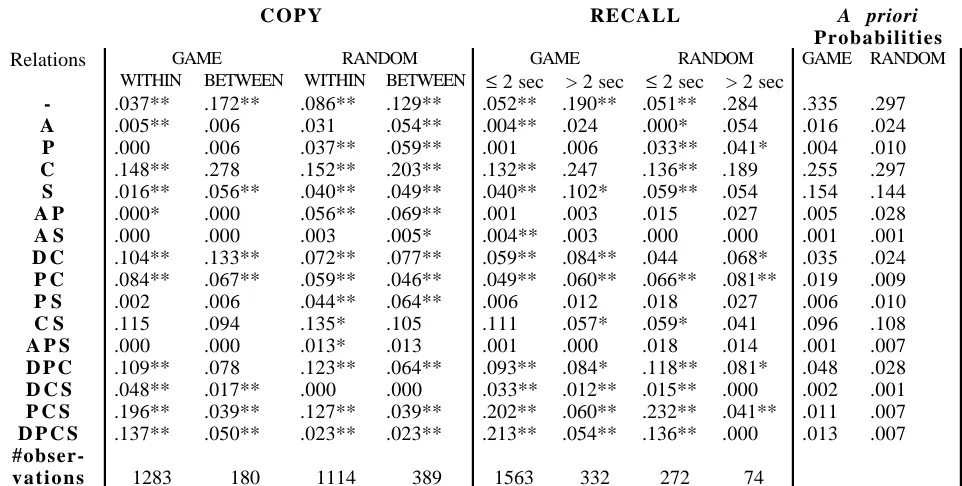
[image:3.595.73.554.111.354.2]Gobet and Simon essentially followed Chase and Simon’s approach. They first estimated a time thresh-old (2 s) as a means to decide whether two pieces placed in succession belonged to the same chunk, and then Table 1: Copy, recall and a priori chess relations probabilities, for combinations of the five chess relations: Attack
validated this threshold by showing that it led, on aver-age, to similar chunks as those obtained by using se-mantic relations. If they are modular, chunks should be characterised by a high density of relations between the elements that constitute it, and by a low density of rela-tions with elements from other chunks (Chase & Simon, 1973; Cowan, 2001). That is, there should be many more relations between successive pieces within the same chunk than between successive pieces on op-posite sides of a chunk boundary. Thus, the relations between successively replaced pieces should be different depending on whether they are separated by short or long latencies. In addition, assuming that the same cognitive mechanisms mediate the latencies in the copy and recall experiments, the two experiments should show the same pattern of interaction between latencies and number of relations. In other words, the relations for the within-glance placements in the copy task should correlate with those for rapid placements (≤ 2 s) in the recall task and the relations for between-glance placements in the former should correlate with those for slow placements (> 2 s), in the latter.
These predictions are met in both the copy and the re-call tasks, whose results correlate highly. Within chunks, small latencies correlate with a large number of relations, while large latencies occur when there are few relations between successive pieces. No such relation-ship is observed for successive pieces belonging to dif-ferent chunks. The shortest latencies are found with four relations (Defence, Proximity, Colour, and Kind), which mainly occur with pawn formations.
Relations Predict Chunk Boundaries
The next step consists in showing that the pattern of relation probabilities for within-chunk, but not for be-tween-chunk placements, differs from what could be expected by chance. Table 1 gives the probabilities of the presence of different combinations of relations in the various experimental conditions, with the three skill levels pooled. The last two columns give the a priori probabilities (for game and random positions, respec-tively) that were calculated by recording, for each posi-tion, all relations that exist between all possible pairs of pieces; the a priori probability for a relation is ob-tained by dividing the total number of occurrences of a relation by the total number of possible pairs. These a
priori probabilities were based on 100 positions and
26,801 pairs. Finally, the z-values indicate whether the observed probabilities reliably differ from the a priori probabilities.
In the copy task, with game positions but not with random positions,1 the between-glance probabilities are much closer to chance than the within-glance probabili-ties. This pattern holds also in the recall of both
1That this pattern does not hold with the copy of random positions may be due to the strategy used by subjects t o replace these positions. Several subjects copied the posi-tions line by line or column by column.
dom and game positions when slow placements (> 2 s) are compared with fast placements (≤ 2 s). The prob-abilities for pieces with three and four relations are high in the within-glance and fast (≤ 2 s) conditions com-pared with the between-glance and slow (> 2 s) condi-tions; the opposite is true for pieces with one relation or none. Note also that the probabilities for combina-tions of relacombina-tions that include an attack (A) are con-spicuously low, compared with chance, for game posi-tions but not for random posiposi-tions.
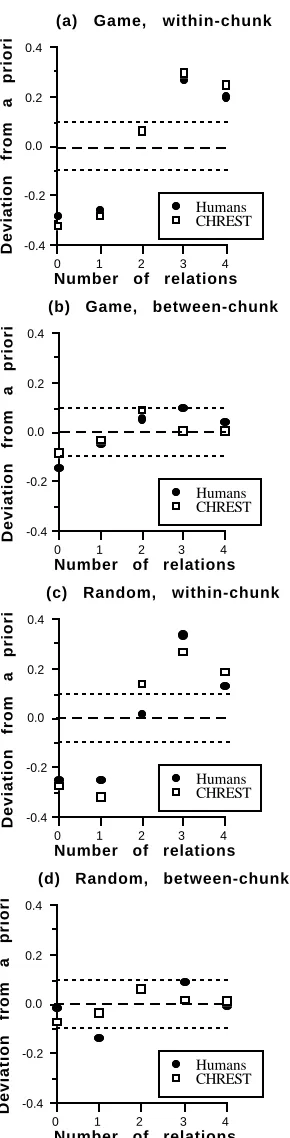
One way to make sense of Table 1 is to analyse the correspondence between the number of chess relations and the deviations from a priori probabilities, computed by subtracting the a priori probabilities from the ob-served frequencies of a given condition. Based on the notion of modularity, it should be expected that the within-chunk deviations from a priori probabilities would be highly correlated with the number of relations, while this would not be the case for the between-chunk deviations. This is exactly what was found. The correla-tions with number of relacorrela-tions are high for the within-chunk conditions (copy game within-glance: 0.81; copy random within-glance: 0.68; recall game short latencies: 0.86; recall random short latencies: 0.79; all the correla-tions are statistically significant at p = .005). The corre-lations are smaller with the between-chunk conditions (copy game between-glance: 0.61; copy random be-tween-glance: 0.56; recall game long latencies: 0.58; recall random long latencies: -0.15; none of the correla-tions are significant at the .01 level). These results are illustrated graphically in Figure 1, which shows the results for game and random positions as a function of whether the placements were within-chunk or between-chunk. From the Figure, it is clear that, for within-chunk conditions, the placements having few rela-tions are below chance, while the placements having several relations are above chance. There is no such clear relation for the between-chunks placements.
Computer Simulations
We now show that CHREST captures the composition of chunks and the pattern of relations of within- and between-chunk placements. Simulations of similar phe-nomena, carried out by Simon and Gilmartin (1973) using MAPP, were limited to a single subject and matched the data only approximately.
Methods
In the learning phase, the program scanned a large data-base of master-game positions, fixating squares with simulated eye movements, and learning chunks using discrimination and familiarisation. Three nets were cre-ated, estimated to correspond roughly to the recall per-centages of Class A players, experts, and masters with a five-second presentation time. These nets had respec-tively 1,000 nodes, 10,000 nodes, and 100,000 nodes.
4 3 2 1 0 -0.4 -0.2 0.0 0.2 0.4
Humans CHREST (a) Game, within-chunk
Number of relations
Deviation from a priori
4 3 2 1 0 -0.4 -0.2 0.0 0.2 0.4
Humans CHREST (b) Game, between-chunk
Number of relations
Deviation from a priori
4 3 2 1 0 -0.4 -0.2 0.0 0.2 0.4
Humans CHREST (c) Random, within-chunk
Number of relations
Deviation from a priori
4 3 2 1 0 -0.4 -0.2 0.0 0.2 0.4
Humans CHREST (d) Random, between-chunk
Number of relations
[image:5.595.109.254.69.638.2]Deviation from a priori
Figure 1: Relation between chess relation probabilities and the number of relations shared by two pieces suc-cessively placed. The long-dash line indicates zero
devia-tion, and the short-dash lines indicate deviations of 0.1 above or below zero.
random positions. Learning was turned off. During the five-second presentation of a position, CHREST moved its simulated eye around the board. Each eye fixation defined a visual field (all squares within two squares from the square fixated); the pieces within the visual field are treated as a single pattern and sorted through the discrimination net. Other patterns are de-fined by the pieces focused upon in two successive eye fixations. If a chunk is found in the discrimination net, a pointer to it is placed in STM.
During the reconstruction of a position, CHREST used the information stored in STM. When a piece belonged to several chunks, it was replaced only once. In case of conflicts (e.g., a square is proposed to contain several pieces), CHREST resolved them sequentially, based on the frequency with which each placement is proposed. Like humans, it sometimes made several different proposals about the location of a piece or about the contents of a square. Finally, some weak heuristics were used, such as the fact that only one white king can be replaced in a position. (See Gobet & Simon, 2000, for more detail.)
A chunk refers to the image of a node in the discrimi-nation net. It is therefore straightforward to decide whether two pieces do or do not belong to the same chunk. The relations between pieces were extracted us-ing the same program as that used with the human data.
Results
[image:5.595.320.555.497.728.2]Table 2 gives the probabilities of observing a pattern of relations, as a function of the type of position and the kind of placement. Although the fit with the corre-sponding human data shown in Table 1 is reasonable
Table 2. Recall and a priori chess relations probabilities, for combinations of the five chess relations: Attack (A), Defence (D), Spatial Proximity (P), Same Colour (C), and
Same Piece (S).
Game p o s i t i o n s
Random p o s i t i o n s
R e l a -t i o n s
W i t h i n
B e t -w e e n
A pri-o r i
W i t h i n
B e t -w e e n
A pri-o r i
- .009 .254 .335 .018 .231 .297
A .005 .034 .016 .021 .061 .024
P .013 .011 .004 .050 .026 .010
C .104 .208 .255 .040 .216 .297
S .021 .148 .154 .050 .136 .144
AP .004 .013 .005 .030 .027 .028
AS .000 .001 .001 .001 .005 .001
DC .042 .059 .035 .038 .042 .024
PC .097 .050 .019 .092 .039 .009
PS .020 .019 .006 .061 .018 .010
CS .064 .113 .096 .094 .111 .108
APS .004 .005 .001 .008 .017 .007
DPC .162 .031 .048 .148 .033 .028
DCS .007 .000 .002 .009 .001 .001
PCS .186 .032 .011 .147 .015 .007
(the r2 are: game within-chunk: .83; game between-chunk: .82; random within-between-chunk: .58; random be-tween-chunk: .75), not too much weight should be given to them, because they are sensitive to a few large values, and because they may in part reflect the statis-tics of the chess environment (i.e., the a priori prob-abilities). As with the human data, we subtracted the a
priori probabilities from the recall probabilities, and
took the sum for each number of relations. Figure 1 shows the results for both the humans and CHREST. The model fits the human data quite well. In particular, the between-chunk placements show little deviation from the a priori probabilities, in contrast to the within-chunk placements, which are clearly below chance with zero and one relation, and above chance with three and four relations. All conditions pooled, CHREST ac-counts for 90% of the variance of the human data.
Conclusion
EPAM and CHREST’s learning mechanisms, based upon the construction of a discrimination net of chunks, offer a crisp and computational definition of the concept of knowledge module. Using this definition, Chase and Simon (1973) have found, and Gobet and Simon (1998) have confirmed, that relations and latencies between pieces offer converging evidence for validating the psy-chological reality of chunks. This paper has shown that, with the same mechanisms used to account for a variety of chess data, CHREST acquires chunks that have the same relational properties as humans’.
The acquisition mechanisms consisting in learning pieces within the visual field and between two eye fixa-tions largely explain the high number of relafixa-tions within chunks. It is important to note that this phe-nomenon is not trivial to simulate, however. For ex-ample, learning mechanisms such as Saariluoma and Laine’s (2001) frequency-based heuristic, where chunk construction is not constrained by spatial contiguity, would fail to account for the data, because they do not capture the relation of proximity which is essential in the chunks acquired by humans (cf. Table 1).
These results, as well as others, indicate that the modular structure of the type of discrimination net used by EPAM and CHREST captures essential aspects of human cognition. Chunks, whose elements share a number of relations, are built up gradually and recur-sively, with later chunks being built from smaller ‘sub-chunks’. Some of these chunks evolve into schema-like structures, and some get later connected by lateral links, thereby constructing both a net of productions and a semantic network. It is not only the presence of a node storing a piece of knowledge which matters, but also the richness with which this node is perceptually indexed and the density with which this node is con-nected to other nodes. These two aspects give some computational meaning to “conceptual understanding”: a richly-connected network of links connecting produc-tions and schemas, that is accessible through perceptual
chunks. In addition to expert behaviour, CHREST, which incorporates mechanisms for all these kinds of learning, including the acquisition of modular struc-tures, accounts for empirical phenomena in a variety of domains.
Acknowledgements
I am grateful to Herb Simon for his involvement in many aspects of this research and to the members of the CHREST group for comments on this paper.
Reference List
Barr, A., & Feigenbaum, E. A. (1989). The handbook
of artificial intelligence. (Vol. 1). New York:
Addison-Wesley.
Chase, W. G., & Simon, H. A. (1973). Perception in chess. Cognitive Psychology, 4, 55-81.
Cowan, N. (2001). The magical number 4 in short-term memory: A reconsideration of mental storage capac-ity. Behavioral and Brain Sciences, 24.
de Groot, A. D. (1965). Thought and choice in chess. The Hague: Mouton. (First edition in Dutch, 1946). de Groot, A. D., & Gobet, F. (1996). Perception and
memory in chess. Assen: Van Gorcum.
Feigenbaum, E. A., & Simon, H. A. (1984). EPAM-like models of recognition and learning. Cognitive
Science, 8, 305-336.
Gobet, F. (1996). Discrimination nets, production sys-tems and semantic networks: Elements of a unified framework. Proceedings of the 2nd International
Con-ference on the Learning Sciences (pp. 398-403).
Evanston Il: Northwestern University.
Gobet, F., Lane, P. C. R., Croker, S., Cheng, P.C-H., Jones, G., Oliver, I., & Pine, J. M. (in press). Chunking mechanisms in human learning. Trends in
Cognitive Science.
Gobet, F., & Simon, H. A. (1998). Expert chess mem-ory: Revisiting the chunking hypothesis. Memory, 6, 225-255.
Gobet, F., & Simon, H. A. (2000). Five seconds or sixty? Presentation time in expert memory.
Cogni-tive Science, 24, 651-682.
Lane, P. C. R., Gobet, F. , & Cheng, P. C-H. (2000). Learning-based constraints on schemata. Proceedings
of the 22nd Meeting of the Cognitive Science Soci-ety. (pp. 776-782). Mahwah, NJ: Erlbaum.
Newell, A. (1990). Unified theories of cognition. Cam-bridge, MA: Harvard University Press.
Rumelhart, D. E., & McClelland, J. L. (1986). Parallel
distributed processing. Cambridge, MA: MIT Press.
Saariluoma, P. & Laine, T. (2001). Novice construc-tion of chess memory. Scandinavian Journal of
Psy-chology, 42, 137-147.
Simon, H. A. (1969). The sciences of the artificial. Cambridge: MIT Press.
Simon, H. A., & Gilmartin, K. (1973). A simulation of memory for chess positions. Cognitive