O R I G I N A L P A P E R
Impact of flavour solvent on biscuit micro-structure as measured
by X-ray micro-Computed Tomography and the distribution
of vanillin and HMF (HPLC)
Ni Yang• Ian D. Fisk•Robert Linforth• Keith Brown•Stuart Walsh•Sacha Mooney• Craig Sturrock•Joanne Hort
Received: 6 July 2012 / Revised: 7 September 2012 / Accepted: 15 September 2012 / Published online: 4 October 2012
ÓThe Author(s) 2012. This article is published with open access at Springerlink.com
Abstract The influence of flavour solvent, propylene glycol (PG) and triacetin (TA), was investigated on the micro-structure (as measured by X-ray micro-Computed Tomography, X-raylCT) and aroma compound distribu-tion (as measured by HPLC) within shortcake biscuits. X-ray lCT scanning showed biscuits made with PG had smaller pores and higher porosity than biscuits made with TA. Vanillin distribution across the biscuits was not homogeneous and was found at higher concentrations in the centre of the biscuits than the edge or bottom. The baked aroma compound 5-hydroxymethyl-furfural (HMF) was present at higher concentrations at the surface of the biscuits where Maillard chemistry is presumed to occur at its highest rate. The type of solvent had a significant effect on the total concentration and distribution of aroma com-pounds (p\0.05). TA biscuits retained greater vanillin and more HMF was formed during baking when compared to PG biscuits. The core of TA biscuits had (on a relative scale) a much greater vanillin and lower HMF concentra-tion than PG biscuits when compared to their periphery. Although this may be due to different physicochemical properties of the two solvents and varying levels of
interactions with other ingredients, the micro-structure differences indicated by X-ray lCT image analysis illus-trate one potential route by which the flavour solvent may be influencing the generation and stability of biscuit aroma compounds.
Keywords Food structureSnack foodsAroma BiscuitX-raylCT
Introduction
Flavourings are commonly divided into classes based on their physical states, for example, liquid, emulsions, pow-der or paste. Typically liquid flavourings are made by blending the required flavouring substances, in the desired concentration, with particular food-grade solvents. Select-ing an appropriate solvent for a liquid flavourSelect-ing is nor-mally based on its ability to dissolve the required flavouring compounds and its solubility in the food prod-ucts to which it is to be applied. Two commonly used solvents in the global flavouring industry are propylene glycol (PG) and triacetin (TA), which are the main solvents of interest in this study.
Propylene glycol (1,2-propanediol) is a colourless, slightly viscous liquid with a faintly sweet taste [1]. Since it is miscible with water, alcohol and many flavour com-pounds, and relatively inexpensive, it is an extensively used flavour solvent in the food industry. The chemical structure of propylene glycol is well known and contains two hydroxyl groups that can directly react with some flavour compounds including vanillin. The flavour carrier solvent can also interact with the food matrix in a number of ways either through chemical reactions or physical modifications [2].
N. YangI. D. Fisk (&)R. LinforthJ. Hort Division of Food Sciences, University of Nottingham, Sutton Bonington Campus, Sutton Bonington, Loughborough, Leicestershire LE12 5RD, UK e-mail: [email protected]
K. BrownS. Walsh
Aromco Ltd, Bell Farm Industrial Park Nuthampstead, Hertfordshire SG8 8ND, UK
S. MooneyC. Sturrock
PG can react specifically with aldehydes and ketones to form acetals and ketals [3]. For instance, cinnamaldehyde and vanillin could form cinnamaldehyde propylene glycol acetal and vanillin propylene glycol acetal [4,5]. In addi-tion to PG-acetal formaaddi-tion, Elmore [5] summarised two other reaction pathways that can occur during the storage of PG flavourings: reactions between PG and organic acids commonly used in flavourings (e.g. acetic and butyric acid) to form both monoesters and diesters; and the transesteri-fication of lactones to give dihydroxy esters in stored flavourings.
Compared to PG, triacetin (1,2,3-propanetriol triacetate) is a colourless, slightly viscous liquid with a very faint ethereal-fruit odour [1]. TA is less polar than PG and more oil soluble. Since TA does not react with aldehydes, it can be used in flavourings where the use of PG is restricted or avoiding acetal formation becomes vital. TA has also been shown to enhance flavour stability, and Choi [6] success-fully incorporated TA into oil-in-water emulsions to alter the stability of citral to chemical degradation. Their results indicated that TA improves the chemical stability of citral in a beverage emulsion.
Choice of the flavour solvent may also impact the physical properties of the food. Dr Roos [7] suggested that PG can act as a plasticiser in glassy state systems, and for hard candies, it can make the product sticky. Triacetin is widely used in the chewing gum flavouring as the gum formulated with triacetin is often softer than when formulated with propylene glycol [8]. Although there is a variety of unconnected research in different food types, it is clear that solvent choice does have the potential to impact not only product flavour but also structure. In this work, the impact of biscuit structure on flavour stability will be studied.
Food structure can be examined from a three-dimen-sional prospective using X-ray micro-Computed Tomog-raphy (X-raylCT). This is a non-destructive technique for visualising solid interiors, where the X-ray attenuation of the solid food is a function of density of the material [9]. The technique involves the acquisition of a series of 2D radiograph images over a 360°rotation of the sample [10]. These radiographs are then reconstructed using filtered back projection algorithms [11] resulting in the creation of a volumetric dataset of the sample’s X-ray attenuation. Image processing software permits the visualisation and quantification of the internal structure of the sample. X-ray lCT scanning has previously been applied on different types of biscuits and breadsticks [12]. Due to the novel nature of the technique and recent advances in image processing power, the impact of solvent on biscuit micro-structure by X-ray lCT analysis and aroma stability has never previously been reported in the literature.
In this study, it is proposed that the combined knowl-edge of the spatial microstructure of shortcake biscuits and
their aroma chemistry may explain the impact of solvent on the concentration of added vanillin and the generation of 5-hydroxymethyl-furfural (HMF).
Materials and methods
Materials
Food-grade vanillin, propylene glycol (PG) and triacetin (TA) were supplied by Aromco Ltd. (Nuthampstead, UK). Two simple vanilla flavours were made by mixing vanillin (10 % w/w) with PG or TA as the flavour solvent. Both flavourings were made on the day of application, the standard application dosage for both flavourings was 0.2 % w/w in the biscuit dough (i.e. 200 ppm of vanillin was added initially).
Acetovanillone (C98 %, SAFC Supply Solutions, St. Louis, USA) was used as the internal standard (IS) for HPLC detection. Methanol (HPLC Grade C99.9 %) was ordered from Fisher Scientific UK Ltd, Loughborough, UK. Acetic acid (C99.85 %) and 5-hydroxymethyl-furfural (HMF,C99 %) were purchased from Sigma Aldrich, UK.
Preparation of standard biscuits
Standard dough was prepared from the ingredients listed below: (1) shortening 15 g/100 g; (2) icing sugar, 15 g/ 100 g; (3) invert sugar, 2 g/100 g; (4) skimmed milk pow-der, 0.3 g/100 g; (5) salt, 0.3 g/100 g; (6) lecithin, 0.3 g/ 100 g; (7) sodium bicarbonate, 0.14 g/100 g; (8) ammonium bicarbonate 0.03 g/100 g; (9) water 11 g/100 g; (10) biscuit flour 56 g/100 g; (11) flavouring, 0.02 g/100 g. Shortening was supplied by Cardowan Creameries Ltd (Glasgow, UK), and the biscuit flour was sourced from Rank Hovis (High Wycombe, UK). All other ingredients were supplied by C Holland & Sons Ltd. (Royston, UK).
The ingredients from No. 1 to No. 6 were weighed and blended by a spade blender (Hobart, Windsor, UK). A fat base was then formed after 2 min of continuous mixing of these ingredients. A water base was prepared by dissolving the Ingredients No. 7 and No. 8 in cold tap water. Standard dough was made by gradually mixing flour into the fat base then added the water base into the fat base using a spade blender. The flavouring (PG or TA) was then added and blended to homogeneity by spade blender. Each dough preparation was then rolled to 40 mm thickness using a Pastry Brake (Seewer Rondon, Burgdorf, Switzerland) and shaped by a model cutter (36 mm diameter, round with fluted edge) to produce individual biscuits.
same tray to reduce baking variation. The tray of biscuits was placed on the top layer of a Deck Oven (Sveba-dahlen, Fristad, Sweden) and baked at 230°C for 8 min on the top layer and were then dried on the bottom layer of the oven for 3 min at 100°C. Finally, the baking tray was removed from the oven to allow the biscuits to cool for 10 min at room temperature (25°C). Biscuits at the edge of the tray were discarded to minimise baking variation that was known to occur in these positions [13]. The biscuits were then carefully packed and stored in sealed aluminium bags with a minimum headspace within the bag, moisture con-tent was analysed as per Fisk [14].
X-raylCT analysis
The microstructure of three PG biscuits and three TA biscuits was analysed by X-ray lCT using a Pheonix Nanotom NF180 X-ray CT System (GE Sensing & Inspection Technologies GmbH, Wunstorf, Germany). Triplicate biscuits were fixed together in the position shown in Fig.1a, in order to be rotated and scanned as one stack. The scan consisted of 1,440 projection images col-lected over a 360° rotation using an electron acceleration energy of 80 kV, a current of 180lA and a scan resolution of 22.5lm. A 3D rendered model of the biscuit after reconstruction is illustrated in Fig.1b.
Image analysis
All images were analysed by ‘Image J’ processing software version 1.44 (public domain Java analysis programme, developed by National Institute of Health, Maryland, US) [15]. Without any physical destruction, a cross-sectioned view of the top (XY slice) and the front slice (ZX slice) for both PG and TA biscuit were extracted from the CT scan, illustrated in Fig.2. The white areas (high X-ray attenua-tion) show the biscuit matrix, and the black areas (low
X-ray attenuation) inside the biscuits indicate pores (air space).
A ‘remove dark outliers’ filter with a radius of 0.5 pixels was applied to reduce binary noise in the images. Image J was then used to analyse the average size of all the pores in a defined region of the biscuit and area fraction (also known as the porosity) using the ‘Analyze Particles’ function in Image J.
Hundred reprehensive XY slice images were selected per biscuit. The central region (area=25925 mm) was used in every biscuit layer and the exterior was discarded. The image analysis settings as described were applied for all six biscuit samples. A total of 300 images were gen-erated for either PG or TA biscuits based on triplicate samples.
Additional investigations were carried out at four dif-ferent blocks within one biscuit (13.5 99 mm) as dem-onstrated in Fig.3. Similar image analysis was carried out for each block per biscuit with 100 XY image slices, therefore generating 1,200 slices in total.
Aroma distribution analysis
Replicates of standard biscuits were cut across with a sharp knife from left to right into seven pieces (A1–A7, as shown in Fig. 4). Three PG biscuits and three TA biscuits were used to assess the average vanillin and HMF concentration in each section. A further three reps of TA biscuits and PG biscuits were sectioned into four layers from top to bottom (L1–L4, as shown in Fig.4). Similarly, each layer was weighed and vanillin and HMF concentration quantified in each layer.
[image:3.595.117.483.554.687.2]Each biscuit piece (*0.11 g) was weighed and extracted with 1 ml methanol, 10ll of the internal standard (IS) was added prior to extraction. The IS consisted of acetovanillone (100 mg) in 100 ml methanol. All samples were then placed on a roller mixer (Thermo Scientific, Tube roller Spiramix
Fig. 1 a A X-ray radiograph image showing the arrangement of three biscuits to be scanned together; b 3D image of one biscuit after
10) to roll side by side for 30 min and then centrifuged at 1,3009g for 20 min at 5°C (Thermo CR3i Multifunction Centrifuge, KeyWrite-DTM). The upper solvent layer was isolated, and 0.5 ml of the extract was filtered (nylon syringe filter 4 mm 0.4lm) into 2-ml amber vials, capped with Teflon-coated lids and analysed by HPLC.
The HPLC (AllianceÒ Waters 2095, Waters Corpora-tion, Massachusetts, USA) fitted with a photodiode array detector (PDA, Waters 996) was used. Compounds were measured at an absorption wavelength of 270 nm and separated by a C18 column (C18 Techsphere, 5lm, 25094.6 mm, Thermo Scientific, Manchester, UK). The instrumental settings were as follows: injection volume 10ll; flow rate 1 ml per min; gradient elution with (1)
water (1 % acetic acid) and (2) methanol (ramped from 20 % B v/v to 50 % B v/v over 30 min then to 100 % B v/v over 1 min and held for 2 min). The chromatography data were analysed by Millennium32 software (Waters, USA). The retention time for authentic standard of HMF, vanillin and acetovanillone was 5.1, 15.0 and 17.9 min, respec-tively. Concentration (ppm,lg/g) was calculated from the ratio of the peak area of compound of interest to the peak area of internal standard.
Data analysis
All results were analysed by SPSS 16.0 (SPSS Inc., Chi-cago, USA) to calculate the average (AV) and standard
Fig. 2 Image from atop slice(XY) and afront slice(ZX) of PG and TA biscuit with 5-mm scale indicator
PG biscuit
B1
B2
B3
B4
5 mm
TA biscuit
5 mm
B1
B2
B3
B4
Fig. 3 Demonstration images
[image:4.595.108.483.56.324.2] [image:4.595.206.545.359.524.2]deviation (STD) of pore size and porosity for both PG and TA biscuits. ANOVA followed by Tukey’s multiple com-parison tests was applied where appropriate (p\0.05). Pearson’s correlations with two-tailed test were applied to the distribution of vanillin and pores (porosity and average pore size) in the defined areas for both PG and TA biscuit, p\0.05.
Results and discussion
Biscuits micro-structure (X-raylCT)
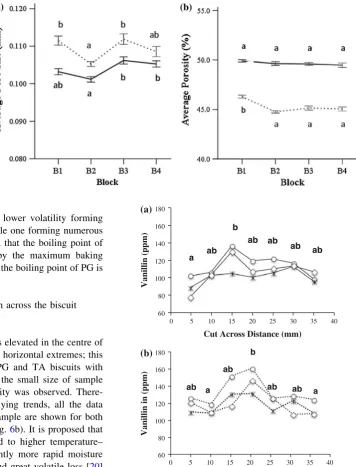
The structure and moisture content of both PG and TA biscuit was analysed by X-raylCT and showed no major differences between the solvent types after baking. Inter-nally the biscuit contains a number of pores, the distribu-tion of pores differed between the biscuits prepared with PG and those prepared with TA. The average pore diameter identified in PG biscuits (diameter 0.105±0.008 mm) was significantly smaller (p\0.001) when compared to TA biscuits (diameter 0.110±0.015 mm). The average porosity (%) of PG biscuits (49.5±2.4 %) was signifi-cantly greater than TA biscuits (45.4±2.1 %,p\0.001). These initial results indicated that PG biscuits contained significantly more pores of smaller diameter when com-pared to TA biscuits. To further understand this difference, 4 regions of the biscuit, which were chosen to represent individual bites (Fig.3), were evaluated by the same approach to calculate pore diameter. The average pore size at each block for TA biscuits was significantly larger than that of the PG biscuits (Fig.5a) (p\0.05). When ANOVA-Tukey’s post hoc test was applied, a significant effect of solvent type was shown (p\0.001). Similarly, the average porosity at each block was calculated for both
solvent types (Fig.5b). PG biscuits had a significantly higher porosity than TA biscuits (p\0.001). Although it should be noted that due to natural product variation, sig-nificant differences were observed between some of the blocks within one solvent for both pore diameter and porosity.
The different micro-structure observed for both PG and TA biscuits may be due to the different physicochemical properties of these two solvents and their interactions during the dough production and baking process. The formation of the cellular solid (biscuit) from short dough during baking is induced by the expansion of the dough as it is subjected to pressures from the vaporisation of water and gases from leavening powders [16]. Although only a small amount of flavour solvent was added, differences in structure were observed, the differences in volatility and hydrophobicity of flavour solvent may interact with dough ingredients in dif-ferent ways leading to differences in structure: PG as the more volatile and hydrophilic solvent may enhance the dis-tribution of the aqueous phase within the dough leading to the formation of larger numbers of small pores being formed as the leavening agent releases gas from the biscuit matrix. In biscuits, fats were reported to have a delaying effect on the release of carbon dioxide during baking [17]: TA is a more heat-stable solvent with more hydrophobic properties which may have led to the formation of larger pores due to the more inhomogeneous distribution of leaving agent and delayed release during baking.
This could further be compared to work by Lara [18] who discussed the impact of the temperature of baking on biscuit volume. Biscuits baked at high temperature (i.e. rapidly heated and moisture rapidly lost) had a higher formation of internal pores, a phenomena attributed to the rapid loss of moisture and rapid gas formation, which can be compared to the addition of solvent of different
Fig. 4 Illustration of cutting a
biscuitaacross seven pieces from left to right (A1–A7);
[image:5.595.179.548.59.267.2]volatilities, the solvent with the lower volatility forming larger pores with the more volatile one forming numerous smaller pores. It should be noted that the boiling point of TA (260°C) is not exceeded by the maximum baking temperature (max 230°C) whilst the boiling point of PG is 188°C.
Horizontal distribution of vanillin across the biscuit structure
The concentration of vanillin was elevated in the centre of the biscuit when compared to the horizontal extremes; this pattern was replicated in both PG and TA biscuits with similar patterns in each. Due to the small size of sample fractions, higher sample variability was observed. There-fore, to fully explain the underlying trends, all the data from each independent biscuit sample are shown for both PG (Fig.6a) and TA biscuits (Fig.6b). It is proposed that the extremities will be subjected to higher temperature– time profiles [19] and subsequently more rapid moisture loss [19], greater heat damage and great volatile loss [20] than the internal core samples, which accounts for the distribution profile.
Although the distribution of vanillin is comparable (Fig.6) between PG and TA, there are subtle differences in the underlying trends. In the PG biscuit, the central 15 cm has elevated vanillin levels when compared to the extreme 5 cm, whereas in the TA biscuit, the central 20 cm retained much elevated levels when compared to the extreme 5–10 cm, this indicates that there is a central core of the TA biscuit that retains statistically elevated concentrations of vanillin. When comparing the biscuit core concentration, 160 ppm can be found in the TA biscuit, whereas the maximal concentration in the PG biscuits was only 136 ppm, this 18 % enhancement in core vanillin con-centration may be of interest commercially. It should be
noted that in all cases, the mean vanillin concentration in the TA biscuit exceeded that of the PG biscuit which supports our previous studies in this area [21].
Vertical distribution of vanillin across the biscuit structure
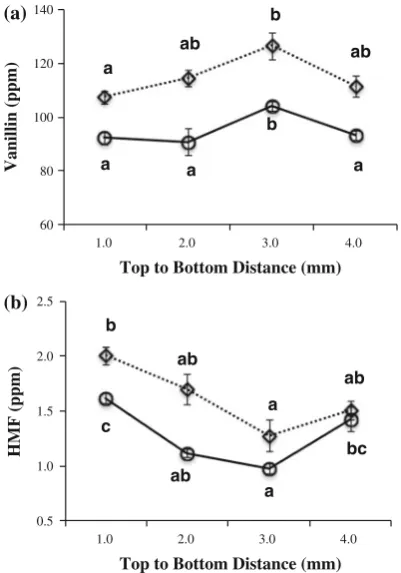
For both PG and TA biscuits (Fig.7), the central region contained the greatest vanillin and the upper section
Fig. 5 Results ofaaverage
pore size (mm) andbcalculated for 4 blocks (B1–B4) within PG biscuits (full line) and TA biscuits (dotted line). Data points are displayed with±SE,
different lettersindicated significant different atp\0.05
60 80 100 120 140 160 180
0 5 10 15 20 25 30 35 40
Vanillin (ppm)
Cut Across Distance (mm)
a ab
b
ab ab
ab ab
60 80 100 120 140 160 180
0 5 10 15 20 25 30 35 40
Vanillin in (ppm)
Cut Across Distance (mm)
a a
b
ab
ab
ab ab (a)
(b)
Fig. 6 Distribution of vanillin concentration (ppm) cutting across
[image:6.595.186.543.56.524.2]contained the lowest concentration of vanillin, this is presumably due to radiative heating leading to the thermal damage at the surface and conductive heating at the base, which can be supported the mass transfer modelling predictions of Sakin [22]. As previously detailed, TA biscuits contained reproducibly greater vanillin after baking than PG biscuits, which was consistent across all slices of all biscuits, which may be due to enhanced moisture diffusivity driven by the higher porosity in the PG biscuits [23].
Horizontal distribution of HMF across the biscuit structure
Distribution of HMF concentration (Fig. 8) followed a similar but inverted pattern to vanillin (Fig.6) when sec-tioned from left to right (horizontally). The concentration of HMF was the highest at the extremities, apart from the furthest right PG sample which did not show elevated HMF. Orientation was such that the darkest baked side of the biscuit always marked as the left (0 mm) to aid inter-pretation, which explains the 35-mm PG sample.
The central core of the TA biscuits had the lowest HMF concentration with a maximal 55 % reduction from the left orientation. The largest reduction observed in the PG bis-cuit was 32 % indicating that a difference in Maillard chemistry occurred between the PG and the TA biscuits or that the components have a higher thermal protection during baking in the TA biscuits. This is comparable to the horizontal vanillin distribution detailed previously. Vertical distribution of HMF across the biscuit structure The vertical distribution for HMF (Fig.7) follows a similar pattern to its horizontal distribution (Fig.8): the lowest HMF concentration is present in the core of the biscuit, and it can be hypothesised that this region would have received the least heat damage [22]. HMF generation is a bi-product of Maillard chemistry, and its formation is strongly linked to thermal exposure, a good example is the high concen-trations found in the crust of bread when compared to the crumb [24].
Figure9 shows the horizontal distribution of pores and relative porosity by analysed layer, TA biscuits had a central core of the biscuit that contained larger pores and lower porosity than that of the PG biscuits which correlates with the higher retention of vanillin in the central core of the TA biscuit shown previously (Fig.7). Diffusivity is strongly correlated to porosity in bread systems, and although there are a large number of interacting variables, Baik [23] has shown that matrices with the highest porosity during baking can have the highest moisture diffusivity,
60 80 100 120 140
1.0 2.0 3.0 4.0
Vanillin (ppm)
Top to Bottom Distance (mm)
a ab ab b a a b a 0.5 1.0 1.5 2.0 2.5
1.0 2.0 3.0 4.0
HMF (ppm)
Top to Bottom Distance (mm)
b ab ab a c bc ab a (a) (b)
Fig. 7 Average concentration (ppm) of a vanillin and b HMF
calculated for four layers cutting from top to bottom for PG biscuits (full lines) and TA biscuits (dotted lines) witherror barsdisplayed as
±SE.Different lettersindicated significant different levels between layers (p\0.05)
0.6 0.8 1.0 1.2 1.4 1.6 1.8
0 5 10 15 20 25 30 35 40
HMF (ppm)
Cut Across Distance (mm) a
b
ab
a a a a
0.6 0.8 1.0 1.2 1.4 1.6 1.8
0 5 10 15 20 25 30 35 40
HMF (ppm)
Cut Across Distance (mm) ab ab ab b ab ab a (a) (b)
Fig. 8 Distribution of HMF
concentration (ppm) cutting across seven pieces forathree PG biscuits (full lines) and
[image:7.595.70.271.58.345.2] [image:7.595.179.545.600.712.2]this could lead one to propose that the higher porosity of the PG sample would be linked to higher moisture loss, greater thermal damage in the core of the biscuit and higher loss of vanillin through volatilisation, which may explain the enhanced stability of vanillin in TA biscuits when compared to PG biscuits.
Previous studies [25] have also applied a quantitative study on biscuit micro-structure from different sections, and their results showed that protein, fat and total starch are evenly distributed throughout the structure of the biscuit. They also found greater gelatinised starch in the middle regions compared with upper and lower surfaces and explained that during baking heat penetrates from the upper and lower surfaces that these surfaces heat up faster than the central core and that aerating agents (carbon dioxide and ammonia) are therefore lost more quickly in the hotter regions. The aerating agents (plus the production of steam) in the central region have more time to act which is pro-posed to be linked to a higher number of pores being produced. Similarly, moisture is removed very quickly from the surface, but the rate of moisture loss is slower in the core of the biscuit, allowing greater concentrations of gelatinised starch to be generated. Since aroma compounds can reversibly interact with starch [26], vanillin may also receive a chemical thermal protection in the central core.
Conclusion
In conclusion, it was shown that vanillin concentration was highest in the centre of biscuits, and HMF concentration was highest at the surface of the biscuit, and that in general, PG biscuits had greater porosity but smaller pore diameter when compared to TA biscuits. In addition, there was a significant effect of solvent type (TA, PG) on the distri-bution of vanillin and HMF across the biscuit matrix with biscuits made with TA as the flavour solvent having the greatest concentration of HMF and vanillin.
This study illustrates how X-ray lCT can be employed as a valuable tool to non-destructively visualise the internal biscuit structure and provide quantitative information on the internal pore structure and, in conjunction with aroma distribution analysis, can help to explain how choice of flavour solvent may impact biscuit micro-structure and the generation and stability of aroma compounds.
Acknowledgments This work was supported by a Knowledge
Transfer Partnership awarded to Aromco Ltd. and the University of Nottingham by Technology Strategy Board, UK. The help of Pro-fessor Andy Taylor, Paul Yeomans, Jackie Harvey and Ray McKee in setting up this project is acknowledged.
Open Access This article is distributed under the terms of the
Creative Commons Attribution License which permits any use,
Fig. 9 Scatter plot of average
pore size (mm) cutting from top to bottom ofathree PG biscuits (black dots) andbthree TA biscuits (grey dots). Scatter plot of average porosity (%) cutting across from left to right of
[image:8.595.179.542.57.356.2]distribution, and reproduction in any medium, provided the original author(s) and the source are credited.
References
1. Acrctander S (1969) Perfume and flavor chemicals, 6th edn. Steffen Arctander’s Publications, Las Vegas
2. Bartlett GR (1959) Phosphorus assay in column chromatography. J Biol Chem 234:466–468
3. Heydanek MG, Min DBS (1976) Carbonyl-propylene glycol interactions in flavor systems. J Food Sci 41:145–147
4. Potineni RV, Peterson DG (2008) Mechanisms of flavor release in chewing gum: Cinnemaldehyde. J Agric Food Chem 56:3260– 3267
5. Elmore JS, Dodson AT, Mottram DS (2011) Reactions of pro-pylene glycol with the constituents of food flavourings. In: The thirteenth Weurman Flavour Research Symposium. Book of Abstracts: Zaragoza, Spain, p 137
6. Choi SJ, Decker EA, Henson L, Popplewell LM, McClements DJ (2009) Stability of citral in oil-in-water emulsions prepared with medium-chain triacylglycerols and triacetin. J Agric Food Chem 57:11349–11353
7. De Roos KB (2007) Modifying flavour in food. In: Taylor AJ, Hort J (eds) Woodhead Publishing Ltd., Cambridge, pp 243–273 8. Potineni R, Peterson D (2008) Influence of flavor solvent on flavor release and perception in sugar-free chewing gum. J Agric Food Chem 56:3254–3259
9. Babin P, Della Valle G, Dendievel R, Lourdin D, Salvo L (2007) X-ray tomography study of the cellular structure of extruded starches and its relations with expansion phenomenon and foam mechanical properties. Carbohydr Polym 68:329–340
10. Kerckhofs G, Schrooten J, Van Cleynenbreugel T, Lomov SV, Wevers M (2008) Validation of X-ray microfocus computed tomography as an imaging tool for porous structures. Rev Sci Instrum 79:13711
11. Feldkamp LA, Davis LC, Kress JW (1984) Practical cone-beam algorithm. J Opt Soc Am A-Opt Image Sci Vis 1:612–619 12. Frisullo P, Conte A, Del Nobile MA (2010) A novel approach to
study biscuits and breadsticks using X-ray computed tomography. J Food Sci 75:E353–E358
13. Ledl F, Severin T (1978) Browning reactions of pentoses with amines.13. Investigation of the Maillard reaction. Z Lebensm-Unters-Forsch 167:410–413
14. Fisk ID, Linforth RST, Taylor AJ, Gray DA (2011) Aroma encapsulation and aroma delivery by oil body suspensions derived from sunflower seeds (helianthus annus). Eur Food Res Technol 232:905–910
15. Abramoff MD, Magalhaes PJ, Ram SJ (2004) Image processing with image. J Biophoton Int 11:36–42
16. Chevallier S, Colonna P, Buleon A, Della Valle G (2000) Physicochemical behaviors of sugars, lipids, and gluten in short dough and biscuit. J Agric Food Chem 48:1322–1326
17. Chevallier S, Colonna P, Lourdin D (2000) Contribution of major ingredients during baking of biscuit dough systems. J Cereal Sci 31:241–252
18. Lara E, Cortes P, Briones V, Perez M (2011) Structural and physical modifications of corn biscuits during baking process. LWT- Food Sci Technol 44:622–630
19. Sakin M, Kaymak-Ertekin F, Ilicali C (2007) Simultaneous heat and mass transfer simulation applied to convective oven cup cake baking. J Food Eng 83:463–474
20. Kayaci F, Uyar T (2012) Encapsulation of vanillin/cyclodextrin inclusion complex in electrospun polyvinyl alcohol (pva) nano-webs: prolonged shelf-life and high temperature stability of vanillin. Food Chem 133:641–649
21. Yang N, Hort J, Linforth R, Taylor A, Brown K, Walsh S, Fisk ID (2011) Aroma and flavour solvent: impact on the matrix. XIII Weurman Flavour Research Symposium, Zaragoza
22. Sakin-Yilmazer M, Kaymak-Ertekin F, Ilicali C (2012) Modeling of simultaneous heat and mass transfer during convective oven ring cake baking. J Food Eng 111:289–298
23. Baik O-D, Marcotte M (2003) Modeling the moisture diffusivity in a baking cake. J Food Eng 56:27–36
24. Ramirez-Jimenez A, Guerra-Hernandez E, Garcia-Villanova B (2000) Browning indicators in bread. J Agric Food Chem 48:4176–4181
25. Burt DJ, Fearn T (1983) A quantitative study of biscuit micro-structure. Starch Sta¨rke 35:351–354