An Evolutionary Algorithm Based on a New Decomposition
Scheme for Nonlinear Bilevel Programming Problems
Hecheng LI1,2, Yuping WANG1
1School of Computer Science and Technology, Xidian University, Xi’an, China
2Department of Mathematics and Information Science, Qinghai Normal University, Xining, China
E-mail: [email protected]
Received July 24, 2009; revised September 21, 2009; accepted November 4, 2009
Abstract
In this paper, we focus on a class of nonlinear bilevel programming problems where the follower’s objective is a function of the linear expression of all variables, and the follower’s constraint functions are convex with respect to the follower’s variables. First, based on the features of the follower’s problem, we give a new de-composition scheme by which the follower’s optimal solution can be obtained easily. Then, to solve effi-ciently this class of problems by using evolutionary algorithm, novel evolutionary operators are designed by considering the best individuals and the diversity of individuals in the populations. Finally, based on these techniques, a new evolutionary algorithm is proposed. The numerical results on 20 test problems illustrate that the proposed algorithm is efficient and stable.
Keywords:Nonlinear Bilevel Programming, Decomposition Scheme, Evolutionary Algorithm, Optimal So-lutions
1. Introduction
The bilevel programming problem (BLPP) involves two optimization problems at different levels, in which the feasible region of one optimization problem (leader’s problem/upper level problem) is implicitly determined by the other (follower’s problem/lower level problem). The general bilevel programming problem can be for-mulated as follows.
min ( , ). . ( , ) 0
min ( , )
. . ( , ) 0
x X
y Y
F x y s t G x y
f x y s t g x y
(1)
where x R n
n m R
and are called the leader’s and follower’s variables, respectively, F(f) :
is called the leader’s (follower’s) objective function, and the vector-valued functions G : and g : are called the leader’s and follower’s constraints, respectively; the sets X and Y place addi-tional constraints on the variables, such as upper and lower bounds or integrality requirements etc. This mathematical programming model arises when two
in-dependent decision makers, ordered within a hierarchical structure, have conflicting objectives, and each decision maker seeks to optimize his/her objective function. In (1), the leader moves first by choosing a vector
m
y R
n m
R R R
p
R
n m
R R
q
R R
n
x X R
in an attempt to optimize his/her objective function F(x,
y); the leader’s choice of strategies affects both the fol-lower’s objective and decision space. The follower ob-serves the leader’s choice and reacts by selecting a vector that optimizes his/her objective function f(x; y). In doing so, the follower affects the leader’s outcome.
m
y Y R
problem is called nonlinear BLPP, which is more com-plex and challenging than linear one. In order to develop efficient algorithms, most algorithmic research to date has focused on some special cases of bilevel programs with convex/concave functions[1,2,6–9], especially, con- vex follower’s functions [10–14]. In these algorithms, the convexity of functions guarantees that the globally optimal solutions can be obtained. Moreover, some intel-ligent algorithms, such as evolutionary algorithms (EAs)/ genetic algorithms (GAs) [10,15–17], tuba search ap-proaches [18], etc, have been applied to obtain the opti-mal solutions to multi-modal functions. However, a question arises when the follower’s objective function is neither convex nor concave. On the one hand, it is diffi-cult for us to obtain the globally optimal solution by us-ing traditional optimization techniques based on gradi-ents; on the other hand, if an intelligent algorithm, such as GA, is used to solve the follower’s problem, it can cause too large amount of computation [16]. To the best knowledge of the authors, there are not any efficient al-gorithm for this kind of BLPPs.
In this paper, we consider a special class of nonlinear BLPP with nonconvex objective functions, in which the follower’s objective is a function of the linear expression of all variables, and the follower’s constraints are convex with respect to the follower’s variables. There are no restrictions of convexity and differentiability on both the leader’s and the follower’s objective functions, which makes the model different from those proposed in the open literature. In view of the nonconvexity of the leader’s objective, we develop an evolutionary algorithm to solve the problem. First, based on the structural fea-tures of the follower’s objective, we give a new decom-position scheme by which the (approximate) optimal solution y to the follower’s problem can be obtained in a finite number of iterations. At the same time, the popula-tions are composed of such points (x, y) satisfying the follower’s optimization problem, that is, y is an optimal solution of the follower’s problem when x is fixed, which improves the feasibility of individuals. Then, to improve the efficiency of proposed algorithm, the better individu-als than crossover parents are employed to design new crossover operator, which is helpful to generate better offspring of crossover. Moreover, we design a single- side mutation operator, which can guarantee the diversity of individual in the process of evolution.
This paper is organized as follows. The model of the bilevel programming problem and some conceptions are presented in Section 2, and a solution method of the fol-lower’s problem is given based on a decomposition scheme in Section 3. Section 4 presents an evolutionary algorithm in which new evolutionary operators are de-signed. Experimental results and comparison are pre-sented in Section 5. We finally conclude our paper in Section 6.
2. Bilevel Programming Problem and Basic
Notations
Let us consider the bilevel programming problem de-fined as follows
min ( , ). . ( , ) 0
min ( , ) ( ( ) )
. . ( , ) 0
x X
y Y
F x y s t G x y
f x y B x y s t g x y
(2)
where g(x, y) is convex and twice continuously differen-tial in y, the function (.) is continuous, B x( )
is vector-valued, where
1 2
( ( ), ( ), ..., ( ))b x b x b xm R
i 1, 2, ...,
: n i
b R m
, and X {( ,..., )x1 xn TRn|
, 1,..., }
i i i
l x u i n , 1,..., )T m|
m
y R
{(
Y y lj
, 1,..., }
j j
y u j m ,l ui i, , ,l uj j i1, 2,... ,n j1,2,...,m, are all real constant. Now we introduce some related definitions and notations [2] as follows.
1) Search space: {( , ) |x y x X y Y , }; 2) Constraint region:
{( , ) | ( , ) 0, ( , ) 0}
S x y G x y g x y ; 3) For x fixed, the feasible region of follower’s prob-lem:
( ) { | ( , ) 0}
S x y Y g x y
4) Projection of S onto the leader’s decision space: ( ) { | ,such that ( , ) }
S X x X y x y S
5) For eachx S X ( ), the follower’s rational reaction set:
( ) { | arg min{ ( , ), ( )}}
M x y Y y f x v v S x
6) Inducible region:
{( , ) | ( )}
IR x y S y M x .
In terms of aforementioned definitions, (2) can also be written as:
min{ ( , ), ( , )F x y x y IR}
In order to ensure that (2) is well posed, in the re-mainder, we always assume that:
A1: S is nonempty and compact;
A2: For all decisions taken by the leader, each fol-lower has some room to react, that is, ( )S x .
A3: The follower’s problem has at most finite optimal solutions for each fixed x.
re-gion (feasible rere-gion). If the individuals (x, y) are gener-ated at random, there are large numbers of infeasible points in the populations, which makes the efficiency of EA decreased. To overcome the disadvantage, for x fixed, we first solve the follower’s problem to get the optimal solution y. After doing so, the point (x, y) at least satis-fies or approximately satissatis-fies the follower’s optimiza-tion. But the follower’s optimization problem may be nonconvex, how one can easily obtain the follower’s globally optimal solutions y for a fixed x? We finish the step in the next section
3. Solution Method of the Follower’s
Problem
For any fixed x, we consider the follower’s problem of (2), that is,
min ( , ) ( ( ) ). . ( , ) 0
y Y f x y B x y
s t g x y
(3)
The optimal solutions to (3) can be found in several steps given as follows. Firstly, we solve the following nonlinear convex programming problems with linear objective function.
min ( ). . ( , ) 0
y Y B x y
s t g x y
(4)
and
min ( ). . ( , ) 0
y Y B x y
s t g x y
(5)
here, both (4) and (5) are convex programming problems, as a result, the optimal solutions can be obtained easily by the existing algorithms. We denote by ymin and ymax
the optimal solutions to (4) and (5), respectively; setting
B(x)ymin= a and B(x)ymax = b. In fact, we only need to
consider the function
over the interval [a, b]. Sec-ondly, let us find the monotone intervals of the function in [a, b], without any loss of generality, denote these intervals by [ai, bi]; i = 1, 2,…, k, and the index set
cor-responding to all increasing intervals is denoted by I1, while that corresponding to all decreasing intervals by I2. Thirdly, we consider the families of nonlinear program-ming problems as follows.
1
min ( )
. . ( , ) 0,
( )
y Y
i i
B x y
s t g x y i I
a B x y b
(6)
and
2
min ( )
. . ( , ) 0,
( )
y Y
i i
B x y
s t g x y i I
a B x y b
(7)
Evidently, the optimal solution to (3) can be obtained by solving (6) and (7). But it is computationally expen-sive to solve all of these nonlinear programming prob-lems given by (6) and (7). In fact, we have
Theorem 1. Each among (6) and (7) can get its mini-mum on the hyperplanes presented by B(x)y = i, (i
= ai or bi, i = 1,2,…, k).
Proof.Note that B(x)y is linear with respect to y, as a result, it can achieve the minimum and maximum values at the boundary of S(x), and the two points were denoted by yminand ymax. Let us recall that S(x) is convex, it
fol-lows that each point on the line segment yminymax is in
S(x). Further, B(x)y is continuous in the compact set
yminymax, it means for eachi [a, b], there exists a point
i
y on yminymaxsuch that B(x) yi = i. As a result, it is easy to see that for each optimization problem pre-sented by (6) and (7), there is a point satisfying B(x)y =
i
in the feasible region. This completes the proof. Since f(x, y) = (B(x)y) is constant over each hyper-plane, we select a hyperplane on which f(x, y) has the smallest value. Recall assumption A3, there exists only a feasible point in the hyperplane. But how can one easily take the point from the hyperplane? Let us finish the process in the last step. Finally, draw a line segment connecting points yminand ymax, which can be presented
by the expression with a parameter t: y = ymin + t(ymax -
ymin). One can obtain easily a feasible point on the
hyper-plane by considering both the expression and the equa-tion of the hyperplane. If there are more than one optimal solution, that is, there exist several hyperplanes on which
[image:3.595.308.536.587.688.2]f(x, y) has the same smallest value, in terms of A3, the number of feasible points is finite in these hyperplanes, we can select one among them according to the fitness function values given in next section. The procedure of solving the follower’s problem is shown in Figure 1. In Figure 1, the elliptical region is the feasible region of the follower’s problem for some fixed x. In terms of the
monotonicity of , one can give the hyperplanes
i
y
x
B
(
)
, and can achieve the optimal value on one or some hyperplanes. Also,)
,
(
x
y
f
is constant on each hyperplane, it means that the optimal solution of the follower’s problem can be found by checking the values of at the black points on
y
miny
max.4. Proposed Algorithm
In the section, we begin with the fitness function, cross-over and mutation operators, and then propose an evolu-tionary algorithm with real number encoding to solve (2).
4.1. Fitness Function
Let us apply the penalty method to deal with the leader’s constraints. In order to use the technique efficiently, we design a dynamic parameter inspired by the sequential weight increasing factor technique (SWIFT) proposed by B. V. Sheela and P. Ramamoorthy [19]. The fitness function is denoted by F(x, y) + Mg
. Where g stands for the ge- neration number, Gi(x, y) are the components of G(x, y);
Mg are penalty parameters (where M1 is given in advance as a positive constant, g = 1, 2,…) and computed as follows.
( , )
R x y }
p
max{0, G x y ii( , ), 1,...,
Choose n + 1 best points from the cur-rent population. Let
0, ,...,1 n
p p p
0 1 1 n i G i d p n
pHere 1 0
1 n G i p n
pi , and is updated by thefollowing formula.
g
M
1
1 max{ , }
g
M M
d
g
1 1
(8)
While n + 1 points chosen as above are affine inde-pendent, these points constitute a simplex
; and as the generation number g in-creases.
0 1 2
{ , ,p p p , ...,pn} Mg
4.2. Crossover Operator
Let N denote the population size. Rank all points in the population pop according to the fitness values from small to large. Without any loss of generality, we also denote these points by , and let > 0 stand for the fitness values of , i=1, 2 ,…, N. We give the crossover operator as follows.
1, 2,..., N
p p p
i
p
i
R
Let be a selected individual for crossover. The cr- ossover offspring of the individual is got as follows.
i p i o 0 ( ), ( ), i i G i i
i i
p r p p i
o
p r p p i
(9)
where r[0,1] is random, is a positive constant, is arbitrarily chosen in the current population and
0 p 1 1 i i G l l
p pl
1 1 1/, 1,..., 1 1/ l l i j j R l i R
In the designed crossover operator, all better individu-als than the crossover parent are used to provide a good direction for crossover, and the coefficients l make
closer to the points with smaller fitness.
i G
p
4.3. Single-Side Mutation Operator
Let be a parent individual for mutation. The mutation offspring of is generated as fol-lows.
1
ˆ ( ,...,ˆ ˆn)
i i i
p p p
ˆi
o pˆi
At first, to select a component of at random, then the hyperplane divides the search space X
into two hypercubes. Let
j i
pˆ pˆi
j i j p
pˆ ˆ
represents the hypercube in which any point satisfies j while
i
pˆ
j
pˆ stands
for the other, V()(V()) presents the volume of
(); and represents the set of all
individu-als belonging to
pop
, stands for the set of other points in the population; presents the number of elements in the set W. Then
pop
|W|
1
2
| | | |
ˆ , ,
ˆ ( ) ( )
ˆ , ;
i i i pop pop o V V o o otherwise (10)
where ˆ ˆ1( )2 is a point taken randomly in
i i
o o ();
is a small positive number, which keeps the denomi-nators away from zero.
The mutation operator designed so is helpful to uni-formly generate points in X, which can help to prevent the algorithm from the premature convergence.
4.4. Evolutionary Algorithm Based on the New Decomposition Scheme (EABDS)
Step1. (Initialization) Randomly generate N initial points , 1, 2,...,
i
x X i N. For each xi fixed, we solve the
follower’s problem for yivia the algorithm presented in
Step2. (Fitness) Evaluate the fitness value R(x, y) of each point in pop(k);
Step 3. (Crossover) Randomly select a parent (x, y) from pop(k) according to the crossover probability . We first execute the crossover for the component x of the parent, and denote the offspring by
c
p
ˆ
x. For fixed ˆx, the follower’s problem is solved to get the optimal solu-tion . Then we can obtain a crossover offspring (yˆ x yˆ ˆ, ). Let O1 stand for the set of all these offspring;
Step4. (Mutation) Randomly select parents from pop(k) according to the mutation probability . For each se-lected parent (x, y), we first execute the mutation for x and get its offspring
m
p
x
, then for fixed x, we optimize the follower’s problem for y. (x y, ) is the mutation off-spring of (x, y). Let O2 represent the set of all these off-spring.Step 5. (Selection) Let . We evaluate the fitness values of all points in O, select the best N1 points from the set and randomly select
1
O O O2 ( )
pop k O N N 1
points from the remaining points of the set. These se-lected points form the next population pop(k + 1);
Step 6. If the termination condition is satisfied, then stop; otherwise, let k = k+1, go to Step 3.
5. Simulation
We select 14 test problems from the references [4,7,8,10, 12–15,17]. All problems are nonlinear except for g01, g02, g05, and g08. In these problems, the function in-volved is differentiable and convex. In order to test the effectiveness of the proposed algorithm for nonconvex or nondifferentiable problems, we also construct 6 addi-tional test problems as follows.
We first choose 2 test problems g10 and g08 randomly from the 14 problems:
g10)
2 2
0 15
2 0 20
min ( 10)
. . 0
min ( 2 30)
. . 0
x
y
x y
s t x y
x y
s t x y
g08)
1 2 1 2
0
1 2 1 2 3
0
1 2 3
1 1 2 3
2 1 2 3
min 8 4 4 40 4
min 2 2
. . 1
2 2 0.5 1
2 2 0.5 1
x y
3
x x y y y
x x y y y
s t y y y
x y y y
x y y y
,
and replace the follower’s objective functions of the two problems by new constructed ones, respectively. As a
result, we get problems g15-g20, in which problems g15- g17 are the same as problem g10 except for
g15) f x y( , ) | x 2y30 |; g16) f x y( , ) sin( x2y30); g17) f x y( , ) cos( x2y30);
While problems g18 -g20 have the same functions as problem g08 except for
g18) f x y( , ) | x12x2 y1 y22y3| g19) f x y( , ) sin( x12x2 y1 y22 )y3
g20) f x y( , ) cos( x12x2 y1 y22 )y3
Generally speaking, the functions constructed so are nondifferentiable or nonconvex, which makes the corre-sponding BLPPs more difficult to solve than those with differentiable and convex objective functions.
The parameters are chosen as follows: the population size N = 30, the crossover probability pc = 0.8, the muta-tion probability pm= 0.2, N1 = 20, = 2 and M1 = 100. For g01- g20, the algorithm stops when the best result can not be improved in 20 successive generations or after 50 generations. We execute EABDS in 30 independent runs on each problem on a computer (Intel Pentium IV-2.66GHz), and record or compute the following data:
1) Best values (Fbest), worst values ( ), mean
(
worst
F
mean
F ), median ( ) and standard deviation (Std) of the objective function values in all 30 runs.
median
F
2) Best solutions ( *, *x y ) in all 30 runs.
3) Mean of generation numbers (gmean), and mean numbers of the individuals (MNI) used by EABDS.
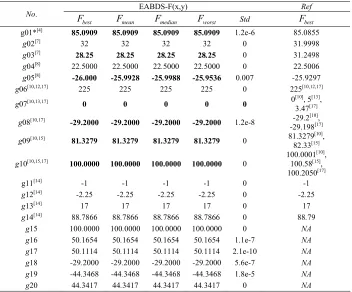
All results are presented in Tables 1-2, in which Table 1 provides the comparison of the results found by both EABDS and the compared algorithms for problems
g01-g20. Table 2 shows the best solutions found by both EABDS and the algorithms in the related references for
g01-g20, and gmeanand CPU used by EABDS are pro-vided in Table 2. NA means that the result is not avail-able for the algorithms, ‘*’ presents the problem is the maximization model and Ref stands for the related algo-rithms in references in Tables 1-2.
It can be seen from Table 1 that for problems g01, g03, g05, g07 [13,17], g08 [17], g09 [15] and g10, the best results found by EABDS are much better than those by the compared algorithms in the references, which indi-cates the algorithms in the related conferences can’t find the globally optimal solutions of these problems. For the constructed problems g15-20, EABDS gives uniform results. From the constructed objective functions, one can easily see that g15 has the same optimal solutions as
Table 1. Comparison of the best results found by EABDS and the algorithms presented by related references.
EABDS-F(x,y) Ref
No.
best
F Fmean Fmedian Fworst Std Fbest
g01*[4] 85.0909 85.0909 85.0909 85.0909 1.2e-6 85.0855
g02[7] 32 32 32 32 0 31.9998
g03[7] 28.25 28.25 28.25 28.25 0 31.2498
g04[8] 22.5000 22.5000 22.5000 22.5000 0 22.5006
g05[8] -26.000 -25.9928 -25.9988 -25.9536 0.007 -25.9297
g06[10,12,17] 225 225 225 225 0 225[10,12,17]
g07[10,13,17] 0 0 0 0 0 0[10], 5[13],
3.47[17]
g08[10,17] -29.2000 -29.2000 -29.2000 -29.2000 1.2e-8 -29.2[10],
-29.198[17]
g09[10,15] 81.3279 81.3279 81.3279 81.3279 0 81.3279[10],
82.33[15]
g10[10,15,17] 100.0000 100.0000 100.0000 100.0000 0 100.0001 [10],
100.58[15],
100.2050[17]
g11[14] -1 -1 -1 -1 0 -1
g12[14] -2.25 -2.25 -2.25 -2.25 0 -2.25
g13[14] 17 17 17 17 0 17
g14[14] 88.7866 88.7866 88.7866 88.7866 0 88.79
g15 100.0000 100.0000 100.0000 100.0000 0 NA g16 50.1654 50.1654 50.1654 50.1654 1.1e-7 NA g17 50.1114 50.1114 50.1114 50.1114 2.1e-10 NA g18 -29.2000 -29.2000 -29.2000 -29.2000 5.6e-7 NA g19 -44.3468 -44.3468 -44.3468 -44.3468 1.8e-5 NA g20 44.3417 44.3417 44.3417 44.3417 0 NA
Table 2.Comparison of the solutions found by EABDS and the related algorithms in references, gmeanand MNI needed by EABDS.
(x*, y*)
No. gmean/MNI
EABDS Ref
g01[4] 40/1353 (17.4545,10.9091) (17.4500,10,9080)
g02[7] 42/1421 (2,6) (2.0002,5.9999)
g03[7] 24/823 (0,0) (1.0071,1.0035)
g04[8] 21/799 (1.5000,4.5000) (4.4922,1.5223)
g05[8] 35/1332 (0,0.9,0,0.6,0.4) (0,0.8965,0,0.5977,0.3906)
g06[10,12,17] 45/1469 (20,5,10,5) (20,5,10,5)[10,12,17]
g07[10,13,17] 41/1401 (0,0,-10,-10) (0,30,-10,10) [10]
(25,30,5,10)[13]
(24.87,29.98,5,10.31)[17]
g08[10,17] 29/1021 (0,0.9,0,0.6,0.4) (0,0.9,0,0.6,0.4)[10]
(0,0.9,0,0.6,0.3999)[17]
g09[10,15] 23/1089 (10.0164,0.8197) (10,0164,0.8197)[10],
(10.04,0.1629)[15]
g10[10,15,17] 38/1184 (10,10) (10.000,10.000) [10],
(10.03,9.969)[15],
(10.01,9.93)[17]
g11[14] 29/897 (0.5,0.5,0.5,0.5) NA
g12[14] 24/765 (0.75,0.75,0.75,0.75) NA
g13[14] 31/959 (1,0) NA
g14[14] 21/682 (0,0.5773) NA
g15 46/1396 (10,10) NA
g16 50/1528 (5.2876,5.2876) NA
g17 35/1102 (4.7640,4.7640) NA
g18 36/1125 (0,0.9,0,0.6,0.4) NA
g19 36/1104 (0.3192,0,1.2490,1.0498,1.1992) NA g20 21/657 (0,0,1.1903,1.1903,0.3805) NA
vex follower’s functions. For other problems except for
g02, the best results found by EABDS are almost as good as those by the compared algorithms. For g02, although
[image:6.595.91.506.410.672.2]prob-lem, which makes the result better than that by EABDS, in fact, EABDS provides a precise solution. In all 30 runs, EABDS finds the best results of all problems ex-cept for problems g01, g05, g08 and g16-g19. For these problems, from Table 1, we can find the worst results are close to the best results and the standard deviations are also very small. This means that EABDS is stable and robust.
From Table 2, we can also see that for all of the prob-lems, EABDS needs much less MNI and gmean, which
means the proposed algorithm is efficient.
6. Conclusions
For the nonlinear bilevel programming problems with a special follower’s objective, we propose an evolutionary algorithm based on a decomposition scheme, in which based on the best points generated so far, we design a new crossover operator, and apply the approximate SWIFT to deal with the leader’s constraints. From the data simulation, we can also see easily that the proposed algorithm is especially effective and efficient for solving this kind of BLPPs.
7. Acknowledgment
This work was supported by the National Natural Sci-ence Foundation of China (No. 60873099).
8. References
[1] B. Colson, P. Marcotte, and G. Savard, “Bilevel pro-gramming: A survey,” A Quarterly Journal of Operations Research (4OR), Vol. 3, pp. 87–107, 2005.
[2] J. F. Bard, “Practical bilevel optimization,” The Nether-lands: Kluwer Academic Publishers, 1998.
[3] U. P. Wen and S. T. Hsu, “Linear bi-level programming problems-A review,” The Journal of the Operational Re-search Society, Vol. 42, pp. 125–133, 1991.
[4] K.-M. Lan, U.-P. Wen, H.-S. Shih, et al., “A hybrid neural network approach to bilevel programming problems,” Ap-plied Mathematics Letters, Vol. 20, pp. 880–884, 2007.
[5] H. I. Calvete, C. Gale, and P. M. Mateo, “A new ap-proach for solving linear bilevel problems using genetic algorithms,” European Journal of Operational Research, Vol. 188, pp. 14–28, 2008
[6] L. D. Muu and N. V. Quy, “A global optimization method for solving convex quadratic bilevel program-ming problems,” Journal of Global Optimization, Vol. 26, pp. 199–219, 2003.
[7] D. L. Zhu, Q. Xua, and Z. H. Lin, “A homotopy method-for solving bilevel programming problem,” Nonlinear Analysis, Vol. 57, pp. 917–928, 2004.
[8] H. Tuy, A. Migdalas, and N. T. Hoai-Phuong, “A novel approach to bilevel nonlinear programming,” Journal of Global Optimization, Vol. 38, pp. 527–554, 2007
[9] H. I. Calvete and C. Gale, “On the quasiconcave bilevel programming problem,” Journal of Optimization Theory and Applications, Vol. 98, pp. 613–622, 1998.
[10] Y. P. Wang, Y. C. Jiao, and H. Li, “An evolutionary al-gorithm for solving nonlinear bilevel programming based on a new constraint - handling scheme,” IEEE Trans. on Systems, Man, and Cybernetics-Part C, Vol. 35, pp. 221– 232, 2005.
[11] H. C. Li and Y. P. Wang, “A hybrid genetic algorithm for solving a class of nonlinear bilevel programming prob-lems,” Proceedings of Simulated Evolution and Learning- 6th International Conference, SEAL, pp. 408–415, 2006.
[12] K. Shimizu and E. Aiyoshi, “A new computational method for Stackelberg and minmax problems by use of a penalty method,” IEEE Transactions on Automatic Con-trol, Vol. 26, pp. 460–466, 1998.
[13] E. Aiyoshi and K. Shimizu, “A solution method for the static constrained Stackelberg problem via penalty method,” IEEE Transactions on Automatic Control, Vol. AC-29 (12), pp. 1111–1114, 1984.
[14] B. Colson, P. Marcotte, and G. Savard, “A trust-region method for nonlinear bilevel programming: algorithm & computational experience,” Computational Optimization and Applications, Vol. 30, pp. 211–227, 2005.
[15] V. Oduguwa and R. Roy, “Bilevel optimization using genetic algorithm,” Proceedings of IEEE International Conference on Artificial Intelligence Systems, pp. 123– 128, 2002.
[16] B. D. Liu, “Stackelberg-Nash equilibrium for mutilevel programming with multiple followers using genetic algo-rithms,” Computer mathematics Application, Vol. 36, No. 7, pp. 79–89, 1998.
[17] X. B. Zhu, Q. Yu, and X. J. Wang, “A hybrid differential evolution algorithm for solving nonlinear bilevel pro-gramming with linear constraints,” Proceedings of 5th IEEE International Conference on Cognitive Informatics (ICCI’06), pp. 126–131, 2006.
[18] J. Rajesh, K. Gupta, and H. Shankar, et al., “A tabu search based approach for solving a class of bilevel pro-gramming problems in chemical engineering,” Journal of Heuristics, Vol. 9, pp. 307–319, 2003.