Intelligent Information Management
, 2010, 2, 1-13
doi:10.4236/iim.2010.21001 Published Online January 2010 (http://www.scirp.org/journal/iim)
Using Rapid Prototyping Data to Enhance a
Knowledge-Based Framework for Product Redesign
Stefano FILIPPI
1, Ilaria CRISTOFOLINI
21
DIEGM Department, University of Udine, Viale delle Scienze Udine, Italy
2DIMS Department, University of Trento, Via Mesiano Trento, Italy
:
[email protected], [email protected]
Abstract
The particular characteristics of Rapid Prototyping technologies, both in terms of constrains and
opportuni-ties, often require the reconfiguration of the product model to obtain the best compliance with the product
functionalities and performances. Within this field of research, a knowledge-based tool named Design
GuideLines Collaborative Framework (DGLs-CF) was developed to support both the designers defining the
product consistently with the manufacturing technologies and the manufacturers defining the building setup
consistently with the product requirements. Present work is focused on enhancing the DGLs-CF knowledge
base and on updating the DGLs-CF knowledge management by using the information gathered on some RP
technologies. The added-value of this research is represented by an improvement in the Redesign/Reconfig-
uration Package, the final result of the DGLs-CF adoption. This is a list of actions to be performed on the
product model and on the process parameters to avoid the limitations of the technology and to exploit at best
its opportunities.
Keywords:
rapid prototyping, knowledge-based engineering, product redesign, collaborative engineering
1. Introduction
The increasing complexity of design tasks and
continu-ous developments in technology require the
improve-ment of designers’ problem-solving capabilities, through
the development of Design for X (DfX) methods and
tools accordingly. Moreover, they must be flexible enou-
gh to allow an easy customization according to the
evo-lution of the technologies that they address. Up to now,
several examples of DfX appeared in the research
land-scape, as described in [1–11] The next research step was
to investigate the possibility of merging several DfXs
together in an integrated framework able to generate
de-sign guidelines related to more than one phase of the
product lifecycle. In this context, the Design GuideLines
Collaborative Framework (DGLs-CF) was developed as
a knowledge-based tool to help designers defining the
product consistently with manufacturing and verification
technologies. The aim of the DGLs-CF is to evaluate the
feasibility of the product (model) with available
manu-facturing technologies, to exploit the particular
charac-teristics of them and to measure the conformity of the
product to the requirements with specific verification
technologies [12].
Purpose of this work is enhancing the DGLs-CF
knowledge base and updating the DGLs-CF knowledge
management by exploiting the information related to
several Rapid Prototyping (RP) technologies. The goal is
to generate richer and more effective guidelines
informa-tion for the designers. RP technologies build physical
models starting directly from their CAD representations,
as this way costs and times are drastically reduced. They
are a very powerful tool in product development. New
products normally develop in Concurrent Engineering
environments where many actors play different roles; in
these scenarios it is of great help having a physical
pro-totype of the product, something tangible, which may
help communicating different skills and developing new
ideas [2,13–20]. The specific characteristics of the RP
technologies, however, are not so widely known in depth
and thus it is worthwhile customizing the DGLs-CF for
them. This may be a good way of helping non-expert
designers in exploiting the opportunities of RP
technolo-gies.
compatibility with the knowledge base format inside the
DGLs-CF. Some considerations about the use of these
new pieces of information relating with specific classes
of products close the paper.
2. The DGLs-CF
The DGLs-CF is a decision support methodology aimed
at effectively helping and leading the activities of
de-signers, manufacturers and inspectors for product
redes-ign and process reconfiguration. The initial consideration
is that designers are not necessarily experts in
manufac-turing and verification processes; likewise,
manufactur-ers and inspectors are not experts in design. A detailed
description of the DGLs-CF appears in [12,21–23]The
DGLs-CF structure is shortly described in the next
para-graph using IDEF0 formalism [24]. IDEF0 is preferred to
more sophisticated description methods (UML, for
ex-ample) because its simplicity makes it a good tool for
sharing information in a concurrent engineering
envi-ronment, especially for non-expert users.
2.1. The DGLs-CF Roadmap
Shortly speaking, the DGLs-CF considers the set of
available technologies and the product to be redesigned
and suggests a list of actions – the Redesign/Reconfigu-
ration Package – to get the best compatibility.
The easiest way to describe this methodology is by
using the so-called DGLs-CF roadmap. It puts in the
correct logical order all the activities required by the
DGLs-CF adoption as well as the related algorithms and
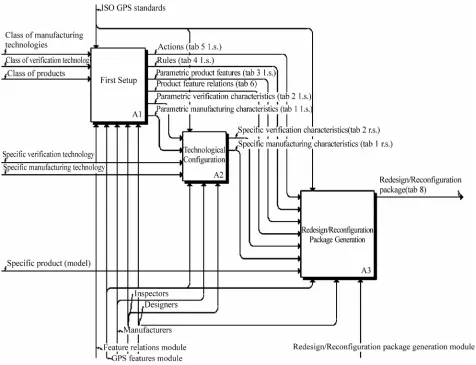
modules. Figure 1 shows the main level of the IDEF0
diagram.
[image:2.595.59.535.341.706.2]In the first setup phase (A1), the DGLs-CF is
custom-ized considering the characteristics of the class of the
available manufacturing and verification technologies as
well as the features characterising the product under
study. Technological characteristics and product features
are then related to each other using rules, which relate
the limitations (but sometimes also the opportunities) of
the technologies to each product feature. Rules are
cou-pled with expressions, which are needed to evaluate
quantitatively the compatibility of the existing version of
the product (model) with the available technologies.
When the compatibility is not present, the rules suggest
actions to be executed to overcome the limitations of the
technologies and to exploit their opportunities. It must be
noted that some actions may also affect different features
when they are performed on a single feature to gain its
compatibility. A “dynamic coefficient” is thus associated
to the actions, with its value determined by the amount of
features the action may affect. This value is decisive in
defining the sequence of actions during the generation of
the Redesign/Reconfiguration Package.
The Technological Configuration phase (A2) allows to
set the parameter values of the manufacturing and
veri-fication characteristics, given the specific brands/models
of the available equipments.
Finally, the Redesign/Reconfiguration Package
Gen-eration phase (A3) generates the list of actions (the
Re-design/Reconfiguration Package) to be applied to the
product (model) and to the technological process
pa-rameters by means of a recursive algorithm that
evalu-ates time by time different product (model)
configura-tions.
In this work the DGLs-CF knowledge base is
en-hanced with information related to some RP technologies;
for this reason the main characteristics of the RP
tech-nologies considered here are described in the following.
3. RP Technologies
The RP technologies considered here are Fused
Deposi-tion Modelling (FDM), Stereolithography (SLA),
Selec-tive Laser Sintering (SLS), and Laminated Object Manu-
facturing (LOM). All of these systems build parts in
mul-tiple thin layers and their main characteristics, which are
used in the DGLs-CF customisation, are summarised
hereafter [25–27].
3.1. Fused Deposition Modelling (FDM)
This technology extrudes a molten thermoplastic
fila-ment (ABS, polyolefin, polyamide...) through a nozzle in
the form of a thin ribbon and delivers it in computer-
controlled locations appropriate for the object geometry,
thus building the sections of the part. No high powered
lasers are used. Typically, the delivery head moves in the
horizontal plane while the support plane, where the part
is built, moves vertically, so that each section is built
over the previous one. The application temperature is
such that the applied material bonds firmly with the
pre-vious layer. Some support material may be necessary to
build the model, depending on the geometrical
complex-ity of the part and on its orientation inside the workspace.
The quantity and the shape of the support, which has to
be removed from the final part, are calculated
automati-cally. The first section is always built on a support plane,
which section is slightly larger than the model to allow
an easy removal of the part from the building platform.
Precision and surface finishing of the parts are affected
by the so-called”slicing” (the layering), which depends
on the kind of equipment used, and can vary typically
from 0.17 mm to 0.33 mm. The final parts do not need
post-processing, except for support removal and some
grinding for a better surface finishing.
3.2. Stereolithography (SLA)
A platform that can be lowered and elevated is usually
located the thickness of a layer below the surface of a
liquid photosensitive polymer contained in a tank. Each
slice is etched onto the surface of the photosensitive pol-
ymer that solidifies when exposed to the laser beam.
Once the laser has covered the whole surface of the layer,
the platform lowers to a depth of another layer thickness,
allowing the liquid resin to flow over the previously cur-
ed layer. A re-coating blade passes over the surface to
ensure that a consistent layer thickness is present before
the beginning of the next layer. Different building styles
for the prototypes can be used with a SLA system.
Nor-mal style involves building full resin prototypes while
other styles leaves some resin in the liquid state for
dif-ferent purposes (stresses minimization, generation of
models for investment casting, etc.). Supports are
re-quired when islands (portion of a layer that is
discon-nected from any other portion of the same layer),
over-hangs, or cantilevered sections exist in the part being built.
SLA parts have good surface texture and dimensional
accuracy, however the orientation of the model in the
workspace (due to the staircase effect) and the presence
of support can influence the surface finishing. At the end
of the building phase the model is carefully removed
from the platform and a post-curing phase is performed,
in a UV-beam oven, to completely solidify the part.
3.3. Selective Laser Sintering (SLS)
material for the objects but in any case additional
struc-tures are needed during the building of overhangs.
SLS
parts have average surface texture and dimensional
ac-curacy, the quality being mainly influenced by the
pow-der particle size. On completion, the built volume has to
cool down to room temperature after which the
proc-essed objects can be removed from the powder bed by
brushing away excess powder. Sandblasting or other
fin-ishing manufacturing techniques are used to remove all
un-sintered particles and to improve the final accuracy of
the sintered objects. Of course in this case the support
removal is not straightforward and requires special
ma-chining and tools.
3.4. Laminated Object Manufacturing (LOM)
In this technology, a sheet of thick paper (coming from a
feed roll) with a polyethylene coating on the reverse side
is placed on a platform. The coating is melted by a
heated roller making the paper adhere to the building
platform that, just like the technologies described before,
can lower and lift along the Z axis. A laser then cuts the
paper following the boundaries of the section of the
ob-ject. The laser also creates hatch marks, which generate a
collection of cubes in the final building volume of glued
paper. These cubes behave as a support structure for the
overhangs of the model. When the laser has finished the
layer, a new paper sheet is applied. At the end of the job,
the model is captured within a block of paper. When all
of the surrounding cubes have been removed, the
unfin-ished part is sanded down. In the case of cavities
prob-lems could be faced in the removal of the paper cubes.
The natural sensitivity of the paper to humidity and
temperature can be reduced by coating the model. The
surface finishing and the accuracy of the model are not to
the same standard as the other methods, however objects
have the look and feel of wood and thus can be worked
and finished like wood.
4. DGLs-CF Knowledge Base Enhancement
4.1. Collection of Data
The aim of this work is the enhancement of the DGLs-
CF knowledge base with pieces of information coming
from the RP field. The attention is focused on the
manu-facturing characteristics, in order to determine the
com-patibility between the RP technologies and the products.
Interviews with expert users and to equipment
manufac-turers, the previous experience of the authors, papers,
user manuals and brochures, etc., have been the sources
used for data collection. The goal of this task is to collect
the characteristics of the four RP technologies described
previously and to identify the related parameters that will
be used afterwards by the DGLs-CF users to describe the
available equipments [28–38].
4.2. Insertion of Data in the DGLs-CF
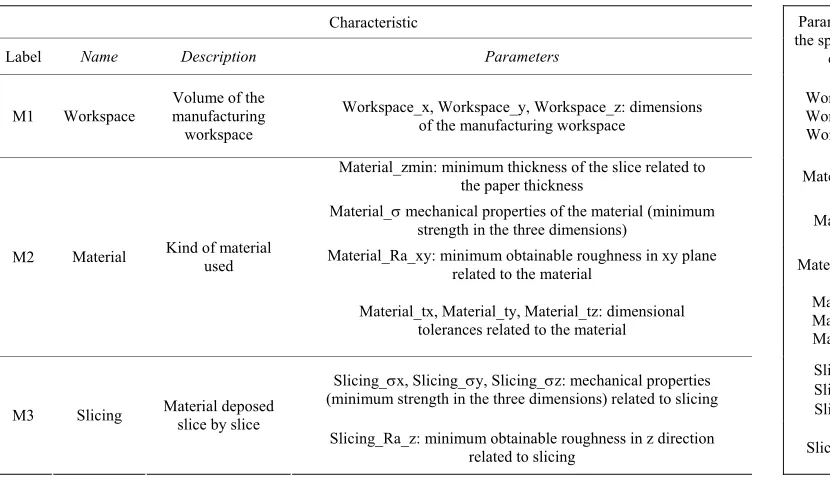
The DGLs-CF data structure is organized in tables.
Those concerned with in this research have a left side
where the characteristics of the class of technology and
the related parameters are listed and a right side where
the values of the parameters are set, given the specific
available equipment. In this research, only the left side is
considered, given that the goal is to characterize classes
of RP technologies and not specific equipments. The
information concerning the four RP technologies
consid-ered in this paper are inserted in the DGLs-CF data
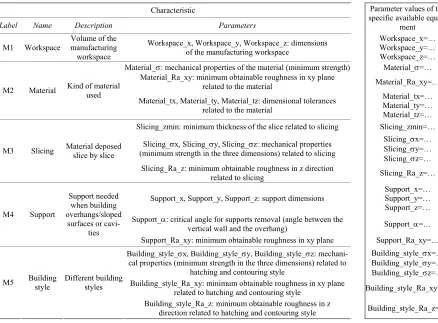
structure, the result is reported in Table 1 (FDM), Table 2
(SLA), Table 3 (SLS), and Table 4 (LOM).
Some characteristics are common to all the RP
tech-nologies considered, as they are intrinsic to the “nature”
of the technologies themselves, these being the volume
of the manufacturing workspace, the slicing (all the
tech-nologies build the models by layers) and the kind of
ma-terial. Another important issue to consider in determining
the compatibility between the RP technology and the
product is the need for support for all of them, except for
the LOM. SLA and SLS also allow the definition of the
building style, as hatching and contouring style, and this
characteristic also affects the product features.
5. Discussion
Table 1. Parametric manufacturing characteristics for the FDM technology
Characteristic
Label Name Description Parameters
Parameter values of the specific available
equipment
M1 Workspace Volume of the manu-facturing workspace Workspace_x, Workspace_y, Workspace_z: dimensions of the manufacturing workspace
Workspace_x=… Workspace_y=… Workspace_z=…
Material_wire: diameter of the wire Material_wire=… Material_: mechanical properties of the material
(minimum strength) Material_=…
M2 Material Kind of material used
Material_tx, Material_ty, Material_tz: dimensional tolerances related to the material
Material_tx=… Material_ty=… Material_tz=…
Slicing_zmin: minimum thickness of the slice Slicing_zmin=…
Slicing_x, Slicing _y, Slicing _z: mechanical properties (minimum strength in the three dimensions)
Slicing_x=… Slicing _y=… Slicing _z=… M3 Slicing Material deposed slice by slice
Slicing_Ra_z: minimum obtainable roughness in z direction Slicing_Ra_z=…
Support_x, Support_y, Support_z: support dimensions
Support_x=… Support_y=… Support_z=…
Support_: critical angle for supports removal (angle between the
vertical wall and the overhang) Support_=… M4 Support
Support needed when building overhangs/
sloped surfaces or cavities
[image:5.595.75.513.403.726.2]Support_Ra_xy: minimum obtainable roughness in xy plane Support_Ra_xy=…
Table 2. Parametric manufacturing characteristics for the SLA technology
Characteristic
Label Name Description Parameters
Parameter values of the specific available
equip-ment
M1 Workspace
Volume of the manufacturing workspace
Workspace_x, Workspace_y, Workspace_z: dimensions of the manufacturing workspace
Workspace_x=… Workspace_y=… Workspace_z=… Material_: mechanical properties of the material (minimum strength) Material_=…
Material_Ra_xy: minimum obtainable roughness in xy plane
related to the material Material_Ra_xy=…
M2 Material Kind of material used
Material_tx, Material_ty, Material_tz: dimensional tolerances related to the material
Material_tx=… Material_ty=… Material_tz=… Slicing_zmin: minimum thickness of the slice related to slicing Slicing_zmin=…
Slicing_x, Slicing_y, Slicing_z: mechanical properties (minimum strength in the three dimensions) related to slicing
Slicing_x=… Slicing_y=… Slicing_z=… M3 Slicing Material deposed slice by slice
Slicing_Ra_z: minimum obtainable roughness in z direction
related to slicing Slicing_Ra_z=…
Support_x, Support_y, Support_z: support dimensions
Support_x=… Support_y=… Support_z=… Support_: critical angle for supports removal (angle between the
vertical wall and the overhang) Support_=… M4 Support
Support needed when building overhangs/sloped
surfaces or cavi-ties
Support_Ra_xy: minimum obtainable roughness in xy plane Support_Ra_xy=… Building_style_x, Building_style_y, Building_style_z:
mechani-cal properties (minimum strength in the three dimensions) related to hatching and contouring style
Building_style_x=… Building_style_y=… Building_style_z=… Building_style_Ra_xy: minimum obtainable roughness in xy plane
related to hatching and contouring style Building_style_Ra_xy=… M5 Building style Different building styles
Building_style_Ra_z: minimum obtainable roughness in z
Table 3. Parametric manufacturing characteristics for the SLS technology
Characteristic
Label Name Description Parameters
Parameter values of the specific available
equipment
M1 Workspace
Volume of the manufacturing workspace
Workspace_x, Workspace_y, Workspace_z: dimensions of the manufacturing workspace
Workspace_x=… Workspace_y=… Workspace_z=…
Material_zmin: minimum thickness of the slice related to the particle size Material_zmin=…
Material_: mechanical properties of the material (minimum strength) Material_=… M2 Material Kind of material used
Material_Ra_xy: minimum obtainable roughness in xy plane related to the
particle size Material_Ra_xy=…
Slicing_zmin: minimum thickness of the slice related to slicing Slicing_zmin=…
Slicing_x, Slicing_y, Slicing_z: mechanical properties (minimum strength in the three dimensions) related to slicing
Slicing_x=… Slicing_y=… Slicing_z=… M3 Slicing Material deposed slice by slice
Slicing_Ra_z: minimum obtainable roughness in z direction related to slicing Slicing_Ra_z=…
Support_x, Support_y, Support_z: support dimensions
Support_x=… Support_y=… Support_z=… Support_: critical angle for supports removal
(angle between the vertical wall and the overhang) Support_=… M4 Support
Support needed when building overhangs/sloped surfaces or cavities
Support_Ra_xy: minimum obtainable roughness in xy plane Support_Ra_xy=…
Building_style_x, Building_style_y, Building_style_z: mechanical properties (minimum strength in the three dimensions) related related to
hatching and contouring style
Building_style_x=… Building_style_y=… Building_style_z=…
Building_style_Ra_xy: minimum obtainable roughness in xy plane related to related to hatching and contouring style
Build-ing_style_Ra_xy=… M5 Building style Different building styles
Building_style_Ra_z: minimum obtainable roughness in z direction related to related to hatching and contouring style
Build-ing_style_Ra_z=…
Table 4. Parametric manufacturing characteristics for the LOM technology
Characteristic
Label Name Description Parameters
Parameter values of the specific available
equipment
M1 Workspace
Volume of the manufacturing workspace
Workspace_x, Workspace_y, Workspace_z: dimensions of the manufacturing workspace
Workspace_x=… Workspace_y=… Workspace_z=…
Material_zmin: minimum thickness of the slice related to
the paper thickness Material_zmin=…
Material_ mechanical properties of the material (minimum
strength in the three dimensions) Material_=… Material_Ra_xy: minimum obtainable roughness in xy plane
related to the material Material_Ra_xy=…
M2 Material Kind of material used
Material_tx, Material_ty, Material_tz: dimensional tolerances related to the material
Material_tx=… Material_ty=… Material_tz=…
Slicing_x, Slicing_y, Slicing_z: mechanical properties (minimum strength in the three dimensions) related to slicing
Slicing_x=… Slicing_y=… Slicing_z=… M3 Slicing Material deposed slice by slice
Slicing_Ra_z: minimum obtainable roughness in z direction
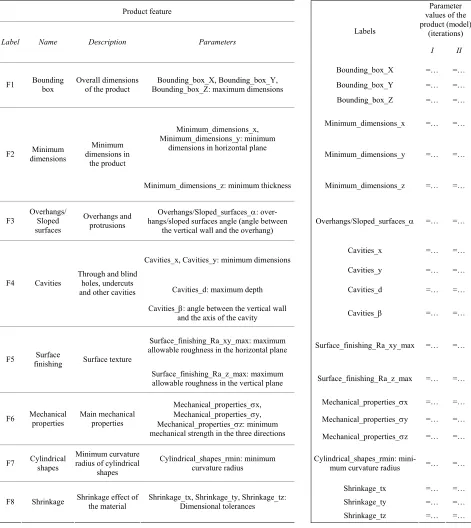
[image:6.595.64.479.483.727.2]Table 5. Parametric product features for plastic front covers
Product feature values of the Parameter
product (model) (iterations)
Label Name Description Parameters
Labels
I II
Bounding_box_X =… =…
Bounding_box_Y =… =…
F1 Bounding box Overall dimensions of the product Bounding_box_Z: maximum dimensions Bounding_box_X, Bounding_box_Y,
Bounding_box_Z =… =…
Minimum_dimensions_x =… =… Minimum_dimensions_x,
Minimum_dimensions_y: minimum dimensions in horizontal plane
Minimum_dimensions_y =… =… F2 dimensions Minimum
Minimum dimensions in
the product
Minimum_dimensions_z: minimum thickness Minimum_dimensions_z =… =…
F3
Overhangs/ Sloped surfaces
Overhangs and protrusions
Overhangs/Sloped_surfaces_: over-hangs/sloped surfaces angle (angle between
the vertical wall and the overhang)
Overhangs/Sloped_surfaces_ =… =…
Cavities_x =… =…
Cavities_x, Cavities_y: minimum dimensions
Cavities_y =… =…
Cavities_d: maximum depth Cavities_d =… =…
F4 Cavities Through and blind holes, undercuts and other cavities
Cavities_: angle between the vertical wall
and the axis of the cavity Cavities_ =… =…
Surface_finishing_Ra_xy_max: maximum
allowable roughness in the horizontal plane Surface_finishing_Ra_xy_max =… =… F5 finishing Surface Surface texture
Surface_finishing_Ra_z_max: maximum
allowable roughness in the vertical plane Surface_finishing_Ra_z_max =… =…
Mechanical_properties_x =… =…
Mechanical_properties_y =… =… F6 Mechanical properties Main mechanical properties
Mechanical_properties_x, Mechanical_properties_y, Mechanical_properties_z: minimum
mechanical strength in the three directions Mechanical_properties_z =… =…
F7 Cylindrical shapes Minimum curvature radius of cylindrical shapes
Cylindrical_shapes_rmin: minimum
curvature radius Cylindrical_shapes_rmin: mini-mum curvature radius =… =…
Shrinkage_tx =… =…
Shrinkage_ty =… =…
F8 Shrinkage Shrinkage effect of the material Shrinkage_tx, Shrinkage_ty, Shrinkage_tz: Dimensional tolerances
Shrinkage_tz =… =…
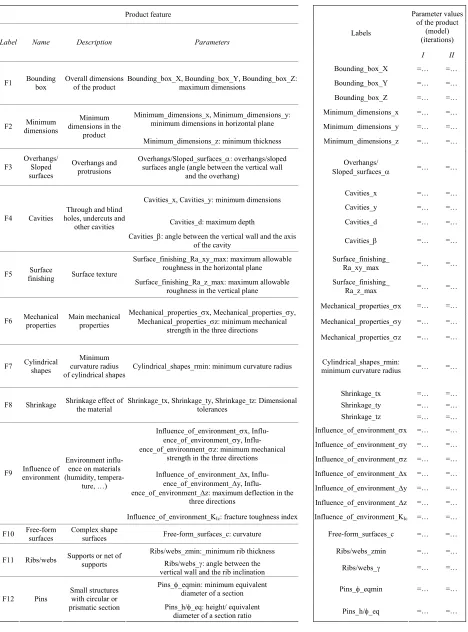
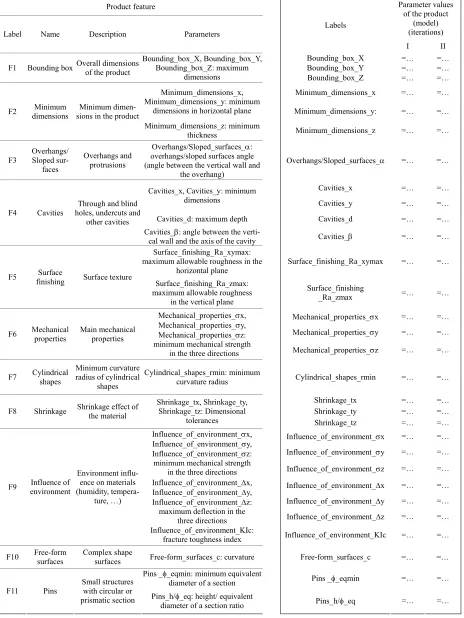
iterative way. The product (model) is analyzed for
com-patibility with the available technologies, some actions
are performed and the resulting product (model) is
proc-essed from the beginning (new iteration).
Finally, Table 9, Table 10, Table 11, and Table 12 show
the relations between the technological characteristics
and the product features, expressed in a qualitative way,
for each meaningful couple technology/product.
Table 6. Parametric product features for headlights
Product feature Parameter values
of the product (model) (iterations)
Label Name Description Parameters
Labels
I II
Bounding_box_X =… =…
Bounding_box_Y =… =…
F1 Bounding box
Overall dimensions of the product
Bounding_box_X, Bounding_box_Y, Bounding_box_Z: maximum dimensions
Bounding_box_Z =… =…
Minimum_dimensions_x =… =… Minimum_dimensions_x, Minimum_dimensions_y:
minimum dimensions in horizontal plane Minimum_dimensions_y =… =… F2 dimensions Minimum
Minimum dimensions in the
product
Minimum_dimensions_z: minimum thickness Minimum_dimensions_z =… =…
F3
Overhangs/ Sloped surfaces
Overhangs and protrusions
Overhangs/Sloped_surfaces_: overhangs/sloped surfaces angle (angle between the vertical wall
and the overhang)
Overhangs/
Sloped_surfaces_ =… =…
Cavities_x =… =…
Cavities_x, Cavities_y: minimum dimensions
Cavities_y =… =…
Cavities_d: maximum depth Cavities_d =… =…
F4 Cavities
Through and blind holes, undercuts and
other cavities
Cavities_: angle between the vertical wall and the axis
of the cavity Cavities_ =… =…
Surface_finishing_Ra_xy_max: maximum allowable
roughness in the horizontal plane Surface_finishing_ Ra_xy_max =… =… F5 Surface
finishing Surface texture Surface_finishing_Ra_z_max: maximum allowable roughness in the vertical plane
Surface_finishing_
Ra_z_max =… =…
Mechanical_properties_x =… =…
Mechanical_properties_y =… =… F6 Mechanical
properties
Main mechanical properties
Mechanical_properties_x, Mechanical_properties_y, Mechanical_properties_z: minimum mechanical
strength in the three directions
Mechanical_properties_z =… =…
F7 Cylindrical shapes
Minimum curvature radius of cylindrical shapes
Cylindrical_shapes_rmin: minimum curvature radius Cylindrical_shapes_rmin:
minimum curvature radius =… =…
Shrinkage_tx =… =…
Shrinkage_ty =… =…
F8 Shrinkage Shrinkage effect of the material
Shrinkage_tx, Shrinkage_ty, Shrinkage_tz: Dimensional tolerances
Shrinkage_tz =… =…
Influence_of_environment_x =… =…
Influence_of_environment_y =… =… Influence_of_environment_x,
Influ-ence_of_environment_y, Influ-ence_of_environment_z: minimum mechanical
strength in the three directions Influence_of_environment_z =… =…
Influence_of_environment_x =… =…
Influence_of_environment_y =… =… Influence_of_environment_x,
Influ-ence_of_environment_y,
Influ-ence_of_environment_z: maximum deflection in the
three directions Influence_of_environment_z =… =… F9 environment Influence of
Environment influ-ence on materials (humidity,
tempera-ture, …)
Influence_of_environment_KIc: fracture toughness index Influence_of_environment_KIc =… =…
F10 Free-form surfaces
Complex shape
surfaces Free-form_surfaces_c: curvature Free-form_surfaces_c =… =… Ribs/webs_zmin:_minimum rib thickness Ribs/webs_zmin =… =… F11 Ribs/webs Supports or net of
supports Ribs/webs_: angle between the
vertical wall and the rib inclination Ribs/webs_ =… =… Pins__eqmin: minimum equivalent
diameter of a section Pins__eqmin =… =…
F12 Pins
Small structures with circular or
prismatic section Pins_h/_eq: height/ equivalent
Table 7. Parametric product features for moulds for headlights
Product feature Parameter values
of the product (model) (iterations)
Label Name Description Parameters Labels
I II
Bounding_box_X =… =…
Bounding_box_Y =… =…
F1 Bounding box Overall dimensions of the product
Bounding_box_X, Bounding_box_Y, Bounding_box_Z: maximum
dimensions Bounding_box_Z =… =…
Minimum_dimensions_x =… =… Minimum_dimensions_x,
Minimum_dimensions_y: minimum
dimensions in horizontal plane Minimum_dimensions_y: =… =… F2 dimensions Minimum sions in the product Minimum
dimen-Minimum_dimensions_z: minimum
thickness Minimum_dimensions_z =… =…
F3
Overhangs/ Sloped
sur-faces
Overhangs and protrusions
Overhangs/Sloped_surfaces_: overhangs/sloped surfaces angle (angle between the vertical wall and
the overhang)
Overhangs/Sloped_surfaces_ =… =…
Cavities_x =… =…
Cavities_x, Cavities_y: minimum
dimensions Cavities_y =… =…
Cavities_d: maximum depth Cavities_d =… =…
F4 Cavities holes, undercuts and Through and blind other cavities
Cavities_: angle between the
verti-cal wall and the axis of the cavity Cavities_ =… =…
Surface_finishing_Ra_xymax: maximum allowable roughness in the
horizontal plane
Surface_finishing_Ra_xymax =… =…
F5 finishing Surface Surface texture
Surface_finishing_Ra_zmax: maximum allowable roughness
in the vertical plane
Surface_finishing
_Ra_zmax =… =…
Mechanical_properties_x =… =…
Mechanical_properties_y =… =… F6 Mechanical properties Main mechanical properties
Mechanical_properties_x, Mechanical_properties_y, Mechanical_properties_z: minimum mechanical strength
in the three directions Mechanical_properties_z =… =…
F7 Cylindrical shapes
Minimum curvature radius of cylindrical
shapes
Cylindrical_shapes_rmin: minimum
curvature radius Cylindrical_shapes_rmin =… =…
Shrinkage_tx =… =…
Shrinkage_ty =… =…
F8 Shrinkage Shrinkage effect of the material
Shrinkage_tx, Shrinkage_ty, Shrinkage_tz: Dimensional
tolerances Shrinkage_tz =… =…
Influence_of_environment_x =… =…
Influence_of_environment_y =… =… Influence_of_environment_x,
Influence_of_environment_y, Influence_of_environment_z: minimum mechanical strength
in the three directions Influence_of_environment_z =… =… Influence_of_environment_x =… =…
Influence_of_environment_y =… =… Influence_of_environment_x,
Influence_of_environment_y, Influence_of_environment_z: maximum deflection in the
three directions Influence_of_environment_z =… =… F9 environment Influence of
Environment influ-ence on materials (humidity,
tempera-ture, …)
Influence_of_environment_KIc:
fracture toughness index Influence_of_environment_KIc =… =…
F10 Free-form surfaces Complex shape surfaces Free-form_surfaces_c: curvature Free-form_surfaces_c =… =…
Pins __eqmin: minimum equivalent
diameter of a section Pins __eqmin =… =…
F11 Pins
Small structures with circular or
prismatic section Pins_h/_eq: height/ equivalent
Table 8. Parametric product features for dashboards
Product feature Parameter values
of the product (model) (iterations)
Label Name Description Parameters Labels
I II
Bounding_box_X =… =…
Bounding_box_Y =… =…
F1 Bounding box Overall dimensions of the product Bounding_box_Z: maximum dimensionsBounding_box_X, Bounding_box_Y,
Bounding_box_Z =… =…
Minimum_dimensions_x =… =… Minimum_dimensions_x,
Minimum_dimensions_y: minimum
dimensions in horizontal plane Minimum_dimensions_y: =… =… F2 dimensions Minimum Minimum dimensions in the product
Minimum_dimensions_z: minimum
thickness Minimum_dimensions_z =… =…
F3 Sloped surfaces Overhangs/ Overhangs and protrusions overhangs/sloped surfaces angle (angle Overhangs/Sloped_surfaces_: between the vertical wall and the overhang)
Overhangs/Sloped_surfaces_ =… =…
Cavities_x =… =…
Cavities_x, Cavities_y: minimum
dimensions Cavities_y =… =…
Cavities_d: maximum depth Cavities_d =… =…
F4 Cavities
Through and blind holes, undercuts and other
cavi-ties Cavities_: angle between the vertical wall
and the axis of the cavity Cavities_ =… =…
Surface_finishing_Ra_xymax: maximum
allowable roughness in the horizontal plane Surface_finishing_Ra_xymax =… =… F5 finishing Surface Surface texture Surface_finishing_Ra_zmax: maximum
allowable roughness in the vertical plane Surface_finishing_Ra_zmax =… =… Mechanical_properties_x =… =… Mechanical_properties_y =… =… F6 Mechanical properties Main mechanical proper-ties
Mechanical_properties_x, Mechanical_properties_y, Mechanical_properties_z: minimum
mechanical strength in the three directions Mechanical_properties_z =… =…
F7 Cylindrical shapes Minimum curvature radius of cylindrical shapes Cylindrical_shapes_rmin: minimum curvature radius Cylindrical_shapes_rmin =… =…
Pins __eqmin: minimum equivalent
diameter of a section Pins __eqmin =… =…
F8 Pins
Small structures with circular or
prismatic section Pins_h/_eq: height/ equivalent diameter
of a section ratio Pins_h/_eq =… =…
Influence_of_environment_x =… =… Influence_of_environment_y =… =… Influence_of_environment_x,
Influence_of_environment_y, Influence_of_environment_z: minimum
mechanical strength in the three directions Influence_of_environment_z =… =… Influence_of_environment_x =… =… Influence_of_environment_y =… =… Influence_of_environment_x,
Influence_of_environment_y, Influence_of_environment_z: maximum
deflection in the three directions Influence_of_environment_z =… =… F9 environment Influence of
Environment influence on materials (humidity,
temperature, …)
Influence_of_environment_KIc: fracture
toughness index Influence_of_environment_KIc =… =…
F10 Free-form surfaces Complex shape surfaces Free-form_surfaces_c: curvature Free-form_surfaces_c =… =…
Table 9. Relations between FDM manufacturing characteristics and the product features for plastic front covers
F1 F2 F3 F4 F5 F6 F7 F8
Bounding box
Minimum dimensions
Overhangs/ Sloped surfaces
Cavities finishing Surface Mechanical properties Cylindrical shapes Shrinkage
M1 Workspace Strong
M2 Material Weak Weak Weak Strong Strong
M3 Slicing Strong Strong Strong Strong Strong Strong
[image:10.595.60.537.601.719.2]Table 10. Relations between SLA manufacturing characteristics and the product features for headlights
F1 F2 F3 F4 F5 F6 F7 F8 F9 F10 F11 F12
Bounding box
Minimum dimensions
Overhangs/ Sloped surfaces
Cavities Surface finishing
Mechanical properties
Cylindrical
shapes Shrinkage
Influence of environment
Free-form surfaces
Ribs/ webs Pins
M1 Workspace Strong
M2 Material Strong Strong Weak Strong
M3 Slicing Strong Weak Strong Strong Strong Weak Strong Strong Strong
M4 Support Strong Strong Strong Strong Weak Strong Strong Strong
[image:11.595.62.537.260.380.2]M5 Building style Weak Weak Weak Weak Weak Weak Strong Weak
Table 11. Relations between SLS manufacturing characteristics and the product features for moulds for headlights
F1 F2 F3 F4 F5 F6 F7 F8 F9 F10 F11
Bounding box
Minimum dimensions
Overhangs/ Sloped surfaces
Cavities Surface finishing
Mechanical properties
Cylindrical
shapes Shrinkage
Influence of environment
Free-form
surfaces Ribs/webs
M1 Workspace Strong
M2 Material Strong Strong Strong Strong
M3 Slicing Strong Weak Strong Strong Weak Strong Weak Strong Strong
M4 Support Strong Strong Strong Strong Weak Strong Strong
M5 Building style Weak Weak Strong Weak Strong Weak Strong Weak
Table 12. Relations between LOM manufacturing characteristics and the product features for dashboards
F1 F2 F3 F4 F5 F6 F7 F8 F9 F10
Bounding box
Minimum dimensions
Overhangs/ Sloped surfaces
Cavities Surface finishing
Mechanical
properties Cylindrical shapes Pins
Influence of environment
Free-form surfaces
M1 Workspace Strong
M2 Material Strong Weak Strong Strong Strong Strong
M3 Slicing Weak Weak Strong Weak Strong Strong Strong Weak Strong
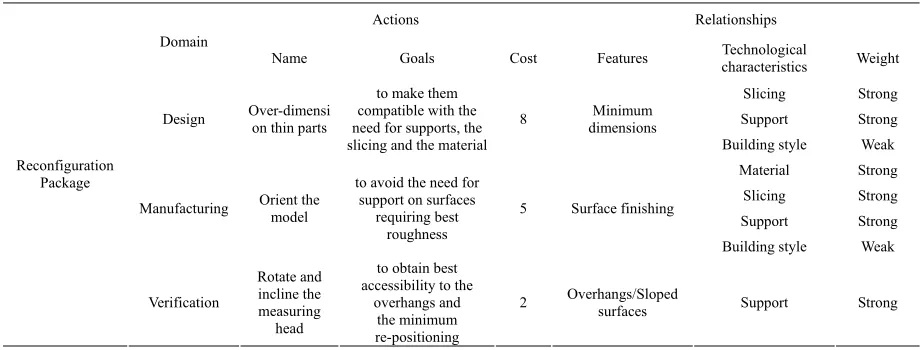
Table 13. Reconfiguration package for a headlight to be produced by SLA
Actions Relationships Domain
Name Goals Cost Features Technological
characteristics Weight Slicing Strong Support Strong Design Over-dimension thin parts
to make them compatible with the need for supports, the slicing and the material
8 dimensions Minimum
Building style Weak
Material Strong Slicing Strong Support Strong Manufacturing Orient the model
to avoid the need for support on surfaces
requiring best roughness
5 Surface finishing
Building style Weak Reconfiguration
Package
Verification
Rotate and incline the measuring
head
to obtain best accessibility to the
overhangs and the minimum re-positioning
2 Overhangs/Sloped
[image:11.595.67.534.417.509.2] [image:11.595.67.529.544.719.2]