https://www.scirp.org/journal/jamp ISSN Online: 2327-4379
ISSN Print: 2327-4352
DOI: 10.4236/jamp.2019.711177 Nov. 5, 2019 2595 Journal of Applied Mathematics and Physics
Algorithm for the Vertex Connectivity Problem
on Circular Trapezoid Graphs
Hirotoshi Honma, Kento Nishimura, Yuto Tamori, Yoko Nakajima
National Institute of Technology, Kushiro College, Kushiro, Japan
Abstract
The vertex connectivity κ
( )
G of a graph G is the minimum number of nodeswhose deletion disconnects it. Graph connectivity is one of the most funda-mental problems in graph theory. In this paper, we designed an
( )
2O n time
algorithm to solve connectivity problem on circular trapezoid graphs.
Keywords
Algorithm Design, Connectivity Problem, Intersection Graphs, Circular Trapezoid Graphs
1. Introduction
The vertex connectivity κ
( )
G of a graph G is the minimum number of nodeswhose deletion disconnects it. The computation of κ
( )
G for a given graph G isknown as the vertex connectivity (vertex connectivity) problem, and it is one of the most fundamental problems in graph theory. In recent years, many studies related to vertex connectivity have been conducted [1]-[6]. Even and Tarjan de-veloped an
(
1.5)
O mn time algorithm to calculate the vertex connectivity of a
general graph [7]. In many cases, more efficient algorithms can be developed by restricting the classes of graphs. For example, Ghosh and M. Pal presented an
( )
2O n time algorithm to solve the VC problem for trapezoid graphs [8].
Sub-sequently, this algorithm was improved by Ilić [9] to O n
(
logn)
time by usinga binary indexed tree.
Lin introduced circular trapezoidgraphs (CTG), which constitute a proper superclass of trapezoid graphs and circular-arc graphs [10]. He also presented
(
2)
log log
O n n time and O n
(
2logn)
time algorithms for the maximum weigh-ted independent set and the minimum weighted independent dominating set on CTGs, respectively [10]. In this paper, we designed an
( )
2O n time algorithm How to cite this paper: Honma, H.,
Ni-shimura, K., Tamori, Y. and Nakajima, Y. (2019) Algorithm for the Vertex Connectiv-ity Problem on Circular Trapezoid Graphs. Journal of Applied Mathematics and Phys-ics, 7, 2595-2602.
https://doi.org/10.4236/jamp.2019.711177
Received: September 18, 2019 Accepted: November 2, 2019 Published: November 5, 2019
Copyright © 2019 by author(s) and Scientific Research Publishing Inc. This work is licensed under the Creative Commons Attribution International License (CC BY 4.0).
http://creativecommons.org/licenses/by/4.0/
DOI: 10.4236/jamp.2019.711177 2596 Journal of Applied Mathematics and Physics
to solve the VC problem on CTGs. Our algorithm was realized by skillfully com-bining the methods of [9] and [11].
The rest of this paper is organized as follows. Section 2 describes some defini-tions of circle trapezoid graphs and models and introduces the extended circle trapezoid model, as well as some notations. Section 3 presents some properties on circle trapezoid graphs, which are useful for finding vertex connectivity in an efficient manner. Section 4 describes our algorithm for the VC problem and its complexity. Finally, Section 5 concludes the paper.
2. Definitions
We describe the circulartrapezoidmodel (CTM) before defining the CTG. The model comprises inner and outer circles C1 and C2 with radii r1<r2,
respec-tively. Each circle is arranged counterclockwise with consecutive integer values
1, 2,, 2n, where n is the number of trapezoids. Consider the two arcs, A1 and A2, on C1 and C2, respectively. Points a and b are the first points encountered when traversing the arc A1 counterclockwise and clockwise, respectively; simi-larly, points c and d are the first points encountered when traversing the arc A2
counterclockwise and clockwise, respectively. A trapezoid is the region in circles
C1 and C2 that lies between two non-crossing chords ac and bd. A trapezoid CTi
is defined by four corner points
[
a b c di, , ,i i i]
. Without loss of generality, weas-sume that each trapezoid has four distinct corner points. Each trapezoid CTi is
numbered in ascending order according to their corner point ai, i.e., i< j if
i j
a <a . The geometric representation described above is the CTM. Figure 1(a)
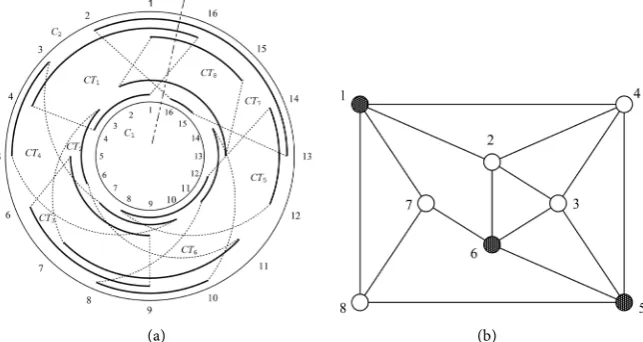
illustrates an example of a CTM M having 8 trapezoids. For example, CTM is used for cities comprising cityscapes that spread radially around facilities such as stations and rotaries. It is used to visually represent the relationships among communities (linkage of transportation networks, sharing of infrastructure facil-ities, etc.), and it is applied to the optimization of city planning and facility ar-rangement. Table 1 shows the details of M as depicted in Figure 1(a).
[image:2.595.213.535.522.693.2](a) (b)
DOI: 10.4236/jamp.2019.711177 2597 Journal of Applied Mathematics and Physics
Table 1. Details of CTM M.
i 1 2 3 4 5 6 7 8
i
a 1 3 5 7 8 11 13 15
i
b 4 6 9 10 12 14 2 16
i
c 16 7 6 3 12 8 15 13
i
d 4 11 9 5 14 10 1 2
A graph G is a CTG if it can be represented by the following CTM M: each vertex of the graph corresponds to a trapezoid, and two vertices in G are consi-dered adjacent if and only if their corresponding trapezoids intersect. Figure 1(b)
illustrates the CTG G corresponding to CTM M shown in Figure 1(a). In this example, G is disconnected by removing vertices 1, 5, and 6 from G. Thus, the vertex connectivity of G is 3.
In the following, we introduce an extendedcirculartrapezoidmodel (ECTM) constructed from a CTM. Let n be the number of trapezoids in CTM M. Con-sider a fictitious line p that connects the points placed between 1 and 2n of C1
and C2. First, we cut CTM along fictitious line p and expand the two circles C1
and C2 into parallel horizontal lines called top and bottom channels, respectively. Hereafter, to avoid confusion, we denote trapezoids in CTM and ECTM by
i
CT and Ti, respectively. Finally, for each Ti, 1≤ ≤i n, copies of Ti n+ and i n
T− are created by shifting 2n to the right and left, respectively. An ECTM is
constructed from a CTM by the above process, which can be executed in O n
( )
time [11]. Figure 2 illustrates an ECTM EM constructed from the CTM M
shown in Figure 1(a). Table 2 shows the details of EM.
Some notations that form the basis of our algorithm in Section 4 are defined as follows. A separating set in a connected graph G is a set of vertices whose de-letion disconnects G. We introduce a new concept to ECTM that is similar to the separating set in CTG. A separating trapezoid set in an ECTM EM is a set of trapezoids whose deletion separates EM into two or more components. Let S be a separating trapezoid set of EM. EM−S is a trapezoid set that is obtained by
deleting S from all trapezoid sets of EM. If EM−S has k components, we
de-note nc
(
EM−S)
=k. Moreover, let G EM[
−S]
be a induced subgraph of Gby the trapezoid set EM−S.
3. Properties of Vertex Connectivity on TCGs
We describe some lemmas that are useful for constructing the algorithm for the VC problem.
Lemma 1. [11] For a given CTM M, an ECTM EM corresponding to M is con-structed in O n
( )
time.Lemma 2. [9] For a trapezoid graph G, the VC problem is solved in O n
(
logn)
time.
DOI: 10.4236/jamp.2019.711177 2598 Journal of Applied Mathematics and Physics
Table 2. Details of ECTM EM.
i −7 −6 −5 −4 −3 −2 −1 0 1 2 3 4 5 6 7 8 9 10 11 12 13 14 15 16
i
a −15 −13 −11 −9 −8 −5 −3 −1 1 3 5 7 8 11 13 15 17 19 21 23 24 27 29 31
i
b −12 −10 −7 −6 −4 −2 −14 0 4 6 9 10 12 14 2 16 20 22 25 26 28 30 18 32
i
c 0 −9 −10 −13 −4 −8 −1 −3 16 7 6 3 12 8 15 13 32 23 22 19 28 24 31 29
i
d −12 −5 −7 −11 −2 −6 −15 −14 4 11 9 5 14 10 1 2 20 27 25 21 30 26 17 18
Figure 2. Extended circular trapezoid model EM.
Lemma 4. [11] Let S be a separating trapezoid set of an ECTM EM. Then, for an ECTM EM, we can compute nc
(
EM−S)
in O n( )
time.Lemma 5. Let G be a CTG G corresponding to an ECTM EM and let S be a separating trapezoid set of EM. Then, a CTG G EM
[
−S]
is connected if(
)
2c
n EM−S = . Furthermore, a CTG G EM
[
−S]
is disconnected if(
)
3c
n EM−S ≥ .
(Proof) If EM consists of one component, it is obvious that G is connected. We consider the case when nc
(
EM−S)
=2, i.e., EM consists of twocompo-nents. Assume that EM is divided into two components Ci and Cj, and vertices
i
v and vj (i< j) are in Ci and Cj, respectively. A trapezoid that intersects a
fictitious line p is called a feedbacktrapezoid, where p connects the points placed between 1 and 2n of C1 and C2 in CTM M. No path exists from vi to vj
through vk for v v vi, k, j (i< <k j) since EM is divided into two components Ci and Cj. However, some paths exist from vi to vj through some feedback
trapezoids. Thus, in the case where EM consists of two components, G is con-nected. In the case where EM consists of three or more components, no path ex-ists from vi to vj through or even through feedback trapezoids. This implies
that CTG G corresponding to CTM M is disconnected.
4. Algorithm
4.1. Outline of Algorithm
DOI: 10.4236/jamp.2019.711177 2599 Journal of Applied Mathematics and Physics
contrast to non-circular intersection graphs, we cannot determine the starting position of an algorithm uniquely for a circular intersection graph owing to the existence of feedback elements. For several problems, we can develop circular versions of the existing algorithms by constructing extended intersection models for the problems. By using extended intersection models such as an ECTM, we can determine the start position of an algorithm uniquely and apply the algo-rithms of the non-circular versions partially. For instance, this method has been applied to develop efficient algorithms for the shortest path query problem [12] [13] and the articulation vertex problem [14] on circular-arc graphs, maximum clique and chromatic number problems [15], the spanning forest problem [16]
and the articulation problem [17] on circular permutation graphs, and the span-ning tree problem [11] and the hinge vertex problem [18] on circular trapezoid graphs.
Here, we concisely describe the outline of our algorithm. When a given CTG has articulation vertices, the vertex connectivity is 1. We can find articulation vertices in O n
(
+m)
time by applying the traditional method with depth firstsearch. Then, we discuss graphs that do not contain articulation vertices. First, we construct an ECTM EM from a given CTM M by using Honma et al.’s algorithm [11] (Figure 2). Next, we compute the family of minimum cardi-nality separating trapezoid set FS =
{
S S1, 2,,Sm}
for a constructed EM. Inthe example in Figure 2, we obtain FS =
{ }
{ }
T1 and nc(
EM−{ }
T1)
=2. Atthis time, if even one Si exists such that nc
(
EM−Si)
≥3,Si∈FS, the size of Si isthe vertex connectivity of CTG G, by Lemma 5. By Lemma 4, for each Si∈FS,
(
)
c i
n EM−S can be computed in O n
( )
time by Honma etal.’s algorithm [11].Conversely, we consider the case where multiple Si,1≤ ≤i m exist such that
(
)
2c i
n EM−S = . In this case, G EM
[
−Si]
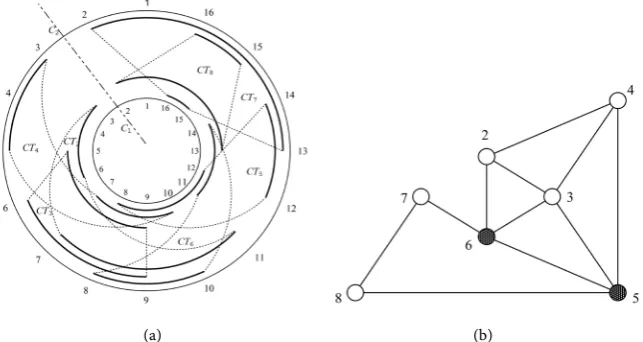
is a connected graph for every Si,by Lemma 5. In this case, a CTM M−Si has a fictitious line connecting C1 and C2 that does not intersect any trapezoid in M−Si (Figure 3(a)). The model
opened along this line is equivalent to a regular trapezoid model, and we denote it as EM′ (Figure 4). Again, we compute the minimum cardinality separating
trapezoid sets Si′ of EM′ by using Ilić’s algorithm [9]. In the example of Figure 4, we obtain Si′ =
{
T T5, 6}
.After this process, nc
(
EM− −Si Si′)
≥3 holds and G EM[
− −Si Si′]
isdis-connected, by Lemma 5. We can obtain the vertex connectivity of G by
1
minm
i= SiSi′. We formally describe Algorithm VC-CTG as follows. A CTM M
is taken as an input. Our algorithm uses both Ilić’s and Honma et al.’s algo-rithms [9] [11].
4.2. Algorithm VC-CTG and Its Analysis
In this section, we present Algorithm VC-CTG to compute the vertex connectiv-ity of a CTG G. We formally describe Algorithm VC-CTG as follows. A CTM M
DOI: 10.4236/jamp.2019.711177 2600 Journal of Applied Mathematics and Physics (a) (b)
Figure 3. Circular trapezoid model M−
{ }
T1 and graph G M −{ }
T1 . (a) CTM{ }
1 [image:6.595.261.484.295.462.2]M− T ; (b) CTG G M −
{ }
T1 .Figure 4. Extended circular trapezoid model EM′.
Here, we analyze the complexity of Algorithm VC-CTG. In Step 1, we check whether given graph G has articulation vertices using the traditional algorithm. Moreover, we return that vertex connectivity is 2 when the minimum degree of vertices in G is 2. This step can be done in O n
(
+m)
time. In Step 2, wecon-struct an ECTM EM from a given CTM M as an input. This step can be per-formed in O n
( )
time by using Honma etal.’s algorithm [11]. In Step 3, we firstcompute all minimum cardinality separating trapezoid sets FS. This process
can execute in O n
(
logn)
time by using Ilić’s algorithm [9]. Here, we obtain thevertex connectivity Si of G if there exists Si∈FS such that nc
(
EM−Si)
≥3.This can execute in O n
(
logn)
time by using Honma et al.’s algorithm [11].In Step 4, we compute a minimum cardinality separating trapezoid set Si′ of i
EM−S for each Si∈Fs. Step 3 requires
( )
2O n time. Thus, we obtain the
fol-lowing theorem.
Theorem 6. Algorithm VC-CTG computes the vertex connectivity of CTG in
( )
2DOI: 10.4236/jamp.2019.711177 2601 Journal of Applied Mathematics and Physics
5. Conclusion
In this study, we proposed Algorithm VC-CTG, which operates in
( )
2 O n time,to compute the vertex connectivity of a CTG. Our algorithm uses both Ilić’s and Honma etal.’s algorithms [9] [11]. CTM is used for cities comprising cityscapes that spread radially around facilities such as stations and rotaries. It is used to visually represent the relationships among communities (linkage of transporta-tion networks, sharing of infrastructure facilities, etc.), and it is applied to the optimization of city planning and facility arrangement. Solutions to the VC prob-lem can be applied to detect connection vulnerabilities in actual networks. Thus, we believe that this paper is significant from both theoretical and algorithmic perspectives. Future research will address reducing the complexity of the algo-rithm and extending the results to other graphs.
Acknowledgements
We express many thanks to anonymous referees for their valuable advices on the theory of our attacks and their helpful editorial comments. This work was par-tially supported by JSPS KAKENHI Grant Number 19K11834 and 17K00324.
Conflicts of Interest
The authors declare no conflicts of interest regarding the publication of this pa-per.
References
[1] Goddarda, W., Rainesb, M.E. and Slaterc, P.J. (2003) Distance and Connectivity Measures in Permutation Graphs. Discrete Mathematics, 271, 61-70.
https://doi.org/10.1016/S0012-365X(02)00870-1
[2] Shang, Y. (2009) Connectivity in a Random Interval Graph with Access Points. In-formation Processing Letters, 109, 446-449.
DOI: 10.4236/jamp.2019.711177 2602 Journal of Applied Mathematics and Physics [3] He, J. and Liang, H. (2012) On Rainbow-k-Connectivity of Random Graphs.
Infor-mation Processing Letters, 112, 406-410.https://doi.org/10.1016/j.ipl.2012.01.014 [4] Chen, L., Peng, J., Rao, C. and Rosyida, I. (2018) Cycle Index of Uncertain Random
Graph. Journal of Intelligent & Fuzzy Systems, 34, 4249-4259. https://doi.org/10.3233/JIFS-17373
[5] Schmidt, J.M. (2013) A Simple Test on 2-Vertex- and 2-Edge-Connectivity. Infor-mation Processing Letters, 113, 241-244.https://doi.org/10.1016/j.ipl.2013.01.016 [6] Chen, L., Peng, J. and Ralescu, D. (2019) Uncertain Vertex Coloring Problem. Soft
Computing, 23, 1337-1346.https://doi.org/10.1007/s00500-017-2861-7
[7] Even, S. and Tarjan, R.E. (1975) Network Flow and Testing Graph Connectivity.
SIAM Journal on Computing, 4, 507-518.https://doi.org/10.1137/0204043
[8] Ghosh, P.K. and Pal, M. (2007) An Efficient Algorithm to Solve Connectivity Prob-lem on Trapezoid Graphs. Journal of Applied Mathematics and Computing, 24, 141-154. https://doi.org/10.1007/BF02832306
[9] Ilić, A. (2013) Efficient Algorithm for the Vertex Connectivity of Trapezoid Graphs.
Information Processing Letters, 113, 398-404. https://doi.org/10.1016/j.ipl.2013.02.012
[10] Lin, W.L. (2006) Circular and Circle Trapezoid Graphs. International Journal of Scientific Engineering and Technology, 2, 11-17.
[11] Honma, H., Nakajima, Y., Aoshima, Y. and Masuyama, S. (2013) A Linear-Time Algorithm for Constructing a Spanning Tree on Circular Trapezoid Graphs. IEICE Transactions on Fundamentals, E96-A, 1051-1058.
[12] Chen, D., Lee, D.T., Sridhar, R. and Sekharam, C. (1998) Solving the All-Pair Shortest Path Query on Interval and Circular-Arc Graphs. Networks, 31, 249-258. https://doi.org/10.1002/(SICI)1097-0037(199807)31:4<249::AID-NET5>3.0.CO;2-D [13] Hsu, F.R., Shan, K., Chao, H.S. and Lee, R.C. (2005) Some Optimal Parallel
Algo-rithms on Interval and Circular-Arc Graphs. Journal of Information Science and Engineering, 21, 627-642.
[14] Kao, T.W. and Horng, S.J. (1995) Optimal Algorithms for Computing Articulation Points and Some Related Problems on a Circular-Arc Graph. ParallelComputing, 21, 953-969.https://doi.org/10.1016/0167-8191(95)00007-B
[15] Lou, R.D. and Sarrafzadeh, M. (1992) Circular Permutation Graph Family with Ap-plications. Discrete Applied Mathematics, 40, 433-457.
https://doi.org/10.1016/0166-218X(92)90012-Y
[16] Honma, H., Honma, S. and Masuyama, S. (2009) An Optimal Parallel Algorithm for Constructing a Spanning Tree on Circular Permutation Graphs. IEICE Transactions on Information and Systems, E92-D, 141-148.
[17] Honma, H., Abe, K., Nakajima, Y. and Masuyama, S. (2013) Linear Time Algorithms for Finding Articulation and Hinge Vertices of Circular Permutation Graphs. IEICE Transactions on Information and Systems, E96-D, 419-425.