arXiv:1204.0248v1 [math.CO] 1 Apr 2012
GAVIN BROWN AND ALEXANDER M. KASPRZYK
Abstract. We describe two different approaches to making systematic classifications of plane lattice polygons, and recover the toric codes they generate, over small fields, where these match or exceed the best known minimum distance. This includes a [36,19,12]-code overF7 whose minimum distance 12 exceeds that of all previously known codes.
1. Introduction
We are interested in planar lattice polygonsP – not least for their own sake – and, for a finite field Fq, the toric codes CP(Fq) that they determine. We recall the construction of such codes,
following Hansen [Han00, Han12], in Section 2 below. Briefly, P and q together determine a
k×n integer matrix – the toric code – for integers k, the dimension, and n, the block length. The important invariant of a codeC is its minimum distanced, the shortest Hamming distance between any two distinct points of the image of the matrix – that is, the distance between points of the lattice generated by the rows of the matrix. It is this measure which limits the ability of the code to detect and correct errors.
The collection of all toric codes includes some champions among linear codes, in the sense that they have minimum distance greater than that of any other known code with equal block length and dimension. This is exemplified by the paper of Joyner [Joy04] and the recent paper of Little [Lit11], the latter describing a generalised champion [49,12,28]-code over F8 (we follow the standard notation and denote the invariants of a code by a triple [n, k, d]). We find a new champion, a [36,19,12]-code over F7, however the novel part of our paper is the systematic approach to classification of polygons that we use to discover this example. This approach exploits database methods in collaboration with computer-aided polygon computations in a way that seems not to have been pursued in this area. As a spin-off, we classify a certain set of ‘small’ lattice polygons, as we now explain.
One of the key points when considering toric codes overFq is to restrict attention to polygons
P that lie in a square of side-lengthm ≤q−2. In this paper we concentrate on fields Fq with q ≤9 a prime power, and so we first enumerate all polygons that lie in a square of side-length
m≤7. We regard two polygonsP andP′ as equivalent if there exists a pointu∈Z2 and change of basisϕof the underlying lattice such that ϕ(P−u) =P′. Table 1 summarises our results by listing the number of integral polygons (up to equivalence) that lie in the square [0, m]×[0, m], but not in a smaller square. It also lists the maximum number of vertices that such a polygon
can have, and the number of polygons that achieve this upper bound. The complete list of polygons is available on the webpage [BK].
The systematic approach described above would certainly exhaust all toric codes over small fields (even the generalised codes of [Rua09, Lit11]), but it obviously becomes less practical as
m increases. It is remarkable to us that the number of polygons grows as slowly as it does, although this is presumably an artefact of two dimensions. We seek champion codes, that is, codes exceeding the current largest known minimum distances. Computing the minimum distance is very often too hard (it is certainly computable, but in many cases we have reliable estimates of computation time of the order of a year), but determining whether or not a given code is a champion is much easier: in most cases, simple linear combinations of the rows of the corresponding matrix provide sufficiently short vectors to rule it out. We carry out this calculation for each one of these polygon codes for every applicable field of size at most nine. In this early part of the polygonal classification, there is exactly one champion – the code mentioned above – as well as many examples that match the current best known minimum distance. All but 257 of the polygonal codes have a short vector that is a combination of at most three rows of the generator matrix; only six of these, other than the champion, require more than four rows.
Table 1. The number of polygons (up to equivalence) contained in the square [0, m]×[0, m], but not contained in a smaller square.
m 1 2 3 4 5 6 7
#Polygons 2 15 131 1369 13842 129185 1104895
Max vertices 4 6 8 9 10 12 13
#Max polygons 1 1 1 1 15 2 3
The champion polygon and many of the equal champions are LDP-polygons (lattice polygons associated to log del Pezzo surfaces, explained in detail in Section 4). Motivated by this, we go on to consider codes associated to toric log del Pezzo surfaces, using the classification of all 15,346 LDP-polygons of indexℓ≤17 [KKN10]. The difficulty here is that these polygons are not presented as lying in the smallest possible square, so we describe an algorithm that determines the smallest square that contains a polygon equivalent to a given polygon. This algorithm – an adaptation of the minimum width algorithm – is the main point, since our search through the resulting data for toric log del Pezzo codes over the smallest possible fieldFq reveals no further
champions.
2. Toric codes
Let M ∼=Z2 be a two-dimensional lattice, and let P ⊂M ⊗ZQ be a convex lattice polygon
each lattice point u:= (u1, u2)∈P ∩M define:
e(u) :F∗
q×F∗q → Fq
(εi, εj) 7→ (εi)u1(εj)u2.
The set of vectors
{(e(u)(εi, εj))0≤i,j≤q−2 |u∈P ∩M}
then generates a linear code of block length n= (q−1)2 and dimensionk=|P∩M|, denoted by CP(Fq).
We sketch the connection with toric geometry. For the details see [Han00, Han02, Joy04]. Associated with any polygon P is a non-singular fan ∆ in N := Hom (M,Z) given by the following construction. Let hP :NQ →Qbe the support function defined by
hP(v) := inf{hu, vi |u∈P}.
This is a piecewise linear function, and partitions NQ into a finite collection of strictly convex polyhedral cones; in other words,hP defines a fan ∆′ inNQ. We can refine ∆′ to a non-singular
fan ∆ by inserting rays via a well-known process (see, for example, [Oda78]). Notice that, for any coneσ ∈∆, there exists a lattice pointlσ ∈M such that
hP(v) =hlσ, vi, for all v∈σ.
Let XP be the complete smooth toric surface associated with ∆, where the algebraic torus TN is defined by TN := Hom
M,F∗q. The polygonP is associated with the Cartier divisor
Dh :=− X
Raysρof ∆
hlρ, ρi ·vert(ρ),
where vert(ρ)∼=P1 is the closure of theTN orbit ofρ inXP (again, see [Oda78] for the details)
as follows. The space of global sections H0(XP,OXP(Dh)) has dimension |P∩M| with basis
{e(u)|u ∈P∩M}. Thus the codeCP(Fq) can be obtained via:
(2.1) H
0(X
P,OXP(Dh))
Frob → C
P(Fq) f 7→ (f(t))t∈TN.
The generators of the code are given by the image of the basis; i.e.
{(e(u)(t))t∈TN |u∈P ∩M}.
The toric codes CP(Fq) obtained via translation of P, or more generally by any affine linear
3. Classifying small polygons
Definition 3.1. Let P ⊂ MQ be a lattice polytope, and let v ∈ vert(P) be a vertex of P. If
the polytope Pv := conv((P ∩M)\ {v}) satisfies dimPv = dimP, then Pv is said to have been
obtained from P by shaving. Given a polytope Q we say that Q can be obtained from P via
successive shaving if there exists a sequence of shavings Q = P(0) ⊂ · · · ⊂ P(n) = P, where
P(i−1)=P(i)
vi for some vi ∈vert P
(i)
, 0< i≤n.
Lemma 3.2. Any lattice polygon Q in the box Bm := [0, m]×[0, m] can be obtained from Bm
via successive shaving.
Proof. Let Q ⊂ Bm. If Q 6= Bm, then we can certainly shave a vertex v of Bm to obtain a
polygonPv that containsQ. Continuing inductively, supposeP ⊂Bm is a polygon withQ⊂P.
IfP 6=Qthen there exists some vertex v∈vert(P) such thatv /∈Qand Q⊆P′:=P
v. But
Vol(Q)≤Vol P′
<Vol(P).
Since these normalised volumes are integers, this process must terminate after finitely many
steps.
Remark 3.3. The normalised volume Vol(P) of a lattice polygonP is twice the Euclidean volume
vol(P); whenP is a lattice polygon, vol(P)∈(1/2)Z.
It is clear how this lemma presents an algorithm for classifying small polygons. Choose a box
Bm and initialise a sequence containing that box as a polygon:
Ps:=[Polytope([[0,0],[0,m],[m,0],[m,m]])];
The algorithm now extends Ps recursively by shaving the vertices from each polygon in the sequence, checking for equivalence before appending each new polygon.
idx:=1;
while idx le #Ps do
for v in Vertices(Ps[idx]) do
P:=Polytope(Exclude(Points(Ps[idx]),v));
if Dimension(P) eq 2 and not &or[IsEquivalent(P,Q) : Q in Ps] then Append(~Ps,P);
end if; end for; idx +:= 1; end while;
4. Log del Pezzo codes
A polygon P ⊂N ⊗ZQis said to be an LDP-polygon if it contains the origin strictly in its
interior, and if each vertex ofP is a primitive lattice point inN := Hom (M,Z). In this case the corresponding toric variety is a log del Pezzo surface: it has only cyclic quotient singularities and −KX is ample. For example, the polygon conv{(1,0),(0,1),(−1,−1)} is an LDP-polygon
corresponding to the projective planeP2. For suchP, the dual polygonP∗ is defined by
P∗ :={v∈MQ | hv, ui ≥ −1 for all u∈P}.
Typically P∗ is not a lattice polygon, but there exists a smallest integer ℓ ≥ 1 for which the vertices ofℓP∗ are lattice points. This integerℓis called theindex ofP. It equals the Gorenstein index of the corresponding log del Pezzo surface.
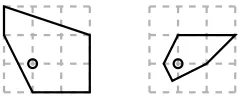
There are infinitely many LDP-polygons, but finitely many for any fixed index ℓ. Figure 1 shows an LDP-polygon with vertices (−1,2), (1,2), (1,0), (−1,−1), (−2,−1). It has index
[image:5.595.239.358.351.402.2]ℓ= 10; the dual is a lattice polygon after dilating by a factor of 10.
Figure 1. An LDP-polygon of index ℓ= 10, with its dual rational polygon.
The classification of LDP-polygons of indices 1 ≤ℓ ≤ 17 is given in [KKN10] and available online at [BK]; the example in Figure 1 is No. 523 in the classification. To use these for toric codes, we allow for translation, and must find equivalent polygons that lie in a box Bm,
rather than containing the origin as given. The representative polygons in the database are not necessarily the smallest, so we describe an algorithm to determine, for given polygon P, the smallest m for which there is a polygon P′ ⊂ B
m equivalent to P. (We treat LDP-polygons
simply as a source of interesting examples to generate codes, and therefore regard P as lying in
MQ, rather than in terms of algebraic geometry, where they should be viewed as lying inNQ.
Our work here is entirely in terms ofMQ, so no confusion arises from the name.)
Lemma 4.1. There is a constructive algorithm that, for any given polygonP ⊂MQ, determines
the smallest m for which there is a polygon P′ ⊂B
m equivalent to P, without enumerating any
other polygons.
Proof. We use a modification of the standard minimal width algorithm. Begin by considering
wi:= wde∗
i (P) for each dual basis vector e
∗
i ∈N := Hom (M,Z). Ifwi≤m for alli, then, after
possible translation, P is contained in Bm.
Suppose without loss of generality that w1 > m. TranslateP so that the (rational) point
1 |vert(P)|
X
v∈vert(P)
is at the origin. Let # ⊂P be the largest disc, centred at the origin, that is contained in P. Then d:= wde∗
1(#) satisfies 0< d≤w1. In the dual space NQ, consider the discD centred at the origin of radiusw1/d. We claim that wdu(P)> w1for any primitive lattice pointu∈N\D. Indeed
wdu(P)≥wdu(#)>wdu′(#) =
w1
d ·d=w1,
whereu′ is the unique rational point lying on the boundary ofD in the direction of u. Thus P is equivalent to some P′ ⊂B
m if and only if there exists a dual basisBm contained in D such
that wdv(P)≤m for eachv∈ Bm, and this is a finite search.
Applying this to the LDP-polygons, we find they distribute overmas in Table 2; we have cut the table short, but it could be continued to list all 15,346 polygons, with maximum m= 68.
Table 2. The number of LDP-polygons (up to equivalence) of index ℓ ≤ 17 contained in the box [0, m]×[0, m], but not contained in a smaller box, for small values ofm.
m 2 3 4 5 6 7 8 9 10
# 11 62 364 591 1125 777 1277 904 1187
5. The computations and champion polygons
We use the computer algebra system Magma [BCP97], and in particular its convex poly-tope [BBK11] and linear codes packages. The polygons are harvested from the Graded Ring Database [BK], which can be queried from within Magma via an XML interface. Since the number of calculations are rather large, they were run in parallel on a cluster of 144 processor cores at Imperial College, London.
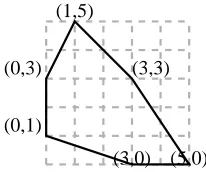
The LDP-polygon number 75 in the Graded Ring Database gives a code over F7 that has length 36, dimension 19 and minimum distance 12 (see Figure 2; this corresponds to a unique LDP-polygon, since the only point that could serve as an origin is (2,2)). The previous best known minimum distance was 11, according to Grassl’s online database of linear codes [Gra] (also accessible from within Magma); the theoretical maximum is 15.
(3,0) (5,0)
(3,3) (1,5)
(0,3)
[image:6.595.240.343.613.699.2](0,1)
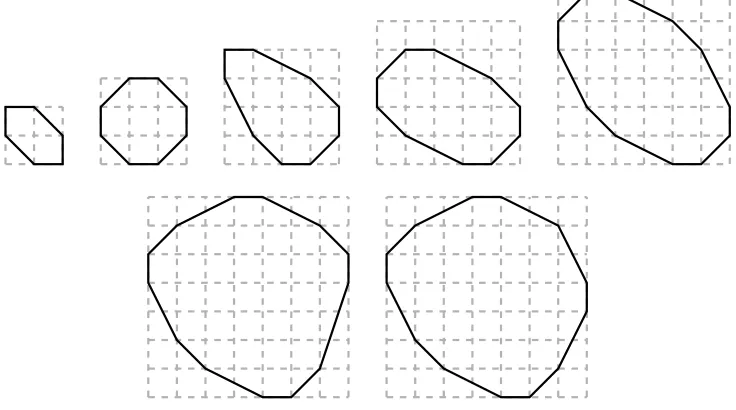
A curiosity about polygons falls out of the classification. Among those having the maximal number of vertices for their box size, there is a unique one of minimal volume that is homogeneous (by which we mean that all vertices are locally isomorphic to one another). We sketch the polygons with maximal number of vertices for m≤ 7 in Figure 3; notice that for m = 7 there are two polygons, but only the first is homogeneous.
Figure 3. The polygons with maximal number of vertices for each box size which have the smallest volume.
We reinterpret this geometrically as the following statement, which holds for box size up to seven.
Conjecture 5.1. Fix m ∈ Z>0. Consider all toric surfaces S with −KS ample (but no
con-ditions on the singularities) for which the anticanonical polygon of monomials in H0(S,−K
S)
lies in an m×m box. Among such S, consider those with maximum Picard rank. Then among
these there is a unique surfaceS which is both smooth and has minimum anticanonical degree.
6. Higher prime powers
We cannot calculate minimum distances, or indeed champions, for higher prime powers: for many polygons with the potential for a large minimum distance, the computation time required to prove this is in the order of millions of years. For specific polygons there exist results on the minimum distance for general prime powers q [LS07, YZ09], and more can be said when the polygon is Minkowski decomposable [LS06], however we do not pursue these techniques here.
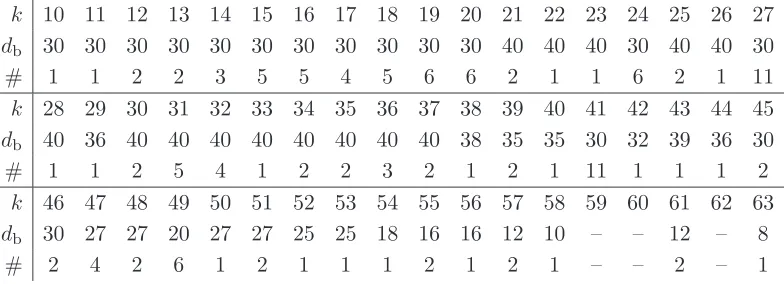
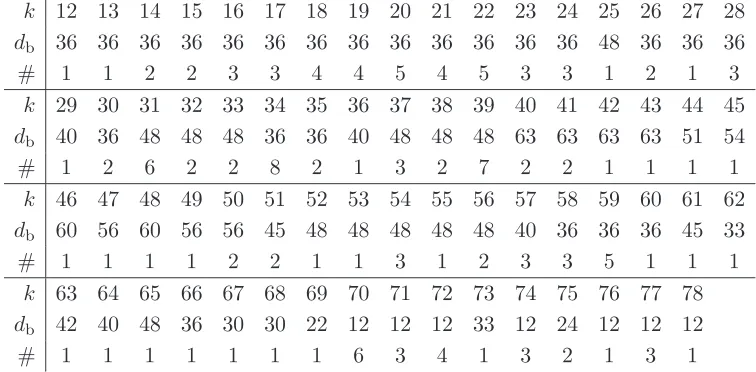
We work with the next two possible values q = 11 and 13, with box sizes 8–9 and 10–11 respectively. In each case, we find all LDP-polygons from the database (of index ≤17) whose minimum box has size m for which q is minimal satisfying q−2 ≥ m. In other words, each known LDP-polygon will be considered in a minimum box and with respect to its minimum q. We partition these LDP-polygons by their number of points,k. For each k, we work through the polygons and find the length of the shortest vector that is a linear combination of up to four rows of the generator matrix, obtaining an upper bounddb on the best minimum distance that could be achieved. These bounds are listed in Tables 3–4.
Remark 6.1. In theory the bounddb depends on the choice of embedding of P in the boxBm;
[image:8.595.105.497.400.542.2]some embeddings may give sharper bounds than others. Lemma 4.1 can generate all possible embeddings inBm, and experimentation suggests that for practical purposesdb is insensitive to the choices made.
Table 3. The number of LDP-polygonal codes with (minimal)q= 11. The first row is the dimensionkof the code; the second, the length of a known vector, and so an upper bound for the largest minimum distance; the third, the number of polygons (up to equivalence) having such a vector achieving this bound.
k 10 11 12 13 14 15 16 17 18 19 20 21 22 23 24 25 26 27
db 30 30 30 30 30 30 30 30 30 30 30 40 40 40 30 40 40 30
# 1 1 2 2 3 5 5 4 5 6 6 2 1 1 6 2 1 11
k 28 29 30 31 32 33 34 35 36 37 38 39 40 41 42 43 44 45
db 40 36 40 40 40 40 40 40 40 40 38 35 35 30 32 39 36 30
# 1 1 2 5 4 1 2 2 3 2 1 2 1 11 1 1 1 2
k 46 47 48 49 50 51 52 53 54 55 56 57 58 59 60 61 62 63
db 30 27 27 20 27 27 25 25 18 16 16 12 10 – – 12 – 8
# 2 4 2 6 1 2 1 1 1 2 1 2 1 – – 2 – 1
Acknowledgments. Our thanks to John Cannon for practical help with adapting minimal distance algorithms and for providing Magma for use on the Imperial College mathematics cluster, to Andy Thomas for technical assistance, and to the referees for several interesting suggestions. The second author is supported by EPSRC grant EP/I008128/1, and this research was supported in part by EPSRC Mathematics Platform grant EP/I019111/1.
References
Table 4. The number of LDP-polygonal codes with (minimal) q= 13; rows as in Table 3.
k 12 13 14 15 16 17 18 19 20 21 22 23 24 25 26 27 28
db 36 36 36 36 36 36 36 36 36 36 36 36 36 48 36 36 36
# 1 1 2 2 3 3 4 4 5 4 5 3 3 1 2 1 3
k 29 30 31 32 33 34 35 36 37 38 39 40 41 42 43 44 45
db 40 36 48 48 48 36 36 40 48 48 48 63 63 63 63 51 54
# 1 2 6 2 2 8 2 1 3 2 7 2 2 1 1 1 1
k 46 47 48 49 50 51 52 53 54 55 56 57 58 59 60 61 62
db 60 56 60 56 56 45 48 48 48 48 48 40 36 36 36 45 33
# 1 1 1 1 2 2 1 1 3 1 2 3 3 5 1 1 1
k 63 64 65 66 67 68 69 70 71 72 73 74 75 76 77 78
db 42 40 48 36 30 30 22 12 12 12 33 12 24 12 12 12
# 1 1 1 1 1 1 1 6 3 4 1 3 2 1 3 1
[BK] Gavin Brown and Alexander M Kasprzyk, The graded ring database homepage, online, access via
http://grdb.lboro.ac.uk/.
[Gra] Markus Grassl,Bounds on the minimum distance of linear codes and quantum codes, online, access via
http://www.codetables.de/.
[Han00] Johan P. Hansen,Toric surfaces and error-correcting codes, Coding theory, cryptography and related areas (Guanajuato, 1998), Springer, Berlin, 2000, pp. 132–142.
[Han02] ,Toric varieties, Hirzebruch surfaces and error-correcting codes, Appl. Algebra Engrg. Comm. Comput.13(2002), no. 4, 289–300.
[Han12] ,Quantum codes from toric surfaces,arXiv:1203.4544v1 [math.AG], March 2012.
[Joy04] David Joyner, Toric codes over finite fields, Appl. Algebra Engrg. Comm. Comput. 15(2004), no. 1, 63–79.
[KKN10] Alexander M. Kasprzyk, Maximilian Kreuzer, and Benjamin Nill, On the combinatorial classification of toric log del pezzo surfaces, LMS Journal of Computation and Mathematics13(2010), 33–46. [Lit11] John B. Little,Remarks on generalized toric codes,arXiv:1107.4530v2 [cs.IT].
[LS06] John Little and Hal Schenck, Toric surface codes and Minkowski sums, SIAM J. Discrete Math.20 (2006), no. 4, 999–1014 (electronic).
[LS07] John Little and Ryan Schwarz,On toric codes and multivariate Vandermonde matrices, Appl. Algebra Engrg. Comm. Comput.18(2007), no. 4, 349–367.
[Oda78] Tadao Oda,Torus embeddings and applications, Tata Inst. Fund. Res. Stud. Math., vol. 57, Tata Insti-tute of Fundamental Research, Bombay, 1978.
[Rua09] Diego Ruano,On the structure of generalized toric codes, J. Symbolic Comput.44(2009), no. 5, 499–506. [YZ09] Stephen S.-T. Yau and Huaiqing Zuo, Notes on classification of toric surface codes of dimension 5,
Appl. Algebra Engrg. Comm. Comput.20(2009), no. 2, 175–185.
Department of Mathematical Sciences, Loughborough University, Loughborough, LE11 3TU, United Kingdom
E-mail address: [email protected]