Disc fragmentation rarely forms planetary-mass objects
Ken Rice,
1‹Eric Lopez,
1Duncan Forgan
2and Beth Biller
11Scottish Universities Physics Alliance (SUPA), Institute for Astronomy, University of Edinburgh, Blackford Hill, Edinburgh EH9 3HJ, UK
2Scottish Universities Physics Alliance (SUPA), School of Physics and Astronomy, University of St Andrews, North Haugh, St Andrews, Fife KY16 9SS, UK
Accepted 2015 August 26. Received 2015 August 25; in original form 2015 May 21
A B S T R A C T
It is now reasonably clear that disc fragmentation can only operate in the outer parts of proto-stellar discs (r>50 au). It is also expected that any object that forms via disc fragmentation will have an initial mass greater than that of Jupiter. However, whether or not such a process actually operates, or can play a significant role in the formation of planetary-mass objects, is still unclear. We do have a few examples of directly imaged objects that may have formed in this way, but we have yet to constrain how often disc fragmentation may actually form such objects. What we want to consider here is whether or not we can constrain the likely population of planetary-mass objects formed via disc fragmentation by considering how a population of objects at large radii (a>50) au – if they do exist – would evolve under perturbations from more distant stellar companions. We find that there is a specific region of parameter space to which such objects would be scattered and show that the known exoplanets in that region have properties more consistent with that of the bulk exoplanet population, than with having been formed via disc fragmentation at large radii. Along with the scarcity of directly imaged objects at large radii, our results provide a similar, but independent, constraint on the frequency of objects formed via disc fragmentation.
Key words: planets and satellites: formation – planets and satellites: general – brown dwarfs – stars: formation.
1 I N T R O D U C T I O N
The most widely accepted mechanism for the formation of planets is the core accretion model (Pollack et al. 1996). In this model, dust grains grow rapidly to form kilometre-sized planetesimals that then coagulate to form a rocky core (Safronov 1972) which, if sufficiently massive, may then accrete a gaseous envelope to form a gas-giant planet (Lissauer1993; Pollack et al.1996). An alternative suggestion (Kuiper1951; Boss1998) is that gas-giant planets may form via direct gravitational collapse in discs that are sufficiently massive so as to sustain a gravitational instability (Toomre1964).
The advantage of the latter mechanism is that it ensures that gas-giant planets can form prior to the dispersal of the gas disc, thought to typically occur within ∼5 Myr (Haisch, Lada & Lada2001). Most of the evidence, however, favours the standard core accretion mechanism. For example, gas-giant planets are preferentially found around metal-rich stars (Santos, Israelian & Mayor2004; Fischer & Valenti2005), and there is an indication of a signature of the snowline in the exoplanet distribution (Schlaufman, Lin & Ida2009; Rice, Penny & Horne2013). Both of these suggest that the amount of solid material in the disc, and the distribution of this material,
E-mail:[email protected]
influences planet formation, which would not be expected if disc fragmentation were a dominant formation mechanism.
Additionally, it is now fairly clear that disc fragmentation is phys-ically implausible in the inner regions of protostellar discs (Rafikov
2005). Fragmentation requires that the disc be both gravitation-ally unstable, and that it be able to cool rapidly (Gammie2001; Rice et al.2003). The inner regions of protostellar discs are likely too optically thick to cool sufficiently fast for fragmentation to be possible (Clarke2009; Rice & Armitage2009). The outer regions (beyond∼50 au), however, may well have conditions suitable for fragmentation and it has, consequently, been suggested that this may explain some of the directly imaged exoplanets (Kratter & Murray-Clay2010), such as those in the HR8799 system (Marois et al.2008).
It has also been suggested (Nayakshin2010a) that planets may form beyond 50 au via disc fragmentation, and then spiral inwards, resulting in them orbiting much closer to their parent stars than where they formed. Also, if both the grain sedimentation time-scale and migration rate are fast, the planet may produce a core and lose some of its outer envelope through tidal interactions with the parent star (Nayakshin2010b). As such, this process could turn what was originally a massive gaseous planet, into a lower mass Neptune-like planet, or even a terrestrial planet.
how a population of planetary-mass bodies forming beyond 50 au would evolve through dynamical interactions with an outer pop-ulation of stellar companions, that drive Kozai–Lidov oscillations (Kozai1962; Lidov1962), and then through tidal interactions with the host star. What we are aiming to do is to establish the orbital properties of planetary-mass objects that originated at large radii, and to determine if a population of such objects exists within the known exoplanet population. In Section 2 we describe the models that we use. In Section 3 we discuss our results, and we draw our conclusions in Section 4.
2 B A S I C M O D E L
The goal is to study the evolution of a planetary system that is being perturbed by a third, stellar-mass body on an outer orbit. Specifically, we aim to establish if we can identify a population, within the known exoplanet population, that could have originated with large initial semimajor axes (a>50 au) and that has then been scattered on to orbits with semimajor axes inside∼5 au.
To do this, we use the equations that describe the secular evo-lution of a star–planet–star system, first presented by Eggleton & Kiseleva (2001) and which have been extensively used to model the evolution of exoplanets that are perturbed by a third body (Wu & Murray2003; Fabrycky & Tremaine2007). The equations include perturbing accelerations from a third body, general relativistic apsi-dal precession, perturbing accelerations from stellar and planetary distortions due to tides and rotation, and tidal interactions between the planet and its host star. We do, however, typically ignore the perturbing acceleration due to the planetary distortion as it only be-comes significant when the planet is very close to its parent star, and reduces the timestep significantly. Here we use the forms presented by Barker & Ogilvie (2009) and Barker (2011) which are regular ate=0, and we expand the contribution due to the third body to octupole order (Naoz et al.2011; Naoz, Farr & Rasio2012). We also include a simple stellar wind model (Kawaler1988) that allows the planetary host star to spin-down as it evolves on the main sequence. Details of the model can be found in Rice (2015).
2.1 Initial conditions
To understand how a population of planetary-mass bodies that form in the outer parts of protostellar discs via disc fragmentation, per-turbed by an outer stellar companion, we run a Monte Carlo-type simulation in which we randomly choose the outer planet to have a semimajor axis between 50 and 80 au, and to have an eccentricity that is initially small (drawn from the positive side of a Gaussian distribution with a half-width ofe=0.025). We do not actually have a good sense of the initial properties for such a population of plan-ets. We could have selected the semimajor axis randomly in loga,
That 30–40 per cent of solar-like stars have stellar, or sub-stellar, companions (Duquennoy & Mayor1991; Raghavan et al.2010), makes it likely that such companions will influence the evolution of the planetary system. We, therefore, assume that there is a com-panion with a mass ofMo=0.5 Mand with a semimajor axis,
chosen randomly in log a, betweenao = 200 andao = 20 000
au (Duquennoy & Mayor1991). Both radial velocity and transit exoplanet searches tend to remove binary systems from their cata-logues. However, these tend to be systems where the separation is smaller than we have assumed here (Brown et al.2011a; Valenti & Fischer2005) and so this should not bias our results.
The companion’s eccentricity is chosen randomly to be between
eo=0 andeo=1, although we impose stability criteria (Mardling &
Aarseth2001; Lithwick & Naoz2011; Naoz et al.2013) that ensure that the triple system is long-term stable and that the quadrupole and octupole terms in the secular equations dominate (see Rice2015for details). We could choose to vary the mass of this outer compan-ion, but since we are in the test-particle regime (Lithwick & Naoz
2011), this should not influence the results. We also fix the outer companion’s orbit to be in thexyplane and orient the inner orbit so that the mutual inclination,i, is distributed isotropically (Wu, Murray & Ramshai2007). We also randomly orient the longitude of the planet’s ascending node, and the argument of periastron.
Since we are also interested in how the planet will evolve tidally with its host star (if scattered into an orbit that with a sufficiently small periastron) we assume that the star and planet have tidal quality factors ofQs=5×10⁶andQp=5×10⁵(Goldreich &
Soter 1966; Yoder & Peale1981; Jackson, Greenberg & Barnes
2008; Baraffe, Chabrier & Barman2010; Brown et al.2011b), and tidal love numbers ofks=0.028 andkp=0.51 (Petrovich2015),
respectively. We also assume that any planet that reaches its Roche limit (Faber, Rasio & Willems2005), given by,
a= Rp
0.462
M∗ Mp
1/3
(1)
is tidally destroyed.
3 R E S U LT S
Figure 1. The final semimajor axis distribution for a population of 5000 planets, initially located between 50 and 80 au and then perturbed by an isotropically distributed population of stellar companions with semimajor axes between 200 and 20 000 au. Most remain at large radii, but∼5 per cent are perturbed into orbits witha<1 au. A further∼17 per cent are perturbed into orbits with periastra inside their Roche limit and are, hence, tidally destroyed.
Fig.1shows the final semimajor axis distribution and illustrates how the perturbations from the outer stellar companion sculpt the initial semimajor axis distribution. A large fraction – with a distri-bution that extends above the limits of they-axis – remains with semimajor axes between 50 and 80 au. Another population un-dergoes Kozai–Lidov oscillations which produces highly eccentric orbits that lead to these planets tidally interacting with their par-ent stars, and ending up on orbits with semimajor axesa<1 au. Another population (not shown in Fig.1) reaches their Roche limit (Faber et al.2005) and is assumed to be tidally destroyed.
From an initial population of 5000 systems, our simulations sug-gest that 864 (∼17 per cent) are tidally destroyed, 237 (∼5 per cent) survive inside 1 au, and the rest primarily remain out beyond 50 au. Binary companions to solar-type stars are quite common, with 30– 40 per cent having stellar, or sub-stellar, companions (Duquennoy & Mayor1991; Raghavan et al.2010) with semimajor axes between 20 and 20 000 au. We have assumed that these companions have semimajor axes that are evenly distributed in logaand have only considered companions witha>200 au. This would suggest that 20–30 per cent of solar-type stars might satisfy these conditions. Given that these results suggest that∼5 per cent of such systems could scatter an outer planet (ainitially between 50 and 80 au) into an orbit that gets tidally circularised – and survives – insidea=1 au, would then suggest that 1–1.5 per cent of all solar-type stars could have such close-in planets if all such stars form planetary-mass companions beyond 50 au via disc fragmentation.
Admittedly, we have only presented results from a single set of parameters here. However, we have run some tests with different
Q
pandQsvalues and the results are broadly similar. For very large
values ofQp(Qp>107) the fraction surviving inside 1 au can drop
below 4 per cent, but that would still suggest that∼1 per cent could have such close-in planets if companions that form at large radii via disc fragmentation are very common.
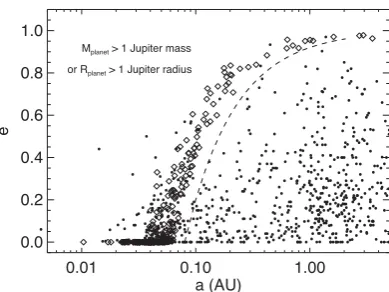
Fig.2shows the eccentricity, plotted against semimajor axis, for all those planets that have final semimajor axes insidea=5 au (dia-monds) and also shows (filled circles) all the known exoplanets with masses aboveMp=1MJupor – for those without a mass estimate
– with radii aboveRp=1RJup. What it shows is that those
plan-ets scattered from beyond 50 au will always end up either as ‘hot’
Figure 2. Figure showing the final eccentricity, plotted against semimajor axis, for those planets that are scattered on to orbits – and survive – with
a<5 au. The diamonds show our simulated planets, while the filled circles are the known exoplanets with masses above 1 Jupiter mass, or radius above 1 Jupiter radius, and witha<5 au. The planets scattered from large radii either become ‘hot’ Jupiters, withe∼0, or protohot Jupiters. This constrains the region ofe–aspace where such planets could be found.
Jupiters witha<0.1 au and with small eccentricities, or as proto-hot Jupiters (Dawson & Johnson2012). Protohot Jupiters are those gas-giant planets that are found on the high-eccentricity boundary, beyond which planets would typically be tidally destroyed, and that will ultimately tidally evolve to become ‘hot’ Jupiters. This is quite useful in that it constrains the region ofe–aspace where we would find such planets, if they do indeed exist.
Again, we have only presented results from a single set of pa-rameters. We have used a relatively lowQpvalue and we find that higherQpvalues tend to result in protohot Jupiters having larger
ec-centricities, for a given final semimajor axis. In fact, for sufficiently largeQpvalues (Qp>107) the protohot Jupiters end up in a region
ofe–aspace where very few exoplanets are found. It does seem clear, therefore, that if planetary-mass bodies are scattered from very large initial radii, they would likely be found either as ‘hot’ Jupiters or as protohot Jupiters, near the boundary beyond which they would probably be tidally destroyed.
Fig. 2introduces the first possible issue with this mechanism playing a significant role in producing close-in exoplanets. As men-tioned above, if planet formation via disc fragmentation is com-mon (i.e. most stars have gas giants orbiting beyond 50 au) then 1–1.5 per cent of stars could have close-in exoplanets that were scattered in from these large initial radii. However, Fig.2shows that these would have to be either ‘hot’ Jupiters, or be protohot Jupiters undergoing high-eccentricity tidal migration. Currently, only about 1 per cent of Sun-like stars have such planets (Fressin et al.2013; Petigura, Marcy & Howard2013; Dawson, Murray-Clay & Johnson
2015) and, so, if planet formation via disc fragmentation is com-mon, this scattering scenario could explain almost all the known ‘hot’ and protohot Jupiters.
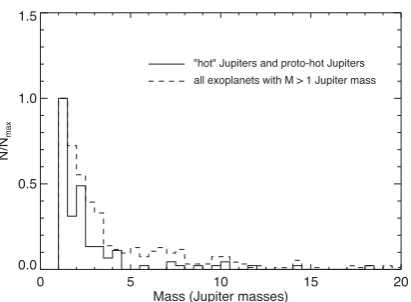
[image:3.595.55.270.55.204.2]Figure 3. The solid line shows the mass distribution of all known exoplanets with masses above 1 Jupiter that exist in the region to which outer planets could be scattered (found to left of the dashed-line in Fig.2). The dashed line shows the mass distribution of all known exoplanets with masses above 1 Jupiter mass. It is clear that the two distributions are very similar and are consistent with ‘hot’ Jupiters and protohot Jupiters coming primarily from the bulk exoplanet population.
possibly a slight under-estimate as we have restricted the compan-ions to be beyond 200 au. However, if 20 per cent of Sun-like stars have gas-giant companions (Marcy et al.2008), and 20–30 per cent of such systems have stellar companions, then this would suggest that 0.2–0.3 per cent of such systems will end up as ‘hot’ Jupiters or protohot Jupiters via this mechanism alone. Moreover, when Dawson et al. (2015) analysed the distribution of transit durations, and therefore eccentricities, among ‘hot’ Jupiters found byKepler, they found that eccentric protohot Jupiters are extremely rare com-pared to ‘hot’ Jupiters, indicating that the majority of the observed ‘hot’ Jupiters likely arrive by disc migration and not by high ec-centricity scattering from the snow-line or beyond. Therefore, that closer stellar companions, other planetary companions, and disc mi-gration could also play a role in forming such planets, suggest that such mechanisms are sufficient to explain the observed population, and that scattering planets from beyond 50 au are unlikely to play a significant role.
3.1 The properties of close-in exoplanets
One way to further investigate this is to consider the properties of the known exoplanets that lie within the region to which these outer planets could be scattered. Fig.2suggests that planets scat-tered from beyond 50 au can only become either ‘hot’ Jupiters, or protohot Jupiters. Consequently, we assume that only those known exoplanets lying to the left of the dashed line in Fig.2could have been scattered from initial radii beyond 50 au. As mentioned above, the exact location ine–aspace to which protohot Jupiters could be scattered does depend somewhat on the tidal dissipation parameters. However, using a higherQpvalue would likely move the boundary
to slightly higherevalues, and so our choice of boundary (dashed line in Fig.3) should at least capture most objects that could have been scattered from a large initial semimajor axis.
Fig.3shows the mass distribution for the known exoplanets with masses above 1 Jupiter mass that exist to the left of the dashed line in Fig.2(solid line) and also shows the mass distribution of all known exoplanets with masses above 1 Jupiter mass. Both distributions are normalized with respect to their maximum value.
As discussed earlier, our simulations assumed that the objects forming at large initial radii had the same mass distribution as the bulk exoplanet population. Since it seems likely that objects forming via disc fragmentation would tend to have initial masses of a few Jupiter masses, this may not be an appropriate mass distribution. However, even if we repeat our simulations with the mass fixed at 15MJup, the fraction that survives inside 1 au drops from∼5 per cent
to∼2.5 per cent, and the region ofe–aspace to which it is scattered remains unchanged. Therefore, even if our mass distribution is not quite representative of what would be expected for objects forming at large radii via disc fragmentation, this would not change our results significantly.
It is also generally recognized that the host stars of gas giants tend to be metal-rich compared to a typical sample of similar stars (Santos et al.2004; Fischer & Valenti2005). This is thought to indicate that gas-giant planets are more likely to form in discs that are enhanced in solids and is regarded as consistent with the standard core accretion scenario (Pollack et al.1996). Disc fragmentation would not seem to require this enhancement and, if anything, it may even be more effective in systems that are metal poor (Clarke2009; Meru & Bate
2010) since such discs can cool more efficiently than discs that are enhanced in solids. It has been suggested, however, that there may be a similar metallicity dependence for planets that form via gravitational instability, undergo pebble accretion, and then migrate rapidly to the inner disc (Nayakshin2015). This, however, does not necessarily apply to those that still have large semimajor axes once the disc has dissipated, and it is this population that is relevant to what we are presenting here.
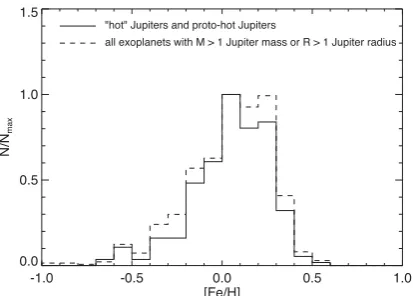
Fig.4shows the metallicity distribution for those known exo-planets in the region to which outer exo-planets can be scattered (solid line) compared to all known exoplanets (dashed line). In both cases, we restrict the mass to be aboveM=1MJupor – for those without
a mass estimate – the radius to be aboveR=1RJup. It is clear that
the distributions are very similar and that – like the bulk exoplanet population – ‘hot’ Jupiters and protohot Jupiters tend to be found around metal-rich stars. Again, this is consistent with such planets being scattered, or migrated, from the bulk exoplanet population, rather than from radii beyond 50 au.
To further quantify if the ‘hot’ and protohot Jupiters could have originated from the bulk exoplanet population, we carried out Kolmogorov–Smirnoff tests on the metallicity and mass distri-butions. A Kolmogorov–Smirnoff test of the metallicity distribu-tion returns a probability ofPKS= 0.78, indicating that we
can-not rule out that ‘hot’ and protohot Jupiters are drawn from the same distribution as the bulk exoplanet population (dashed line in Fig. 4). Similarly, the KS test of the mass distributions (Fig.3) returns a probability ofPKS=0.22, again indicating that we
Figure 4. The solid line shows the metallicity distribution for all known exoplanets – with masses above 1 Jupiter mass, or radii above 1 Jupiter radius – that exist in the region to which outer planets could be scattered (to the left of the dashed-line in Fig.2). The dashed-line is the metallicity distribution for all known exoplanets with masses, or radii, greater than that of Jupiter. That both populations are preferentially found around metal-rich stars is consistent with ‘hot’ Jupiters and protohot Jupiters coming primarily from the bulk exoplanet population.
Fig.3therefore suggests that most ‘hot’ Jupiters and protohot Jupiters have lower masses than would be expected for planets forming via disc fragmentation, and the KS test indicates that we cannot rule out that they are drawn from the same distribution as the bulk exoplanet population. This would appear inconsistent with a significant fraction originating from an outer population that formed via disc fragmentation. That we also cannot rule out that the metallicity distribution is drawn from the same distribution as the bulk exoplanet population would also suggest that ‘hot’ and protohot Jupiters are more likely to have come from the main exoplanet population, than from a population of planetary-mass bodies that formed via disc fragmentation at large orbital radii.
3.2 KELT1-B – the closest brown dwarf companion
Possibly one of the more interesting objects in the context of what we are considering here is KELT-1B (Siverd et al. 2012). It is a brown dwarf, rather than a planetary-mass, companion to a 1.335 solar-mass star on an orbit with a semimajor axis ofa=
0.024 au, and an eccentricity ofe=0.001. It has a mass of 27.4 Jupiter masses and so is more consistent with what might be ex-pected for objects that form via disc fragmentation at large radii (Stamatellos & Whitworth2009; Forgan & Rice2013a,b). We did not directly address this system, as it is beyond what we can consider here, but we did repeat our simulations with the only changes being that we simulated 2500 systems (rather than 5000) and assumed that the outer non-stellar object had a mass of 30 Jupiter masses.
As with our earlier simulations, a large fraction of the ob-jects are scattered on to orbits that pass close to the parent star. In the simulations with an outer object with M = 30MJup, 558
(22 per cent) are tidally destroyed and 45 (1.8 per cent) survive on orbits witha<1 au. This means that a smaller percentage survive with small semimajor axis, than for the case where the outer object was assumed to be of planetary mass, but a similar fraction are scattered. Again, as shown in Fig.5, they are all either in the same location as ‘hot’ Jupiters or protohot Jupiters, beyond which they would be tidally destroyed. The position of KELT-1B is indicated
Figure 5. Figure showing the final eccentricity, plotted against semimajor axis, for objects with a mass ofM=30 Jupiter masses, that started with a semimajor axis betweena=50 anda=80 au, and that were scattered by an even more distant stellar companion. As with the simulations of planetary-mass objects, the only objects that survive insidea=10 au are those that end up insidea=0.1 au and have a small eccentricity, or those that are on the high-eccentricity boundary, beyond which they would be tidally destroyed. The location of KELT-1B is indicated ata= 0.024 au ande= 0.001, showing that scattering from a large initial radius could potentially form such a system.
ata=0.024 au ande=0.001. As is clear, it is possible for a system such as KELT-1B to form via scattering from a large initial radius. As already mentioned, about 1 per cent of Sun-like stars have a ‘hot’ Jupiter or a protohot Jupiter (Fressin et al.2013; Petigura et al.
2013; Dawson et al.2015). If we consider the known exoplanets with mass estimates, there are 127 with masses above 1 Jupiter mass and that are either ‘hot’ Jupiters or protohot Jupiters (i.e. lie to the left of the dashed line in Fig.2). If we also consider those without mass estimates, but with radii above 1 Jupiter radius, it increases to 282. KELT-1B is one of the few brown dwarf companions that have orbital properties similar to that of a typical ‘hot’ Jupiters. The only other known one is Corot-3b (Triaud et al.2009), a 21 Jupiter mass companion to a 1.36 solar-mass star, with an orbital semimajor axis ofa=0.057 au. As mentioned above, a 30 Jupiter mass object, scattered from a large initial radius, is a few times less likely to survive insidea=1 au, than a planetary-mass body. Consequently, if KELT-1B is indicative of a population of bodies at large orbital radius, a few of the known ‘hot’ and protohot Jupiters may have originated via scattering from such a population. In other words, maybe∼1 per cent of the known ‘hot’ and protohot Jupiters originated from beyond∼50 au. However, as mentioned earlier, all the known ‘hot’ and protohot Jupiters could have such origins if just over half of solar-like stars have a population of outer planetary companions. Therefore, if only ∼1 per cent of known ‘hot’ and protohot Jupiters have such an origin, less than∼1 per cent of Sun-like stars can have planetary, or brown dwarf, mass companions at large radii.
3.3 Properties of wide exoplanets probed by direct imaging
[image:5.595.60.267.55.203.2]In the last decade, numerous 8 m telescope + coronagraph surveys have searched for planetary-mass bodies around young stars (e.g. Lowrance et al.2005; Billet et al. 2007; Lafeni`ere et al. 2007; Chauvin et al.2010,2015; Heinze et al.2010; Biller et al.2013; Vigan et al.2012; Rameau et al.2013; Wahhaj et al.2013; Brandt et al.2014; Bowler et al.2015), in order to detect new companions and also to determine the frequency of such wide companions. Al-though individual surveys tend to only cover 80–100 stars, these surveys have – overall – now observed a sample of∼500 stars.
They have unearthed few new planets and most have yielded null planet detections, leading to the unambiguous result that planetary-mass bodies are rare at large radii (>50 au). For instance, Biller et al. (2013) find, from a Bayesian analysis of a null planet detec-tion from 78 young moving group stars observed with the Gemini NICI planet-finder, that the frequency of 1–20MJupcompanions at
semimajor axes from 10 to 150 au is<18 per cent at a 95.4 per cent confidence level using DUSTY models (Chabrier et al.2000) and is<6 per cent at a 95.4 per cent confidence level using COND models (Baraffe et al.2003). Brandt et al. (2014) combine imag-ing data from multiple surveys to build a 250 star survey with five detections of brown dwarf companions. Modelling this population with a single power-law distribution, they find that 1–3 per cent of stars (68 per cent confidence) host 5–70MJupcompanions between
10 and 100 au. They argue that this suggests that most wide com-panions formed through disc fragmentation rather than through core accretion. However, whichever formation mechanism is responsi-ble for their formation, wide giant-exoplanet companions are quite rare.
Further analysis, however, suggests that the few known wide companions are indeed more likely to have been formed by disc fragmentation, than via core accretion. Biller et al. (2013) marginal-ize over a wide range of potential planetary distributions and Brandt et al. (2014) explicitly fit power laws unconnected to radial veloc-ity studies. However, most statistical treatments of directly imaged planetary companion distributions adopt fixed power-law distribu-tions in semimajor axis and planet mass drawn from radial velocity planet studies (e.g. Cumming et al.2008) and extend these pro-scriptions to separations appropriate for directly imaged planets (e.g.>10 au). As the population of planets probed by radial ve-locity is likely formed by core-accretion (Fischer & Valenti2005), these simple empirical power laws have been interpreted (even when extended to wide separations) as the expected population as pro-duced by core-accretion. Since the power laws used in radial ve-locity studies extend to arbitrary semimajor axes, these studies add a new ‘cutoff’ parameter, truncating the power-law distribution at a specific semimajor axis (assumed to be similar to the size of the primordial disc). These studies have found that the semimajor axis cutoff for core-accretion planets must be<75 au (e.g. Nielsen & Close2010) and likely less than 30–40 au.
population, from within the known exoplanet population, that may have originated from large initial radii (a> 50 au). Given that a reasonable fraction (∼30–40 per cent) of solar-like stars have stellar companions, a population of planetary-mass companions beyond 50 au – if it does exist – should be susceptible to scat-tering via perturbations from these even more distant stellar com-panions. The analysis here suggests that if any such planets are scattered to closer orbits they should be found as ‘hot’ Jupiters (a<
0.1 au ande ∼ 0) or protohot Jupiters; gas-giant planets on the high-eccentricity boundary, beyond which they would typically be tidally destroyed. However, when we consider the known exoplan-ets that lie in that region of parameter space, they have properties (mass and metallicity distributions) that are consistent with that of the bulk exoplanet population. Similarly, the typical mass of the known exoplanets in these regions is less than that expected for planets that form via disc fragmentation at large radii. Additionally, direct imaging searches for planetary-mass bodies around solar-like stars also suggest that such objects are rare. Therefore, we conclude that there is probably not a substantial population of planetary-mass bodies at large radii around solar-like stars and, consequently, that disc fragmentation rarely forms such objects.
Of course, there are a number of caveats to the above. We only presented results from a single set of parameters in our simulations, but most were chosen to be conservative. For example, the stellar wind parameter was chosen to spin the star down slightly more than may be reasonable. A weaker wind would remove less angular momentum, slow the tidal evolution of the planet, and allow a larger fraction to survive. The tidal quality factors were also chosen to be on the low side of the range. Additional tests suggest that larger
Q
p values would not change the fraction surviving inside 1 au
substantially and would tend to move the protohot Jupiters to even larger eccentricities than considered here. Therefore, if planetary-mass objects at large radii were common, they could explain a large fraction of the known ‘hot’ Jupiters and protohot Jupiters. That such known exoplanets appear more consistent with an origin from within the main exoplanet population suggests that there is not a substantial population of planetary-mass bodies at large radii.
As suggested above, a possible consequence of this analysis is that disc fragmentation rarely forms planetary-mass bodies. One possibility is that any object formed via this mechanism would quickly grow in mass to become a brown dwarf (M > 15MJup)
as suggested by disc fragmentation simulations (Stamatellos & Whitworth 2009). An example might be KELT-1B, which has a mass ofM=27.4MJupand an orbital radius ofa=0.024 au. Our
object scattered from beyond 50 au, it would still be consistent with such objects being rare and, hence, that disc fragmentation rarely operates.
Studies of self-gravitating disc evolution (Whitworth & Stamatellos 2006; Rice & Armitage 2009; Clarke2009; Forgan & Rice 2011) do, however, suggest that any disc with an initial outer radius that extends beyond ∼50 au should be susceptible to fragmentation and, consequently, the formation of planetary or brown dwarf-mass objects. That disc fragmentation seems unlikely, may suggest that discs with such large initial radii are rare, or that external irradiation is able to stabilize such discs against fragmenta-tion (Rice et al.2011). There are indeed observations (Maury et al.
2010) suggesting that discs around in very young Class 0 protostel-lar systems do tend to be compact, with outer radii inside 50 au. If so, then by the time such discs have expanded to larger radii, there may be insufficient mass for them to be susceptible to fragmen-tation (Rice, Mayo & Armitage 2010). There is, however, some evidence for extended discs in very-young protostellar systems (Tobin et al.2012), which may be gravitationally unstable (Forgan & Rice2013c). If such discs do exist, then the possibility that disc fragmentation rarely operates, may indicate that something, such as magnetic fields (Commerc¸on, Hennebelle & Henning2011), is inhibiting fragmentation in such discs.
Additionally, fragment destruction is a common outcome for all disc fragmentation studies, especially as self-gravitating disc mi-gration appears to be relatively rapid, and induces tidal disruption before the fragment is fully bound (Baruteau, Meru & Paardekooper
2011; Zhu et al.2012; Forgan & Rice2013b). Dynamical evolution while still in the nascent stellar cluster could also remove objects that survive at large radii (Forgan et al.2015). This, however, would need to be very efficient if it were to reduce an initially large popu-lation of outer planetary-mass bodies, to one more consistent with the results presented here. It is possible, therefore, that the results here have implications for planet formation, suggesting that most known exoplanets formed via core accretion, and for star forma-tion itself, suggesting – for example – that discs around very young stars are typically compact, with initial outer radii inside the radius where disc fragmentation becomes viable, or that magnetic fields and external irradiation can stabilize radially extended discs against fragmentation.
AC K N OW L E D G E M E N T S
The authors acknowledge very useful discussions with Adrian Barker, Gordon Ogilvie, Phil Armitage and Douglas Heggie. KR gratefully acknowledges support from STFC grant ST/M001229/1. The research leading to these results also received funding from the European Union Seventh Framework Programme (FP7/2007-2013) under grant agreement number 313014 (ETAEARTH). DF grateful acknowledges support from the ECOGAL ERC advanced grant.
R E F E R E N C E S
Baraffe I., Chabrier G., Barman T. S., Allard F., Hauschildt P. H., 2003, A&A, 402, 701
Baraffe I., Chabrier G., Barman T., 2010, Rep. Prog. Phys., 73, 016901 Barker A. J., 2011, PhD thesis, Univ. Cambridge
Barker A. J., Ogilvie G. I., 2009, MNRAS, 395, 2268
Baruteau C., Meru F., Paardekooper S.-J., 2011, MNRAS, 416, 1971 Biller B. A. et al., 2007, ApJS, 173, 143
Biller B. A. et al., 2013, ApJ, 777, 160 Boss A. P., 1998, ApJ, 503, 923
Bowler B. P., Liu M. C., Shkolnik E. L., Tamura M., 2015, ApJS, 216, 7
Brandt T. D. et al., 2014, ApJ, 794, 159
Brown T. M., Latham D. W., Everett M. E., Esquerdo G. A., 2011a, ApJ, 142, 112
Brown D. J. A., Collier Cameron A., Hall C., Hebb L., Smalley B., 2011b, MNRAS, 415, 605
Chabrier G., Baraffe I., Allard F., Hauschildt P. H., 2000, ApJ, 542, 464 Chauvin G. et al., 2010, A&A, 509, A52
Chauvin N. et al., 2015, A&A, 573, A127 Clarke C. J., 2009, MNRAS, 396, 1066
Commerc¸on B., Hennebelle P., Henning T., 2011, ApJ, 742, L9
Cumming A., Butler R. P., Marcy G. W., Vogt S. S., Wright J. T., Fischer D. A., 2008, PASP, 120, 531
Dawson R. I., Johnson J. A., 2012, ApJ, 756, 122
Dawson R. I., Murray-Clay R. A., Johnson J. A., 2015, ApJ, 798, 66 Duquennoy A., Mayor M., 1991, A&A, 248, 485
Eggleton P. P., Kisileva L. G., 2001, ApJ, 562, 1012 Faber J. A., Rasio F. A., Willems B., 2005, Icarus, 175, 248 Fabrycky D., Tremaine S., 2007, ApJ, 669, 1298
Fischer D. A., Valenti J., 2005, ApJ, 622, 1102 Forgan D., Rice K., 2011, MNRAS, 417, 1928 Forgan D., Rice K., 2013a, MNRAS, 430, 2082 Forgan D., Rice K., 2013b, MNRAS, 432, L353 Forgan D., Rice K., 2013c, MNRAS, 433, 1796 Forgan D., Parker R. J., Rice K., 2015, MNRAS, 447, 836 Fressin F. et al., 2013, ApJ, 766, 81
Gammie C. F., 2001, ApJ, 553, 174 Goldreich P., Soter S., 1966, Icarus, 5, 375 Haisch K., Lada E., Lada C., 2001, ApJ, 552, L153
Heinze A. N., Hinz P. M., Sivanandam S., Kenworthy M., Meyer M., Miller D., 2010, ApJ, 714, 1551
Jackson B., Greenberg R., Barnes R., 2008, ApJ, 678, 1396 Kawaler S. D., 1988, ApJ, 333, 236
Kozai Y., 1962, AJ, 67, 591
Kratter K. M., Murray-Clay R. A., 2010, ApJ, 740, 1
Kuiper G., 1951, in Hynek J. A., ed., Proc. Topical Symp., Commemorating the 50th Anniversary of the Yerkes Observatory and Half a Century of Progress in Astrophysics, McGraw-Hill, New York, p. 357
Kuzuhara M. et al., 2013, ApJ, 774, 11 Lafreni`ere D. et al., 2007, ApJ, 670, 1367 Lagrange A.-M. et al., 2009, A&A, 493, L21 Lagrange A.-M. et al., 2010, Science, 329, 57 Lidov M. L., 1962, Planet. Space Sci., 10, 719 Lissauer J. J., 1993, ARA&A, 31, 129 Lithwick Y., Naoz S., 2011, ApJ, 742, 94 Lowrance P. J. et al., 2005, AJ, 130, 1845
Maois C., Zuckerman B., Konopacky Q. M., Macintosh B., Barman T., 2010, Nature, 468, 1080
Marcy G. W. et al., 2008, Physica Scripta, 130, 014001 Mardling R. A., Aarseth S. J., 2001, MNRAS, 321, 398
Marois C., Macintosh B., Barman T., Zuckerman B., Song I., Patience J., Lafreni`ere D., Doyon R., 2008, Science, 322, 1348
Maury A. et al., 2010, A&A, 512, A40 Meru F., Bate M. R., 2010, MNRAS, 406, 2279 Nagasawa M., Ida S., Bessho T., 2008, ApJ, 678, 498
Naoz S., Farr W. M., Lithwick Y., Rasio F. A., Teyssandier J., 2011, Nature, 431, 2155
Naoz S., Farr W. M., Rasio F. A., 2012, ApJ, 754, L36
Naoz S., Farr W. M., Lithwick Y., Rasio F. A., Teyssandier J., 2013, MNRAS, 431, 2155
Nayakshin S., 2010a, MNRAS, 408, L36 Nayakshin S., 2010b, MNRAS, 408, 2381 Nayakshin S., 2015, MNRAS, 448, L25 Nielsen E. L., Close L. M., 2010, ApJ, 717, 878
Petigura E. A., Marcy G. W., Howard A. W., 2013, ApJ, 770, 69 Petrovich C., 2015, ApJ, 799, 27
Pollack J. B., Hubickyj O., Bodenheimer P., Lissauer J. J., Podolak M., Greenzweig Y., 1996, Icarus, 124, 62
Schlaufman K. C., Lin D. N. C., Ida S., 2009, ApJ, 691, 1322