ISSN Online: 2157-9431 ISSN Print: 2157-9423
DOI: 10.4236/pp.2018.912040 Dec. 14, 2018 515 Pharmacology & Pharmacy
Onset Time Profiles for Syncope Associated
with
α
1
-Adrenoceptor Blockers in Males:
Analysis of a Spontaneous Adverse Drug Event
Database
Katsuhiro Ohyama
1*, Masaya Furumoto
1, Munetoshi Sugiura
1,21Center for Experiential Pharmacy Practice, School of Pharmacy, Tokyo University of Pharmacy and Life Science, Tokyo, Japan 2Department of Drug Safety and Risk Management, School of Pharmacy, Tokyo University of Pharmacy and Life Science, Tokyo,
Japan
Abstract
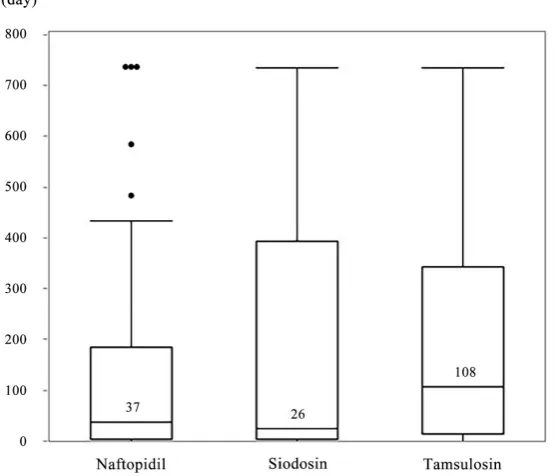
Background: α1-Adrenoceptor blockers (α1Bs) are used for the treatment of benign prostatic hyperplasia and hypertension, but they are known to cause hypotension-related adverse events. The objective of the present study was to evaluate the onset time profiles for syncope associated with the use of α1Bs. Methods: We analyzed the data obtained from the Japanese Adverse Drug Event Report (JADER) database for a period from April 2004 until November 2016 and calculated reporting odds ratios (RORs) for eight α1Bs available on the Japanese market, using disproportionality analysis. Moreover, time in-formation recorded in the JADER database was analyzed to evaluate the onset times of adverse events. Results: In total, 186,724 reports for males older than 20 years were analyzed. Significant RORs for syncope, with 95% confidence intervals, were obtained for naftopidil (2.53, 1.81 - 3.53), silodosin (4.24, 2.37 - 5.20), and tamsulosin (2.22, 1.75 - 2.81). The median onset times of syncope for naftopidil, silodosin, and tamsulosin were 37, 26, and 108 days, respec-tively. The shape parameters obtained by fitting the data for the three α1Bs to the Weibull distribution were all less than 1.0, indicating that all these drugs could be classified as the early failure type. The cumulative incidence rates showed that the onset times of syncope tended to be similar among the three
α1Bs. Conclusions: Patients treated with selective α1Bs should be closely monitored for 100 days, especially in the first 20 to 40 days after initiation of silodosin or naftopidil. This information may be useful for patients and healthcare professionals in preventing syncope due to the use of selective
α1Bs. How to cite this paper: Ohyama, K.,
Fu-rumoto, M. and Sugiura, M. (2018) Onset Time Profiles for Syncope Associated with α1-Adrenoceptor Blockers in Males: Analy-sis of a Spontaneous Adverse Drug Event Database. Pharmacology & Pharmacy, 9, 515-526.
https://doi.org/10.4236/pp.2018.912040
Received: November 1, 2018 Accepted: December 11, 2018 Published: December 14, 2018
Copyright © 2018 by authors and Scientific Research Publishing Inc. This work is licensed under the Creative Commons Attribution International License (CC BY 4.0).
http://creativecommons.org/licenses/by/4.0/
DOI: 10.4236/pp.2018.912040 516 Pharmacology & Pharmacy
Keywords
Reporting Odds Ratio, Adverse Drug Event Report Database, Syncope,
α1-Adrenoceptor Blocker
1. Introduction
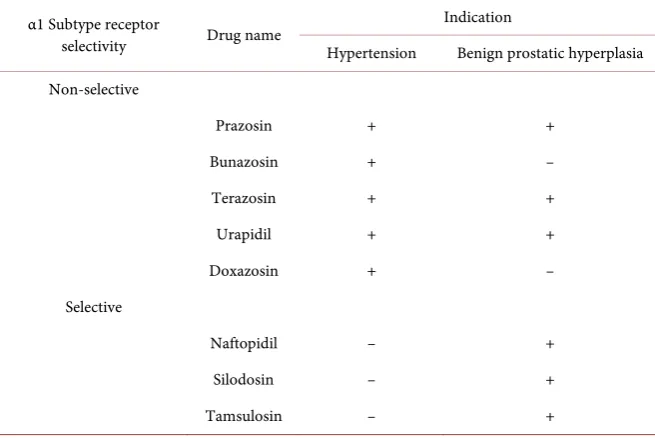
α1-Adrenoceptor blockers (α1Bs) are most commonly indicated for the ment of benign prostatic hyperplasia (BPH) but can also be used for the treat-ment of hypertension because of their ability to decrease blood pressure. These drugs are divided into two groups, depending on whether they display selectiv-ity for α1-adrenoceptor subtypes (Table 1). The guidelines of the Japanese So-ciety of Hypertension (JSH) [1] [2] [3] recommend that non-selective α1Bs are preferably used for hypertensive patients with BPH; however, the indications of α1Bs for the treatment of hypertension are becoming more restricted [4] [5]. In contrast, selective α1Bs are used as first-line therapies for BPH [6].
α1-Adrenoceptors are classified into three subtypes. The α1A subtype primarily regulates the smooth muscle tone and is expressed in the bladder neck and prostate gland [7] [8]; the α1B subtype regulates arterial smooth muscles which mediate blood pressure; and the α1D subtype is expressed in the detrusor muscle and sacral spinal cord, both involved in bladder filling [7] [8] [9]. Since selective
α1Bs can only target the prostate gland or bladder smooth muscle, they are ex-pected to generate fewer adverse drug events, such as dizziness, hypotension, and syncope, than do non-selective α1Bs.
Syncope is defined as “a transient loss of consciousness due to transient global cerebral hypoperfusion characterized by rapid onset, short duration, and spon-taneous complete recovery” [10]. A fall in systolic blood pressure to 60 mmHg or lower is associated with syncope in the absence of compensatory mechanisms and inadequate automatic regulation of systemic or cerebral blood flow [11]. Syncope leads to falls, which can cause minor injuries or major morbidities. In-deed, 17% of the patients with syncope visited an emergency department with bruises or lacerations on the head and face [12]; fractures and motor vehicle ac-cidents due to syncope have also been reported [13] [14].
Adverse event databases are repositories of information, overseen by regula-tory authorities of each country and used to quickly find adverse events caused by marketed drugs. The Japanese Adverse Drug Event Report (JADER) database, managed by the Pharmaceutical and Medical Devices Agency (PMDA), which is the regulatory authority in Japan, is a publicly available database, suitable for analyzing adverse events.
DOI: 10.4236/pp.2018.912040 517 Pharmacology & Pharmacy
Table 1. α1-Adrenoceptor blockers available on the market in Japan.
α1 Subtype receptor
selectivity Drug name
Indication
Hypertension Benign prostatic hyperplasia Non-selective
Prazosin + +
Bunazosin + –
Terazosin + +
Urapidil + +
Doxazosin + –
Selective
Naftopidil – +
Silodosin – +
Tamsulosin – +
for occurrence of such an event would allow the patient to be alerted and avoid or minimize the potential injury. Therefore, to evaluate the onset time of syn-cope due to α1B usage, a disproportionality analysis was performed in this study to examine the association between α1B use and syncope in males. Furthermore, for each drug for which statistical significance was detected, its onset time profile was evaluated using the time information available in the JADER database.
2. Materials and Methods
2.1. Data Source
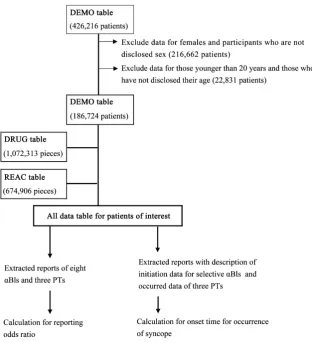
The data recorded in the JADER database from April 2004 to November 2016 were downloaded from the PMDA website. The database consists of four data sets: patient demographic information (DEMO), drug information (DRUG), adverse event (REAC), and primary disease (HIST). A flowchart of the steps in-volved in the construction of a data analysis table is provided in Figure 1. In the present study, we only extracted data for males over 20 years old.
2.2. Study Drugs and Definition of Adverse Events
DOI: 10.4236/pp.2018.912040 518 Pharmacology & Pharmacy Figure 1. Flowchart of the steps involved in the construction of a data analysis table.
2.3. Data Analysis
2.3.1. Reporting Odds Ratio (ROR)
RORs, safety signal indexes for adverse drug events, were calculated using a data mining algorithm, (a:c)/(b:d) [19] [20] [21] [22], where the letters refer to the following: a) individuals who were administered the drug of interest (e.g., an
α1B) and experienced an adverse event (e.g., syncope); b) individuals who were administered the drug of interest but did not experience the adverse event; c) in-dividuals who were not administered the drug of interest but experienced the adverse event; and d) individuals who were not administered the drug of interest and did not experience the adverse event. The signal was considered significant when the estimated ROR and the lower limit of the corresponding 95% confi-dence interval (CI) were greater than 1.0.
2.3.2. Onset Times of Adverse Events
DOI: 10.4236/pp.2018.912040 519 Pharmacology & Pharmacy of the adverse event were created, and the median data were compared for dif-ferent drugs.
Furthermore, a Weibull distribution was used to evaluate the expression pro-file of the adverse event using the Weibull shape parameter test [15] [23] [24]. The Weibull distribution is expressed using a scale parameter, α, and a shape parameter, β. The scale parameter α represents the scale of the distribution func-tion. A larger scale value stretches the distribution, while a smaller scale value shrinks the data distribution. The shape parameter β represents the change in the hazard over time. There are three types of failure, according to the value of β, as follows: β < 1 indicates that the hazard increases at an early stage but subse-quently decreases (early failure type); β = 1 indicates that the hazard is constant over the time of exposure (random failure type); and β > 1 indicates that the ha-zard increases over time (wear-out failure type). Plots of the cumulative inci-dence of syncope for the α1B drugs were constructed using the Kaplan–Meier method.
We set the maximum number of days to the onset of adverse events to 730. Data analysis was performed using JMP Pro 13.0 (SAS Institute, Inc., Cary, NC, USA).
3. Results
3.1. JADER Data
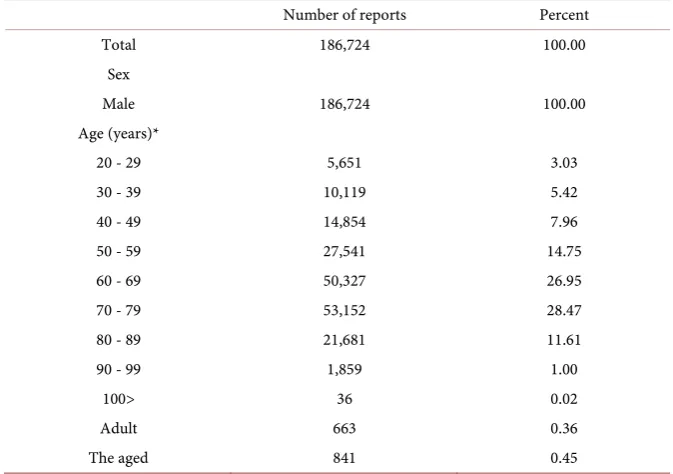
The JADER data, containing 426,216 reports from April 2004 to November 2016, were downloaded from the PMDA website. After extracting data for males older than 20 years, 186,724 reports (41.8% of the data) were used for analysis. Numbers of reports in the JADER database by age groups of the male patients analyzed in this study are described in Table 2.
3.2. ROR Values
Ninety-six reports were extracted for prazosin, 57 for bunazosin, 50 for terazo-sin, 252 for urapidil, 1,929 for doxazoterazo-sin, 1,678 for naftopidil, 1,627 for silodo-sin, and 3,965 for tamsulosin. There were 288 reports of syncope and 1,346 re-ports of loss of consciousness as adverse events. After cases with identical identi-fication numbers were excluded from the analysis, the associations between α1Bs and syncope were determined, and the results are shown in Table 3. The ROR values (95% CI) for α1Bs that were found to be statistically significant for syn-cope were 2.53 (1.81 - 3.53) for naftopidil, 4.25 (3.25 - 5.60) for silodosin, and 2.22 (1.75 - 2.81) for tamsulosin (Table 3).
3.3. Onset Times of the Adverse Event
DOI: 10.4236/pp.2018.912040 520 Pharmacology & Pharmacy The results of the Weibull distribution analysis for the three drugs are sum-marized in Table 4. The lower limits of the 95% CI for the shape parameter β
were all <1, indicating the early failure type. The cumulative incidence rates of syncope, generated by the Kaplan–Meier method for naftopidil, silodosin, and tamsulosin, are shown in Figure 3. Although naftopidil and tamsulosin admin-istration resulted in the earliest and latest onsets of syncope, respectively, in the first 350 days, the overall onset times of syncope were similar among the three
[image:6.595.203.540.236.473.2]α1Bs.
Table 2. Numbers of reports in the JADER database by age groups of the male patients analyzed in this study.
Number of reports Percent
Total 186,724 100.00
Sex
Male 186,724 100.00
Age (years)*
20 - 29 5,651 3.03
30 - 39 10,119 5.42
40 - 49 14,854 7.96
50 - 59 27,541 14.75
60 - 69 50,327 26.95
70 - 79 53,152 28.47
80 - 89 21,681 11.61
90 - 99 1,859 1.00
100> 36 0.02
Adult 663 0.36
The aged 841 0.45
*Age groups correspond to those provided in the DEMO table.
Table 3. Signal detection for α1-adrenoceptor blockers associated with syncope.
Drug name Total number of reports Number of cases Reporting ratio (%) ROR 95% CI
Prazosin 96 0 0 – –
Bunazosin 57 1 1.75 2.03 0.28 - 14.7
Terazosin 50 0 0 – –
Urapidil 252 5 1.98 2.31 0.95 - 5.60
Doxazosin 1929 17 0.88 1.01 0.63 - 1.64
Tamsulosin 3965 74 1.87 2.22 1.75 - 2.81
Naftopidil 1678 36 2.15 2.53 1.81 - 3.53
Silodosin 1627 57 3.50 4.25 3.25 - 5.60
[image:6.595.212.537.520.664.2]DOI: 10.4236/pp.2018.912040 521 Pharmacology & Pharmacy
Table 4. Weibull shape parameters of onset times of syncope due to α1-adrenoceptor
blockers.
Drug name Number of cases Scale parameter α (95% CI) Shape parameter β (95% CI)
[image:7.595.237.515.218.456.2]Naftopidil 28 91.6 (41.1 - 195) 0.52 (0.38 - 0.69) Silodosin 45 97.2 (51.2 - 179) 0.51 (0.40 - 0.63) Tamsulosin 30 162 (90.2 - 282) 0.69 (0.50 - 0.90) 95% CI: 95% confidence interval.
Figure 2. Box plots for the onset times of syncope due to α1-adrenoceptor blockers.
The number in each box represents the median number of days to onset of syncope.
[image:7.595.232.518.508.701.2]DOI: 10.4236/pp.2018.912040 522 Pharmacology & Pharmacy
4. Discussion
Knowing in advance the approximate onset times of adverse events would be useful information to avoid those. In the present study, we evaluated the onset time profiles of syncope due to the use of individual α1Bs.
For more than 10 years since the JSH published its first guidelines on the management of hypertension in 2000 (JSH2000), α1Bs had been preferably indi-cated for hypertensive patients with BPH. However, the guidelines were updated in 2014 to recommend that caution be exercised when treating elderly hyperten-sive patients [4]. Moreover, the 2015 guidelines for medical treatment and safety in the elderly [5] recommended that α1Bs be maximally avoided for elderly pa-tients with hypertension. Thus, the recent indications of α1Bs for hypertension are so few that the small numbers of reports remaining in the JADER database are likely to represent the background.
Tamsulosin, naftopidil, and silodosin were shown to be selective for the
α1B-adrenoceptor subtype, with 15.3-, 5.4-, and 583-fold higher affinity than that for the α1A-adrenoceptor subtype and 4.6-, 16.7-, and 10.5-fold higher affinity than that for the α1D-adrenoceptor subtype, respectively [25] [26]. However, in the present study, using adverse event data from clinical reports, significant sig-nals were detected for the three selective α1Bs, but no significance was found for the non-selective α1Bs, including doxazosin, despite a sufficient number of re-ports. The reasons for these findings are unclear, but one of the likely explana-tions may be differences in the numbers of reports in the JADER database. As described above, there are relatively few reports on the non-selective α1Bs in the JADER database, as compared with those on the selective α1Bs. The differences may be due to some reporting biases because it is worth reporting severe adverse events, such as syncope, that are attributable to selective α1Bs, whereas orthos-tatic hypotension, an adverse event caused by non-selective α1Bs, is too common to be reported. Furthermore, concomitant medications coadministered for hypertension may be responsible for the findings. Lai et al. [27] [28] have re-ported that during an early period after treatment initiation, α1B therapy in pa-tients not taking antihypertensive medications was associated with an increased risk of ischemic stroke and hip/femur fracture, which are severe adverse effects due to α1Bs. The non-selective α1Bs examined in the present study were suppo-sedly indicated for hypertensive BPH patients. Therefore, it would be unlikely for patients taking antihypertensive medications to experience severe adverse events sequential to orthostatic hypotension.
DOI: 10.4236/pp.2018.912040 523 Pharmacology & Pharmacy According to the Weibull shape parameter test, there was anincrease in ad-verse events at an early stage, indicating that syncope was likely caused by hypo-tension-related adverse events due to the α1-adrenoceptor-blocking activity. We also calculated the onset times of orthostatic hypotension-related adverse events, using PTs for orthostatic hypotension (PT 10031127), dizziness (PT 10013573), and dizziness postural (PT 10013578), and the median values (with interquartile ranges) were 8 (1 - 149) for naftopidil, 3 (1 - 11) for silodosin, and 71 (15 - 730) days for tamsulosin (data not shown).Considering the median onsettimes of syncope, one of the precursor symptoms would have preceded the occurrence of syncope. In the clinic, patients with these precursor symptoms can be routinely treated to avoid inadequate regulation of systemic or cerebral blood flow.
There are several limitations in this study. First, the reports examined in this study may have included syncope due to factors other than orthostatic hypoten-sion since syncope is classified into three types, namely, syncope due to orthos-tatic hypotension, neurallymediated syncope, and cardiac syncope [10]. There is a possibility that we included α1Bs that were administered to patients with car-diac arrhythmias, coronary artery disease, or myocardial infarction. In addition, owing to the background α1B indications, only reports for males were extracted and analyzed. Moreover, spontaneous reporting systems have limitations, in-cluding the lack of details needed to assess causal associations, generalized un-derreporting bias, dependence of the reporting rate on the time of the presence of each drug on the market, exclusion of healthy individuals, and the lack of de-nominators [19] [29]. We excluded some data because of the missing dates, making it impossible to calculate the onset time. However, despite the unique limitations of spontaneous adverse event reporting systems, our study revealed typical onset times of adverse events.
5. Conclusion
In conclusion, in the present study, we found, using the information from the JADER database, that the use of selective α1Bs was associated with syncope, and the onset time profiles for syncope were similar among the drugs. Therefore, pa-tients treated with selective α1Bs should be closely monitored for 100 days, espe-cially in the first 20 to 40 days after initiation of silodosin or naftopidil. We hope that this information will be useful for patients and healthcare professionals in preventing syncope due to the use of selective α1Bs.
Conflicts of Interest
The authors declare no conflicts of interest regarding the publication of this paper.
References
[1] Japanese Society of Hypertension Guidelines Subcommittee for the Management of Hypertension (2001) Guidelines for the Management of Hypertension for General Practitioners. Hypertension Research, 24, 613-634.
Guide-DOI: 10.4236/pp.2018.912040 524 Pharmacology & Pharmacy lines for the Management of Hypertension (JSH 2004). Hypertension Research, 29, S1-S105.
[3] Ogihara, T., Kikuchi, K., Matsuoka, H., Fujita, T., Higaki, J., Horiuchi, M., Imai, Y., Imaizumi, T., Ito, S., Iwao, H., Kario, K., Kawano, Y., Kim-Mitsuyama, S., Kimura, G., Matsubara, H., Matsuura, H., Naruse, M., Saito, I., Shimada, K., Shimamoto, K., Suzuki, H., Takishita, S., Tanahashi, N., Tsuchihashi, T., Uchiyama, M., Ueda, S., Ueshima, H., Umemura, S., Ishimitsu, T. and Rakugi, H. (2009) The Japanese So-ciety of Hypertension Guidelines for the Management of Hypertension (JSH 2009). Hypertension Research, 32, 3-107. https://doi.org/10.1038/hr.2009.34
[4] Shimamoto, K., Ando, K., Fujita, T., Hasebe, N., Higaki, J., Horiuchi, M., Imai, Y., Imaizumi, T., Ishimitsu, T., Ito, M., Ito, S., Itoh, H., Iwao, H., Kai, H., Kario, K., Kashihara, N., Kawano, Y., Kim-Mitsuyama, S., Kimura, G., Kohara, K., Komuro, I., Kumagai, H., Matsuura, H., Miura, K., Morishita, R., Naruse, M., Node, K., Ohya, Y., Rakugi, H., Saito, I., Saitoh, S., Shimada, K., Shimosawa, T., Suzuki, H., Tamura, K., Tanahashi, N., Tsuchihashi, T., Uchiyama, M., Ueda, S. and Umemura, S. Japa-nese Society of Hypertension Committee for Guidelines for the Management of Hypertension (2014) The Japanese Society of Hypertension Guidelines for the Management of Hypertension (JSH 2014). Hypertension Research, 37, 253-387.
https://doi.org/10.1038/hr.2014.20
[5] The Japan Geriatrics Society (2015) Guidelines for Medical Treatment and Its Safe for the Elderly 2015. Medical Review, Tokyo.
[6] The Japanese Urological Association (2011) Clinical Guideline for Benign Prostatic Hyperplasia. RichHill Medical Inc., Tokyo.
[7] Schwinn, D.A. and Michelotti, G.A. (2000) Alpha11-Adrenergic Receptors in the Lower Urinary Tract and Vascular Bed: Potential Role for the a1D-Subtype in Fill-ing Symptoms and Effects of AgeFill-ing on Vascular Expression. BJU International, 85, 6-11. https://doi.org/10.1046/j.1464-410X.2000.00061.x
[8] Hatano, A., Takahashi, H., Tamaki, M., Komeyama, T., Koizumi, T. and Takeda, M. (1994) Pharmacological Evidence of Distinct Alpha 1-Adrenoreceptor Subtypes Mediating the Contraction of Human Prostatic Urethra and Peripheral Artery. British Journal of Pharmacology, 113, 723-728.
https://doi.org/10.1111/j.1476-5381.1994.tb17053.x
[9] De Mey, C. (1999) Alpha(1)-Blockers for BPH: Are There Differences? European Urology, 36, 52-63. https://doi.org/10.1159/000052349
[10] Task Force for the Diagnosis and Management of Syncope (2009) Guidelines for the Diagnosis and Management of Syncope (Version 2009). European Heart Journal, 30, 2631-2671.
[11] Sheldon, R. and Killam, S. (1992) Methodology of Isoproterenol-Tilt Table Testing in Patients with Syncope. Journal of the American College of Cardiology, 19, 773-779. https://doi.org/10.1016/0735-1097(92)90517-Q
[12] Hori, S. (1994) Diagnosis of Patients with Syncope in Emergency Medicine. Keio Journal of Medicine, 43, 185-191.
[13] Bänsch, D., Brunn, J., Castrucci, M., Weber, M., Gietzen, F., Borggrefe, M., Brei-thardt, G. and Block, M. (1998) Syncope in Patients with an Implantable Cardi-overter-Defibrillator: Incidence, Prediction and Implications for Driving Restric-tions. Journal of the American College of Cardiology, 31, 608-615.
https://doi.org/10.1016/S0735-1097(97)00543-3
DOI: 10.4236/pp.2018.912040 525 Pharmacology & Pharmacy and Clinical Electrophysiology, 22, 1576-1580.
https://doi.org/10.1111/j.1540-8159.1999.tb00375.x
[15] Nakamura, M., Umetsu, R., Abe, J., Matsui, T., Ueda, N., Kato, Y., Sasaoka, S., Ta-hara, K., Takeuchi, H. and Kinosada, Y. (2015) Analysis of the Time-to-Onset of Osteonecrosis of Jaw with Bisphosphonate Treatment Using the Data from a Spon-taneous Reporting System of Adverse Drug Events. Journal of Pharmaceutical Health Care and Science, 1, 34. https://doi.org/10.1186/s40780-015-0035-2
[16] Kose, E., Uno, K. and Hayashi, H. (2017) Evaluation of the Expression Profile of Extrapyramidal Symptoms Due to Antipsychotics by Data Mining of Japanese Ad-verse Drug Event Report (JADER) Database. Yakugaku Zasshi, 137, 111-120.
https://doi.org/10.1248/yakushi.16-00219
[17] Hara, A., Matsumoto, K., Yokoyama, Y. and Kizu, J. (2017) Factorial Analysis of Hepatitis B Virus Reactivation-Induced Hepatitis B Using JADER. Biological and Pharmaceutical Bulletin, 40, 782-788.https://doi.org/10.1248/bpb.b16-00765
[18] Noguchi, Y., Katsuno, H., Ueno, A., Otsubo, M., Yoshida, A., Kanematsu, Y., Sugi-ta, I., Esaki, H., Tachi, T., Tsuchiya, T. and Teramachi, H. (2018) Signals of Ga-stroesophageal Reflux Disease Caused by Incretin-Based Drugs: A Disproportional-ity Analysis Using the Japanese Adverse Drug Event Report Database. Journal of Pharmaceutical Health Care and Science, 4, 15.
https://doi.org/10.1186/s40780-018-0109-z
[19] Van Puijenbroek, E.P., Bate, A., Leufkens, H.G., Lindquist, M., Orre, R. and Egberts, A.C. (2002) A Comparison of Measures of Disproportionality for Signal Detection in Spontaneous Reporting Systems for Adverse Drug Reactions. Pharmacoepidemi-ology and Drug Safety, 11, 3-10.https://doi.org/10.1002/pds.668
[20] Fujita, T. (2009) Signal Detection of Adverse Drug Reactions. Japanese Journal of Pharmacoepidemiology, 14, 27-36.
[21] Suzuki, Y., Suzuki, H., Umetsu, R., Uranishi, H., Abe, J., Nishibata, Y., Sekiya, Y., Miyamura, N., Hara, H., Tsuchiya, T., Kinosada, Y. and Nakamura, M. (2015) Analysis of the Interaction between Clopidogrel, Aspirin, and Proton Pump Inhibi-tors Using the FDA Adverse Event Reporting System Database. Biological and Pharmaceutical Bulletin, 38, 680-686. https://doi.org/10.1248/bpb.b14-00191
[22] Fujimoto, M., Kanou, M., Hosomi, K. and Takada, M. (2017) Angiotensin Receptor Blockers and the Risk of Cancer: Data Mining of a Spontaneous Reporting Database and a Claims Database. International Journal of Clinical Pharmacology and Thera-peutics, 55, 295-303.https://doi.org/10.5414/CP202842
[23] Sauzet, O., Carvajal, A., Escudero, A., Molokhia, M. and Cornelius, V.R. (2013) Il-lustration of the Weibull Shape Parameter Signal Detection Tool Using Electronic Healthcare Record Data. Drug Safety, 36, 995-1006.
https://doi.org/10.1007/s40264-013-0061-7
[24] Yamada, M. and Handa, J. (2014) Comparison of the Onset Time Profile among the Interferon Formulations in Adverse Drug Reaction of Suicide- or Diabetes-Related. Japanese Journal of Pharmacoepidemiology, 19, 23-30.
https://doi.org/10.3820/jjpe.19.23
[25] Takei, R., Ikegaki, I., Shibata, K., Tsujimoto, G. and Asano, T. (1999) Naftopidil, a Novel α1-Adrenoceptor Antagonist, Displays Selective Inhibition of Canine Pros-tatic Pressure and High Affinity Binding to Cloned Human α1-Adrenoceptors. Japanese Journal of Pharmacology, 79, 447-454.https://doi.org/10.1254/jjp.79.447
DOI: 10.4236/pp.2018.912040 526 Pharmacology & Pharmacy Characterization Using Recombinant Human α1-Adrenoceptors and Native Tis-sues. Molecular Pharmacology, 48, 250-258.
[27] Lai, C.L., Kuo, R.N., Chen, H.M., Chen, M.F., Chan, K.A. and Lai, M.S. (2016) Risk of Ischemic Stroke during the Initiation Period of α-Blocker Therapy among Older Men. Canadian Medical Association Journal, 188, 255-260.
https://doi.org/10.1503/cmaj.150624
[28] Lai, C.L., Kuo, R.N., Chen, H.M., Chen, M.F., Chan, K.A. and Lai, M.S. (2015) Risk of Hip/Femur Fractures during the Initiation Period of α-Adrenoceptor Blocker Therapy among Elderly Males: A Self-Controlled Case Series Study. British Journal of Clinical Pharmacology, 80, 1208-1218.https://doi.org/10.1111/bcp.12671
[29] Poluzzi, E., Raschi, E., Moretti, U. and De Ponti, F. (2009) Drug-Induced Torsades de Pointes: Data Mining of the Public Version of the FDA Adverse Event Reporting System (AERS). Pharmacoepidemiology and Drug Safety, 18, 512-518.