RESEARCH ARTICLE
INTERVENTION BASED ON TRAINING IN PATTERN RECOGNITION IN LEARNING
DISABILITY: A CASE STUDY APPROACH
*,1
Anwesha Chakrabarti and
2Prof. Mallika Banerjee
1
Department of Psychology, Sarojini Naidu College
2Department of Psychology, University of Calcutta
ARTICLE INFO ABSTRACT
The present paper reports three case studies of children with learning disabilities introducing a combined mode of intervention on pattern recognition along with behaviour therapy. The present intervention plan gave special emphasis on visual recognition training on letters, numbers and words. The module has been applied to three different individuals having different features of learning disability problem. The associated problem of emotional disturbances and low motivation was controlled by behavior modification. The intervention was given through 10 sessions (1 hour each). The data is analyzed by comparing the pre- post data quantitatively as well as qualitatively. The overall result shows that the present holistic approach of SLD intervention in computerized and paper pencil modes along with behavioural therapy is effective to improve the pattern recognition skill and reducing learning difficulty. Additionally, the module was helpful for management of emotional disturbances, motivation and self esteem.
Copyright©2017, Anwesha Chakrabarti and Prof. Mallika Banerjee. This is an open access article distributed under the Creative Commons Attribution License, which permits unrestricted use, distribution, and reproduction in any medium, provided the original work is properly cited.
INTRODUCTION
Learning Disability (LD) is associated with deficiency in object recognition and visual attention deficit (Kevan and Pammer, 2008; Bose and Valdois, 2009). The notion of difficulty in visual recognition has also been supported by the findings of neuro anatomical studies (Dehane and Cohen, 2011). Previously investigated by Vidyasagar (1998) and later on supported by Simola et al., (2009), findings are available to show the inadequacy of visual signal in primary visual cortex. Whatsoever, visual pattern recognition is one of the affected areas in specific learning disability and demands to be the focus of the intervention process. So far, the most popular intervention techniques in learning disability have focused on remedial teaching or educational therapy. This clinical teaching (Kline and Learner, 2006), involves several stages such as assessment, planning for teaching tasks, implementation of teaching plan, evaluation of student performance and modification of the assessment. It is characterized by flexibility and continual decision making. Little variability is found in the application procedure of these strategies, e.g. multisensory approach was introduced by Grace Fernald (1943) who addressed kinesthetic modes of
*Corresponding author: Anwesha Chakrabarti
Department of Psychology, Sarojini Naidu College
stimulation as one of the most important part in clinical teaching. Lerner and Kline (2006) suggested differentiated instructions such as i)psychological processing which refers to mental processes of perception, memory and attention,ii) implementation of cognitive strategies for higher order thinking skills (Meltzer & Montague, 2001), iii) direct instruction and mastery learning focusing on teaching the academic curriculam in a controlled and structured manner (Mainzer et al., 2003), iv) special teaching techniques (Gillingham and Stillman, 1970) and v) psychotherapeutic teaching concentrating on the student’s feeling and relationship with the teachers. Few other successful techniques which can be applied in regular classrooms are peer tutoring (Greenwood
et al., 2002; Fuchs and Fuchs, 1998), explicit teaching (Gerstein, 1998), promoting active learning (Resnick, 1987; Wittrock, 1988), scaffolded instruction (Rosenshine, 1997; Stone, 1998) and reciprocal teaching (Palinscar et al, 1991). Differentiated instructions are suggested by a group of therapists who thinks that the brains of the persons with learning Disability are wired differently, thus requiring new sets of pattern learning (Levine, 2003; Shaywitz, 2003). However, a number of special educators and researchers agree with the notion of one to one instruction to be beneficial for the students of LD (Slavin, 2000; Vaughn et al., 2000). Thus, the literature suggests that pattern recognition remained ignored by most of the available intervention techniques. The present paper is an attempt to plan an intervention focusing on the
ISSN: 0975-833X
International Journal of Current Research
Vol. 9, Issue, 06, pp.52702-52709, June, 2017
INTERNATIONAL JOURNAL OF CURRENT RESEARCH
Article History:
Received 11th March, 2017 Received in revised form 17th April, 2017 Accepted 21st May, 2017 Published online 30th June, 2017
Citation: Anwesha Chakrabarti and Prof. Mallika Banerjee, 2017. “Intervention based on training in pattern recognition in learning disability: a case study approach”, International Journal of Current Research, 9, (06), 52702-52709.
Key words:
pattern perception skill in learning disability. A relatively new popular intervention plan makes use of computer and software programming. Researchers found software programming can serve an efficient role in teaching LD students. Kline and Lerner (2006) found that students become more motivated by computer thus work longer and harder than they do in paper and pencil tasks. Few software tools are also available such as Imindmap 5 (developed and revised by Buzan, 2006, 2014), Kidspiration 3.0- Inclusive technology, Smartdraw, Visual mind- Mind Technology for teaching numbers, concepts and words to the children. Although these might be applied to the LD children group but these are not specifically made for learning disability. Moreover, none of the software program has focused upon pattern recognition training based on the deficit skill of children with learning difficulty. Thus, the second aim of the present study is to implement a computerized training program focusing on pattern recognition skill.
Although learning disability is said to be a neuro-cognitive disorder, but the difficulty is not confined only within the cognitive domain. Often, it is associated with low self esteem, low motivation and emotional maladjustment which are potential hindrances in implementation of any cognitive skill training. The present study experimentally controls the unwanted hindrance by behaviour modification technique. Thus, the present paper offers a clinical module which purports to implement a cognitive training on pattern recognition controlling the affective difficulties through behaviour therapy techniques. In short, the management plan accumulates the cognitive therapy by pattern recognition training both in computerized as well as paper pencil mode and behaviour therapy for controlling the hindering effect of emotional and motivational disturbances. Thus the present paper has following objectives: I) To see the accumulated effect of pattern recognition training along with behaviour therapy on pattern recognition skill. II) To see the accumulated effect of pattern recognition training along with behaviour therapy on learning disability score.
General Method
Materials
Assessment of Specific Learning disability
Malin’s Intelligence Scale for Indian Children, adapted by Dr. Arthur J. Malin (1969) from the original American Intelligence test developed by Dr. David Wechsler (1953) was used for measurement of IQ. The original WISC is an individual intelligence test or scale for children from ages 5 to 15.11. The Indian adaptation covers from 6 to 15.11 years. NIMHANS Index for specific learning disability (Kapur et al., 1991), originally developed by John (1989), was used for identification of academic backwardness. The present test consists of Attention test (number cancellation), Language test (Reading, writing, spelling and comprehension), arithmetic (Addition, Subtraction, Multiplication, Division and Fractions), Visuo- motor Skills (The Bender Gestalt Test and the Developmental Test for Visuo-motor Integration) and Memory (Auditory and Visual). The responses of the participants on this test have also been checked against case history and behavioural observation of each participant.
Training
A software program on pattern recognition was prepared in Direct RT software. Each task contains 12-14 trials. Each trial
requires the participant to differentiate a target pattern from the other similar non-targets. Thus the participant’s task is to identify the target throughout the trials and to respond by pressing the respective keys for the target and the non-targets. Responses are scored as 1 for correct answer and 0 for incorrect answer. For the purpose of training 4 sets of stimuli were prepared in each pattern recognition task. For the first four trials Set 1 is used and the first trial was used for pre training session also. Set 2 and set 3 contained 3 trials separately. The Set 4 was used for post training session. Thus, a total number of 10 training sessions are administered, once in a week, to each subject having specific learning disability. Attempt has been made to keep the difficulty level constant between Set 1 and 4. A pilot study was conducted on 8 children (Age: 8 to 14 years) to see whether there is any difference between set 1 & 4. The two sets were administered in two months of interval. The results of the two sets were compared statistically by Wilcoxon Signed Rank test. As the result is not significant at .05 level, thus, it may be concluded that there is no significant difference between the difficulty levels of the two sets.
Pre-post measure
1. Diagnostic test of Learning Disability (DTLD)- The test is developed by Dr. Swarup and Dr. Mehta (1993). The test covers ten domains of psychological process. A deficit in any area or combination of areas leads to learning problem. Six areas represent the processes involved in visual and auditory perception, e.g. eye hand coordination, figure ground perception, figure constancy, position in space, spatial relation and auditory perception. Four areas represent the aspects of cognitive functioning e.g. memory, cognitive abilities, receptive language, expressive language. Although the test is only standardized on sample of 8-11years, as it is used for only the purpose of a before- after measure, the age range was not followed.
2. Software Program on pattern recognition- Set 1 and 4.
Case 1
The child is a 7 years old girl, a student of a well known English medium school of Kolkata, diagnosed as having ‘Dyslexia’ with an Average intelligence (IQ= 105). During the initial clinical sessions, she had severe difficulty in reading words. While reading words the child has difficulty in identifying few letter names and confuses between few letters such as b with d, p with q and w with m. Due to the excessive difficulty the child developed apathy in studying. She used to start crying while sat for study. Her writing involves excessive spelling errors, e.g. ‘scie’ for ‘sky’, ‘ise’ for ‘ice’ and ‘bukt’ for ‘bucket’. The errors show that the child confuses the spelling and writes a homophone substitute for the actual spelling. She had difficulty in scoring the pass marks of last midterm test.
Parental report (pre- training session)
Intervention
Although the Chief complaints are regarding the child’s learning difficulty but the problem of low motivation and low confidence were so significant that it was primarily attended by the therapeutic goal. Thus, the intervention plan was focused upon two different problem areas: learning problem and low motivation. Firstly, for the difficulty in learning, the child was given the training on pattern recognition both in computerized and paper pencil mode. Secondly, for enhancement of motivation, behavior modification techniques were followed. Schedule of reinforcement was explained to the parents and reinforcement was given to each small steps of success. The computerized training was provided throughout 10 sessions, once in a week. The paper pencil mode of computerized training and the behaviour modification technique were followed throughout the week by the parents.
Computerized mode of training on visual pattern recognition:
a.Single letter-As the child used to confuse in recognizing a
single letter and makes reversal of letters (eg. She confuses between b & d) she was given a task of detecting a particular target letter and discriminate this for other non targets. Each letter appeared in the computer screen for 500 milli seconds and then disappears. The child had to decide whether the actual image of an alphabet came on the screen or it is a rotated form of that image.She was instructed to respond by pressing a specific key (e.g. ‘Z’) while detecting the target and pressing another key (e.g. ‘/’) while non-target comes.
b.Consecutive letters- Considering the difficulty of the child in
perceiving a group of letters which is manifested by skipping a part of the words, substitution, and also reversal of group of letters within word training on consecutive letter perception was given. Here the child is given a target of identifying a set of consecutive letters (e.g. ‘st’).
c.Word reversal- Focusing on the difficulty of the child of
reversal of words during both reading and writing, training on syllable reversal was given. Here the child was instructed to detect whether the given sets of two syllables are reversed form of each other. The two syllables are presented hyphened with 14 white fonts in Times New Roman against a black background on computer screen. The same procedure of collecting response was followed.
Training in paper pencil mode
In case of implementation of teaching strategies, we replicated the same recognition tasks in paper pencil mode. For minimizing the difficulty of single letter perception and reduction of confusion between structurally similar letters the child was given cancellation task for single and consecutive letters varying the length of non-targets. In addition the child was given time bound reversal tasks with words and numbers. Also for spelling difficulty attempt has been made to increase the visual memory of the child for common spellings in the curriculum. For fulfilling this goal at first the common mistakes in spelling made by the child was recorded. Then on the basis of that visual charts has been prepared where the correction are made in bold and distinct colour (e.g. the child wrote ‘vagetable’, and the correction was made by making it ‘vegetable’).
Behavior modification
Reward was given when the child tries to read, follows the instruction and does not cry during studying. The nature of reward was a temporal break from study (duration lasts for 10- 15 mins), verbal appraisal for daily basis and materialistic reward for maintenance of a desired routine throughout a week. Punishment, which is withdrawal of reward, was only given when the child disobeys the instruction. For building up confidence for reading and writing the child was given a new topic each and every day for creative writing on her interested topics. Writing 5 sentences on a new topic is followed by verbal appraisal focusing on every mild improvement. At the same time no negative feedback for wrong spellings and grammatical mistakes was recommended. In order to encourage the child to improve the flow of writing any negative feedback immediately after her creative production was prohibited. After each 5 days the parents were instructed to monitor all the writings and enlist the common spelling mistakes. This is followed by teaching the child the correct spellings and then asking her to correct her own writing with a different coloured pen (preferably red). For improving the reading skill the mother who teaches her at home was instructed to explain the subject matter to the child before reading. Then as she becomes interested regarding the subject matter then the mother demonstrates reading 5/7 lines in front of the child and then asking her to read. Here also when she has difficulty in pronunciation, prompting was instructed and at the time of substitution the child was given an alert tone to concentrate again onto the letters. Each attempt from the part of the child was reinforced by appraisal.
RESULTS
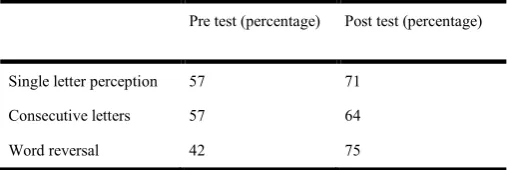
[image:3.595.306.560.595.680.2]The result has been analysed on the basis of comparison of pattern recognition score, learning difficulty scores, informant’s report and behavioural observation between pre and post testing situation. Table 1 shows that the percentage of correct response was increased in each pattern recognition task in post training condition in comparison to the pre training condition. Thus after 10 sessions of pattern recognition task the child’s score on pattern recognition was increased.
Table 1. The scores on Pattern recognition in pre and post training conditions
Pre test (percentage) Post test (percentage)
Single letter perception 57 71
Consecutive letters 57 64
Word reversal 42 75
Table 2. Scores on Diagnostic Test of Learning Disability
Pre test Post test
[image:4.595.47.277.76.347.2]Eye hand coordination 6 6
Figure ground perception 4 5.5
Figure constancy 7 7
Position in space 5 6
Spatial relations 6 6.5
Auditory Perception 5 4.5
Memory 5 5.5
Cognitive abilities 3 4
Receptive Language 2 3
Expressive Language 1 3
Z score -2.68 Significant at .007
Behavioural Observation
After 10 sessions the child resolves the difficulty of letter identification. The child no longer confuses between structurally similar letters. As she becomes more aware regarding reversal of word her reading and writing becomes more accurate. However, the difficulty in spelling and reading lengthy words is still present although dropped off. Moreover, her motivation was enhanced, she looked confident and socialization was improved.
Parental report (post training session)
In comparison to earlier situation the child feels much motivated for studying. Complaints of word reversal in reading and writing were almost demolished. The child becomes willing in reading storybooks and regains her confidence in reading, writing and socialization. She scored 76% which the parents seem satisfactory, in her last final examination.
Case-II
The child is a 7 years old boy, studied in class I in an English medium school (verbal IQ= 97). He is diagnosed with high functioning autism as well as dysgraphia in psychiatric as well as psychological examination. When the child came for assessment he was very much preoccupied with numbers. He used to play with writing numerical table and breaking up the numbers with its possible divisors. Among the autistic features the symptoms of hand flapping, poor socialization and poor understanding of societal demands, obsessive thoughts are prominent. Among the features of Dysgraphia, the child showed very poor handwriting failing in maintaining horizontal lines. The child used to rotate the page over 90 degree and started writing. The handwriting of the child was not readable at all, letters reside one after another in such a way that it looks like a string of arbitrary letters vertically crossing the horizontal lines of the page. When the child was taught he used to stick on few parts of the total chapter (or
story) and used to form and reform and repeat the same story. He used to continue to utter the same story repeatedly throughout a temporal period of two weeks or so. The child also had difficulty in shoe-lace tying, copying from board and following the classroom instruction. When the child was asked to write the English alphabets he used to confuse between small and capital letters and letter reversal was also present.
Intervention
As the aim of the intervention is mainly focused on learning problem, the problem of autism was not under the therapeutic objective. For motivational arousal behavior therapy was applied in addition to visuo perceptual training and application of teaching strategy. At first the psycho education was provided to the parents. Then the schedule of reinforcement was designed where one of the target behaviors was obeying the mother’s instruction for handwriting. At the initial phase reinforcement was materialistic in nature and it was given immediately when he follows the instruction and acts accordingly. For controlling the excessive repetitive talk during studying punishment was given by withdrawing the reinforcement. Sometimes ignorance was applied. After two weeks when the child became habituated in following instruction, he was exposed to the visuo perceptual training. But in the training condition the child started showing difficulty in focusing his attention after 5 minutes over first three training session. Due to the very short attention span, very few targets were fixed in the successive training sessions.
1.As the child had difficulty in recognizing upper case and lower case letters so the first training target was to differentiate between upper and lower case letter. He was made to watch the computer screen where upper and lower case letters appeared at random, each for 500 milliseconds. The child had to press ‘1’ watching upper case letter and press ‘2’ for lower case letters.
2.The child had a problem of letter reversal. So he was given a task to discriminate between a rotated image of letters from their actual image. When the actual letter comes the child had to press a specific key when the rotated image comes he had to press another key.
3.For his poor hand writing and disproportional letter size the child was given a task of identifying whether the words coming on the screen are of equal letter size or of a combination of different sized letters.
4.One of the features of his handwriting was he had a tendency to mix up cursive fonts with print fonts. So his hand writing gets affected by lack of synchronicity. The child was given a task of discriminating the two fonts –Italicized fonts and Non-Italicized fonts. The child had to discriminate between the two kinds of fonts and respond accordingly by pressing specific keys.
Teaching Strategies
letters. He was given the differentiation task repeatedly (both through computer programming and in paper- pencil). For his confusion between cursive and print writing he was given a basic task of differentiating straight and slanting lines and shapes. When the child became a bit comfortable between these differentiations then the same procedure was replicated in case of letters. Reward was given when the child listened to the instruction and followed this. However, it was little difficult to draw the child’s attention because he was preoccupied with some imaginary ideas in most of the times. However, one of his basic tendencies was to make stories out of some imaginary characters and repeat the same. When the child focused his attention toward the instructor’s word then he was given materialistic reward for which he placed his demand and liking, for example a particular snack or sweet. It was also very difficult for the child to sustain his motivation and attention for more than 5 minutes. The second form of reinforcement was if the child can perform the said task for 10 minutes without interruption then the instructor will listen to his story for the next 10 minutes.
RESULTS
As the child has high functioning autism (diagnosed by Psychiatrist), the implementation of all the strategies was somewhat difficult for the caregiver and the therapist. Neither DTLD nor pattern recognition pre and post training test could be administered on him. Only the result of training in paper pencil mode (with behaviour therapy) is discussed on the basis of parental report and behavioural observation.
Behavioural observation during training
Due to his short attention span when he was given the computerized task of visual discrimination he had difficulty in focusing his attention for more than 30 secs. As a result he took a relatively longer duration with repeated verbal prompts for responding. For number of times within 10 sessions he started attending to stimuli but after 3 or 4 trials out of 14 he was unable to sustain his attention. It was easier for the instructor working in paper-pencil mode as it is more concrete form of teaching for the special child. Some of the sessions has gone almost non productive as the child had difficulty in focusing attention. However, in those situations, the caregiver was given the task of training the child in paper pencil mode at home. After 10 sessions the child could write 70% letters maintaining proper line orientation. He could write capital and small letters separately in 47 out of 52 cases (26 alphabets both in upper and lower cases). He acquired the size concept also and with verbal prompting of instructor he could make uniform letter size production. However, in most of the times he was unable to continue with same level of motivation. In those conditions verbal prompt helped in certain extent to hold his motivation for accomplishment of the task. But an interesting observation reveals that the child had difficulty in grasping the alignment of the letters and he could not resolve his confusion between cursive and print writing even after 10 sessions.
Parental report (post training session)
Now, he sits for study for half an hour or so. He writes the alphabets with his own. His obsession regarding numbers is no longer present. The child conforms some of the rules and instructions for getting the immediate reinforcement. His writing has improved to some extent.
Case III
The client was a 13 years old boy ( IQ= 92), studying in an English medium school within Kolkata metropolis and was diagnosed as having mixed form of specific learning disability, i.e., ‘Dyslexia’, ‘Dysgraphia’ and ‘Dyscalculia’. In the pre training session the child had difficulty in reading a five-words -sentence of class II standard. His reading was characterized by lack of fluency, fumbling, guessing of letters, substitution and inappropriate punctuation. He had problem in writing a single complete sentence. His writing was characterized by inappropriate grammar, very poor hand writing and excessive spelling error. In mathematics also he had severe difficulty in number sense and calculation. He had difficulty in simple arithmetic and remembering tables. In addition with his learning problem he was severely bullied in school by his classmates. As a result he developed a sense of low self esteem, lack of confidence, aggression and emotional discomfort. The case was referred for assessment and therapies for specific learning disabilities.
Parental report (Pre-training session)
Since early childhood he has been facing difficulty in acquiring academic skills, letter identification and number reasoning. Reading, writing and arithmetic skills are very much poor. He does not acquire the pass marks in school examination. He does not want to study and sometimes he becomes aggressive while told to sit for study. He becomes withdrawn from socialization. His overall confidence is very low. He has severe difficulty in adjustment in school.
Intervention
As the client was in his adolescence, some of his emotional irregulation might be attributed to adolescent developmental period but the major part comes from his associated specific learning problem. So the intervention for specific learning disability was associated with cognitive behavior therapy and behavior modification techniques. Unless and until the problem of low motivation, emotional disturbances and low self esteem are met by the therapist, the learning problem could not be addressed. Thus, the management plan firstly focused on the emotional and motivational disturbances and then the difficulty in learning was addressed. The entire realm of problems was thus sub divided into the following goals.
Goal 1: reduction of problem of low motivation and emotional disturbances
a.Reduction of confusion– As the child used to get
assured that if he comes to be truthful then he will never get punished and he will only get tokens for being truthful. On the other hand if he will be caught for any response based on social desirability tokens will be deducted.
b.Raising confidence and self esteem– Cognitive behavioural
techniques were applied for raising confidence. At first he was given some task within his comfortable level of difficulty. At the time he could accomplish the task his success was pointed out. After repeated success in a session the client was asked to summarize the session. Then a similar pattern of task with raising difficulty level was scheduled for his homework for the week. In the successive sessions those performances were analyzed. With the confidence of achieving the goal the self esteem of the child was automatically raised.
c.Controlling of Aggression- It was mainly controlled by
behavior therapy technique. Psychoeducation was provided to his parents. Antecedents and consequences of behaviour were analyzed with them. They were asked to keep the home environment least provocative for raising his anger, to encourage him for all small steps of achievements and the implementing the token economy technique.
Goal 2: reduction of problem of learning disability
d.Pattern recognition training on working memory tasks associated with SLD problems
1.For Dyslexia- As the adolescent had difficulty in word recognition, guessing of words and substitution of letters so he was given tasks of identification of single and consecutive letters and word reversal as mentioned in case I.
2.For Dysgraphia-As he had confusion between upper and lower case letters, difficulty in producing uniform letter size and mixture of cursive and print writing all the visuo perceptual tasks described in case II were applied here.
3.For Dyscalculia- the child had difficulty in number sense, perception of numbers and calculation, the following tasks were chosen.
a.Identification of single number- here a target number was given, e.g., ‘6’ and the adolescent was instructed to identify the single number within a lengthy digit number e.g., 768. If he locates the target then he has to press ‘z’ and finding out the ‘no- presence’ of the target he has to press ‘/’.
b.Identification of consecutive numbers-here a set of consecutive numbers were given, e.g., ‘37’, and the participant was said to locate the presence of this within a lengthy digit number. When he locates the target he has to press ‘z’ and the absence of target is to be followed by pressing the key ‘/’.
c.Calculation- Here the subject is presented few calculations, one appearing in each time onto the LCD screen. The program is set as in 50% of the cases the calculation is correct and in rest of the cases the calculation is wrong. The subject has to identify which one is right and which one is wrong. Identifying the right one he was instructed to press ‘z’ and in cases of wrong calculation press ‘/’.
e.Implementation of training in paper-pencil mode-
The child, for his manifested reading difficulties, were given single and consecutive letters cancellation task with a moderately difficult time limit. With the practice of the same, the time limit was gradually decreased. Thus gradually he was
exposed to more difficult task of letter identification. The third strategy to increase the visuo perceptual task related to reading was word reversal. The subject was given the task of reversing the words (starting from three lettered words up to 5 letters). At first 10 trails consisted of reversing the letters by paper pencil and after that he was asked to solve the similar problem mentally and produce the answer verbally. For dysgraphia, as in computerized training, the participant was also given the paper pencil task of the same visuo perceptual skill. At first attempt was made to help the subject in distinguishing small and capital letters. He was to cancel out either the upper case letters or the lower case letters each time. Once he found the task easy then he was asked to write 5 simple sentences on a particular topic being non-hesitant regarding the spelling and grammatical mistakes. Then his written account wastaken for correction of the incorrect use of upper and lower case letters and it was discussed with him. In the same process he was given the writing tasks of copying, dictation and creative writing and then he was asked for self correction.The next aim was to make the subject distinguish between print and cursive writing. For that a mixture of print and cursive letters are presented to the subject and he was asked to distinguish either of the two. The next day he had given a parallel form and asked to cancel the other kind of letter. When he got habituated in distinguishing the two then he was given new sets of words, mixing with both of the letter fonts. Now his task is to recognize the fonts of each letter in the word. The final step is to write down new sets of letters, words and sentences. The next therapeutic aim was to make the person identify as well as produce equal sized letters. For that his own hand writing was taken at first. Then he was given the task of circling the smallest letter (in terms of size) within each word. Necessary corrections were made. The next day he was to circle the biggest letter. After that he had to identify the most disproportionate letter with a word and was encouraged to produce equal sized letter in words. Once the subject grasps the rule he was exposed to rigorous handwriting tasks and asked for self correction. For difficulty in mathematics at first the single and consecutive number cancellation task was done by the person as before. Then he was given `coin counting tasks with reinforcement schedule, i.e. with correct counting the person will get equal amount of money in his hand. It needed rigorous practice. When the child could grasp the rules and was comfortable in doing so he was given simple as well as graded calculation in paper pencil mode. The next step was replication of the same method in verbal mode that is mental maths with the help of coins, notes flash cards etc.
RESULTS
Observation of behavior
[image:7.595.31.294.165.378.2]After 10 sessions the adolescent could successfully identified upper and lower case letters and used it correctly in his written expression. He could perform the cancellation task in single and consecutive number and letters.
Table 3. The pre and post training performance on pattern recognition score
Pattern recognition task
Pre test (percentage)
Post test (percentage) Z value Reading
difficulty
Single letter 42 67 -2.313
(Significa nt at .02)
Consecutive letter 37 50
Word reversal 43 50
Arithmetic difficulty
Single number 57 50
Consecutive number 42 57
Calculation 37 67
Writing difficulty
Upper and lower case letters
57 57
Rotated alphabet 67 67
Letter Size 33 42
Letter font 25 42
Table 4. DTLD scores in pre and post training session
Pre test Post test
[image:7.595.55.271.412.635.2]Eye hand coordination 5 5
Figure ground perception 5 4.5
Figure constancy 5.5 5
Position in space 4.5 5
Spatial relations 5 6
Auditory Perception 6 6
Memory 6 6.5
Cognitive abilities 2 3.5
Receptive Language 2 3
Expressive Language 1 3
Z score -8.45 Significant at 0.065
The most difficult area for the child was font perception. He took longer time to grasp the problem. After 10 sessions his font perception score increased upto 23%. In paper pencil mode he could reverse the words but he had difficulty in doing it verbally and with longer words. His handwriting improved and he could maintain the line orientation. He developed interest in counting task and he performed it as if he is playing a game and he has to win the tokens. Although he still had difficulty in graded calculation, especially in borrowing, but he could perform the simple arithmetic successfully. Moreover his mood swing was reduced; aggressive outburst became much in control. He started showing interest in study. As a result all these made a positive bearing on his self esteem.
Parental report (post training session)
As per the parental report the happy mood prevails for longer and the withdrawal symptoms were reduced for participating in new activities. He started showing confidence in different academic and non academic activities. Sense of self worth has been developed and the adolescent reported having better peer adjustment in group activities.
Summary and concluding Discussion
The results of three different case studies show that the pattern recognition training through software programs as well as paper-pencil mode along with behavioural techniques was helpful for all the cases of learning disability. The use of both computerized and paper-pencil mode in teaching has created greater scope of inclusion different modes of stimulus presentation. Repetition has been found as essential in teaching LD group (Nicolson & Fawcett, 2000; Dehaene, 2004). Thus it is a form of repetition of stimulus exposure using various modes. Authors like Kline and Lerner (2006) noted that the use of computer and software programs seem to be more interesting and motivating for the children than paper pencil tasks. Thus, at first the computerized mode has been exposed to the children with learning disability for making the learning mode more interesting. Then the paper pencil mode has been introduced so that they will transfer the learning from one mode to another, thus strengthening the association areas by creating more number of neural connections for pattern recognition. As it was evident that readers with dyslexia have lower sensitivity to both visual and auditory stimuli than the normal readers due to impaired development of large neuron (Stein and Talcott, 1999), the visuo perceptual training becomes useful for increasing sensitivity for pattern recognition in learning disability. It has also seen that the attainment of specific academic skills had a positive effect on the personality dimensions of the children. These were helpful to raise confidence and self esteem within the children and boost their social adjustments. As Richardson (2003) noted that self-esteem cannot be injected or taught, it is a result of success. Brooks (2000) also noted that a therapeutic teaching must bring success in learning in such a way that it has a beneficial effect on personality, enhances feelings of self worth and rekindles an interest in learning. Subjective understanding of the students’ feelings, emotions and attitudes was regarded as essential in effective teaching (Brooks and Goldstein, 2002). Kline and Learner (2006) also agree with the importance of interpersonal relationship factor or rapport between teacher and student, mutual respect is of paramount importance. Therefore, an overall effect of emotion based psychotherapy; computerized training program and implementation of associated teaching strategies are helpful to improve the academic skills along with raising the self esteem, motivation and social adjustment.
Conclusion
REFERENCES
Bosse, M.L. & Valdois, S. 2009. Influence of the visual attention span on child reading performance: across-sectional study. J. Res. Read., 3, 230–253. doi: 10.1111/ j.1467-9817.2008.01387.x
Dehaene, S., and Cohen, L. 2011. The unique role of the visual word form area in reading. Trends Cogn. Sci. 15, 254– 262.doi:10.1016/j.tics.2011.04.003
Fernald, G. 1988. Remedial techniques in basic school subjects. Austin, TX: Pro-Ed. (Original work published 1943). Fuchs, D., & Fuchs, L. 1998. Researchers and teachers working
together to adapt instruction for diverse learners. Learning Disabilities Research and Practice, 13 (3), 126-137.
Gersten, R. 1998. Recent advances in instrumental research for students with learning disabilities: An overview. Learning Disability research and Practice, 13(3), 162-170.
Gillingham, A. & Stillman, B. 1970. Remedial training for children with specific difficulty in reading, spelling, and penmanship. Cambridge, MA: Educators Publishing Service.
Greenwood, C.R., Maheedy, L. F. & Delquardi, J. C. 2002. Class-wide peer tutoring. In G. Stoner, M.R. Shinn, & H. Walker (Eds.), Intervention for achievement and behavior problems (pp.611-649). Washington, D.C.: National Association for School Psychologist.
Kevan, A. and Pammer, K. 2008. Visual processing deficits in preliterate children at familial risk for dyslexia. Vision Res, 48, 2835–2839.doi: 10.1016/j.visres.2008.09.022
Lerner J.W. & Kline F. 2006. Learning disabilities and related disorders: Characteristics and Teaching Strategies. Tenth edition. Houghton Miffin Co. New York.
Levine, M. 2003. The Myth of Laziness. New York: Simon and Schuster.
Mainzer, R., Deshler, D., Coleman, M., Kozleski, M., & Rodriguez- Walling, E. 2003. To ensure the learning of every children with disabilities (pp. 130-163). San Diego: Academic Press.
Meltzer, L. & Montage, M. 2001. Strategic Learning in students with learning disabilities: What have we learned? In D. Hallahan & B. Keogh (Eds.), Research and global perspectives in learning disabilities: Essays in honor of William M. Cruickshank (pp. 111- 130). Mahwah, NJ: Lawrence Erlbaum.
Palinscar, A., Brown, A., & Campione, J. 1991. Dynamic assessment.In H.L. Swanson (Ed.), Handbook on the assessment of Learning Disabilities (pp.77-94). Austin, TX: Pro-Ed.
Resnick, L. 1987. Constructing knowledge in school.In L.A. Liben (Ed.), Development and Learning: Conflict or congruence? (pp. 19-50). Hillsdale, NJ: Erlbaum.
Richardson, S. 2003. Are we enablers or disablers? Perspectives. International Dyslexia Association, 29 (3), 13-14.
Rosenshine, B. 1997. Advances in research on instruction. In J. Lloyd, E. Kame’enui & D. Chard (Eds.). Issues in Educating Students with Disabilities (pp.197-220). Mahwah, NJ: Erlbaum.
Shaywitz, S. 2003. Overcoming dyslexia: Anew and complete scince-based program for reading problems at any level.
New York: Alfred A. Knopf.
Simola, J., Stenbacka, L. and Vanni, S. 2009. Topography of attention in the primary visual cortex. Eur. J. Neurosci. 29, 188–196.doi:10.1111/j.1460- 9568.2008.06558.x
Slavin, R. 2000. Educational psychology: Theory and practice.
Boston: Allyn& Bacon.
Stone, C.A. 1998a. The metaphor of scaffolding: Its utility for the field of learning disabilities. Journal of Learning Disabilities, 13 (4), 344-364.
Vaughn, S., Gersten, R., & Chard, D. 2000. The underlying message in LD intervention research: Findings from research syntheses. Exceptional Children., 67(1), 99-114. Vidyasagar, T.R. 1998. Gating of neuronal responses in
macaque primary visual cortex by anattentional spotlight.
Neuroreport, 9, 1947–1952.doi: 10.1097/00001756-199806220-00006
Wittrock, M. 1988. A constructive review of research on learning strategies. In C. Weinstein, E.Weinstein, E.Goetz, & P. Alexander (Eds.), Learning and study strategies: Issues in assessment, instruction and evaluation (pp. 287-298). San Diego: Academic Press.