SATELLITE REMOTE CONTROL
Retd. EE, HP, M.S. and Electrical Engg. Faculty (2007 to 2013), Nanded, M.S., India
ARTICLE INFO ABSTRACT
Since miss
NASA that time, the conceptual cause and within three days I le of Begule
system cannot behave erroneously. In
They work perfectly without erring, as per the concepts put in the system to work. The difference in behavior may occur due to some concepts insta
truth of the Relativity concept; a formula for satellite remote control is built up in this article. The futuristic clock's software should be built up or revised, according to the corrected concepts of Relativity and in line with the formula derived.
Copyright © 2017, Dhone.This is an open access distribution, and reproduction in any medium, provided
INTRODUCTION
Probing satellites, missing their path; is an unwanted phenomenae in space projects. It is seen by Author, it is due to conceptual difference with Relativity Principles. It is in respect of position of moving satellite in space w.r.t. signal received from the satellite. Second difference in concept is about speed of light. It is considered by Physics world that,
light in free space is c the constant, irrespective of any frame and its relative motion. But the fact is otherwise. The difference is, many of the Physicists still consider that, space contraction in Special Relativity is, Real. Here again the actual fact is different. So, all these, differences are discussed in line with the title of this article and correct results as per Author's innovative studies are stated where ever necessary.
DISCUSSION
It is considered that, a satellite is launched from its station assumed stationary. We require to know its position in space at a particular instant, to know its distance from us; in order to verify its direction and speed of travel and to asses; whether i is travelling along the correct path, to reach its destination, pre decided by us; so that, if it is diverting from its path, we can correct it by remote signaling.
*Corresponding author: Dhone, D.B.
Retd. Electrical Engg. Faculty (2007 to 2013), Nanded, M.S., India
ISSN: 0975-833X
Vol.
Article History:
Received 23rd August, 2017
Received in revised form 10th September, 2017
Accepted 17th October, 2017
Published online 30th November, 2017
Citation: Dhone, D.B. 2017. “Satellite remote control Key words:
Missing Satellites, Beagle 2, Apparent Contraction, Gravitational Bending, Gravitational contraction, Futuristic Clock, Exact Signaling Point for Satellite in Space.
RESEARCH ARTICLE
SATELLITE REMOTE CONTROL
*Dhone, D. B.
Electrical Engg. Faculty (2007 to 2013), Nanded, M.S., India
ABSTRACT
miss-landing of Beagle-2nd , the Author is verifying the cause of it. I had conveyed by email to NASA that time, the conceptual cause and within three days I learnt in a News Paper that, the missing of Begule-2, from its destination was due to a mathematical mistake. The guiding and
system cannot behave erroneously. In his service life, he believed on control systems of machine. They work perfectly without erring, as per the concepts put in the system to work. The difference in behavior may occur due to some concepts installed, being (excuse me) un
truth of the Relativity concept; a formula for satellite remote control is built up in this article. The futuristic clock's software should be built up or revised, according to the corrected concepts of
lativity and in line with the formula derived.
article distributed under the Creative Commons Attribution License, the original work is properly cited.
satellites, missing their path; is an unwanted in space projects. It is seen by Author, it is due to conceptual difference with Relativity Principles. It is in respect of position of moving satellite in space w.r.t. signal received llite. Second difference in concept is about speed of light. It is considered by Physics world that, the speed of light in free space is c the constant, irrespective of any frame and its relative motion. But the fact is otherwise. The third many of the Physicists still consider that, space contraction in Special Relativity is, Real. Here again the actual fact is different. So, all these, differences are discussed in line with the title of this article and correct results as per Author's
ative studies are stated where ever necessary.
It is considered that, a satellite is launched from its station assumed stationary. We require to know its position in space at a particular instant, to know its distance from us; in order to verify its direction and speed of travel and to asses; whether it is travelling along the correct path, to reach its destination, pre-decided by us; so that, if it is diverting from its path, we can
Nanded, M.S., India
Remote Signaling Systems are developed a lot at present; but, events like missing their destinations by satellites still happen. Surely, there are different reasons for missing satellites as accounted in Missing Space probes & Satellit
reason is not seen considered, due to which, satellites may be missing. It is Relativistic length contraction, between the satellite and its controlling system including observer. Because, in Physics World; it is considered that, when we calculate the distance of a launched satellite with the help of light signal coming from it; the calculated distance is the distance of satellite from the observer (the Signaling Device) in space at the instant, when the signal was released from the satellite. But, it is not the truth. If one studies Relativity Principles microscopically; he will see the truth. And it is that, the distance of a satellite from observer or from the signaling machine as is found, is the distance, at the instant of the receipt of the signal by the observer or the signaling machine. It is proved in my article titled, 'Length Contraction, Time Dilation, Gravity, Total Existence of Universe and Beyond; published in, International Journal of Current Research, a
before. While deriving Lorentzian Transformations, the distance x from the assumed stationary observer O, is the distance of the event source; when the signal has reached the Observer, and in derivation of respective equation, the result doesn't negate, the consideration a
by stationary observer. No doubt it suffers from
contraction; but, respective Lorentzian transformation, gives
International Journal of Current Research Vol. 9, Issue, 11, pp.61877-61882, November, 2017
Satellite remote control”, International Journal of Current Research, 9, (11), 61877-618
Electrical Engg. Faculty (2007 to 2013), Nanded, M.S., India
the Author is verifying the cause of it. I had conveyed by email to nt in a News Paper that, the missing 2, from its destination was due to a mathematical mistake. The guiding and controlling service life, he believed on control systems of machine. They work perfectly without erring, as per the concepts put in the system to work. The difference in lled, being (excuse me) un-natural. By proving the truth of the Relativity concept; a formula for satellite remote control is built up in this article. The futuristic clock's software should be built up or revised, according to the corrected concepts of
License, which permits unrestricted use,
Remote Signaling Systems are developed a lot at present; but, events like missing their destinations by satellites still happen. Surely, there are different reasons for missing satellites as accounted in Missing Space probes & Satellites; but, one reason is not seen considered, due to which, satellites may be missing. It is Relativistic length contraction, between the satellite and its controlling system including observer. Because, in Physics World; it is considered that, when we late the distance of a launched satellite with the help of from it; the calculated distance is the distance of satellite from the observer (the Signaling Device) in space at the instant, when the signal was released from the But, it is not the truth. If one studies Relativity Principles microscopically; he will see the truth. And it is that, the distance of a satellite from observer or from the signaling machine as is found, is the distance, at the instant of the receipt e signal by the observer or the signaling machine. It is proved in my article titled, 'Length Contraction, Time Dilation, Gravity, Total Existence of Universe and Beyond; published in, International Journal of Current Research, a few days
iving Lorentzian Transformations, the distance x from the assumed stationary observer O, is the distance of the event source; when the signal has reached the Observer, and in derivation of respective equation, the result doesn't negate, the consideration about the distance x measured by stationary observer. No doubt it suffers from relativistic contraction; but, respective Lorentzian transformation, gives
INTERNATIONAL JOURNAL OF CURRENT RESEARCH
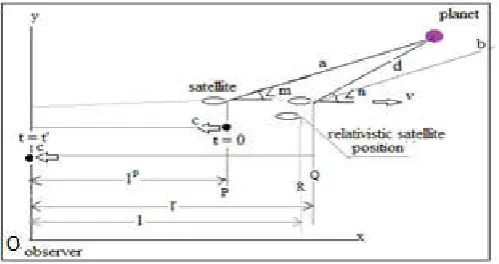
the true distance at the instant of receipt of signal by the observer, equal to its rest frame distance with the help of respective equation (Missing Space Probes & Satellites, 1989 and en.wikipedia.org/wiki.special relativity). Now, to realize, how the above two understandings (one existed in Science at present and is used; second, the Author's one; will act differently in signaling. please refer below Figure 1.
[image:2.595.38.288.146.278.2]
Figure 1. Satellite Position; at Receipt of Signal by Observer
In Figure-1, the satellite is moving at velocity v w.r.t. observer O (assumed stationary), in direction of vision of the observer O, along +x direction, parallel to x-axis. The satellite has released signal at its position in space, marked by point P and it is received by the observer at the instant of time t, read in watch of observer O. Observer calculates the position of the satellite at that instant of time t. Actually calculations give the relativistic position of the satellite at point R as shown in the
Figure-1 above. It is (x=l). But, as said earlier; the Observer considers the position of satellite, given by the signal is the position of it; when, it has released the signal (x=lp). And he believes that, the satellite is at point P, as shown by the respective signal, at lp distant from him. At the same instant computing turning angle of satellite, to reach it to the planet i.e. its destination; as calculated by the observer and shown in
Figure-1 above, he gives the satellite angular turning signal corresponding to the angle m. In fact, the satellite has reached to the point Q; when, the observer O has received the signal. Hence, it was essential to understand him that, the received signal gave him the position where, actually it is at that instant t of receipt of the signal by him.
And hence, accordingly, it was necessary for the observer, to give the satellite angular turning signal corresponding to angle n at point Q, taking into consideration the relativistic contraction of actual distance of the satellite from him, to give correct path d to satellite. But actually due to miss-conceptual understanding, the observer has directed the satellite towards its destined planet by angular signal corresponding to angle m at point P; Thereby, the satellite was misguided along path b which will cause missing of the satellite. When Beagle-2 was miss-landed on Mars, away from its destination; author has intimated above consideration to NASA as one of the cause for Beagle's miss-landing. Now in futuristic clock of NASA; above real Relativity Principle is required its application suitably for undoubted sure success in space probes. Therefore, Signaling Software as per below derived formula must be considered for design, construction and installation, along with counter act to gravitational apparent displacements of the satellite and the Planet destined; in remote control equipments meant for Satellite Navigation; used by satellite launching systems, being monitored by futuristic clock.
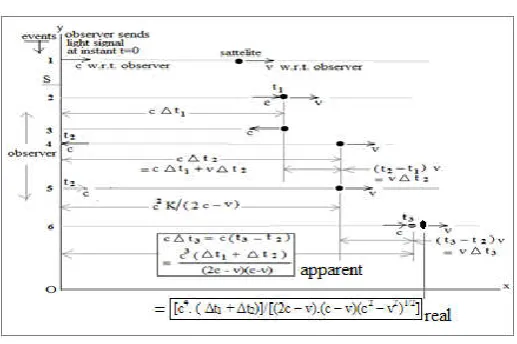
In the figure-2 below, the observer sends a signal at instant of time, (t=0), read on his watch. The satellite is moving at constant linear speed ‘v’ in free space in the direction of vision of the observer, parallel to x-axis. The moving satellite, receives that signal at the instant of time t1. The signal has travelled at speed ‘c’ w.r.t. the observer as the source of the signal, and arrived the satellite at instant 't1' (The speed of light in free space is 'c' w.r.t. its source.) (scirj, volume V, Issue V pages 33 to 40). Therefore at instant 't1', the satellite is at straight distance of (c.Δt1) from the observer, where, [Δt1 = (t1-0)]. Soon the signal reaches the satellite; it is reflected back, towards the observer at the same instant 't1'. The reflected signal is received back by the observer at the instant of time 't2', at signal speed ‘c’ w.r.t. the satellite. The satellite velocity ‘v’ is ridded upon the signal speed ‘c’ in the reflected signal; when the signal is observed by the observer. The reflected signal reaches the observer at instant of time 't2'. During the period (t2-t1), the satellite travels a distance [(t2 - t1).v = v.Δt2] further to distance (c.Δt1) calculated above. The reflected signal has travelled at speed c w.r.t. the satellite and the signal has arrived at observer at instant 't2'. Thus, when the observer received the reflected signal from the satellite, the satellite is at a real distance of (c.Δt2). With the help this information, we construct below mentioned equations.
c.Δt2 = c.Δt1 + v.Δt2
(c – v).Δt2 – c.Δt1 = 0 . Assume, Δt2 = (c.Δt1)/(c - v),
Δt1 + Δt2 = K i.e. Δt2 + Δt1 = K
Solving these two equations to find out time span Δt2, we get,
Δt2 = c.K/ (2c–v ) ……….(1)
Where K is the duration of time between the two instants of time from instant of firing the signal by the observer and receipt of the signal reflected back from the from the launched satellite. Hence in above equation K,c,v are known. Therefore, the distance of the satellite from the observer, at the instant of time t2, is,
c.Δt2 = c2.K/(2c–v) ………..(2)
Soon path correction suitable signal is sent to the satellite, manipulating its distance at the instant of receipt of this correction signal by the satellite as below.
Assume that, the correction signal is fired at instant t2 and that will be received by the satellite at instant of time t3. The time period required to the correction signal to travel from observer to the satellite is
(t3-t2) = Δt3
During the period Δt3, the satellite travels a distance v.Δt3.
Thus, the distance of the satellite from the observer when its correction signal will be received by the satellite will be,
c.Δt3 = [c2.K/ ( 2c – v )] + v.Δt3.
Collecting Δt3 terms, we get the value of
Hence, the distance at which the satellite receives the control signal is equal to,
c.Δt3 = [c3. (Δt1 + Δt2)]/ [(2c–v).(c– v)]……….(4)
The distance thus found by the observer assumed stationary is apparent distance. Because, it is the distance of moving body which is determined by electromagnetic signal-measurement method; that is, determined by light-signaling method; and, not by mechanical measurement method (that is the measuring by a measure tape or field-survey). It is the distance of a moving body w.r.t. the observer assumed stationary (in which the signal velocity 'c' w.r.t. its source and source velocity 'v' w.r.t. the observer, get added Relativistic-ally).
As explained in my article, 'An Innovative Review of Kennedy-Thorndike Experiment' (scirj, volume V, Issue V, May, 2017, pages 33 to 40), that, the speed of light in free space is depended on relative motion between the light signal and its source and it is less than c, either they may be moving towards each other or away from each other; hence, the distance between the source of the signal and the observer; is seen contracted by relativistic factor, (1- v2/ c2)1/2 w.r.t. actual/rest distance as per Special Relativity. Hence, the distance c.Δt3 will be measured by observer apparently and not exactly; as in derivation of Lorentzian Relativistic transformations, though the distance x is considered true, by taking signal speed 'c' w.r.t. its source every now and then; but, when measurement of it is considered to be taken by observer assumed stationary; the distance works out apparent. Hence, we have the distance c.Δt3, 'apparent distance', as calculated in above equation (4). In order to find out the real distance or the rest distance; between the source and the observer; we have to divide the apparent distance, c.Δt3. by the relativistic factor, (1- v2/ c2)1/2 .
Though we have taken distances by considering velocity of light c w.r.t. its source; i.e. when measuring from source and when measuring from observer; considering the observer as source; still the distance between the observer and the satellite arrived to, as given in above equation (1); is not real distance for observer. Because, in deriving Lorentzian transformations, the basic mathematical equations; (x = ct; and x' = ct'), the distance of moving signal-source from observer, assumed stationary; the speed of light is considered c rightly w.r.t. its source. But, the mathematical process gives negative answer to non-correct assumptions/considerations, if during 'the example solving process' not any other; hence, there the distance x measured by signaling method, works out negative and the speed of light signal w.r.t. observer is obtained is equal to, x.[1/(c2 - v2)]. Similarly, Special Relativity's relativistic math, gives speed of light c w.r.t. its source and that equal to, (c2 - v2)1/2 w.r.t. the observer (ijcr, vol.9, issue 10, October 2017, Physical Sciences and Engineering, Sr. No. 25; scirj, Volume V, May 2017, "An Innovative…Pge no. 33 to 40").
[image:3.595.309.568.48.220.2]It is so; because, light travels w.r.t. its source at speed c, and w.r.t. its observer at speed (c2 - v2)1/2. It is because of that, speeds greater than c cannot be sensed to their actual magnitude; instead they are sensed lower than c. c is not the speed limit of light but, it is the limit of perception of any type of observer (either a human eye or an instrument); which is lodged on observer by the Nature.
Figure 2. Distance of Satellite @ Path Change-Signaling
Hence, with the above reasoning, the distance (c.Δt3) in equation (4) above, given by right hand side of the equation, is the contracted length. Hence it is divided by the factor [(1 - v2/c2)1/2 = (1/c).(c2 - v2)1/2]. Therefore the equation (4) above giving apparent distance of the launched satellite reduces to,
c.Δt3 = [c4. (Δt1 + Δt2)]/[(2c – v). (c – v)(c2 – v2)1/2]………...(5)
that gives the real distance
Now, please be serious. In the case under our consideration is that, the satellite is in motion in the rest frame of observer. As per special relativity, the observer's frame is S; and the rest frame of the satellite is S' moving at linear speed v w.r.t. the observer. There in both frames, light cannot travel at speed greater than c. any effort to add speed to light, to enhance it beyond c, the effort, acts on the light to shift it into a respective suitable direction. Therefore, the terms, c4, (2c-v).(c-v) seem ambiguous. Relativistic-ally, therefore, c4= c and (2c - v).(c-v) = (c - v).(c - v) = [(c2 - v2)1/2].[ (c2 - v2)1/2]. Because, As in relativistic derivation of Lorentzian transformations; a light photon either released or accepted by an object in motion v w.r.t. the observer or source; have not speed (c -v) or ( c +v ) w.r.t. observer; instead it has speed ( c - v )1/2 in both cases. Hence, above equation-2, becomes as below.
c.Δt3 = c.(Δt1 + Δt2)/[(c2 - v2)3/2] ……….(6)
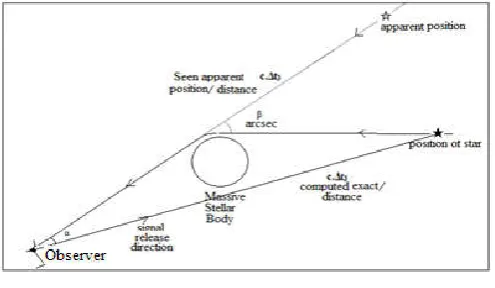
length due to gravity. It is stated w.r.t. gravity along the path and in direction of the path between sending and receiving ends as follows. Though gravitation contracts the distance along signal-path; it also dilates the time proportionately. Hence, it doesn't affect the signal, along its direction and the distance between the signaling equipment and the controlled equipment by it. But, the gravity effect in transverse direction to the path of signal should be taken care of separately, because of bending of light due to gravitation. Hence the relative angular shifting between the satellite and the light signal coming from it also is to be taken into account to target the satellite exactly towards its destination. These effects are different from gravitational contraction. If the angle of transverse shifting of the light, in respect of the satellite is observed say β arc-sec as shown in Figure-3 below; we have to compensate that angle in signal launching.
Figure 3. Gravitational Bending of Light
In case the signal experiences Gravitational Bending in its path of travel as shown in Figure-4 below; calculating the angle of gravitational bending and there from the apparent angle α of signal with the monitoring equipment as the observer; the signal is to be fired at an angle α w.r.t. the apparent image at its real position. The phrase, 'apparent image at its real position is used to remain cautious with Special Relativity apparent length contraction of signal-path.
Figure 4. Angle of Signal Releasing
Thus ,for firing control signal to the launched satellite, it should be fired with controlling quantities w.r.t. the satellite predicted position,
c.Δt3 = c.(Δt1 + Δt2)/[(c2 - v2)3/2] ……….(6)
and at an angle α swapping the Gravitational Body from real apparent image position of the Naturalsatellite………….….(7)
The effect of gravitational bending of the path of satellite is not acconted in these derivations. Hence, the angle α is to be modified accordingly.
To be absolutely accurate, we need to consider the gravitational time dilation as below,
In respect of gravitational effects on time and, length in direction of signal travel; one will be required to compute equivalent actual gravitational time dilation in the total path, due to gravity component along signal direction of different effective masses (mass densities) if any in the path of the signal; integrating the gravitational effects of different masses in the direction of travel of the signal and then, calculate its equivalent time dilation period Tdg, w.r.t. signal monitor or an observer. Tdg is difference of time period between Δt3 and time period through gravitational spaces in the gravity free total path travel during Δt3 as judged by the observer. Then, Tdg measured by ticks of clock of the signal monitor will be greater. Say it is Δtg. Hence, the distance of the Natural satellite destined, will be increase by
Δtg………. (8)
Adding this gravitational effect in above special Relativistic equation (6) we get,
c.Δt3=c.(Δt1+Δt2)/[(c2-v2)3/2+c.Δtg] ………(9)
The equation (9) above with the angle α calculated above, and rectified by gravitational bending if any; will give signal firing information.
How the NASA's futuristic clock will work against Relativistic effects in space probing; I don't know its technical actuals; but, according to my conscious as far as its application in space probing is concerned; it should be installed and definitely they might have been installed therein the following feature.
[image:4.595.38.286.541.685.2]‘the receipt of signal from a moving object gives its position in space at the instant of receipt of the signal from the object and not at the instant when the signal is released from the object'.
Speed of Light w.r.t. its Source and that w.r.t. the
Observer: It has been proved in my review article titled as,
'An Innovative Review of Kennedy-Thorndike Experiment' and, published in 'Science Research Journal' in its issue V, May 2017; that the speed of light in free space vary, observer to observer in his/its rest frame, depending upon the relative speed between the observer and the source of light. The speed of light is 'c' the constant for each pair of source of light and observer; both attached to the same inertial frame with free space in between them. Therefore, that fundamental experiment, on which the concept of constancy of speed of light in free space irrespective of any frame, irrespective of relative motion of any frame w.r.t. source, is based; doesn't prove the above concept; instead it proves; Einstein's concept that. "All inertial Frames are Equal in Them-selves". In my articles every now and then it comes that, speed of light is c w.r.t. the source; but, it is (c2 - v2)1/2 w.r.t. the observer. But, how; is it so? It is explained in short below.
Please realize that, when an atom is excited by external energy; some of its mostly the outermost orbiting electrons or an electron is excited. An excited orbital electron gains linear revolving speed around its nucleus; the speed of which is the speed of light 'c', and rejects throughout the extra energy in the form of light particle photon, a light quanta of energy. The energy is not something illusive waves in a void medium. It is the density variation of photon particles travelling in free space that can be represented in the form of waves of different frequencies. Second thing to be noted is that, 'c' is the limit of perception that is imposed by the Nature on an Observer who/which realizes or records the event. It is not the speed limit. It works as speed limit w.r.t. its source only. And that is the reason, why we run in miss-understanding that, the speed of light is c the ultimate speed in Universe. By the way I would like to state the real fact, which we are not caring for it; that, "All experiments performed till now to verify speed of light Involve, the source of light and the observer, both attached to the same conman frame. There is not relative linear motion between the two. In the experiment at CERN, they have tried to accelerate the neutrinos in the same rest frame of observer. When a neutrino or any mass particle will be tried to accelerate beyond speed c w.r.t. observer; the particle behaves as if it changes its state of existence. It behaves like an electronic basic charge.
A moving electrical charge produces magnetic field surround its path of motion so as to oppose its motion. At speed c, this changing magnetic field becomes so high that it doesn't allow any more speed rise of the particle w.r.t. observer. Because, observer's light sensing equipment works on the principles of the electrical charges. Therefore, in order to detect speeds greater than that of c; electromagnetic methods won't work. Electro-Magnetic methods en-camphorating Mechanical engineering must have to be used. That is like putting suitable sensors at measured periodic distances. If we want to observe anything moving at speed greater than c w.r.t. us, we have to speed up our-self in the direction of motion of the object; so that, it will be moving at or less than speed c w.r.t. us. Then we will be able to take observations in respect of facts beyond speed c. It is the fact that, experiments giving materialistic benefits are only promoted. Experiments intending to verify
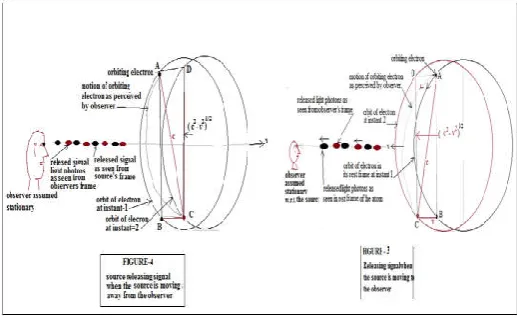
[image:5.595.308.567.367.526.2]purely the facts of theory are denied. But, we forget at the same time that, the base of the blasted progress of Science; is the 'Theoretical-Science' only. Thanks to Lego Scientists; who, proved the existence of 'Gravitational Waves and enabled to hear them as was stated by the Great Scientist Einstein. That's all. The figure-5 below, indicates an orbital electron, whose orbit is moving at speed v w.r.t. observer. Both relative speeds are considered, one the orbit as source moving away and also moving towards the observer. Again it is necessary to repeat the facts that, c is the natural limit of perception; anything moving at speed greater than that c is observed by the observer, moving at speed lower than c. An observer creates an image of the object under his/its observation in vertical direction to its line of vision. The three dimensional image is constructed with the help of phase differences between light photon waves reaching to the observer, from different distances of the points on the surface of the object at the same instant of time (of reaching the signals to observer). Now please concentrate on the below Figure-5. An excited orbital electron whose upper energy level orbit (along with its atom) is moving at linear speed v w.r.t. the observer; throws out in space, its extra energy, in the form of light photons, during its travel from A to B in its rest frame. But, the orbit is in motion at speed v w.r.t. the observer. Hence, the electron moves from A to C w.r.t. the Observer. And therefore, the Orbital electron has moved from A to C at a speed greater than c.
Figure 5. Speed of Light w.r.t. Relative Speed Between the Sorce and the Observer
But, due to natural limitation on perception, the Observer experiences the speed of the electron as c only and not higher than c. The path AC is the path AB for the rest frame observer of the atom (it is O' in Relativity Theory explanations). But for the Observer assumed stationary (that's O), speed along path AC is greater than c but he naturally feel it speed c. the observer (O) experiences the speed of light equal to (c2 - v2)1/2 actually (Please see the triangle ABC and apply Principle of Pythagoras to it). In practice also we experience Red-Shift in expanding Universe. The light of uncondensed bulb light is red-shifted because it is emitted by moving, free electrons, where as the light of a fluorescent bulb is white, because, it is released by orbital electron of an atom of the fluorescent material which is stationary w.r.t. observer..
Conclusions:- The real distance of satellite, from observer is,
c.Δt3=c.(Δt1+Δt2)/[(c2-v2)3/2+c.Δtg]
with the application of angle α calculated above duly to be
modified if required as mentioned at equation (9).
Where, Δt1 isperiod of time required by the signal to reach the satellite in transit from the observer toward its destination; Δt2 is the period of time required by signal to travel from the satellite to the observe since immediate reflection of the signal from the observer; Δt3 is the period of time required to the control signal to reach the satellite from the observer immediately the reflected signal from satellite is received. This signal carry exact signal to reach the satellite at its exactly achieved location point in space. v is the linear speed of the satellite towards its destination. c is the speed of light w.r.t. its source.
In deriving this formula, following revised concepts to their actual sense are used.
Speed of light w.r.t. its source is c and w.r.t. an observer is (c2 - v2)1/2 where, v is speed of the satellite w.r.t. satellite-monitoring-observer.
The distance of moving satellite computed by stationed observer with the help of signal from the satellite; is the distance at the instant of time, when the observer
received the signal. The direct calculated distance is apparent. Dividing it by Lorentzian factor, [(1 - v2/c2)1/2] the observer gets the exact distance at that instant.
The Special Relativistic length contraction is apparent and general relativistic length contraction i.e. Gravitational-length-contraction is Real.
REFERENCES
Beagle2 Wikipedia; Discovery og Beagle2 spacescraft on Mars.
Gravitational Bending of Light: Don Edward May 24, 2007. Gravitational Time Dilation Wikipedia and its references. Kennedy-Thorndike Experiment, first conducted in 1932. (and
onwards)
Let Us Go Over How the Lorentz Transformation was erived and <oyg.yale.edu/sites/default/fieldnotes_relativity_3pdf>. Missing Space Probes & Satellites; March 28, 1989; from,
www.alliens-everything-you-want-to-know.com
Satellite Technology Challenges: Signal Level: Free Space Path Loss.
Special Relativity-Wikipedia: <en.wikipedia.org/wiki.special relativity>.
The Effect of Gravity on Light by ESA.