Occupancy Estimation in Smart Buildings Using Iot-Based
Techniques
Manthri Lavanya
& K.Saifuddin
1
M.Tech ,Assistant Professor, Department of ECE, Anantha Lakshmi Institute of Technology,
Anantapur, Ap, India.
2
M.Tech ,Assistant Professor, Department of ECE , Srinivasa Ramanujan Institute of Technology,
Anantapur, Ap, India.
ABSTRACT: Nowadays, the research and innovation of smart buildings has been gaining increasingly attentions in building construction and management society. Among a variety of emerging technologies, demand driven HVAC (i.e., heating, ventilation and air conditioning) operation is promising to significantly reduce the building operation cost, and ultimately to achieve sustainable smart buildings. The “Internet of Things (IoT)” is about physical items talking each other, machine to machine communications and person to computer communications will extended to “things”. The Key technologies that drive future IoT related to Smart sensor technologies including Nanotechnology, WSN and Miniaturization .The integrated network architecture and the interconnecting mechanisms for reliable measurements of parameters by smart sensors and transmission of data via internet. In most cases these building HVAC systems run on fixed schedules and do not employ any fine grained control based on detailed occupancy information. In this paper we present the design and implementation of a presence sensor platform that can be used for accurate occupancy detection at the level of individual homes. Our presence sensor is low-cost, wireless, and incrementally deployable within existing buildings. The goal of this analysis is to help designers to select the most relevant parameters to control the energy consumption of buildings according to their context, selecting them as input data of the management system. Following this approach, we select a reference smart buildings with different contexts, and
where our automation platform for energy monitoring is deployed.
1 INTRODUCTION
is preferable. The probe requests are not encrypted, and can be captured and decoded with the help of wireless sniffers passively, without connecting to a particular network or transmitting any signal. 1 It is possible to capture the received signal strength (RSS) information of probe requests using sniffers such as Wi-Fi Pineapple (Wi-Fi-PA). This information can then be used for occupancy monitoring inside the building. Probe requests are burst in nature as they are broadcasted in the air in search of Wi-Fi networks to get connected, to get a list of available networks, or to handover between Wi-Fi APs. Frequent transmission of probe requests introduces an opportunity to track occupancy of building by simply monitoring probe requests. To our best knowledge, there are no detailed studies in the literature that report efficiency of occupancy tracking using Wi-Fi probe requests. Our work is unique about using WiFi probe requests for occupancy tracking several key applications. Their use in several different contexts are quickly transforming from a futuristic idea to reality. Amazon, for example, claims that seeing its Prime Air order delivery UAVs in the sky is expected to be as conventional as seeing mail trucks on the road within the next few years1. Google and Face book have been investigating the use of a network of high-altitude balloons2. And drones3. Over specific population centers for providing broadband connectivity. Such solar-powered drones are capable of flying several years without refueling. UAVs can also be used to deliver broadband data rates in emergency and public safety situations through low-altitude platforms. In this thesis, occupancy tracking has been done using linear least square estimation method along with security issues in Wi-Fi enabled Smartphone’s have been discussed. With the help of occupancy information we can control the devices accordingly to save power and provide security.
The smart or intelligent homes designed till now are for different purposes like decision support system & information collection for the wellbeing of the inhabitants, surveillance, storing & retrieving of multimedia data where the data is processed to obtain information can help to raise alarms after the data is captured from the environment, for to protect the inhabitants and home from theft, burglaries & natural disasters. The effective flexible solution and low cost for energy management & condition monitoring in home. It is a big motivation for me to choose this as a project. The basic operations include control of domestic devices and remote management such as Water heater; electric lamp etc., for to providing ambient intelligence to reduce the consumption of energy & unobtrusive monitoring of domestic utilizations through IoT technology are the functions of the new system. This will reschedule & support the inhabitant operating time according to the supply & energy demand.
infrastructure in buildings. WiFi APs have been used extensively for indoor localization in the past [7]–[10]. These works, however, focus on individual user localization, assuming that an individual carries a wireless device and in most cases an app on the user’s device is needed. Nevertheless, some of these works can still be leveraged in occupancy monitoring. For instance, fingerprinting-based training schemes can be employed to localize people when the RSSI values of these users can be obtained from the APs or log files. As an example, the approach in [11] proposes using RSSI values extracted from APs to locate people and hence the occupancy. The idea is to install a packet analyzer at each AP and capture each incoming packet via tcpdump. The packets are forwarded to a central computer via SSH connection to extract MAC addresses and the corresponding RSSI values. The authors use a coarse-grained localization (i.e., based on zones) which is inspired from the idea of passive localization of rogue access points [12]. Another recent work that focuses on coarse-grained localization is reported in [13]. The authors solely utilize WiFi APs along with the users’ smartphones to build a system in the Department of Computer Science at UC San Diego. The basic source of user information is the Authentication, Authorization and Accounting (AAA) WiFi logs which is augmented with metadata information such as occupant identity, WiFi MAC address and AP location within the building to improve the accuracy of occupancy detection further. The authors show that the proposed system can be easily integrated with building HVAC system and can actuate it effectively. Based on the experiments conducted for 10 days on 116 occupants, the authors show that the proposed approach infers occupancy correctly for 86% of the time, with only 6.2% false negative occupancy detections in personal spaces. The inaccuracies are mostly attributed to aggressive power management by
smartphones which stops their WiFi connections temporarily. The authors report savings of 17.8% in the HVAC electrical energy consumption through this technique. There are other works that somewhat utilizes WiFi but complements it with other information. Ghai et al. [14] use a combination of WiFi signals, calendar schedules, personal computer activity and instant-messaging client status to infer the occupancy within cubicles with an accuracy of up to 91%. However, the algorithms have been evaluated for just 5 volunteers, and do not evaluate scalability. Similarly, the work in [15] complements data from APs with sensors and cloud-based calendars to estimate the occupancy in buildings to be used in emergency response. The WiFi-based approach uses an intrusion detection tool, namely SNORT, to analyze HTTP traffic and identify mobile devices that are connected. Once the MAC address of a device is identified, the AP it is connected to is used to get the zone of the mobile device. This information is then used along with sensors and room schedules to come up with an estimate of the occupancy in the building. The work in [5] used the WiFi users’ DHCP leases to infer the occupancy information. Additionally the authors looked at other options such as PC Monitor software, PIR sensors etc. The results indicated that PIR sensors that are attached to computer monitors provide the best accuracy. DHCP approach had issues since a user may get connected to different APs when walking in different locations which may not necessarily indicate its actual zone. We note that none of these approaches measure energy-efficiency improvement since their focus is just the improvement of the accuracy of occupancy monitoring.
3.BLOCK DIAGRAM: BUILDING SECTION:
Fig 1 Block Diagram of proposed system MONITORING CONTROLLING SECTION:
Fig 2 Block Diagram of monitoring and controlling system
4 BLOCK DIAGRAM DESCRIPTION AND WORKING:
The proposed system consists of two sections 1. Building section
2. Monitoring or controlling section Here the building section consists of different sensors (smoke, Temperature sensor, Humidity sensor and LDR sensor), wifi module , lcd display and dc motors. Here the sensor will sense the corresponding parameters and fed to the arm7 microcontroller, the wifi module provides the occupancy (number of users connected) , then the controller process the data and send it to the monitoring node through Gtalk application installed in PC. The ARM7 microcontroller also reads the commands from controlling node through Gtalk application and control the lights and fans accordingly. In the proposed
system we are using a PC with installed App as a monitoring /controlling node.
5 Flow Charts:
Software Applications:
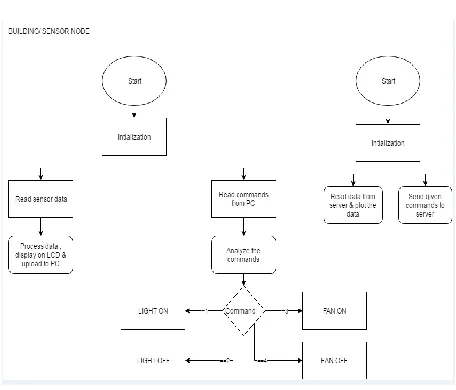
Fig 3 Flow Diagram of building/sensor node
The application software flow chart is helps to explain that how to use this software to monitoring the Home by using IOT. The data from coordinator node is valid then data is plotted by using the software & published. This process is continuously running & data is updated continuously.
6.RESULT AND ANALYSYS 6.1 SENSOR NODE-1
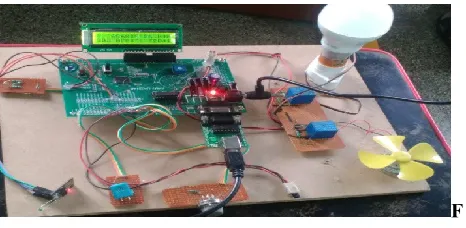
F ig 5 Kit prototype of sensor node-1 working condition 6.2 SENSOR NODE-2
Fig 6 Kit prototype of sensor node-2 giving toggle to the bulb when command=1
Fig 7 Kit prototype of sensor node-2 giving toggle to the bulb when command=3
Fig 8 Kit prototype of sensor node-2 giving toggle to the fan when command=2
Fig 9 Kit prototype of sensor node-2 giving toggle to the bulb when command=4
6.3 Graphical Display using GTalk
Fig10 Real-time Graphical representation of different types of sensing information on the IOT system when log in as local
Fig11 Real-time Graphical representation of different types of sensing information on the IOT system when log in as remote
7 CONCLUSION AND FUTURE SCOPE
energy efficiency purposes. Specifically, we first identified the problem types that are related to people occupancy. We also discussed the past research that solely focused on using sensors and cameras. Finally, we investigated the current efforts where IoT comes into picture with the involvement of smart phones, motion sensors and WiFi APs. The existing approaches indicated a trend towards the use of existing IoTs that are available within the buildings. With the goal of using minimal hardware and software costs, future smart buildings have a great potential to save energy by employing smart control strategies on HVAC through the help of data collected via IOT. We concluded the system by identifying major future trends in this emerging area. Right now we have implemented the idea for Building parameter and occupancy monitoring through IOT. Therefore the system is limited to the parameter and occupancy monitoring. But in future we intend to extend for security, automation.
BIBILOGRAPHY
[1] G. Levermore, Building Energy Management Systems: An Application to Heating, Natural Ventilation, Lighting and Occupant Satisfaction. Taylor & Francis, 2002. [Online]. Available: http://books.google.com/ books?id=hy-tFK4F9YQC
[2] A. De Paola, M. Ortolani, G. Lo Re, G. Anastasi, and S. K. Das, “Intelligent management systems for energy efficiency in buildings: A survey,” ACM Computing Surveys, vol. 47, no. 1, May 2014.
[3] T. A. Nguyen and M. Aiello, “Energy intelligent buildings based on user activity: A survey,” Energy and buildings, vol. 56, pp. 244–257, 2013.
[4] K. Nyarko and C. Wright-Brown, “Cloud based passive building occupancy characterization for attack and disaster response,” in Proc. IEEE Int. Conf.
Technologies for Homeland Security (HST), 2013, pp. 748– 753.
[5] R. Melfi, B. Rosenblum, B. Nordman, and K. Christensen, “Measuring building occupancy using existing network infrastructure,” in Green Computing Conference and Workshops (IGCC), 2011 International, July 2011, pp. 1–8.
[6] V. L. Erickson, M. A. Carreira-Perpi ´ n˜an, and A. E. Cerpa, “Occupancy ´ modeling and prediction for building energy management,” ACM Transactions on Sensor Networks (TOSN), vol. 10, no. 3, p. 42, 2014. [7] K. Chintalapudi, A. Padmanabha Iyer, and V. N. Padmanabhan, “Indoor localization without the pain,” in Proceedings of the Sixteenth Annual International Conference on Mobile Computing and Networking, ser. MobiCom ’10. New York, NY, USA: ACM, 2010, pp.
173–184. [Online]. Available:
http://doi.acm.org/10.1145/1859995.1860016
[8] M. Youssef and A. Agrawala, “The Horus WLAN location determination system,” in Proceedings of the 3rd International Conference on Mobile Systems, Applications, and Services, ser. MobiSys ’05. New York, NY, USA: ACM, 2005, pp. 205–218. [Online]. Available: http://doi.acm.org/10.1145/1067170.1067193
Workshop on Embedded Sensing Systems for Energy-Efficiency in Buildings, ser. BuildSys ’12. New York, NY, USA: ACM, 2012, pp. 205–206. [Online]. Available: http: //doi.acm.org/10.1145/2422531.2422572
[12] D. B. Faria and D. R. Cheriton, “Detecting identity-based attacks in wireless networks using signalprints,” in