© 2014, IJCSMC All Rights Reserved
573
Available Online at www.ijcsmc.comInternational Journal of Computer Science and Mobile Computing
A Monthly Journal of Computer Science and Information Technology
ISSN 2320–088X
IJCSMC, Vol. 3, Issue. 8, August 2014, pg.573 – 580
REVIEW ARTICLE
A Review on Comparative Analysis
of Routing Protocols of MANET
Umara Urooj
1, Nafees Ayub
2, Ramzan Talib
3, Yahya Saeed
41,2,3,4
College of Computer Science & Information Studies Government College University Faisalabad, Pakistan
1
Abstract— Mobile Ad Hoc Networks is an emerging field of networking. This system has some distinct characteristics than existing networking technologies. This system is builds up by the collection of mobile nodes come in contact of each other to work together or serve each other. If a payload is not related to a node it is sent to next node. So a node acts as a router. MANET has its own set of routing protocols. It has different Proactive nature, Reactive nature and Hybrid nature routing protocols. In this paper those journals are selected for review which considered OPNET as simulator and performed comparative analysis on different MANET routing protocols. Here it is checked which type of traffic is considered for routing purpose and which routing protocol performed well, which parameters were considered? So that after reviewing this paper, an idea about MANET routing protocols, their working can be developed.
Keywords— MANET, Proactive Routing Protocol, Reactive Routing Protocol, Hybrid Routing Protocol, OPNET
I. INTRODUCTION
Networking technology is playing a vital role in communication. Wireless systems, due to their convenience are preferred to use. [1]
Mobile Ad-Hoc Networks (MANET) is a branch of wireless networking technology. It has some distinct features, that is why it has its own significance in the communication field and getting popularity with time. It provides easiness as its predecessors did. Reason behind popularity of this new technology is that portable, mobile devices are increasing day by day and the networking technology that can provide facilities for such devices are getting popular. Wireless networking technology and mobile devices manufacturing are evolving side by side. Both are trying to provide efficient products on cheaper rates. That is why it is also becoming a hot topic for consideration. [2]
© 2014, IJCSMC All Rights Reserved
574
nodes. If a node moves from its position it causes disturbance/link failure. In this type of network links builds up continuously.
In MANET as there is no dependency on the central body operating a network, MANET getting more popular. MANET removes dependency mechanism. A node serves both as router and a host providing flexibility to the network. No prediction can be made about movement of node, a link establishment, its failure. Mobile nodes users don’t know which nearby node providing communication mean. When a node comes in contact of other node, it’s become part of communication setup. It sends data that do not relate to it. When a node moves from a network, the links that are established due to this node break and route discovery process initiates.
A. Mobile Networks
Mobile networks fall into two categories. One is structure based network in which each device is performing its own predefined functionalities and other type of mobile networks is infra structure less. In infra structure less networks, there is no predefined topology and movement pattern. WLAN is an example of structure based network while MANET is an example of Infrastructure less network [3].
Fig. 1 Mobile Networks Types
B. MANET Routing Protocols
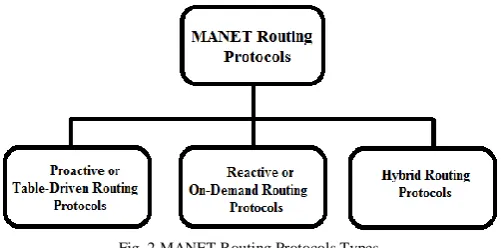
MANET has its own set of routing protocols that performed functionalities for Mobile devices communication. According to nature and way to behave MANET routing protocols falls into three categories i.e. Proactive, Reactive and Hybrid nature routing protocols.
Fig. 2 MANET Routing Protocols Types
1) Proactive Routing Protocols
Proactive routing protocols also called Table Driven routing protocols. As its name show these routing protocols maintains information of nodes in Tables. These tables are periodically updated to check the changes in the network. When a new node comes into the network, routing table add this node and its nearby nodes to the routing table. Each node, routes related to each node is calculated before their need. When a node wants to send data to other node, it simply utilizes already calculated nodes. A periodic updating of routing protocols is needed to keep them up to date. But this updating cause overhead. DSDV, OLSR are examples of these types of routing protocols for MANET. [4]
2) Reactive Routing Protocols
© 2014, IJCSMC All Rights Reserved
575
3) Hybrid Routing Protocols
As its name show, Hybrid routing protocols includes features of both i.e. Proactive routing protocols and Reactive routing protocols. These protocols are smarter as including good characteristics of both routing protocols. These protocols are few in number as passing through from developing and designing stages. GRP, ZRP are examples of this type of routing protocols for MANET. [4]
C. Literature Reviewed
An overview of MANET routing protocols, work done over MANET routing protocols, traffic types considered and Parameters considered for evaluation to be fulfilled is presented in this paper. Aim behind selecting MANET routing protocols is that MANET is an evolving technology of field networking.
In [5] comparative analysis on reactive routing protocol AODV and proactive routing protocol OLSR was performed. OPNET Modeller was used for simulation purpose. Simulation was run for 1800 seconds. Total four scenarios with different conditions were performed. In two scenarios modified parameters were used for evaluation. Modified parameters enhance the performance by reducing End to End Load and Network Load. OLSR performed well as compare to AODV. But reactive nature AODV generated low Network Load and proactive nature OLSR generated more Network Load.
Parameters considered for analysis were
Number of nodes: 72
Area: 5000*5000 m
Network Traffic: IP G.711 voice channel
Data Rate: 120 kbps
Packet Size: 120 B
Simulation Time: 120 seconds
In [6] four MANET routing protocols DSR, AODV, OLSR and GRP were considered for work. Two applications were considered i.e. FTP and E-mail on same condition parameter set for analysis. OPNET 14.0.APL3 was considered as simulator. Uploading and downloading time for FTP and E-mail were considered for analysis. After evaluation they concluded that OLSR performed well while DSR protocols performed poor for considered set of performance parameters. After OLSR, GRP performed well and after GRP, AODV performed well.
Parameters considered for analysis were
No. of Nodes: 30
Area: 5000*5000 m
Simulation Time: 5 hours=5*3600=18000
Traffic Source: CBR
Mobility Model: Random Way Point
Operational Mode: 802.11g
Data Rate: 11 Mbps
Command Mix (Get/Total) for ftp: 50%
Send/Receive Interarrival time (sec) for email: Exponential (3600)
In [7] comparative analysis on AODV reactive routing protocol and OLSR proactive routing protocol was performed. Performance evaluation parameters were set to Throughput, Traffic Received and Delay. Simulator used for simulation was OPNET 14.5. AODV has higher End to End Delay while OLSR has lower values. When number increased from 10 to 100 AODV again has higher End to End Delay. In case of FTP Traffic Received for lower number of nodes OLSR and for higher numbers of nodes AODV performed good. Proactive routing protocol OLSR performed well as compare to AODV.
Parameters considered for analysis were
Area: 1000 * 1000 m
No. of Nodes: 10, 100
Nodes Mobility: 10 m/s
Traffic Type: FTP
Movement Model: Random Way Point Model
Transmit Power (W): 0.005
© 2014, IJCSMC All Rights Reserved
576
In [8] comparative analysis was performed on DSR and TORA two Reactive Routing protocols. OPNET 14.5 was considered for simulation design. Quality of Service parameters included for evaluation were End to End Delay, Throughput and Retransmission of Packets. TORA showed worst behaviour while DSR showed comparatively good results. CBR traffic was used that has effect on End to End Delay. DSR has low Packet Dropped, has high Throughput, good Scalability, low Routing Overhead. On the other hand, TORA has average Packet Dropped, high Throughput values, best Scalability, low Routing Overhead. DSR suits to a network having mobile nodes of moderate speed. TORA is suitable for the network with large number of mobile nodes having high speed values.
Parameters considered for analysis were
No. of Nodes: 50
Area: 1000 * 1000 m
Mobility Model: Random Way Point Model
Simulation Time: 10 sec
Application: FTP
Start Time Offset: Constant
Duration: 10 sec
Random Way Point Speed: 30 m/s
Pause Time: 300 sec
Start Time: 0 sec
In [9] comparative analysis was performed on OLSR and AODV. Throughput, Media Access Delay and Network Load, WLAN standard parameter of IEEE 802.11 were set as performance evaluation metrics. Due to proactive nature of OLSR it has low values for Network Load and Media Access Delay. In this analysis results showed that OLSR outperformed than AODV.
Parameters considered for analysis were
No. of Nodes: 40
600*600 m
Simulation Time: 20*60=1200 seconds
Mobility: 30 m/s
Traffic Type: FTP
Packet Inter Interval Time (sec): Exponential (1)
Packet Size (Bits): Exponential (1024)
IP: IPv4
Mobility Model: Random Waypoint
Seed: 128
Update Interval: 500,000 Events
In [10] OLSR and TORA were considered for comparative analysis. Simulator considered for simulation was OPNET. Parameters considered for Performance matrices include Throughput, Delay, Data Dropped and Retransmission Attempt. OLSR performed better for Retransmission attempt, has low Data Dropped, high Throughput and lower Delay. TORA has large number of Retransmission Attempt, high values for Delay, higher values of Data Dropped and lower Throughput. So overall Proactive Routing protocol OLSR performed better than Reactive routing protocol TORA.
Parameters considered for analysis were
Maximum Simulation Time: 420 seconds
No. of Nodes: 70
Mobility Model: Random Waypoint
MAC Layer Protocol: IEEE 802.11
Node Placement: Uniform
© 2014, IJCSMC All Rights Reserved
577
Throughput, Data Rate and Delay. OLSR outperformed than other three routing protocols i.e. TORA, DSR and AODV. OLSR performed well in case of Mobility however Data Rate was high for TORA.
Parameters considered for analysis were
No. of Nodes: 18
Speed: 10 km/hr
Area: 100*100 m
Simulation time: 5*60=300 seconds
In [12] OLSR, AODV, GRP, TORA and DSR were considered for comparative analysis. VoIP traffic was considered for analysis. Simulation was carried out in OPNET simulator. Performance evaluation parameters included Packet Delay Variation, Jitter, End to End Delay, Voice Quality, Wireless LAN Delay and Throughput. Results showed that TORA is suitable for VoIP network due to its Optimized Routing Algorithm. It performed well with voice codec G.711. OLSR and GRP performed well for large network. DSR gave poor results. Parameters considered for analysis were
Area: 800*800 m & 1600*1600
No. of Nodes: 25 & 85
Mobility Model: Random Way Point with continuous movement
Minimum Speed: 10 m/s
Maximum Speed: 5 m/s
Simulation Time: 600 sec
Communication Model: Selection by Strict Channel Match
Distance Threshold: 300 m
MAC Layer: IEEE 802.11 DCF with transmission rate of 12 Mbps for voice application
Application: Voice
Codec: G.711 and GSM-EFR
Frame Size: 20 ms
Compression & Decompression Delay: 0.02 sec
Type of Service: Interactive Voice
In [13] DSR, OLSR, TORA and AODV were considered for comparative analysis. Parameters included for evaluation were Throughput and Delay. HTTP traffic was used for analysis. Traffic with Heavy and Light Load were set for evaluation. Simulator used for simulation was OPNET 14. OLSR performed well for medium size networks. TORA has longest Delay values but it has high Throughput than AODV and DSR. TORA has higher Delay values than DSR.
Parameters considered for analysis were
No. of Nodes: 30
Area: 1000*1000 m
Server: WLAN randomly distributed
Mobility Model: Random Way Point
Speed: 2 m/s
Pause Time: 100 sec
MAC protocol: 802.11 b
Transmission Range: 150 m
Transmission Rate: 11 Mbps
Packet Size: 1024 Bytes
Heavy Browsing:
Page Rate (Pages/Hour): 60
Page Size (Objects/Size): 10
Average Object Size (Bytes/Object): 12000
Light Browsing:
Page Rate (Pages/Hour): 5
Page Size (Objects/Size): 10
Average Object Size (Bytes/Object): 12000
© 2014, IJCSMC All Rights Reserved
578
GRP showed good results. GRP protocol outperformed than DSR in the cases of Throughput, Delay and Network Load.
Parameters considered for analysis were
Area: 1200*1200 m
Operation Mode: 802.11a & 802.11g
No. of Nodes: 50 & 100
Bit Rate: 54 Mbps
Transmit Power: 0.10 Watt
Simulation Time: 1200 sec
Addressing Mode: IPv4
Speed: 128 sec
Update Interval: 50,000 event
Simulation Kernel: Based on ‘Kernel Type’ preference
Buffer Size: 1024000
Packet reaction power threshold: -95
In [15] OLSR and AODV were considered for comparative analysis. FTP type traffic is considered for evaluation. Simulator used for simulation purpose was OPNET 14.5. Performance evaluation parameters were set to Network Load, Throughput and End to End Delay. Node density considered for evaluation purpose has 25 and 50 numbers of nodes. Simulation time set for simulation was 480 seconds at a rate of 11 Mbps. For OLSR 20 and 50 nodes network was designed, same parameters were set to generate network for AODV protocol. It was concluded selection of an efficient routing protocol has a great impact on the network efficiency.
Parameters considered for analysis were
Trajectory Model: wlan_interference _scenario
Area: 3.5*3.5 km
Simulation Time: 8 min = 480 sec
No. of Nodes: 25 & 50
802.11 Data Rate: 11 Mbps
Traffic type: FTP
In [16] DSR, AODV and OLSR were considered for comparative analysis. HTTP and DB traffic were used for evaluation. Simulator considered for simulation design was OPNET. Performance evaluation parameters included Media Access Delay, Throughput and Delay for a network caring 50 number of nodes. Results showed that for both traffics considered, OLSR performed well. For a network having different data traffic, OLSR has good results for Media Access Delay, Throughput and Delay.
Parameters considered for analysis were
Area:10*10 km
Data Rate: 11 Mbps
No. of Nodes: 50
Buffer Size: 256000
Traffic Type: Database (DB) (Medium Load) & HTTP (Heavy Browsing)
© 2014, IJCSMC All Rights Reserved
579
Parameters considered for analysis were
No. of Nodes: 15, 30
Area: 2.5 * 2.5 Km
Data Rate: 11 Mbps
Application Traffic: VoIP
Simulation Time: 30 * 60 = 1800 sec
Channel Type: Wireless/GSM Voice Channel
Network Interface Type: Phy/Wireless Phy
In [18] TORA, DSR and AODV were considered for comparative analysis. Simulator used for simulation was OPNET. Performance evaluation matrices included Numbers of Hopes per Route, Total Traffic Received, Route Discovery Time, Traffic Load and Throughput. Different node density scenarios were generated varying from 20 to 200 for mobile and stationary nodes. In case of Packet Received when number of nodes increased performance increased exponentially. Results showed that AODV performed well as compare to TORA and DSR. DSR performed well as compare to TORA for large number of nodes. They also put light on Power awareness and security issues.
Parameters considered for analysis were
Area: 500 * 500 m
Mobility Model: Random Way Point Model
Pause Time: 260 sec
D. Summary
In all the considered Journals DSR, AODV, TORA, OLSR, GRP were considered. FTP, E-mail, HTTP, VoIP, Data Base traffic were used for communication among the nodes. Minimum 20 and Maximum 200 nodes were selected. Different parameters were included for evaluation. In some Journals IEEE 802.11 WLAN standard was also considered for evaluation. In all the considered Journals Proactive routing protocol OLSR performed well as compare to Reactive routing protocols.
References
[1] Kumar, R. & Singh, P. (2013). Performance Analysis of AODV, TORA, OLSR and DSDV Routing Protocols using NS2 Simulation. International Journal of Innovative Research in Science, Engineering and Technology, 2(8): 3857-3864
[2] Misra, S., Woungang, I. & Misra, C. S. (2009). Guide to Wireless Ad Hoc Networks. London: Springer.
[3] Bang, O. A. and Ramteke, L.P. (2013). MANET: History, Challenges and Applications. International Journal of Application or Innovation in Engineering & Management (IJAIEM), 2(9): 249-251
[4] Patel, K., Kumar, R. & Daniel, K. (2013). Performance Analysis & Behavioral Study of Proactive & Reactive Routing Protocols in MANET. International Journal of Advanced Research in Computer and Communication Engineering, 2(4): 1789-1796
[5] Hosek, J. (2011). Performance Analysis of MANET Routing Protocols OLSR and AODV. International, 2(3): 22-27
[6] Verma, A. & Gujral, S. (2011). Performance Analysis of Routing Protocols for Ad hoc Networks. International Journal of Computer Science & Emerging Technologies IJCSET, 2(4): 484-487
[7] Walia, K. & Singh, C. (2011). Simulation based Performance Evaluation and Comparison of Proactive and Reactive Routing Protocols in Mobile Ad hoc Networks. (IJCSIT) International Journal of Computer Science and Information Technologies, 2(3): 1235-1239
© 2014, IJCSMC All Rights Reserved
580
[9] Bhardwaj, K., Sharma, S. & Dubey, V. (2012). Comparative Analysis of Reactive and Proactive Protocol of Mobile Ad hoc Network. International Journal on Computer Science and Engineering (IJCSE), 4(7): 1281-1288
[10] Palta, P. & Goyal, S. (2012). Comparison of OLSR and TORA Routing Protocols using OPNET Modeler. International Journal of Engineering Research & Technology (IJERT), 1(5): 1-6
[11] Soomro, W., Memon, A. & Abro, I. (2012). Performance Analysis of Routing Protocols in MANET with Static and Mobile Nodes using HTTP Traffic. International Journal of Electronics and Commutation Engineering (IJECE), 1(2): 23-31
[12] Islam, S. Riaz, A. & Tarique, M. (2012). Performance Analysis of Routing Protocols of Mobile Ad hoc Networks for VoIP Applications. Cyber Journals Multidisciplinary Journals in Science and Technology, Journal of Selected Areas in Telecommunications (JSAT), 26-33
[13] Kadyamatimba, A., Mbougni, Michel., Helberg, A. & Dube, E. (2012). Performance Evaluation of Routing Protocols in Mobile Ad hoc Networks using HTTP Traffic. DOI: 10.7763/IPEDR, 54.14: 69-74
[14] Dhawan, S. & Saroha, V. (2013). Optimize the Routing Protocol (GRP, OLSR, DSR) using OPNET & its Performance Evaluation. International Journal of Advances in Engineering & Technology, 6(3): 1399-1408
[15] Chauhan, K., Pandey, A., Mandeal, D. & Sharma, A. (2013). Performance Analysis of Proactive and Reactive Routing Protocols for QoS in MANET through OLSR & AODV. MIT International journal of Electrical and Instrumentation Engineering, 3(2): 57-61
[16] Kaur, S., Bansal, K. & Bansal, S. (2013). Performance Analysis of AODV, DSR and OLSR Routing Techniques for Ad hoc Mobile Networks. International Journal of Computer Science Engineering and Information Technology Research (IJCSEITR), 3(5): 195-200
[17] Mahajan, S. & Chopra, V. (2013). Performance Evaluation of MANET Routing Protocols with Scalability using QoS Metrics of VoIP Applications. International Journal of Advanced Research in Computer Science and Software Engineering, 3(2): 150-156