Scholarship@Western
Scholarship@Western
Electronic Thesis and Dissertation Repository
8-3-2017 12:00 AM
The Role Of Individual Differences In Bilingual Language
The Role Of Individual Differences In Bilingual Language
Processing
Processing
Emily S. Nichols
The University of Western Ontario
Supervisor Marc Joanisse
The University of Western Ontario Graduate Program in Psychology
A thesis submitted in partial fulfillment of the requirements for the degree in Doctor of Philosophy
© Emily S. Nichols 2017
Follow this and additional works at: https://ir.lib.uwo.ca/etd
Part of the Cognitive Neuroscience Commons
Recommended Citation Recommended Citation
Nichols, Emily S., "The Role Of Individual Differences In Bilingual Language Processing" (2017). Electronic Thesis and Dissertation Repository. 4842.
https://ir.lib.uwo.ca/etd/4842
This Dissertation/Thesis is brought to you for free and open access by Scholarship@Western. It has been accepted for inclusion in Electronic Thesis and Dissertation Repository by an authorized administrator of
i
In this thesis, I investigated the neural correlates of bilingualism, and how individual
differences in both brain and behaviour affect second language processing. To date, theories
of bilingualism have tended to treat bilinguals as a uniform group, while in practice they vary
greatly in both experience and ability. By examining how individual differences in
proficiency and age of acquisition contribute to second language learning and processing, I
sought to address this issue. In chapter two, I used event-related potentials to investigate how
age of acquisition and proficiency modulate processing of a novel versus a grammatical rule
that is similar across languages. I provided evidence that both age of acquisition and
proficiency, in addition to bilingual status, modulate processing of a novel grammatical rule.
In contrast, only proficiency predicted processing of a similar grammatical rule. Thus, while
the similarities between languages affect second language processing, the degree of their
influence is modulated by individual differences in second language experience. In chapter
three, I used functional magnetic resonance imaging to investigate how bilinguals represent
their shared, integrated lexicons in the brain. Several areas showed differing patterns of
representation, while univariate analyses in these areas showed no differences in levels of
activation. The separate representation of first and second languages in these regions
provides a possible basis for the neurocognitive realization of a shared, integrated lexicon
proposed by many theories of bilingualism. In chapter four, I used diffusion tensor imaging
to investigate how AoA modulates white matter microstructure, examining white matter
tracts in the left and right hemispheres that underlie language processing. Group statistics
suggested that second language speakers as a whole may have lower fractional anisotropy,
while the within-group analysis revealed that white matter integrity is sensitive to individual
experience. Chapter five discusses the relevant findings of the previous chapters, and
considers how individual differences arise. Next, I make recommendations for theories of
ii
Keywords
Bilingualism, language, individual differences, event-related potentials, functional magnetic
iii
Co-Authorship Statement
The chapters of this dissertation are manuscripts that have been prepared for submission to
scientific journals. The presented data are based on a series of collaborative research projects;
however all manuscripts have been primarily written by Emily S. Nichols. Chapter 2 has
been written in preparation for publication, authored by Emily S. Nichols and Marc F.
Joanisse. Chapter 3 has been written in preparation for publication, authored by Emily S.
Nichols, Yue Gao, Li Liu, and Marc F. Joanisse. Chapter 4 has also been written in
preparation for publication, authored by Emily S. Nichols, Marc F. Joanisse, Yue Gao, and Li
iv
Acknowledgments
First, I am incredibly grateful to Marc Joanisse. Your supervision and guidance allowed
me to grow as a scientist and an academic, and your mentorship and friendship helped me
to grow as a person. Thank you for taking me on six years ago and for keeping me on four
years ago. I feel incredibly lucky to have had you as a supervisor.
I also must thank all of the academics I have worked with over the years. Thanks to the
Language and Concepts Research Group who provided feedback on my work over the
course of six brown bags. To my advisory committee, Rhodri Cusack and Debra Jared,
thank you - your input was incredibly valuable and resulted in better research. To my
collaborators at Beijing Normal University, Lily Liu and Yue Gao; thank you for the
wonderful opportunity to work with you, and for the hospitality you showed me in
Beijing. And thank you to the Brain and Mind Institute; not only is the science inspiring,
and unrivaled, but the friendliness and warmth of everyone at the BMI has made for an
amazing experience.
To my past and present lab mates: Jeff Malins, Suzanne Welcome, Laura Westmaas,
Diedre DeSouza, Alex Cross, Nicolette Noonan, Veronica Whitford, Christina Vanden
Bosch der Nederlanden, and Joe Nidel, thank you for your academic support and your
invaluable friendship. Having friends like you in the lab made it a pleasure to come into
work every day. To the RAs, honours students, and lab managers I have worked with,
thank you for all the hard work you’ve done – I couldn’t have done it without you.
I would also like to thank my parents, brothers, and sister, as well as the rest of my family,
who have been a constant source of love and support, even if some of you thought I was in
med school this whole time. And finally, thanks to the amazing friends who have been
with me the whole way, both in and out of grad school. I am incredibly lucky to be
v
Table of Contents
Abstract ... i
Co-Authorship Statement... iii
Acknowledgments... iv
Table of Contents ... v
List of Tables ... ix
List of Figures ... x
List of Appendices ... xi
1 Introduction ... 1
1.1 Differences between monolingual and bilingual language processing ... 3
1.1.1 Language acquisition experience ... 3
1.1.2 Conflict between languages ... 4
1.2 Current theories of bilingual language processing ... 4
1.2.1 Bilingual Interactive Activation Plus Model ... 5
1.2.2 Unified Competition Model ... 6
1.2.3 The Revised Hierarchical Model ... 7
1.2.4 Declarative/Procedural Model ... 9
1.2.5 Bilingual Dual-Coding Theory ... 10
1.3 Research questions ... 11
1.3.1 What factors influence learning of novel grammatical rules in bilinguals? ... 12
1.3.2 Which brain areas are involved in bilingual language representation? .... 13
1.3.3 What factors influence connectivity within the bilingual brain? ... 15
1.4 Summary ... 16
vi
2 Individual differences predict ERP signatures of second language learning of novel
grammatical rules ... 25
2.1 Introduction ... 25
2.1.1 Rationale for the Current Study ... 31
2.2 Method ... 32
2.2.1 Subjects ... 32
2.2.2 Materials and Procedures ... 33
2.2.3 EEG Recording and Preprocessing ... 35
2.3 Results ... 37
2.3.1 Behavioural ... 37
2.3.2 Left Anterior Negativity ... 38
2.3.3 P600 ... 43
2.4 Discussion ... 45
2.4.1 Left Anterior Negativity ... 45
2.4.2 P600 ... 48
2.4.3 Theoretical considerations ... 49
2.5 References ... 52
3 Representational dissimilarity of first and second languages in the bilingual brain .... 61
3.1 Introduction ... 61
3.1.1 Rationale for the Present Study... 62
3.2 Methods... 63
3.2.1 Participants ... 63
3.2.2 Behavioural materials ... 63
3.2.3 fMRI Task ... 63
3.2.4 fMRI acquisition and processing ... 64
vii
3.3.1 Behavioural ... 67
3.3.2 Univariate analysis ... 68
3.3.3 Multivariate analysis ... 69
3.4 Discussion ... 72
3.4.1 Conclusion ... 77
3.5 References ... 78
4 Age of second-language acquisition predicts white matter microstructure in bilinguals 84 4.1 Introduction ... 84
4.2 Method ... 88
4.2.1 Subjects ... 88
4.2.2 Behavioural Materials ... 89
4.2.3 DTI Acquisition and Preprocessing ... 89
4.2.4 Analyses ... 90
4.3 Results ... 91
4.3.1 Group Comparison ... 91
4.3.2 Linear Mixed Effects of L2 Speakers ... 92
4.4 Discussion ... 97
4.4.1 Conclusion ... 102
4.5 References ... 104
5 Accounting for individual differences in theories of bilingual language processing . 110 5.1 Relevant Findings ... 110
5.1.1 Individual differences interact with similarities across L1 and L2 ... 110
5.1.2 Languages are represented differently in certain shared cortical areas .. 112
5.1.3 Language experience impacts white matter microstructure of the bilingual brain ... 113
viii
5.3 Recommendations and directions for future research ... 114
5.4 References ... 118
ix
List of Tables
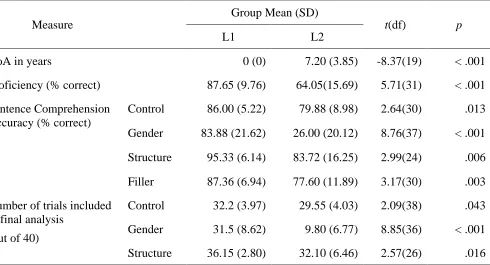
Table 2.1. Group demographic and behavioural measures ... 33
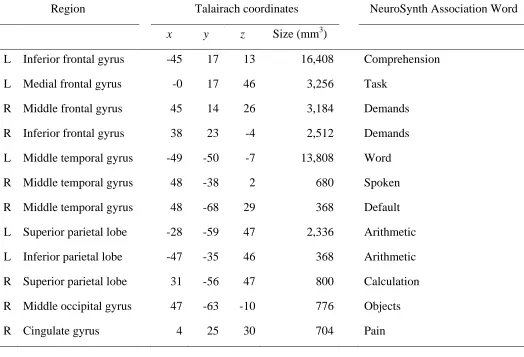
Table 3.1. Clusters of activation included in the “word recognition” meta-analysis, with
associated terms, retrieved from NeuroSynth. ... 67
Table 3.2. Clusters of significant activation in L2-L1 contrast at a voxel-wise alpha of p <
.01, and a corrected p-value of p < .01... 68
Table 3.3. Clusters showing significant on-off diagonal dissimilarity at voxelwise p < .02,
and a 1-sided corrected p-value of p < .01 ... 71
x
List of Figures
Figure 1.1. The Revised Hierarchical Model ... 8
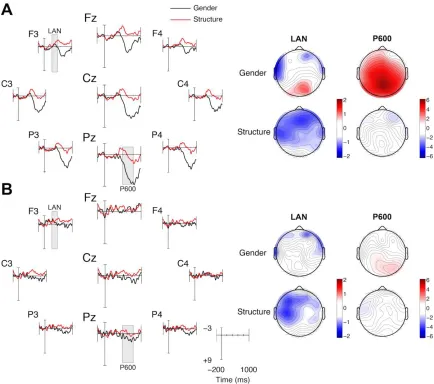
Figure 2.1. Group average ERPs for L1 French speakers and L2 French speakers ... 39
Figure 2.2. ERP differences waves and topographic plots for native and L2 French speakers
... 40
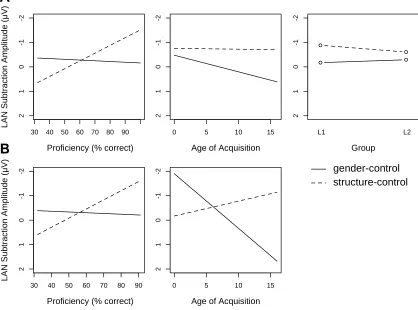
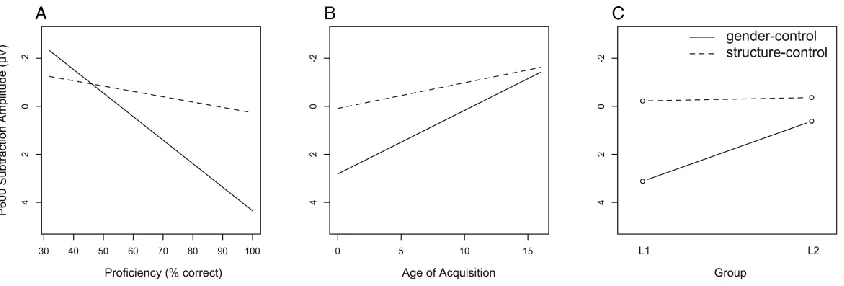
Figure 2.3. Proficiency, age of acquisition, and group interactions with sentence type in the
LAN time window. ... 42
Figure 2.4. Proficiency, age of acquisition, and group interactions with sentence type in the
P600 time window. ... 44
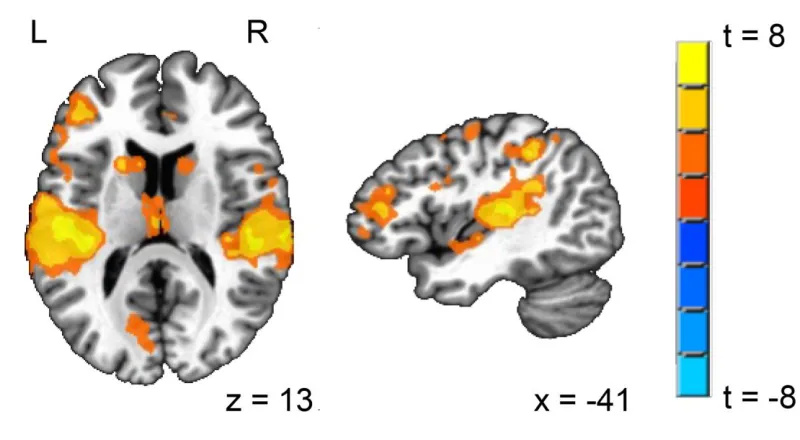
Figure 3.1. Regions showing differences between L1 English and L2 Mandarin ... 69
Figure 3.2. Results of the searchlight analysis superimposed on the “word recognition”
meta-analysis brain mask ... 70
Figure 3.3. Mean correlation of activity patterns between even and odd runs of the Mandarin
and English tasks, at each region of interest ... 70
Figure 4.1. FA in the 16 tracts of interest, extending from superior/anterior to
inferior/posterior for intra-hemispheric tracts, and left to right for corpus callosum tracts. .. 93
Figure 4.2. Differences in FA between monolinguals and bilinguals in intrahemispheric tracts
... 94
Figure 4.3. Differences in FA between monolinguals and bilinguals in the segments of the
corpus callosum ... 95
Figure 4.4. Correlations of AoA and FA in the intrahemispheric tracts of bililnguals ... 96
Figure 4.5. Correlations of AoA and FA in the segments of the corpus callosum of bililnguals
xi
List of Appendices
Appendix A - L2 demographic and behavioural variables ... 122
Appendix B – Language History Questionnaire ... 123
Appendix C – Chapter 2 experimental items ... 127
Appendix D – Chapter 3 experimental items ... 137
Appendix E - Ethical approval for the ERP experiment reported in Chapter 2 ... 139
1
Introduction
The relationship between brain and behaviour in relation to bilingualism is just
beginning to be understood. The majority of neurocognitive models of language
processing have focused on that of a single language (Seidenberg and McClelland, 1989;
McClelland and Patterson, 2002; Pinker and Ullman, 2002; Mcclelland et al., 2014),
despite it being estimated that more than half the world speaks more than one language
(Ansaldo et al., 2008; Grosjean, 2008). Although a number of models of bilingual
language processing have been put forward, we currently lack a single comprehensive
neurocognitive model. Such a model must include core aspects of language processing,
specifically grammar and syntax, semantics, and phonology. In addition, it must include
the domain-general processes required to successfully function in one language or the
other; such cognitive processes include working memory, inhibitory control, and
attention.
Additionally, individual differences in both brain and behaviour greatly affect
second language (L2) processing. Learning an L2 is considerably easier and more
successful when it begins early in life (Johnson and Newport, 1991). Indeed, many
studies have shown both behavioural and brain differences in early vs. late L2 learners
(Wartenburger et al., 2003; Pakulak and Neville, 2011; Newman et al., 2012; Nichols and
Joanisse, 2016). However, there is ambiguity as to the source of these differences. We
might interpret differences in the apparent neural organization of L2 learning as reflecting
age-dependent differences in neuroplasticity, or they could simply reflect general
differences in proficiency to which an L2 has been learned (Wartenburger et al., 2003;
Newman et al., 2012; Nichols and Joanisse, 2016). The difficulty in disentangling the
effects of age of acquisition (AoA) and proficiency on L2 learning lies in the fact that the
two are frequently correlated such that earlier L2 learners generally achieve higher
proficiency in their L2 (Johnson and Newport, 1989; Weber-Fox and Neville, 1996;
Stevens, 1999; Pakulak and Neville, 2011).
Despite the correlation between proficiency and AoA, some late learners do
comparable in language function to native speakers. For example, highly proficient
individuals, regardless of AoA, show an increase in the use of discourse markers and
conjunctions, as well as higher fluency when compared to individuals with low
proficiency (Neary-Sundquist, 2013). Highly proficient late L2 learners have also shown
differences in brain activation from that of low proficiency late learners using
neurophysiological and neuroimaging measures (Perani et al., 1998; Wartenburger et al.,
2003; Gillon Dowens et al., 2011; Nichols and Joanisse, 2016). However, when
controlling for proficiency, late learners still differ from early learners both in measures
of timing (Pakulak and Neville, 2011; Meulman et al., 2015) and level of brain activity
(Wartenburger et al., 2003; Nichols and Joanisse, 2016). Thus, differences in L2
processing could be due to either proficiency or differences in developmental
neuroplasticity.
There is also the issue of how the cutoff for early and late AoA is determined.
Past studies have used a variety of ages to categorize late AoA groups, ranging from 6 to
16 years of age. This means that early learners in some studies would be classified as late
learners in others, and vice versa. There is still much debate about when the critical
period ends, if it exists at all. Indeed, results supporting a critical period are confounded
with other predictive factors, such as amount of L2 education, chronological age, and L2
language exposure (Flege et al., 1999). Instead, there may be no qualitative difference
between early and late AoA, but rather that AoA has a graded effect in addition to, and
independent of, the effect of proficiency (Nichols & Joanisse, 2016). Accordingly,
treating AoA as a continuous variable may allow for a more complete and accurate
description of the effects of AoA on L2 processing.
Thus, although current models have begun to account for cognitive processing
data, there remain a number of factors, including individual differences, which must be
considered in order to form a comprehensive neurocognitive model of L2 processing. The
aim of this chapter is to describe in further detail why current models of L2 processing
are problematic, and to offer suggestions on how to improve current theories of bilingual
language processing, taking into account evidence from the brain. I will provide
language processing; grammar, word recognition, and the brain’s connectivity between
areas involved. Finally, I will consider individual differences and how they might interact
with these processes.
1.1
Differences between monolingual and bilingual
language processing
1.1.1
Language acquisition experience
Monolingual and bilingual language processing can differ in fundamental ways,
due in part to the different conditions under which each was learned. Most people acquire
their first language (L1) with ease, under naturalistic settings and via mostly implicit
learning (Houston, Santelmann, & Jusczyk, 2004; Jusczyk, 1999; Jusczyk, Houston, &
Newsome, 1999; Saffran, Aslin, & Newport, 1996). However, there remain individual
differences in L1 acquisition; children are raised in both language-impoverished and
language-rich households, and monolingual adults do indeed differ in L1 proficiency
levels (Newman et al., 2012). However, first exposure to L1 is largely considered to be
from birth, and barring the presence of language disorders, most adults are relatively
proficient in L1.
In contrast, learning an L2 can be a greater challenge, especially with increasing
AoA (Stevens, 1999; Weber-Fox & Neville, 1996). There is also a wider range of
circumstances in which L2 acquisition occurs. If a child is being raised in a balanced
bilingual household, then both languages may be learned simultaneously. However, often
one language is the dominant language in the household and the child receives
unbalanced exposure. Additionally, the dominant language at home may differ from the
dominant language in society, such as in the case of a Chinese family emigrating to
Canada. Often, as is the case in schools, L2 instruction is explicit and begins at or after
the age of five. In other cases, monolingual adults may decide to learn a new language,
enrolling in a course or using language-instruction software. While none of these
scenarios prevents an individual from becoming fully fluent in two or more languages,
as instruction method and AoA, and ultimate language proficiency. Thus, both intrinsic
and extrinsic individual experiences shape the way L1 and L2 are represented in the
brain, and the independent contributions of each are difficult to disentangle (Newman et
al., 2012; Nichols & Joanisse, 2016; Pakulak & Neville, 2011).
1.1.2
Conflict between languages
There is also the issue of conflict between languages. Bilinguals must contend
with language-nonspecific access and competition between their two languages
(Dijkstra, Grainger, & van Heuven, 1999; Haigh & Jared, 2007; Jared & Kroll, 2001;
Jared & Szucs, 2002), creating a necessarily different language processing experience
from monolinguals. That is, in addition to the difficulties L1 speakers experience such as
resolving different speakers, accents, and coarticulatory cues, L2 speakers must inhibit
the inappropriate language, while effectively communicating in the appropriate one.
Much research has been dedicated to the role of inhibitory control in bilinguals,
suggesting that this is an important mechanism in bilingual language processing (Costa,
Santesteban, & Ivanova, 2006; Green, 1998; Linck, Schwieter, & Sunderman, 2012).
In addition to interference between languages, L1 and L2 differ in some
constructs (e.g., Mandarin has tone, French has gender) but not others (e.g., cognates
between English and French). Thus, L2 speakers need to resolve different aspects of each
language, producing the correct response for the situation. L2 grammatical structure is
more difficult to acquire than semantics (Hahne, 2001; Hahne & Friederici, 2001;
Pakulak & Neville, 2011; Weber-Fox & Neville, 1996), while similarity between
languages can aid in L2 grammar acquisition (Foucart & Frenck-Mestre, 2011;
Hartsuiker et al., 2016). Monitoring and inhibitory control processes are thought to be
involved in resolving conflict between languages, while monolingual language
processing may not need to resolve conflict to the same degree.
1.2
Current theories of bilingual language processing
There are competing models of bilingual language processing that differ in their
languages at once, effects of age of acquisition, and similarities across languages. Despite
the numerous strengths of each model and theory, there remains a distinct lack of
agreement on the mechanisms responsible for bilingual language processing, especially at
the neural level. Especially difficult to account for is how neural representation of a
bilingual’s two languages is shaped by individual differences, due to the relative
heterogeneity within bilinguals. Here, I discuss several models and theories of bilingual
language processing and their relative strengths and weaknesses with regards to how they
account for individual differences.
1.2.1
Bilingual Interactive Activation Plus Model
The Bilingual Interactive Activation Plus (BIA+; Dijkstra & van Heuven, 2002)
model describes bilingual word recognition, and posits that two subsystems exist: a
language processing system, and a task/decision system. The language processing system
consists of orthographic, phonological, and semantic representations that are integrated
across languages, and are present at the sublexical, lexical, and semantic levels. The
different levels of representation are highly interactive; lexical access simultaneously
activates both sublexical and semantic representations. Within the language subsystem
there are also language “nodes”, which are activated by the lexical level, and represent
language membership, or the language to which the lexical input belongs. In contrast, the
task/decision system is non-linguistic in nature. It comprises the necessary processing
steps for completing the task (e.g., word identification) by allocating the required
attention, inhibitory, and working memory resources. It receives input from the language
system, and determines decision criteria and produces a response.
There is both behavioural and neuroimaging evidence to support the BIA+ model.
The effect of cross-language priming has been used to support the assumption of an
integrated lexicon and non-selective lexical access (Ando et al., 2015; Jouravlev, Lupker,
& Jared, 2014; Midgley et al., 2008; Zhou et al., 2010). For example, numerous
behavioural and event-related potential (ERP) studies have shown L1 priming L2 target
words in both the phonological and orthographic modalities (Brysbaert, Van Dyck, &
& Brysbaert, 2002). Jouravlev and colleagues (2014) found L2-L1 cross-language
priming at both the orthographic and phonological level between English and Russian,
further confirming that L1 and L2 representations are integrated across languages. The
BIA+ also accounts for individual differences in proficiency level; in unbalanced
bilinguals, resting activation levels are lower in the non-dominant language (often L2)
leading to slower word recognition. However as bilinguals become balanced in
proficiency, resting activation levels become similar between languages, leading to
symmetrical priming effects across languages. Several neuroimaging studies have also
supported parallel access to an integrated lexicon, by demonstrating overlap of activation
during word processing and simple sentence processing tasks (Briellmann et al., 2004;
Chee, Tan, & Thiel, 1999; Yokoyama et al., 2006) However, the model is limited to
sublexical, lexical, and semantic levels, and has yet to include a grammatical and
syntactic mechanism that would provide a complete model of bilingual language
processing. Additionally, the neural mechanisms underlying the BIA+ remain unclear,
specifically how bilinguals are able to maintain a shared, non-selective lexicon in the
brain.
1.2.2
Unified Competition Model
The Unified Competition Model (UCM; MacWhinney, 2005) is a model of first
and second language acquisition, and the main tenet is that of competition between
activating languages. The model proposes a processing system that selects between
outputs based on their strength of activation. The strength of activation depends on
multiple factors, including transfer between languages, cue strength, and resonance
within the model. Competition takes place in many forms, including auditory, lexical, and
morphosyntactic. This model describes several observations regarding L2 learning, such
as transfer between L1 and L2 (Tolentino & Tokowicz, 2011, 2014) and how processing
load affects sentence processing (Yokoyama et al., 2006).
Support for the UCM comes from behavioural, ERP, and neuroimaging research.
Using eye-tracking, Tuninetti et al. (2015) demonstrated that in a syntactic task, number
language, in line with the UCM’s component of cue strength. Although Tuninetti and
colleagues found no evidence of cross-language transfer as revealed by eye movements, a
number of studies have shown these effects using ERPs. While shared syntactic
structures between L1 and L2 show similar ERP effects, differences arise when
processing crosslinguistically dissimilar syntactic structures (Tolentino & Tokowicz,
2011; Vainio et al., 2014; Yokoyama, 2006). The UCM, therefore, provides a compelling
model of bilingual language learning, supported by neural evidence. However, there is an
ongoing challenge to determine how neural data map onto the tenets of the UCM and
how competition changes with factors such as AoA. For example, while similarities
between L1 and L2 facilitate L2 acquisition, it is unclear how this actually occurs in the
brain, and how that might be affected by level of plasticity or learning environment.
1.2.3
The Revised Hierarchical Model
The Revised Hierarchical Model (RHM; Kroll and Stewart, 1994; Kroll et al.,
2010) is a model of lexical processing that proposes an asymmetric mapping of words to
concepts in bilingual memory. This model has been used to explain differences in
performance between low and high proficiency L2 speakers, suggesting that a greater
mismatch in proficiency between L1 and L2 leads to a greater asymmetry in
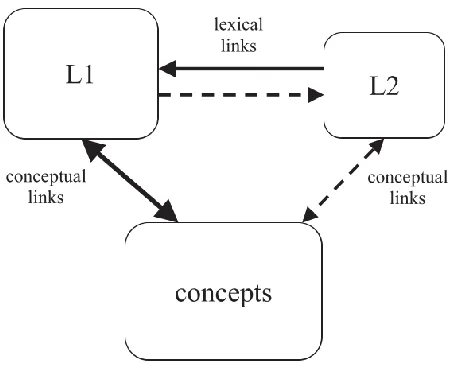
word-concept mappings. Specifically, the RHM proposes a direct link from L2 to L1, as
learned words in L2 have been mapped onto words in L1, but that there is an indirect link
from L1 to L2, by way of the concept (Figure 1.1). Importantly, the RHM proposes
Figure 1.1. The Revised Hierarchical Model (RHM). The RHM proposes that words
in L2 are mapped onto words in L1. L1 is indirectly linked to L2 by way of the
shared concepts (Kroll & Stewart, 1994).
Issues have been raised with regard to the tenets of the RHM (Brysbaert &
Duyck, 2010; Kroll et al., 2010). Research strongly suggests that bilinguals have an
integrated lexicon, with non-selective access (Ando et al., 2015; Brysbaert, Van Dyck, &
Van de Poel, 1999; Haigh & Jared, 2007; Jouravlev, Lupker, & Jared, 2014; Lemhöfer &
Dijkstra, 2004; Midgley et al., 2008; Van Wijnendaele & Brysbaert, 2002; Zhou et al.,
2010). However the main concept that there are asymmetrical connections between
bilingual memory representations has been supported. Poarch and colleagues (2015)
found that in Dutch speakers who were beginning to learn English, reaction times were
shorter to translate words from L2 to L1 than from L1 to L2, suggesting that there are
indeed asymmetric mappings between L1 and L2 and that the route from L1 to L2 is
weaker. Similarly, Declerck et al. (2015) found stronger connections between concepts
and their L1 lemma than between concepts and their L2 lemma. Thus, although the RHM
in its current construction does not take into account an integrated lexicon and language
1.2.4
Declarative/Procedural Model
Unlike the BIA+ and the Unified Competition Model, the Declarative/Procedural
(DP) Model (Ullman, 2001) proposes that L1 and L2 are initially processed by differing
underlying systems. L1 is processed by two underlying memory systems; that of
declarative memory, upon which lexical memory depends, and that of procedural
memory, upon which syntactic processing depends. In contrast, it assumes L2 is initially
processed entirely by the declarative memory system reflecting a process of
memorization. However, with increasing proficiency in L2, syntactic processes shift to
the declarative/procedural system as individuals begin learning rules rather than
memorizing words and phrases. This can be compared to the theory that children learn
grammar initially via memorization, and then begin to generalize (Marcus, 1993).
The DP model builds upon studies that locate declarative memory to temporal
structures (Hodges & Patterson, 1997; Squire, Knowlton & Musen, 1993; Squire & Zola,
1996, Ullman, 1997), while frontal and basal ganglia structures are thought to underlie
procedural memory (Squire et al., 1993, Ullman, 1997). The model is supported by
neuroimaging data showing greater temporo-parietal activity for L2 versus L1 in both
right and left hemispheres of the brain during grammatical tasks but not semantic tasks
(Dehaene et al., 1997; Perani et al., 1998, Wartenburger et al., 2003). Additionally, ERP
effects of syntactic processing are more affected by AoA than semantic processing
(Hahne & Friederici, 2001; Weber-Fox & Neville, 1996). The greater differences
between L1 and L2 processing in syntactic, but not semantic, processing suggest that
while the same underlying structures process semantic information (i.e., the declarative
memory system), L1 and L2 syntactic processing relies on different structures. That is,
while syntactic processing in L1 is procedural, in L2 it relies on declarative memory.
The DP model describes both syntax and semantics, and can account for the effect
of individual differences on bilingual language processing. The cortical regions
underlying the DP model have also been described. However, it is unclear how an L2
speaker makes the transition from declarative to procedural memory when acquiring L2
relies on declarative memory, and cannot account for proficiency and AoA effects in
lexico-semantic processing. Although grammatical processing is more sensitive to L1/L2
differences, individual differences in L2 acquisition and fundamental differences in
L1/L2 processing still modulate lexico-semantic processing (Newman et al., 2012;
Nichols & Joanisse, 2016). Thus, the DP model remains an incomplete model of second
language acquisition and processing.
1.2.5
Bilingual Dual-Coding Theory
The bilingual application of Dual-Coding Theory (DCT; Paivio & Desrochers,
1980), similar to the DP model, proposes separate verbal systems underlying L1 and L2,
but includes a third imagery system to represent nonverbal objects and events which can
be both separate and shared between languages. The two verbal systems interact through
translation equivalents, and the single nonverbal system is connected with both verbal
systems. The independence of verbal and imagery systems is best exemplified in that
there are abstract words that have no nonverbal equivalents, while some experiences are
difficult or impossible to describe verbally.
Both behavioural and neuroimaging data have supported the bilingual DCT.
Culturally biased pictures are named faster in the culturally-relevant language than in the
culturally unrelated language, suggesting that some image representations are more
strongly connected to one language than the other (Jared, Poh, & Paivio, 2013). That is,
when the North American depiction of “dragon” was presented, it was named faster in
English than in Mandarin; similarly, the Chinese depiction of “dragon” was named faster
in Mandarin than in English. Other studies have focused on the implications of DCT on
concrete versus abstract words in a single language. Topographic distributions in ERP
responses to abstract words are more left lateralized than concrete words (Binder et al.,
2005; Kounios & Holcomb, 1994); high imagery words have faster response times and
show different patterns of activation in bilateral occipital regions of the brain (Lee et al.,
2014). Together, these results have been taken to support DCT by suggesting that
imagery is an important part of language processing, and may affect each language
been observed, the actual neural mechanism underlying the relationship between imagery
and language remains to be described, along with the influence of individual differences
on this relationship. The DCT also does not describe sentence-level syntactic processing,
or the observed relationship between L1 and L2 syntactic similarities and dissimilarities.
Thus, there are several strong models of bilingual language processing, sharing
several main ideas. The evidence for a shared, integrated lexicon is overwhelming, and
most models have acknowledged the importance of its inclusion. Several models also
stress the importance of transfer between L1 and L2, based on neural correlates of shared
versus differing constructs. However, while some models attempt to describe the main
aspects of bilingual language processing, such as grammar and semantics (e.g., the
UCM), others focus solely on word processing (e.g., the BIA+ and the RHM). Each
model uses neurophysiological and neuroimaging results to support its predictions,
describing brain structures that may underlie the processes it describes, often referring to
the same work, and mostly agreeing on the brain regions and ERP components involved.
Although several brain regions are agreed to support bilingual language processing, such
as the left inferior frontal and superior temporal gyri, the neural mechanisms that engage
these areas, leading to the observed behaviour of bilingual language comprehension and
production, remain to be described. Finally, bilingual language acquisition is
heterogeneous across learners, thus the described models must also be able to account for
the influence of both endogenous and exogenous factors on each aspect of the model.
1.3
Research questions
My central objective is therefore to better articulate how individual differences in
proficiency and AoA contribute to second language learning and processing, while
understanding the neural mechanisms underlying different linguistic processes. By taking
a largely individual differences approach in describing grammatical processing and word
recognition, I will consider how variation in behaviour relates to variation in neural
While proficiency and AoA are known to affect L2 processing, specific
characterization of their effects on different parts of language is lacking. Both factors are
often investigated in isolation, and discrete groups are created from inherently continuous
variables. Thus, I will discuss three different aspects of L2 language acquisition and
processing which deserve greater understanding. In chapter 2 I will describe the
individual contributions of proficiency and AoA on grammatical processing, using
grammatical structures that are and are not present in the bilinguals’ L1. In chapter 3 I
will describe how L1 and L2 are represented differently within language processing areas
in the bilingual brain. In chapter 4 I will describe how underlying white matter
connectivity changes with proficiency and AoA, drawing connections between previous
findings in bilingual research of differential activity and the possible neuroanatomical
mechanisms responsible.
The goal of my dissertation is to describe current models of bilingual language
processing and to provide suggestions for future models based upon both neural evidence
and individual differences. The first study of my dissertation will use ERPs to examine
French L2 grammatical gender processing in native speakers of English, who do not
posses a grammatical gender system in L1. Study two will discuss a study in which I
examined how the brain represents bilinguals’ two languages within language processing
areas, describing a neural mechanism to support the observation of an integrated lexicon.
Study three will investigate how individual differences affect white matter tracts in the
bilingual’s brain, describing how cortical areas involved in bilingual language processing
may depend upon the connections between them. The general discussion will integrate
each of these studies into a series of results and suggestions for future neurocognitive
models of L2 acquisition and processing.
1.3.1
What factors influence learning of novel grammatical rules in
bilinguals?
In Chapter 2, I investigate how AoA and proficiency affect the learning of novel
grammatical rules in bilinguals. Research suggests that individuals who learn an L2 can
Hartsuiker et al., 2016), but many languages contain aspects of grammar that others do
not. Inflectional morphology varies greatly across languages; not only do different
morphological systems exist in different languages (e.g., pluralization, gender), but
different languages also employ similar morphological systems differently (Aronoff,
1994). The lack of clear mapping from one language to another may be one reason why
inflectional morphology tends to be a particularly difficult part of L2 learning (Pakulak &
Neville, 2011). Thus, a neurocognitive model of L2 processing must be able to account
for these observations. Indeed, models such as the UCM (MacWhinney, 2005) consider
L1-L2 transfer to be central to L2 processing. Additionally, research has demonstrated
effects of proficiency and AoA on how L2 grammar is processed (Pakulak & Neville,
2011; Foucart & Frenck-Mestre, 2011; Gillon Dowens et al, 2011), indicating that
individual differences must also be considered.
In the first study of my dissertation, we used ERPs to examine French L2
grammatical gender processing in native speakers of English, who do not possess a
grammatical gender system in L1. Of interest was whether individual differences in L2
proficiency and AoA influenced these effects. L2 learners and native speakers of French
read French sentences that were grammatically correct, or contained either a grammatical
gender or word order violation, and produced different effects of grammatical gender and
structure violations. The results speak to theories that emphasize L1-L2 grammatical
transfer, while describing how different individual factors contribute to how a novel
grammatical rule is learned.
1.3.2
Which brain areas are involved in bilingual language
representation?
In Chapter 3, I used RSA to investigate whether areas involved in word
recognition distinguish between languages. Proficient bilinguals are typically skilled at
the seemingly complex task of keeping their two languages separate; they are able to
function in one language without much intrusion from the other. Past research has
provided much evidence that L2 relies on similar brain areas involved in processing L1
brain activity for L1 and L2, there remains extensive overlap, such that regions of
dissociation often occur outside the margins of the classical language network (Indefrey,
2006). Within regions that do not differentiate between L1 and L2 using typical
univariate analyses, the general conclusion is that these regions are processing L1 and L2
similarly given similar levels of activity for both languages. However, because univariate
analyses of fMRI data cannot inform us of how information is being represented, this
conclusion may be incorrect. Bilinguals, including those who do not show neural
differences between L1 and L2, are still able to keep separate their two languages,
suggesting that there may be some degree of separation of the two languages in the brain.
For instance, it is generally accepted that bilinguals have a single, integrated lexicon (see
van Heuven & Dijkstra, 2010, for a review), and while neuroimaging provides much
support for an integrated lexicon through activation of similar structures, the separation
of the pattern of activity within the shared L1/L2 brain areas may provide evidence that
bilinguals represent words separately for both languages.
In order to understand how bilinguals maintain an integrated yet separable
lexicon, especially when differences in brain activation are absent, research must
examine how the languages are being represented within the language-processing
network. To address this I used Representational Similarity Analysis (RSA), which
allowed us to determine whether L1 and L2 were distinctly represented at the level of
neural populations. RSA is an fMRI analysis technique relying on reproducible spatial
patterns of activity that correlate with distinct experimental conditions (Kriegeskorte et
al., 2008). RSA has been used to reveal differences between conditions within individual
brain regions that were previously undetectable using standard univariate methods; it
reveals cortical patterns sensitive to stimulus patterns even when there is no apparent
difference in degree of activation. The results describe how the brain supports an
integrated lexicon, a recurring theme in models of bilingualism, linking previous
observations of cross-linguistic priming to actual representation of the integrated lexicon
1.3.3
What factors influence connectivity within the bilingual brain?
It has been proposed that L2 learning requires increased neural resources due to
maturational changes in neural plasticity within pathways supporting L1 learning
(Mohades et al., 2012; Nichols & Joanisse, 2016). This is usually measured by comparing
the size and extent of brain region activation for either language, however this may tell
only part of the story. For instance, more activation could be due to compensatory
resources needed when processing a more difficult language. Connectivity may provide a
better way to understand neural efficiency in L2 language processing. Concordant with
this view, studies have found that age-of-acquisition (AoA) modulates structural
connectivity, as measured using diffusion tensor imaging (DTI). A common measure of
white matter microstructure is fractional anisotropy (FA), which ranges from zero to one
and is interpreted as indexing the cohesiveness of white matter tracts. High FA suggests
that water diffusion is restricted to a single direction, which corresponds to greater
myelination of the white matter tract (Pierpaoli & Basser, 1996), promoting faster neural
transmission, and highly organized directionality or coherence of white matter (Mädler et
al., 2008). Low FA suggests that water diffusion is unrestricted and that the tract is less
myelinated and coherent, leading to less efficient signal transmission. FA varies with
AoA such that children who learned two languages from birth (simultaneous bilinguals)
show higher white matter integrity in the left inferior fronto-occipital fasciculus (IFOF),
the tract connecting anterior frontal regions with posterior temporal regions when
compared to children who learned their two languages sequentially (Mohades et al.,
2012). However, lower integrity was also found in the tracts projecting from the anterior
portion of the corpus callosum to orbitofrontal cortex compared to late L2 learners.
Similarly, in a study by Nichols and Joanisse (2016), increasing AoA was correlated with
higher white matter integrity, however the specific tracts that showed this positive
relationship between AoA and FA conflict with the tracts in Mohades et al. (2012). These
results highlight how differences in brain connectivity may be related to L2 AoA,
however the relationship of AoA and specific white matter tracts is unclear. In fact at
least one proposal maintains that there are separate L1 and L2 networks that are
differing influence of AoA on separate tracts may reflect their relative importance in L1
vs. L2 processing.
Chapter 4 therefore investigates the differences in monolingual and bilingual
white matter integrity, and the relationship between individual differences in AoA and
white matter microstructure. We acquired measures of AoA from 22 monolingual English
speakers and 20 English-Mandarin L2 speakers, along with their DTI scans. We first
contrasted FA between groups in four bilateral tracts known to underlie bilingual
language processing: the arcuate fasciculus, the inferior fronto-occipital fasciculus, the
superior longitudinal fasciculus, and the inferior longitudinal fasciculus. Next, we
examined how AoA in the L2 group related to white matter integrity in the tracts that
showed differences between groups. Results speak to theories such as the DP model,
which suggest that the underlying subsystems in the bilingual brain change to become
similar to L1 as a factor of individual differences.
1.4
Summary
A neurocognitive model of bilingual language processing must take into account
different areas of language processing such as grammar, semantics, and phonology. It
also must take into account how the brain functionally and structurally supports each of
these factors, and how the function and structure of the brain changes and is changed by
the bilingual experience. Future research should focus on understanding this complex
relationship between brain and behaviour.
The aim of the present review was to identify issues with the current state of theories
and models of L2 processing. Although there are a number of current models that have
been developed, we still do not have a comprehensive neurocognitive model that takes
into account individual differences. As outlined, individual differences must be included
in any model of L2 processing. Although many factors are tightly intertwined, such as
AoA and proficiency, there are separable effects of each that must be considered. There is
1.5
References
Ando E, Matsuki K, Sheridan H, Jared D (2015) The locus of Katakana–English masked
phonological priming effects. Biling Lang Cogn 18:101–117.
Ansaldo AI, Marcotte K, Scherer L, Raboyeau G (2008) Language therapy and bilingual
aphasia: Clinical implications of psycholinguistic and neuroimaging research. J
Neurolinguistics 21:539–557.
Aronoff, M. (1994). Morphology by Itself: Stems and Inflectional Classes. The MIT
Press, Cambridge, MA.
Binder JR, Westbury CF, McKiernan KA, Possing ET, Medler DA (2005) Distinct brain
systems for processing concrete and abstract concepts. J Cogn Neurosci 17:905–917.
Briellmann RS, Saling MM, Connell AB, Waites AB, Abbott DF, Jackson GD (2004) A
high-field functional MRI study of quadri-lingual subjects. Brain Lang 89:531–542.
Brysbaert M, Duyck W (2010) Is it time to leave behind the Revised Hierarchical Model
of bilingual language processing after fifteen years of service? Biling Lang Cogn
13:359–371.
Brysbaert M, Van Dyck G, Van de Poel M (1999) Visual word recognition in bilinguals:
evidence from masked phonological priming. J Exp Psychol Hum Percept Perform
25:137–148.
Chee MWL, Tan EWL, Thiel T (1999) Mandarin and English single word processing
studied with functional magnetic resonance imaging. J Neurosci 19:3050–3056.
Costa A, Santesteban M, Ivanova I (2006) How do highly proficient bilinguals control
their lexicalization process? Inhibitory and language-specific selection mechanisms
Declerck M, Koch I, Philipp AM (2015) The Minimum Requirements of Language
Control: Evidence From Sequential Predictability Effects in Language Switching. J
Exp Psychol Learn Mem Cogn 41:377–394.
Dehaene S, Dupoux E, Mehler J, Cohen L, Paulesu E, Perani D, van de Moortele PF,
Lehéricy S, Le Bihan D (1997) Anatomical variability in the cortical representation
of first and second language. Neuroreport 8:3809–3815.
Dijkstra T, Grainger J, van Heuven WJB (1999) Recognition of Cognates and
Interlingual Homographs: The Neglected Role of Phonology. J Mem Lang 41:496–
518.
Dijkstra T, van Heuven WJB (2002) The architecture of the bilingual word recognition
system: From identification to decision. Biling Lang Cogn 5:175–197.
Flege JE, Yeni-Komshian GH, Liu S (1999) Age Constraints on Second-Language
Acquisition. J Mem Lang 41:78–104.
Foucart A, Frenck-Mestre C (2011) Grammatical gender processing in L2:
Electrophysiological evidence of the effect of L1–L2 syntactic similarity. Biling
Lang Cogn 14:379–399.
Gillon Dowens M, Guo T, Guo J, Barber H a., Carreiras M (2011) Gender and number
processing in Chinese learners of Spanish - evidence from Event Related Potentials.
Neuropsychologia 49:1651–1659.
Green DW (1998) Mental control of the bilingual lexico-semantic system. Biling Lang
Cogn 1:67–81.
Grosjean, F. (2008). Studying Bilinguals. Oxford University Press, New York, NY.
Hahne A (2001) What’s Different in Second-Language Processing? Evidence from
Hahne A, Friederici AD (2001) Processing a second language: Late learners’
comprehension mechanisms as revealed by event-related brain potentials. Biling
Lang Cogn 4:123–141.
Haigh C a, Jared D (2007) The activation of phonological representations by bilinguals
while reading silently: evidence from interlingual homophones. J Exp Psychol Learn
Mem Cogn 33:623–644.
Hartsuiker RJ, Beerts S, Loncke M, Desmet T, Bernolet S (2016) Cross-linguistic
structural priming in multilinguals : Further evidence for shared syntax. J Mem Lang
90:14–30.
Hodges JR, Patterson K (1997) Semantic memory disorders. Trends Cogn Sci 1:68–72.
Houston D, Santelmann L, Jusczyk P (2004) English-learning infants’ segmentation of
trisyllabic words from fluent speech. Lang Cogn Process 19:97–136.
Indefrey P (2006) A Meta-analysis of Hemodynamic Studies on First and Second
Language Processing: Which Suggested Differences Can We Trust and What Do
They Mean? Lang Learn 56:279–304.
Jared D, Kroll JF (2001) Do Bilinguals Activate Phonological Representations in One or
Both of Their Languages When Naming Words? J Mem Lang 44:2–31.
Jared D, Poh RPY, Paivio A (2013) L1 and L2 picture naming in Mandarin–English
bilinguals: A test of Bilingual Dual Coding Theory. Biling Lang Cogn 16:383–396.
Jared D, Szucs C (2002) Phonological activation in bilinguals: Evidence from interlingual
homograph naming. Biling Lang Cogn 5:225–239.
Johnson JS, Newport EL (1991) Critical period effects on universal properties of
language: The status of subjacency in the acquisition of a second language.
Jouravlev O, Lupker SJ, Jared D (2014) Cross-language phonological activation:
Evidence from masked onset priming and ERPs. Brain Lang 134:11–22.
Jusczyk PW, Houston DM, Newsome M (1999) The beginnings of word segmentation in
english-learning infants. Cogn Psychol 39:159–207.
Jusczyk PW (1999) How infants beging to extact words from speech. Trends Cogn Sci
3:323–328.
Kounios J, Holcomb PJ (1994) Concreteness effects in semantic processing: ERP
evidence supporting dual-coding theory. J Exp Psychol Learn Mem Cogn 20:804–
823.
Kroll JF, Stewart E (1994) Category Interference in Translation and Picture Naming:
Evidence for Asymmetric Connections Between Bilingual Memory Representations.
J Mem Lang 33:149–174.
Kroll JF, Van Hell JG, Tokowicz N, Green DW (2010) The Revised Hierarchical Model:
A critical review and assessment. Biling (Camb Engl) 13:373–381.
Lee JS, Choi J, Yoo JH, Kim M, Lee S, Kim JW, Jeong B (2014) The effect of word
imagery on priming effect under a preconscious condition: An fMRI study. Hum
Brain Mapp 35:4795–4804.
Lemhöfer K, Dijkstra T (2004) Recognizing cognates and interlingual homographs:
effects of code similarity in language-specific and generalized lexical decision. Mem
Cognit 32:533–550.
Linck JA, Schwieter JW, Sunderman G (2012) Inhibitory control predicts language
switching performance in trilingual speech production. Biling Lang Cogn 15:651–
662.
Mcclelland JL, Mirman D, Bolger DJ, Khaitan P (2014) Interactive activation and mutual
constraint satisfaction in perception and cognition. Cogn Sci 38:1139–1189.
McClelland JL, Patterson K (2002) Rules or connections in past-tense inflections: What
does the evidence rule out? Trends Cogn Sci 6:465–472.
Meulman N, Wieling M, Sprenger SA, Stowe LA, Schmid MS (2015) Age effects in L2
grammar processing as revealed by ERPs and how (not) to study them. PLoS
One:1–31.
Midgley KJ, Holcomb PJ, van Heuven WJB, Grainger J (2008) An electrophysiological
investigation of cross-language effects of orthographic neighborhood. Brain Res
1246:123–135.
Mohades SG, Struys E, Van Schuerbeek P, Mondt K, Van De Craen P, Luypaert R
(2012) DTI reveals structural differences in white matter tracts between bilingual
and monolingual children. Brain Res 1435:72–80.
Neary-Sundquist CA (2013) The development of cohesion in a learner corpus. Stud
Second Lang Learn Teach 3:109–130.
Newman AJ, Tremblay A, Nichols ES, Neville HJ, Ullman MT (2012) The Influence of
Language Proficiency on Lexical Semantic Processing in Native and Late Learners
of English. J Cogn Neurosci 24:1205–1223.
Nichols ES, Joanisse MF (2016) Functional activity and white matter microstructure
reveal the independent effects of age of acquisition and proficiency on
second-language learning. Neuroimage 143:15–25.
Paivio A, Desrochers A (1980) A dual-coding approach to bilingual memory. Can J
Psychol Can Psychol 34:388–399.
Pakulak E, Neville HJ (2011) Maturational constraints on the recruitment of early
Perani D, Abutalebi J, Paulesu E, Brambati S, Scifo P, Cappa SF, Fazio F (2003) The role
of age of acquisition and language usage in early, high-proficient bilinguals: an
fMRI study during verbal fluency. Hum Brain Mapp 19:170–182.
Perani D, Paulesu E, Galles NS, Dupoux E, Dehaene S, Bettinardi V, Cappa SF, Fazio F,
Mehler J (1998) The bilingual brain proficiency and age of acquisition of the second
language. Brain 121:1841–1852.
Pinker S, Ullman MT (2002) The Past-Tense Debate: the past and future of the past
tense. Trends Cogn Sci 6:456–463.
Poarch GJ, Van Hell JG, Kroll JF (2014) Accessing word meaning in beginning second
language learners: Lexical or conceptual mediation? Biling Lang Cogn 18:1–15.
Saffran JR, Aslin RN, Newport EL (1996) Statistical Learning by 8-Month-Old Infants.
Science (80- ) 274:1926–1928.
Seidenberg MS, McClelland JL (1989) A distributed, developmental model of word
recognition and naming. Psychol Rev 96:523–568.
Squire LR, Knowlton B, Musen G (1993) The structure and organization of memory.
Annu Rev Psychol 44:453–495.
Squire LR, Zola SM (1996) Structure and Function of Declarative and Nondeclarative
Memory Systems. Proc Natl Acad Sci U S A 93:13515–13522.
Stevens G (1999) Age at immigration and second language proficiency among
foreign-born adults. Lang Soc 28:555–578.
Tolentino LC, Tokowicz N (2011) Across language, space, and time: A Review of the
Role of Cross-Language. Stud Second Lang Acquis 33:91–125.
Tolentino LC, Tokowicz N (2014) Cross-Language Similarity Modulates Effectiveness
Tuninetti A, Warren T, Tokowicz N (2015) Cue strength in second-language processing:
An eye-tracking study. Q J Exp Psychol 68:568–584.
Ullman MT (2001) The neural basis of lexicon and grammar in first and second
language: the declarative/procedural model. Biling Lang Cogn 4:105–122.
Vainio S, Pajunen A, Hyönä J (2014) L1 and L2 word recognition in Finnish: Examining
L1 Effects on L2 Processing of Morphological Complexity and
Morphophonological Transparency. Stud Second Lang Acquis 36:133–162.
van Heuven WJB, Dijkstra T (2010) Language comprehension in the bilingual brain:
fMRI and ERP support for psycholinguistic models. Brain Res Rev 64:104–122.
Van Wijnendaele I, Brysbaert M (2002) Visual word recognition in bilinguals:
phonological priming from the second to the first language. J Exp Psychol Hum
Percept Perform 28:616–627.
Wang Y, Xiang J, Vannest J, Holroyd T, Narmoneva D, Horn P, Liu Y, Rose D,
deGrauw T, Holland S (2011) Neuromagnetic measures of word processing in
bilinguals and monolinguals. Clin Neurophysiol 122:1706–1717.
Wartenburger I, Heekeren HR, Abutalebi J, Cappa SF, Villringer A, Perani D, Olgettina
V (2003) Early Setting of Grammatical Processing in the Bilingual Brain. Neuron
37:159–170.
Weber-Fox CM, Neville HJ (1996) Maturational constraints on functional specializations
for language processing: ERP and behavioral evidence in bilingual speakers. J Cogn
Neurosci 8:231–256.
Yokoyama S, Okamoto H, Miyamoto T, Yoshimoto K, Kim J, Iwata K, Jeong H, Uchida
S, Ikuta N, Sassa Y, Nakamura W, Horie K, Sato S, Kawashima R (2006) Cortical
activation in the processing of passive sentences in L1 and L2 : An fMRI study.
Zhou H, Chen B, Yang M, Dunlap S (2010) Language nonselective access to
phonological representations : Evidence from Chinese – English bilinguals. Q J Exp
2
Individual differences predict ERP signatures of second
language learning of novel grammatical rules
2.1
Introduction
Learning a second language is considerably easier and more successful when it
begins early in life (Johnson & Newport, 1991). Indeed, many studies have shown both
behavioural and neural differences in early vs. late L2 learners (Newman, Tremblay,
Nichols, Neville & Ullman, 2012; Pakulak & Neville, 2011; Wartenburger, Heekeren,
Abutalebi, Cappa, Villringer & Perani, 2003). However, there is ambiguity as to the
source of these differences. We might interpret differences in the apparent neural
organization of second-language learning as reflecting age-dependent effects of
neuroplasticity, or they could simply reflect the general proficiency with which a second
language has been learned (Newman et al., 2012; Wartenburger et al., 2003). The
difficulty in disentangling the influences of age of acquisition (AoA) and proficiency on
L2 learning is the fact that the two tend to correlate to some extent such that earlier L2
learners generally achieve higher proficiency in their second language (Johnson &
Newport, 1989; Pakulak & Neville, 2011; Stevens, 1999; Weber-Fox & Neville, 1996).
Bilingualism research has explored many areas of second language acquisition
and speaking, in both similar and dissimilar languages, however one area that is lacking a
large body of literature is that of grammatical gender. There is research suggesting that
individuals who learn a second language can often use knowledge of their first language
to aid them in their second (Foucart & Frenck-Mestre, 2011; Hartsuiker, Beerts, Loncke,
Desmet & Bernolet, 2016), but many languages contain aspects of grammar that others
do not. Inflectional morphology varies greatly across languages; not only do different
morphological systems exist in different languages (e.g., pluralization, gender), but
different languages also employ similar morphological systems differently (Aronoff,
1994). The lack of clear mapping from one language to another may be one reason why
inflectional morphology tends to be a particularly difficult part of L2 learning (Pakulak &
Grammatical gender systems, which classify nouns as masculine, feminine, or
sometimes neuter, are present in many of the world’s languages. In those languages that
contain gender systems, there is sometimes overlap in article-noun gender agreement
between languages, which can facilitate learning of noun genders; for instance the word
table is feminine in both French and Spanish (i.e., la table/la mesa; Foucart &
Frenck-Mestre, 2011, Paolieri, Cubelli, Macizo, Bajo, Lotto & Job, 2010). However, the situation
may be different for a native speaker of a language that does not have grammatical
gender. Current data suggest that L2 speakers with a grammatical gender in L1 show
higher accuracy in both gender assignment and pronoun-noun gender agreement in L2
compared to L2 speakers without grammatical gender in L1 (Sabourin, Stowe, & de
Haan, 2006).
The present study examines the joint contribution of proficiency and AoA to
learning grammatical gender in L2. Proficiency is defined as the competence and facility
in a second language. It is admittedly correlated with AoA (Stevens, 1999); however,
some late learners do achieve high proficiency, and may appear comparable in fluency to
early learners and native speakers. For example, highly proficient individuals, regardless
of AoA, show an increase in use of discourse markers and conjunctions, and higher
fluency when compared to individuals with low proficiency (Neary-Sundquist, 2013).
Highly proficient late L2 learners have also shown differences in language-related brain
activity from that of low proficiency late learners (Caffarra, Molinaro, Davidson, &
Carreiras, 2015; Gillon Dowens, Guo, Guo, Barber, & Carreiras, 2011; Kotz, 2009;
Perani, Paulesu, Sebastian Galles, Dupoux, Dehaene, Bettinardi, Cappa, Fazio, & Mehler,
1998; Stowe & Sabourin, 2005; Wartenburger et al., 2003). In addition, when controlling
for proficiency, late learners still differ from early learners both in measures of timing
(Meulman, Wieling, Sprenger, Stowe & Schmid, 2015; Pakulak & Neville, 2011; Rossi,
Kroll, & Dussias, 2014) and level of brain activity (Wartenburger et al., 2003). Thus,
differences in L2 processing could be due to either behavioural proficiency or true
differences in neuroplasticity.
In addition to the effects of proficiency and AoA, some prior work also suggests
speakers.Lemhöfer, Spalek, and Schriefers (2008) investigated whether German-Dutch
bilinguals performed differently on tasks where the gender of a noun was the same in
both languages, compared to when the gender differed. In both a lexical decision task and
a picture-naming task, reaction times were faster for gender-congruent trials than for
gender-incongruent trials. The authors attributed this to an interaction between
grammatical gender systems in the two languages, with facilitation occurring when the
genders are congruent. These results have been supported by numerous studies in several
different languages (Foucart & Frenck-Mestre, 2011; Paolieri, 2010; Salamoura &
Williams, 2007), suggesting that the effect is quite robust among languages containing
grammatical gender systems, although conflicting results have also been found (Costa,
Kovacic, Franck & Caramazza, 2003).
The majority of the behavioural research surrounding grammatical gender in L2
speakers has focused on adult learning of a gender system. In an experiment by Alarcón
(2011), behavioural measures of written comprehension and oral production were used to
investigate whether English adult L2 learners of Spanish can acquire gender in their
grammar. Results of these measures indicated that at high proficiencies, late
(post-puberty) L2 learners showed no difficulty with grammatical gender, similar to native
speakers. Similarly, Keating (2009) found that adult learners of Spanish produce higher
rates of gender agreement errors with increasing distance between the adjective and noun.
However, other studies have shown conflicting evidence, with adult learners experiencing
difficulty in acquiring grammatical gender (Arnon & Ramscar, 2012; Montrul, Foote, &
Perpiñán, 2008).
The many observed interactions between first and second languages in L2
speakers raise the question of how grammatical gender is learned in individuals whose L1
does not contain a grammatical gender system. Indeed, many of the world’s most-spoken
languages (e.g., English, Mandarin, Cantonese) do not possess a gender system, and
studies examining L2 grammatical gender learners who do not possess a grammatical
gender in their L1 have focused on late learners (Foucart & Frenck-Mestre, 2012; Gillon
Dowens et al., 2011). The lack of research focusing on early learners leaves open the
ERP provides an ideal mechanism for studying grammatical relationships in first-
and second-language processing (Caffarra & Barber, 2015; Foucart & Frenck-Mestre,
2012; Meulman et al., 2015; Morgan-Short, Sanz, Steinhauer & Ullman, 2010; Newman
et al., 2012; Osterhout & Holcomb, 1992; Pakulak & Neville, 2011; Rossi et al., 2014;
Silva-Pereyra, Gutierrez-Sigut, & Carreiras, 2012; Tanner et al., 2013). ERPs represent
electroencephalography (EEG) signals that are time-locked to sensory or cognitive
events. The high temporal resolution of ERPs allows the researcher to observe neural
processing of language as it unfolds over time. This is in turn allows us to pinpoint
changes in neural processes corresponding to a particular manipulation and isolate the
moment at which they occur, typically well before the moment individuals can make an
overt judgment of the stimulus or execute a behavioural response. In particular,
grammatical violation tasks involve showing subjects sentences which are either
grammatically congruent or contain a grammatical violation. For example, the sentence
“He took the whistling teapot off the of stove” contains a grammatical violation of phrase
structure that evokes predictable modulations in ERPs time locked to the onset of the
violation. There are several possible grammatical violations, including phrase structure,
number, tense, and, most relevant to the present study, grammatical gender. Manipulating
the type of violation allows us to isolate processing of specific aspects of grammatical
processing.
One ERP component that is sensitive to grammatical violations is the Left
Anterior Negativity (LAN), a negative-going component with a left-anterior distribution
(Molinaro, Vespignani, & Job, 2008; Neville, Nicol, Barss, Forster & Garrett, 1991;
Pakulak & Neville, 2011). The LAN is thought to reflect early syntactic integration or
first-pass grammatical processing (Friederici, Pfeifer & Hahne, 1993; Rösler, Pütz,
Friederici & Hahne, 1993). Although the time-course is similar to the N400, the LAN
possesses a different topography and is evoked in response to syntactic rather than
semantic errors (however see Tanner, 2014 for a discussion). The LAN is often followed
by a P600, a positive going component with a centro-parietal distribution that occurs
approximately 600 ms post-stimulus onset. It is thought to reflect second-pass
grammatical processing (Hahn & Friederici, 1999) or syntactic reanalysis (Kaan, Harris,