Available Online atwww.ijcsmc.com
International Journal of Computer Science and Mobile Computing
A Monthly Journal of Computer Science and Information Technology
ISSN 2320–088X
IJCSMC, Vol. 3, Issue. 12, December 2014, pg.514 – 520
RESEARCH ARTICLE
IMAGE ENHANCEMENT USING DWT
Neeraj Varma
CSE/IT, People‟s College of Research and Technology People‟s University, Bhopal, India
Asst. Prof. Shital Gupta Dr. Anshuman Sharma
(Guide) HOD (CSE/IT)
ABSTRACT: The aim of image enhancement is to improve the interpretability or perception of information in images for human viewers, or to provide `better' input for other automated image processing techniques. Image Enhancement process is use to enhances the original image into the good image according to quality. The aim is to enhance the features of original image for the better output. In this paper, we propose image enhancement technique such as DWT (Discrete Wavelet Transform) and image segmentation is a popular approach and has been widely used in many display related fields, such as consumer electronics, medical analysis, and so on. we use 3- Level of DWT to filter the original image with low pass and high pass filters to remove the unwanted information and fuzzy c-mean clustering segmentation technique partitioning a digital image into multiple segments i.e. set of pixels, pixels in a region locate n are similar according to some homogeneity criteria such as color, texture, or intensity to identify and locate boundaries and an object in an image. The quality of segmentation results of different images are evaluated using PSNR and MSE values.
Keywords: 3-Level DWT, Clustering, Fuzzy C-Means, Image Enhancement, Image Segmentation, MSE, PSNR, Wavelet Transform
1. Introduction
Images are considered as one of the most important medium of conveying information, in the field of computer vision, by understanding images the information extracted from them can be used for other tasks for example: navigation of color, extracting information from body by x-rays, detection of dead cells, and identification of an object from brain. Now there is a useful method, with the help of that, we can understand images and extract information or objects, image Enhancement fulfill above requirements.
enhance the visual appearance and remove the noise from images to increase the quality. One of the most important stages in medical images detection and analysis is Image Enhancement techniques which improves the quality of images and removes noise, increasing contrast, and revealing details are examples of enhancement operations. The image enhancement technique can be classified into two categories such as spatial domain and frequency domain [1].
This works represents a new and efficient scheme for estimation and removal of single image. Estimating the noise level from a single image seems like an impossible task: we need to recognize whether local image variations are due to color, texture, or lighting variations from the image itself, or due to the noise. Digital image enhancement techniques provide a multitude of choices for improving the visual quality of images.
There is no general theory for determining what `good‟ image enhancement is when it comes to human perception. If it looks good, it is good! However, when image enhancement techniques are used as pre-processing tools for other image pre-processing techniques, then quantitative measures can determine which techniques are most appropriate. For image segmentation, we use frequency domain methods such as 3-level discrete wavelet transform method for better enhancement of image. The medical image has been enhanced to apply the 3 Level Discrete Wavelet Transform. The obtained result using discrete wavelet transform technique is compared with their previous level (first and second level). The quality of images is evaluated with performance using MSE and PSNR values of images obtained from Discrete Wavelet Transform filter using fuzzy c-mean segmentation algorithm
.
2. Discrete Wavelet Transform
We present an overview of image enhancement processing techniques in Frequency based domain image enhancement. Frequency based domain image enhancement is a term used to describe the analysis of mathematical functions or signals with respect to frequency and operate directly on the transform coefficients of the image, such as discrete wavelet transform.
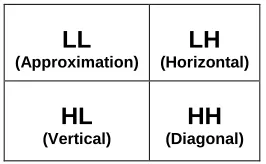
The Discrete Wavelet Transform is used the low pass and high pass filter to find the desire information. The most important information in the signal appears in high amplitudes and the least important information in the signal appears in very low amplitudes. Appropriate high pass and low pass filters are applied to the data at each level and also there is down sampling done at each level. The discrete wavelet transformation is used to analyze the two dimensions image where it has the ability to divide the image into four main areas. The filtered data depends on the level of dwt. low-low (LL1) sub band is called the approximation data area and others sub bands are called the detail information. The present sub bands are as follow: high-low (HL1), low high (LH1) and the high-high (HH1). In brief, they are indicated (DWT) as shown in Fig.1 [1].
The wavelet analysis is permitted in using the long periods of time where the ambition is to get more accurate information from low frequency, and high frequency from the shorter zones. The important data reside in the low frequency because it gives you the opportunity to get a signal of an identity. it can be observed by the wavelet analysis for Rose‟s image (see Fig.2). The following figure, displays the first level of the DWT. The tactical followed by the separation of the different characteristics of the signal relies on the method of gathering the energy of a few elements. This is called mechanism sub band coding. This class of DWT refers to the place of analysis via the approximation area at level j in four zones. Specifically, level j + 1 consist of approximation and the details [2].
Fig 1 the first level of dwt
LL
(Approximation)
LH
(Horizontal)
HL
(Vertical)
HH
Fig 2 the original image and 1-level wavelet decomposition image of rose‟s image
2.1 Discrete Wavelet Transform Procedure
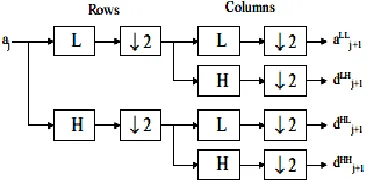
The discrete wavelet transform is a linear transformation that operates on a data vector whose length is an integer power of two, transforming it into a numerically different vector of the same length. It is a tool that separates data into different frequency components, and then studies each component with resolution matched to its scale. DWT is computed with a cascade of filtering followed by a factor 2 sub-sampling (Fig.3).
Fig. 3 one level dwt tree
H and L denote high and low-pass filters respectively, ↓ 2 denotes sub-sampling. Outputs of these filters are given by equations (2) and (3)
+∞
aj+1 [p]=∑ l [n-2p] aj[n] …. (2)
n= -∞
+∞
dj+1 [p]=∑ h [n-2p] aj[n] …. (3)
n= -∞
Elements a j are used for next step (scale) of the transform and elements d j, called wavelet coefficients,
determine output of the transform. l[n] and h[n] are coefficients of low and high-pas filters respectively One can assume that on scale j+1 there is only half from number of a and d elements on scale j. This causes that DWT can be done until only two a j elements remain in the analyzed signal.
The DWT is performed firstly for all image rows and then for all columns (Fig.4).
Fig. 4 wavelet decomposition for two-dimensional pictures.
This process is recurring recursively, pairing up the sums to give the next scale: finally resulting in (2 power n) -1 differences and one final sum.
2.2 3-Level Discrete Wavelet Transform
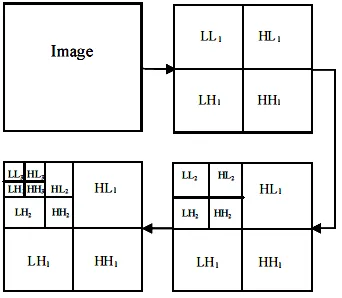
In two dimensional applications, after the first level of decomposition, there are 4 sub-bands: LL1, LH1, HL1, and HH1. For each successive level of decomposition, the LL sub band of the previous level is used as the input. To perform second level decomposition, the DWT is applied to LL1 band which decomposes the LL1 band into the four sub- bands LL2, LH2, HL2, and HH2. To perform third level decomposition, the DWT is applied to LL2 band which decompose this band into the four sub-bands – LL3, LH3, HL3, HH3. LH1, HL1, and HH1 contain the highest frequency bands present in the image tile, while LL3 contains the lowest frequency band. The 3-level of wavelet transform is shown in Fig. 5 [3].
The advantages of discrete wavelet transform are as follows: It provides fast computation.
The discrete wavelet transform provides sufficient information for the analysis and synthesis of the signal. The discrete wavelet transform also suffers from the following drawbacks: Poor directionality, translational invariant and lack of phase information. DWT is currently used in a wide variety of signal processing applications, such as in audio and video compression, removal of noise in audio, and the simulation of wireless antenna distribution. Wavelets have their energy concentrated in time and are well suited for the analysis of transient, time-varying signals. Since most of the real life signals encountered are time varying in nature, the wavelet transform suits many applications very well.
Fig. 5 3-level discrete wavelet decomposition
3. Image Segmentation
Image segmentation is the process of partitioning a 2D digital image into multiple segments (sets of pixels, also known as super pixels). The aim of segmentation is to change the representation of an image into something that is more meaningful and easier to analyze. So Image segmentation is the process of providing a label to every pixel in an image such that pixels with the same label share certain characteristics.
3.1 Image Segmentation Techniques
The basic idea in using 3-level discrete wavelet transform (DWT) with image segmentation technique is to enhance the image by manipulating the transform coefficients. There are some basic image segmentation technique such as Edge based, Fuzzy clustering based, PDE based, ANN based, Threshold based and Region based segmentation according to particular type of images.
In proposed method, we used Fuzzy C-Mean clustering algorithm using 3-level discrete wavelet transform.. It is a type of Fuzzy clustering based segmentation [4].
3.2 Fuzzy C-Mean Clustering Algorithm
It is one of the unsupervised clustering techniques used in image segmentation. The idea is simple, clusters the data into two or more classes by known no of classes that the image cluster to it. FCM was first demonstrated by DUNN and later it was improved by BEZDEK. FCM algorithm operates by providing a membership to each data point corresponding to each cluster center on the basis of distance between the cluster center and the data point. After each iteration membership and cluster centers are updated according to the formula:
c
µ
=
1/
∑ (
d
ij/ d
ik)
2/m-1 (4) k=1
n
∑(
µ
ij)m xji=1
v
j=
Vj =1,2,,,c. (5) n∑(
µ
ij)mi=1
where,
„n’ is the number of data points. „vj‟ represents the jth cluster center. ‘m’ is the fuzziness index m €[1,∞]. ‘c’ represents the number of cluster center.
„µij‟ represents the membership of ith data to jth cluster center.
„dij‟ represents the euclidean distance between ith data and jth cluster center. Main objective of fuzzy c-means algorithm is to minimize:
n c m 2
J(U,V)
=
∑ ∑
(µ
i j)||
x
i –v
j||
(6)i=1 j=1 where,
„|| xi –vj ||„ is the Euclidean distance ithdata and jt +h Cluster center.
The major advantages of Fuzzy c-means clustering are: 1) Gives best result for overlapped data set and comparatively betterthen k-means algorithm.2) Unlike k-means where data point must exclusively belong to one cluster center.
4. Proposed Methodology
Here, we find the 1-level, 2-level and finally 3-level discrete wavelet transform image‟s output as a input of fuzzy c-mean clustering segmentation algorithm to locate an object clearly by using all output of decomposition (1-level, 2-level and 3-level).after all, find PSNR and MSE values of segmented images one by one to measure the performance. In the proposed methodology, following flow chart is given below in Fig.6 [6, 7]:
5. Experimental Results
The input images and their segmented results using proposed algorithm and 3-Level DWT with FCM algorithm is shown in Fig. 7 and 8.
Fig.7 (a) (b) (c)
Fig.8 (a) (b) (c)
For –Image 1 and 2
Table 1: Performance of the FCM Algorithm using 3-level DWT
DWT FCM (Image 1) FCM (Image 2)
MSE PSNR MSE PSNR
Level 1 32.53 32.61 32.53 32.46
Level 2 32.54 32.57 32.55 32.54
Level 3 32.55 32.62 32.57 32.58
From Table 1, it can be observed that the value of PSNR (peak signal to noise ratio) is higher in case of 3-level discrete wavelet transform for both image which means that the proposed 3-3-level DWT algorithm provide the better performance than 1-level & 2-level DWT algorithm.
6. Conclusion
In this paper, an image enhancement technique based on a 3-level discrete wavelet transform has been implemented. This technique used the FCM algorithm of image segmentation. Experiment results shows that the quality of the segmented image and also indicate that the three level DWT provide better performance than 1-level and 2- level DWT. In near future we will use a modified image enhancement model to enhance the short comings of the earlier work. Future research in image segmentation should strive toward improving the accuracy, precision, and computation speed of the segmentation algorithms, while reducing the amount of manual interactions needed.
References
[1] V. Ramya1, G.P.Rameshkumar “ An Efficient MR Image Brain Tumor Segmentation Based On Discrete Wavelet Transform and Region Growing Algorithm, International Journal of Engineering Sciences & Research Technology ISSN: 2277-9655 December, 2013.
[2]Ali A. Yassin, Rana M. Ghadban, Salah F. Saleh, Hikmat Z. Neima”
Using Discrete Wavelet Transformation to Enhance UnderWater Image”, IJCSI International Journal of Computer Science Issues, Vol. 10, Issue 5, No 2, September 2013.
[3]Nikita Kashyap, G. R. SINHA “Image Watermarking Using 3-Level Discrete Wavelet Transform (DWT)” I.J.Mo dern Education and Computer Science, 2012, 3, 50-56 Published Online April 2012 in MECS DOI: 0.5815/ijmecs.2012.03.07.
[4] Inderpal Singh, Dinesh Kumar “ A Review on Different Image Segmentation Techniques” Indira Journal of Applied Research Volume: 4 Issue: 4, Apr 2014, ISSN - 2249-555X.
[5] S.Janani, R.Marisuganya, R. Nivedha “MRI Image Segmentation using Stationary Wavelet Transform and FCM” International Conference on Innovations in Intelligent Instrumentation, Optimization and Signal Processing “ICIIIOSP-2013”.
[6] Ram Krishna Deshmukh, Yogesh S. Bahendwar “A competent MRI images segmentation using wavelet transform” International Journal of Computer Science and Management Research, Vol 1 Issue 5 December 2012.