4(12): 2463-2469, 2014 SCIENCEDOMAINinternational
www.sciencedomain.org
The Effect of a New Type of Dressing for
Chronic Venous Wounds
Katarzyna Skórkowska-Telichowska
1,2, Anna Kulma
3, Magdalena Zuk
3and Jan Szopa
3 1Department of Endocrinology, Clinic of Internal Medicine, 4thClinical Military Hospital, Weigla 5, 50-981 Wrocław, Poland. 2Department of Dermatology and Venereology, 4thClinical Military Hospital, Weigla 5, 50-981 Wrocław, Poland. 3Faculty of Biotechnology, University of Wrocław, Przybyszewskiego 63, 51-147 Wrocław, Poland.Authors’ contributions
This work was carried out in collaboration between all authors. Author KST performed conception and design, acquisition of data, clinical evaluation, analysis and interpretation of data, drafting the article. Author AK performed analysis of constituents, critical revision of the article, analysis and interpretation of data. Author MZ performed preparation of flax dressings, analysis of constituents. Author JS performed conception and design, critical revision of the article, final approval of the version to be published. All authors read and approved the final manuscript.
Received 27thJune 2013
Accepted 21stSeptember 2013
Published 11thFebruary 2014
ABSTRACT
Aims: The aim of the current study was to assess the clinical efficacy of the FlaxAid dressing for the treatment of chronic venous wounds in a patient unresponsive to previous treatment protocols.
Presentation of Case:A 50-year old male patient presented with recurrent venous ulcers of the lower extremities. All of the ulcers had lasted for 5 years and their size was increasing despite clinically relevant local therapy. FlaxAid dressing were applied to the wound area in three stages consisting of FlaxAid dressings wetted with: isotonic salt solution; oil emulsion; and seedcake extract.
Discussion and Conclusion:After 12 weeks of therapy with the newly developed FlaxAid bandages, all of the patient’s ulcers had been cured. After 6 months of follow-up, the sites of the patient’s ulcers were found to still be in a healthy state.
Keywords: FlaxAid; antioxidants; dressing; venous wound; chronic ulcers.
1. INTRODUCTION
The incidence of chronic venous ulcers has reached epidemic levels worldwide [1-3]. Venous ulcers significantly impair the quality of life and thus have both social and psychological impact on sufferers [4]. Ulcers of venous origin are mostly due to chronic venous insufficiency, untreated varices in the lower extremities or deep or superficial vein thrombosis [5]. About 80% of venous ulcers are due to complications arising from chronic vein insufficiency [6].
A successful method of treatment that stimulates ulcers to heal is an essential step toward eliminating morbidity, improving the patients’ quality of life, and decreasing healthcare costs. Although scientists and clinicians are developing novel therapeutic approaches to promote healing, we are still far from success. Newly developed dressings called FlaxAid were created from transgenic flax plants overproducing various antioxidative compounds obtained by genetic engineering. FlaxAid bandages are enriched in antioxidant substances that exhibit health-promoting activities in the wound bed. The healing properties of those bandages were proven in pre-clinical study [7,8]. The highly hygroscopic linen fibres keep the ulcer at an optimal moisture level by absorbing excess exudates and the high quantities of phenolic acids and particular flavonoids cause a reduction in the inflammatory state of the wound. The unsaturated fatty acids in the linen fibres diffuse to the tissues surrounding the wound causing an increase in the integrity of the fibroblast cytoplasmic membranes. The lignans increase fibroblast proliferation from the surrounding wound margins, accelerating wound closure as the fibroblasts steadily migrate along the wound surface. In addition, the flavonoids from the linen fibres have anti-allergenic, anti-viral, anti-inflammatory and vasodilatory activities [9,10]. The above-mentioned properties of the FlaxAid dressing were observed in in vitrostudies. In addition, such studies confirmed that applying a high level of antioxidant compounds in a concentrated format as found in the dressings enhances wound tissue defenses against both biotic and abiotic stresses [11].
In this study, we used this new type of dressing and a new clinical method for the treatment of chronic wounds of a patient not responsive to traditional treatments.
2. PRESENTATION OF CASE
2.1 Patient
An active, 50-year old man (initials: TR) visited the dermatology outpatient clinic due to recurring venous ulcers. He had four venous ulcers on his lower extremities. At the time, all of the ulcers had lasted for about 5 years and despite systematic and continuous local therapy, their size had increased. All of the ulcers were shallow and clean, with a considerable amount of exudates but without necrotic tissue. The patient qualified for the program of FlaxAid bandage treatment and was enrolled within the study. Within our clinical setting, the treatment with the new bandage was proposed to patients in whom local and general treatment (compression therapy, antibiotics, analgesic or anticoagulant therapy) neither stopped the progression nor healed the ulcer.
exudates which forced him to change his bandages several times per day; and the appearance of his legs.
2.2 Clinical Tests for Confirmation of Venous Ulcer
Routine laboratory tests were performed on the patient during his first visit in order to assess his general state of health and to confirm a purely venous origin for the ulcers, i.e. to exclude the presence of any internal disease that could have contributed to the presence and growth of the ulcers. Routine diagnostic tests for venous disease confirmed the primary pathology of the disease and excluded other systemic causes. Such tests included venography, duplex ultrasonography, ABI, etc. Arterial pathology was excluded by anamnesis, physical examination, ABI measurements (Sonodop 4000 DSM 2P Doppler Segmental Sphygmomanometer, Sonotechnic GmbH) and doppler ultrasonography (Vivid 7) of the leg arteries. The ultrasonography and the venography revealed residues after deep vein thrombosis and venous valves insufficiency in the popliteal vein. The venous valves insufficiency was also seen in all deep veins below the knee and in the varicose small and in the great saphenous veins. A surgeon disqualified patient of any surgical intervention because of presence of ulcerations.
Peripheral blood was also collected in the morning after an overnight fast in order to establish that the origin of the ulcers was purely venous in nature and not caused by any internal disease. The lab tests performed included: a complete blood count with a differential chemistry profile including the blood urea nitrogen, creatinine, uric acid, serum protein, CRP, fibrinogen, alanine aminotransferase and aspartate aminotransferase; a lipid profile with total cholesterol, HDL cholesterol, LDL cholesterol and triglycerides; a coagulation profile with PT, APTT and INR; the levels of fasting glucose and glycosylated hemoglobin and a urinalysis. All the obtained results were within normal range.
2.3 Preparation of the FlaxAid Dressing
The FlaxAid fabric was prepared from raw yarn using the standard weaving method as described previously [8]. Where indicated, the linen dressing for the wound treatment was covered with 2ml of sterile seedcake extract or with 2ml of oil emulsion prepared as described [8].
2.4 Chemical Constituents of the FlaxAid Dressing
The FlaxAid dressing contains: cellulose (680 mg/g); pectins (35 mg/g); lignans (25 mg/g); soluble (0.05 mg/g) and ester-bound phenolics (1.3 mg/g); and carotenoid-lutein (0.29 µg/g). With regards to the phenolics, the most aboundant in flax fibers are vanillin (0.48mg/g) and ferulic acid (0.35 mg/g).
The seed cake extract also provides antioxidants. The main constituents of a seedcake are: lignans such as secoisolariciresilol diglucoside (SDG) (58 mg/g); and phenolic acids such as ferulic acid (0.32 mg/g), ferulic acid glucoside (5.48 mg/g), coumaric acid (0.03 mg/g), coumaric acid glucoside (0.71 mg/g), caffeic acid (0.032 mg/g) and caffeic acid glucoside (0.547 mg/g).
2.5 Application
The applied FlaxAid therapy was part of a complex ulcer therapy regime that included education, analgesic treatment and compression therapy.
The treatment period was divided into three stages (first, second and third), each lasting four weeks. Stage zero was designated as common treatment (cotton gauze wetted with isotonic salt solution) which had been locally applied to the ulcer for a period in excess of 12 weeks over the 5 year period prior to the FlaxAid application and had in essence served as a control for the study to assess treatment efficacy.
After each week, during a consultation, the ulcers were evaluated in the following way: the ulcers were measured using sterile dressings with a millimeter scale and photographic and descriptive documentation were prepared. The patient filled in a questionnaire the day before each visit and this was also collated within the clinical evaluation for the efficacy of the new dressing. The quantity of exudates was measured by weighting the used dressings. The pain level was established using one of the standard scales (Wong-Baker Faces Pain Rating Scale) combined with Visual Analogue Scale (VAS).
In the zero stage, the patient’s wound was treated with popular, widely available cotton dressings wetted with an isotonic salt solution. This part of the study was treated as the control stage.
In the first stage, the wounds were treated with FlaxAid bandages wetted with an isotonic salt solution. Since the flax fibers have hygroscopic properties, the ulcers were expected to become cleaner and to dry up during this stage.
In the second stage, the ulcers were treated with FlaxAid bandages wetted with oil emulsion rich in polyunsaturated fatty acids and antioxidants. In the third stage, the wounds were treated with FlaxAid bandages wetted with seedcake extract, which contains a high quantity of antioxidants.
All the dressings were changed every 24 hours. The first in each stage was applied by qualified hospital personnel. The patient himself changed the dressings thereafter, having been thoroughly instructed by a qualified nurse during the weekly visits.
3. RESULTS
To evaluate the clinical changes associated with the FlaxAid therapy, several parameters were considered: the level of wound exudates; the fibrin and granulation levels within the ulcers; the level of pain reported by the patient; and the size of the ulcers.
After the first stage of the experiment, the ulcers became shallower, and a reduction in the wound size was observed. In addition, a decrease in the amount of exudates and fibrin was detected. The patient reported that the level of pain had diminished slightly (measured by a reduction in the number of analgesic pills which the patient felt he needed).
Following the second stage of treatment (FlaxAid with oil emulsion), all the ulcers were clean and fibrin had completely disappeared. New red granulation tissue was observed in the wound beds. The wounds became dry and the patient found that he could change the bandages once every 24 hours without pain. A significant reduction in wound size was also observed.
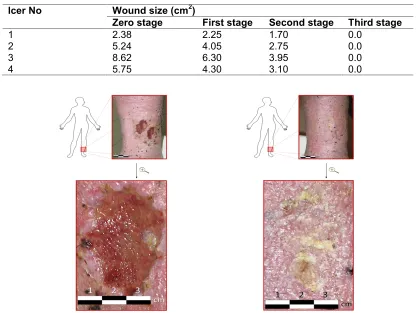
All these effects were also observed in the third stage (FlaxAid with seedcake extract) of treatment. After two weeks within this stage of treatment, the two smaller ulcers had completely healed and the two larger ulcers were healed completely after a further two weeks (Fig. 1, Table 1).
Table 1. The changes in wound size during FlaxAid therapy. The measurements were taken during the last visit of each stage of the study
lcer No Wound size (cm2)
Zero stage First stage Second stage Third stage
1 2.38 2.25 1.70 0.0
2 5.24 4.05 2.75 0.0
3 8.62 6.30 3.95 0.0
4 5.75 4.30 3.10 0.0
4. DISCUSSION
After 12 weeks of therapy with the newly developed FlaxAid bandages, all the ulcers had healed. Following this treatment period, the patient only had to use compression therapy and skin grease. It is believed that the beneficial nature of FlaxAid is derived from its high levels and broad spectrum of antioxidants. The observation of a reduction in pain symptoms is also important, although the reason for this is as yet unknown. All the ulcers were still healed when the patient returned for a follow-up observation six months after the end of the study. Additional studies are currently underway in order to determine the longer-term outcome of this product. Furthermore, a series of studies are currently investigated in order to determine the clinical efficacy of the FlaxAid dressing in treating different skin wound conditions.
5. CONCLUSION
Newly developed dressings called FlaxAid created from transgenic flax plants that overproduce various antioxidative compounds and that were obtained via genetic engineering. FlaxAid bandages are enriched in particular antioxidant substances that exhibit health-promoting activities in the wound bed and have well-documented allergenic, anti-viral, anti-inflammatory and vasodilatory activities.
CONSENT
The patient was provided with written information on the purpose and design of the study and an informed consent was obtained.
ETHICAL APPROVAL
Ethics approval was obtained from the local bioethics committee (Bioethics Committee, Łódź, no RNN/441/08/KB).
ACNOWLEGMENTS AND FUNDING SOURCES
This study was supported by grant no. N R12 0009 06 from the Polish Ministry of Science and Education.
COMPETING INTERESTS
The authors declare that they have no conflict of interest.
REFERENCES
1. Jaul E. Non-healing wounds: the geriatric approach. Arch Gerontol Geriatr.
2009;49:224–226.
2. Simon DA, Dix FP, McCollum CN. Management of venous leg ulcers. BMJ.
2004;328:1358–1362.
3. McCollum CN: Venous leg ulcers: where does surgery fit in? Pol Arch Med Wew. 2008;118:262–263.
5. Żmudzińska M, Czarnecka-Operacz M. Management of venous leg ulcers – modern wound dressings. Postępy Dermatologii i Alergologii. 2006;3:143–148.
6. Bergan JJ, Schmid-Schönbein GW, Smith PD, et al.: Chronic venous disease. N Engl
J Med. 2006;355:488–498.
7. Skórkowska-Telichowska K, Czemplik M, Kulma A, Szopa J. The local treatment and
available dressings designed for chronic wounds. J Am Acad Dermatol. DOI: 10.1016/j.jaad.2011.06.028.
8. Skórkowska-Telichowska K, Żuk M, Kulma A, et al. New dressing materials derived from transgenic flax products to treat long-standing venous ulcers—a pilot study. Wound Repair and Regeneration. 2010;18(2):168-179.
9. Harborne JB, Williams ChA. Advances in flavonoids research since 1992.
Phytochemistry. 2000;55:481–504.
10. Arora A, Muraleedharan GN, Strasburg GM. Structure activity relationships for antioxidant activities of a series of flavonoids in a liposomal system. Free Radical Biol Med. 1998;9:1355–1363.
11. Lee JH, Shim JS, Lee JS, et al. Inhibition of pathogenic bacterial adhesion by acidic polysaccharide from green tea (Camellia sinensis). J Agric Food Chem. 2006;54:8717–8723.
© 2014 Skórkowska-Telichowska et al.; This is an Open Access article distributed under the terms of the Creative Commons Attribution License (http://creativecommons.org/licenses/by/3.0), which permits unrestricted use, distribution, and reproduction in any medium, provided the original work is properly cited.
Peer-review history: