Almost-Everywhere Secure Computation
with Edge Corruptions
∗Nishanth Chandran† Juan Garay‡ Rafail Ostrovsky§
Abstract
We consider secure multi-party computation (MPC) in a setting where the adversary can sepa-rately corrupt not only the parties (nodes) but also the communication channels (edges), and can furthermore choose selectively and adaptively which edges or nodes to corrupt. Note that if an adversary corrupts an edge, even if the two nodes that share that edge are honest, the adversary can control the link and thus deliver wrong messages to both players. We consider this question in the information-theoretic setting, and require security against a computationally unbounded adversary. In a fully connected network the above question is simple (and we also provide an answer that is optimal up to a constant factor). What makes the problem more challenging is to consider the case of sparse networks. Partially connected networks are far more realistic than fully connected networks, which led Garay and Ostrovsky [Eurocrypt’08] to formulate the notion of (unconditional) almost everywhere (a.e.) secure computation in the node-corruption model, i.e., a model in which not all pairs of nodes are connected by secure channels and the adversary can corrupt some of the nodes (but not the edges). In such a setting, MPC amongst all honest nodes cannot be guaranteed due to the possible poor connectivity of some honest nodes with other honest nodes, and hence some of them must be “given up” and left out of the computation. The number of such nodes is a function of the underlying communication graph and the adversarial set of nodes.
In this work we introduce the notion ofalmost-everywhere secure computation with edge corrup-tions, which is exactly the same problem as described above, except that we additionally allow the adversary to completely control some of the communication channels between two correct nodes—i.e., to “corrupt” edges in the network. While it is easy to see that an a.e. secure computation protocol for the original node-corruption model is also an a.e. secure computation protocol tolerating edge corruptions (albeit for a reduced fraction of edge corruptions with respect to the bound for node corruptions), no polynomial-time protocol is known in the case where a constant fraction of the edges can be corrupted (i.e., the maximum that can be tolerated) and the degree of the network is sub-linear.
We make progress on this front, by constructing graphs of degreeO(n) (for arbitrary constant
0 < <1) on which we can run a.e. secure computation protocols tolerating a constant fraction of adversarial edges. The number of given-up nodes in our construction is µn (for some constant 0< µ <1 that depends on the fraction of corrupted edges), which is also asymptotically optimal.
∗
A version of this paper, entitled “Edge Fault Tolerance on Sparse Networks,” is scheduled to appear in the proceedings of the 39th International Colloquium on Automata, Languages and Programming(ICALP 2012); this version presents a more cryptographically oriented treatment, and also includes proofs and additional details.
†
Microsoft Research, Redmond; Email: [email protected]. Part of this work was done while the author was at UCLA.
‡
AT&T Labs – Research; Email: [email protected].
§
Key words: Almost-everywhere secure computation, bounded-degree network, secure message trans-mission, Byzantine agreement.
1
Introduction
Secure multi-party computation (MPC) [27, 16, 3, 7] is perhaps the most popular paradigm in the area of cryptographic protocols. It requires that n parties compute some function f of their inputs without revealing any additional information, even when some of them may behave arbitrarily. More specifically,nparties P1,· · · , Pn, each holding inputxi, must run a protocol such that at the end of the
protocol, all “honest” (i.e., not misbehaving) parties obtain f(x1,· · ·, xn), while any set of colluding
malicious parties Tnodes ⊂ [n] learn nothing more than what can be learnt from f(x1,· · ·, xn) and the xi values for all Pi ∈ Tnodes.
Traditionally, MPC protocols assume that any two of thenparties share a private and authenticated channel which they can use for communication. In the case of information-theoretic MPC, the channel between two honest nodes is assumed to be a secure physical link which the adversary cannot eavesdrop nor tamper with; in the computational case, this channel is provided via a public-key infrastructure.
However, in many settings, the assumption of incorruptible pair-wise secure chanels might be unreal-istic and overoptimunreal-istic. Think for example, of the communication subsystem of a networked computer (e.g., network interface controller card) being infected by malicious software designed to disrupt or alter operation. This would affect the communication between honest parties. Or worse, of a scenario where the secret keys shared by two parties in the system is compromised, yet the parties themselves are honest. In light of this, one first question we can ask is whether we can obtain MPC protocols when both parties as well as communication channels are corrupted.
Naturally, we must assume some bound on the number of parties as well as the number of com-munication channels that the adversary can corrupt. First, observe that we cannot hope to obtain a protocol that is secure against an adversary that corrupts at least n32 +n of the n2 communication
channels1 (a constant fraction of the edges in the network), even if all the parties are honest. This is because, such an adversary can effectively “simulate” the corruption of n3 + 1 out of the n parties (in the standard setting where only parties can be corrupted). and in this case MPC is known to be impossible [3]. (In this work, we focus on information-theoretic MPC.) On the positive side, it is quite easy to construct protocols that asymptotically match these bounds of edge corruptions; i.e., protocols tolerating corruption of a constant fraction of communication channels as well as a constant fraction of parties (for constants < 13)2.
However, all the protocols discussed so far assume that any two parties share a secure channel to begin with! (These channels may later on be corrupted, but the connectivity of every party is still n.) For protocols that are executed over large networks such as the Internet, in which nodes are typically connected by a communication graph of small degree, this assumption is unreasonable. Thus, we turn our attention to the problem of constructing MPC protocols (secure against corruption of both parties and communication channels) in which parties (or nodes) have low connectivity.
1.1 Almost-everywhere secure computation
Before we describe our model in more detail, we remark that the setting of constructing protocols on networks that are not fully connected is not new. Obtaining protocols on networks that are of
1For ease of exposition, we will assume that the total number of communication channels between then parties isn2 (i.e., we assume a “self-channel”).
low degree (in the presence of node corruptions alone), was first considered for the task of Byzantine agreement [20, 19] in the seminal work of Dwork, Peleg, Pippenger, and Upfal [12]. More formally, in the Dwork et al. formulation, the nparties (or nodes) are connected by a communication network
G. Nodes that are connected by an edge in G share a reliable and authentic channel, but other nodes must communicate via paths in the graphs that may not be available to them (due to the adversarial “corruption” of some of the nodes).
Naturally, in such a setting, one may not be able to guarantee agreement amongst all honest parties; for example, one cannot hope to be able to communicate at all with an honest party whose neighbors are all adversarial. Given this fact—and ubiquitously—Dworket al. termed the new problem
almost-everywhere (a.e.) agreement, wherein the number of such abandoned nodes (which henceforth
will be called “doomed”) introduces another parameter of interest, in addition to the degree of the communication graph (which we wish to minimize), and the number of adversarial nodes that can be tolerated (which we wish to maximize) in reaching agreement.
Indeed, in [12], Dwork et al. provide a.e. agreement protocols for various classes of low-degree graphs and bounds on the number of adversarial nodes as well as abandoned nodes. For example, they construct a graph of constant degree and show an agreement protocol on this graph tolerating a logαn fraction of corrupted nodes (for constant 0 < α <1), guaranteeing agreement amongst (1−α−µ)n
of the honest nodes (for constant 0 < µ < 1). In another construction, they give a graph of degree
O(n) (for constant 0< <1) and show an agreement protocol on this graph tolerating a constant α
(0< α <1) fraction of corrupted nodes, and again guaranteeing agreement amongst (1−α−µ)nnodes. In a subsequent and remarkable result, Upfal [23] constructed a constant-degree graph and showed the existence of an a.e. agreement protocol on this graph tolerating a constant fraction of corrupted nodes, while giving up a constant fraction of the honest nodes. Unfortunately, the protocol of [23] runs in exponential time (in n).
Garay and Ostrovsky [15] were the first to consider the problem of unconditional MPC in the context of partially connected networks with adversarial nodes, and obtained results with bounds similar to those in [12]. More recently, Chandran, Garay, and Ostrovsky [6] constructed a graph of degree O(logkn) (for constant k > 1) and show an agreement, as well as an MPC protocol on this graph tolerating a constant fraction of corrupted nodes, while giving up only O(lognn) of the honest nodes.
1.2 Almost-everywhere secure computation with edge corruptions
All existing work on a.e. agreement and a.e. secure computation mentioned above considers the case where only nodes may be corrupted and misbehave 3. Furthermore, all existing work, construct
specific graphs (of low degree) on which one can obtain an a.e. secure computation protocol. In an
ideal scenario, we would like to construct a.e. computation protocols on arbitrary adversarially chosen communication networks. Unfortunately, this is impossible in general4 . However, we can take a step in this direction by allowing the adversary to corrupt edges in the network that we design. That is, we will still construct a specific graph (on which we will obtain a.e. computation protocols); however, we will allow the adversary to “modify” this graph by corrupting a constant fraction of edges in it, thereby taking down (and even actively corrupting) certain channels in the communication network.
In more detail, in this work we will endow the adversary with additional powers which allow him, in addition to corrupting nodes, to corrupt some of the edges in the network—i.e., we consider a.e.
agreement and computation with edge corruptions. When he does (corrupt an edge), he is able to
3In the closely related problem ofsecure message transmission[11] (and its variants), however, it is assumed that the “wires” (abstraction of paths in a network) connecting sender and receiver might be corrupted and misbehave.
completely control the communication channel between the two honest nodes, from simply preventing them to communicate, to injecting arbitrary messages that the receiving end will accept as valid. As in the node-only corruption case, in this case also some of the honest nodes in the network must be abandoned. In this work, we ask the following question:
Can we obtain a.e. secure computation protocols on networks of low (i.e., sublinear) degree when a constant fraction of nodes as well as communication channels are corrupted?
Which we answer in the affirmative. To put things in perspective, observe that an a.e. agreement or a.e. secure computation protocol for node corruptions can be readily transformed into a corresponding a.e. protocol also tolerating edge corruptions, albeit for a reduced fraction of edge corruptions. More specifically, let d be the maximum degree of any node in a graph G on n nodes that admits an a.e. agreement (a.e. computation) protocol Π amongst p < n nodes, in the presence of x corrupt nodes. Then, it is easy to see that G admits an a.e. agreement (a.e. computation) protocol Π0 amongst p
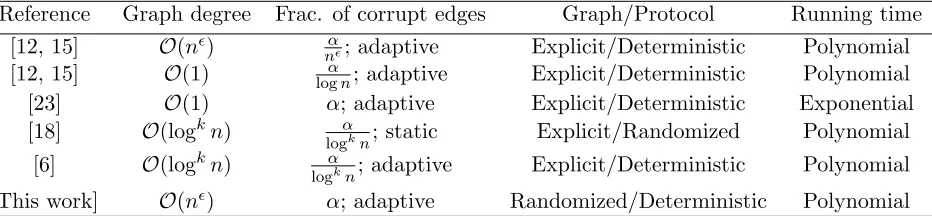
nodes in the presence of x corrupt edges5. However, this means that the graph will only admit an agreement/computation protocol for an ndx fraction of corrupted edges, as opposed to an nx fraction of corrupted nodes in the former case. Therefore, the result that we get for the case of edge corrup-tions using this na¨ıve method is asymptotically weaker than in the case of node corrupcorrup-tions (except when dis a constant). Indeed, by applying this method, none of the existing protocols for a.e. agree-ment/computation against node corruptions give us a solution tolerating a constant fraction of edge corruptions. This is depicted in Table 1, where we outline the results one would obtain by applying this approach to the a.e. agreement/computation protocols for node corruptions of [12, 23, 18, 15, 6], and compare them with the results we obtain in this work. In all the results listed in the table, 0< α <1 is a constant, 0< <1 can be any arbitrary constant, andk >1 is a constant.
Reference Graph degree Frac. of corrupt edges Graph/Protocol Running time
[12, 15] O(n) nα; adaptive Explicit/Deterministic Polynomial
[12, 15] O(1) logαn; adaptive Explicit/Deterministic Polynomial
[23] O(1) α; adaptive Explicit/Deterministic Exponential
[18] O(logkn) α
logkn; static Explicit/Randomized Polynomial
[6] O(logkn) α
logkn; adaptive Explicit/Deterministic Polynomial
[This work] O(n) α; adaptive Randomized/Deterministic Polynomial
Table 1: A.e. secure computation against edge corruptions from a.e. secure computation against node corruptions.
Note that all the previous results (except for the result obtained as a corollary to [23], in which the protocol’s running time is exponential) cannot handle the case where we have a constant fraction of corrupted edges. Here we are precisely interested in this case. Specifically, we construct the first protocols for a.e. agreement and a.e. secure computation on graphs with sub-linear degree that can tolerate a constant fraction of edge corruptions. We remark that while the above graph constructions are deterministic, we construct our graph probabilistically, and our result holds with high probability. However, a graph satisfying the conditions required for our protocols to be successful can be sampled with probability 1−neg(n), whereneg(n) denotes a function that is negligible inn, and furthermore, one can also efficiently check if the graph thus sampled satisfies the necessary conditions for our protocols.
5
1.3 Overview of our results
We show that for every constant , 0 < < 1, there exists a graph, call it Gmain, on n nodes, with
maximum degree dm = O(n), and such that it admits a.e. agreement and a.e. secure computation
protocols that guarantee agreement/computation amongst γmn honest nodes (for some constant 0 < γm < 1), even in the presence of an αm fraction of corrupted edges (i.e., at most αmnd2 m corrupted
edges), for some constant 0< αm <1. Our protocols work against an adversary that is adaptive (i.e.,
the adversary can decide which edges to corrupt on the fly during the protocol after observing messages of honest parties) and rushing (i.e., in every round, the adversary can decide on its messages after seeing the messages from the honest parties).
First, note that the problem of a.e. secure computation can be reduced to the problem of obtaining a public and authentic channel between any two pair of nodes in the set of privileged nodes (i.e., the set of honest nodes from which the set of doomed nodes have been excluded), due to techniques developed in [15]; and the problem of a.e. agreement trivially reduces to the problem of obtaining such a public channel. Hence, our main focus will be on constructing a protocol for this task. We now outline the high-level ideas behind our construction:
1. The first step in our construction is to build a graph with higher degree, O(√nlogn), on which we can have obtain a public channel (between any two nodes in a set of size O(n)) tolerating a constant fraction of corrupted edges.
To do this, we first observe a property of a graph that is sufficient for such a construction (besides, obviously, every node having degreeO(√nlogn)), namely, that any two nodes in the graph haveO(log2n) number of paths of length 2 between them.
Second, we observe that the Erd˝os-Renyi random graph G(n,log√n
n ) satisfies the above two
properties with high probability. That is, a graph G on n nodes satisfying the above two properties can be easily sampled by putting an edge (u, v) inG, independently, with probability
p= log√n
n .
Once we have a graph satisfying these properties, the construction is fairly straightforward: to obtain a public channel between any two nodes, say, u and v, u simply sends the message to all nodes in the network via all the paths of length 2, and all the nodes then send the message tov, again via all their paths of length 2. One can then show that ifvtakes a simple majority of the received values, then a constant fraction of the nodes can build a public channel even in the presence of a constant fraction of corrupted edges.
2. Next, we show how to construct a graph,G0, recursively from G ←G(n,log√n
n) above such that the
new graph is of sizen2 and its degree at most twice that ofG, and yet we can have a public channel on G0 (between every pair of privileged nodes) tolerating a constant fraction of corrupted edges.
We constructG0 by taking n“copies” ofG to formn“clouds,” and then connecting the clouds using another copy ofG. We connect two clouds by connecting theith node in one cloud with theith node in the other.
Now our hope is to be able to simulate the communication between two nodesu and v in the following way: u will send the message to all nodes in its cloud (call this cloud Cu). Cloud Cu will then send the message to cloud Cv (the cloud which v is a part of). Finally, v will
somehow receive the message from cloudCv.
The problem with this approach is that we need to have a protocol that will allow two clouds to communicate reliably. But clouds themselves are comprised of nodes, some of which might be corrupted or doomed; hence, the transmission from cloud Cu to cloud Cv might end up being
known as differential agreement [13], which, informally and whenever possible, allows parties to agree on the majority value of the honest parties’ inputs. Careful application of this protocol allows us to perform a type of “error-correction” of the message when it is being transferred from one cloud to another.
Combining the above techniques leads us to our main result, the construction of a public channel between any two nodes in a set of size O(n), on graphs of degree O(n) (for all constants 0 < < 1), tolerating a constant fraction of corrupted edges, while giving up µn
honest nodes (for a constant 0< µ <1).
Our new public channel construction directly gives us an a.e. agreement protocol tolerating both node and edge corruptions (with the required parameters), and by applying our protocol to the con-struction in [15], we also obtain an a.e. MPC protocol tolerating both node and edge corruptions for graphs of degree O(n) and same parameters as above.
1.4 Related work
As mentioned above, the problem we consider is most closely related to the problem of almost-everywhere agreement tolerating node corruptions [12, 5, 23, 6]. To our knowledge, the problem of agreement or computation on networks with faulty (either Byzantine or not) edges has been only con-sidered before either in the setting of random faults or where there are limited edge faults in a complete network. We now present a brief overview.
The work of Diks and Pelc [9] considers the problem of obtaining an agreement protocol (amongst all nodes) in a complete network when every edge in the network can fail independently with constant probability pf (this in turn means that the expected degree of every node is linear (in n)). This work
also deals only with non-Byzantine faults. The work of Pelc [21] also considers only probabilistic edge faults (where the failure probability is a constant less than 0.29), but considers Byzantine faulty edges. The work of Chlebuset al.[8] considers the round complexity of agreement protocols in the presence of probabilistic, non-Byzantine edge faults (where the failure probability is a constant). Shanbhogue and Yung [22] study the necessary and sufficient conditions for asynchronous agreement protocols amongst
n nodes on a complete graph in the presence of Byzantine edges (and show a tight upper and lower bound of bn−2
2 c on the total number of corrupted edges). Similarly, the work of Yan et al. [26, 24]
also considers malicious faulty links in complete networks with the aim of constructing protocols for optimal-round Byzantine agreement, while Wang and Yan [25] additionally consider fault detection in a similar setting. Berman et al.[4] consider agreement on protocols with random Byzantine edge faults (with a probability of failure < 12) and show a broadcasting algorithm that works for nnodes in time
O(logn), with probability of correctness 1− 1
n.
The work of Barak et al. [1] considered the problem of secure computation in the computational setting without authentication. In this setting, parties wish to run secure computation protocols when
no two of them share an authenticated channel, and, furthermore, the adversary controls the delivery of messages. In this setting, the adversary can trivially partition the parties into various sets of parties, with each set running its own “secure” computation protocol. Barak et al. show that, essentially, this is all that an adversary can do. We remark that our setting is different – while some pairs of parties share authenticated channels in our setting (namely those that are connected by an edge in the communication network), we wish to include a much larger fraction of honest nodes in the computation protocol (by making use of other nodes in the network to perform secure message transmission).
of honest parties. Their setting differs from ours in the following two ways. Their work permits the adversary to only block messages of honest parties, whereas, in our setting, when an adversary takes over a channel, he completely controls all messages on it. Secondly, their setting allows the adversary to block only eitherall incoming or outgoing messages of a party, or none, whereas, we allow the adversary to selectively corrupt the edges incident on any node.
Dolev [10] and Dolevet al.[11] showed that if there aretfaulty processors in a network, then every pair of processors can communicate reliably if and only if every node has connectivity at least 2t+ 1. This work also assumes that whenever a connection is present between two nodes, the connection is reliable and not under the control of an adversary (unlike in our work). In order to overcome the barrier on the maximum number of adversaries that can be corrupted, Beimel and Franklin [2], considered a model in which some pairs of processors (other than the pairs that are already connected by reliable channels), are also given authentication keys. The reliable channels defines a natural “communication graph” and the pairs of parties sharing authentication keys define a natural “authentication graph”. Beimel and Franklin showed that every pair of processors can communicate reliably if and only if all nodes in the communication graph have connectivity at least t+ 1 and the union of the two graphs has connectivity at least 2t+ 1.
2
Model, Definitions and Building Blocks
Let G = (V,E) denote a graph with n nodes (i.e., |V| = n). The nodes of the graph represent the processors (parties) participating in the protocol, while the edges represent the communication links connecting them. We assume a synchronous network and that the protocol communication is divided into rounds. In every round, all parties can send a message on all of their communication links (i.e., on all edges incident on the corresponding node); these messages are delivered before the next round.
An adversaryA can “corrupt” a set of nodes (as in taking over them and completely control their behavior), Tnodes ⊂ V, as well as a set of edges, Tedges ⊂ E, in the network such that |Tnodes| ≤ tn and
|Tedges| ≤te. A has unbounded computational power and can corrupt both nodes and edgesadaptively
(that is, the adversary can decide which nodes and edges to corrupt on the fly during the course of the protocol, after observing the messages from honest parties). Furthermore, A isrushing, meaning that it can decide the messages to be sent by adversarial parties (or on adversarial edges) in a particular round after observing the messages sent by honest parties in the same round.
Almost-everywhere agreement. The problem of almost-everywhere agreement (“a.e. agreement” for short) was introduced by Dwork et al. [12] in the (traditional) context of node corruptions. A.e. agreement “gives up” some of the non-faulty nodes in the network from reaching agreement, which is unavoidable due to their poor connectivity with other non-faulty nodes. We refer to the given-up nodes
as doomed nodes, and to the honest nodes for which we guarantee agreement asprivileged nodes. Let
the set of doomed nodes be denoted by X and the set of privileged nodes by P; note that the sets P
and X are a function of the set of corrupted nodes (Tnodes) and the underlying graph. Let|X |=x and
|P| =p. Clearly, we have p+x+t=n. We now present a definition of a.e. agreement.
Definition 1 A protocol for parties {P1, P2,· · · , Pn}, each holding initial value vi, is an
almost-everywhere agreement protocol for node corruptions if the following conditions hold for any adversary
A that corrupts a set of nodes Tnodes with|Tnodes| ≤t:
Agreement: All nodes in P output the same value.
The difference with respect to standard Byzantine agreement [20, 19] is that in the latter the two conditions above are enforced on allhonest nodes, as opposed to only the nodes inP. For brevity, we keep the same names.
In the context of a.e. agreement, one would like the graph G to have as small a degree as possible (in relation to the size of the graph and to the number of corrupted parties), while tolerating a high value for tn (a constant fraction ofnis the best possible), while minimizing x.
In [12], Dworket al. construct graphs with degreeO(n) (for constant 0< <1) tolerating at most
tn=αnn(for constant 0< αn<1) corruptions and at the same time guaranteeing agreement amongst n− O(tn) nodes in the network, with a number of doomed nodes a constant timestn; call such a graph
GDPPU= (VDPPU,EDPPU). The idea behind the a.e. agreement protocol is to simulate a complete graph
on the set of privileged nodes. The theorem from [12] is as follows:
Theorem 1 [12] There exist constants 0 < α, µ < 1 independent of n and tn, an n-vertex O(n)
-regular graph GDPPU which can be explicitly constructed, and a communication protocol (transmission
scheme)TSDPPU, such that for any set of adversarial nodes Tnodes inGDPPU such that|Tnodes|=tn=αnn,
TSDPPU guarantees reliable communication between all pairs of nodes in a set of non-faulty nodes P
of size |P| ≥ n−tn−µn. The protocol generates a polynomial (in n) number of messages and has
polynomial (in n) running time.
Given the above theorem, Dwork et al. observe that one can run any Byzantine agreement protocol designed for a fully connected graph on GDPPU by simulating all communication between nodes in the
network with the communication protocolTSDPPU. We refer the reader to [12] for further details.
As a result, letµ, d,andtnbe as defined above and letBA(n, t0n) be a Byzantine agreement protocol
for a complete network tolerating up to t0n=µn+tn faulty processors. Then, simulating the protocol
BA(n, t0n) on the networkGDPPUusing the communication protocolTSDPPU, guarantees agreement among
at least n−tn−µnhonest nodes in the presence of up totn=αnn faulty nodes.
Differential agreement. In [13], Fitzi and Garay introduced the problem ofδ-differential agreement. In the standard Byzantine agreement problem, nparties attempt to reach agreement on some value v
(for simplicity, we assume v ∈ {0,1}). Let cv denote the number of honest parties whose initial value
is v, and δ be a non-negative integer. δ-differential agreement is defined as follows:
Definition 2 A protocol for parties {P1, P2,· · ·, Pn}, each holding initial value vi, is a δ-differential
agreement protocol if the following conditions hold for any adversary A that corrupts a set Tnodes of
parties with |Tnodes| ≤tn:
Agreement: All honest parties output the same value.
δ-Differential Validity: If the honest parties output v, then cv+δ≥cv¯.
Theorem 2 [13] In a synchronous, fully connected network, δ-differential agreement is impossible if n ≤ 3tn or δ < tn. On the other hand, there exists an efficient (i.e., polynomial-time) protocol that
achieves tn-differential agreement for n >3tn in tn+ 1rounds.
We will useDA(n, tn, δ) to denote a δ-differential agreement protocol for a fully connected network
The edge-corruption model. In this work we additionally allow the adversary to corrupt edges on the network graph—the set Tedges ⊂ E, |Tedges| ≤te. We will bound this quantity, as well as the total
number of nodes that the adversary can corrupt, and attempt to construct a network graph G of small (sublinear) degree on which a significant number of honest nodes can still perform MPC. We now give some definitions and make some remarks about a.e. agreement and a.e. MPC for this setting.
We first observe that since we are working with (asymptotically) regular graphs, obtaining an a.e. (agreement, MPC) protocol in the presence of a constant fraction of corrupted edges will also imply a protocol in the presence of a constant fraction of corrupted edges and a constant fraction of corrupted nodes nodes, as every corrupted node can be “simulated” by corrupting all the edges incident on this node. Thus, we will henceforth consider only adversarial edges and assume that all the nodes are honest. As in the case of a.e. MPC on sparse networks in the presence of adversarial nodes, a.e. MPC in the presence of adversarial edges also “gives up” certain honest nodes in the network, which, as argued before, is unavoidable due to their poor connectivity with other honest nodes. Let the set of such doomed nodes be denoted by X and the set of privileged nodes by P. Note that the sets P and X are a function of both the set of corrupted edges (Tedges) and the underlying graph. Let |X |=xand |P|= p; we let the fraction of corrupt edges beαe. The definition of a.e. agreement with corrupted edges, in
particular, now readily follows in the same manner as in Definition 1.
Next, we remark that the problem of a.e. agreement for edge corruptions also reduces to that of constructing a reliable and authentic channel between any two nodesu, v∈ P, in particular those which are not directly connected by an edge in E. (With foresight, we will be calling such a channel apublic
channel.) Furthermore, Garay and Ostrovsky showed that, given such a public channel between two
nodes u and v ∈ P, plus some additional paths, most of which (i.e., all but one) might be corrupted, it is possible to construct a (unidirectional) secure (i.e., private and reliable) channel between them. The construction is via a protocol known as secure message transmission by public discussion (SMT-PD) [15, 14]. In turn, from the protocol for a secure channel, an a.e. MPC protocol amongst the nodes in P, satisfying the same notion of security as in [15], readily follows (see Theorem 7 in Appendix A). The definition of a secure channel between two nodes, which are not necessarily directly connected, and in the presence of adversarial edges, essentially paraphrases the more general definition of secure message transmission (see, e.g., [14]), where the channel is parameterized by a privacy error (κ1) and a
reliability error (κ2).
More formally, an execution of a (unidirectional) secure channel protocol between two nodesu, v∈ V, withu as the sender anduas the receiver, is determined by the random coins of the two nodes and the adversary A controlling the set of edges Tedges, and the message m (without loss of generality, we will
assume that m∈ {0,1}). Let ViewA denote the view of the adversary in the execution of the protocol
between u and v; this view includes all messages seen by A(on edges in the set Tedges), as well as the
adversary’s random coins. Let ViewA(b) denote the view of the adversary. In each execution, v will
output a message mv. We now describe the security of secure-channel protocol:
Definition 3 We say that a protocolΠ between nodes u, v∈ P, is a (κ1, κ2)-secure channelprotocol if it satisfies:
Privacy: ViewA(0) and ViewA(1) are κ1-close.
Reliability: For m ∈ {0,1}, Pr[mv = m] ≥ 1−κ2. (The probability is taken over all players’ coins.)
Similarly, we say a protocol Π between nodes u, v ∈ P, is a κ-public channel protocol between u
and v if it satisfies the reliability property (as defined above) with probability at least 1−κ.
Finally, we remark that one can define the notion ofa.e. differential agreement (for edge corruptions) in the same manner as a.e. agreement by replacing the set of honest parties with the set of privileged parties in Definition 2 (i.e., by treating doomed parties also as adversarial). Furthermore, note that one can also obtain an a.e. differential agreement protocol (for edge corruptions) from the construction of a public channel between any two nodes u, v∈ P: simply, execute a standard differential agreement protocol and replace every communication between nodes with an execution of the public channel protocol. We will use AE-DA(n, tn, δ) to denote an a.e. δ-differential agreement protocol for a partially
connected network where the number of privileged parties is n−tn.
3
Remote and Secure Channels on Low-Degree Networks
In this section we construct a graph in which the maximum degree of any node is low, and yet, there exists a set of nodes (of size a constant times the total number of nodes), such that any two nodes in this set can communicate with each other privately and reliably, even a constant fraction of the edges in the graph are corrupted. More specifically, our goal is to construct a graph G = (V,E) on nnodes with maximum degree d, and a protocol for a secure channel, SCu,v(m), with the following properties.
Let the set of edges that are corrupted by an adversary be denoted by Tedges ⊂ E,|Tedges| ≤ αnd. We
shall show that there exists a set of nodes P ⊆ V, such that|P| ≥γn, and any two nodesu, v∈ P can communicate usingSCu,v(m). As mentioned earlier, our main focus will be on building a public channel
PCGu,v(m) that can be used by any two nodes u, v ∈ P to communicate authentically, but publicly, as this will be sufficient to obtain a protocol for secure channel using the techniques from Garay and Ostrovsky [15]. Our graph will have maximum degree O(n), for arbitrary constants 0 < < 1, such that |P| ≥γn, for constant 0< γ <1.
We begin this section by constructing such a public channel scheme on a graph of larger degree,
O(√nlogn), and then show how to use that construction to obtain a scheme on a graph of maximum degree O(n) . Finally, we show how to obtain a secure channel between any two nodes in P.
3.1 Public channels on O(√nlogn)-degree graphs
We now show how to construct a graph of maximum degreeO(√nlogn), and then present a protocol for a public channel between any two nodesu, v∈ P, tolerating a constant fraction of corrupted edges. For simplicity, we will assume that all messages in our protocols are binary. We remark that this restriction can be easily removed.
Let G = (V,E) denote a graph on n nodes, dv the degree of vertex v ∈ V, and Paths2(u, v) the
set of all paths between any two vertices u, v∈ V of length exactly 2. LetG satisfy the following two properties:
1.
√
nlogn
2 ≤dv ≤2
√
nlognfor all v∈ V; and 2. |Paths2(u, v)| ≥ log
2n
2 for all u, v∈ V.
We will construct our public channel on any graph G satisfying the above properties. We first observe that such a graph is easy to construct probabilistically. Consider the Erd˝os-Renyi random graph G(n, p), withp = log√n
n; that is, construct the graph G such that there is an edge between every
pair of nodes u and v, independently with probability p = log√n
n (for simplicity, we allow self-edges).
Then, except with negligible (inn) probability,G(n, p) satisfies the conditions that we require of graph
Lemma 1 In graphG, no edge participates in more than4√nlognpaths of length exactly2(Paths2(u, v)) between any two vertices u, v∈ V.
Proof. Since paths in any Paths2(u, v) are of length exactly 2, an edge (w, t) can participate only in
paths of the form {x, y, z} where either (x, y) = (w, t) or (y, z) = (w, t). From graph G’s property 1 above, every vertex has degree ≤2√nlogn. Hence, edge (w, t) participates in no more than 4√nlogn
paths.
Let 0 < αe, αn < 1 be constants denoting the fraction of corrupt edges and corrupt nodes in the
graph, respectively. Note that if we are able to design a protocol that can tolerate αe
√
n(n−1) logn+ 2αn
√
n(n−1) logn edge corruptions, then we will automatically get a protocol that can tolerate an
αe fraction of corrupt edges and an αn fraction of corrupt nodes. Hence, let α = αe+ 2αn; we will
construct a protocol that can tolerate an α fraction of corrupt edges (and no corrupt nodes). The next lemma bounds the number of nodes in G with poor connectivity.
Lemma 2 Let Yu denote the set of nodes v such that the fraction of paths in Paths2(u, v) with no corrupt edges is ≤ 1
2. We say that a node u ∈ V is doomed if |Yu| ≥
n
4. Then, in graph G, at most
64αn nodes are doomed.
Proof. Consider a particular nodeu. In order to make udoomed, an adversary must corrupt at least
log2n
4 ·
n
4 paths. Recall (Lemma 1) that every edge can participate in at most 4
√
nlogn paths. Since at most α√n(n−1) logn edges can be corrupt, this contributes to at most 4αn(n−1) log2n corrupt paths. Hence, the total number of nodes that can be doomed is at most 64α(n−1)<64αn.
The set of privileged nodes P in G will simply be the nodes that are not doomed. By Lemma 2 above, we have that |P| ≥ (1−64α)n = γn (for some constant 0 < γ < 1). We now present the construction of a public channel between any two nodes u, v∈ P:
PCGu,v(m)
1. For every nodew∈ V,usends m over all paths inPaths2(u, w).
2. Every node w ∈ V, upon receiving m over the different paths, takes the majority of the values received, and sends this value tov over all paths inPaths2(w, v).
3. For every w,v takes the majority value of all messages received over Paths2(w, v) as the message
received from w. Then, v takes the majority (over all w) of the received values as the value sent by u.
We now show that if nodesuandv are not doomed, then the protocol described above is a 0-public channel protocol.
Lemma 3 Let u, v ∈ P (i.e., any two nodes in G that are not doomed), Then, after an execution of
PCGu,v(m), v outputs m with probability1.
Proof. Since u is not doomed, when u sends m to every nodew in the first step of the protocol, the number of nodes that will receive the value m correctly is more than 34n (since more than half of the paths from uto each of these nodes is not corrupted). Consider now one of these nodeswthat receives the value correctly from u. Let us discount those nodesw that do not have a majority of uncorrupted paths to v. Since there can be only less than n4 such nodes (as otherwise, v would be doomed), this leaves us with> 34n−n
4 =
n
hence values sent by these nodes tov in step 2 will be received correctly byv. Hence,vwill receive, out of the nvalues6, more than n2 values correctly, and hence when v takes the majority of values received in step 3 it will output m correctly. Note also, that our protocol is deterministic, and hence v will furthermore output m correctly with probability 1 when it takes the majority of values received.
3.2 Public channels and secure channels on O(n)-degree graphs
In this section we present our main technical result: we show how to recursively increase the number of nodes in graphG from the previous section, while not increasing its degree (asymptotically), and show how to implement a public channel on such graphs. We will do this in two steps. Let γ = (1−64α). We will first show the following:
Lemma 4 Let G be a graph on n nodes with maximum degree d. Furthermore, let G be such that it admits a public channel protocol, PCGu,v(·), between any two nodes uand v from a set of size at leastγn nodes even in the presence of αndcorrupt edges. Then, there exists a graphG0 onn2 nodes of maximum degree 2d, such that G0 admits a public channel protocol between any two nodes u and v from a set of size at least γ2n2 nodes even in the presence of α2n2dcorrupt edges.
Later on, we will show how to apply the G0 construction from G recursively to obtain the desired result on graphs of degree O(n).
Construction of G0. We construct G0 as follows. Take ncopies of graph G; we will call each copy a
cloud, and denote themC1,· · · , Cn. Connect the nclouds using another copy of graph G. We do this
by connecting the ith node in cloud Cj to the ith node in cloud Ck by an edge, whenever there is an
edge between Cj and Ck inG. We will call such a collection of edges between cloud Cj and cloud Ck
as a cloud-edge. Note that the maximum degree of any node in G0 is 2d.
We now describe how a node u in cloud Cj will communicate with a node v in cloud Ck—call
this protocol PCGu,v0 (m). To do this, we will first describe how two clouds that share a cloud-edge will communicate. Let every node i∈Cj hold a value mi as input (note that every node need not hold the
same value mi) and assume cloud Cj wishes to communicate with cloud Ck. We describe a protocol
such that, assuming a large-enough fraction of nodes in Cj hold the same input value, say m, then at
the end of this protocol’s execution a large-enough fraction of nodes in cloud Ck will output m. We
call this protocol CloudTransmitCj,Ck(mi). Letδ be such that 64αn < δ <(γ−130α)n.
CloudTransmitCj,Ck(mi)
1. For every node 1 ≤ i ≤ n, the ith node in Cj sends m to the ith node in Ck through the edge
connecting these two nodes.
2. The nodes in Ck execute a.e. differential agreement protocol AE-DA(n,64αn, δ) using the value
they received from their counterpart node in Cj as input. (Recall that the existence of protocol
PCGu,v(m) between privileged nodes in G guarantees that one can construct an a.e. differential agreement protocol; see Section 4 for more details on constructing an a.e. agreement protocol on
G.)
3. Each node takes the output of protocol AE-DA(n,64αn, δ) as its output in this protocol.
We are now ready to describe PCGu,v0 (m):
6
PCGu,v0 (m)
1. u sends m to i for all nodes i in cloud Cj using PCGu,i(m) from Section 3.1. The ith node in Cj
receives messagemi.
2. Clouds Cj and Ck now execute protocol PCGCj,Ck(mi) over the graph G connecting the n clouds7.
Whenever cloud Cw is supposed to send a message to Cz according to the protocol, they use
protocolCloudTransmitCw,Cz(·) over the cloud-edge connecting Cw and Cz.
3. Node v∈Ck takes its output in the protocol PCCGj,Ck(mi) as the value sent byu.
We prove the correctness of the transmission scheme above through a series of lemmas. At a high level, our proof goes as follows. We will call a cloud Cj as good if it does not have too many corrupt
edges within it (that is, corrupt edges of the form (u, v) with both u and v in Cj); otherwise we will
call the cloud, bad (Definition 4). We first show that an adversary cannot create too many bad clouds (Lemma 5). Next, we define what it means for a cloud-edge between two clouds Cj and Ck to be
good in Definition 5 (informally, the cloud-edge is good if both Cj and Ck are good clouds and there
are sufficient number of edges connecting privileged nodes in Cj and Ck). We then show that the
adversary cannot create too many bad cloud-edges (Lemma 6). Next, we show that two good clouds can communicate reliably across a good cloud-edge (Lemma 7). Finally, we show that there exists a large set of clouds such that any two privileged nodes in any two clouds from this set, can communicate reliably (Lemma 8). From this, the proof of Lemma 4 readily follows.
Definition 4 We say that a cloud Cj, 1 ≤ j ≤ n, is good if tCj ≤αnd. Otherwise, we say that the cloud is bad.
Lemma 5 The number of bad clouds in G0 is at most b tc
αndc.
Proof. By Lemma 2, in order to make a cloud bad, Amust corrupt more than αnd edges within the
cloud. Since the total number of edges that the adversary corrupts within clouds is tc, the total number
of bad clouds is at most b tc
αndc.
Definition 5 We say that a cloud-edge between two cloudsCj and Ck is good if
1. BothCj andCk are good, and
2. the number of nodesisuch that theithnode inCj as well as theithnode inCkare both not doomed
(in the graph G connecting the nodes in the respective cloud), while the edge connecting these two nodes is corrupt, is≤αn.
Otherwise, we say that the cloud-edge is bad.
Lemma 6 The number of bad cloud-edges is at most btce
αnc.
Proof. In order to make a cloud-edge between two good clouds Cj and Ck bad, A must corrupt at
least αn edges connecting them. Since the total number of corrupt inter-cloud edges is tce, the total
number of bad cloud-edges is at most btce
αnc.
Lemma 7 Let Cj and Ck be two good clouds connected by a good cloud-edge. Further, let all nodes
in Cj that are not doomed (in G) hold value mi = m as input. Then, after executing protocol
CloudTransmitCj,Ck(mi), all nodes in Ck that are not doomed (inG) outputm.
7We again usem
Proof. SinceCj is a good cloud, at mostαndedges in cloud Cj are corrupt. Hence, there are at least γn nodes inCj that are not doomed, and that hold valuemas input. WhenCloudTransmitCj,Ck(mi) is
executed, all these nodes will send m across their edges to their counterpart nodes in Ck. Now, since
a node that is not doomed in Cj may be connected to a node that is doomed inCk, and some of the
edges connecting two nodes that are not doomed may also be corrupted, the number of nodes that are not doomed in Ck that receive the valuem correctly is at least γn−64αn−αn= (γ−65α)n.
Next, in step 2 of protocol CloudTransmitCj,Ck(mi), the nodes in Ck execute protocol AE-DA(n,
64αn, δ). In cloud Ck, we shall consider every doomed node as corrupt and every node that is not
doomed as honest. By the property of the a.e. differential agreement protocol (cf. Definition 2), we have that whenever the honest nodes output a value, say, v, we havecv+δ≥c¯v, wherecv denotes the
number of honest nodes with initial value v (recall that, for simplicity, we are considering the binary case). From the calculation above, the number of nodes that are not doomed with the correct value m
is at least (γ−65α)n. Hence, the number of nodes with the wrong value ( ¯m) is at most 65αn. Since 65αn+δ <(γ−65α)n by the wayδ is picked (in transmission scheme forG0), we have that the nodes that are not doomed will never output ¯m in protocolAE-DA(n,64αn, δ) and hence all the nodes inCk
that are not doomed will output m after protocol CloudTransmitCj,Ck(mi).
Lemma 8 There exists a set of clouds PC,|PC|=γn, such that for allCj, Ck∈ PC and for all nodes u∈Cj and v∈Ck that are not doomed,v always outputs m after protocol PCG
0
u,v(m).
Proof. Let us consider the graph G that connects the n clouds in graph G0. By Lemma 5 we know that at most b tc
αndc clouds are bad. Furthermore, we know by Lemma 6 that in this graph G at most
btceαnc cloud-edges are bad. Thus, in total, in graph G connecting the n clouds A can corrupt b tc
αndc
clouds and btce
αnccloud-edges. Now, such an adversary can be perfectly simulated by an adversary that
corrupts tc
αnd·d+ tce
αn cloud-edges in total. Since, the total number of edges thatAis allowed to corrupt
in G0 is tc+tcex and is bounded by α2n2d, we get that this new adversary can corrupt at most αnd
cloud-edges.
Now assume, as in Lemma 4, that the graphG that connects the nclouds, admits a public channel between any two clouds in a set of clouds of size at least γn (since at most αnd cloud-edges are corrupted), provided that any two clouds that are connected by a good cloud-edge can communicate reliably. Let this set of γn clouds be PC. By now applying Lemma 7 which precisely gives us the guarantee that any two clouds that are connected by a good cloud-edge can communicate reliably, the
lemma follows.
Public channels and secure channels on O(n)-degree graphs. We now arrive at our main result by applying the construction of G0 from G recursively, a constant number of times, beginning with graph G ←G(n,√nlogn). We first show:
Theorem 3 For all constants 0< <1 and sufficiently large n, there exists a graph, call it Gmain, on n nodes, of degree at most dm = O(n), admitting a 0-public channel protocol between any two nodes
in a set of size at least γmn(for some constant 0< γm<1) even in the presence of anαm fraction of
edge corruptions (for some constant 0< αm <1).
Proof. Applying Lemma 4 recursively, in conjunction with Theorem 5 (that states that we can obtain a.e. agreement on any graph that admits a public channel between the nodes in the privileged set), we get that there exists a graph G00 on nk (for constant k ≥1) nodes, with maximum degree at most
d00 = 2k−1√nlogn and such that G00 admits a public channel between any two nodes in a set of size
Setting nm =nk, we get that there exists a graph Gmain on nm nodes, with maximum degree at most dm = 2
k−1 k n
1 2k
m lognm =O(n) (for all constants k≥1 and appropriately chosen 0 < <1) admitting
a public channel between any two nodes in a set of size at least γmnm nodes even in the presence of
αmnmdm corruptions (for some constants 0< αm, γn<1).
As mentioned in the beginning of the section, the availability of public channels in Gmain for a
constant fraction of nodes, together with the techniques in [15], allow those nodes to communicate securely even in the presence of a constant fraction of corrupted edges.
Theorem 4 For all constants 0< <1 and sufficiently large n, there exists a graph, call it Gmain, on n nodes, of degree at most dm =O(n), admitting a (0, κ2)-secure channel protocol (for negligible κ2) between any two nodes in a set of size at least γmn(for some constant 0< γm <1) even in the presence
of an αm fraction of edge corruptions (for some constant 0< αm <1).
The proof of the theorem follows directly from Theorems 3 and 7 (from [15]). The reliability error, κ2,
comes from the SMT-PD (secure message transmission by public discussion) protocol used in [15], and it is unavoidable when a majority of paths between sender and receiver are corrupted (see, e.g., [14]), which is the case for privileged nodes in our low-degree setting.
4
A.E. Agreement and Secure Computation with Edge Corruptions
on Low-Degree Networks
In this section, we describe our protocols and derive our conclusions for a.e. agreement and secure computation on O(n)-degree networks, achieving security even in the presence of a constant fraction of edge corruptions.
We start by showing a.e. agreement on graph G, of degreeO(√nlogn) (Section 3.1). The nodes in
G simply execute any standard Byzantine agreement protocolBA(n,64αn) (αdefined below), executing PCGu,v(m) whenever node u is supposed to send message m to node v according to BA(n,64αn). Let Privbe the set of nodes inV that are not doomed at the end of the execution of the protocol. We then have the following.
Lemma 9 Let α < 1921 . Then there exists a set P ⊂ V, |P| ≥γn (for some constant 0< γ <1), such that all nodes in P can reach agreement in the presence of anαfraction of edge corruptions inG. Since the number of doomed nodes is 64αn, we can obtain agreement when 64α < 13.
Proof. Let P =Priv. From Lemma 3, we have that any two nodes u, v ∈ P can reliably
communi-cate with each other using protocol PCGu,v(m) in the presence of an α fraction of edge corruptions in
G. Hence, nodes in P can reach agreement by executing any standard Byzantine agreement protocol BA(n,64αn) (that is, treating the number of doomed nodes as corrupt nodes—recall Lemma 2) and by simply executing PCGu,v(m) whenever u is supposed to send message m to v in BA, and provided that 64α < 13 (necessary condition on the number of faulty players for Byzantine agreement in the fully connected setting, yieldingα < 1921 ). Hence, we have that |P| ≥(1−64α)n=γn.
Since graph G is constructed probabilistically, the following theorem establishes the soundness of our construction.
Theorem 5 Except with negligible probability, graph G ← G(n,log√n
n ) is a graph of maximum degree
The proof of the theorem follows from Propositions 1 and 2, and Lemma 9. As a corollary, we get:
Corollary 1 Except with negligible probability, graph G ← G(n,log√n
n) is a graph of maximum degree
d= 2√nlogn such that γn nodes in V can reach agreement even in the presence of an αe fraction of
edge corruptions and an αn fraction of node corruptions (withαe+ 2αn≤α).
We now turn to our target degree: O(n), for constant 0 < <1. We first describe an agreement protocol on graphG0(Section 3.2), withn2nodes and degree same as that ofG. Applying this recursively, we will obtain our agreement protocol on Gmain. To reach agreement on G
0, the n2 nodes execute any
standard agreement protocolBA(n2,(1−γ2)n2) for a complete graph, replacing the sending of a message between any two nodes, say,uandv, by an invocation to protocolPCGu,v0 (m). We now show that almost all nodes in G0 can reach agreement.
Lemma 10 There exists a set P ⊂ V, |P| ≥γ2n2 (for some constant 0< γ <1), such that all nodes in P can reach agreement in the presence of an α2 fraction of edge corruptions inG0.
Proof. We put a vertex uin P if the following conditions hold: 1. u∈Cj such thatCj ∈ PC (from Lemma 8), and
2. u is not doomed in graphG which connects Cj.
By Lemma 8, since at mostαndcloud-edges are bad, we get that|PC| ≥γn. Furthermore, since all clouds in PC are good, we have (from Definition 4) that for any given cloud inPC at mostαnd edges are corrupted, and therefore at least γnnodes in each cloud inPC are not doomed. Hence,|P| ≥γ2n2.
Also by Lemma 8, any two nodes in P, say, u and v, can communicate reliably using protocol PCGu,v0 (m) in the presence of an α2 fraction of edge corruptions in G0. Hence, nodes in P can reach
agreement by executing any standard Byzantine agreement protocol BA(n2,(1−γ2)n2) for complete networks, and simply executing PCGu,v0 (m) whenever u is supposed to send messagem tov inBA.
Applying this protocol recursively (similarly to what is done in the proof of Theorem 3), we get our a.e. agreement protocol on Gmain, which is a graph on n nodes with maximum degree O(n) (for
constant 0< <1). We now state our main conclusion, whose proof follows from Theorems 3 and 7.
Theorem 6 For all sufficiently large n and all constant0< <1, there exists a graph Gmain = (V,E)
with maximum degree O(n), and a set of nodes P ⊆ V, with |P| ≥ µn (for constant 0 < µ < 1) such that the nodes in P can execute a secure multi-party computation protocol (satisfying the security definition of [15]), even in the presence of of an α fraction of edge corruptions in Gmain (for some
constant 0< α <1).
5
Summary and Open Problems
In this work, we considered the problem of a.e. secure computation in the presence of edge corruptions, and in particular focussed on the case when a constant fraction of the edges in the network can be corrupted. We presented graphs of degree O(n) (for arbitrary constant 0 < < 1) on which such protocols for a.e. secure computation are possible. Several natural questions remain.
While it is easy to show that one can obtain an a.e. secure computation protocol (amongst a constant fraction of the honest nodes) in the presence of a constant fraction of corrupted edges when the network is fully connected, whether one can obtain such a protocol when less than a 13rd fraction of the edges are corrupted remains an interesting open problem8.
Another interesting question is whether we can obtain polynomial-time protocols for a.e. secure computation when a constant fraction of the edges are corrupted on constant-degree networks. Together, the results of Upfal [23] and Garay and Ostrovsky [15] show the existence of such a protocol. The running time of the parties, however, is exponential (in n).
References
[1] Boaz Barak, Ran Canetti, Yehuda Lindell, Rafael Pass, and Tal Rabin. Secure computation without au-thentication. InCRYPTO’05, 25th Annual International Cryptology Conference, Santa Barbara, California, USA, August 14-18, 2005, Proceedings, pages 361–377, 2005.
[2] Amos Beimel and Matthew Franklin. Reliable communication over partially authenticated networks. Theo-retical Computer Science, 220(1):185 – 210, 1999.
[3] Michael Ben-Or, Shafi Goldwasser, and Avi Wigderson. Completeness theorems for non-cryptographic fault-tolerant distributed computation (extended abstract). InSTOC, Proceedings of the Twentieth Annual ACM Symposium on Theory of Computing,2-4 May 1988, Chicago, Illinois, USA, pages 1–10, 1988.
[4] Piotr Berman, Krzysztof Diks, and Andrzej Pelc. Reliable broadcasting in logarithmic time with byzantine link failures. InJournal of Algorithms 22 (1997), pages 199–211, 1997.
[5] Piotr Berman and Juan A. Garay. Fast consensus in networks of bounded degree (extended abstract). InWDAG, Distributed Algorithms, 4th International Workshop, Bari, Italy, September 24-26,1990, pages 321–333, 1990.
[6] Nishanth Chandran, Juan A. Garay, and Rafail Ostrovsky. Improved fault tolerance and secure computation on sparse networks. In ICALP (2), 37th International Colloquium, ICALP 2010, Bordeaux, France, July 6-10, 2010, Proceedings, Part II, pages 249–260, 2010.
[7] David Chaum, Claude Cr´epeau, and Ivan Damg˚ard. Multiparty unconditionally secure protocols (abstract). InSTOC, Proceedings of the Twentieth Annual ACM Symposium on Theory of Computing, 2-4 May1988, Chicago, Illinois, USA, pages 11–19, 1988.
[8] Bogdan Chlebus, Krzysztof Diks, and Andrzej Pelc. Reliable broadcasting in hypercubes with random link and node failures. InCombinatorics, Probability and Computing 5 (1996), 1996.
[9] Krzysztof Diks and Andrzej Pelc. Reliable gossip schemes with random link failures. InProc. 28th Annual Allerton Conference on Communication, Control and Computing, Allerton, Illinois, October 1990, pages 978–987, 1990.
[10] Danny Dolev. The byzantine generals strike again. Journal of Algorithms, 3(1):14 – 30, 1982.
[11] Danny Dolev, Cynthia Dwork, Orli Waarts, and Moti Yung. Perfectly secure message transmission. InFOCS, 31stAnnual Symposium on Foundations of Computer Science,22-24October1990, St. Louis, Missouri, USA, pages 36–45, 1990.
[12] Cynthia Dwork, David Peleg, Nicholas Pippenger, and Eli Upfal. Fault tolerance in networks of bounded degree (preliminary version). InSTOC, Proceedings of the Eighteenth Annual ACM Symposium on Theory of Computing,28-30May 1986, Berkeley, California, USA, pages 370–379, 1986.
[13] Matthias Fitzi and Juan A. Garay. Efficient player-optimal protocols for strong and differential consensus. InPODC, pages 211–220, 2003.
[14] Juan A. Garay, Clint Givens, and Rafail Ostrovsky. Secure message transmission by public discussion: A brief survey. InCoding and Cryptology - Third International Workshop, IWCC 2011, Qingdao, China, May 30-June 3, 2011. Proceedings, pages 126–141, 2011.
[16] Oded Goldreich, Silvio Micali, and Avi Wigderson. How to play any mental game or a completeness theorem for protocols with honest majority. InSTOC, Proceedings of the Nineteenth Annual ACM Symposium on Theory of Computing, 25-27 May 1987, New York City, NY, USA, pages 218–229, 1987.
[17] S. Dov Gordon, Jonathan Katz, Ranjit Kumaresan, and Arkady Yerukhimovich. Authenticated broadcast with a partially compromised public-key infrastructure. InStabilization, Safety, and Security of Distributed Systems - 12th International Symposium, SSS 2010, New York, NY, USA, September 20-22, 2010. Proceed-ings, pages 144–158, 2010.
[18] Valerie King, Jared Saia, Vishal Sanwalani, and Erik Vee. Towards secure and scalable computation in peer-to-peer networks. In FOCS, 47th Annual IEEE Symposium on Foundations of Computer Science, 21-24
October2006, Berkeley, California, USA, pages 87–98, 2006.
[19] Leslie Lamport, Robert Shostak, and Marshall Pease. The Byzantine generals problem. ACM Transactions on Programming Languages and Systems, 4(3):382–401, 1982.
[20] Marshall Pease, Robert Shostak, and Leslie Lamport. Reaching agreement in the presence of faults. Journal of the ACM, 27:228–234, 1980.
[21] Andrzej Pelc. Reliable communication in networks with byzantine link failures. In Networks 22 (1992), pages 441–459, 1992.
[22] Vasant Shanbhogue and Moti Yung. Distributed computing in asynchronous networks with byzantine edges. InCOCOON’96, Computing and Combinatorics, Second Annual International Conference, Hong Kong, June 17-19, 1996, Proceedings, pages 352–360, 1996.
[23] Eli Upfal. Tolerating linear number of faults in networks of bounded degree. InPODC, pages 83–89, 1992.
[24] Shu-Chin Wang, Yeh-Hao Chin, and Kuo-Qin Yan. Byzantine agreement in a generalized connected network. IEEE Trans. Parallel Distrib. Syst., 6(4):420–427, 1995.
[25] Shu-Ching Wang and Kuo-Qin Yan. Revisiting fault diagnosis agreement in a new territory. Operating Systems Review, 38(2):41–61, 2004.
[26] Kuo-Qin Yan, Yeh-Hao Chin, and Shu-Ching Wang. Optimal agreement protocol in malicious faulty pro-cessors and faulty links. IEEE Trans. Knowl. Data Eng., 4(3):266–280, 1992.
[27] Andrew Chi-Chih Yao. Protocols for secure computations (extended abstract). In FOCS, 23rd Annual Symposium on Foundations of Computer Science, 3-5 November 1982, Chicago, Illinois, USA, pages 160– 164, 1982.
A
Additional A.E. Definitions and Protocols
Here we present the definition of a.e. computation (in the node-corruptions model) found in [15]. The definition of a.e. computation (in the edge-corruptions model) follows trivially from this.
Definition 6 [GO08] Let G = (V,E), |V| = n be a network. Let Tnodes ⊂ V be the set of corrupted
nodes and let the privileged set of nodes be denoted byP (i.e., the nodes inP will be the nodes for which we will guarantee the secure computation). Let|Tnodes| ≤αn (with α being such that|P| ≥µn, for some
constant 0< µ <1, for all sets Tnodes). An n-player two-phase protocol Π is a secure a.e. multi-party
computation protocol if for all sets of corrupted nodes Tnodes controlled by a single adversary A, and
any probabilistic polynomial-time computable function f, the following two conditions are satisfied at the end of the respective phases:
Commitment phase: During this phase, all players in V commit to their inputs.
Binding: For all Pi∈ V, there is a uniquely defined value x∗i; if Pi∈ P, then x∗i =xi.
Privacy: For all players Pi ∈ P, x∗i is information-theoretically hidden. Computation phase:
Correctness: For all playersPi ∈ P, f(x∗1, x∗2,· · · , x∗n) is the value output by Pi.
Privacy: Let
−→
x∗S denote the vector of committed inputs corresponding to players in a given set S, andPrivCompA,Π denote the following indistinguishability experiment:
1. The adversary A specifies a set P and input vectors −−→x∗P,0, −−→x∗P,1 and −−→zV\P∗ such that f(−−→x∗P,0,−−→z∗V\P) =f(−−→x∗P,1,−−→zV\P∗ ).
2. A random bit b ← {0,1} is chosen (by the challenger). Then Π is executed on inputs
−−→
x∗P,b,−−→z∗V\P.
3. A outputs a bitb0.
4. The output of the experiment is defined to be 1 if b0 = b, and 0 otherwise; we write
PrivCompA,Π= 1 if the output is 1. Then it holds that
Pr[PrivCompA,Π= 1]≤
1 2 +,
where is negligible in the input size.
We next state the result from [15]:
Theorem 7 ([15]—informal) Let G = (V,E) be a graph with maximum degree d, and let P ⊆ V be such that any two nodes u, v∈ P can execute aκ-public channel protocol, call itPCGu,v(m) (for negligible κ). Then, there exists a graph G0 with maximum degree 2d such that there exists a set P0 in G0, with
|P0| ≥θ|P| (for some constant 0< θ <1) such that
1. Every pair of nodes in G0 can execute a (κ1, κ2)-secure channel protocol, call it SCu,v(m) (for
negligible κ1, κ2);
2. All nodes in P0 can execute an a.e. MPC protocol (satisfying Definition 6).
B
Properties of Erd˝
os-Renyi Random Graphs
We show below that the Erd˝os-Renyi random graphG(n, p), with p= log√n
n satisfies the two properties
we need with high probability.
Proposition 1 Let dv be the degree of vertex v ∈ V. Then, in G(n, p), except with probability pd =
2ne−pn3 , we have pn
2 ≤dv ≤2pn for all v∈ V.
Proof. Let d be the expected degree of a vertex v ∈ V. Then d = pn. By the Chernoff bound,
Pr[dv ≤ pn2 ] ≤e−2pn and Pr[dv ≥2pn] ≤e−
pn
3 . So Pr[pn
2 ≤dv ≤2pn]≤ 2e −pn
3 . Applying the union
bound, we get that except with probability 2ne−pn3 ,pn
2 ≤dv ≤2pnfor all v∈ V.
Proposition 2 Except with probability pa = n 2
e2p2n, we have |Paths2|(u, v) ≥
p2n
2 for all u, v ∈ V in
graph G(n, p).
Proof. For any given vertexw∈ V, probability thatu−w−vis a path of length 2 in the graph isp2. Hence, the expected number of paths between u and v is p2n. Hence, by the Chernoff bound, we get that Pr[|Paths2(u, v)| ≤ p
2n
2 ]≤e −2p2n
. Applying the union bound, we get the required proposition.
Note, that whenp= log√n
n , bothpdandpa are negligible (inn) and hence properties 1 and 2 describe
above hold in G(n,log√n