Security Analysis of Multilinear Maps
over the Integers
?Hyung Tae Lee1 and Jae Hong Seo2
1
Division of Mathematical Sciences, School of Physical and Mathematical Sciences,
Nanyang Technological University, Singapore
2 Department of Mathematics, Myongji University, Korea
Abstract. At Crypto 2013, Coron, Lepoint, and Tibouchi (CLT) proposed a practical Graded Encod-ing Scheme (GES) over the integers, which has very similar cryptographic features to ideal multilinear maps. In fact, the scheme of Coronet al.is the second proposal of a secure GES, and has advantages over the first scheme of Garg, Gentry, and Halevi (GGH). For example, unlike the GGH construction, the subgroup decision assumption holds in the CLT construction. Immediately following the elegant in-novations of the GES, numerous GES-based cryptographic applications were proposed. Although these applications rely on the security of the underlying GES, the security of the GES has not been analyzed in detail, aside from the original papers produced by Garget al.and Coronet al.
We present an attack algorithm against the system parameters of the CLT GES. The proposed algo-rithm’s complexity ˜O(2ρ/2) is exponentially smaller than ˜O(2ρ) of the previous best attack of Coronet
al., whereρis a function of the security parameter. Furthermore, we identify a flaw in the generation of the zero-testing parameter of the CLT GES, which drastically reduces the running time of the proposed algorithm. The experimental results demonstrate the practicality of our attack.
1 Introduction
In 2003, Boneh and Silverberg [3] introduced the concept of cryptographic multilinear maps by gen-eralizing cryptographic bilinear maps. They proposed interesting applications based on the concept, such as the multipartite Diffie-Hellman key exchange and an efficient broadcast encryption. Until recently, it was an important, yet hard-to-achieve open problem to construct multilinear maps sat-isfying cryptographic requirements. At Eurocrypt 2013, Garg, Gentry, and Halevi [20] proposed the first candidate multilinear maps, calledGraded Encoding Scheme (GES), having very similar cryp-tographic features to ideal multilinear maps. At Crypto 2013, Coron, Lepoint, and Tibouchi [12] proposed the second GES over the integers. The CLT construction has an advantage over the GGH construction; specifically, it allows one to use a desirable assumption such as the subgroup deci-sion assumption, which does not hold with the GGH construction. Thus, the CLT construction has broader applications. Very recently, Langlois, Stehl´e, and Steinfeld [28] improved the GGH construction in terms of the bit size of the public parameters. Immediately following the elegant inventions of the GES, they received significant attention from the cryptography community, and numerous cryptography applications based on the GES inventions were built; for example, pro-grammable hash [19], full-domain hash [25], functional encryption [21, 22], witness encryption [23], and indistinguishability obfuscation [6, 21, 7]. Although these applications rely on the security of the underlying GES, the security of the GES itself has not been analyzed in detail, aside from the original papers produced by Garg et al. and Coron et al.
?
Table 1.Algorithms for n-MPACD
Algorithm Error Type Computation (Zx0 op.) Space
(Corrected) CLT [12] arbitrary errors† O(ρ22ρ) O(ρ22ρ)
This paper arbitrary errors † O
(√ρlogρ·ρ22ρ/2) O(√ρlogρ·ρ22ρ/2)
uniform errors O(
q ρlogρ
n ·ρ
2
2ρ/2) O(
q ρlogρ
n ·ρ
2 2ρ/2)
An instance of n-MPACD consists of x0 (product of n primes) and polynomially many
samples with errors chosen from (−2ρ,2ρ).
†: Mild assumptions are necessary, which are specified in the paper.
1.1 Our Contributions
n-Masked Partial Approximate Common Divisors (n-MPACD). We begin by introduc-ing a new number theoretic problem, calledn-Masked Partial Approximate Common Divisors (n -MPACD), which is a generalization of the system parameters (such as the zero-testing parame-ter [12] and the re-randomization parameparame-ter [12, 9]) from integer-based schemes such as multilinear maps [12] and Fully Homomorphic Encryptions (FHE) [9]. Roughly speaking, a problem instance is a product of η-bit primesx0 =Qipi and polynomially-many samplesxj such that xj ≡Q·rij
(modpi) where Q
$
←Zx0,rij
$
← (−2ρ,2ρ) and ρη. Because of the unknown Q, it is unlikely to directly apply the meet-in-the-middle attack of Chen and Nguyen [8]; therefore, it appears to be harder than the Partial Approximate Common Divisors (PACD) problem [26]. In fact, the attack algorithm of Coron, Lepoint, and Tibouchi (CLT) [12], which is the most efficient currently known algorithm for n-MPACD, has ˜O(2ρ) complexity, although it employs the technique used in the Chen-Nguyen attack.
Exponentially Faster Attack for n-MPACD. We present an attack algorithm forn-MPACD, which is exponentially faster than the CLT attack. The proposed algorithm follows the basic flow of the strategy of the Chen-Nguyen attack [8]. However, several tricks are required to manage the unknownQ and several moduli. Our attack is based on the following observation for subset-sums of integers in the same interval (−2ρ,2ρ): given 2m integers, there are 22m different subset-sums (ignoring duplications), but such subset-sums range from (−2m2ρ,2m2ρ). That is, the number of subset-sums increases exponentially in m; however, those ranges increase only polynomially in m. Therefore, by slightly increasingm, we can find a collision among subset-sums. This observation is essential to our exponentially faster algorithm, as compared to the CLT attack. We summarize the comparison in Table 1.
A Flaw in the Generation of the Zero-Testing Parameter. We apply the proposed attack algorithm to the system parameters of multilinear maps over the integers; in particular, the zero-testing parameter [12]. The complexity of both our attack algorithm and the CLT attack primarily depend on ρ, the size of errors rij; therefore, it is necessary to enlarge the size of errors. In the
generation of the zero-testing parameter, the matrix H = (hij) ∈ Zn×n plays the role of (rij)
in n-MPACD, indicating that the size of hij is very important for the security of the CLT GES.
For the functionality of the multilinear maps, the matrix H is defined to be unimodular, and to satisfy two boundskH>k∞≤2β and k(H−1)
>
k∞≤2β. In [12], the authors provided a method for
generatingH. However, we point out that the given method does not provide sufficient randomness inH; that is, the average size of each entry hij inH is much less than expected. Eventually, this
Table 2.Fast polynomial algorithms using FFT
AlgF F TP oly Alg
F F T M P E
Input x0 and{a0, . . . , a`−1} x0,f(X) of`-deg., and{pti}i∈[0,`−1] Output f(X) =Q`i=0−1(X−ai) (modx0) f(pt0), . . . , f(pt`−1) (modx0) Comp. cost O(`log2`) operations modulox0 O(`log2`) operations modulox0
Space cost O(`log2`) polynomially many bits O(`log2`) polynomially many bits
Experimental Results.We provide several experimental results for our algorithm. In particular, we apply our attack algorithm to the implementation parameters on Small size for 52-bit security and Medium size for 62-bit security in [12] with a slight modification; the implementation in [12] used only a single zero-testing integer. However, we assume that a zero-testing vector is given, as in the original CLT GES. Our experimental results demonstrate that our algorithm requires less than 234.84and 237.23 clock cycles on average for Small size and Medium size, respectively.
1.2 Outline
In the following section, we provide some preliminary information that should be helpful for reading this paper. In Section 3, we define our new problem, and investigate a relation between it and the system parameters of multilinear maps. Section 4 provides our attack algorithm along with a detailed analysis. We describe how to speed our basic algorithm up and provide implementation results of our algorithm on the parameters of multilinear maps over the integers in Section 5. In Section 6, we discuss additional issues related to multilinear maps and our attack algorithms.
2 Preliminaries
Notation.Throughout the paper,λis the security parameter, and we consider only discrete values; the interval notation [a, b] indicates all integers between a and b, containing a and b. Similarly, (a, b) and (a, b] notations also indicate respective sets of all integers contained in the corresponding continuous intervals. For integers aand p, the reduction of amodulop is denoted by a(mod p)∈
(−p/2, p/2]. Problem instances are defined by Chinese Remaindering with respect to n co-prime integersp1, . . . , pn, making it convenient to use the notation CRTp1,...,pn(r1, . . . , rn) (abbreviated as
CRT(pi)(ri)) to denote the unique integer x in (−12Qi∈[1,n]pi,12Qi∈[1,n]pi] with x ≡ ri (mod pi)
for all i∈[1, n].
2.1 Fast Polynomial Algorithms
We consider polynomials with integer coefficients modulox0. There are classic algorithms for fast polynomial arithmetic, which use the Fast Fourier Transformation (FFT) [17, 4, 5] and have been used in various areas of cryptography; e.g., for efficiency improvement in protocols [10, 35, 24, 2] and in cryptanalysis [11, 8, 18]. In this paper, we use two fast polynomial arithmetic algorithms, each denoted by AlgF F TP oly and AlgF F TM P E, as subroutines; the algorithm AlgF F TP oly takes ` points as inputs and outputs a monic degree-` polynomial overZx0 having ` input points as roots. The algorithm AlgF F TM P E takes a degree-` polynomial f(x) over Zx0 and ` points as inputs, and then it evaluates
3 Masked Partial Approximate Common Divisors
Before providing our algorithm, we first generalize the problem instances for both the re-randomization parameter and the zero-testing parameter in the CLT GES. We believe that the following gener-alization will help readers to understand the security of the multilinear maps; specifically, both the hardness and weakness of the problem. We introduce a new number theoretic problem, which is a variant of (Partial) Approximate Common Divisors [26]. First, we describe the new hardness problem, then discuss its relationship with the system parameters of CLT GES in the following subsection.
Definition 1 (n-Masked Partial Approximate Common Divisors) Given integersQ, q0, p1, . . . , pn, we state that xj is sampled from the distribution DρM(Q, q0, p1, . . . , pn) if
xj =Q·CRTq0,(pi)(qj, r1j, . . . , rnj)(mod q0
Y
i∈[1,n] pi),
where qj ←[0, q0) and rij ←(−2ρ,2ρ).
We define the (ρ, η, γ, n)-Masked Partial Approximate Common Divisors (abbreviated as n -MPACD) problem as follows. Chooseη-bit random primespi fori∈[1, n]and letπ be their product.
Setx0 :=q0·π, whereq0 is a randomly chosen2λ2-rough integer from[0,2γ/π). ChooseQ←[0, x0). Given x0 and polynomially many samples xj from DρM(Q, q0, p1, . . . , pn), find a non-trivial factor
of (x0/q0).
Note that we do not restrict the distribution ofrij’s andQin Definition 1 explicitly to cover various
variants; in addition, our attack algorithm provided in the following section succeeds regardless of the distributions of Q and rij’s. We require only mild restrictions satisfied by both the
zero-parameters and the re-randomization zero-parameters of multilinear maps, which are the primary targets of our algorithm.
Hardness of n-MPACD: This paper mainly proposes attack algorithms against n-MPACD; however, it would be interesting to precisely understand the hardness ofn-MPACD as well. To this end, we prove thatn-MPACD is hard if PACD [26, 15, 16, 8] is also hard. The reduction is provided in Appendix B.
Asymptotic Parameters:When we consider algorithms forn-MPACD, we basically assume that parameters are set to thwart various lattice-based attacks and factoring algorithms; that is, γ (x0’s bit size) must be large enough to prevent lattice-based attacks, so that γ = ω(η2logλ) [34, 15, 12] and η = ω(λ2), to prevent an efficient factorization algorithm such as ECM from having sub-exponential complexity in the size of factors. In this paper, we focus on the size of errors rij ∈(−2ρ,2ρ) and the complexities of all algorithms associated withρ.
3.1 Parameters as an Instance of the MPACD Problem
We demonstrate that the system parameters in the CLT GES can be considered as instances of n-MPACD.
Zero-testing Parameter: The zero-testing parameters (x0, (pzt)j forj∈[1, n]) are of form
(pzt)j =Pni=1hij·(zκ·gi−1 mod pi)·Qi06=ipi0 (mod x0)
where Q =CRT(pi)(z
κ·g−1
i ·
Q
i06=ipi0). Here, hij is distributed in a small bounded set (−2β,2β),
where 2β pi. Therefore, we can regard the zero-testing parameters as an instance ofn-MPACD.
Re-randomization Parameter:The re-randomization parameters are of form
Πj =CRT(pi)(
$ij·gi
z )≡Q·CRT(pi)($ij) modx0,
whereQ=CRT(pi)(gi
z). Note that the $ij’s of the errors are not chosen from the same set, unlike
those inn-MPACD; non-diagonal entries are chosen from (−2ρ,2ρ), while the diagonal entries are
chosen from (n2ρ, n2ρ+ 2ρ). Although errors are chosen from two different sets, the sizes of both sets are almost equal to 2ρ. This is sufficient for our attack algorithm provided in Section 4.
Remark 1. In fact, by excluding some parts that have entries chosen from (n2ρ, n2ρ + 2ρ), the re-randomization parameters generated by nprimes may be considered as an instance of (n− k)-MPACD as well for k < n. That is, {Πj}j∈[1,k] fork∈[1, n] can be re-written by
Πj ≡CRT(pi)(
gi
z)·CRT(pi)($ij)≡CRTq0,(pi)i∈[k+1,n](q
0,$ij·gi
z ) modx0,
whereq0=Qki=1pi andq0 =CRTp1,...,pk($1j, . . . , $kj). Subsequently, all errors$ij fori∈[k+ 1, n]
andj ∈[1, k] are chosen from (−2ρ,2ρ), so that (x0,{Πj}j∈[1,k]) is an instance of (n−k)-MPACD.
4 Our Algorithms for the n-MPACD Problem
We present an exponentially faster algorithm for solvingn-MPACD problems; our (basic) algorithm requiresO((logρ)0.5ρ2.52ρ/2) Zx0 operations. In [12], the attack algorithm forn-MPACD is roughly
sketched and details are omitted. We present the detailed description of the CLT attack based on our speculation in Appendix C, which achieves the complexity Coronet al.claimed. Our analysis of the CLT algorithm forn-MPACD requires two mild assumptions about the distribution of samples. Similarly, the proposed algorithm also requires two mild assumptions about samples satisfied by our main application, multilinear maps over the integers.
4.1 Overview
We provide an overview of our algorithm for solvingn-MPACD problems. Our strategy follows the basic flow of the Chen-Nguyen attack; however, we require several additional ideas to manage the unknown maskingQand several moduli in then-MPACD problem, in contrast to the Chen-Nguyen attack for the PACD problem.
Consider an instance of an n-MPACD problem: x0 = q0Qni=1pi and xj ≡ rij modpi for 1 ≤
j ≤2m where pi’s are η-bit primes, rij ∈(−2ρ,2ρ) for 1 ≤j ≤ 2m, and 2ρ pi. For randomly
chosen bitsb0j’s, ifm is sufficiently large, then for eachpi there is a high probability that
pi
gcd
x0,
Y
(b1,...,b2m)∈{0,1}2m
(b1,...,b2m)=(6 b01,...,b02m)
( 2m
X
j=1 bjxj−
2m
X
j=1
b0jxj) (mod x0)
. (1)
For each pi, there are 22m possible sums P2j=1m bjxj such that P2jm=1bjxj (modpi) is contained in
samples m satisfies an inequality 22m ≥ m2ρ+3 (e.g., 2m = ρ+ logρ + log logρ for sufficiently largeρ), then there are many collisions in the range. In fact, at least a half of all possible elements have a collision in the range (−2m2ρ,2m2ρ) according to the pigeonhole principle. Therefore, for such an m, we have Q
(b1,...,b2m)∈{0,1}2m
(b1,...,b2m)6=(b0
1,...,b02m)
(P2m
j=1bjxj −
P2m
j=1b0jxj) ≡0 (mod pi) with at least 1/2
probability, depending on the choice of b0j’s.
To solve ann-MPACD problem using the relation (1), two remaining issues must be considered, in terms of efficiency and correctness. First, 22m > 2ρ modulus multiplications, which are quite large, are required for naive computation of the above product. To reduce the complexity, we follow the concept of the meet-in-the-middle approach, similar to the Chen-Nguyen attack. Second, it is likely that the result of the gcd computation in (1) is not a non-trivial factor of x0, but just x0. To overcome this obstacle, we additionally equip our algorithm with the concept of the divide-and-conquertechnique.
Let us address the efficiency issue first. We define the 2d-degree polynomial fd,(b0
j)(X) over Zx0
as follows:
fd,(b0
j)(X) =
Y
(b1,...,bd)∈{0,1}d
((X+
d
X
j=1
bjxj)−
2m
X
j=1
b0jxj) (mod x0) (2)
Using this new notation, we can rewrite (1) as3
pi
gcd
x0, Y
(bm+1,...,b2m)∈{0,1}m
fm,(b0
j)(
2m
X
k=m+1
bkxk) (mod x0)
. (3)
We can compute the 2m-degree polynomial fm,(b0
j)(X) via Alg
F F T
P oly and evaluate fm,(b0j)(X) at 2m points{P2km=m+1bkxk}(bm+1,...,b2m)∈{0,1}m via Alg
F F T
M P E so that we can solve the n-MPACD problem
withO(2mm2) complexity. If we set 2m=ρ+logρ+log logρ, then we determine that the complexity isO((logρ)0.5ρ2.52ρ/2).
For the second issue regarding the gcd computation result, we can apply the divide-and-conquer method. It is clear that the result should bex0 or its divisor. If the output of the gcd computation is x0, then we divide the product Q
(bm+1,...,b2m)∈{0,1}mfm,(b0j)(
P2m
k=m+1bkxk) (mod x0) into four
factors and compute all factors. If there is a non-trivial factor among four factors, then the algorithm succeeds. Otherwise, we select a factor that is a multiple of x0, and repeat the same process until a non-trivial factor is found. We can demonstrate that this process will find a non-trivial factor with overwhelming probability, and the recursive process’s asymptotic complexity is still
O((logρ)0.5ρ2.52ρ/2). We provide a clear description and analysis of our algorithm in the following subsections.
If the errorsrij’s are distributed (almost) uniformly, then we can reduce the complexity further
by scrunching the domain of the product up; if the domain size is decreasing, we cannot expect that (P2jm=1b0jxj) will have a collision in each modulus pi with high probability; however, we can
3
Strictly speaking, (3) is not equal to (1) because(3) contains the case (b1, . . . , b2m) = (b01, . . . , b02m) therefore the
product is trivially 0. We can easily change (3) to not contain the case (b1, . . . , b2m) = (b01, . . . , b 0
2m). Because such
expect that it will have a collision in at least one modulus pi, which is exactly what we want. In
fact, we can reduce the√nfactor further from the complexity. In Section 5, we discuss the method we used to increase the speed of our basic algorithm.
4.2 Basic Algorithm for n-MPACD
Given 2msamplesxj’s when 2m≤nandm2ρ+2 ≤22m, we require two mild assumptions regarding
samples.
Assumption 1. 2m2ρ+1 ≤p
i for each pi.
Assumption 2. The rank of the integer matrix(rij) i∈[1,n]
j∈[1,2m]
∈Zn×2m is2m, where x
j ≡rij (modpi).
Note that both the zero-testing parameter and the re-randomization parameter of multilinear maps over the integers satisfy both Assumption 1 & 2; Assumption 1 is trivial. In the zero-testing parameter, the matrix (hij) is invertible, so it can satisfy Assumption 2. For the re-randomization
parameter, rij’s are distributed uniformly and independently; thus, the rank(rij) will be equal to
2m with overwhelming probability because rij’s are chosen from the exponentially large set in the
security parameter.
Our n-MPACD Algorithm:We present our basic algorithm forn-MPACD in Algorithm 1. Our algorithm consists of two steps. First, the algorithm computes a product A that is a multiple of some prime factor ofx0. Second, ifAis not a multiple ofx0, then the algorithm stops and outputs it. Otherwise, the algorithm runs thewhile loopto extract a non-trivial factor from the multiple of x0; that is, we repeatedly split multiples of x0 into four factors, until a non-trivial factor is found. Because A is a product, we can compute A’s four factors denoted by A00, A01, A10, and A11 via the same process used for computing A such that A=A00A01A10A11, and then check if there is a non-trivial factor ofx0 among them. If not, repeat the same process until a non-trivial factor of x0 is found. To optimize efficiency, we divide A into four factorsevenly, that is, each Ai is also
a product with the same size domain. Furthermore, we should set each domain of Ai to take full
advantage of AlgF F TP oly and AlgF F TM P E. To this end, we define A00, A01, A10, and A11 as follows: In the while loop,A∈Zx0 is of the form
Y
∀(bi
1,...,bm),∀(bi2,...,b2m) (b1,...,b2m)=(6 b01,...,b02m)
(
m
X
j=i1
bjxj+
2m
X
j=i2
bjxj+C) (mod x0),
where b1, . . . , bi1−1, bm+1, . . . , bi2−1 are fixed for some 1 ≤ i1 ≤ m, m+ 1 ≤ i2 ≤ 2m, and so
C=Pi1−1
j=1 bjxj+Pij2=−m1+1bjxj−P2j=1m b0jxj is a constant. Then,
A00:=Q (Pm
j=i1+1bjxj+
P2m
j=i2+1bjxj+C) (mod x0),
A01:= Q
(Pm
j=i1+1bjxj+
P2m
j=i2+1bjxj+C+xi2) (mod x0),
A10:=Q(Pmj=i1+1bjxj+
P2m
j=i2+1bjxj+C+xi1) (mod x0),
A11:=Q (Pm
j=i1+1bjxj+
P2m
j=i2+1bjxj+C+xi1 +xi2) (mod x0),
whereCis defined as before and each product is defined over allbi1+1, . . . , bm, bi2+1, . . . , b2m ∈ {0,1}
such that (b1, . . . , b2m)6= (b01, . . . , b02m). It is clear thatA=A00A01A10A11and eachAihas the same
Algorithm 1 n-MPACD algorithm: arbitrary distribution
Input: (x0, x1, . . . , x2m)
Output: a non-trivial factor of x0 or⊥
1: Choose b0j ← {$ 0,1} for 1≤j≤2m.
2: Compute A=Q
(b1,...,b2m)∈{0,1}2m
(b1,...,b2m)=(6 b01,...,b02m)
(P2jm=1bjxj−P2jm=1b0jxj) (mod x0)
.by using Alg. 2
3: if A6≡0 (mod x0) then returngcd(x0, A).
4: else Setk←1.
5: while k≤m do
6: Compute gcd(x0, Ai) for i∈ {00,01,10,11}.
. by using (a variant of) Alg. 2
7: if gcd(x0, Ai)∈(1, x0) for some ithen returngcd(x0, Ai).
8: else Choose an Ai s.t.Ai ≡0 (mod x0) and set A←Ai, and k←k+ 1.
9: end if
10: end while return ⊥.
11: end if
Subroutine for Computing A and Its Factors: We describe how to compute
A= Y
(b1,...,b2m)∈{0,1}2m
(b1,...,b2m)=(6 b01,...,b02m)
( 2m
X
j=1 bjxj−
2m
X
j=1
b0jxj) (modx0).
Using the notation in (2), Acan be rewritten as
Y
(bm+1,...,b2m) ∈{0,1}m,
(bm+1,...,b2m)
6
=(b0
m+1,...,b02m)
fm,(b0
j)(
2m
X
k=m+1 bkxk)·
Y
(b1,...,bm) ∈{0,1}m,
(b1,...,bm)
6
=(b01,...,b0m)
(
m
X
j=1
(bj−b0j)xj) (4)
The left term is for the case (bm+1, . . . , b2m) 6= (b0m+1, . . . , b02m) and the right term is for the
case (bm+1, . . . , b2m) = (b0m+1, . . . , b02m) with (b1, . . . , bm) 6= (b01, . . . , b0m). Therefore, (4) covers all
(b1, . . . , b2m)’s except (b01, . . . , b02m), so that it is equal to A. We describe an algorithm for (4) in
Algorithm 2. FactorsA00, A01, A10andA11ofAhave approximately the same form asA, and hence we can compute it similarly to Algorithm 2.
4.3 Analysis
Success Probability:We demonstrate that Algorithm 1 correctly finds a non-trivial factor of x0 with at least 1/2 probability, where the probability goes over only the algorithm’s random tape.4
Algorithm 1 begins by selecting b0j ∈ {0,1} for 1 ≤ j ≤ 2m. Given an n-MPACD instance x0 andxj’s, we state that (b01, . . . , b02m)∈ {0,1}2mis ‘good forpi’ if there exists (b1, . . . , b2m)∈ {0,1}2m 4Because the success probability of our algorithm is constant, we can make that the probability of success is
Algorithm 2 Subroutine for solving n-MPACD
Input: (x0, x1, . . . , x2m) and (b01, . . . , b02m). Output: A=Q
(b1,...,b2m)∈{0,1}2m
(b1,...,b2m)6=(b0
1,...,b 0 2m)
(P2j=1m bjxj−P2jm=1b0jxj) (mod x0) 1: Compute a polynomial fm,(b0
j)(X) over Zx0 as follows.
Q
(b1,...,bm)∈{0,1}m((X+
Pm
j=1bjxj)−
P2m
j=1b0jxj) (mod x0).
. by AlgF F TP oly withx0 and {(P2j=1m b0jxj−Pmj=1bjxj)}(b1,...,bm)∈{0,1}m as inputs.
2: Perform multi-points evaluation of fm,(b0
j)(X) at {
P2m
k=m+1bkxk}∀bk∈{0,1} . byAlg
F F T M P E. 3: return
Y
(bm+1,...,b2m) ∈{0,1}m,
(bm+1,...,b2m)
6
=(b0m+1,...,b02m)
fm,(b0
j)(
2m
X
k=m+1 bkxk)·
Y
(b1,...,bm) ∈{0,1}m,
(b1,...,bm)
6
=(b01,...,b0m)
(
m
X
j=1
(bj −b0j)xj) (modx0)
such that (b1, . . . , b2m)6= (b01, . . . , b02m) and
P2m
j=1bjxj =
P2m j=1b
0
jxj (mod pi). We can prove that if
we selectb0j’s uniformly and independently, then with high probability (b01, . . . , b02m) is ‘good forpi’
for each pi. See Lemma 1 for details.
Lemma 1 Given an n-MPACD instance x0 andxj’s, we have that for each i∈[1, n],
Pr
b0j←{$ 0,1}
[(b01, . . . , b02m) is good for pi]>1/2 under Assumption 1.
We provide the proof of Lemma 1 in Appendix D.
Once the algorithm has a good (b01, . . . , b02m) forp1, then we can demonstrate that the algorithm eventually outputs a non-trivial factor of x0. If the while loop arrives at the end before finding a non-trivial factor ofx0 (that is, it is repeatedm times), then ultimately we should have an integer P2m
j=1bjxj−P2jm=1b0jxj ≡0 (modx0) for some (b1, . . . , b2m)6= (b01, . . . , b02m); that is, we are not able
to divide A any further. Therefore, it is sufficient to demonstrate that such a tuple (b1, . . . , b2m)
cannot exist, and Lemma 2 guarantees it.
Lemma 2 Under Assumption 1 and 2, if (b1, . . . , b2m) 6= (b01, . . . , b02m), then there is an index
i0∈[1, n]such that
2m
X
j=1
bjxj 6=
2m
X
j=1
b0jxj (mod pi0)
so thatP2j=1m bjxj 6=P2jm=1b0jxj (modx0).
We provide the proof of Lemma 2 in Appendix D.
Algorithm 1 uses the randomness only in the 1st and 8th steps. Because any Ai with correct
Complexity: The complexity of Algorithm 1 is dominated by computing A and its factors. The complexity of Algorithm 2 mainly depends on the domain size in the product; we requireO(m22m)
operations modulo x0 (from AlgF F TP oly and AlgF F TM P E’s complexity). Similarly, for each of A’s four factors, we must performO((m−1)22m−1) operations modulo x0 because each factor of A uses a half-size degree polynomial and number of points in Algorithm 2 in comparison withA. Similarly, we requireO((m−2)22m−2) operations modulox0 for each ofAi’s four factors, and so on. Overall,
the computational complexity forAand all its factors is bounded byO(m22m)+4O((m−1)22m−1)+
· · ·+ 4 ˜O(21) =O(5m22m) =O(m22m) operations modulox0. Therefore, the overall computational cost is O(m22m) +O(m2m) = O(m22m) Zx0 operations. Similarly, we can demonstrate that the
space complexity is bounded by O(m22m) polynomially many bits from the storage complexity of
AlgF F TM P E and AlgF F TP oly.
If we set m = ρ+logρ+log log2 ρ, then it asymptotically satisfies the requirement 2m ≤ n and 2m2ρ+1 < 22m, where ρ ≥ 4. Therefore, for m = ρ+logρ+log log2 ρ, the computational cost is
O((ρ+logρ+log log2 ρ)2 2ρ+logρ+log log2 ρ) =O((logρ)0.5ρ2.52ρ/2)Zx
0 operations and the space complexity
isO((logρ)0.5ρ2.52ρ/2) polynomially many bits.
5 Attack on System Parameters of Multilinear Maps over the Integers
5.1 Speed Increase for Multilinear Maps Parameters
We introduce several techniques to increase the speed of Algorithm 1, where all of our techniques are applicable to the parameters of multilinear maps. If rij’s are uniformly distributed, we can
increase the speed of the attack algorithm. For example, $ij’s in the re-randomization parameter
are uniformly distributed in the corresponding domains. Furthermore, we know the distribution of hij’s in the zero-testing parameter. Although it is not a uniform distribution, we can consider it as
a quasi-uniform distribution in an appropriate bound.
Using Shorter m: To guarantee exponentially many good (b01, . . . , b02m) for each pi, we select m
with 2m2ρ+1 ≤ 22m. The sum of uniform variables follows the bell-shaped distribution, so that P2m
j=1bjxj has a shorter image size than its range. Furthermore, the bell-shaped distribution has
more collisions around a center than uniform distributions. This fact allows us to select a shorter m, and our experimental results provided in Table 3 support our expectation.
Table 3.Shorter domains (Experimental results on average of 100 instances)
ρ 14 16 18 20
m 8 9 10 11
|domain|/|range|0.25 0.22 0.20 0.18
|domain|/|image|1.49 1.51 1.48 1.44
Shorter Domain in Products: Basically, Algorithm 1 becomes a brute-force attack once we select a good (b01, . . . , b02m) for some pi at the beginning. It is likely that (b01, . . . , b02m) is good for
several moduli pi’s. (That is the exact reason why we must have the while loop in Algorithm 1.)
However, our goal is to select a vector (b01, . . . , b02m) that is good for only one (or a few) pi and
Algorithm 3 n-MPACD algorithm: speedup for the uniform distribution
Input: (x0, x1, . . . , x2m),d= 2δ forδ≥1 Output: a non-trivial factor of x0 or⊥
1: Choose (b01, . . . , b02m)← {$ 0,1}2m. 2: Choose b1, . . . , bδ, bm+1, . . . , bm+δ
$
← {0,1}.
3: Compute A=Q
(bδ+1,...,bm)∈Zmx0−δ
(bm+δ+1,b2m)∈Zmx0−δ
(b1,...,b2m)6=(b0
1,...,b02m)
(P2j=1m bjxj−P2jm=1b0jxj) (modx0)
.by using Alg. 2
4: The remaining process is the same as Step 3−11 of Algorithm 1.
of the product A in Algorithm 1. Then, we can expect the probability, Pri, that pi divides A0 is
roughly equal to 1/2n. Furthermore, rij’s are independent, and thus we can also expect that the
probabilities Pri’s are nearly independent. Therefore, the probability that A0 is a multiple of at
least one ofpi is significant, from the birthday paradox; e.g., 1−1/ √
e. Applying this technique, we present an improved attack in Algorithm 3. The analysis above is heuristic, and thus to support our expectations and the heuristic analysis, we provide experimental results in Table 4.
Table 4.Speedup with shorter interval (Experimental results on average of 100 instances)
Instantiation λ n η ρ m d (Average) trials
Micro ≥34 64 1528 22 12 8 1.81 times
Parameters are set the average ratio between the domain and the image (mod-uluspi) ofP1≤j≤2mbjxjfor 100 problem instances to be 1.44 for eachpi.
Insufficient Entropy in Zero-testing Parameters: The matrixH= (hij)∈Zn×n in the
zero-testing parameters is selected to satisfy kH>k
∞ ≤ 2β and k(H−1)>k∞ ≤2β where || · ||∞ is the
operator norm ofn×nmatrices with respect to the`∞ norm onRn. In [12], Coronet al.proposed
an algorithm to generate such a matrixH, with sufficient entropy. However, their approach does not rapidly increase the entropy of H, though it satisfies the above two bounds. We will demonstrate this by providing some experimental results in this section.
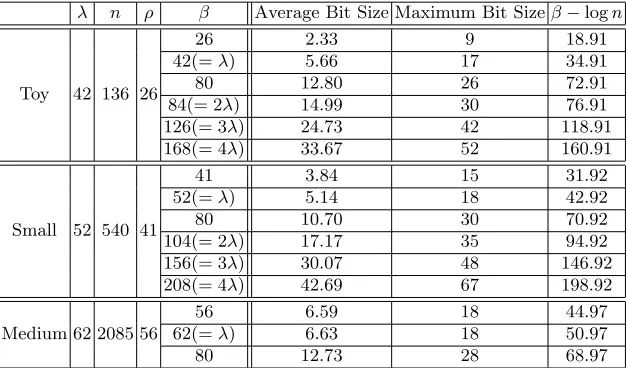
Table 55 lists the average bit size of entries in Hgenerated by the algorithm of Coronet al. on various parametersβ and n. From the last three columns of Table 5, one can observe that average bit sizes are approximately 10 whenβ = 80 as in the implementation parameters in [12]; moreover, the maximum bit sizes are lower than 30, and they are much smaller than the bestβ−logn, which is obtained from the boundkH>k
∞≤2β.
In [12, Section 3.1], the authors stated that “One can take β =λ”; however, our analysis and experimental results indicate that β should be much larger than λ. In Table 5, when β ≤3λ, the expected average bit-size of |hij| is still smaller than ρ, and for Small security, when β ≈4λ, the
expectation of the average bit-size of |hij|is equal to ρ; thus,β ≥4λwould be safe for the security
of the multilinear maps. We investigate the reason why theH-generation in [12] could not increase enough entropy in Section 6.
5
Table 5.Bit-size of entries of a matrixH(Experimental results on average of 100 matrices for Toy and Small and 10 matrices for Medium)
λ n ρ β Average Bit Size Maximum Bit Sizeβ−logn
Toy 42 136 26
26 2.33 9 18.91
42(=λ) 5.66 17 34.91
80 12.80 26 72.91
84(= 2λ) 14.99 30 76.91
126(= 3λ) 24.73 42 118.91
168(= 4λ) 33.67 52 160.91
Small 52 540 41
41 3.84 15 31.92
52(=λ) 5.14 18 42.92
80 10.70 30 70.92
104(= 2λ) 17.17 35 94.92
156(= 3λ) 30.07 48 146.92
208(= 4λ) 42.69 67 198.92
Medium 62 2085 56
56 6.59 18 44.97
62(=λ) 6.63 18 50.97
80 12.73 28 68.97
5.2 Implementation
We have implemented Algorithm 3 with various parameters in C++, using the Gnu MP library [1] and NTL library [33], on an Intel(R) Core(TM) i7-2600 CPU at 3.4 GHz with 16 GB RAM.
Attack on Zero-testing Parameter: We have implemented Algorithm 3 to attack on the zero-testing parameters; we setn,η, and ρ as in the implementation parameters for Small (52-bit) and Medium (62-bit) security [12, Section 6.4] and generated the zero-testing parameter normally by using the method described in [13, Appendix F]. We summarize the result in Table 6, and it displays that Algorithm 3 finds a non-trivial factor very quickly on the parameters for Small and Medium security levels.
Table 6.Attack on zero-testing parameter
Inst. λ n η β Exp(|hij|) m d Time? Security against Alg. 3
Small 52 540 1838 80 10.70 8 16 8.42 sec ≤234.84clock cycles Medium 62 2085 2043 80 12.73 9 32 47.28 sec ≤237.23clock cycles
?The average running time for solving 50 problem instances
Attack on Re-randomization Parameter: We first define Toy parameters for 42-bit security. To this end, we benchmark the parameter of FHEs in [14], which is conservatively determined according to the complexity of the Chen-Nguyen attack [8]. In Table 7, we provide the average running time to solve 50 problems for Toy parameters, and the experimental result demonstrates that the expected security level is tight.
In fact, the complexity difference between Algorithm 3 and the Chen-Nguyen attack isO( q
ρlogρ n )
and q
ρlogρ
n ≈1 for 42-bit security. For Large and Extra security level parameters,
q
ρlogρ n is less
Table 7.Attack on re-randomization parameter
Inst. λ n η ρ m d (Average) trials Running time Sec. ag. Alg 3† Toy 42 136 1628 26 14 16 3.7 times 1979.55 sec 242.72 †This counts the number of clock cycles.
for Large security (Extra security, resp.), with a similar storage advantage. Therefore, when one selects secure ρ size for large security level integer-based multilinear maps, we suggest that the performance of Algorithm 3 should be considered.
6 Discussions
Generating The Matrix H: First, we look at the method of generating a matrixHin the zero-testing parameters, which satisfies the bound kH>k∞ ≤ 2β and k(H−1)>k∞ ≤ 2β, proposed by
Coronet al. [13].
For any matrix A∈M atbn/2c×dn/2e({−1,0,1}), define HA∈Zn×n as
HA=
Ibn/2c A
0 Idn/2e
.
Letβ0 =jdlog(1+βdn/2e)ekand randomly chooseAi
$
←M atbn/2c×dn/2e({−1,0,1}). PickHi randomly
as eitherHAi or its transpose for eachi∈[1, β
0], and computeH asQβ0
i=1Hi.
We can easily prove that the above resulting matrix H satisfies the bounds kH>k∞ ≤2β and
k(H−1)>k∞≤2β; for each i∈[1, β0], kHik∞≤1 +dn/2e andkH>i k∞≤1 +dn/2e and hence
kH>k∞≤
Y
i∈[1,β0]
kH>i k∞≤(1 +dn/2e)β
0 ≤2β,
and similarly (H−1)> satisfies the same bound because HA−1 =H(−A).
Although the above approach enables the resulting matrixHto satisfy the upper bound of the operator norms, and the set of resulting matrices generated in this manner could be exponentially large, this approach does not guarantee the average and expectation of the operation norms of resulting matrices sufficiently large. We briefly explain the reason why this approach slowly increases the expected bit size of the absolute value ofhij’s, in comparison with its upper boundβ−logn.
For brevity, we assume that n is even number, that is, n = 2t. The maximum operator norm of
H can be achieved when the operator norm of each matrix Hi has the maximum value and H’s
operator norm is the product of HAi’s operator norms.H is a product of HAi’s and H
>
Ai’s, there
would be many continuous product of HAi and HAj, orH
>
Ai and H
>
Aj in computingH. (We state
that HAi and HAj are the same type, and H
>
Ai and H
>
Ai are also the same type.) Considering a
product ofHAi and HAj,
HAiHAj =
ItAi
0 It
ItAj
0 It
=
ItAi+Aj
0 It
.
Thus, kHAiHAjk∞ ≤ 1 +n. Although the multiplicative bound (≤ (1 +dn/2e)
we can generalize for products of many continuous matrices of the same type. In this case, each entry of a sum ofAi’s is a sum of random elements in{−1,0,1}, and hence its distribution will be
bell-shaped and it has a value nearby zero with a high probability. Therefore, the expected operator norm of the product matrix of the same types will be much smaller than even the additive bound.
From the above, we know H is of the form HB1H
>
B2HB3H
>
B4· · · or its transpose, where Bi’s
are sums ofAj’s. ConsideringHB1H
>
B2,
HB1H
>
B2 =
ItB1
0 It
It 0
B2It
=
It+B1B2 B1
B2 It
,
and kHB1H>B
2k∞ is significantly effected by kB1B2k∞. Each entry of Bi is distributed in [−`, `],
where Bi is a sum of ` matrices. Thus, the distribution of each entry ofB1B2 will be bell-shaped
and each entry has a value nearby zero with a high probability. Thus, we expect thatkHB1H>B 2k∞’s
expectation is much smaller than its upper bound, and sokHk∞’s expectation is much smaller than
2β. Therefore, we expect the expected bit size ofhij is much smaller than its possible upper bound
(β−logn).
Next, we present a candidate for H generation, which is expected to become immune to our attack rather than the original one, by slightly modifying Coron et al.’s suggestion.6 According to the above analysis on the originalHgeneration, the most problematic situation making low entropy is continuous product of HAi and HAj, or H
>
Ai and H
>
Aj. In our modification, we multiply HAi
wheniis odd and H>A
i wheniis even, instead of randomly choosing betweenHAi and H
>
Ai. Then,
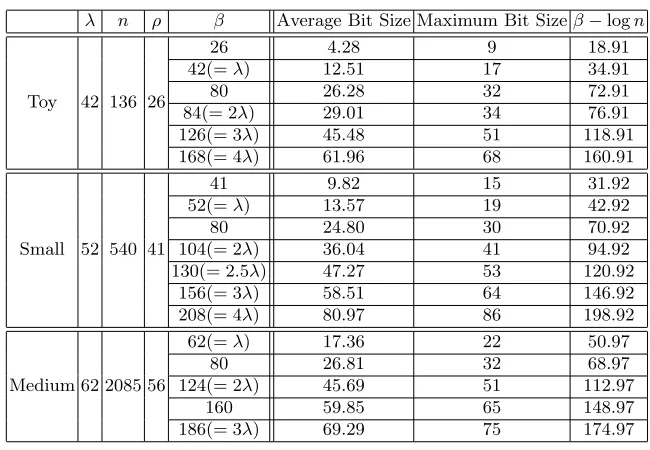
we always multiply different types, so that the norm ofHand bit sizes of entries ofHare increased relatively quickly. Table 8 shows that the modifiedHgeneration quickly increases bit-size of entries of H in comparison with the original one (Table 5). However, it seems necessary to increase β to be larger than λ, in contrast to the original suggestion in [12]. For Toy parameter (with β = 80), our implementation shows that the actual security is less than or equal to 42.59 against our attack algorithm, which is almost the same as the expected security levelλ= 42.
Although we suggest a candidate for H generation, it is still unclear how large β should be. According to our experimental result, it would be safe to set β to be larger than 3λ for practical parameters. However, it is open to find asymptotic bound ofβ for secureHgeneration, or to show asymptotic weakness of our modification.
Encoding-validity Test: Zero-testing Vector vs. Zero-testing Integer:In [12], Coronet al. implemented a one-round N-way Diffie-Hellman key exchange protocol [3], based on their multi-linear maps. They used heuristic optimizations for implementation, in particular the zero-testing integer, instead of the zero-testing vector as in the original construction. Note that both the CLT attack algorithm and our attack algorithm forn-MPACD require more than one sample; therefore, both are inapplicable to their optimized version of multilinear maps over the integers.
Garg et al. [20] pointed out a plausible threat when using a single zero-testing element. In applications that require resilience of the zero test, including against invalid encodings, several zero-testing elements can be utilized to prevent the use of invalid encodings. In cryptographic applications such as the Diffie-Hellman key exchange, it is important to test whether a given encoding is a group element. Because GES is a substitute for ideal multilinear groups, it is also important to test whether a given encoding is valid, and has an appropriate level. In Appendix E,
6In fact, this is proposed by one of the anonymous reviewers of CRYPTO 2014. We give the credit for this
Table 8.Bit-size of entries of Hgenerated by our suggestion (Experimental results on average of 100 matrices for Toy and Small and 10 matrices for Medium)
λ n ρ β Average Bit Size Maximum Bit Sizeβ−logn
Toy 42 136 26
26 4.28 9 18.91
42(=λ) 12.51 17 34.91
80 26.28 32 72.91
84(= 2λ) 29.01 34 76.91
126(= 3λ) 45.48 51 118.91
168(= 4λ) 61.96 68 160.91
Small 52 540 41
41 9.82 15 31.92
52(=λ) 13.57 19 42.92
80 24.80 30 70.92
104(= 2λ) 36.04 41 94.92
130(= 2.5λ) 47.27 53 120.92
156(= 3λ) 58.51 64 146.92
208(= 4λ) 80.97 86 198.92
Medium 62 2085 56
62(=λ) 17.36 22 50.97
80 26.81 32 68.97
124(= 2λ) 45.69 51 112.97
160 59.85 65 148.97
186(= 3λ) 69.29 75 174.97
Table 9.Attack on zero-testing parameters generated by our suggestion
Inst. λ n η β Exp(|hij|) m d Time? Security against Alg. 3
Toy 42 136 1628 80 26.28 14 16 1816.45 sec 242.59clock cycles
?The average running time for solving 25 problem instances
we present a (polynomial-time) key recovery attack on the multipartite Diffie-Hellman key exchange protocol, based on the CLT GES with a single integer zero-testing parameter. The basic idea of the attack is analogous to the Lim-Lee [30] key recovery attack of using invalid encodings on two-party Diffie-Hellman key exchange based on group structures.
Applications Beyond Multilinear Maps:We note that Algorithm 3 is applicable to the public parameters of a FHE scheme in [9].
In [9] two batch FHE schemes are proposed. Attacking the first scheme, called KLYC-FHE [27], Algorithm 3 with d = d√ne is asymptotically faster than the previous best Chen-Nguyen attack on the error size [8]. The public parameter in the KLYC-FHE contains
x0 =q0Qi∈[1,n]pi, {xj =CRTq0,p1,...,pn(e0j, e1jQ1, . . . , enjQn)}τj=1,
whereeij
$
←(−2ρ,2ρ) fori∈[1, n].xj can be considered asQ·CRTq0,p1,...,pn(ej0, ej1, . . . , ejn), where
Q = CRTq0,p1,...,pn(1, Q1, . . . , Qn) is unknown. Therefore, we can consider these parameters as an
instance ofn-MPACD. In this case, the parameterτ is very large; therefore, we have a sufficiently large number of samples for applying Algorithm 3. As mentioned previously, Algorithm 3 is faster
than the Chen-Nguyen attack, with the difference of O( q
ρlogρ
n ). In fact, the parametern in the
7 Conclusion
We introduce a new hard problem, calledn-MPACD, by generalizing system parameters of integer-based schemes. Furthermore, we present an attack algorithm for n-MPACD with speeding up techniques and implement our attack algorithm for particular system parameters of multilinear maps over integers [12]. We also point out a flaw, which makes the cost of our attack algorithm for the zero-testing parameters drastically reduce, in the generation of the zero-testing parameter in [12]. Although we present a simple modification of the original method for generating zero-testing parameter and it seems to mitigate the flaw for practical parameters, we do not have complete figures about theoretical and asymptotic analysis. We leave it as an interesting open problem.
Acknowledgement This work was supported by IT R&D program of MSIP/KEIT [No. 10047212]. Hyung Tae Lee was also supported in part by the Singapore Ministry of Education under Research Grant MOE2013-T2-1-041. Part of work was done while Hyung Tae Lee was with Seoul National University, Korea. Jae Hong Seo is the corresponding author for this paper. The authors also would like to thank Jung Hee Cheon and the anonymous reviewers of CRYPTO 2014 for their helpful comments. Part of this paper was made public through [32].
References
1. GMP: The GNU multiple precision arithmetic library ver. 5.1.3. http://gmplib.org, 2013.
2. S. Bayer and J. Groth. Efficient zero-knowledge argument for correctness of a shuffle. InEUROCRYPT 2012, volume 7237 ofLNCS, pages 263–280. Springer, 2012.
3. D. Boneh and A. Silverberg. Applications of multilinear forms to cryptography. Contemporary Mathematics, 324(1):71–90, 2003.
4. A. Bostan and ´E.Schost. On the complexities of multipoint evaluation and interpolation. Theoretical Computer Sciences, 329(1-3):223–235, 2004.
5. A. Bostan and ´E.Schost. Polynomial evaluation and interpolation on special sets of points.Journal of Complexity, 21(4):420–446, 2005.
6. Z. Brakerski and G. N. Rothblum. Obfuscating conjunctions. InCRYPTO (2) 2013, volume 8043 of LNCS, pages 416–434. Springer, 2013.
7. Z. Brakerski and G. N. Rothblum. Virtual black-box obfuscation for all circuits via generic graded encoding. In TCC 2013, volume 8349 ofLNCS, pages 1–25. Springer, 2013.
8. Y. Chen and P. Q. Nguyen. Faster algorithms for approximate common divisors: Breaking fully-homomorphic-encryption challenges over the integers. InEUROCRYPT 2012, volume 7237 ofLNCS, pages 502–519. Springer, 2012.
9. J. H. Cheon, J.-S. Coron, J. Kim, M. S. Lee, T. Lepoint, M. Tibouchi, and A. Yun. Batch fully homomorphic encryption over the integers. InEUROCRYPT 2013, volume 7881 ofLNCS, pages 315–335. Springer, 2013. 10. J. H. Cheon, S. Jarecki, and J. H. Seo. Multi-party privacy-preserving set intersection with quasi-linear complexity.
http://eprint.iacr.org/2010/512, 2010.
11. J.-S. Coron, A. Joux, A. Mandal, and D. Naccache. Cryptanalysis of the RSA subgroup assumption from TCC 2005. InPKC 2011, volume 6571 ofLNCS, pages 147–155. Springer, 2011.
12. J.-S. Coron, T. Lepoint, and M. Tibouchi. Practical multilinear maps over the integers. InCRYPTO (1) 2013, volume 8042 ofLNCS, pages 476–493. Springer, 2013.
13. J.-S. Coron, T. Lepoint, and M. Tibouchi. Practical multilinear maps over the integers. http://eprint.iacr.org/2013/183, 2013 (Full version of [12]).
14. J.-S. Coron, T. Lepoint, and M. Tibouchi. Batch fully homomorphic encryption over the integers. http://eprint.iacr.org/2013/036, 2013 (Full version of the second part of [9]).
15. J.-S. Coron, A. Mandal, D. Naccache, and M. Tibouchi. Fully homomorphic encryption over the integers with shorter public keys. InCRYPTO 2011, volume 6841 ofLNCS, pages 487–504. Springer, 2011.
17. A. M. Fiduccia. Polynomial evaluation via the division algorithm: the fast fourier transform revisited. STOC 1972, pages 88–93, 1972.
18. P.-A. Fouque, M. Tibouchi, and J.-S. Coron. Recovering private keys genrated with weak PRNGs. InIMACC 2013, volume 8308 ofLNCS, pages 158–172. Springer, 2013.
19. E. S. V. Freire, D. Hofheinz, K. G. Paterson, and C. Striecks. Programmable hash functions in the multilinear setting. InCRYPTO (1) 2013, volume 8042 ofLNCS, pages 513–530. Springer, 2013.
20. S. Garg, C. Gentry, and S. Halevi. Candidate multilinear maps from ideal lattices. In EUROCRYPT 2013, volume 7881 ofLNCS, pages 1–17. Springer, 2013.
21. S. Garg, C. Gentry, S. Halevi, M. Raykova, A. Sahai, and B. Waters. Candidate indistinguishability obfuscation and functional encryption for all circuits. InFOCS 2013, pages 40–49. IEEE Computer Society, 2013.
22. S. Garg, C. Gentry, S. Halevi, A. Sahai, and B. Waters. Attribute-based encryption for circuits from multilinear maps. InCRYPTO (2) 2013, volume 8043 ofLNCS, pages 479–499. Springer, 2013.
23. S. Garg, C. Gentry, A. Sahai, and B. Waters. Witness encryption and its applications. In STOC 2013, pages 467–476. ACM, 2013.
24. J. Groth. Efficient zero-knowledge arguments from two-tiered homomorphic commitments. In ASIACRYPT 2011, volume 7073 ofLNCS, pages 431–448. Springer, 2011.
25. S. Hohenberger, A. Sahai, and B. Waters. Full domain hash from (leveled) multilinear maps and identity-based aggregate signatures. InCRYPTO (1) 2013, volume 8042 ofLNCS, pages 494–512. Springer, 2013.
26. N. Howgrave-Graham. Approximate integer common divisors. In J. H. Silverman, editor,CaLC, volume 2146 of LNCS, pages 51–66. Springer, 2001.
27. J. Kim, M. S. Lee, A. Yun, and J. H. Cheon. CRT-based fully homomorphic encryption over the integers. http://eprint.iacr.org/2013/057, 2013 (Full version of the first part of [9]).
28. A. Langlois, D. Stehl´e, and R. Steinfeld. GGHLite: More efficient multilinear maps from ideal lattices. In EUROCRYPT 2014, volume 8441 ofLNCS, pages 239–256. Springer, 2014.
29. H. T. Lee and J. H. Seo. Security analysis of multilinear maps over the integers. In J. A. Garay and R. Gennaro, editors,CRYPTO (1) 2014, volume 8616 ofLNCS, pages 224–240. Springer, 2014.
30. C. H. Lim and P. J. Lee. A key recovery attack on discrete log-based schemes using a prime order subgroup. In CRYPTO 1997, pages 249–263, 1997.
31. T. Mateer. Fast Fourier Transform Algorithms with Applications. PhD thesis, Clemson University, 2008. 32. J. H. Seo. Faster algorithms for variants of approximate common divisors problem: Application to multilinear
maps over the integers.Memoirs of the 7th Cryptology Paper Contest, arranged by Korea government organization, 2013.
33. V. Shoup. NTL: A library for doing number theory ver. 6.0.0. Available at http://www.shoup.net/ntl/, 2013. 34. M. van Dijk, C. Gentry, S. Halevi, and V. Vaikuntanathan. Fully homomorphic encryption over the integers. In
EUROCRYPT 2010, volume 6110 ofLNCS, pages 24–43. Springer, 2010.
35. D. Vergnaud. Efficient and secure generalized pattern matching via fast fourier transform. InAFRICACRYPT 2011, volume 6737 ofLNCS, pages 41–58. Springer, 2011.
36. J. von zur Gathen and J. Gerhard. Modern computer algebra (2nd ed.). Cambridge University Press, 2003.
A Coron et al.’s Multilinear Maps Construction
Here, we recall the description of the CLT GES construction only. For parameter selections and the design rationale, we refer to the original paper [12].
Multilinear Maps over the Integers.The GES consists of six algorithmsInstGen, samp, enc, reRand, isZero and ext, except for adding and multilinear maps. The InstGen takes the security parameter λ and the required mulitilinearity levelκ as inputs and outputs a zero testing parameter pzt and
other system parameters params. The samp algorithm takes as an input the system parameter
paramsand then outputs a level-zero encoding of a random message. The encalgorithm is used to encode at higher levels; that is, it takesparamsand a level-0 encoding as inputs, and then it outputs a level-1 encoding of the same message. The reRand algorithm is for re-randomization of level-1 encodings. TheisZero algorithm takesparams,pzt, uκ as inputs, and then it determines whetheruκ
is an encoding of zero or not. Lastly, the ext algorithm with params,pzt, uκ as inputs extracts a
Instance Generation: InstGen(1λ,1κ)→(params,pzt). Fori∈[1, n], choose pi
$
← {η-bit primes}
and gi
$
← {α-bit primes}. For i ∈ [1, n] and j ∈ [1, `], select aij
$
← [0, gi). Set x0 = Qn
i=1pi and
pick z ←$ [0, x0) with gcd(z, x0) = 1. Then, define parameters y,{xj}τj=1,{x0j}`j=1,{Πj}nj=1 and zero-testing parameters{(pzt)j}nj=1 as follows:
y =CRT(pi)(
ri·gi+1
z ), whereri
$
←(−2ρ,2ρ).
For 1≤j≤`, x0j =CRT(pi)(r0ij·gi+aij), wherer0ij
$
←(−2ρ,2ρ). For 1≤j≤n, Πj =CRT(pi)(
$ij·gi
z ), whereΠ = ($ij)∈Z
n×nis defined below.
For 1≤j≤τ, xj =CRT(pi)(
rij·gi
z ), whererij’s are defined below.
For j∈[1, n], (pzt)j =Pni=1hij·(zκ·gi−1 mod pi)·Qi06=ipi0 (mod x0),
where z, gi, and hij are secret information and κ is the maximum allowed level. In particular, H = (hij) ∈ Zn×n is invertible in Z and both kH>k∞ ≤ 2β and k(H−1)>k∞ ≤ 2β. Π’s non
diagonal entries are randomly and independently chosen from (−2ρ,2ρ), while the diagonal entries are randomly chosen from (n2ρ, n2ρ + 2ρ). The column vector of the matrix (rij) ∈ Zn×τ are
randomly and independently chosen from the half-open parallelepiped spanned by the columns of Π.
Finally, the InstGen algorithm chooses a seed s for a strong randomness extractor, and then outputs the zero-testing vector pzt∈Zn and the other system parameters
params= (n, η, α, ρ, β, τ, `, y,{xj}τj=1,{x
0
j}`j=1,{Πj}nj=1, s).
Sampling Level-zero Encodings: samp(params)→ c. This algorithm chooses a random binary vectorb= (bj)∈ {0,1}` and outputs the level-0 encoding
c=
`
X
j=1
bj·x0j modx0.
Encoding at Higher Levels7: enc(params,c) → ck. Given a level-0 encoding c, this algorithm
outputs a level-1 encoding of the same message by just computing the product c·y modx0.
Re-randomization8:reRand(params,c)→c0. Given as an input a level-1 encodingc1, the algorithm randomizes c1 as follows:
c01 =c1+
τ
X
j=1
bj·xj+ n
X
j=1
b0j·Πj modx0,
wherebj
$
← {0,1} and b0j ←$ [0,2µ).
Adding and Multilinear Map:We can add encoded messages by adding encodings modulusx0. For multilinear maps, given level-1 encodings uj forj∈[1, κ], we can simply compute
u=
κ
Y
j=1
uj mod x0.
7
In [12], this algorithm takes one more valuekas an input, but in the algorithm description of [12]kis not used, and hence we omit it here.
8
Zero Testing:
isZero(params,pzt, uκ) =
1 if kuκ·pztmodx0k∞< x0·2−ν
0 otherwise .
Given uκ as an input, this algorithm determines whether uκ is a level-κ encoding of 0 or not by
computing kuκ·pztmodx0k∞ with the zero-testing parameterpzt.
Extraction: ext(params,pzt, uκ) = Extracts(msbsν(uκ·pztmodx0)), where msbsν extracts the ν
most significant bits of the result and Extracts is a strong randomness extractor with the seed s
from the system parameterparams.
B Approximate Common Divisors and Variants
We first give the definitions of the approximate common divisors (ACD) problem and its weaker version, partial ACD, which were originally presented by Howgrave-Graham [26].
Definition 2 (Approximate Common Divisors) We first define the following distribution over γ-bit integers for an integer p:
Dγ,ρ(p) ={Choose q ←$ [0,2γ/p), r←$ (−2ρ,2ρ) : Output x=pq+r}.
The (ρ, η, γ)-Approximate Common Divisors (abbreviated as ACD) problem is defined as follows. Given polynomially many samples from Dγ,ρ(p) for a randomly chosen η-bit odd integer p, findp.
Definition 3 (Partial Approximate Common Divisors) We use the following distribution over γ-bit integers for an integer p:
Dγ,ρ(p) ={Choose q
$
←[0,2γ/p), r←$ (−2ρ,2ρ) : Output x=pq+r}.
The (ρ, η, γ)-Partial Approximate Common Divisors (abbreviated as PACD) problem is defined as follows. Pick a random η-bit prime p and a random 2λ2-rough integer q0 from [0,2γ/p).9 Given x0 =pq0 and polynomially many samples xj from Dγ,ρ(p), findp.
Coronet al.introduced a variant of ACD, which was utilized to argue the security of their FHE scheme [14]. Here, we give its definition because it will be used as an intermediate problem to show relations between PACD and new variants.
Definition 4 (n-decisional Partial Approximate Common Divisors) We first define the fol-lowing oracleOq0,(p
i), given integersq0, p1, . . . , pn.Oq0,(pi)takes as inputs a vector(v1, . . . , vn)∈Z
n
and outputsx with
x=CRTq0,(pi)(q, v1+ 2r1, . . . , vn+ 2rn)
where q ←$ [0, q0) and ri ←$ (−2ρ,2ρ). 9
Fig. 1.Relations among ACD variants
The (ρ, η, γ, n)-decisional Partial Approximate Common Divisors (abbreviated as n-dPACD) problem is as follows. Pick random η-bit primespi for i∈[1, n] and let π be the their product. Set
x0 :=q0·π, whereq0 is a randomly chosen2λ
2
-rough integer from[0,2γ/π), and let w0= (0, . . . ,0) and choosew1 ← {$ 0,1}n. Givenx0,z=O
q0,(pi)(wb) and oracle access to Oqo,(pi) for a random bit
b, guess b.
To link then-MPACD with other well-known problems, we introduce another number-theoretic problem,n-Partial Approximate Common Divisors.
Definition 5 (n-Partial Approximate Common Divisors) Given integers q0, p1, . . . , pn, we
state that xj is sampled from the distribution Dρ(q0, p1, . . . , pn) if xj =CRTq0,(pi)(qj, r1j, . . . , rnj)
where qj
$
←[0, q0) and rij
$
←(−2ρ,2ρ) for all i∈[1, n].
We define (ρ, η, γ, n)-Partial Approximate Common Divisors (abbreviated asn-PACD) problem as follows. Pickη-bit random primespi for i∈[1, n]and let π be the their product. Setx0 :=q0·π,
where q0 is a randomly chosen 2λ2-rough integer from [0,2γ/π). Given x0 and polynomially many samples xj from Dρ(q0, p1, . . . , pn), find a prime factor of (x0/q0).
Let us clarify differences betweenn-PACD andn-MPACD; in the distributionDM
ρ , we generalize by
allowing non-uniformrij in contrast toDρ. Furthermore, (more importantly) the unknown masking
Q is multiplied in DM
ρ in contrast to Dρ. We do not restrict Q to be chosen uniformly, but it is
required to have enough entropy so that it is hard to guessQ. It looks like that these two differences make n-MPACD much harder thann-PACD.
B.1 Relations
by a line or a dotted line;A→B means thatAis a hard problem ifBso. If the other side relation is unknown yet, we use AL99B.
By definition, it is straightforward that PACD is easier than or equal to ACD. Moreover, there exists a specialized algorithm for PACD [8] that has asymptotically lower cost than that of the known best algorithms for ACD [8, 16]. We can also easily check that n-MPACD is harder than or equal to n-PACD from their definitions, as we briefly discussed in the previous section.10 Furthermore, one side relations between PACD and 1-dPACD and between 1-dPACD andn-dPACD are proven by Coronet al. [14]. We recall their results;
Theorem 1 [14, Lemma 11] The n-dPACD problem is hard if the1-dPACD problem is hard.
Theorem 2 [14, Lemma 12] The 1-dPACD problem is hard if the PACD problem is hard.
Now we address the remaining relations between n-PACD and n-dPACD and between PACD and 1-dPACD (the other direction of Theorem 2).
Theorem 3 Then-PACD problem is hard if the n-dPACD problem is hard.
Proof. We consider all parameters n,ρ, and m (the number of samples) used for generating prob-lem instances as being polynomially bounded in the security parameter. Suppose that there is an algorithmAfor solving then-PACD problem whose errors are chosen from (−2ρ+1,2ρ+1). By using
A, we construct an algorithmBfor then-dPACD problem whose errors are distributed in (−2ρ,2ρ).
Subsequently, we show that ifAoutputs a prime factor with a non-negligible probability, then B’s advantage for distinguishing then-dPACD instance is also non-negligible.
B starts with receiving an instance of the n-dPACD problem (x0, z) along with oracle access
toOq0,(p
i).B chooses and queries polynomially manyvi
$
← {0,1}nto the oracle, and then receives Oq0,(pi)(vi)’s.B sends Oq0,(pi)(vi)’s along withx0 toA. Then, A outputsp.B checks whether p is
a prime factor ofx0/q0 or not; it can be done by computing gcd(p, x0)∈(1, x0) and by checking if the size ofpis the same with the predetermined size. If yes,B outputs 1 if and only if (zmodp) is odd. Otherwise, Boutputs a random bit.
Let us first consider the distribution of Oq0,(p
i)(vi);
Oq0,(pi)(vi) =CRTq0,(pi)(q, v1+ 2r1, . . . , vn+ 2rn),
wherevi = (v1, . . . , vn) and r1, . . . , rn←$ (−2ρ,2ρ). Because vi is uniformly chosen from {0,1} and
ri is uniformly chosen from (−2ρ,2ρ),vi+ 2ri is uniformly distributed in (−2ρ+1+ 1,2ρ+1) for each
i∈ [1, n]. Then, the statistical distance between the simulated distribution of {Oq0,(pi)(vi)}i∈[1,m] and the real distribution of the instance of n-PACD is at most 2nmρ+1, which is negligible in the
security parameter under our selection of polynomial n,m, and ρ.
Finally, we analyze the advantage ofBfor distinguishingb. LetEbe the event that Aoutputs a
prime factor ofx0/q0. Recallz=Oq0,(pi)(wb), whereb
$
← {0,1},w0 = (0, . . . ,0) andw1 ← {$ 0,1}n.
Note thatbis completely hidden in A’s view becausez is not given toA. The advantage ofBis as
10For n-PACD, we are required to output a prime factor in contrast ton-MPACD. We note that there is a trivial
follows:
Pr[B outputs 0|b= 0]−Pr[Boutputs 0|b= 1]
= Pr[B outputs 0∧E|b= 0] + Pr[Boutputs 0∧ ¬E|b= 0]
− Pr[B outputs 0∧E|b= 1] + Pr[B outputs 0∧ ¬E|b= 1]
= Pr[B outputs 0|E∧(b= 0)]·Pr[E|b= 0] + Pr[B outputs 0|¬E∧(b= 0)]·Pr[¬E|b= 0]
− Pr[B outputs 0|E∧(b= 1)]·Pr[E|b= 1] + Pr[Boutputs 0|¬E∧(b= 1)]·Pr[¬E|b= 1]
= Pr[B outputs 0|E∧(b= 0)]·Pr[E] + Pr[Boutputs 0|¬E∧(b= 0)]·Pr[¬E]
− Pr[B outputs 0|E∧(b= 1)]·Pr[E] + Pr[B outputs 0|¬E∧(b= 1)]·Pr[¬E]
≥Pr[B outputs 0|E∧(b= 0)]·(− nm
2ρ+1) + Pr[Boutputs 0|¬E∧(b= 0)]·(1−−2nmρ+1) − Pr[B outputs 0|E∧(b= 1)]·(+ 2nmρ+1) + Pr[B outputs 0|¬E∧(b= 1)]·(1−+2nmρ+1)
= 1·(−2nmρ+1) +
1
2 ·(1−−
nm
2ρ+1) −
1 2 ·(+
nm
2ρ+1) +
1
2 ·(1−+
nm
2ρ+1)
= 2 −52 ·2nmρ+1,
where is A’s success probability. Without loss of generality, we assume that A outputs a prime factor p1. The third equality holds since bis completely hidden in the view of A. When b= 1, w1 could be 0 with 1/2 probability, wherew1is the first component ofw1, and hence Pr[B outputs 0|E∧ (b = 1)] = 1/2 in the fifth equation. Therefore, B’s advantage is non-negligible if A’s success probability is non-negligible and n,m,ρ are polynomial in the security parameter. ut
Because the 1-PACD problem is the exactly same with the PACD problem, Theorem 3 implies the following corollary.
Corollary 1 The PACD problem is hard if the 1-dPACD problem is hard.
From the above results, we can conclude both n-PACD and n-MPACD are hard problems if PACD is hard.
C (Corrected) Coron-Lepoint-Tibouchi Algorithm for n-MPACD
The CLT attack for n-MPACD takes x0 and two samples x1 and x2 as inputs and computes u =x1/x2 (mod x0). Then, it computes gcd(i2u−i1, x0) for all possible i1, i2 ∈ (−2ρ,2ρ). While the naive gcd computation for all i1 and i2 costs O(22ρ) operations, their algorithm reduces the attack complexity toO(ρ22ρ) using the meet-in-the-middle attack like the Chen-Nguyen’s attack [8] with the fast polynomial algorithm provided in Table 2. More precisely, the CLT algorithm takes x0,x1 and x2 and then computes
gcdx0,
Y
i1,i2∈(−2ρ,2ρ)
(i2u−i1) (mod x0)
by using the fast polynomial algorithms.
However, this approach is insufficient to find a non-trivial factor ofx0. The approach of comput-ing common divisors betweenx0 and a product of all candidates of multiples of a prime factor was successful to attack PACD. But, if we naively apply the same approach to n-MPACD, there is an issue we have to carefully address; because the productQ
i1,i2∈(−2ρ,2ρ)(i2u−i1) (mod x0) consists
result gcdx0,Qi1,i2∈(−2ρ,2ρ)(i2u−i1) (mod x0)
will be a zero, not a non-trivial factor of x0. To overcome this obstacle, we apply the divide-and-conquer approach used in our attack algorithms under the following assumption.
Assumption 3. 22ρ+1 ≤ pi; that is, the rij’s are sufficiently smaller than pi for all i ∈ [1, n].
Assumption 4. The integer matrix (rij)i∈[1,n]
j∈[1,2]
∈Zn×2’s rank is 2.
Note that the matrix (hij)i∈[1,n]
j∈[1,2]
in the zero-testing parameter satisfies Assumption 4. We provide
the full description of the (corrected) CLT algorithm for n-MPACD in Algorithm 4. The following lemma shows that each integer in the product cannot be zero modulusx0, so that we conclude our procedure should find a non-trivial factor before arriving at the final step.
Lemma 3 For all i1, i2 ∈(−2ρ,2ρ)\ {0},i2u−i1 6≡0 modx0 under Assumption 3 and 4.
We provide the proof of Lemma 3 in Appendix D.
Complexity: The complexity of computing A mainly depends on the interval size used in the product; that is, we require O((ρ+ 1)22ρ+1) operations modulo x
0 from AlgF F TP oly and AlgF F TM P E’s
complexity. Similarly, for each ofA’s four factors, we must performO(ρ22ρ) operations modulo x0 because each A’s factor uses a half size interval of I. Similarly again, we require O((ρ−1)22ρ−1) operations modulox0for each ofAi’s four factors, and so on. Overall, the computational complexity
forA and all its factors is bounded by
O((ρ+ 1)22ρ+1) + 4O(ρ22ρ) +· · ·+ 4 ˜O(21) =O(5(ρ+ 1)22ρ+1) =O(ρ22ρ) operations modulox0.
We can also demonstrate that the space complexity is bounded byO(ρ22ρ) polynomially many bits from the storage complexity ofAlgF F TM P E andAlgF F TP oly.
Algorithm 4 (Corrected) CLT algorithm Input: (x0, x1, x2)
Output: a non-trivial factor ofx0 or⊥
1: ComputeA:=Q
i1,i2∈I(i2u−i1) modx0, whereI= (−2
ρ
,2ρ); First, compute a polynomialf(X) =Q
i1∈I(Xu−i1) modx0 by usingAlg
F F T P oly.
Second, evaluate on multipoints{f(i2) modx0}i2∈I by usingAlgF F TM P E.
Finally, compute a productQ
i2∈If(i2) modx0, which is equal to
Q
i1,i2∈I(i2u−i1) modx0.
2: Setk←1.
3: while k≤ρ+ 1do
4: ComputeAifori∈ {00,01,10,11}. .Similarly to Step 1, whereAiis defined in this paper.
5: Compute gcd(x0, Ai) fori∈ {00,01,10,11}.
6: if gcd(x0, Ai)∈(1, x0) for someithen
7: returngcd(x0, Ai).
8: else
9: Choose anAisuch that gcd(x0, Ai) =x0, and then setA←Aiandk←k+ 1.
10: end if
11: end while