DAMA/LIBRA Results and Perspectives
R. Bernabei1,2, P. Belli1,2, F. Cappella3,4, V. Caracciolo5,a, R. Cerulli1,2, C.J. Dai4, A. d’Angelo3,4, A. Di Marco1,2, H.L. He4, A. Incicchitti3,4, H.H. Kuang6, X.H. Ma6, F. Montecchia2,7, X.D. Sheng6, R.G. Wang6and Z.P. Ye6,8
1Dip. di Fisica, Università di Roma “Tor Vergata”, 00133 Rome, Italy 2INFN, sez. Roma “Tor Vergata”, 00133 Rome, Italy
3Dip. di Fisica, Università di Roma “La Sapienza”, 00185 Rome, Italy 4INFN, sez. Roma, 00185 Rome, Italy
5Laboratori Nazionali del Gran Sasso, I.N.F.N., Assergi, Italy
6Key Laboratory of Particle Astrophysics, Institute of High Energy Physics, Chinese
7Dip. di Ingegneria Civile e Ingegneria Informatica, Università di Roma “Tor Vergata”, 00133 Rome, Italy 8University of Jing Gangshan, Jiangxi, China
Abstract.The DAMA/LIBRA experiment (∼250 kg sensitive mass composed by highly radio-pure NaI(Tl)) is in data taking in the underground Laboratory of Gran Sasso (LNGS). In its first phase (DAMA/LIBRA–phase1) this experiment and the former DAMA/NaI experiment (∼100 kg of highly radio-pure NaI(Tl)) collected data for 14 independent annual cycles, exploiting the model-independent Dark Matter (DM) annual modulation signature (total exposure 1.33 ton ×yr). A DM annual modulation effect has been observed at 9.3σC.L., supporting the presence of DM particles in the galactic halo. No systematic or side reaction able to mimic the observed DM annual modulation has been found or suggested by anyone. Recent analyses on possible diurnal effects, on the Earth shadowing effect and on possible interpretation in terms of Mirror DM will be mentioned. At present DAMA/LIBRA is running in its phase2 with increased sensitivity.
1 Introduction
The DAMA project is based on the development and use of low background scintillators. In par-ticular, the second generation DAMA/LIBRA apparatus [1–21], as the former DAMA/NaI (see for example Ref. [8, 22, 23] and references therein), is further investigating the presence of DM particles in the galactic halo by exploiting the model independent DM annual modulation signature, originally suggested in the mid 80’s[24]. At present DAMA/LIBRA is running in its phase2 with increased sen-sitivity. The detailed description of the DAMA/LIBRA set-up during the phase1 has been discussed in details in Ref. [1–4, 8, 17–21].
The signature exploited by DAMA/LIBRA (the model independent DM annual modulation) is a consequence of the Earth’s revolution around the Sun; in fact, the Earth should be crossed by a larger flux of DM particles around≃2 June (when the projection of the Earth orbital velocity on the Sun velocity with respect to the Galaxy is maximum) and by a smaller one around≃2 December (when
the two velocities are opposite). This DM annual modulation signature is very effective since the effect induced by DM particles must simultaneously satisfy many requirements: the rate must contain a component modulated according to a cosine function (1) with one year period (2) and a phase peaked roughly≃2 June (3); this modulation must only be found in a well-defined low energy range, where DM particle induced events can be present (4); it must apply only to those events in which just one detector of many actually “fires” (single-hitevents), since the DM particle multi-interaction probability is negligible (5); the modulation amplitude in the region of maximal sensitivity must be≃
7% for usually adopted halo distributions (6), but it can be larger (even up to≃30%) in case of some possible scenarios such as e.g. those in Ref. [25, 26]. Thus this signature is model independent, very discriminating and, in addition, it allows the test of a large range of cross sections and of halo densities. This DM signature might be mimicked only by systematic effects or side reactions able to account for the whole observed modulation amplitude and to simultaneously satisfy all the requirements given above. No one is available [1–4, 7, 8, 12–16, 19, 21–23, 27].
2 The Results of DAMA/LIBRA–phase1 and DAMA/NaI
The total exposure of DAMA/LIBRA–phase1 is 1.04 ton ×yr in seven annual cycles; when also including also that of the first generation DAMA/NaI experiment it is 1.33 ton×yr, corresponding to 14 annual cycles [2–4, 8].
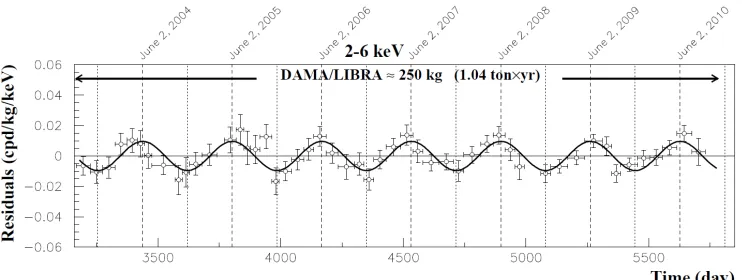
To point many different independent data analyses have been performed giving always consistent results. In particular, for simplicity we report in Fig. 1 the the time behaviour of the experimental residual rates of thesingle-hitscintillation events only for DAMA/LIBRA–phase1 in the (2–6) keV energy interval is plotted. Theχ2test excludes the hypothesis of absence of modulation in the data: χ2/d.o.f.=154/87 for the (2–6) keV energy interval (P-value=2.2×10⁻³). When fitting the single-hitresidual rate of DAMA/LIBRA–phase1 together with the DAMA/NaI ones, with the function: Acosω(t −t0), considering a period T = 2ωπ = 1 yr and a phase t0 = 152.5 day (June 2nd) as
expected for the DM annual modulation signature, the following modulation amplitude is obtained: A=(0.0110±0.0012) cpd/kg/keV corresponding to 9.2σC.L.. When the period, and the phase are kept free in the fitting procedure, the modulation amplitude is (0.0112±0.0012) cpd/kg/keV (9.3σ
C.L.), the periodT =(0.998±0.002) year and the phaset0 =(144±7) day, values well in agreement
with expectations for a DM annual modulation signal. In particular, the phase is consistent with about June 2nd and is fully consistent with the value independently determined by Maximum Likelihood
analysis [4]1. The run test and theχ2 test on the data have shown that the modulation amplitudes
singularly calculated for each annual cycle of DAMA/NaI and DAMA/LIBRA–phase1 are normally fluctuating around their best fit values [2–4, 8].
We have also performed a power spectrum analysis of thesingle-hitresiduals of DAMA/LIBRA– phase1 and DAMA/NaI [8], obtaining a clear principal mode in the (2–6) keV energy interval at a frequency of 2.737×10⁻³d−1, corresponding to a period of≃1 year, while only aliasing peaks are
present in the energy region above 6 keV.
Absence of any significant background modulation in the energy spectrum has been verified in energy regions not of interest for DM [4]; it is worth noting that the obtained results account for whatever kind of background and, in addition, no background process able to mimic the DM annual modulation signature (that is able to simultaneously satisfy all the peculiarities of the signature and to account for the whole measured modulation amplitude) is available (see also discussions e.g. in Refs. [1–4, 7, 8, 14, 15]).
1For completeness, we recall that a slight energy dependence of the phase could be expected in case of possible contributions
the two velocities are opposite). This DM annual modulation signature is very effective since the effect induced by DM particles must simultaneously satisfy many requirements: the rate must contain a component modulated according to a cosine function (1) with one year period (2) and a phase peaked roughly≃2 June (3); this modulation must only be found in a well-defined low energy range, where DM particle induced events can be present (4); it must apply only to those events in which just one detector of many actually “fires” (single-hitevents), since the DM particle multi-interaction probability is negligible (5); the modulation amplitude in the region of maximal sensitivity must be≃
7% for usually adopted halo distributions (6), but it can be larger (even up to≃30%) in case of some possible scenarios such as e.g. those in Ref. [25, 26]. Thus this signature is model independent, very discriminating and, in addition, it allows the test of a large range of cross sections and of halo densities. This DM signature might be mimicked only by systematic effects or side reactions able to account for the whole observed modulation amplitude and to simultaneously satisfy all the requirements given above. No one is available [1–4, 7, 8, 12–16, 19, 21–23, 27].
2 The Results of DAMA/LIBRA–phase1 and DAMA/NaI
The total exposure of DAMA/LIBRA–phase1 is 1.04 ton ×yr in seven annual cycles; when also including also that of the first generation DAMA/NaI experiment it is 1.33 ton×yr, corresponding to 14 annual cycles [2–4, 8].
To point many different independent data analyses have been performed giving always consistent results. In particular, for simplicity we report in Fig. 1 the the time behaviour of the experimental residual rates of thesingle-hitscintillation events only for DAMA/LIBRA–phase1 in the (2–6) keV energy interval is plotted. Theχ2test excludes the hypothesis of absence of modulation in the data: χ2/d.o.f. =154/87 for the (2–6) keV energy interval (P-value=2.2×10⁻³). When fitting the single-hitresidual rate of DAMA/LIBRA–phase1 together with the DAMA/NaI ones, with the function: Acosω(t −t0), considering a period T = 2ωπ = 1 yr and a phase t0 = 152.5 day (June 2nd) as
expected for the DM annual modulation signature, the following modulation amplitude is obtained: A=(0.0110±0.0012) cpd/kg/keV corresponding to 9.2σC.L.. When the period, and the phase are kept free in the fitting procedure, the modulation amplitude is (0.0112±0.0012) cpd/kg/keV (9.3σ
C.L.), the periodT =(0.998±0.002) year and the phaset0=(144±7) day, values well in agreement
with expectations for a DM annual modulation signal. In particular, the phase is consistent with about June 2nd and is fully consistent with the value independently determined by Maximum Likelihood
analysis [4]1. The run test and theχ2 test on the data have shown that the modulation amplitudes
singularly calculated for each annual cycle of DAMA/NaI and DAMA/LIBRA–phase1 are normally fluctuating around their best fit values [2–4, 8].
We have also performed a power spectrum analysis of thesingle-hitresiduals of DAMA/LIBRA– phase1 and DAMA/NaI [8], obtaining a clear principal mode in the (2–6) keV energy interval at a frequency of 2.737×10⁻³d−1, corresponding to a period of≃1 year, while only aliasing peaks are
present in the energy region above 6 keV.
Absence of any significant background modulation in the energy spectrum has been verified in energy regions not of interest for DM [4]; it is worth noting that the obtained results account for whatever kind of background and, in addition, no background process able to mimic the DM annual modulation signature (that is able to simultaneously satisfy all the peculiarities of the signature and to account for the whole measured modulation amplitude) is available (see also discussions e.g. in Refs. [1–4, 7, 8, 14, 15]).
1For completeness, we recall that a slight energy dependence of the phase could be expected in case of possible contributions
of non-thermalized DM components to the galactic halo, such as e.g. the SagDEG stream [28–30] and the caustics [31].
Figure 1. Experimental residual rate of thesingle-hitscintillation events measured by DAMA/LIBRA–phase1 in the (2–6) keV energy interval as a function of the time. The data points present the experimental errors as vertical bars and the associated time bin width as horizontal bars. The superimposed curves are the cosinusoidal functions behaviorsAcosω(t−t0) with a periodT =2ωπ=1 yr, a phaset0=152.5 day (June 2nd) and modulation amplitudes,A, equal to the central values obtained by best fit on these data points. The dashed vertical lines correspond to the maximum expected for the DM signal (June 2nd), while the dotted vertical lines correspond to
the minimum.
A further relevant investigation in the DAMA/LIBRA–phase1 data has been performed by apply-ing the same hardware and software procedures, used to acquire and to analyse thesingle-hitresidual rate, to themultiple-hitone. In fact, since the probability that a DM particle interacts in more than one detector is negligible, a DM signal can be present just in thesingle-hitresidual rate. Thus, the comparison of the results of thesingle-hitevents with those of themultiple-hitones corresponds prac-tically to compare between them the cases of DM particles beam-on and beam-off. This procedure also allows an additional test of the background behaviour in the same energy interval where the pos-itive effect is observed. In particular, the residual rates of thesingle-hitevents measured in the (2–6) keV energy interval over the DAMA/LIBRA–phase1 annual cycles, as collected in a single cycle, are reported in Ref. [4] together with the residual rates of themultiple-hitevents in the same energy interval. A clear modulation satisfying all the peculiarities of the DM annual modulation signature is present in thesingle-hitevents, while the fitted modulation amplitude for themultiple-hitresidual rate is well compatible with zero: −(0.0005±0.0004) cpd/kg/keV in the same energy region (2–6) keV. Thus, again evidence of annual modulation with the features required by the DM annual modulation signature is present in thesingle-hitresiduals (events class to which the DM particle induced events belong), while it is absent in the multiple-hitresidual rate (event class to which only background events belong). Similar results were also obtained for the last two annual cycles of the DAMA/NaI experiment [23]. Since the same identical hardware and the same identical software procedures have been used to analyse the two classes of events, the obtained result offers an additional strong support for the presence of a DM particle component in the galactic halo.
By performing a maximum-likelihood analysis of thesingle-hitscintillation events, it is possible to extract from the data the modulation amplitude,Sm, as a function of the energy consideringT =1
yr andt0 =152.5 day. Again the results have shown that positive signal is present in the (2–6) keV
energy interval, whileSmvalues compatible with zero are present just above; for details see Ref. [4].
performed. All of them confirm the evidence for the presence of an annual modulation in the data satisfying all the requirements for a DM signal.
Sometimes naive statements were put forwards as the fact that in nature several phenomena may show some kind of periodicity. The point is whether they might mimic the annual modulation signa-ture in DAMA/LIBRA (and former DAMA/NaI), i.e. whether they might be not only quantitatively able to account for the observed modulation amplitude but also able to contemporaneously satisfy all the requirements of the DM annual modulation signature. The same is also for side reactions. This has already been deeply investigated in Ref. [1–4] and references therein; the arguments and the quan-titative conclusions, presented there, also apply to the entire DAMA/LIBRA–phase1 data. Additional arguments can be found in Ref. [7, 8, 14, 15].
No modulation has been found in any possible source of systematics or side reactions; thus, cau-tious upper limits on possible contributions to the DAMA/LIBRA measured modulation amplitude are summarized in Ref. [2–4]. It is worth noting that they do not quantitatively account for the measured modulation amplitudes, and also are not able to simultaneously satisfy all the many requirements of the signature. Similar analyses have also been done for the DAMA/NaI data [22, 23]. In particular, in Ref. [15] it is shown that, the neutrons, the muons and the solar neutrinos cannot give any significant contribution to the DAMA annual modulation results.
In conclusion, DAMA gives model-independent evidence (at 9.3σC.L. over 14 independent
an-nual cycles) for the presence of DM particles in the galactic halo.
As regards comparisons, we recall that no direct model independent comparison is possible in the field when different target materials and/or approaches are used; the same is for the strongly model dependent indirect searches. In particular, the DAMA model independent evidence is compatible with a wide set of scenarios regarding the nature of the DM candidate and related astrophysical, nuclear and particle Physics; as examples some given scenarios and parameters are discussed e.g. in Ref. [2, 8, 22] and references therein. Further large literature is available on the topics. In conclusion, both negative results and possible positive hints are compatible with the DAMA model-independent DM annual modulation results in various scenarios slso considering the existing experimental and theoretical uncertainties; the same holds for the strongly model dependent indirect approaches (see e.g. arguments in Ref. [8] and references therein).
For completeness we recall that other rare processes have also been searched for by DAMA/LIBRA-phase1; see for details Refs. [9–11].
2.1 Diurnal Modulation
The results obtained by investigating the presence of possible diurnal variation in the low-energy single-hit scintillation events collected by DAMA/LIBRA–phase1 have been analysed in terms of a DM second order model-independent effect due to the Earth diurnal rotation around its axis [14]. Also this daily modulation of the rate on the sidereal time - expected when taking into account the contribution of the Earth rotation - presents some specific peculiarities. In particular the interest in this signature is also that the ratioRdyof this DM diurnal modulation amplitude over the DM annual
modulation amplitude is a model independent constant at a given latitude; considering the LNGS latitude,Rdy =Sd/Sm≃0.016. Thus, taking into account the DM annual modulation effect pointed
out by DAMA/LIBRA–phase1 for single-hit events in the low energy region, the expected value of the diurnal modulation amplitude for the (2-6) keV energy interval is≃1.5×10⁻⁴cpd/kg/keV. No diurnal
variation with a significance of 95% C.L. is found at the reached level of sensitivity, as reported in [14]. Considering the (2-6) keV energy interval the obtained upper limit on the DM diurnal modulation amplitude is 1.2×10⁻³ cpd/kg/keV (90% C.L.) [14]; thus, the effect of DM diurnal modulation,
performed. All of them confirm the evidence for the presence of an annual modulation in the data satisfying all the requirements for a DM signal.
Sometimes naive statements were put forwards as the fact that in nature several phenomena may show some kind of periodicity. The point is whether they might mimic the annual modulation signa-ture in DAMA/LIBRA (and former DAMA/NaI), i.e. whether they might be not only quantitatively able to account for the observed modulation amplitude but also able to contemporaneously satisfy all the requirements of the DM annual modulation signature. The same is also for side reactions. This has already been deeply investigated in Ref. [1–4] and references therein; the arguments and the quan-titative conclusions, presented there, also apply to the entire DAMA/LIBRA–phase1 data. Additional arguments can be found in Ref. [7, 8, 14, 15].
No modulation has been found in any possible source of systematics or side reactions; thus, cau-tious upper limits on possible contributions to the DAMA/LIBRA measured modulation amplitude are summarized in Ref. [2–4]. It is worth noting that they do not quantitatively account for the measured modulation amplitudes, and also are not able to simultaneously satisfy all the many requirements of the signature. Similar analyses have also been done for the DAMA/NaI data [22, 23]. In particular, in Ref. [15] it is shown that, the neutrons, the muons and the solar neutrinos cannot give any significant contribution to the DAMA annual modulation results.
In conclusion, DAMA gives model-independent evidence (at 9.3σC.L. over 14 independent
an-nual cycles) for the presence of DM particles in the galactic halo.
As regards comparisons, we recall that no direct model independent comparison is possible in the field when different target materials and/or approaches are used; the same is for the strongly model dependent indirect searches. In particular, the DAMA model independent evidence is compatible with a wide set of scenarios regarding the nature of the DM candidate and related astrophysical, nuclear and particle Physics; as examples some given scenarios and parameters are discussed e.g. in Ref. [2, 8, 22] and references therein. Further large literature is available on the topics. In conclusion, both negative results and possible positive hints are compatible with the DAMA model-independent DM annual modulation results in various scenarios slso considering the existing experimental and theoretical uncertainties; the same holds for the strongly model dependent indirect approaches (see e.g. arguments in Ref. [8] and references therein).
For completeness we recall that other rare processes have also been searched for by DAMA/LIBRA-phase1; see for details Refs. [9–11].
2.1 Diurnal Modulation
The results obtained by investigating the presence of possible diurnal variation in the low-energy single-hit scintillation events collected by DAMA/LIBRA–phase1 have been analysed in terms of a DM second order model-independent effect due to the Earth diurnal rotation around its axis [14]. Also this daily modulation of the rate on the sidereal time - expected when taking into account the contribution of the Earth rotation - presents some specific peculiarities. In particular the interest in this signature is also that the ratioRdyof this DM diurnal modulation amplitude over the DM annual
modulation amplitude is a model independent constant at a given latitude; considering the LNGS latitude,Rdy =Sd/Sm≃0.016. Thus, taking into account the DM annual modulation effect pointed
out by DAMA/LIBRA–phase1 for single-hit events in the low energy region, the expected value of the diurnal modulation amplitude for the (2-6) keV energy interval is≃1.5×10⁻⁴cpd/kg/keV. No diurnal
variation with a significance of 95% C.L. is found at the reached level of sensitivity, as reported in [14]. Considering the (2-6) keV energy interval the obtained upper limit on the DM diurnal modulation amplitude is 1.2×10⁻³ cpd/kg/keV (90% C.L.) [14]; thus, the effect of DM diurnal modulation,
expected because of the Earth diurnal motion on the basis of the DAMA DM annual modulation
results, is out the present sensitivity [14]. DAMA/LIBRA–phase2, presently running, with a lower software energy threshold [6] can also offer the possibility to increase sensitivity to such an effect.
2.2 Daily Effect on the Sidereal Time due to the Shadow of the Earth
The results obtained in the investigation of possible diurnal effects for low-energy single-hit scin-tillation events of DAMA/LIBRA–phase1 have been analysed in terms of Earth Shadow Effect, a model-dependent effect that is expected for DM candidates having a relative high cross-section (σn)
with ordinary matter [20]. In fact a diurnal variation of the low energy rate could be expected for these specific candidates, because of the different thickness of the shield due to the Earth during the sidereal day. The induced effect should be a daily variation of their velocity distribution, and therefore of the signal rate measured deep underground. However, this effect is very small and would be appreciable only in case of high cross-section candidates. By the fact, this analysis decouplesξ(fraction of galac-tic dark halo in form of the considered candidate) fromσn. Considering the measured DM annual
modulation effect and the absence – at the present level of sensitivity – of diurnal effects, the analysis selects allowed regions in the three-dimensional space: ξ,σnand DM particle mass in some model
scenarios; for details see Ref. [20].
2.3 Mirror Dark Matter
The model independent annual modulation effect observed by the DAMA experiments has also been investigated in terms of a mirror-type dark matter candidates in some scenarios [32, 33]. In the frame-work of asymmetric mirror matter, the DM originates from hidden (or shadow) gauge sectors which have particles and interaction content similar to that of ordinary particles. It is assumed that the mirror parity is spontaneously broken and the electroweak symmetry breaking scalev′in the mirror sector is much larger than that in the Standard Model,v=174 GeV. In this case, the mirror world becomes a heavier and deformed copy of our world, with mirror particle masses scaled in different ways with respect to the masses of the ordinary particles. Then, in this scenario dark matter would exist in the form of mirror hydrogen composed of mirror proton and electron, with mass of about 5 GeV which is a rather interesting mass range for dark matter particles. The data analysis in the Mirror DM model framework allows the determination of the √fϵparameter (where f is the fraction of Mirror DM in
the Galaxy in form of mirror atoms andϵis the coupling constant). In the analysis several
uncertain-ties on the astrophysical, particle physics and nuclear physics models have been taken into account in the calculation. The obtained values of the √fϵparameter in the case of mirror hydrogen atom ranges
between 7.7×10⁻¹⁰to 1.1×10⁻⁷ and they are well compatible with cosmological bounds [32]. In
addition, releasing the assumptionMA′≃5mp, allowed regions for the √fϵparameter as function of
MA′, mirror hydrogen mass, obtained by marginalizing all the models for each considered scenario,
have been obtained [32]; they also are well compatible with cosmological bounds.
In the framework of symmetric mirror DM model considered in Ref. [33], 3 different scenarios have been considered depending on: i) the adopted quenching factors; ii) either inclusion or not of the channeling effect; iii) either inclusion or not of the Migdal effect. For each scenario a different halo compositions reported have been considered, with halo temperature in the range 104- 108K and
with halo velocity from -400 to+300 km/s. The results achieved in [33] for the symmetric mirror DM considered demonstrate that many configurations and halo models favoured by the annual modulation effect observed by DAMA corresponds to √fϵvalues well compatible with cosmological bounds. It
3 DAMA/LIBRA–phase2 and Perspectives
An important upgrade was done at end of 2010 replacing all the PMTs with new ones having higher Quantum Efficiency (QE); details on the developments and on the reached performances in the opera-tive conditions are reported in Ref. [6]. They have allowed us to lower the software energy threshold of the experiment to 1 keV and to improve also other features as e.g. the energy resolution [6].
Since the fulfillment of this upgrade and after some optimization periods, DAMA/LIBRA–phase2 is continuously running in order e.g.: (1) to increase the experimental sensitivity thanks to the lower software energy threshold; (2) to improve the corollary investigation on the nature of the DM particle and related astrophysical, nuclear and particle physics arguments; (3) to investigate other signal fea-tures and second order effects; (4) to investigate other rare processes as also the former DAMA/NaI apparatus did.
Future improvements to further increase the sensitivity (possible DAMA/LIBRA-phase3) of the set-up can be considered by using new metallic high QE and ultra-low background PMTs to be di-rectly coupled to the NaI(Tl) crystals. In this way a further large improvement in the light collection and a further lowering of the software energy threshold would be obtained. The developments with Hamamatsu Co. are successful and 4 PMT prototypes are at hand. New protocols, and also alternative ideas, are ongoing that regards the possibility to dismount the light guide of the detectors which they act also as optical guides.
Finally, the possibility of a pioneering experiment with anisotropic ZnWO4 detectors to further
investigate, with the directionality approach, those DM candidates that scatter offtarget nuclei is in progress [34]; as e.g. the use of the present detectors untouched but with the metallic PMTs and new ultra low background crystal scintillators (e.g. ZnWO4) placed among the DAMA/LIBRA detectors
in order to reach a high sensitivity and contemporarily to perform directionality measurements is on going.
References
[1] R. Bernabei et al., Nucl. Instr. and Meth. A592, 297 (2008). [2] R. Bernabei et al., Eur. Phys. J. C56, 333 (2008).
[3] R. Bernabei et al., Eur. Phys. J. C67, 39 (2010). [4] R. Bernabei et al., Eur. Phys. J. C73, 2648 (2013). [5] P. Belli et al., Phys. Rev. D84, 055014 (2011). [6] R. Bernabei et al., J. of Instr.7, P03009 (2012). [7] R. Bernabei et al., Eur. Phys. J. C72, 2064 (2012).
[8] R. Bernabei et al., Int. J. of Mod. Phys. A28, 1330022 (2013). [9] R. Bernabei et al., Eur. Phys. J. C62, 327 (2009).
[10] R. Bernabei et al., Eur. Phys. J. C72, 1920 (2012). [11] R. Bernabei et al., Eur. Phys. J. A49, 64 (2013).
[12] R. Bernabei et al., Adv. High Energy Phys. 605659 (2014). [13] R. Bernabei et al., Phys.Part.Nucl.46, 138-146 (2015). [14] R. Bernabei et al., Eur. Phys. J. C74, 2827 (2014). [15] R. Bernabei et al., Eur. Phys. J. C74, 3196 (2014).
3 DAMA/LIBRA–phase2 and Perspectives
An important upgrade was done at end of 2010 replacing all the PMTs with new ones having higher Quantum Efficiency (QE); details on the developments and on the reached performances in the opera-tive conditions are reported in Ref. [6]. They have allowed us to lower the software energy threshold of the experiment to 1 keV and to improve also other features as e.g. the energy resolution [6].
Since the fulfillment of this upgrade and after some optimization periods, DAMA/LIBRA–phase2 is continuously running in order e.g.: (1) to increase the experimental sensitivity thanks to the lower software energy threshold; (2) to improve the corollary investigation on the nature of the DM particle and related astrophysical, nuclear and particle physics arguments; (3) to investigate other signal fea-tures and second order effects; (4) to investigate other rare processes as also the former DAMA/NaI apparatus did.
Future improvements to further increase the sensitivity (possible DAMA/LIBRA-phase3) of the set-up can be considered by using new metallic high QE and ultra-low background PMTs to be di-rectly coupled to the NaI(Tl) crystals. In this way a further large improvement in the light collection and a further lowering of the software energy threshold would be obtained. The developments with Hamamatsu Co. are successful and 4 PMT prototypes are at hand. New protocols, and also alternative ideas, are ongoing that regards the possibility to dismount the light guide of the detectors which they act also as optical guides.
Finally, the possibility of a pioneering experiment with anisotropic ZnWO4detectors to further
investigate, with the directionality approach, those DM candidates that scatter offtarget nuclei is in progress [34]; as e.g. the use of the present detectors untouched but with the metallic PMTs and new ultra low background crystal scintillators (e.g. ZnWO4) placed among the DAMA/LIBRA detectors
in order to reach a high sensitivity and contemporarily to perform directionality measurements is on going.
References
[1] R. Bernabei et al., Nucl. Instr. and Meth. A592, 297 (2008). [2] R. Bernabei et al., Eur. Phys. J. C56, 333 (2008).
[3] R. Bernabei et al., Eur. Phys. J. C67, 39 (2010). [4] R. Bernabei et al., Eur. Phys. J. C73, 2648 (2013). [5] P. Belli et al., Phys. Rev. D84, 055014 (2011). [6] R. Bernabei et al., J. of Instr.7, P03009 (2012). [7] R. Bernabei et al., Eur. Phys. J. C72, 2064 (2012).
[8] R. Bernabei et al., Int. J. of Mod. Phys. A28, 1330022 (2013). [9] R. Bernabei et al., Eur. Phys. J. C62, 327 (2009).
[10] R. Bernabei et al., Eur. Phys. J. C72, 1920 (2012). [11] R. Bernabei et al., Eur. Phys. J. A49, 64 (2013).
[12] R. Bernabei et al., Adv. High Energy Phys. 605659 (2014). [13] R. Bernabei et al., Phys.Part.Nucl.46, 138-146 (2015). [14] R. Bernabei et al., Eur. Phys. J. C74, 2827 (2014). [15] R. Bernabei et al., Eur. Phys. J. C74, 3196 (2014).
[16] R. Bernabei et al., Int. J. Mod. Phys. A31, 1642006 (2016). [17] R. Bernabei et al., Int. J. Mod. Phys. A31, 1642005 (2016). [18] R. Bernabei et al., Int. J. Mod. Phys. A31, 1642004 (2016).
[19] R. Bernabei et al., Int. J. Mod. Phys. A30, 1545006 (2015). [20] R. Bernabei et al., Eur. Phys. J. C75, 239 (2015).
[21] R. Bernabei et al., Phys. Part. Nucl.46, 138-146 (2015).
[22] R. Bernabei el al., La Rivista del Nuovo Cimento26, n.1 1-73 (2003). [23] R. Bernabei et al., Int. J. Mod. Phys. D13, 2127 (2004).
[24] K.A. Drukier et al., Phys. Rev. D33, 3495 (1986); K. Freese et al., Phys. Rev. D37, 3388 (1988). [25] D. Smith and N. Weiner, Phys. Rev. D64, 043502 (2001); D. Tucker-Smith and N. Weiner, Phys.
Rev. D72, 063509 (2005); D. P. Finkbeiner et al, Phys. Rev. D80, 115008 (2009).
[26] K. Freese et al., Phys. Rev. D71, 043516 (2005); K. Freese et al., Phys. Rev. Lett.92, 11301 (2004).
[27] R. Bernabei et al., Eur. Phys. J. C18, 283 (2000). [28] R. Bernabei et al., Eur. Phys. J. C47, 263 (2006).
[29] K. Freese et al., Phys. Rev. D 71, 043516 (2005); New Astr. Rev. 49, 193 (2005); astro-ph/0310334; astro-ph/0309279.
[30] G. Gelmini, P. Gondolo, Phys. Rev. D64, 023504 (2001).
[31] F.S. Ling, P. Sikivie and S. Wick, Phys. Rev. D70, 123503 (2004). [32] A. Addazi et al., Eur. Phys. J. C75, 400 (2015).