Constrained PRFs for Unbounded Inputs
Hamza Abusalah∗ Georg Fuchsbauer∗ Krzysztof Pietrzak∗
Institute of Science and Technology Austria {habusalah,gfuchsbauer,pietrzak}@ist.ac.at This is the full version of the extended abstract that appears in the proceedings of CT-RSA 2016.
Abstract
A constrained pseudorandom functionF:K × X → Y for a familyT ⊆2X of subsets ofX is a function where for any keyk∈ Kand setS ∈ T one can efficiently compute a constrained key
kS which allows to evaluate F(k,·) on all inputs x∈S, while even given this key, the outputs on all inputs x /∈ S look random. At Asiacrypt’13 Boneh and Waters gave a construction which supports the most general set family so far. Its keyskC are defined for sets decided by
boolean circuitsC and enable evaluation of the PRF on anyx∈ X whereC(x) = 1. In their construction the PRF input length and the size of the circuitsC for which constrained keys can be computed must be fixed beforehand during key generation.
We construct a constrained PRF that has an unbounded input length and whose constrained keys can be defined for any set recognized by a Turing machine. The only a priori bound we make is on the description size of the machines. We prove our construction secure assuming public-coin differing-input obfuscation.
As applications of our constrained PRF we build a broadcast encryption scheme where the number of potential receivers need not be fixed at setup (in particular, the length of the keys is independent of the number of parties) and the first identity-based non-interactive key exchange protocol with no bound on the number of parties that can agree on a shared key.
Keywords: Constrained PRFs, broadcast encryption, identity-based non-interactive key ex-change.
1
Introduction
Constrained PRFs. A pseudorandom function (PRF) [GGM86] is a keyed functionF:K×X → Y for which no efficient adversary, given access to an oracle O(·), can distinguish the case where
O(·) isF(k,·) with a random keyk∈ K from the case whereO(·) is a uniformly random function
X → Y.
Three papers [BW13, BGI14, KPTZ13] independently introduce the concept of a constrained
PRF. Consider a set P, where each v∈ P specifies some predicatepv: X → {0,1} that defines a (potentially exponential-size) subsetSv ={x∈ X |pv(x) = 1}. A constrained PRF for a predicate familyP is a PRF F with an additional constrain algorithm kv ←F.Constr(k, v) that on input a keyk∈ Kand a predicatev∈ P outputs a constrained keykv that can be used to computeF(k, x) on allx∈Sv, while, given this key, all valuesF(k, x) for x6∈Sv still look random.
Constrained PRFs (CPRF) have been constructed for several interesting predicates. All three papers [BW13,BGI14,KPTZ13] show that the classical GGM construction [GGM86] of a PRF with input domain{0,1}n yields aprefix-constrained PRF. This meansP ={0,1}≤nand for anyv∈ P the derived keykv allows to computeF(k, x) for allxwith prefixv, i.e.,x=vkx0∈ {0,1}nfor some x0. Assuming (leveled) multilinear maps [GGH13a, CLT13, LSS14], Boneh and Waters [BW13] construct CPRFs for much more general set systems. They present a bit-fixing PRF, where
P ={0,1,?}n and for v ∈ P we have p
v(x) = 1 ifxagrees with v on all indices different from ‘?’,
∗
i.e., for alli= 1, . . . , n, eitherv[i] = ? orv[i] =x[i]. They moreover construct a circuit-constrained PRF, where the predicates are arbitrary circuitsC:{0,1}n→ {0,1} of some fixed depth.
CPRFs have already found many interesting applications. From a prefix CPRF, one can construct a puncturable PRF [SW14], which is a constrained PRF for predicates P = {0,1}n where for v ∈ P, the key kv lets one compute F(k, x) on all x 6= v. The GGM construction yields a puncturable PRF with punctured keys whose length is linear in the PRF input length. Puncturable PRFs play a crucial role in the security proofs of most of the recent constructions based on indistinguishability obfuscation [BGI+12, GGH+13b], and we will also use them in this paper.
The more general bit-fixing and circuit-constrained PRFs can be used to construct a variety of sophisticated cryptographic tools including broadcast encryption (BE) and identity-based non-interactive key-exchange, as outlined next.
Broadcast encryption. In a BE scheme [FN94,YFDL04, BGW05, BH08, PPS11, BWZ14] there is a set of n users, and for any given subset S ⊆ {1, . . . , n} of users, we want to be able to encrypt a message (as a short ciphertext) that can be decrypted only by the users included in S. This can be achieved using a bit-fixing PRF with domain {0,1}n: Sample a random key k, and give a constrained keykvi to user iwherevi[i] = 1 andvi[j] = ? for any j6=i. Thus, kvi allows to evaluate the PRF on exactly those inputs with a ‘1’ in positioni.
To broadcast a message m to a set S of users, we simply send a symmetric encryption of m under the key F(k, xS), where xS[i] = 1 if i ∈ S and xS[i] = 0 otherwise. Note that user i can compute F(k, xS) (and thus decrypt) iff her key kvi satisfies vi[i] = xS[i], which by construction holds iffi∈S.
Non-interactive key exchange. In an identity-based non-interactive key exchange (ID-NIKE) [SOK00,FHPS13,BW13] scheme there are parties that each have some identityid∈ {0,1}`. For any set S of at most n parties we want the parties in S to be able to locally compute a shared key KS which is indistinguishable from random for all parties outside of S. Such a scheme can be constructed from a bit-fixing PRF F with domain {0,1}n·`. At setup, sample a key k for F and give to party id ∈ {0,1}` a set of n constrained keys k(1)
id , . . . , k (n)
id , where k (i) id is a key for the set ?(i−1)`kidk?(n−i)`. Now, only parties id1, . . . ,idn can compute the joint key KS:=F(k,id1kid2k. . .kidn).
CPRFs with unbounded input length. The disadvantage of the BE and ID-NIKE construc-tions just outlined is that the numbernof possible recipients (for BE) or parties agreeing on a key (for ID-NIKE) must be fixed when setting up the system. Moreover, the length of the constrained keys given to every user is at least linear inn.
In this paper we construct a constrained PRF for which there is no a priori bound on the input length. The constraints on keys are given by Turing machines (TM), that is, given a keyk and a machine M, we can derive a constrained key kM that allows to compute F(k, x) for any input x for whichM(x) = 1. The only thing that must be bounded beforehand is thesize of the TMs that we want to support. In our construction a constrained key for a machineM will be an obfuscated circuit whose size only depends on the size ofM.
show that for the bit-fixing CPRF from [BW13] any “simple” security reduction must lose an exponential factor.
Adaptive security of CPRFs was proved for the GGM-based prefix-constrained PRF in [FKPR14] losing only a quasi-polynomial (rather than an exponential) factor. Moreover, Hohenberger, Kop-pula and Waters [HKW14] construct an adaptively secure puncturable PRF with polynomial se-curity loss using indistinguishability obfuscation (iO) [GGH+13b, SW14, PST14]. Hofheinz et al. [HKKW14] construct an adaptively secure bit-fixing PRF, also using iO, and additionally re-lying on the random-oracle model. We leave the construction of adaptively secure constrained unbounded-length PRFs (for any interesting set of constraints) as a challenging open problem.
Applications. As two applications of our constrained PRFs we show that they directly yield broadcast encryption and ID-NIKE for an unbounded number of parties. In particular, all pa-rameters (private/public key size and for BE also ciphertext overhead) are poly-logarithmic in the number of potential parties (or equivalently, polynomial in the length of the identities). For BE, this has only recently been achieved by Boneh, Waters and Zhandry [BWZ14], who construct a BE scheme supportingnparties directly fromO(log(n))-way multilinear maps. For ID-NIKE, our construction is the first to achieve this; all previous schemes require the maximum size of the group of users agreeing on a key to be fixed at setup, and they have parameters that depend at least linearly on this size.
A circuit-constrained PRF. A first idea for constructing a constrained PRF is to start with a standard PRFF; given a keykand a setS, we can define a constrained key as a programPS which on inputxchecks whether x∈S, and if so, outputsF(k, x). We cannot define the constrained key as the program PS as such, since an adversary could extract the keyk fromPS, and henceF(k,·) would not be pseudorandom forx /∈S given PS.
When S is decided by a circuit, the above issue can be avoided by obfuscating PS before outputting it. The strong notion ofvirtual black-box obfuscation, which requires that an obfuscated program leaks nothing about the program apart from its input/output behavior, is not achievable for general functionalities [BGI+12]. We therefore use indistinguishability obfuscation (iO), which only guarantees that obfuscations of two circuits (of the same size) that output the same on any input are indistinguishable. A candidate iO scheme was proposed by Garg et al. [GGH+13b]. Although the notion seems weak, it has proven to be surprisingly useful.
Consider a CPRF derived from a puncturable PRF F for which a constrained key kC for a circuit C is defined as an iO obfuscation of the circuit PC, which on input x returns F(k, x) if C(x) = 1 and ⊥ otherwise. In the selective-security game an adversary A chooses an input x∗, can then ask for constrained keys for circuits C with C(x∗) = 0 and must distinguish F(k, x∗) from random. In the security proof we first define a modified game where A, when asking for a constrained key for a circuitC, is given aniO obfuscation of a circuitPC0 that outputsF(kx∗, x) if
C(x) = 1 and ⊥otherwise. The difference betweenPC and PC0 is that in the latter F is evaluated using a keykx∗ that is punctured atx∗.
Recall that the adversary can only submit circuits C with C(x∗) = 0 to its oracle. For every suchC we havePC(x∗) =PC0(x∗) =⊥, and on any other inputx,PC andPC0 also return the same output (namelyF(k, x) ifC(x) = 1 and⊥ otherwise). By security of iO, obfuscations of PC and PC0 are thus indistinguishable, which means that the modified game is indistinguishable from the original game. From an adversary A winning the modified game we obtain an adversary B that breaks the puncturable PRF F: When A commits to x∗, B asks for a punctured key kx∗, which
allows B to answer A’s constrained-key queries in the modified game. If A distinguishes F(k, x∗) from random then so doesB.
replace circuits by TMs in the construction just sketched. In the security proof we need to upper-bound the size of the TM to be obfuscated when we switch from a TM using k to a TM using kx∗. This is however impossible because the size of the underlying punctured keykx∗ cannot be a
priori bounded for unbounded inputsx∗.
To overcome this problem, we use a collision-resistant hash function H to map long inputs to inputs of fixed length. Concretely, we define our CPRF as F(k, x) := PF(k, H(x)), where PF is a puncturable PRF. Consequently, a constrained key would be an obfuscation of the TM PM that checks the input legitimacy of x, i.e., whether M(x) = 1, and evaluates PF on H(x). In order to give a reduction of security to the puncturable PRF PF, we would, as before, replace the obfuscation ofPM by one ofPM0 , which useskH(x∗)instead ofk. While this solves the size-bounding
problem, it poses new challenges. Namely, iO is not sufficient as PM and PM0 are in general not functionally equivalent: consider a machine M with M(x∗) = 0 and M(x) = 1 for some x with H(x) =H(x∗); then PM(x) =F(k, x), whereasPM0 (x) =⊥.
Differing-input obfuscation. Instead of iO, we resort to a stronger form of obfuscation. Whereas iO yields indistinguishable obfuscations of programs that are functionally equivalent, differing-input obfuscation (diO, a.k.a. extractability obfuscation) introduced by [BGI+12,BST14] for circuits and later by [BCP14, ABG+13] for TMs, guarantees that from an adversary that
distinguishes obfuscations of two circuits (or TMs), one can extract an input on which they differ. diO is a strong assumption and in fact was shown to be implausible to exist [GGHW14]. We will use a weaker assumption suggested by Ishai, Pandey and Sahai [IPS15] and called public-coindiO, for which no such implausibility results are known. Informally, this notion only implies indistinguishability for pairs of programs if it is hard to find an input on which the two programs differeven when given the randomness used to sample this pair of circuits.
We replace iO in our CPRF construction by public-coindiO for TMs with unbounded inputs from [IPS15] and define a constrained key forM as adiO obfuscation ofPM. This solution is not without limitations; a constrained key is now a diO-obfuscated TM and therefore keys are large and their size depends on the running time of the constraining TM M, which we show how to avoid next.
SNARKs. We “outsource” the check of input legitimacy (whether x satisfiesM(x) = 1) to the party that evaluates the PRF. The latter first computes a succinct non-interactive argument of knowledge (SNARK) of a legitimate x and passes this SNARK to the obfuscated program. A SNARK system is a computationally sound non-interactive proof of knowledge for which proofs are universally succinct. That is, the length of a proofπfor a statementηas well as its verification time are bounded by an a-priori-fixed polynomial in the length|η|of the statement. In particular, we use a SNARK system for the languageLlegit:={(H, M, h)| ∃x:M(x) = 1∧H(x) =h}.
Instead of running M, the program PM now only needs to verify a SNARK, which can be implemented by acircuit; we thus only require obfuscation of circuits. Let PM be the circuit that on input (h, π) outputsPF(k, h) iff π is a valid SNARK for (H, M, h). A constrained key is then a public-coin diO obfuscation of PM, whose size only depends on the size of M but not on its running time.
As we use public-coin diO, we require the hash functionH to be public-coin [HR04], that is, collision-resistance (CR) must hold when the adversary is given the randomness used to sample a hash function from the family; moreover, the SNARK must be in the common random string model. Such hash functions and SNARKs exist as discussed in [IPS15]. Assuming puncturable PRFs, public-coin CR hash functions, a SNARK for the language Llegit and public-coin diO for
ExpOF,,bA(λ)
k←F.Smp(1λ);C, E:=∅
(x∗, st)← AO1
1 (1λ) Ifx∗∈E then abort
Ifb= 1 theny:=F.Eval(k, x∗) Elsey← Y
C:=C∪ {x∗} Returnb0← AO2
2 (st, y)
OracleConstr(S)
IfS /∈ Sλ∨S∩C6=∅
Return⊥
E:=E∪S
kS ←F.Constr(k, S) ReturnkS
OracleEval(x)
Ifx /∈ X ∨x∈C
Return⊥
E:=E∪ {x}
y=F.Eval(k, x) Returny
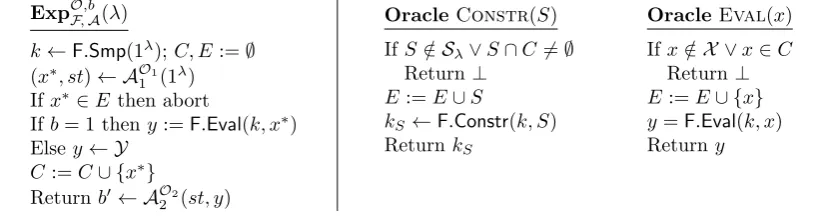
Figure 1: The security game for constrained PRFs.
2
Preliminaries
2.1 Constrained and Puncturable PRFs
Definition 1 (Constrained Functions). A family of keyed functions Fλ ={F:K × X → Y} over
a key space K, a domain X and a range Y is efficiently computable if there exist a PPT sampler
F.Smpand a deterministic polynomial-time (PT) evaluator F.Eval such that:
• k←F.Smp(1λ): On input a security parameterλ, F.Smpoutputs a key k∈ K.
• F(k, x) :=F.Eval(k, x), for k∈ K andx∈ X.
We say Fλ is constrained w.r.t. a family Sλ of subsets of X, with constrained key space KS such
that KS∩ K =∅, if F.Eval accepts inputs from (K ∪ KS)× X and there exists the following PPT
algorithm:
• kS ← F.Constr(k, S): On input a key k ∈ K and a description1 of a set S ∈ Sλ, F.Constr
outputs a constrained keykS ∈ KS such that
F.Eval(kS, x) =
F(k, x) if x∈S
⊥ otherwise .
Definition 2 (Security of Constrained PRFs). A family of (efficiently computable) constrained functions Fλ = {F:K × X → Y} is selectively pseudorandom, if for every PPT adversary A = (A1,A2) inExpO,bF,A, defined in Fig.1, withO1 =∅ andO2 ={Constr(·),Eval(·)}, it holds that
AdvOF,A(λ) :=
Pr
ExpO,0F,A(λ) = 1−PrExpF,AO,1(λ) = 1=negl(λ) . (1)
Fλ isadaptively pseudorandom if the same holds for O1 =O2 ={Constr(·),Eval(·)}.
Puncturable PRFs [SW14] are a simple type of constrained PRFs whose domain is{0,1}nfor some n, and constrained keys can only be derived for the sets {{0,1}n\ {x
1, . . . , xm} | x1, . . . , xm ∈
{0,1}n, m = poly(λ)}, i.e., a punctured key k
x1...xm can evaluate the PRF on all inputs except on polynomially many x1, . . . , xm. We only require pseudorandomness to hold against selective adversaries.
Definition 3 (Puncturable PRFs [SW14]). A family of PRFs Fλ = {F:K × {0,1}n → Y} is puncturableif it is constrainable for sets {0,1}n\T, where T ⊆ {0,1}n is of polynomial size. F
λ
is (selectively) pseudorandom if for every PPT adversary A = (A1,A2) in ExpPCT-bF,A (λ), defined
in Fig. 2, we have
AdvPCTF,A(λ) :=Pr
ExpPCT-0F,A (λ) = 1
−Pr
ExpPCT-1F,A (λ) = 1
=negl(λ) .
1
ExpPCT-F,A b(λ)
(x∗, T, st)← A1(1λ); Ifx∗∈/T, then abort
k←F.Smp(1λ); kT ←F.Constr(k,{0,1}n\T)
Ifb= 1 theny:=F.Eval(k, x∗); elsey← Y Returnb0 ← AEval(·)
2 (st, kT, y)
OracleEval(x)
Ifx=x∗, return⊥ ReturnF.Eval(k, x)
Figure 2: The selective-security game for puncturable PRFs.
Puncturable PRFs are easily obtained from prefix-constrained PRFs, which were constructed from the GGM PRF [GGM86] in [BW13,BGI14,KPTZ13].
2.2 Collision-Resistant Hash Functions
A family of hash functions is collision-resistant (CR) if given a uniformly sampled function, it is hard to find inputs on which it collides. It is called public-coin CR if this is hard even when given the coins used to sample the function.
Definition 4(Public-Coin CR Hash Functions [HR04]). A family of (efficiently computable) func-tions Hλ = {H: {0,1}∗ → {0,1}n}, for which Smp samples a random function, is public-coin
collision-resistant if for every PPT adversary A it holds that
Pr
r ← {0,1}poly(λ);H :=Smp(1λ, r); (x1, x2)← A(1λ, r)
: H(x1) =H(x2)
∧ x16=x2
=negl(λ) .
2.3 Indistinguishability and Differing-Input Obfuscation
As a consequence of the impossibility of virtual black-box obfuscation, Barak et al. [BGI+12], proposed two weaker notions: indistinguishability obfuscation (iO) anddiffering-input obfuscation
(diO). The first,iO, guarantees that obfuscations of equivalent functionalities are computationally indistinguishable.
Definition 5(iO [GGH+13b]). A uniform PPT algorithmiO is an indistinguishability obfuscator for a family of polynomial-size circuitsCλ, if the following hold:
• For all λ∈N, C∈ Cλ, andx: Pr
e
C ←iO(1λ, C) : C(x) =
e
C(x)
= 1.
• For every PPT adversary A and all C0, C1∈ Cλ s.t. ∀x, C0(x) =C1(x):
Pr
A iO(1λ, C0)= 1−PrA iO(1λ, C1)= 1=negl(λ) .
Differing-input obfuscation is a stronger notion which requires that for any efficient adversary that distinguishes obfuscations of two functionalities, there exists an efficient extractor E that extracts a point on which the functionalities differ. Ishai, Pandey and Sahai [IPS15] weaken this topublic-coin diO, where the extractor is given the coins used to sample the functionalities. We will use this concept for circuits, which is formalized by requiring that indistinguishability only holds for circuits output by a samplerSamp for which no differing-input extractor exists.
Definition 6 (Public-Coin Differing-Input Sampler [IPS15]). A non-uniform PPT sampler Samp
is a public-coin differing-input sampler for a polynomial-size family of circuitsCλ if the output of
Samp is in Cλ× Cλ and for every non-uniform PPT extractor E it holds that
Pr
r← {0,1}poly(λ); (C
0, C1) :=Samp(1λ, r);x← E(1λ, r) : C0(x)6=C1(x)
Definition 7 (Public-Coin diO [IPS15]). A uniform PPT algorithmdiOis a public-coin differing-input obfuscator for a family of polynomial-size circuits Cλ if the following hold:
• For all λ∈N, C∈ Cλ and x: Pr
e
C ←diO(1λ, C) : C(x) =Ce(x)
= 1.
• For every public-coin differing-input sampler Samp for a family of polynomial-size circuits Cλ, every non-uniform PPT distinguisher D and every λ∈N:
Pr
r← {0,1}poly(λ); (C
0, C1) :=Samp(1λ, r); ˜C ←diO(1λ, C0) : 1← D(r,C˜)
− (3)
Prr← {0,1}poly(λ); (C0, C1) :=Samp(1λ, r); ˜C ←diO(1λ, C1) : 1← D(r,C˜)
=negl(λ) .
A candidateiO was constructed based on a simplified variant of multilinear maps and proven secure in an idealized model [GGH+13b]. The candidate was conjectured to be a diO for NC1 [BCP14]. Unfortunately, Garg et al. [GGHW14] present an implausibility result fordiO for arbi-trary distributions. However, Ishai et al. [IPS15] argue that current candidate constructions for iO satisfy their notion of public-coin diO.
2.4 Succinct Non-interactive Arguments of Knowledge
A succinct interactive argument of knowledge (SNARK) is a computationally sound non-interactive proof-of-knowledge system for which proofs are universally succinct. A proof π of knowledge of a witnesswto a statement η is succinct if the proof length and its verification time are bounded by an a priori fixed polynomial in the statement length|η|.
Definition 8 (The Universal Relation RU [BG08]). The universal relation RU is the set of
in-stance/witness pairs of the form ((M, m, t), w) where M is a TM accepting an input/witness pair
(m, w) within t steps. In particular|w| ≤t.
We define SNARK systems in the common-random-string model following Bitansky et al. [BCCT13,BCC+14,IPS15] as follows.
Definition 9 (SNARK). A pair of PPT algorithms (Prove,Verify) is a succinct non-interactive argument of knowledge (SNARK) in the common-random-string model for a languageL with wit-ness relation R ⊆ RU if there exist polynomials p, `, q independent of R such that the following
hold:
1. Completeness: For every (η= (M, m, t), w)∈ R the following holds:
Prcrs← {0,1}poly(λ); π←Prove(crs, η, w) : Verify(crs, η, π) = 1= 1 .
Moreover, Prove runs in timeq(λ,|η|, t).
2. (Adaptive) Soundness: For every PPT adversary A:
Pr
crs← {0,1}poly(λ); (η, π)← A(crs) : Verify(crs, η, π) = 1 ∧ η /∈ L
=negl(λ) .
3. (Adaptive) Argument of knowledge: For every PPT adversaryAthere exists a PPT extractor EA such that
Pr
crs← {0,1}poly(λ);r← {0,1}poly(λ) (η, π) :=A(crs;r);w← EA(1λ,crs, r) :
Verify(crs, η, π) = 1
∧(η, w)∈ R/
=negl(λ) .
4. Succinctness: For all (crs, η, w)∈ {0,1}poly(λ)× R, the length of a proofπ ←Prove(crs, η, w)
Bitansky et al. [BCC+14] construct SNARKs forR
c⊂ RU wheret=|m|candcis a constant, based on knowledge-of-exponent assumptions [BCCT13] and extractable collision-resistant hash functions (ECRHF) [BCC+14]. These are both non-falsifiable assumptions, but Gentry and Wichs [GW11] prove that SNARKs cannot be built from falsifiable assumptions via black-box reductions. Relying on exponentially hard one-way functions and ECRHF, [BCC+14] construct SNARKs forRU.
3
Constrained PRFs for Unbounded Inputs
As a warm-up we first construct a constrained PRF for sets decided by polynomial-size circuits and show how to extend it to Turing machines in Sect. 3.2.
3.1 A Circuit-Constrained PRF
Our circuit-constrained PRF F uses a puncturable PRF PF with input space X = {0,1}n. The output ofF(k, x) is simplyPF(k, x). To constrain Fw.r.t. a circuit C, we construct a circuitPk,C, which on inputx runs C on x and outputsPF(k, x) if C(x) = 1, and⊥ otherwise. A constrained keykC forC is then an indistinguishability obfuscation ofPk,C, i.e., kC ←iO(1λ, Pk,C).
Construction 1 (Circuit-Constrained PRF). Let Cλ = {C: {0,1}n → {0,1}} be a family of
polynomial-size circuits, PFλ ={PF:K × {0,1}n → Y}a family of selectively secure puncturable
PRFs, and iO an indistinguishability obfuscator for a family of poly-size circuits Pλ that contains
all circuits defined in(4)for allC ∈ Cλ. We construct a family of PRFsFλ ={F:K×{0,1}n→ Y}
constrained w.r.t. Cλ with a constrained-key space KC such that KC∩ K=∅.2
k←F.Smp(1λ): Given security parameter λ, output k∈ K ask←PF.Smp(1λ).
kC ←F.Constr(k, C): On input a secret key k ∈ K and a description of a circuit C ∈ Cλ, output kC ∈ KC as kC ←iO(1λ, Pk,C), withPk,C∈ Pλ defined as:
Pk,C(x) :=
PF(k, x) if |x|=n ∧ C(x) = 1
⊥ otherwise . (4)
y:=F.Eval(κ, x): On inputκ∈ K ∪ KC andx∈ {0,1}n, do the following:
• If κ∈ K, output PF.Eval(κ, x).
• If κ∈ KC, interpret κ as a circuit and output κ(x).
The proof of selective security of F, as just constructed, is relatively straightforward. Recall that in the selective-security game the adversary A outputs x∗, then the challenger chooses k ←
F.Smp and gives A access to a constrained-key oracle Constr, which can be queried on any C withC(x∗) = 0. Amust then distinguishF(k, x∗) from random. We modify this game by deriving from k a key kx∗ which is punctured at x∗ and computing constrained keys as obfuscations of
Pkx∗,C (defined like Pk,C but using kx∗ instead of k). Since PF(k, x) =PF(kx∗, x) for all x 6=x ∗, and since for any circuit C that the adversary can query we have Pk,C(x∗) = Pkx∗,C(x
∗) = ⊥, the circuits Pkx∗,C and Pk,C are functionally equivalent, and thus by Def. 5 the two games are indistinguishable. Note that we also need to ensure that these circuits are of the same size, which can be achieved by appropriate padding.
An adversaryAwinning the modified game can be translated into an adversaryBagainstPF. In the security game forPF (Fig.2),Bruns (x∗,st)← Aand outputs (x∗,{x∗},st). Givenkx∗ and
y,B can simulate the modified game and output whateverAoutputs. B’s probability of breaking the security of PF is the same as that of Awinning the modified game.
2
3.2 A TM-Constrained PRF
In this section we construct a family of constrained PRFs for unbounded inputs whose keys can be constrained to sets decided by Turing machines (TM). As a first attempt, in Construction1we could replaceCinPk,C with a TMM, yielding a TMPk,M. We would thus have to use obfuscation for Turing machines rather than just circuits. However, the problem with this construction is that in the proof we would have to replace the underlying PRF key k with a punctured key kx∗ for
some x∗ whose length is not a priori bounded. It is thus not clear how to pad the original key, which could be done in our previous construction.
To overcome this problem we compress the unbounded input to a fixed length by applying a collision-resistant hash functionH to it, that is, we evaluate the PRF on hashed inputs. Moreover, we outsource the check of input legitimacy outside the program Pk,M by using a SNARK. In particular, when evaluating the PRF, the user computes a SNARK proving that a given hash is the hash value of a legitimate input. The program Pk,M is then only given the hash of the input to the PRF and a SNARK proof confirming the legitimacy of a preimage, and evaluates the PRF on the hash if the proof verifies.
Note that Pk,M can now be implemented by a circuit, which means that we can avoid obfus-cation of Turing machines altogether. In our construction a constrained key kM for a TMM is a public-coin diO obfuscation of a circuit Pk,M which is given (h, π) and checks whether π proves knowledge of anx such thatH(x) =h and M(x) = 1, and if so, evaluates PFon h.
Let us justify the use of (public-coin) diO and SNARKs. As for our circuit-constrained PRF, we want to reduce the selective security of the TM-constrained PRFF to the selective security of the underlying puncturable PRF PF. In a first game hop we replace Pk,M with Pkh∗,M, which is identical toPk,M except that the keykis replaced with a keykh∗ that punctures outh∗ :=H(x∗).
Unfortunately, the two circuitsPk,M and Pkh∗,M are not equivalent: there existsx6=x
∗ such that H(x) =H(x∗), and on input H(x), Pk,M outputsPF(k, H(x)) =PF(k, h∗) andPkh∗,M outputs⊥. We thus cannot use iO and hence we use diO instead. This requires that it be hard to find an input (h, π) on which the two circuits differ, which means that eitherπ proves a wrong statement or it proves knowledge of somex with H(x) =H(x∗). That is, finding a differing input amounts to either breaking soundness of the SNARK or breaking collision-resistance ofH. Since both are hard even for adversaries that know the coins used to sample the hash function or the common random string for the SNARK, it suffices to use public-coindiO.
Finally, hash-function collisions are also the reason we need to use SNARKs rather than SNARGs: if an adversary can distinguish obfuscations of Pk,M and Pkh∗,M by finding a colli-sion forH then we need to extract this collision in the security proof, which SNARKs (arguments ofknowledge) allow us to do.
Definition 10 (Rlegit). We define the relation Rlegit ⊂ RU, with RU defined in Def. 8, to be
the set of instance/witness pairs (((H, M), h, t), x) such that M(x) = 1 and H(x) = h within t
steps, and M is a TM and H is a hash function. We let Llegit be the language corresponding to
Rlegit. For notational convenience, we abuse the notation and write((H, M, h), x)∈Rlegitto mean
(((H, M), h, t), x)∈Rlegit while implicitly setting t= 2λ.
Remark 1. Let t= 2λ in the definition of Rlegit; then by succinctness of SNARKs (Def. 9), the length of a SNARK proof is bounded by `(λ) and its verification time is bounded by p(λ+|M|+
|H|+|h|), where p, ` are a priori fixed polynomials that do not depend on Rlegit.
Construction 2(TM-Constrained PRF). LetPFλ={PF:K ×{0,1}n→ Y}be a selectively secure
puncturable PRF, Hλ ={H:{0,1}∗ → {0,1}n}λ a family of public-coin CR hash functions, diO
a public-coin diO obfuscator for a family of polynomial-size circuits Pλ, and SNARK a SNARK system for Rlegit (cf. Def. 10). We construct a family of PRFs Fλ = {F: K × {0,1}∗ → Y}
Exp(∅F,,A{Constr,Eval}),b(λ)
(x∗, st)← A1(1λ)
K←F.Smp(1λ)
Ifb= 1
y∗:=F.Eval(K, x∗) Else
y∗← Y
b0← AConstr(·),Eval(·)
2 (st, y∗)
Returnb0
OracleConstr(M)
IfM /∈ Mλ∨M(x∗) = 1
Return⊥
kM ←F.Constr(K, M)
ReturnkM
OracleEval(x)
Ifx=x∗
Return⊥
y=F.Eval(K, x) Returny
Expb,F(,cA)(λ) // c∈ {0,1,2}
(x∗, st)← A1(1λ)
H←H.Smp(1λ)
crs← {0,1}poly(λ)
k←PF.Smp(1λ)
kh∗ ←PF.Constr(k,{0,1}n\ {H(x∗)})
pp:= (H,crs)
Ifb= 1, y∗:=PF.Eval(k, H(x∗)), elsey∗← Y
b0← AConstr(·),Eval(·)
2 (st, y∗)
Returnb0
OracleConstr(M)
IfM /∈ Mλ∨M(x∗) = 1
Return⊥ Ifc= 0
P:=PM,H,crs,k
(as defined in (5)) Else
P:=PM,H,crs,kh∗
e
P ←diO(1λ, P)
ReturnkM := (M,P ,e pp)
OracleEval(x)
Ifx=x∗
Return⊥ Ifc≤1
y:=PF.Eval(k, H(x)) Else
IfH(x) =H(x∗), abort Elsey:=PF.Eval(kh∗, H(x)) Returny
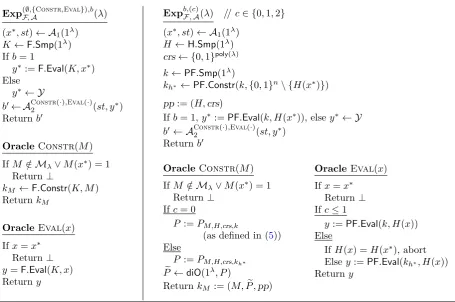
Figure 3: The original security game and hybrids used in the proof of Theorem1.
K←F.Smp(1λ): On input a security parameterλ, sampleH←H.Smp(1λ),crs← {0,1}poly(λ), k← PF.Smp(1λ), setpp:= (H,crs)) and returnK := (k,pp).
kM ←F.Constr(K, M): On inputK = (k,pp= (H,crs))and M ∈ Mλ, set
PM,H,crs,k(h, π) :=
PF.Eval(k, h) if SNARK.Verify(crs,(H, M, h), π) = 1
⊥ otherwise (5)
and compute Pe←diO(1λ, PM,H,crs,k). Return kM := (M,P ,e (H,crs)).
y:=F.Eval(κ, x): On inputκ∈ K ∪ KM and x∈ {0,1}∗, do the following:
• If κ∈ K, κ= (k,(H,crs)): return PF.Eval(k, H(x)).
• If κ ∈ KM, κ = (M,P ,e (H,crs)): if M(x) = 1, let h := H(x) (thus ((H, M, h), x) ∈
Rlegit), computeπ←SNARK.Prove(crs,(H, M, h), x), interpretPeas a circuit and return
e
P(h, π).
Remark 2. Note that Pλ is in fact a family of circuits with an input length n+|π| where |π|is
upper bounded by`(λ) even for an exponentially long x (cf. Remark1).
Theorem 1. Fλ of Construction 2 is a selectively secure family of constrained PRFs with
in-put space {0,1}∗ for which constrained keys can be derived for any set that can be decided by a polynomial-size Turing machine.
Expb,(0):=Expb,Expb,(1) andExpb,(2), which are all defined in Fig.3. We show that forb= 0,1 andc= 0,1 the gamesExpb,(c)andExpb,(c+1)are indistinguishable and thatExp0,(2)andExp1,(2) are also indistinguishable, which concludes the proof.
Expb,(0) is the original game Expb,(∅,{F,A Constr,Eval})(λ) for Construction2.
Expb,(1)differs from Expb,(0) by replacing the full key of the puncturable PRFPF, with one that is punctured atH(x∗) in the definition of P.
Expb,(2)differs fromExpb,(1)by answeringEvalqueries using the punctured keykh∗and aborting
whenever the query is a collision withx∗ forH.
The only difference between Expb,(0) and Expb,(1) is the definition of the circuits P that are obfuscated when theConstr oracle is queried. InExpb,(0) the circuitP is defined as in (5), with k←PF.Smp(1λ). InExpb,(1), the keykis replaced byk
h∗ ←PF.Constr(k,{0,1}n\{H(x∗)}), a key
that punctures outH(x∗). By a hybrid argument there must exist some query (say theith forMi) where the adversary distinguishes adiO obfuscation ofPMi,H,crs,k from one ofPMi,H,crs,kh∗. Thus, there exists a diO extractor that extracts an input (ˆh,πˆ) on which PMi,H,crs,k and PMi,H,crs,kh∗ differ.
By correctness ofPF, the circuits only differ on inputs (ˆh,πˆ), where
ˆ
h=H(x∗) , (6)
as that is where the punctured key behaves differently. Moreover, the extracted proof ˆπ must be valid for (H, Mi,ˆh), as otherwise both circuits output ⊥. By SNARK extractability, we can extract a witness ˆx for (H, Mi,ˆh)∈Llegit, that is, (i) Mi(ˆx) = 1 and (ii) H(ˆx) = ˆh. Since Mi is a legitimate query, we haveMi(x∗) = 0, which together with (i) implies ˆx6=x∗. On the other hand, (ii) and (6) imply H(ˆx) =H(x∗). Together, this means (ˆx, x∗) is a collision forH.
Proposition 1. For b= 0,1, Expb,(0) and Expb,(1) are computationally indistinguishable if diO
is a public-coin differing-input obfuscator and H is public-coin collision-resistant.
For the game hop from games Expb,(1) to Expb,(2), indistinguishability follows directly from collision resistance ofH, as the only difference is thatExpb,(2) aborts when Afinds a collision.
Proposition 2. For b = 0,1, Expb,(1) and Expb,(2) are computationally indistinguishable for if H is collision-resistant.
We have now reached a game, Expb,(2), in which the key k is only used to create a punctured key kh∗. The experiment can thus be simulated by an adversary B against selective security
of PF, which first asks for a key for the set {0,1}n\ {H(x∗)} and then uses A to distinguish y∗ =PF.Eval(k, H(x∗)) from random.
Proposition 3. Exp0,(2) and Exp1,(2) are indistinguishable ifPF is a selectively secure family of puncturable PRFs.
Theorem1now follows from Propositions1,2and3, whose proofs can be found in AppendicesA.1,
A.2and A.3.
4
Applications
4.1 ID-Based Non-interactive Key Exchange for Unbounded Groups
Identity-based non-interactive key exchange (ID-NIKE) [SOK00] allows users to compute shared keys without any interaction—it suffices to know the identity of the users one wants to share a key with. In our construction a user can compute a shared key for any group of users and there is no a priori bound on the size of these groups. We generalize the construction of [BW13,HKKW14], in which identities are elements from {0,1}` and the system is set up by creating a secret key
mskfor a constrained PRF. A key for a group of users{id1, . . . ,idn}is defined as F.Eval(msk, x), wherex=id1k. . .kidn and we assume identities are always ordered lexicographically. Boneh and Zhandry [BZ14] suggest a similar scheme (assuming indistinguishability obfuscation) which does not require any setup, but where each party publishes a value, and a key for a set of parties can be computed when knowing this values for each party in the set.
Since in the previous constructions the CPRF is set up for a fixed input length m there is an a-prior-fixed maximum number of users that can share a key, namely m/`. As a user’s id
could appear in any position of the string x, the owner ofidis given constrained keys for the sets
idk?(n−1)` := {idkz|z ∈ {0,1}(n−1)·`}, ?`kidk?(n−2)`, . . . , ?(n−1)`kid. These keys then allow the user to compute the key for any set which she is part of.
We generalize this to sets of users of unbounded size. Again, a key for a (lexicographically ordered) set{id1, . . . ,idn} is defined asF.Eval(msk,id1k. . .kidn), but now ncan be arbitrary and is not fixed in advance. In order to let a user with identity idcompute the keys of the sets which she is part of—but not anything else—, she is given a constrained key for the following Turing machine Mid: on input x ∈ {0,1}∗, machine Mid outputs 1 if and only if id is a substring of x, which starts at position i·`+ 1, for somei≥0, that is, at position 1 or`+ 1 or 2`+ 1, etc.
ID-NIKE. An (unbounded) ID-NIKE scheme consists of three algorithms:
• (pp,msk) ← Setup(1λ): On input λ, output public parameters pp and a master secret key
msk.
• skid←Extract(msk,id): On input mskand id∈ {0,1}`, output a secret keyskid.
• kI ← KeyGen(pp,skid,I): On input pp, a key skid for id and a list I ⊆ {0,1}` of n (for arbitraryn) users withid∈ I, output a shared key kI.
Correctness is defined as follows: for all id,id0 ∈ {0,1}`, all I ⊆ {0,1}` with id,id0 ∈ I, all (pp,msk) ← Setup(1λ), skid ← Extract(msk,id) and skid0 ← Extract(msk,id0), it holds that
KeyGen(pp,skid,I) =KeyGen(pp,skid0,I).
Following [PS09], we define security via a game where an adversary can obtain secret keys skid for identities of his choice and can query secret keys kI for sets I of his choice. The scheme is secure if the adversary cannot distinguish a keykI∗ for a setI∗ of his choice from random, where
we must haveid∈ I/ ∗ for all idfor which the adversary queried key extraction, andI∗ 6=I for all
I for which the adversary queried a shared key. We prove that our scheme satisfies the selective variant of this definition, where the adversary must outputI∗ before getting access to its oracles.
ID-NIKE from constrained PRFs for unbounded inputs. Our unbounded ID-NIKE is obtained from a TM-constrained PRF (F.Smp,F.Constr,F.Eval) as follows.
• Setup(1λ): Returnmsk←F.Smp(1λ). (There are no parameterspp.)
• Extract(msk,id): On input id∈ {0,1}` do the following: define a Turing machine M id that on input a string x∈ {0,1}∗ outputs 1 iffx is of the formx0kidkx00 with x0 ∈ {0,1}n0·`
and x00∈ {0,1}n00·` for somen0, n00∈
N; returnskid←F.Constr(msk, Mid).
• KeyGen(skid,I): If I = {id1, . . . ,idn} ⊆ {0,1}` for some n and id ∈ I then define x :=
Correctness of our scheme follows from correctness of the underlying constrained PRF. Selective security of the ID-NIKE follows from selective security of the CPRF (Def.2). Given an adversaryA
against the ID-NIKE, we construct an adversaryBagainst the CPRF. FirstBrunsAto obtainI∗
and sendsx∗, the concatenation of the lexicographically ordered elements of I∗, to its challenger.
B answers A’s queries as follows: When A queries a secret key for id∈ I∗ or the shared key forI∗ then reply with ⊥. On a legal secret-key query forid, construct a Turing machine Mid as in the definition of Extract, query the Constr oracle on Mid and forward the reply to A. When
Aqueries a shared key for a set I 6=I∗, constructx as in KeyGen, query Eval on x and forward the reply.
Note that Bmakes no illegal queries (any queriedM evaluatesx∗ to 0 and x∗ is never queried to Eval) and perfectly simulates the game for A. When B receives a value y which is either F.Eval(msk, x∗) or random, it forwards y as the challenge key kI∗ to A and outputs whatever A
returns. B thus breaks the CPRF with the same probability as A breaking the ID-NIKE, which concludes the proof.
4.2 Broadcast Encryption to Unbounded Number of Users
As a second application we use a constrained PRF for unbounded inputs to construct a broadcast encryption (BE) [FN94] where there is no limit on the number of receivers. We start with defining
dynamic BE, which allows users to join the system after it is set up. Each user is identified by a consecutive numberi.
A broadcast encryption scheme BE for a symmetric encryption scheme (enc,dec) with key space
Ksym consists of the following four PPT algorithms:
• (bk,msk)← Setup(1λ): On input a security parameterλ, output a broadcast keybk and a master secret key msk, used to enroll new members in the system.
• ski ← KeyGen(msk, i): On input a master key mskand a member identity i, output ski, a secret key for member i.
• (hdr, K)← Encrypt(bk, S): On input a set S ⊆Nand a broadcast key bk, output a header
hdrand a keyK∈ Ksym. (A message m is then broadcast as (S,hdr,enc(K, m)).)
• K ← Decrypt(i,ski, S,hdr): On input a member identity i, an associated secret key ski, a setS ⊆N and a headerhdr, ifi∈S then output a symmetric keyK ∈ Ksym. (A broadcast
(S,hdr, C) can then be decrypted viam←dec(K, C).)
Like Boneh and Waters [BW13], whose construction we build on, we will construct a secret-key
BE scheme, where bk must only be known to the broadcaster. Correctness of a BE scheme is defined as follows: for all S ⊆ N, i ∈ S, all (bk,msk) ← Setup(1λ), ski ← KeyGen(msk, i) and (hdr, K)←Encrypt(bk, S), we haveK ←Decrypt(i,ski, S,hdr).
Selective security is defined via the following gameExpBE-b for an adversaryA:
ExpBE-BE,bA(λ)
(bk,msk)←Setup(1λ)
(S∗,st)← A1(1λ)
(hdr∗, K∗)←Encrypt(bk, S∗) Ifb= 0 thenK∗← Ksym
b0← AKey(·),Encrypt(·)
2 (st,(hdr
∗, K∗))
Returnb0
OracleKey(i)
Ifi∈S∗
Return⊥
ski←KeyGen(msk, i)
Returnski
OracleEncrypt(S)
IfS=S∗
Return⊥
(hdr, K)←Encrypt(bk, S) Return (hdr, K)
We sayBE is secure if
AdvBEBE,A(λ) :=
Pr[ExpBE-0BE,A(λ) = 1]−Pr[ExpBE-1BE,A(λ) = 1]
BE from constrained PRFs for unbounded inputs. For a finite set S ⊆N, we define the characteristic vector χS as the binary vector whose length equals the largest element in S and whose entry at positioniis 1 iff i∈S. Let (enc,dec) be a symmetric encryption scheme with key space Ksym. Let F ={F:K × X → Y} be a constrained PRF with input spaceX ={0,1}∗ and rangeY =Ksym for which constrained keys ki for the following set can be computed:
Si:={x∈ {0,1}∗|xi = 1} . (7)
(AsSi can be decided by a polynomial-time Turing machine, our construction from Sect. 3.2 can be used.) We define a broadcast encryption schemeBE withoptimal ciphertext length (that is, the header is empty: hdr=∅) as follows:
• Setup(1λ): Generatek←F.Smp(1λ) and returnbk:=k,msk:=k.
• KeyGen(msk, i): Returnki ←F.Constr(msk, Si) withSi as in (7).
• Encrypt(bk, S): LetχS ∈ {0,1}∗be the characteristic vector ofS; computeK ←F.Eval(bk, χS) and output (∅, K).
• Decrypt(i,ski, S,hdr): With χS as above, output K ←F.Eval(ski, χS).
Correctness of BE follows from correctness of F; security follows by reduction to selective pseu-dorandomness of F. Let A be a PPT adversary that breaks security of BE; then we construct a PPT algorithmB= (B1,B2) that breaks F with the same probability:
B1(1λ)
– (S∗,stA)← A1(1λ).
– Let x∗ be the characteristic string ofS∗.
– Return (x∗,st A).
BConstr(·),Eval(·)
2 (st, K∗)
– b0 ← AKey(·),Encrypt(·)
2 (st,(∅, K∗));
– simulateKey(i): defineSi as in (7); queryki←Constr(Si); replyki;
– simulateEncrypt(S): define the characteristic vectorχS ∈ {0,1}∗ ofS;
queryK←Eval(χS); reply (∅, K).
– Returnb0.
By construction, we have Exp(∅,{F,BConstr,Eval}),b=ExpBE-bBE,A, which proves the claim.
References
[ABG+13] Prabhanjan Ananth, Dan Boneh, Sanjam Garg, Amit Sahai, and Mark Zhandry. Differing-inputs obfuscation and applications. Cryptology ePrint Archive, Report 2013/689, 2013.
http://eprint.iacr.org/2013/689.
[BCC+14] Nir Bitansky, Ran Canetti, Alessandro Chiesa, Shafi Goldwasser, Huijia Lin, Aviad Rubin-stein, and Eran Tromer. The hunting of the SNARK. IACR Cryptology ePrint Archive, 2014:580, 2014.
[BCCT13] Nir Bitansky, Ran Canetti, Alessandro Chiesa, and Eran Tromer. Recursive composition and bootstrapping for SNARKS and proof-carrying data. In Dan Boneh, Tim Roughgarden, and Joan Feigenbaum, editors,45th ACM STOC, pages 111–120. ACM Press, June 2013.
[BCP14] Elette Boyle, Kai-Min Chung, and Rafael Pass. On extractability obfuscation. In Yehuda Lindell, editor,TCC 2014, volume 8349 ofLNCS, pages 52–73. Springer, Heidelberg, February 2014.
[BGI+12] Boaz Barak, Oded Goldreich, Russell Impagliazzo, Steven Rudich, Amit Sahai, Salil Vadhan, and Ke Yang. On the (im)possibility of obfuscating programs. J. ACM, 59(2):6:1–6:48, May 2012.
[BGI14] Elette Boyle, Shafi Goldwasser, and Ioana Ivan. Functional signatures and pseudorandom functions. In Hugo Krawczyk, editor, PKC 2014, volume 8383 of LNCS, pages 501–519. Springer, Heidelberg, March 2014.
[BGW05] Dan Boneh, Craig Gentry, and Brent Waters. Collusion resistant broadcast encryption with short ciphertexts and private keys. In Victor Shoup, editor,CRYPTO 2005, volume 3621 of LNCS, pages 258–275. Springer, Heidelberg, August 2005.
[BH08] Dan Boneh and Michael Hamburg. Generalized identity based and broadcast encryption schemes. In Josef Pieprzyk, editor,ASIACRYPT 2008, volume 5350 ofLNCS, pages 455–470. Springer, Heidelberg, December 2008.
[BST14] Mihir Bellare, Igors Stepanovs, and Stefano Tessaro. Poly-many hardcore bits for any one-way function and a framework for differing-inputs obfuscation. In Palash Sarkar and Tetsu Iwata, editors, ASIACRYPT 2014, Part II, volume 8874 ofLNCS, pages 102–121. Springer, Heidelberg, December 2014.
[BW13] Dan Boneh and Brent Waters. Constrained pseudorandom functions and their applications. In Kazue Sako and Palash Sarkar, editors,ASIACRYPT 2013, Part II, volume 8270 ofLNCS, pages 280–300. Springer, Heidelberg, December 2013.
[BWZ14] Dan Boneh, Brent Waters, and Mark Zhandry. Low overhead broadcast encryption from multilinear maps. In Juan A. Garay and Rosario Gennaro, editors,CRYPTO 2014, Part I, volume 8616 ofLNCS, pages 206–223. Springer, Heidelberg, August 2014.
[BZ14] Dan Boneh and Mark Zhandry. Multiparty key exchange, efficient traitor tracing, and more from indistinguishability obfuscation. In Juan A. Garay and Rosario Gennaro, edi-tors, CRYPTO 2014, Part I, volume 8616 of LNCS, pages 480–499. Springer, Heidelberg, August 2014.
[CLT13] Jean-S´ebastien Coron, Tancr`ede Lepoint, and Mehdi Tibouchi. Practical multilinear maps over the integers. In Ran Canetti and Juan A. Garay, editors,CRYPTO 2013, Part I, volume 8042 ofLNCS, pages 476–493. Springer, Heidelberg, August 2013.
[FHPS13] Eduarda S. V. Freire, Dennis Hofheinz, Kenneth G. Paterson, and Christoph Striecks. Pro-grammable hash functions in the multilinear setting. In Ran Canetti and Juan A. Garay, editors, CRYPTO 2013, Part I, volume 8042 ofLNCS, pages 513–530. Springer, Heidelberg, August 2013.
[FKPR14] Georg Fuchsbauer, Momchil Konstantinov, Krzysztof Pietrzak, and Vanishree Rao. Adaptive security of constrained PRFs. In Palash Sarkar and Tetsu Iwata, editors,ASIACRYPT 2014, Part II, volume 8874 ofLNCS, pages 82–101. Springer, Heidelberg, December 2014.
[FN94] Amos Fiat and Moni Naor. Broadcast encryption. In Douglas R. Stinson, editor,CRYPTO’93, volume 773 ofLNCS, pages 480–491. Springer, Heidelberg, August 1994.
[GGH13a] Sanjam Garg, Craig Gentry, and Shai Halevi. Candidate multilinear maps from ideal lattices. In Thomas Johansson and Phong Q. Nguyen, editors, EUROCRYPT 2013, volume 7881 of LNCS, pages 1–17. Springer, Heidelberg, May 2013.
[GGH+13b] Sanjam Garg, Craig Gentry, Shai Halevi, Mariana Raykova, Amit Sahai, and Brent Waters. Candidate indistinguishability obfuscation and functional encryption for all circuits. In54th FOCS, pages 40–49. IEEE Computer Society Press, October 2013.
[GGM86] Oded Goldreich, Shafi Goldwasser, and Silvio Micali. How to construct random functions. Journal of the ACM, 33(4):792–807, October 1986.
[GW11] Craig Gentry and Daniel Wichs. Separating succinct non-interactive arguments from all falsifiable assumptions. In Lance Fortnow and Salil P. Vadhan, editors, 43rd ACM STOC, pages 99–108. ACM Press, June 2011.
[HKKW14] Dennis Hofheinz, Akshay Kamath, Venkata Koppula, and Brent Waters. Adaptively secure constrained pseudorandom functions. Cryptology ePrint Archive, Report 2014/720, 2014.
http://eprint.iacr.org/.
[HKW14] Susan Hohenberger, Venkata Koppula, and Brent Waters. Adaptively secure puncturable pseudorandom functions in the standard model. Cryptology ePrint Archive, Report 2014/521, 2014. http://eprint.iacr.org/2014/521.
[HR04] Chun-Yuan Hsiao and Leonid Reyzin. Finding collisions on a public road, or do secure hash functions need secret coins? In Matthew Franklin, editor, CRYPTO 2004, volume 3152 of LNCS, pages 92–105. Springer, Heidelberg, August 2004.
[IPS15] Yuval Ishai, Omkant Pandey, and Amit Sahai. Public-coin differing-inputs obfuscation and its applications. In Yevgeniy Dodis and Jesper Buus Nielsen, editors, TCC 2015, Part II, volume 9015 ofLNCS, pages 668–697. Springer, Heidelberg, March 2015.
[KLW15] Venkata Koppula, Allison Bishop Lewko, and Brent Waters. Indistinguishability obfuscation for turing machines with unbounded memory. In Rocco A. Servedio and Ronitt Rubinfeld, editors,47th ACM STOC, pages 419–428. ACM Press, June 2015.
[KPTZ13] Aggelos Kiayias, Stavros Papadopoulos, Nikos Triandopoulos, and Thomas Zacharias. Dele-gatable pseudorandom functions and applications. In Ahmad-Reza Sadeghi, Virgil D. Gligor, and Moti Yung, editors,ACM CCS 13, pages 669–684. ACM Press, November 2013.
[LSS14] Adeline Langlois, Damien Stehl´e, and Ron Steinfeld. GGHLite: More efficient multilin-ear maps from ideal lattices. In Phong Q. Nguyen and Elisabeth Oswald, editors, EURO-CRYPT 2014, volume 8441 ofLNCS, pages 239–256. Springer, Heidelberg, May 2014.
[PPS11] Duong Hieu Phan, David Pointcheval, and Mario Strefler. Security notions for broadcast encryption. In Javier Lopez and Gene Tsudik, editors, ACNS 11, volume 6715 of LNCS, pages 377–394. Springer, Heidelberg, June 2011.
[PS09] Kenneth G. Paterson and Sriramkrishnan Srinivasan. On the relations between non-interactive key distribution, identity-based encryption and trapdoor discrete log groups. Des. Codes Cryptography, 52(2):219–241, 2009.
[PST14] Rafael Pass, Karn Seth, and Sidharth Telang. Indistinguishability obfuscation from semantically-secure multilinear encodings. In Juan A. Garay and Rosario Gennaro, editors, CRYPTO 2014, Part I, volume 8616 ofLNCS, pages 500–517. Springer, Heidelberg, August 2014.
[SOK00] Ryuichi Sakai, Kiyoshi Ohgishi, and Masao Kasahara. Cryptosystems based on pairing. In SCIS 2000, Okinawa, Japan, January 2000.
[SW14] Amit Sahai and Brent Waters. How to use indistinguishability obfuscation: deniable encryp-tion, and more. In David B. Shmoys, editor,46th ACM STOC, pages 475–484. ACM Press, May / June 2014.
A
Proofs
A.1 Proof of Proposition 1
Letb∈ {0,1}be arbitrarily fixed. Assume towards contradiction that there exists a PPT adversary
A= (A1,A2) that distinguishesExpb,(0) and Expb,(1) with non-negligible probability, i.e., there exists a polynomialp(·) such that for infinitely many λ
Pr[Exp
b,(0)
F,A(λ) = 1]−Pr[Exp b,(1)
F,A(λ) = 1]
≥ 1
p(λ) . (8)
We use A to construct a series of PPT adversaries D(1), D(2), . . . , one of which non-negligibly distinguishes public-coindiO-obfuscations.
Concretely, we construct a series of hybrids between Expb,(0) and Expb,(1) as follows. Let q=q(λ) be a polynomial upper bound on the total number of constraining queriesAmakes. Define thei-th hybridExpb,(0,i) likeExpb,(0), except that the firsticonstraining queries are answered by using the punctured keykh∗ of the puncturable PRF, and all remaining queries are answered by
using private keyk. By construction, we have Expb,(0,0) =Expb,(0) and Expb,(0,q)=Expb,(1). We useAto construct a PPT adversaryD(i) which distinguishes public-coindiO-obfuscations. We define the series of public-coin differing-input samplersSamp(i) as follows:
Samp(i)(1λ, r:=r
AkrHkrskrkkrckrykr1k. . .kri−1) // r← {0,1}poly(λ).
– (x∗,stA) :=A1(1λ;rA). – H :=H.Smp(1λ;r
H) andh∗:=H(x∗).
– crs:=rs.
– k:=PF.Smp(1λ;rk).
– kh∗:=PF.Constr(k,{0,1}n\ {h∗};rc). – Ifb= 1 theny∗:=PF.Eval(k, H(x∗)) – Elsey∗← Y, using randomnessry.
– b0← AConstr(·),Eval(·)
2 (stA, y∗;rA);
– simulate the j-th queryConstr(Mj):
– if Mj∈ M/ λ∨Mj(x∗) = 1, reply⊥;
– if j < i, computeP =PMj,H,crs,kh∗ as defined in (5) andPe:=diO(1λ, P;rj) and returnkM := (Mj,P ,e (H,crs)). – if j=i, stop and output (P0:=PMi,H,crs,k, P1:=PMi,H,crs,kh∗).
– simulate Eval(x):
ifx=x∗, reply⊥; else replyy:=PF.Eval(k, H(x)).
We now define a public-coin diO distinguisherD(i) as follows:
D(i)(r, e
P) //Pe is eitherPe0←diO(1λ, P0) orPe1←diO(1λ, P1).
– Using randomnessrrun all steps ofSamp(i).
– AnswerA’si-thConstrquery forMi with (Mi,Pe). – Simulate the remainingConstr(Mj) as follows:
– ifMj∈ M/ λ∨Mj(x∗) = 1, reply⊥;
– computePj=PMj,H,crs,k as defined in (5) andPje ←diO(1λ, Pj);
– returnkM := (Mj,Pej,(H,crs)).
– WhenA2 outputsb0, outputb0.
If Pe is a public-coin diO obfuscation of P0 then D(i) simulates Expb,(0,i−1) for A, while if Pe is
distinguishes Expb,(0,i−1) and Expb,(0,i) with probability 1/(p(λ)q(λ)). Thus infinitely many λ, it holds that
1 p(λ)q(λ) ≤
Pr[Exp
b,(0,i)
A (λ) = 1]−Pr[Exp b,(0,i−1)
A (λ) = 1]
=
Pr
r ← {0,1}poly(λ); (P0, P1) :=Samp(1λ, r);Pe0←diO(1λ, P0) : 1← D(r,Pe0)
−
Prr← {0,1}poly(λ); (P0, P1) :=Samp(1λ, r);Pe1←diO(1λ, P1) : 1← D(r,Pe1)
.
By security of diO (Def. 7), this means that Samp(i) cannot satisfy Def. 6. Thus, there exists a non-uniform PPT extractorE(i) that givenrfinds an inputχ= (h, π) on whichP
0 andP1, output bySamp(i)on coinsr, differ. In particular, for some polynomial`(·) and infinitely manyλit holds that
Pr
r← {0,1}poly(λ);
(P0, P1)←Samp(i)(1λ, r);χ← E(i)(r)
: P0(χ)6=P1(χ)
≥ 1
`(λ) . (9)
Let ˆχ = (ˆh,ˆπ) be a differing input output by E(i). Recall that ˆπ is a short proof of ˆη = (H, Mi,ˆh) ∈ Llegit, i.e., a short proof of knowledge of a witness x such that Mi(x) = 1 and
H(x) = ˆh. By the definition of Samp(i) we have P0 := PMi,H,crs,k and P1 := PMi,H,crs,kh∗, as defined in (5). Since (ˆh,πˆ) is a differing input, the following conditions must hold.
condition(1): SNARK.Verify(crs,(H, Mi,ˆh),πˆ) = 1, for otherwise both P0 and P1 output⊥.
condition(2): ˆh=h∗=H(x∗), for otherwiseP0outputsPF.Eval(k,ˆh) andP1outputsPF.Eval(kh∗,ˆh),
which are equal by the correctness of puncturing.
condition(3): Mi(x∗) = 0; otherwise theConstr query would have returned ⊥.
Since the SNARK ˆπ extracted byE(i) is a proof of knowledge, we can extract a witness ˆx for it. In order to formally apply item3. of Def.9, we first construct a machineAsnrk that outputs ˆπ together with the statement. Asnrk simply runs E(i) except that it embeds the crs from its input
into the randomness.
Asnrk(crs)
– Sample randomnessrA, rH,rk,rc,ry,r1, . . . , ri−1 – Setr:=rAkrHkcrskrkkrckrykr1k. . .kri−1.
– SimulateSamp(i)(r);
– letH be the sampled hash function. – letMibe the i-thConstrquery.
– (ˆh,πˆ)← E(i)(crs, r).
– Output (η:= (H, Mi,ˆh),πˆ).
By the construction ofAsnrk, Eq. (9) and condition(1) we have that
Pr
crs← {0,1}poly(λ); (η,πˆ)← A
snrk(crs) : Verify(crs, η,ˆπ) = 1
≥ 1
`(λ) . (10)
Further, since SNARKis an adaptive argument of knowledge, there exists EAsnrk which extracts a witness, that is:
Pr
crs← {0,1}poly(λ);r← {0,1}poly(λ) (η,πˆ) :=Asnrk(crs;r); ˆx← EAsnrk(crs, r)
: Verify(crs, η,πˆ) = 1
∧ (η,xˆ)∈/Rlegit
which together with (10) yields:
Pr
crs← {0,1}poly(λ);r← {0,1}poly(λ) (η,πˆ) :=Asnrk(crs;r); ˆx← EAsnrk(crs, r)
: (η,xˆ)∈Rlegit
≥ 1
`(λ) −negl(λ) . (11)
We now construct an adversary Acll-fnd againstH that on inputλand coins rH, used to sample a functionH, outputs a collision forH: GivenrH,Acll-fnd generates a CRS for SNARKs, then runs
Asnrk(crs), but using the randomnessrH from its input, and then runsEAsnrk to extract a collision:
Acll-fnd(1λ, r∗
H)
– crs← {0,1}poly(λ).
– Sample randomnessrA, rH,rk,rc,ry,r1, . . . , ri−1 – Setr:=rAkr∗Hkcrskrkkrckrykr1k. . .kri−1.
– (ˆh,πˆ)← E(i)(r).
– Setr0 :=rAkr∗Hkrkkrckrykr1k. . .kri−1 //Asnrk’s coins – ˆx← EAsnrk(crs, r
0).
– Output (ˆx, x∗) as a collision pair forH.
By (11), with non-negligible probability, the values Mi,h,ˆ πˆ computed during the execution of
Acll-fndsatisfy ((H, Mi,ˆh),xˆ)∈Rlegit, that is,Mi(ˆx) = 1 and ˆh=H(ˆx). Bycondition(3), Mi(x∗) = 0, and hence ˆx 6=x∗. By condition(2), ˆh =H(x∗), and hence (x, x∗) is a collision. In particular, the following is non-negligible:
Pr
rH ← {0,1}poly(λ);H :=HSmp(1λ, rH); (x1, x2)← Acll-fnd(1λ, rH)
: H(x1) =H(x2) ∧ x1 6=x2
.
Therefore we have reached a contradiction to collision resistance of H, and it must be that Expb,(0) and Expb,(1) are computationally indistinguishable, i.e.,
Pr[Exp
b,(0)
F,A(λ) = 1]−Pr[Exp b,(1)
F,A(λ) = 1]
=negl(λ) .
A.2 Proof of Proposition 2
Let b ∈ {0,1} be arbitrarily fixed. The only difference between games Expb,(1) and Expb,(2) is whenA queriesEval(·) onx such thatH(x) =H(x∗). Then Expb,(2) aborts, while on any other query the oracleEvalbehaves equivalently in both games sinceH(x)6=H(x∗) impliesPF.Eval(kh∗,
H(x)) =PF.Eval(k, H(x)).
We can therefore build an adversaryAcll-fnd against the hash-function familyH that on input (1λ, rH) simulatesExpb,(2) (except that instead of sampling H, it usesH :=H.Smp(1λ;rH)) until in an oracle queryEval(x) the game would abort. Acll-fnd then outputs (x∗, x), which is a collision
precisely when the game would have aborted.
A.3 Proof of Proposition 3
Assume towards contradiction that there exists a PPT adversary A= (A1,A2) and a polynomial p(·) such that for infinitely manyλ
Pr[Exp
0,(2)
F,A(λ) = 1]−Pr[Exp 1,(2)
F,A(λ) = 1]
≥
1 p(λ) .
B1(1λ)
– (x∗,stA)← A1(1λ).
– H ←H.Smp(1λ) andh∗:=H(x∗). – Return (h∗, T :={h∗},st:= (H, x∗,stA)).
BEval(·)
2 (st, kh∗, y∗) //y∗ is eitherPF.Eval(k, H(x∗)) or random.
– crs← {0,1}poly(λ). – pp:= (H,crs).
– b0← AConstr(·),Eval(·)
2 (stA, y∗). – simulate Constr(M):
ifM /∈ Mλ∨M(x∗) = 1, reply⊥;
else P:=PM,H,crs,kh∗ as defined in (5);Pe←diO(1
λ, P
M,H,crs,kh∗).
ReturnkM := (M,P ,e (H,crs)). – simulate Eval(x):
ifx=x∗, reply⊥; ifH(x) =H(x∗) then abort; else replyy:=PF.Eval(kh∗, H(x)).
– Outputb0.
By construction Pr[ExpPCT-bPF,B (λ) = 1] = Pr[Expb,(2)F,A(λ) = 1], and therefore for infinitely many λ, it holds that
Pr[ExpPCT-0PF,B (λ) = 1]−Pr[ExpPCT-1PF,B (λ) = 1]
≥
1 p(λ) .
This contradicts the selective security ofPF, and we conclude that
Pr[Exp
0,(2)
F,A(λ) = 1]−Pr[Exp 1,(2)
F,A(λ) = 1]