Study on Mechanical Properties of the Self Curing Concrete
BOLLA SHIVA1, T.DHILIP2, B.VIJAYA PRASAD3
1,Assistant Professor, Department Of Civil Engineering, Talla Padmavathi College Of
Engineering, Tekulagudem,Somidi, Kazipet, Telangana 506003
2,3,Assistant Professor, Department Of Civil Engineering, Methodist College Of Engineering
And Technology, Abids, Hyderabad, Telangana-500 001
Abstract
Concrete is most extensively used improvement materials in light of its quality, and
significant sturdiness. Since the strong is accessible to air, the water that will be used as a
piece of bond to complete the hydration of cement scatters. In case the hydration system is to
be done with no impediment, extra water must be added to recharge the lost water. Of course,
a couple of measures must be accepted to keep the loss of water from the surface of bond. In
this way, the curing can be considered as generation of a positive circumstance in the midst of
the early period for constant hydration. The key purpose of the undertaking is to consider the
effect of ethylene glycol (commonly known by a trade name called spent Glycol) as
self-curing administrator on nature of concrete. The limit of self-self-curing expert is to decrease the
water scattering from concrete. The use of self-curing admixtures is basic from the point of
view that saving of water is a need every day. In this examination, workability, compressive
quality, split versatility and bond nature of concrete containing self-curing administrator is
looked into and differentiated and those of expectedly cured bond. There is an adjustment in
each one of the properties of the strong. The results proposes that self-curing concrete has a
promising future in the field of strong advancement. The economy of the improvement is
moreover affected as the cost of external curing is hacked down
Catchphrases: curing, dissipation, hydration, prompting, self-curing
1. INTRODUCTION
The nature of the strong depends upon the
curing. Suitable curing of strong structures
is basic to meet the execution and quality
requirements. Curing is the term which
imply the supply of the water to the strong
to such a degree, to the point that water
lost through dispersal is offered back to
bond to complete the hydration system. In
curing associated in the wake of mixing,
putting and wrapping up. Self-curing or
internal curing is a framework that can be
used to give additional soddenness in
concrete to all the more capable hydration
of bond.
Systems for Curing
The going with are the systems for curing
1. External curing
2. Internal curing
Outside curing
The major grasped outside curing systems
are
1. Shading strong works
2. Covering strong surface with gunny
packs
3. Pond strategy
4. Sprinkling of water
5. Steam curing etc..,.
2. LITERATURE REVIEW
C.Selvamonyet. al. (2010) explored on
self-compacted self-curing Concrete
utilizing limestone powder and clinkers. In
this examination, the impact of supplanting
the concrete, coarse total and fine total by
limestone powder (LP) with silica
fume(SF), quarry dust(QD) and clinkers
individually and their mixes of different
extents on the properties of SCC has been
thought about. Swamyet. al. (1990)
displayed a basic technique to acquire a 50
MPa 28-day quality cement having 50 and
65 percent by weight concrete supplanting
with slag having a moderately low
particular surface. The compressive and
flexural qualities and the versatile modulus
of these two cements as influenced by
curing conditions are then exhibited. With
no water curing, concrete with 50 percent
slag substitution came to almost 90 percent
of its objective quality of 50 MPa at 28
days 14 and kept on indicating humble
quality change up to a half year. Hans W.
Reinhardt et. al. (1998) they exhibited on
self-cured superior solid that a halfway
substitution of ordinary weight totals by
prewetted lightweight totals prompts an
interior water supply for consistent
hydration of concrete. Regardless of water
misfortune by dissipation there is nonstop
quality pick up to 25% more quality
following 1 year contrasted with standard
compressive testing following 28 days.
3. EXPERIMENTAL
PROCEDURE
The exploratory examination has been
1. Preparatory examinations
2. Phase II.Procurement of materials
3. Phase III Design
4. Phase IV. Throwing
5. Phase V. Curing
6. Phase VI. Testing
Tests for Specific Gravity of totals and
bond
Particular gravity of the totals is thought to
be a measure of quality of nature of the
material. Stones having low particular
gravity are by and large weaker than those
with higher particular gravity. Tests were
directed on the totals and bond to acquire
the particular gravity of them, which is
utilized on the blend proportioning of the
solid This test is directed in view of the
rules gave in IS 2386 (Part III)- 1963
4. PROCUREMENT OF
MATERIALS
Materials acquired are
1. OPC (53 review) (BIRLA A1
PREMIUM CEMENT) fitting in with IS
12269-1987
Particular gravity of the bond is =3.1
2. Fine totals complying with IS
383-1970 Particular gravity of the fine totals
is= 2.159
3. Coarse totals affirming to IS
383-1970
Coarse totals of ostensible sizes 20mm and
12.5 mm are utilized The particular
gravity of the aggregatesof ostensible size
20mm= 2.74 and of 12.5mm-=2.94
4. Spent glycol arrangement as
provided by the neo poly businesses
5. DESIGN
Grade of Concrete :
The review of the solid embraced in this
undertaking is M30 Mix extent :
The blend plan of the M30 concrete is
done utilizing IS 10262-2009-"Rules FOR
CONCRETE MIX DESIGN
PROPORTIONING"
Table 1mix plan extent of different
segments of the solid
CEM
ENT
FINE
AGGRE
GATE
COARSE
AGGRE
GATE
WAT
ER
450
Kg/
655
Kg/m3
1548
Kg/m3
202.5
m3 m3
1 1.46 3.44 0.45
NOTE:
The spent glycol solution as provided by
the supplier contained 3% spent glycol
(replacement of water i.e., 97% water and
3% spent glycol)
Coarse aggregates of nominal sizes 20mm
and 12.5mm are taken the ratio of 3:2.
Table 1 number of samples casted
Test/
(Properties
studied )
No. of
samples
casted
Convention
al concrete
Self-curing
concret
e
7 days 28
days 7
day
s
28
day
s
Compressi
on test
3 3 3 3
Split
tensile test
- 3 - 3
Pull out
test
- 3 - 3
The procedure adopted for casting the test
specimens is provided in the IS code books
and it is strictly followed
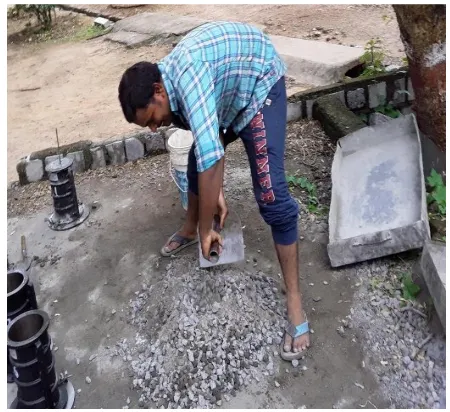
Figure 1 mixing of the components of the
concrete
Figure 2 pouring the concrete into the
moulds and compacting them thoroughly
6. RESULTS, AND DISCUSSION
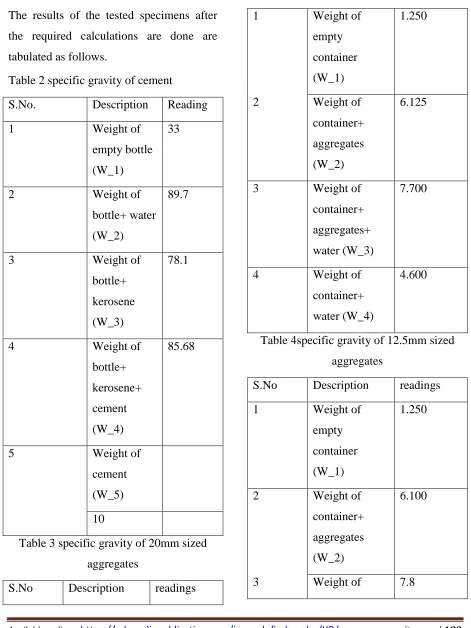
The results of the tested specimens after
the required calculations are done are
tabulated as follows.
Table 2 specific gravity of cement
S.No. Description Reading
1 Weight of
empty bottle
(W_1)
33
2 Weight of
bottle+ water
(W_2)
89.7
3 Weight of
bottle+
kerosene
(W_3)
78.1
4 Weight of
bottle+
kerosene+
cement
(W_4)
85.68
5 Weight of
cement
(W_5)
10
Table 3 specific gravity of 20mm sized
aggregates
S.No Description readings
1 Weight of
empty
container
(W_1)
1.250
2 Weight of
container+
aggregates
(W_2)
6.125
3 Weight of
container+
aggregates+
water (W_3)
7.700
4 Weight of
container+
water (W_4)
4.600
Table 4specific gravity of 12.5mm sized
aggregates
S.No Description readings
1 Weight of
empty
container
(W_1)
1.250
2 Weight of
container+
aggregates
(W_2)
6.100
container+
aggregates+
water (W_3)
4 Weight of
container+
water (W_4)
4.6
Table 5 specific gravity of sand
S.No Description readings
1 Weight of
empty
container
(W_1)
0.365
2 Weight of
container+
aggregates
(W_2)
1.295
3 Weight of
container+
aggregates+
water (W_3)
1.6075
4 Weight of
container+
water (W_4)
1.100
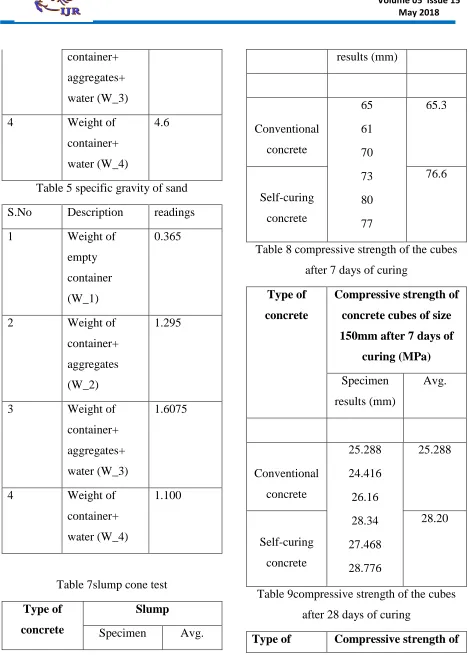
Table 7slump cone test
Type of
concrete
Slump
Specimen Avg.
results (mm)
Conventional
concrete
65
61
70
73
80
77
65.3
Self-curing
concrete
76.6
Table 8 compressive strength of the cubes
after 7 days of curing
Type of
concrete
Compressive strength of
concrete cubes of size
150mm after 7 days of
curing (MPa)
Specimen
results (mm)
Avg.
Conventional
concrete
25.288
24.416
26.16
28.34
27.468
28.776
25.288
Self-curing
concrete
28.20
Table 9compressive strength of the cubes
after 28 days of curing
concrete concrete cubes of size
150mm after 7 days of
curing (MPa)
Specimen
results (mm)
Avg.
Conventional
concrete
34.88
36.188
34.008
37.932
34.88
37.06
35.025
Self-curing
concrete
36.025
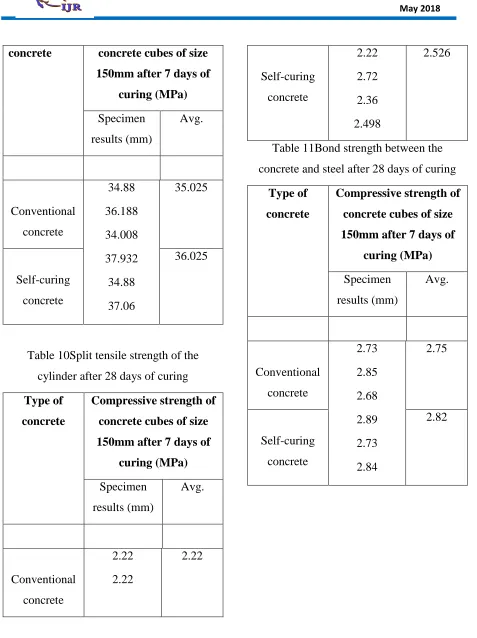
Table 10Split tensile strength of the
cylinder after 28 days of curing
Type of
concrete
Compressive strength of
concrete cubes of size
150mm after 7 days of
curing (MPa)
Specimen
results (mm)
Avg.
Conventional
concrete
2.22
2.22
2.22
Self-curing
concrete
2.22
2.72
2.36
2.498
2.526
Table 11Bond strength between the
concrete and steel after 28 days of curing
Type of
concrete
Compressive strength of
concrete cubes of size
150mm after 7 days of
curing (MPa)
Specimen
results (mm)
Avg.
Conventional
concrete
2.73
2.85
2.68
2.89
2.73
2.84
2.75
Self-curing
concrete
7. CALCULATIONS
Note: the calculations explained below
corresponds to the first result in the above
table
Specific gravity of the Cement and
Aggregates:
CEMENT
The specific gravity of the cement is
calculated using the following formula
Sc = [W5(W3− W1)]
[(W2− W1)(W5+ W3− W4)]
Here Sc refers to the specific gravity of the
cement
Based on the values recorded in table no.4
Sc = 3.279
AGGREGATES
The specific gravity of the cement is
calculated using the following formula
Sg= (W2− W1)
[(W4− W1) − (W3− W2)]
Here Sg refers to the specific gravity of the
aggregates
Based on the values recorded in table no.5
(i.e.., of 20mm aggregates)
Sg = 2.74
OBSERVATION
In view of the outcomes got from the tests
as said, it can be the accompanying
conclusion with respect to the impact of
SPENT GLYCOL on the workability and
mechanical properties can be drawn
The droop of the solid expanded from 65.3
to 76.6i.e., by 17.3%
The compressive quality of the solid
following 7 days of curing is expanded
from 25.288 to 28.20 i.e., by 11.51%
The compressive quality of the solid
following 28 days of curing is expanded
from 35.025 to 36.624 i.e., by 4.56%
The split elasticity of the solid following
28 days of curing is expanded from 2.22 to
2.526 (i.e.., there is an expansion of
13.78% )
The bond quality between the solid and
expanded from 2.75 N/mm^2 to 2.82
N/mm^2(i.e., there is increment of 2.54% )
8. CONCLUSION
SPENT GLYCOL is the consequence of
the oil business and which is also arranged
to get the rough material for the create of
polyethene things, fluid impetus, and
coolant and warmth trade administrator.
The purification of the spent glycol is an
excessive system. Now and again it is
disposed of. As opposed to that, they can
be used as a piece of strong which will
provoke the economy of the improvement.
The progress of the work is speedier and
don't achieve any wastage of water by its
capable utilize. Focus East countries are
respected with giant measure of oil spares
and moreover have lack of water. The
spent glycol procured in the oil business
and can be diverted into the advancement
goals to be used as a piece of the strong. In
India there are various areas where there is
water lack however there non military
work force people winning in those
regions. The improvement in such regions
can be adequately completed with the
utilization of the self-curing administrators
which have constructive outcome on the
strong and add to the economy and
condition. The above test results pass on
that Slump, compressive quality after 7
days of curing, Compressive nature of the
strong after 28 days, split unbending
nature, bond nature of self-curing
concretehave extended by 17.3%, 11.51%,
4.56%, 13.78%, 2.54% exclusively. Right
when stood out from that of the standard
bond.
In perspective of the test results and their
recognition it can be assumed that SPENT
GLYCOL has a promising future in the
field of strong advancement.
9. FUTURE SCOPE OF STUDY
The SPENT GLYCOL has a promising
future in the field of basic building. Also
investigate is to be finished with it. Since
this thing is new to the strong development
monster research ought to be conceivable.
Few of the prescribed purposes of research
are
Move the movements in mechanical
properties of the uncured, cured, and
self-cured concrete. Contrast the union of the
spent glycol course of action and the
perfect concentration to achieve the best
results ought to be found Assortment the
compressive quality, unbending nature,
bond quality flexural quality, shear quality
et cetera.., of the strong ought to be
considered Effect of temperature on the
curing and mechanical properties is to be
considered
BIBLIOGRAPHY
JOURNALS
[1]. C. Selvamony, M. S. Ravi Kumar, S.
U. Kannan and S. Basil Gnanappa, (2010),
"examinations on compacted
self-curing solid utilizing limestone powder and
clinkers ", ARPN Journal of Engineering
and Applied Sciences.
[2]. Swamy, R. N. in like manner, Bouikni.
A, "Some Engineering Properties of Slag
Concrete As Influenced By Mix
Proportioning and Curing", ACI Materials
Journal.
[3].Hans W. Reinhardt and Silvia Weber,
(1998), "self-cured world class concrete ",
diary of materials in fundamental building
November 1998.
[4]. John Roberts and Ron Vaughn ,
(2013), "inside curing overhauls flexural
and compressive nature of pervious cement
", Northeast Solite Corporation Saugerties,
New York
[5]. Magda. Mousa, Mohamed G. Mahdy,
Ahmed H. Abdel-Reheem, Akram Z.
Yehia, (2014), " mechanical properties of
self-curing concrete (scuc) ", Housing and
Building National Research Center HBRC
Journal.
[6]. Mateusz Wyrzykowski; Pietro Lura;
Francesco Pesavento; and DariuszGawin,
(2012), "Appearing of Water Migration
amidst Internal Curing with
Superabsorbent Polymers ", diary of
materials in assistant laying out ©
ASCE/AUGUST 2012.
[7]. N. Yazdani, F.ASCE; M. Filsaime; and
S. Islam , (2008), "Breathed life into
Curing of Silica-Fume Concrete ", diary of
materials in assistant sketching out ©
ASCE/August 2008
[8]. Nirav R Kholia, Prof. Binita A Vyas,
Prof. T. G. Tank , (2013), " influence on
concrete by various curing system and
ampleness of curing mixes ", boundless
diary of front line building
progression/Vol. IV/Issue II/April-June,
2013.
[9]. Ravi Kumar M.S., Selvamony. C.,
Kannan S.U., Basil Gnanappa .S, (2011),
"self-compacted/self-curing/radiator
and assembling types of progress, Vol. 5,
No.1, January 2011.
[10]. Sathanandham.T, Gobinath.,
NaveenPrabhu.M, Gnanasundar.S,
Vajravel.K, Sabariraja.G, Manojkumar.R,
Jagathishprabu.R, (2013), " Preliminary
Studies Of Self Curing Concrete With
The Addition Of Polyethylene Glycol
",across the board diary of building
examination and advancement (IJERT)
Vol. 2 Issue 11.
[11]. Tarun R. Naik and
FethullahCanpolat , (2006), "self-curing
concrete ", A CBU report branch of helper
building and mechanics school of
sketching out and related science THE
UNIVERSITY OF